| Bandwagon Discussion Convention Logos Photos Publications Research History Routes Ads-Titles Humor Search Links |

Bandwagon, May - June 1959
Back to Bandwagon Index
| Bandwagon Discussion Convention Logos Photos Publications Research History Routes Ads-Titles Humor Search Links |
Bandwagon, Vol. 3, No. 3 (May-Jun), 1959. Note: Only some articles are included in this online edition. Not all illustrations are included. The Circus Historical Society does not guarantee the accuracy of information contained in the information in these online articles. Information should always be checked with additional sources.
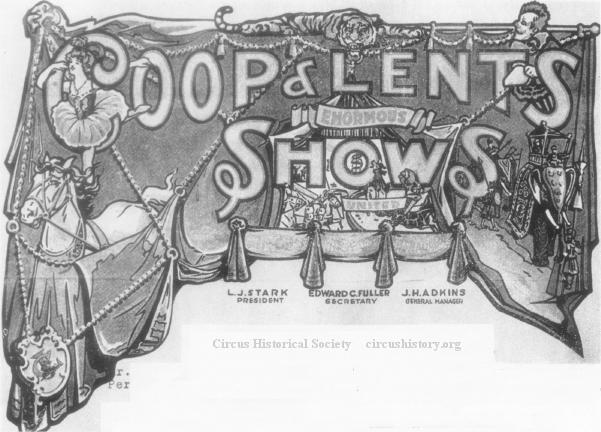
This letterhead was sent on March 24, 1917, and is from the collection of Harry Parkhurst, Jr. The elaborately colored cut is one of the most attractive ever used by any circus. Color scheme is as follows: The large letter are yellow with orange outline. The words, "Enormous," "Circus," "Museum," and "Menagerie" are in dark pink. The entire background is a light lavender with folds of medium blue. The initial in lower left are "C" in greenish yellow and "L" in light blue. The equestrienne's dress is pinkish. The breastpiece on the horse and the rope or chain on the sides are orange.
The Coop and Lent Circus was on the road as a 20 car railroad show for the 1916 and 1917 seasons, and in 1918 was converted to a fully motorized outfit in the first large scale attempt to transport a circus entirely by trucks. During the three years it was on the road the show suffered a variety of misfortunes, and had a series of management and reorganizations.
To get the full story of how the show came into being we must go back a year to the winter of 1914-15 when Charles and Vic Hugo organized a ten car show at Cedar Rapids, Iowa. The new circus went out for the 1915 season on 1 advance, 3 stocks, 4 flats, and 2 coaches under the title of Hugo Bros. Modern United Shows. It leased the railroad cars from the Arms Palace Car Co. The show presented a performance on the dog, pony, and monkey show format that had proved successful for the Gentry Brothers and other shows, although observers say that the quality of the Hugo acts was not up to the par excellence of the Gentry performance. Rhoda Royal had two elephants, Victor and Helen, on the show. Hugo Bros. was commonly referred to in the trade publications as a dog and pony show, and although no photos of the physical equipment of the outfit exist among the better known collectors, it can be assumed that the show was equipped with the typical small cross cages, tableaux, etc. common to similar shows. This assumption can be further realized by an advertisement appearing in the April 8, 1916 Billboard to the effect that Coop & Lent had for sale miniature fire wagons and cages, which of course would have been Hugo Bros. property as we shall see. In this connection it might be pointed out that it has been said that some of the small cages and wagons that were used in the 1935 Bailey Bros. Circus parade and which later become the property of the late Frank J. Walter were said to have once been on Hugo Bros. The title of Hugo Bros, was said to have shown through the paint on a small ticket wagon in the group, but the "how" and the "why" and details of this story are unknown to me.
The May 22, 1915 Billboard said that the Hugo Bros. parade had two bands, a clown band, and a calliope. Although not positive it is believed this was an air calliope rather than a steamer. We know that Hugo Bros. must have had bandwagons and tableaux but what they were we don't know since no photos seem to be available, nor eyewitness reports to rely on.
Hugo Bros, opened May 10, 1915 at Cedar Rapids, Iowa and then played stands during the season in Iowa, Nebraska, Minnesota, Wisconsin, Illinois, and Missouri. On August 22 the show began a 41 day stand playing Chicago city and suburban lots, finally closing on October 4 and returning to quarters in Cedar Rapids. The show failed to click and had a streak of bad luck including a bout with hoof and mouth disease among the stock, and a damaging "Hey Rube" in Chicago. Some reorganization may have been underway late in the season as the Billboard stated that William P. Hall had sent a carload of horses, elephants, and the private rail car that had been used by John A. Barton on the short lived Barton & Bailey's World's Celebrated Shows which had been put out in 1915 by Thomas Wiedeman and John A. Barton with equipment leased from Hall, to Chicago to enlarge the Hugo show. It is known that Vic Hugo was attempting to interest other backers in Cedar Rapids to help refinance the show which had lost heavily during the season.
Full reorganization of the show set in as soon as it was back in Cedar Rapids. L. J. Stark, one of the show's backers, become president of a new company composed of himself, W. T. Hanright, and Frank Kanak. The two Hugo brothers were now completely out of the picture and Vic Hugo is reported to have vanished from the scene under rather strange circumstances leaving the show in a sad state of affairs.
Elmer Jones, who had operated small two car circuses for a number of years, bought the large supply of unused Hugo Bros. paper and later put out a two car show using that title. In those days the cost of the large amount of lithograph paper put up by shows was a major item of expense and small shows such as those operated by Jones often would pick up a good supply of paper at a bargain and would change their title to fit that on the paper.
The new company of Stark's proceeded to enlarge the Hugo show to 20 cars, and organize a show to present standard circus acts to tour the 1916 season. New title selected for the show was Coop and Lent’s New United Monster Shows. It was named for two old time showmen, William C. Coup and Lewis B. Lent. An error made by the printer preparing the lithograph paper had the first name in the title spelled Coop. The 1916 staff included L. J. Stark, president and business manager; W. T. Hanright, manager; Frank Kanak, secretary-treasurer; F. C. Cooper, general agent; W. C. Cox, adjuster; and Jack Cousins, equestrian director.
F. C. Cooper and Art Eldridge had the job of framing the show. When it was ready to roll the train consisted of 1 advance, 4 stocks, 10 flats, and 5 coaches. The 1915 Hugo equipment formed the nucleus of the show with additional equipment coming from William P. Hall of Lancaster, Mo. Where other equipment may have come from is not definitely known, however, several cars are believed to have been leased, no doubt from the Arms Palace Car Co. As they owned the Hugo cars. (Note the 1917 inventory of the show when it was sold lists only 8 cars in the property, so it can be assumed that the additional cars were leased.)
In addition to wagons, the show also secured from Hall, horses, ponies, and elephants. Bill Woodcock says that in 1917 Coop & Lent had four elephants on lease from Hall. They were Mary, Albert, Juno, and Barnum Show Ruth. Woodcock says he has seen a photo showing the bull herd in 1916 and four elephants are pictured and he remarks that these are probably the same four the show had in 1917. One observer lists only three elephants for 1916, but the Billboard in the shows opening review lists four.
As we are striving for accuracy in this article and not attempting just to make up a good story, it must be pointed out that there is great difficulty in trying to get a clear cut picture of just what bandwagons, tableaux, and calliopes were on the show during the three years, 1916, 1917 and 1918. There is a dearth of photos of the 1916-17 rail show, a total of six turning up to be exact and with very few wagons appearing in them. We have good coverage of the 1918 truck show but we are not positive if all of the 1918 bandwagons and tableaux were on the rail show but believe in most cases they were, however, not all of them were. Likewise, we have evidence from eyewitnesses of some rail show equipment not appearing on the truck show. We just don't have a clear year by year absolutely infallible list of equipment, so by necessity we must make some assumptions, but will try to keep them all logical, and will refrain from making wild guesses. We are most indebted to Lee Melvin, long time collector of circus photos, who caught the Coop & Lent Circus at St. Thomas, Ontario, in 1916 and gave us his eyewitness account of the show that day.
Melvin describes the show as follows, "Three stock cars were painted orange, and the bull car was red. The ten flats were painted orange, but the show's title did not appear on any of the stocks or flats. Flats were loaded very light and probably all wagons could have been crowded on seven cars. The five coaches included a workingmen's sleeper, privilege car, private car, and two other sleepers. All coaches were nicely painted orange and lettered with the title in silver. Interiors of the coaches were done in white. The workingmen's sleeper had platform ends, the rest had vestibule ends. The show carried 50 odd head of baggage stock, all good looking horses, and the show also had a good many ring stock and ponies. In mid season the canvas looked good, some almost new. Seven cages were carried. Six were the cross cage variety, and one was a larger den that carried a sacred cow. All cages were without carvings and were painted solid rather dull colors, but all were equipped with sunburst wheels. The baggage wagons were painted red or blue and the pole wagon painted white. Scarcely any of them had the title painted on them. The ticket wagon was a big office wagon that didn't make parade. It had no carvings but did have sunburst wheels. Show had three elephants and two camels."
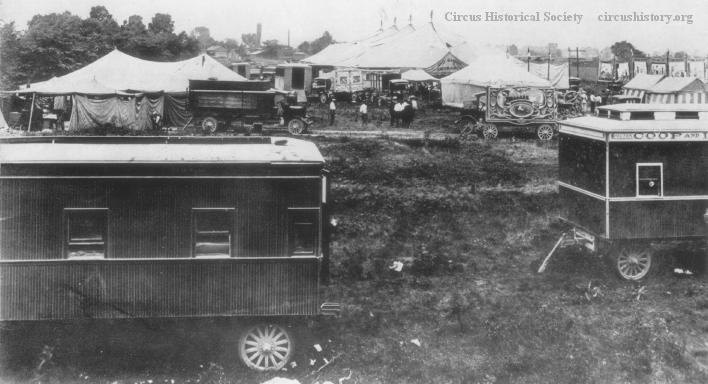
Melvin further described the parade wagons, "The chariot bandwagon, painted red with gold carvings, carried the big show band and was pulled by eight horses. The sideshow band rode the old Campbell Bros. No, 1 bandwagon, which was painted blue and gold and pulled by 8 horses. One big carved tableau was pointed red and had a golden hippo carving on the side, and was pulled by a 8-horse hitch, with an oriental band riding the wagon. I have never seen the wagon before nor since, nor have I seen a photo of it. The show also had three box type tableau wagons, each with full side painted scenes. The clown band rode one of these wagons, and performers in costume the others. A ten pony hitch pulled a small tableau that had full carved sides with small mirrors. (see cover photo [above]). Another small tableau ticket wagon with one square and one round mirror to a side was pulled by a 8-pony hitch. This wagon was painted orange and gold, and a costumed lady rode the top. This little tab come from the Sig Sautelle show and I have a photo of it on that show. The air calliope was pulled by a 10-pony hitch. It was painted green and had gold leaf carvings of some kind of harp or lyre. I have no photo of this nor have I seen it since."
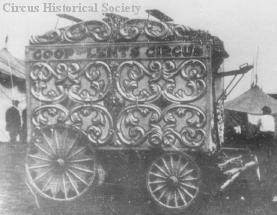 Photo: Small Mirror Tableau Wagon, Coope and Lent Circus 1916. William Woodcock Colletion.
Melvin's comments give a pretty good picture of the parade for 1916. We have some further notes on the parade vehicles he described. The chariot bandwagon was on the show all three years, carrying the No. 1 band in parade. It featured a carved rearing horse in front and carved lion or similar creature in the rear. This wagon originated on the Great Wallace Shows and was used by them in the 90's. Some confusion exists as to what route the wagon came to Coop & Lent. Many say this wagon was on Welsh Bros. in period 1905-1915, and some say it was definitely on Welsh Bros. & Lessig in 1915, the final year of operation for that show. If that be true the wagon would have been available for Coop & Lent in 1916. Now, I have a photo showing this wagon dated 1913 on the Sig Sautelle 9 Big Railroad Shows. It came from an old bandsman who says it positively is Sautelle, although there is nothing in the photo itself to prove it. Now if this statement is true, then evidently the wagon come to Coop & Lent from the Hall equipment purchased. William P. Hall did purchase the Sig Sautelle railroad show property when it was sold in fall of 1914, and we know another Sautelle wagon was definitely on Coop & Lent in 1916 so there is some merit to this theory. Still unsolved though is this business of the wagon being on Welsh Bros. Many of us have photos showing it there. I have three, although there is nothing in any of the photos proving positively it is actually Welsh Bros. One guess (and I promised no guesses) is that the photos may have been taken on the Welsh Bros. - Sig Sautelle Circus of 1905-06 and somehow Sautelle retained possession of the wagon later putting it on his rail show of 1913-14. It seems too heavy to have been on Sautelle's mud show of 1911-12. Anyway, this is just an example of what you get into when you dig into circus wagon history, and although at present this confusion exists concerning this wagon, one of these days it will all be cleared up, as have so many similar cases in the past.
The sideshow bandwagon was on the show all three years and featured full side carvings with two panels of carved swans. This wagon led the Campbell Bros. Great Consolidated Shows parade for many years and appears as the lead bandwagon in the famous 1908 Campbell parade panorama. The wagon come to Coop & Lent by way of the Hall Farm. Hall purchased the Campbell equipment in the fall of 1912. In 1913 no doubt this wagon went out on the Cole Bros. Circus put out from Hall Farm with ex Campbell Bros. equipment.
The clown bandwagon, along with two other wagons, had painted scenes on the sides, and were merely baggage wagons decorated for parade purposes. Note in one of the truck show photographs a wagon mounted on truck chassis featuring a full side painting of a variety of comic looking characters. This probably was the clown bandwagon that Melvin described.
The origin of the small carved mirror tableau is obscure but it might be of Campbell Bros. origin.
Melvin has always insisted on the big red wagon with the oriental band as having a carved hippo. He may be absolutely correct, and I would not argue the point, but I must point out there is pretty good evidence that the carving he described might have been a rhino instead of a hippo. This wagon could very well have been the old Great Wallace tableau that featured a carved rhino as the central figure. This wagon later was on Sells-Floto, and in 1920 Al G. Barnes purchased it from I. S. Horne when the show was playing Kansas City. I. S. Horne is the same gentleman we shall find out later who purchased the Coop & Lent railroad show in 1917 and moved the property to Kansas City. Most of the 1917 property Horne got appeared on the 1918 truck show, but we have ample photos to prove no wagon with a carved, hippo or rhino was on the show, therefore the wagon could have remained in Kansas City and been the Rhino wagon that Barnes purchased. Most fans are familiar with this Rhino wagon as it was kept around the Los Angeles area until it was destroyed about 1954.
Enough photos are floating around to prove positively that the little ticket tableau wagon Melvin described was actually on the Sig Sautelle show, however, no photos have turned up of the little air calliope he mentioned.
Now we come to this business of the Coop & Lent steam calliope. Melvin has always insisted there was no steamer in 1916, only an air calliope. I can't question that. Actually we have no proof that the steam calliope was ever on the rail show in either 1916 or 1917, and know only for certain that it was on the 1918 truck show. However, this calliope was at the Hall Farm and it is logical that it should have come to Coop & Lent with the other Hall property, although not necessarily at the same time. Even if not on the show in 1916 I feel certain that it must have been there in 1917. The sale inventory of the 1917 show lists both a calliope and a unifon. True it doesn't actually say if the calliope was steam or air, but logic says it probably was steam. I wonder if perhaps the wagon housing the 1917 unifon wasn't the same one as that Melvin described in the 1916 parade with the air calliope. No evidence of a unifon being on the truck show of 1918, so we don't know just what become of it. We know the steam calliope on the show came from the Hall Farm, Hall had two almost identical calliopes, there being only a slight difference in the carvings. One came by way of the Lemen Bros. Circus, the other from the Walter L. Main Circus. From close observation of the two, it seems like the one Coop & Lent got came originally from the Lemen show. The Main calliope later went to the Campbell-Bailey-Hutchinson Circus of 1920-22. The Coop & Lent steamer originated on Lemen Bros. probably in the 90's and used on the show through the 1900 season. From 1901-04 the show was called the Great Pan American Circus, and in 1905 it was Lemon Bros. Circus (note difference in spelling) and in 1906 was Lemon Bros. & Hales Fire Fighters, in 1907 not on the road, and in 1908-09 was Lemon Bros. again. The calliope with the rest of the Lemen property was sold to Hall in mid-season 1909. In period 1910-15 the calliope was probably sent out on some of the Hall equipped shows.
The 1917 inventory lists one bandwagon (the No. 1 chariot wagon) and 5 tableau wagons, and from the above description I think we have covered them all.
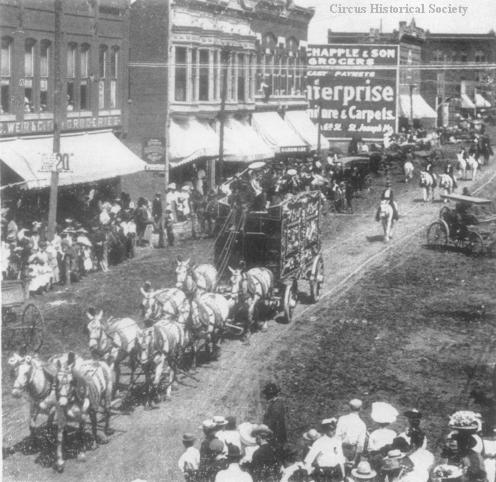
The 1916 show made a nice appearance on the lot with plenty of canvas up. All new canvas was acquired for the show, and although no tent sizes are available, believe them to be the same as those listed in the 1917 sale inventory, which had the big top a 110 ft. round with three forty foot middle pieces, the menagerie top a 70 ft. round with two 40 ft. middles, and the side show a 60 ft. round with two 40 ft. middles.
Lee Melvin reviews the 1916 performance as follows: "Big show was short but very good. Performance had the two Omar Sisters and the three LaDill Sisters working iron jaw and aerial numbers; the four Flying Zendas, flying return act; The Waltons and Rodregelez Troups of acrobats the four Ortans, tight wire act; the Stick Davenport Family riding act; and the Van Zant Family riding act which was similar to that made famous by the Riding Duttons. Art Eldridge presented posing, liberty, and high school horses. Jack Cousins worked in the Wild West Concert. The performance featured plenty of horse and riding acts."
Cal Tower had the sideshow which featured J. S. Rigger's Minstrel and Band, Viola Larkin and her seven big snakes, Barney Crutch, tattooed marvel, Grace Allen the Thousand Eyed Girl, and Minnie Carl, fat girl. The show also featured a cooch dancers show, and Marion Organ, who caught the 1916 show in his home town of Wilmington, Ohio reports that the show had a prize banner which read "Biblical Dancers," which he though was a fine approach to the subject or carried for "insurance" purposes. Mr. Organ also reported the 1916 show to have had plenty of grift with it.
The show opened the 1916 season, Saturday, April 29 at Cedar Rapids, Iowa. The Billboard gave the show a nice review and stated that Art Eldridge deserves a great deal of credit for having the show looking in tip top form. After the opening the show proceeded to tour Iowa, Wisconsin, Illinois, Indiana, Ohio, Pennsylvania, and New York. Mark Anthony in an article on the show some years ago stated that the early route was well laid out the show was routed to where the money was and did some pretty good business at the start. Anthony says the show was scheduled to go into New England at the conclusion of the New York state tour, but that an infantile paralysis scare caused cancellation of those plans and instead the show went into Canada, entering Quebec at St. Johns on July 13. Thirty-one stands were played in Quebec and Ontario, but business was off and the show lost considerable money. The U. S. was re-entered August 19 at Mt. Clemens, Michigan but business was no better, and the show closed shortly thereafter at Oak Park, Illinois, a big loser for the season. A good route had been laid out, the show had a good line of paper, and was well billed, but poor business conditions especially in Canada, which had now been in World War I for two years, caused the show's failure.
L. J. Stark bought out the interests of the other owners, and then succeeded in finding new money for backing and reorganization of the show in Dixon, Illinois, the main backer being a Mr. Lawrence. The show was transported from Cedar Rapids to Dixon where new quarters were established. A new corporation, the Dixon Amusement Company, with L. J. Stark as president, was organized to operate the show. The show's title remained the same and it is believed that due to the strained financial position of the show, little or no changes were made in the physical equipment during the winter of 1916-17. Mart Goodwin painted the show during the winter and gave it a much flashier appearance for the 1917 season than it had had in 1916. There was consideration given for cutting the show from 20 to 15 cars for 1917, but it went out in 1917 on the same number and type of cars as before. The complete title used in 1917 as per the show's very flashy letterhead was "Coop and Lent's Enormous Shows United.
Considerable revamping of the staff did take place. Jess H. Adkins was named manager and James Shropshire, assistant manager. Other staff members for 1917 included; O. L. Hoffman, treasurer; Lon B. Williams, general agent; David Jarrett, contracting agent; Bert Andrews, advance car manager; James J. Brown, legal adjuster; Frank T. St. John, equestrian director, Oscar Duenwag, musical director; W. H. McFarland, sideshow manager; Jack Kent, boss hostler and ring stock; Edgar Peyton, trainmaster; and Harry Clausman, supt. of elephants.
A splendid program was signed for 1917, which was better balanced than the one presented the previous year. Mark Anthony listed the 1917 program as follows:
1. Grand Entry
2. Aerial ladders - Humpreys and Wolfgrams
3. Equestriennes - Misses Guice and Davenport.
4. Ponies worked by Maude Dillion and Ethel Schafer, and bears worked by Pete Taylor
5. Statue horses worked by Etta Meyers, Mrs. Greer, Stick Davenport, and Walter Guice.
6. Trapeze acts by the Haydens and Kafkos. Trained tigers worked by Pete Taylor
7. Comic acrobats, the Kent brothers, Harts, and Kafkos
8. High School Horses, worked by Etta Meyers, Mrs. Greer, Mr. St. John, and Miss Schafer
9. Clowns
10. Trained lions worked by Pete Taylor
11. Wire acts by the Wolfgrams, Alex Lowande, and the Haydens
12. Clown barber shop and Jargo
13. Riding troupes, the Davenports and Guices.
14. Iron Jaw, the Hart Sisters and Kafkos
15. Alex Lowande's comic mule
Kenneth B. Waite was producing clown. A notable omission of the program as listed for both 1916 and 1917 were trained elephant acts. Seems strange the bulls didn't perform, but no reviews, including that given by the Billboard lists any elephant acts.
The heavy payments on the leased equipment and animals that had drained so heavily on the show in 1916 would continue to plague it in 1917, and it was well known that although the show had good appearance, parade, and performance, it had to draw heavily if it was to make a full season.
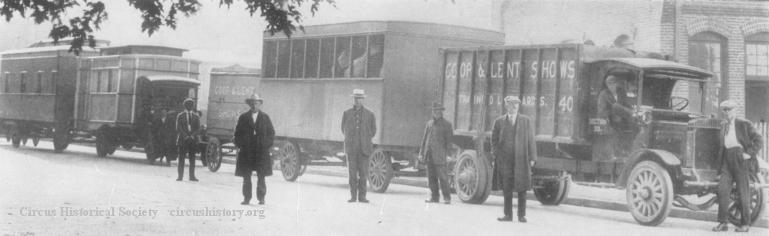
The 1917 season opened April 25 at Dixon, Illinois for a two day stand in the winter quarters town. Opening day was cold and wet. A runaway team pulling a cage injured several spectators causing heavy claims against the show. The show then moved and played a few Chicago suburban towns before going into Indiana. On May 2 at Gary, W. H. McFarland was attacked and injured by the fighting lion used in the sideshow act. Two days later at Warsaw, Archie Paul of the show fell from his wagon and was run over by the wheels and killed.
Bad weather and accidents seemed to plague the show from the start. The first good stand of the season was at Defiance, Ohio on May 8.
On May 12 at Kenton, Ohio another misfortune hit the show. A gasoline lantern, carried by a bull man, exploded in the car carrying the show's four elephants. The straw in the car ignited and in seconds the entire car was aflame. Barnum Show Ruth was removed from the car, but the other three, Mary, Albert, and Juno perished. Two circus men were overcome by smoke but fortunately suffer no permanent injuries. The show was forced to pay William P. Hall $8,000 for the three dead elephants, which was a serious financial blow.
Two additional elephants, Jenny and Nellie Lockhart, were leased from Hall to boost the bull herd to three. Bill Woodcock says that, "it seems that Hall had just purchased the Lockhart elephants from Ringling Brothers and that Al Langdon had returned to the farm in Lancaster from time put in with the J. E. Henry Show where he had delivered and remained for awhile with the big male elephant, Toddles. Langdon was then sent with the two Lockhart elephants to join the Coop & Lent show. After the show folded Langdon took the three Hall owned elephants to the Cook Bros. World's Greatest Shows, a ten car show owned by D. C. Cook."
Coop & Lent entered Pennsylvania May 21 at New Brighton and after 23 stands in the state went into New Jersey for 14 stands before returning to Pennsylvania again. Business was bad and the additional burden of heavy claims and payments on the leased animals and property caused serious financial difficulties. The show halted at Barnesboro, Pa., July 7, and remained there for two days while a reorganization was attempted. Melville B. Raymond formed a syndicate and took over the management. Money was raised to move the show to Connellsville, Pa for performances on Wednesday, July 11. The show was unable to move from that town and was thrown into bankruptcy in the District Court of the United States for the Western District of Pennsylvania. The South Side Trust Co. of Pittsburgh was appointed receiver for the bankrupt, Dixon Amusement Co.
On July 23, 1917 the show's property was sold to I. Sherman Horne of Kansas City, Mo. A copy of the Bill of Sale, Property Inventory, and Court Order, is printed as an annex to this article. Since so few animals and railway cars on the property list are shown it can be assumed that the additional animals and cars used by the show were leased property and did not figure in the sale.
After the sale the equipment purchased by Horne was moved to Independence, Mo. where E. P. and I. S. Horne had operated for some years the Horne Zoological Arena Co. They dealt in circus equipment and animals for circuses, carnivals, and zoos.
The Coop & Lent show had closed owing salaries to the personnel as well as other obligations. If and how the personnel got paid is not definitely known. The Jan. 19, 1918 Billboard reported that Kenneth R. Waite, clown on the show, had written from Kansas City, that he had gotten 49% of the money due him in back salary from the show and that all people holding claims could get their money by writing for it. Just what this all meant is not clear. Nothing in the court order indicated that I. S. Horne assumed any obligations of the show, but perhaps some provision was made by the Receiver to pay off the employees and it was coordinated through Horne.
It seems that Horne was undecided at first just what he would do with the show. In November 1917 the Billboard reported that Horne said that due to the war and uncertain business conditions the Coop & Lent show might not go out in 1918.
However, in early 1918, R. M. Harvey, President of the Outdoor Showmen's Association, and who had been associated with Edward Ballard, owner of the Hagenbeck-Wallace Circus, for some time, entered into a business agreement with the Hornes to operate the Coop & Lent Circus for the coming 1918 season. In April the American Circus Corporation was organized with E. P. Horne, president; I. S. Horne, vice president and secretary; and R. M. Harvey, treasurer and general manager. (Please note that this company is not to be confused with the corporation of the same name that was later organized by Jerry Mugivan, Bert Bowers, and Ed Ballard.) The new company proceeded immediately to frame a circus, completely motorized, that would be the equivalent of a 20 car railroad show. Although trucks had been used for some time by various shows this was to be the first large scale attempt to transport a show entirely by trucks. The new show set up headquarters in the Tribune Building in Chicago, and it was decided to use the Coop & Lent title and what property of the 1917 rail show that could be converted to motorized use would be done so.
The April 6, 1918 Billboard stated that the Hornes and Harvey had placed orders for sleepers, a dining car, horse and elephant vans, and special sized trucks to handle all baggage and equipment.
The Service Motor Co. of Wabash, Indiana was contracted to furnish the trucks, and the April 27, 1918 Billboard stated that the old Coop & Lent equipment had been sent to Wabash to be assembled and that the bodies for the new stock cars, sleepers, and baggage trucks were being built in Chicago.
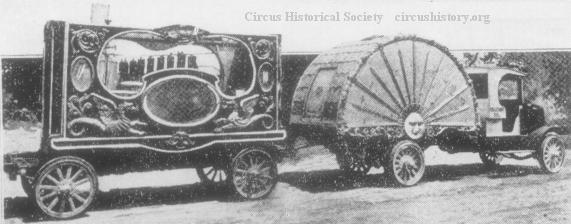
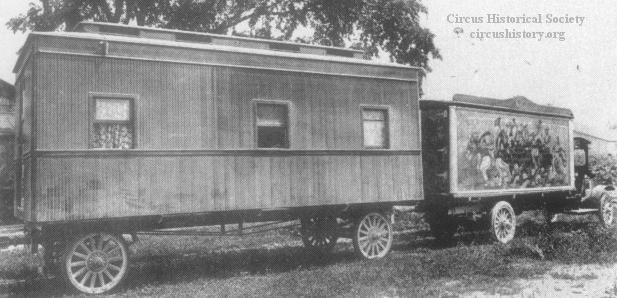
The actual transferring of the old wagon bodies on to Service truck chassis took place at the old Wallace Farms in Peru, a short distance from Wabash. The Sullivan & Eagle Wagon Works of Peru had the job of mounting the wagons on the new trucks. The new custom built sleepers, elephant and horse cars, were complete four wheel trailers and were designed to be pulled by trucks. While at the Wallace farms the show picked up an old tableau wagon that was built in shape of a semi circle and decorated with carvings to resemble a sunburst. This tableau was originally a "cottage" den built in the 90's for John Robinson's Ten Big Shows and was used on that show through the final season of 1911. It may be recalled that the Robinson equipment was then stored at Terrace Park, Ohio near Cincinnati, until the show was sold to Jerry Mugivan and Bert Bowers in April 1916. Mugivan and Bowers used the John Robinson title on one of their shows in 1916 but sold the physical equipment they acquired in the sale to B. E. Wallace, who shipped it to Peru. Back in 1914 John Robinson and Frank P. Spellman were partners in a show entitled, "Frank P. Spellman's Combined Circus Inc." and it is reported that this tableau was on that show. This little sunburst tableau, when mounted on a truck chassis, made a very nice addition to the parade in 1918.
Title used for the motorized show was Coop & Lent's 3 Ring Circus and all advertising emphasized the novelty of a circus traveling entirely by trucks. Two fine advertising trucks, complete in all details, were constructed and were managed by Harry Davis and O. J. Wild.
The operating staff for the show included R. M. Harvey, manager; H. S. Rowe, asst. manager; Ed C. Warner, general agent; B. L. (Bernie) Wallace, treasurer; Bert J. Chipman, legal adjuster and press representative.
Bert Chipman in his most delightful book, "Hey Rube," covers the 1918 show quite thoroughly. He states that the performance "was an excellent one, including the Riding Davenports; Dallie Julian, Irene Montgomery (Ledgett); Rhoda Royal's horse and elephant acts; Ray Thompson's horses; Frank Miller's horses; Mrs. Ray Thompson (Boulware) and sister; Maud Edwards; Wasson's Arabs or H. B. Liazeed's Troupe of Swarthy Sons of the Desert, tumblers; the Tum Chin Troupe of Chinese; the Australian Waites; Marguerite and Hanley, gymnasts; the Renos, aerial artists; the Delrays, jugglers; Botsford and Chappelle, skatorial artists; Manske, contortionist; C. Z. Bronson's Band and the Bronsonian Statuary." Clown alley included Harry Green, Will Delavaye, Phil King, Louis Plamondon, Sam Bennett, and others. The concert featured Von Arx, world toured illusionist. Other reviews also state the 1918 performance to have been most complete and of fine quality.
Two sideshows were carried, both using carnival type push pole tents. A fine 20 in 1 sideshow, with a long colorful bannerline, was operated by C. J. Sedlmayr, currently of Royal American Shows fame, and a snake show was managed by Walter Rhodes.
New canvas throughout was obtained from Baker & Lockwood of Kansas City. The big top was about a 110 ft. round with three 40's.
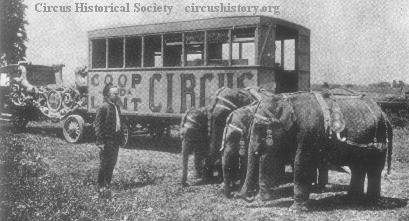 Photo: "Elephant" Kelly and the Rhoda Royal Elephants, Coop and Lent Circus, 1918. Old Great Wallace Bandwagon and Bull Trailer in Background. William Woodcock collection.
Four small elephants were leased from Rhoda Royal and were under the direction of "Elephant" Kelly. Three of the bulls were Victor, Helen, and Carrie, but name of fourth is not known. The show also carried about 30 head of ring stock, some of which were leased from Royal. A menagerie was planned and Bert Chipman states that the show did have one at first but soon dropped it. The July 6, 1918 Billboard remarked that the shows excellent performance squared any complaint that might exist because of the lack of a menagerie.
The show paraded when possible, the quality of the parade being on par with those of the 1916 and 1917 railroad shows.
By opening day the new show looked "like a million." The new trucks and trailers were all equipped with hard rubber tires, and were well painted and lettered with the show's title. The vehicles were also marked with a unit number and a section number. The new four wheel sleeper trailers were spacious and complete with windows and doors and every comfort. The show also had a large four wheel trailer for the elephants and others for the horses. A mechanical stake driver was carried and the cookhouse was as modern as any on the road. The cookhouse truck was painted with the railroad show jargon, "Flying Squadron."
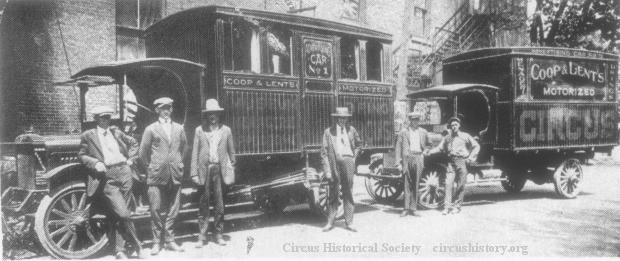
All equipment was moved to Chicago and the show opened the season, May 25, 1918 at 115th Street and Cottage Grove Avenue in Kensington, Ill., to big business and splendid reviews. A year of World War I had made the country amusement hungry and the show never suffered from lack of patronage and had not mechanical problems doomed the show to an early failure, it should have been a tremendous success.
The first two weeks of the tour found the show in Indiana and it moved fairly well, but as Bert Chipman points out the show's troubles started almost from the beginning. Chipman says that inexperienced drivers, poor road conditions, and overloaded trucks caused the show to gradually fall behind its billing and sometimes would pull into a town two or three days late. This confusion of course made itself felt sharply at the ticket wagon.
In the route printed elsewhere the dates from June 9 to June 14 are missing. It is not known definitely whether or not the show actually halted during that period to catch up on the billing, rework the trucks, etc. Such might well have been the case, as the route was furnished by Dick Conover and is originally from the John P. Grace Route Collection which was most complete.
The show entered Kentucky June 15 at Shelbyville and found the roads muddy and in bad condition. This caused more delays. A storm struck the show June 21 at Nicholasville causing severe damage to the big top. It was necessary to sidewall the show for several days while the tent was being repaired.
July 2 found the show in Ohio at Norwood and still experiencing difficulty in moving. When it reached Zanesville on July 26 the Billboard reported that the show had given only five performances in the past week and only eight in the past two weeks. The show finally had to halt August 2 at Dover, Ohio. The Billboard quoted R. M. Harvey as saying the show hoped to iron out its transportation difficulties, reorganize, and open later. Harvey, remarking on how bad the situation was, stated that on August 1 the show was unable to give a single performance at New Philadelphia and then in spite of only a four mile jump to Dover, was unable to give a matinee there. Harvey also said that the big mistake had been made when the show had been equipped with heavy four wheel trailers as the trucks just didn't have the power to pull them. He said that the trucks would be returned to the Service Motor Co. to be reworked and that everything would be redesigned to run on its own power. The sleepers would be dropped and when the show reopened the personnel would be housed in hotels and fed in the cookhouse. The Billboard further stated that the show might be called the Wallace Circus when it reopened. It has been said that Bernie Wallace purchased part of the equipment and that may have led to that speculation.
The August 24, 1918 Billboard quoted R. M. Harvey as stating that the plan to reorganize the show had been dropped because the financial burden would be too great, and that they wanted to liquidate so as to pay what salaries and obligations they could. The trucks and most of the equipment, with exception of the canvas, was returned to the Service Motor Co. in Wabash, and the Billboard reported that Harvey had left to take out "Harvey's Greater Minstrels" to open about September 18 in Perry, Iowa.
Last year when this article was being planned, R. M. Harvey wrote the following to Fred Pfening Jr., which just about sums up his part in the motorized show: "Mr. Horn, a wild animal dealer of Kansas City, and myself were equal owners of the Coop & Lent Circus. He put in some animals, some old circus property, and a sum of money and he was to supervise the upkeep of the outfit. I put in Twenty Thousand Dollars cash and was to organize the show, frame the performance and the staff, route it and handle publicity. I promoted the Service Motor Co. of Wabash, Ind., who agreed to provide us with as many and the kind of trucks as were required to haul the show. It was all carefully weighed and measured and their engineers worked out the computation of the power needed. It was a beautiful outfit and had some wonderful sleeping cars, modern in every way. The president of the Service Company travelled with us at the start. Our trouble started immediately in that we were unable to move, a shortage of power. The president phoned Wabash and told them, and the engineer replied that according to his figures there was plenty of power. Of course the president said regardless of his figures, the show could not move and instructed them at once to prepare to give us more trucks. Then at the same time the U. S. Government clamped down on them and forbid them from doing any more commercial work and ordered them to use all their efforts in favor of the U. S. (due to World War I). Thus we were left without power. We were behind our billing with no chance to catch up as every day, trucks had to be sent back to bring up property that had been left behind. The show opened at Kensington, Ill., and closed at Dover, Ohio after several weeks. It was a beautiful show, big time acts, and a wonderful performance, but under the circumstances all we could do was to let it die. When we did show we did big business, but we lost too much time. Our canvas was all new from Baker & Lockwood of Kansas City."
In the Spring of 1919 the Service Motor Company advertised in the Billboard that they were offering for sale all of the properties used by the Coop and Lent Motorized Circus with exception of the canvas and lights. A copy of this advertisement is printed elsewhere. Who purchased the property is not definitely known, nor just what disposition was made of the show's title.
The April 19, 1919 Billboard carried a story to the effect that a Coop and Lent Motorized Show was being organized in Montreal, Canada. The owner of the new venture was listed as A. R. Lavoie. Lavoie was a French Canadian who was well known in outdoor amusement circles in Canada and had furnished attractions for fairs and celebrations for some years. He also had handled sideshow concessions for Mugivan and Bowers in Canada when their shows would visit the Dominion. The Billboard article said that the show claimed it would use 23 two-ton trucks and 23 one-ton trailers and would have 20 draft horses and 40 ponies. The plan was outlined to play the various Canadian provinces of Quebec, New Brunswick, Nova Scotia, and Prince Edward Island, and then would be transported by boat to Norfolk, Virginia where a tour of the southern United States would begin. Just how this new show got use of the Coop and Lent title is not known, and only very sketchy details are available. It may have been possible for the new show to have picked up some Coop and Lent paper at a bargain and secured use of the title, or they may have just “appropriated” the title hoping to obtain some value from the large amount of publicity given the 1918 motorized show in the amusement world. Observers state that the show was much smaller than that claimed and probably traveled on about 6 trucks and a few wagons. From the few notes on the show appearing in the Billboard the summer of 1919 it seems that Al Root was general agent and Frank Walsh handled the publicity. The show did open in Canada and evidently went into New England sometime later. The August 16, 1919 Billboard reported the show to be in trouble in New Hampshire because of heavy claims caused by injuries to spectators when the seats collapsed during a performance. The August 23, 1919 Billboard reported that the Coop and Lent show had halted at St. Johnsbury, Vt. and was being sold at auction.
It is possible, but doubtful, that this small 1919 show did secure some circus property from the Service Motor Co. If so, then it was scattered at the sale in St. Johnsbury. But what become of all of the 1918 bandwagons, tableaux, etc. is not known. Wagon historians have been especially anxious to find out what became of the show's steam calliope but no clue as to its disposition has ever turned up, and to this day no one seems to know just what happened to the property after the Service Motor Co. offered it for sale.
The author would like to state that this article has been strictly a "joint effort" of members of the Circus Historical Society. Cooperation from the membership has been wonderful. Practically everyone who was called on to help did so by furnishing photos, letterheads, newspaper ads, and information on the show's history. Without this help it would have been impossible to have completed the article. I would like to personally thank the following for the help they rendered, Dick Conover, Bill Woodcock, Fred Pfening Jr., Marion Organ, Chalmer Condon, Harry Parkhurst Jr., Lee Melvin, Trader Horne, R. M. Harvey, Bob Parkinson, and Orin King.
We hope this article will set a format for future coverage of similar shows. It is regrettable that we secured no more photos of the railroad show of 1916 and 1917, but if any readers may have some photos in their collection of the rail show which they would be willing to loan us they will be printed in a later issue as a supplement to this article and the photos returned to the owner in good condition.
The following is a copy of the bill of sale, inventory of property, and court order for sale of the Coop & Lent Circus to I. S. Horne, July 23, 1917.
In the District Court of the United States For the Western District of Pennsylvania
In the matter of)
Dixon Amusement Company, a corporation No. 8766 In Bankruptcy Bankrupt)
Bill of Sale
For and in consideration of the sum of Ten Thousand ($10,000) dollars to it in hand paid by I. Sherman Horne, of Kansas City, Missouri, in accordance with an order of the United States District Court, made July 20, 1917, in the matter of the Dixon Amusement Company, bankrupt, No. 8766 in Bankruptcy, a true copy of which said order is hereto attached and made part thereof, the South Side Trust Company of Pittsburgh, Receiver in Bankruptcy of Dixon Amusement Company, a Corporation, hereby assigns, transfers, sells, and delivers to said I. Sherman Horne, his heirs and assigns in strict accordance with said order of Court and subject to all the terms and conditions hereto, the personal property specified in Exhibit "A" hereto attached and made a part hereof, the title hereby conveyed being that as set forth in said Order of Court.
Witness the seal of said Receiver, duly attested by its Secretary at Pittsburgh, Pa., this 23rd day of July A.D. 1917.
South Side Trust Company of Pittsburgh. Receiver in Bankruptcy of Dixon Amusement Company, a Corporation. By Benjamin Cagle, President
Exhibt "A"
List of show property belonging to Coop and Lent's Circus at Connellsville, Pennsylvania.
Four sleeping cars No. 60-61-62-64
Two sixty foot flat cars No. 5 and 57
One fifty foot flat car No. 56
One stake and chain wagon
One pole wagon
One reserve seat wagon
One blue plank wagon
One stringer wagon
One jack wagon
One property wagon
One cookhouse wagon
One side show wagon
One stable wagon
One tableau wagon No. 53
One tableau wagon No. 59
One tableau wagon No. 99
One tableau wagon No. 62
One tableau wagon No. 42
One bandwagon
One tableau wagon containing unifone
One tank wagon
One chandelier wagon
One ticket wagon
One big den wagon
Four cross cage wagons
Four miniature cage wagons
One calliope wagon
One stake driver
One two wheeled cart
One calliope
One unifone
Twenty lengths eight tier high seats, (reserve)
Twenty-five ten tier high seats (blue seats)
One advance bill poster's car at Cincinnati
Bedding including mattresses, blankets, comforts, pillows, sheets, and pillow cases for about two hundred people.
One 110 foot round to a tent with three forty foot middle pieces ten foot wall
One 70 foot round top tent two forty foot middle pieces ten foot wall.
One 60 foot found top two forty foot middle pieces ten foot wall
One 50 foot round top one twenty foot middle piece ten foot wall
One 20x40 foot pitcho tent one forty by sixty foot dressing tent
Two 30x60 horse tents
One 12x20 candy stand with complete equipment for same
One 20x20 kitchen tent with complete equipment including ranges, dishes, and all kitchen paraphernalia
All poles, riggings, ropes, stakes, and other equipment for erecting tents
Complete blacksmith outfit, sledges, and so forth
Complete parade wardrobe including 22 band uniforms, 12 grey uniforms, 8 ladies costumes, two complete cowboy outfits, one cowgirl outfit, ten property men's suits, nets for side show, ticket boxes, ring curbs, plumes for horses in parade and all trappings used in performance and parade.
Forty-five draft horses
Six saddle horses
Thirty-one Shetland Ponies including two colts
One pony known as Dandy
Two mules
Complete harness for forty-six work horses
Complete harness for twenty-six ponies
Six saddles and bridles
One complete lighting system four big top lights, two menagerie lights, two side show lights, one marquee light, one outside side show light, twelve Beacon lights, about 18 torches.
Banner poles, ropes, stakes, and sledges for sideshow, platforms, stage, and curtains for interior sideshow.
One camel
One puma
Two monkeys with baby
Four cockatoos
Dining room equipment, tables, table linen, dishes, etc.
One set of steel runs
One set of steel runs
One set jacks, four runs, all ropes, pulleys, stakes, sledges, grubbing hoes, and tools used in operating show.
One bay mare and colt on hand at Dixon, Illinois, and various wheels, and other miscellaneous paraphernalia on hand at Dixon, Illinois.
Order
And now, to-wit, July 20, 1917, the within petition presented in open Court, and upon due consideration hereof and upon motion of Charles A. Woods, Esq., attorney, it appearing to the Court that owing to the peculiar nature of the property involved and the conditions effecting the sale of the property now existing the Court hereby approves the recommendation of said Receiver and authorizes, empowers and directs it to accept said offer of I. Sherman Horne of Ten Thousand ($10,000.00) Dollars for said property, specified in Exhibit "A" and upon receipt of the balance of said purchase price the said Receiver is authorized and directed to execute and deliver to I. Sherman Horne a Bill of Sale for said property, the said Bill of Sale to be without recourse and without warranty of the said Receiver's title or the title of the bankrupt to any of the property specified in said Exhibit "A" but for all the right, title and interest of the said bankrupt Company of in and to the said property specified in Exhibit "A" whatever the some may be. All the right whatsoever the same may be to use trade and name of Coop and Lent's Shows United.
Per Curiam
The following advertisement appeared in the March 22, 1919 Billboard.
Circus Property for Sale
Below is a complete list of CIRCUS PROPERTY for sale used last summer with Coop & Lent Motorized Shows. Everything listed in first-class shape and ready for shipment. Can be seen and inspected of SERVICE MOTOR TRUCK CO., Wabash, Ind.; 18 sections 10 high Blue Seats $13.00 per section; 25 sections Star Back Reserves, 8 high, 8 to a Plank, $35.00 per section (all seat planks for Blues and Reserves are bolted at each end); 4 - 35 ft. Center Poles, geared, and bale rings for same, $18.00 each; 5 - 20 ft. Center Poles, geared and bale rings for same, $10.00 each; 30-20 ft. Quarter Poles, $6.00 each; 75 - 10 ft. Side Poles, $1.00 each; 300 natural growth hickory Stakes, ironed, 20 cents each; 40 iron stakes, 3 and 4 ft., 40 cents each; 400 iron Layout Pins, eyelet in top, 15 cents each; 100 Toe Pins, 10 cents each; 2 Stake Pullers, $15.00 each; 2-35 ft. wood Curb Rings, in 10 ft. sections, $65.00 for each; 5 wood and 3 iron Blocks for Falls, $1.00 each; Ticket Boxes, $2.00 each; Sledges, $1.00; Grub Hoes, $1.00; 1 - 7x7 red and green stripe Palmetto or Fortune Teller's Tent, $8.00; 4 red, white and blue Curtains for each of seats, 20 ft. long, 10 high, $8.00 each, nearly new; several hundred Newspaper Cuts (all pictorial), that can be used for most any R. R. Show; Menagerie Cuts, Circus Interior Cuts, Animal Acts, Riders, Wild West etc; will sell these cheap; can be used for any show; number can be used for wagon show; 7 Sleeping Cars on trailers, 20 ft. long, each sleep 16 to 24 people, equipped with steel springs for upper and lowers, mattresses, sheets, pillows, pillow slips and each car has wash rooms, toilets, clothes closets, iron drawbar at either end, ready for truck or auto to couple onto (prices submitted). We also have on hand Bodies and the Trailers ready for mounting; Heavily carved Bandwagon, 2 advance Cars, with sleeping accommodations for billposters; Ticket Wagon, Tableaux, Canvas, Plank, Seat, Pole, Stringer, Stake and Chain, Cookhouse, 5 small 8 ft. Cages, 1 - 8 ft. Wardrobe Wagon or Tab, Steel Water Tank, 8 ft. long, with all attachments, holds 750 gallons. We have everything to equip a motor or truck show, except canvas and lights. We do not have any HORSE RUNNING GEAR for any of the above named wagons or Cage Bodies. All mounted on trailers, and in excellent shape. Write, wire, phone, or call. It will be a pleasure to show you over the outfit and submit prices that are not quoted above.
Service Motor Truck Co., Wabash, Indiana
|
Sat., Apr. 29 - Cedar Rapids, Iowa
Sun., Apr. 30 Mon., May 1 - Independence, Iowa Tue., May 2 - Decorah, Iowa Wed., May 3 - Prairie Du Chien, Wis. Thu., May 4 - Boscobel, Wis. Fri., May 5 - Stoughton, Wis. Sat., May 6 - Janesville, Wis. Sun., May 7 Mon., May 8 - Rochelle, Ill. Tue., May 9 - La Salle, Ill. Wed., May 10 - Streator, Ill. Thu., May 11 - Fairbury, Ill. Fri., May 12 - Watseka, Ill. Sat., May 13 - Chicago Heights, Ill. Sun., May 14 Mon., May 15 - Gary, Ind. Tue., May 16 - Goshen, Ind. Wed., May 17 - Wabash, Ind. Thu., May 18 - Huntington, Ind. Fri., May 19 - Peru, Ind. Sat., May 20 - Kokomo, Ind. Sun., May 21 Mon., May 22 - Alexandria, Ind. Tue., May 23 - Greensburg, Ind. Wed., May 24 - Martinsville, Ind. Thu., May 25 - Linton, Ind. Fri., May 26 - Bedford, Ind. Sat., May 27 - Bloomington, Ind. Sun., May 28 Mon., May 29 - Salem, Ind. Tue., May 30 - New Albany, Ind. Wed., May 31 - Columbus, Ind. Thu., June 1 - Shelbyville, Ind. Fri., June 2 - No. Vernon, Ind. Sat., June 3 - Lawrenceburg, Ind. Sun., June 4 Mon., June 5 - Middletown, Ohio Tue., June 6 - Washington C. H., Ohio Wed., June 7 - Hillsboro, Ohio Thu., June 8 - Wilmington, Ohio Fri., June 9 - Marysville, Ohio Sat., June 10 - Shelby, Ohio Sun., June 11 Mon., June 12 - Delaware, Ohio Tue., June 13 - Mt. Vernon, Ohio Wed., June 14 - Loudonville, Ohio Thu., June 15 - Leetonia, Ohio Fri., June 16 - Sharon, Pa. Sat., June 17 - Oil City, Pa. Sun., June 18 Mon., June 19 - Union City, Pa. Tue., June 20 - Johnsonburg, Pa. Wed., June 21 - Smethport, Pa. Thu., June 22 - Mt. Morris N. Y. Fri., June 23 - Corning, N. Y. Sat., June 24 - Norwich, N. Y. Sun., June 25 Mon., June 26 - Walton, N. Y. Tue., June 27 - Sidney, N. Y. Wed., June 28 - Oneida, N. Y. Thu., June 29 - Fulton, N. Y. Fri., June 30 - Camden, N. Y. |
Sat., July 1 - Northville, N. Y.
Sun., July 2 Mon., July 3 - Gloversville, N. Y. Tue., July 4 - Lowville, N. Y. Wed., July 5 - Carthage, N. Y. Thu., July 6 - Gouverneur, N. Y. Fri., July 7 - Canton, N. Y. Sat., July 8 - Potsdam, N. Y. Sun., July 9 Mon., July 10 - Malone, N. Y. Tue., July I I - Ellensburg, N. Y. Wed., July 12 - Plattsburg, N. Y. Thu., July 13 - St. Johns, Quebec Fri., July 14 - Valleyfield, Quebec Sat., July 15 - Ottawa, Ontario Sun., July 16 Mon., July 17 - Smith Falls, Ontario Tue., July 18 - Kingston, Ontario Wed., July 19 - Belleville, Ontario Thu., July 20 - Peterboro, Ontario Fri., July 21 - Toronto, Ontario Sat., July 22 - Toronto, Ontario Sun., July 23 Mon., July 24 - Hamilton, Ontario Tue., July 25 - Brantford, Ontario Wed., July 26 - Woodstock, Ontario Thu., July 27 - London, Ontario Fri., July 28 - Stratford, Ontario Sat., July 29 - Berlin, Ontario Sun., July 30 Mon., July 31 - Galt, Ontario Tue., Aug. I - Guelph, Ontario Wed., Aug. 2 - Barrie, Ontario Thu., Aug. 3 - Gravenhurst, Ontario Fri., Aug. 4 - No. Bay, Ontario Sat., Aug. 5 - Sudbury, Ontario Sun., Aug. 6 Mon., Aug. 7 - Perry Sound, Ontario Tue., Aug. 8 - Lindsay, Ontario Wed., Aug. 9 - Cobourg, Ontario Thu., Aug. 10 - Picton, Ontario Fri., Aug. 11 - Trenton, Ontario Sat., Aug. 12 - Oshawa, Ontario Sun., Aug. 13 Mon., Aug. 14 - Brampton, Ontario Tue., Aug. 15 - Simcoe, Ontario Wed., Aug. 16 - St. Thomas, Ontario Thu., Aug. 17 - Chatham, Ontario Fri., Aug. 18 - Windsor, Ontario Sat., Aug 19 - Mt. Clemens, Mich. Sun., Aug. 20 Mon., Aug. 21 - Monroe, Mich. Tue., Aug. 22 - Tecumseh, Mich. Wed., Aug. 23 - Sturgis, Mich. Thu., Aug. 24 - Three Rivers, Mich. Fri., Aug. 25 - Mishawaka, Ind. Sat., Aug. 26 - Indiana Harbor, Ind. Sun., Aug. 27 Mon., Aug. 28 - Oak Park, Ill. |
|
Wed., Apr. 25 - Dixon, Ill.
Thu., Apr. 26 - Dixon, Ill. Fri., Apr. 27 - Belvidere, Ill. Sat., Apr. 28 - Oak Park, Ill. Sun., Apr. 29 Mon., Apr. 30 - Hammond, Ind. Tue., May 1 - Chicago Heights, Ill. Wed., May 2 - Gary, Ind. Thu., May 3 - Elkhart, Ind. Fri., May 4 - Warsaw, Ind. Sat., May 5 - Wabash, Ind. Sun., May 6 Mon., May 7 - Huntington, Ind. Tue., May 8 - Defiance, Ohio Wed., May 9 - Fremont, Ohio Thu., May 10 - Norwalk, Ohio Fri., May 11 - Tiffin, Ohio Sat., May 12 - Kenton, Ohio Sun., May 13 Mon., May 14 - Sidney, Ohio Tue., May 15 - Bellefontaine, Ohio Wed., May 16 - Crestline, Ohio Thu., May 17 Loudenville, Ohio Fri., May 18 - Salem, Ohio Sat., May 19 - Mingo, Ohio Sun., May 20 Mon., May 21 - New Brighton, Pa. Tue., May 22 - Greenville, Pa. Wed., May 23 - Sharon, Pa. Thu,, May 24 - Oil City, Pa. Fri., May 25 - Titusville, Pa. Sun., May 26 - Corry, Pa. Sun., May 27 Mon, May 28 - Warren, Pa. Tue., May 29 - Kane, Pa. Wed., May 30 - Ridgeway, Pa. Thu., May 31 - Emporium, Pa. |
Fri., June 1 - Lock Haven, Pa.
Sat., June 2 - Bellefonte, Pa. Sun., June 3 Mon., June 4 - Mt. Carmel, Pa. Tue., June 5 - Shamokin, Pa. Wed., June 6 - Shenandoah Pa. Thu., June 7 - Mahanoy City, Pa. Fri., June 8 - Tamaqua, Pa. Sat., June 9 - Danville, Pa. Sun., June 10 Mon June 11 - Bloomsburg, Pa. Tue., June 12 - Berwick, Pa. Wed., June 13 - Nanticoke, Pa. Thu., June 14 - Lehighton, Pa. Fri., June 15 - Bethlehem, Pa. Sat, June 16 - Phillipsburg, N. J. Sun., June 17 Mon., June 18 - Washington, N. J. Tue., June 19 - Morristown, N. J. Wed., June 20 - Summit, N. J. Thu., June 21 - Dover, N. J. Fri., June 22 - Somerville, N. J. Sat., June 23 - Elizabeth, N. J. Sun., June 24 Mon., June 25 - Red Bank, N. J. Tue., June 26 - Freehold, N. J. Wed., June 27 - Rehay, N. J. Thu., June 28 - New Brunswick, N. J. Fri., June 29 - Bristol, Pa. Sat., June 30 - Bridgeton, N. J. Sun., July 1 Mon., July 2 - Penns Grove, N. J. Tue., July 3 - Coatesville, Pa. Wed., July 4 - Columbia, Pa. Thur., July 5 - Lancaster, Pa. Fri., July 6 - Huntingdon, Pa. Sat., July 7 - Barnesboro, Pa. Sun., July 8 - (Stopped to Reorganize) |
|
May 25 - Kensington, Ill.
May 26 Sunday May 27 - Gary, Ind. May 28 - Valparaiso, Ind. May 29 - LaPorte, Ind. May 30 - South Bend, Ind. May 31 - Goshen, Ind. June 1 - Warsaw, Ind. June 2 Sunday June 3 - Wabash, Ind. June 4 - Huntington, Ind. June 5 - Marion, Ind. June 6 - Muncie, Ind. June 7 - New Castle, Ind. June 8 - Connersville, Ind. Information missing on dates until: June 15 - Shelbyville, Ky. June 16 Sunday June 17 - Frankfort, Ky. June 18 - Lawrenceburg, Ky. June 19 - Harrodsburg, Ky. June 20 - Danville, Ky. June 21 - Nicholasville, Ky. June 22 - Versailles, Ky. June 23 Sunday June 24 - Mount Sterling, Ky. June 25 - Paris, Ky. June 26 - Lexington, Ky. June 27 - Georgetown, Ky. June 28 - Cynthiana, Ky. June 29 - Falmouth, Ky. June 30 Sunday |
July 1 - Covington, Ky.
July 2 - Norwood, Ohio July 3 - Oakley (Cinci.), Ohio July 4 - Lebanon, Ohio July 5 - Xenia, Ohio July 6 - Jamestown, Ohio July 7 Sunday July 8 - Washington C. H., Ohio July 9 - Greenfield, Ohio July 10 - Hillsboro, Ohio July 11 - Bainbridge, Ohio July 12 - Chillicothe, Ohio July 13 - Chillicothe, Ohio July 14 Sunday July 15 - Circleville, Ohio July 16 - Lancaster, Ohio July 17 - Logan, Ohio July 18 - Nelsonville, Ohio July 19 - Glouster, Ohio July 20 - Athens, Ohio July 22 - Logan, Ohio (Repeat) July 23 - Lancaster, Ohio (Repeat) July 24 - Buckey Lake, Ohio July 25 - Newark, Ohio July 26 - Zanesville, Ohio July 27 - Dresden, Ohio July 28 Sunday July 29 - Coshocton, Ohio July 30 - Newcomerstown, Ohio July 31 - Uhrichsville, Ohio Aug. 1 - New Philadelphia, Ohio Aug. 2 - Dover, Ohio Season closes. |
In a recent issue of Bandwagon was an article dealing with the slogan Greatest Show on Earth. I enjoyed reading it and thank the writer for it, I would however, like to say a few words regarding it. Some time ago I had an occasion to meet a circus proprietor, one Bill Clinton. This was a very small family show and I would say, without any disrespect an inferior one, yet the advertising posters were headed "Clinton's Circus, The Greatest Show on Earth." I told Bill that I thought he was being rather ambitious using such a slogan but he said no, it's the way you interpret it. According to his interpretation the posters meant that the circus, not his, but any circus, was the greatest form of entertainment on earth, and so by deleting a word or so the message conveyed "The circus is the greatest show on earth. Then by a little further alteration it becomes Clinton's Circus, The Greatest Show on Earth.
Bill says naturally the public does not know his interpretation of it but he can't be worried about that - that's what it means and that's what the posters say. I think he's right, don't you?
Editor's Note: The article referred to in the above story appeared in the January-February 1959 Bandwagon. it was entitled "Press Agent's Trade Mark Prerogatives" by Bob Parkinson.
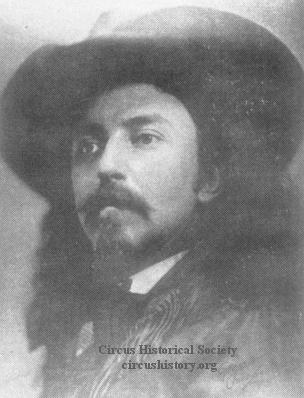 Photo: Young Buffalo 1910
In writing any history it pays to have someone who had a part in it help you and in writing this history of the Young Buffalo Wild West Show. I had the help of the leading man himself. "Young Buffalo" Mr. Joe R. Smith now a member of the Circus Historical Society. For four years he was the titled head of the show owned by Vernon C. Seavers of Peoria & Chicago, Ill. Now living in Montezuma, Kansas, he answered letters and questions by the score, furnished the names, places and photos without which I could not have completed this narrative.
Being always interested in the Wild West end of outdoor show business I found among collectors and fans of the circus little on this show and very little on its personnel. For some four years it was one of the three largest railroad Wild West Shows to tour the country and was studded with some of the most famous names in this field.
In 1908 theater owner Mr. Seavers in looking around for a summer attraction for Al. Fresco Park in Peoria, Ill., which he also owned, decided on a Wild West Show. Calling it the "Lone Bill" Wild West it headlined one Joe Pollock of Chicago as "Lone Bill." With his wife Mr. Pollock did a shooting act and a knife throwing impalement act. A member of the cowboy troupe was Mr. Joe R. Smith. After a successful park season in 1908, Mr. Seavers and his manager Major C. F. Rhodes decided to take the show on the road, probably to get reaction, and loading it into two railroad cars it played the following stands. Aug. 23 Bloomington, Ill.; 24 - Farmer City; 25 North Champaign; 27 - Paris; 28 Charleston; 29-30 - Mattoon; 31 - Shelbyville; Sept. 1 - Litchfield.: 2 - Ashton; 3 Granite City; 4-5 - East St. Louis at Lansdowne Park. The show closed there at the park and was shipped up river back to Peoria, Illinois by boat and stored in winter quarters.
The die was cast and purchasing equipment and signing personnel was a job Mr. Seavers undertook that winter and in the spring of 1909 the Young Buffalo Wild West Show took the road for its first tour. The name Young Buffalo was probably picked by Mr. Seavers as being more western sounding that Lone Bill. Here I would inject a thought. In various articles this show has often been referred to as the Young Buffalo Bill Show, and often Mr. Smith has been referred to as Young Buffalo Bill which is wrong. Inasmuch as Buffalo Bill was still alive and touring, it is common sense that no one would have assumed this title without a lawsuit, therefore the correct title was Young Buffalo.
Headlining the show in 1909 when it left quarters was one Cal Lavelle, a good looking old timer with long hair, mustache, and goatee who played the part of Young Buffalo. Being rather old and a poor rider, he also imbibed frequently and after two months Mr. Seavers had to let him go. The job was then offered to Mr. Smith who also sported a mustache and goatee. From this time on Mr. Smith let his hair grow, and for the next four years he was the titled head of the show as Young Buffalo.
As near as can be recalled the show left Peoria, Illinois in 1910 on its own yellow and red train of 30 cars including 12 flats, 10 stocks, 6 sleepers with two cars on advance. It carried parade equipment and paraded every day. A side show was also carried.
The program was typical wild west the first two years and included some of the greatest western stars of that period. It had one of the greatest shooting act, when at one time it featured the four greatest sharpshooters of all time, Captain Bogardus, Curtis Liston, Captain O. G. Stevens and the fabulous Annie Oakley. With her husband Frank Butler as her personal manager also on the show with her, Miss Oakley played all of the 1911-12-13 seasons and was headlined in the billing.
The Indians on the show came from the famous Pine Ridge, South Dakota Reservation and led by Red Shirt it had some of the most famous Sioux Chiefs including Flat Iron, Painted Horse and Good Face.
The cowboys were led by Colorado Cotton and included among others, Ambrose Means, Red Burns, Ray Thompson, Alkali Pete, and Buffalo Vernon. In 1912 one of the cowboys was a fellow named Tom Mix. Captain Stevens was the famous 20 ox team driver of whom it was said "he could drive the team through a knothole." Captain Hardins Mexican Experts were a fast Zouave drill team. The cowgirls were led by one Prairie Rose champion lady bronc rider.
It was a real wild west program with Pony Express, attack on stage coach and covered wagon, bucking horses, shooting act and steer wrestling.
In 1912 Mr. Seaver brought on Col. Fred Cummins with his Far East contingent and the show now had elephants and camels to add to the buffalo, horses, and steers, along with Cossacks and Singalese performers. Enlarged, the show was now the Young Buffalo Wild - West Col. Cummins Far East and V. C. Seavers Hippodrome, an imposing title.
The band the first two years was led by Henry Kern, his wife having the cowgirl band which paraded on horseback. In 1912-13 the bandleader was George Atterbury.
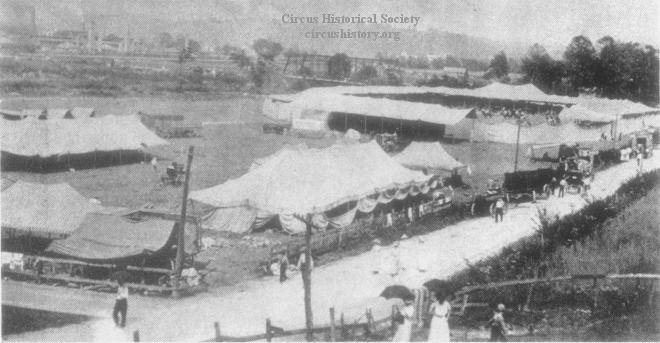
The show was well received wherever it played and it played many of the larger towns east of the Mississippi. It also played Eastern Canada in 1911 and again in 1913 and had great crowds at Montreal and Ottawa, playing three shows in one day at Montreal. Washington, D. C., Baltimore, Detroit, Chicago and Newark were some of the bigger towns this show played. As you can see from the route for 1912 the Chicago engagement was two weeks long with the show moving to a different location every night.
In its four years on the road it had no real casualties and was one of the more successful Wild West Shows.
After the 1913 season, Mr. Seavers sold the show to a trio of men, one of whom was a Mr. McGinley of Denver, and another was believed to be his own general superintendent, M. C. Cookston. Mr. Smith did not tour the 1914 season, his wife and himself having retired from show business after the 1913 season. The show went on in 1914 strong on grift and folded after two months. Thus ended the Young Buffalo Wild West. Mr. Seavers retiring from show business, moved to Florida where he died some years ago.
Following is a list of department heads for 1912 with the complete route.
|
Apr. 27 - Peoria, Ill.
Apr. 29 - Springfield, Ill. Apr. 30 - Decatur, Ill. May 1 - Lafayette, Ind. May 2 - Muncie, Ind. May 3 - Ft. Wayne, Ind. May 4 - Kalamazoo, Mich. May 6 - Battle Creek, Mich. May 7 - Jackson, Mich. May 8 - Lansing, Mich. May 9 - Saginaw, Mich. May 10 - Flint, Mich. May 11 - Bay City, Mich. May 13 - Detroit, Mich. May 14 - Detroit, Mich. May 15 - Toledo, Ohio May 16 - Tiffin, Ohio May 17 - Mansfield, Ohio May 18 - Canton, Ohio May 20 - Alliance, Ohio May 21 - Youngstown, Ohio May 22 - New Castle, Pa. May 23 - Connelsville, Pa. May 24 - Cumberland, Md. May 25 - Martinsburg, W. Va. May 27 - Washington, D. C. May 28 - Washington, D. C. May 29 - Baltimore, Md. May 30 - Baltimore, Md. May 31 - Wilmington, Del. June 1 - Chester, Pa. Sunday June 3 - Trenton, N. J. June 4 - Newark, N. J. June 5 - Jersey City, N. J. June 6 - Newburg, N. Y. June 7 - Kingston, N. Y. June 8 - Poughkeepsie, N. Y. June 10 - Stamford, Conn. June 11 - Waterbury, Conn. June 12 - New Britain, Conn. June 13 - Hartford, Conn. June 14 - Putman, Conn. June 15 - So. Bridge, Mass. June 17 - Worchester, Mass. June 18 - Woonsocket, R. I. June 19 - Pawtucket, R. I. June 20 - Newport, R. I. June 21 - Taunton, Mass. June 22 - Plymouth, Mass. June 24 - Brocton, Mass. June 25 - Marlboro, Mass. June 26 - Clinton, Mass. June 27 - Fitchburg, Mass. June 28 - Lowell, Mass. June 29 - Waltham, Mass. July 1 - Lynn, Mass. July 2 - Gloucester, Mass. July 3 - Salem, Mass. July 4 - Haverhill, Mass. July 5 - Lawrence, Mass. July 6 - Dora, N. H. July 8 - Portsmouth, N. H. July 9 - Concord, N. H. July 10 - Manchester, N. H. July 11 - Nashua, N. H. July 12 - Keene, N. H. July 13 - Greenfield, Mass. July 15 - Northampton, Mass. July 16 - Springfield, Mass. July 17 - Westfield, Mass. July 18 - Pittsfield, Mass. July 19 - No. Adams, Mass. July 20 - Troy, N. Y. July 22 - Glens Falls, N. Y. July 23 - Schenectady, N. Y. July 24 - Little Falls, N. Y. July 25 - Rome, N. Y. July 26 - Watertown, N. Y. July 27 - Ogdensburg, N. Y. July 29 - Oswego, N. Y. July 30 - Auburn, N. Y. July 31 - Rochester, N. Y. |
Aug. 1 - Medina, N. Y.
Aug. 2 - Niagara Falls, N. Y. Aug. 3 - Buffalo, N. Y. Aug. 5 - Erie, Pa. Aug. 6 - Ashtabula, Ohio Aug. 7 - Sharon, Pa. Aug. 8 - Warren, Ohio Aug. 9 - Elyria, Ohio Aug. 10 - Norwalk, Ohio Aug. 12 - Bellevue, Ohio Aug. 13 - Bellefontaine, Ohio Aug. 14 - Union City, Ind. Aug. 15 - Marion, Ind. Aug. 16 - Frankfort, Ind. Aug. 17 - Hammond, Ind. Chicago, Ill.: Aug. 18 - 38th & Wentworth Aug. 19 - 46th & Cottage Grove Aug. 20 - 59th & Ashland Aug. 21 - 111th & Indiana Aug. 22 - 40th & Ogden Aug. 23 - 47th & Lake Aug. 24 - Lake & Sacramento Aug. 25 - Chicago & Western Aug. 26 - Milwaukee & Sawyer Aug. 27 - Lincoln Aug. 28 - Divirny Aug. 29 - Janesville, Wis. Aug. 30 - Belvidere, Ill. Aug. 31 - Maywood, Ill. Sept. 1 - So. Chicago, Ill. Sept. 2 - Chicago Hts., Ill. Sept. 3 - Danville, Ill. Sept. 4 - Paris, Ill. Sept. 5 - Terre Haute, Ind. Sept. 6 - Clinton, Ind. Sept. 7 - Linton, Ind. Sunday Sept. 9 - Sullivan, Ind. Sept. 10 - Mt. Vernon, Ind. Sept. 11 - Vincennes, Ind. Sept. 12 - Washington, Ind. Sept. 13 - Olney, Ill. Sept. 14 - Pana, Ill. Sept. 16 - Pontiac, Ill. Sept. 17 - Lincoln, Ill. Sept. 18 - Jacksonville, Ill. Sept. 19 - Alton, Ill. Sept. 20 - Litchfield, Ill. Sept. 21 - E. St. Louis, Ill. Sept. 23 - Columbia, Mo. Sept. 24 - Mexico, Mo. Sept. 25 - Fulton, Mo. Sept. 26 - Marshall, Mo. Sept. 27 - Lexington, Mo. Sept. 28 - Warrensburg, Mo. Sept. 30 - Butler, Mo. Oct. 1 - Carthage, Mo. Oct. 2 - Webb City, Mo. Oct. 3 - Ft. Scott, Kan. Oct. 4 - Clinton, Mo. Oct. 5 - Booneville, Mo. Season Ends |
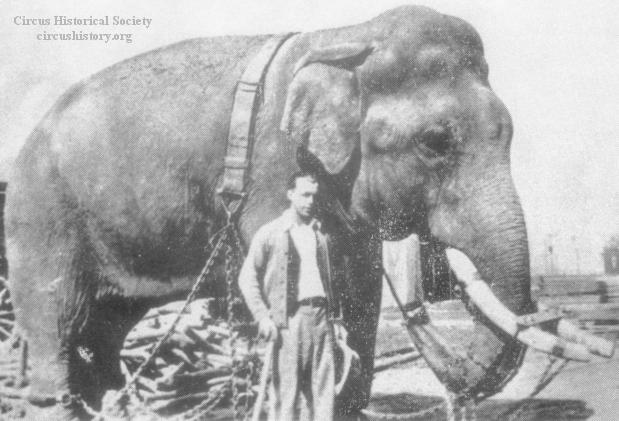
The elephant Diamond (The name "Black" was not added to his name until years later by Bill Woodcock) started in this Country with the Original Gentry Shows. It is understood that he was one of four punks that the Gentrys bought from the Hagenbeck firm in 1900. He was broke on the Gentry Show by a German trainer who also broke the other punks for the Gentrys. He remained with the various Gentry Troupes until either 1913 or 1914, when with a bull named Trilby, he was sold to Wm. P. Hall and Joe Metcalf once told Bill Woodcock that he took these two bulls to Lancaster, Mo. and the Hall Quarters. By 1915, Diamond was one of a herd of five bulls (Alice, Annie, Lizzie, Diamond and Baby Boo) that Hall sent with the Barton & Bailey Shows. Then in 1916, this herd went with Wheeler Bros. Enormous Shows. Wheeler sold the five bulls to the R. T. Richards Shows. Latter was owned by Richard T. Ringling who was the son of Alf T. Ringling. This show was moved on trucks and wagons and the bulls hiked overland. This toured during 1917, but played at Luna Park on Coney Island during 1918. After that season Ringling sold four of the bulls, including Diamond, back to Hall. The elephant Annie, went to the Madison, Wis. Zoo and remained there until her death a few years ago.
Diamond remained on the Hall Farm in 1919, but that winter he was sold to The Atterbury Wagon Show. Stayed with that one until the show was sold to A. M. Cauble in August, 1924. Bill Woodcock was working Diamond with Atterbury at that time, he would give a lecture on the bull before working his act, which closed the performance, the Black Diamond crept into his speil, and it stuck right down to the present time. In 1925 the title of Atterbury Show was changed to Monroe Bros. and Diamond was billed as "Congo" and Woodcock handled him on this show. By 1927, Black Diamond was with a show called Wilson's Greater Shows, operated by Wilson Fulbright, a nephew of above mentioned Albert Monroe Cauble.
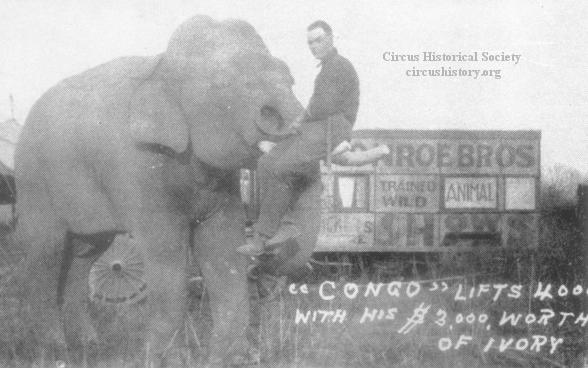
Black Diamond always worked in a herd until he went to the Atterbury Wagon Show in 1920. Bill Woodcock tells me Black Diamond did a pretty fair single act, but by the time he was around him in 1924, he had lost some of it. He wouldn't lay down on command, hence no ground setup; also had blown his tub set up. He did three-leg-hop (left front leg); shimmy; dance front and back feet (used to snap bracelets of sleigh bells around ankles for front foot dance walkover); rang a cowbell; head mount or on his tusks; also a hind-leg stand. Then as a finale, Woodcock called for volunteers out of the audience to ride him. Put about four guys on his back. Had collar chain on his neck for front guy to told; and made others hold onto man in front. Then around the ring doing the three leg hop. This shook the riders up good and caused much amusement and was a good finish for this type show.
After 1927, Black Diamond was bought by Al G. Barnes, who was noted for having bad male tuskers in his herd. Black Diamond replaced Tusko at times when Tusko had to be left at quarters, because of his behavior. George (Slim) Lewis in his book "Elephant Tramp," tells of the time he was working on Tusko, syringing the sores caused by his chains, Black Diamond turned and glared at him with his wicked bulging eyes and Tusko turned as far as his chains would allow him to, trunk coiled, head back and tusks forward. He believes if they had not been securely chained, there'd have been a bull battle that would have been legendary in circus history.
When both Black Diamond and Tusko were on the road with the Barnes Show, Diamond was called "Tusko" and Tusko was called "The Mighty Tusko." That was the case when the show arrived in Corsicana, Texas on the morning of October 12, 1929, when the tragedy occurred that resulted in the execution of Black Diamond. Some people still like to believe the story that Mrs. Eva Donehoe who was killed that morning had married one of Diamond's keepers years before and he had left the show and Diamond had grieved about his keeper and when he saw Mrs. Donehoe, he had killed her in a fit of jealous anger. The fact that the man who in question had been his trainer was Curley Prichett and he had asked that morning to be allowed to take Diamond from the train to the show lot and had been granted the request. He then lived in Corsicana and wanted the town folks to see him handle Diamond.
George (Slim) Lewis, whom I mentioned before, was one of the bull hands on the show the morning Mrs. Donehoe come up where they had stopped on the street to water the elephants and wanted to pet Black Diamond. Lewis said, Diamond, like a number of other dangerous elephants, respected and obeyed only one man at a time. Once it had been Curley Prichett; but right now it was Jack O'Grady. As to Curley, Diamond was through with him and had been only choosing his time to strike. Lewis said that Black Diamond was a known killer and Bill Woodcock, a well-known elephant authority and had been around Black Diamond a lot in his wagon show days, says he was not only mean but a confirmed runaway. He said that earlier with rail shows he was younger and not as vicious; but a runaway. That is the reason the Gentry Show got rid of him to Hall.
Woodcock told me he replaced Curley Prichett on the Atterbury Show in 1924. He was also on the Monroe Bros. Circus when Black Diamond killed an old man by the name of Ben Sweet at Oilton, Texas, Jan. 1st, 1926. This man had been around the Atterbury Show for a long time and had handled Diamond when he first went with that show in 1920. He said Diamond killed him for no apparent reason only that he was trying to replace a leg chain. Bill was eating supper in the cookhouse at that time.
Slim Lewis said he and Blumer English another bull hand were directly behind Diamond when he killed Eva Donehoe, they were a few feet away from the terrible scene, so heard and saw all that went on. He thinks the story of Diamond being overjoyed to see his old trainer and become jealous of Mrs. Donehoe when she talked to Curley, that was pure fiction. He said as Mrs. Donehoe raised her hand to the side of Diamond's head, he whirled in a flash. He caught Curley with the side of his long tusks and hurled him completely over the top of the nearest car. Lewis said before Bloomer or I could catch our breath, Diamond had turned on Mrs. Donehoe. He knocked her to the sidewalk and ran his tusks through her body. She gave one short scream.
Public opinion was so great against Black Diamond that he was executed a few days later in Kennedy, Texas. Thus ended another of the big male tuskers of the circus.
(I am thankful to Wm. H. Woodcock for much of the information on Black Diamond, also to Little, Brown & Company, publishers for permission to use material from "Elephant Tramp" by George Lewis and Byron Fish.)
Researcher note: Black Diamond's skull was on display in the Houston Museum of Natural Science.
In January 1934, announcement was made of a financial deal between Tom Mix and Sam Dill. Mr, Dill had operated a truck show for several seasons. The new title would be Sam Dill's Circus and Tom Mix Roundup. It was to comprise 90 trucks. The show closed at Riverside, California on Thanksgiving Day, Nov. 29. It was enroute 33 weeks, exhibiting in 14 states. A few weeks before that Mr. Dill had sold his interests to Tom Mix.
When the Barnes show opened in San Diego, March 31st, Captain Curtis had the big top; Fiesta of the Rio Grande was the opening number. It was a strong program with such acts as Mabel Stark, Terrell Jacobs, Poodles Hanneford, Flying Clarkonians, Phil Escalante and others. Southern California newspapers offered a free ticket to any child bringing in a new subscriber.
Ringling interests had tossed around the idea of playing indoors before John Ringling North made his historical statement after closing the show two years ago. In the summer of 1935 the Billboard carried a story to the effect that the Ringling owners and operators for the first time in history would try an ambitious scale in the operation of winter shows indoors.
Charles Sparks announced in the winter of 1934 that he had bought from Carlos Correon the trained horses that had been on the Ringling show. Mr. Correon would work these on Downie Bros.
No part of this publication may be reproduced in any form or means
The Circus Historical Society does not guarantee the accuracy of information contained in the information in these online articles. Information should always be checked with additional sources.
Last modified January 2006.
without written permission of the author and the Circus Historical Society, Inc.