


Circus Historical Society
Excerpts From Show World - January through April, 1910
-
Show World was a weekly trade newspaper for the entertainment industry from 1907 to 1911. It was published by the
Show World Publishing Co., Warren A. Patrick, General Director, Walt Makee, Editor; M. S. Patrick, Secretary and Treasurer, Grand Opera House Building, 87 So. Clark St., Chicago, U. S. A. Show World contained regular news about circuses, acts, personnel, circus life and carnivals, etc. Included here are a limited number of dates and of information on circuses published in the Show World. Note: there will be typographical errors, and the transcription will have additional typos. Information should be checked with additional sources. Transcribed by Judith L. Griffin.
Show World, December 25, 1909 (Vol. V, No. 1), p. 9. All information should be checked with additional sources.
John D. Carey Engaged
Bliss, Okla., Dec. 20. Edward Arlington has closed arrangements with John D. Carey for contracting press agent and manager of the excursion car for the 101 Ranch Wild West for the season of 1910. Mr. Carey is said to have had several other offers, but decided to accept the proposition submitted by Arlington, which carries with it a yearly salary. Mr. Carey will organize his own crew for the car and billposters who have been with him before.
The Jones Brothers' Show
Erie, Pa., Dec. 20. It is definitely stated here by those in authority that the Jones Brothers' Combined shows will go out next season as an eight-car show. The company has been incorporated and many prominent Springfield, Ill. citizens are down as stockholders. The Erie Lithograph company of this city has a contract to furnish the printing.
Circuses Lose Tax Case
Colorado Springs, Dec. 16. (Special.) Circuses must pay a county, as well as a city tax, when demanded. The Barnum & Bailey show was here in July, 1908, and in addition to a city fee of $200 the county commissioners demanded $100. Their contention was sustained today by District Judge Sheafor.
Show World, January 1, 1910 (Vol. V, No. 2), pp. 24, 29. All information should be checked with additional sources.
Mighty Haag Closes
Montgomery, Ala., Dec. 25. The Mighty Haag shows, which closed a season of forty weeks December 21, have gone into winter quarters here at the fair grounds.
John Robinson Shows Are to be Enlarged
Terrace Park, O., Dec. 28. The winter quarters of the John Robinson Ten Big Shows are just now the busiest place in the state. The sound of the hammer is heard from morning until night. The saws are buzzing, and men rush to and fro in busy preparation for next season. The place is a veritable bee hive of industry now, for an army of men is at work making ready the circus paraphernalia for a great show. Everything indicates that the shows will be larger and better than ever before. All signs point to enlargements, and to betterments and improvements.
The frame-up as now outlined, will be as follows: Rolling stock, fifteen stock cars, 10 coaches, 2 elephant cars, 22 flat cars, one special stock (store-men) car, making fifty cars in all. There will be three advertising cars in advance. The Robinson shows will have a big spread of canvas, orders having been placed for a 150-foot round-top, with three 50-foot and tow 40-foot middle pieces, making a six-pole big top, and for the menagerie a 90-foot round top with nine 30-foot middle pieces, manking a 10-pole top. The parade paraphernalia will include thirty 14 to 20-foot tableau cages.
New Elephants to Arrive
Two new elephants have been purchased, and they are due to arrive here some time before the opening of the season. They will be added to the two big herds of performing elephants now owned by this show. Other additions will be 15 camels, and the menagerie will be replenished by the addition of numerous other rare animals.
The Robinson shows will next season have three curb rings and two stages. The spectacle will be the gorgeous scenic and historical pageant, "King Solomon and the Queen of Sheba." This will show the renowned potentate at the time of his meeting with the famed Queen, and it will be participated in by hundreds of gorgeously arrayed men and women. It will be a glittering spectacle, of unusual sumptuousness, and costumers are now busily engaged in making the vestments, which will be the most costly ever seen in a like offering, while the scenic environment will be unusually elaborate, if the work of the artists at present employed is any criterion.
A wild west section will embody every known kind of frontier sport and pastime. There will be many thrilling features, such as the holding up and the robbing of a stage coach, the hanging of a horse thief; a representation of Custer's last stand; the holding up and robbing of an emigrant train and numerous other exciting exhibitions.
A troop of Cossacks and Arabs will also be offered in their wild and untamed riding specialties, and a troop of United States cavalry will be a prominent feature in its feats of riding, its manoeuvers and other spectacular offerings. Three brand new foreign novelty features have been obtained for the parade, but information concerning them is not divulged at this time. Two new Pullman cars have recently been purchased in Chicago for the shows.
Robinson Wins Success
The success won by John G. Robinson during the season just closed is gratifying to his many friends, as it marks his first year as an owner. The season has been remarkably free from serious accidents and the Robinson circus bank account shows a happy balance on the right side of the ledger.
Your correspondent can assure the public that the John Robinson shows next season will be a great organization. The activity about the winter quarters is assurance of that, and the presence of John G. Robinson, at headquarters from time to time, where he is looking over the details of his shows for the coming season means that everything will be on an elaborate scale, and that all ramifications of the great aggreation will be elaborate and interesting.
Cole Show Undecided; Lawsuits May Result
Not Incorporated as Reported and Positively Unsold to Date Says an Erie Authority
Erie, Pa., Dec. 29. It is more than possible that the Cole Brothers' show will become the defendant in a number of suits unless something definite is done regarding next season. It is no secret that the show is in the market for sale and it is also a fact that there are a number of employes who have not been released from the contracts made with them at the close of last season. These contracts are still in force and as the salaries of some of them under contract will start the first of the year, if the salaries are not forthcoming and no provision made for the future of those holding contracts, serious results are liable to ensue.
The report that the show has been incorporated is entirely without the least foundation. It is known that there are several would-be purchasers who have looked over the outfit in Corry and have made offers, but that nothing that looked like a sale has resulted. The names of Walter L. Main, William P. Hall and "Bunk" Allen have all been mentioned as prospective purchasers, but a sale to either of them is as distant as if no names at all had been mentioned. Main and Hall have both been in touch with James Downs, who, under the will of his late father, is the owner at present. Those who should know claim that unless he can get what he is of the opinion the show is worth, he will not sell. There have been several offers for the horses and the animals, but it is said that the show will not be sold unless it can be sold in its entirety. Should Main get the show he will put it out at once, but it is said that Hall is not a purchaser for the purpose of again entering the game, but will merely buy on a speculation. - Kerwin.
C. G. Snowhill, special agent with Ringling Brothers for several season, is at present ahead of Billy Watson and His Beef Trust.
Show World, January 8, 1910 (Vol. V, No. 3), pp. 3, 12, 20, 22. All information should be checked with additional sources.
"Flying Jordans" Are Injured
Detroit, Jan. 5. The Flying Jordans who were injured here at the Detroit Opera house are recovering. The young men were doing their hanging by teeth act when a guy rope snapped and the four were thrown to the stage, 20 feet below. All were picked up unconscious and were removed to a hospital. Their injuries are so serious that all contracts have been cancelled for three weeks. This is the third time the boys have narrowly escaped death in this act.
Obituary
Willian Newman, an old time circus man, died at Bath, N. Y., aged seventy years. He was one of the men who brought "Jumbo," the famous elephant, to this country.
A Panama Circus
The following interesting letter has been received from a member of the Lowande Bros. Circus, traveling in Panama:
Pedro Miguel, Canal Zone, Panama, Dec. 14, 1909.
Editor, The Show World:
We all sailed from New Orleans on Nov. 20 on the steamer and after five days of beautiful weather in the tropical waters of the Culph of Mexico and Carribean Sea, we landed in Colon, from which point we boarded the Panamea R. R., and went direct across the Isthums to Panama City, only forty-seven miles distants, which is the distance across the isthmus. One goes from coast to coast down here in a few hours. On this trip we got out first view of the canal and the great work that is going on.
Nov. 26 was our opening date in Panama City. We give only night performances, excepting Sunday when we give a matinee. We gave four night and a Sunday matinee at Panama City and literally "packed them in" at each performance.
Our first serious accident was on our last night in that city, when one of our loaded trucks started downhill and got the best of the horses. The driver, "Scotty," was picked up with two ribs broken and his assistant, whom we picked up in Panama, fell on his head and broke his skull. He died one hour afterward. "Scotty" has rejoined the show after a few days in a hospital.
Our tent is made by Baker, of Chicago, and Mr. Lowande is highly pleased with same. It's a 90-foot round top with 2 x 40-foot middle piece, 25 lenths of seats, 10 tiers, 366 chairs, and 32 boxes, 4 chairs in each box.
The exclusive staff consists of Martinho Lowande, Jr., equestrian director; Harry Lamkin, treasurer; Mrs. Harry Lamkin, bookkeeper; Mrs. Parson, front door ticket taker. The performers are: Berry & Hicks, novelty gymnasts; The Five Mizimo [?] Troupe; Howard & De Leon, hand balancing and equestrian; Mrs. Cecil Lowande, principal riding; Miss Julian, hurricane and hurdle riding; Cecil & H. Lankin, double jockey act; Gariforma & Frisco, American and Spanish clowns; Miss Maggie Lesler, ring and single traps; Adam Sisters, revolving iron jaw act; The Athas, bar and acrobatic act; Harry Smith, and his 12-piece band; Shanny, boss chandelierman; A. Spring ("Tony"), privileges; J. weitzel ("Sheney"), boss canvasman, who says he'd rather have one white U. S. A. canvasman than to have two hundred of these natives.
We have a special train, consisting of four cars. We also have four horses and two mules.
"Sheney" got 16 native canvasmen, from Panama City we made three days in Gorgona, three days in Gatun, and one week in Colon, and so far only lost two days in Colon, owing to cloudbursts; in fact, it's been raining every day since we've been in the isthmus, and yet we just pack them in at each performance.
All of us are well and pleased to know we can buy the Show World in Colon, so we are in touch with all circus news. Price here is 15 cents per copy. All mail addressed to any of us, kindly forward to Colon, Panama. From above date we have four more weeks in the isthmus. Regards to all. - A. Spring ("Tony").
Many Staff Changes in Sells-Floto Show
Double Duty Falls to W. E. Franklin; Fred Wagner to Assist Him; Warner and Hutchinson Slated
Denver, Colo., Jan. 3. Starting in the first of the year there will be considerable changes around the Sells-Floto shows. W. E. Franklin will this year be the general agent of the show in addition to being the general manager but will spend most of his time ahead of the show. Fred Wagner who was busines manager back with the show last season, will also be in advance assisting Mr. Franklin. Ed. C. Warner will again be the traffic manager. Fred B. Hutchinson will be business manager back with the show and will be assisted by Henry Gilbertson. It is understood that Mr. Gilbertson will be on the lot early in the morning and then Mr. Hutchinson will remain up at night until the show has left town. Mr. Tammen is very much pleased with this new arrangement and says that he will have a very effective staff for 1910.
It is said in Chicago that the Gilbertson appointment is by no means certain. Gilbertson is reported to have said that he had reached no conclusion regarding his next season's work.
Bonfils and Tammen Promise a Surprise
Sells-Floto Heads Get Together at Denver and Will Soon Announce Big Circus Innovation
Denver, Jan. 1. During Christmas week F. C. Bonfils returned to Denver and he, together with H. H. Tammen and W. E. Franklin, who was also in Denver, held many consultations and perfected their plans for the coming season. As soon as the minor details are worked out there will be given to the public through the columns of The Show World the outlines of one of the greatest innovations that has ever been pulled off in the history of the circus world.
Peru, Ind., Jan. 5. It is said here on pretty good authority that Fred Wagner will be identified with the Hagenbeck-Wallace show the coming season.
Old Circus Man Dead
Buffalo, Dec. 31. Circus men will be interested in the recent report from Bath, N. Y., that William Newman, a well-known member of the Soldiers' Home at Bath, dropped dead from heart disease. Newman was for the greater part of his life engaged with the Barnum & Bailey circus. He was a member of the circus expedition that transported the world-famous elephant Jumbo to this country, and for many years was engaged as the keeper and trainer of Jumbo. He exhibited the elephant with the show in many parts of the world. Mr. Newman was 70 years old, and a member of the First Connecticut Infantry during the Civil War. He had been a member of this home for several years, where among his comrades he was known as Jumbo Bill. - Joseph A. M'Guire.
Circus Notes
W. E. Haines, who was 24-hour-man last year with Sells-Floto shows, arrived in Denver two weeks ago and has accepted a position with the auditing department of the Denver Post until the tented season opens, when he again will occupy his old position. Mr. Haines is stopping at the Auditorium Hotel in Denver.
Arch Donaldson, of the Donaldson Lithography company spent several days in Denver recently in consultation with Tammen and Bonfils, and returned East with Mr. Franklin. No doubt the Donaldson imprint will be seen on some of the Sells-Floto printing next season.
Ringlings Are Home
Baraboo, Wis., Jan. 4. Alf. T. Ringling and son, Richard, arrived at their home here last week after several months' absence. After returning from Europe they went to Bridgeport, Conn., for a visit with Otto Ringling, and to see how things are moving along at the winter quarters of the Barnum & Bailey circus.
Harry Parrish Signs Up
Fairbury, Neb., Jan. 3. The Campbell Bros. have engaged Harry Parrish as trainmaster of the Campbell Bros.' circus for 1910. Mr. Parrish is at the winter quarters, where he is superintending the building of cars and repairs on the rolling stock equipment. It would appear that Campbell Bros. are securing the best bosses available for all departments of their show for next year, and it is reported that the organization is to be considerably enlarged.
"Buck" Massie in Town
H. L. ("Buck") Massie arrive in Chicago this week on his way to his home in St. Louis, Mo., and was a caller at The Show World offices. He has fully recovered from his recent illness and is looking forward to the forthcoming circus season wiht considerable anticipation as he has signed as local contractor with the Hagenbeck and Wallace shows, despite the fact that he has a most flattering offer from O. T. Crawford to become manager of the Gayety theater in St. Louis.
Patterson Shows to Be Greater Than Ever
Plans in the Making Indicate That the Amusement Enterprise Will Offer Astonishing Attractions This Season.
Shreveport, La., Jan. 4. The Great Patterson Shows, in winter quarters at the fair grounds here, are just now a hive of busy industry. Monday a force of men began to build one of the most elaborate and unique fronts that ever graced a Midway. Animal trainers have been busy teaching new animals, and forming new wild and domestic animal acts. Machinery hall has been converted into animal quarters, where the elephants have a large room, the cat animals another large room with the arena close at hand, and on the opposite side is the ring where the ponies and elephants and other animals go through their daily stunts. This building is in charge of John Backman, who is also wintering his four-car animal show here.
During this week the Sparks circus will also take up winter quarters in other buildings here, which will make three shows in quarters here. Patterson's 21 cars, Backman's 4 cars and Sparks' 12 cars make some showing. Mr. Patterson and his family are now north. He has been purchasing some fine horses and performing ponies. Every indication is that the shows will be larger and better than ever in the history of this form of amusement.
Show World, January 15, 1910 (Vol. V, No. 4), pp. 6, 11, 17, 18, 19, 24, 25, 27. All information should be checked with additional sources.
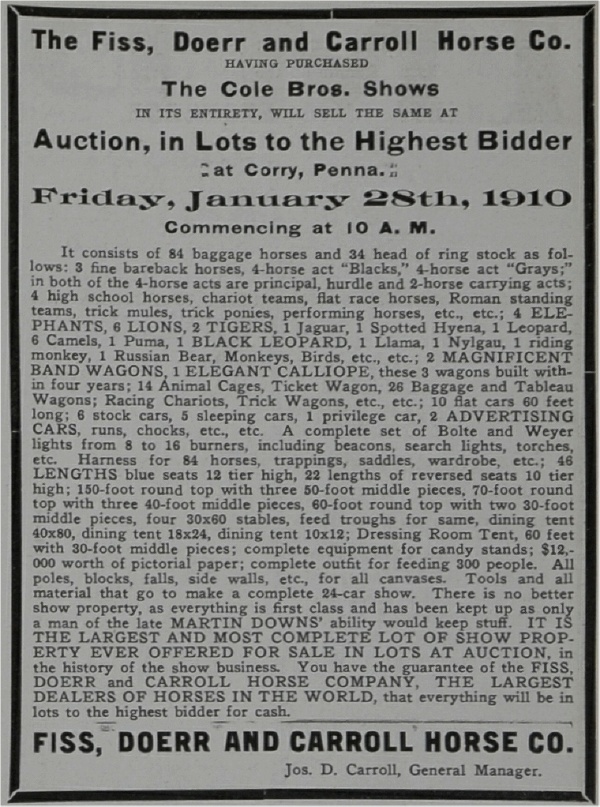
Cole Bros.' Show at Auction
Corry, Pa., Jan. 13. The Fiss, Doerr & Carroll Horse Company of this city will offer at auction sale Friday, January 18, at 10 o'clock in the morning, the entire Cole Bros. Show, to be sold either as a whole or in parts.
Arlington in the City
General Manager George ARlington of the 101 Ranch Wild West shows and Mrs. Arlington were guests at the Auditorium hotel in Chicago this week, as was J. C. Miller, associate proprietor of the aggregation. Mr. Arlington declared that the 101 Ranch Wild West shows this season would surpass all former efforts in the spectacular Wild West line.
Cleveland Prepares for the Royal Show
Cleveland, Ohio, Jan. 12. Alterations are in progress this week in the Central Armory, which is being prepared for the Rhoda Royal Mid-winter Circus, to be given under the auspices of the Shriners next week. In order to utilize every square inch of space in the armory, blueprints of the interior of the building were made. The hippodrome or race track, with the rings and elevated stage inside it, was laid off in the center of the floor. Tiers of seats, rising from the main floor to the galleries, were then arranged to accommodate 5,000 people. Care has been observed to have the plans in conformity with the city's fire regulations. The executive committee has decided that the Shriners, who volunteered to don their fezes and act as ushers, won't do. Professionals will be retained to do the real "this way, please" act. The refreshment committee has come to the same decision and the services of Senators Burton and Dick, ex-Senator Foraker and Congressman Howland have been dispensed with as peanut venders. - Frye.
Circus "Kings" Cut a Large, Juicy Melon
Ringling Brothers Clean Up a Cool Million During the Season of 1909. Enormous Sum Is Realized by Noted Showmen
Baraboo, Wis., Jan. 13. According to information received here by your correspondent, and which would appear authentic, the Ringling Brothers last week cut the juiciest financial melon every apportioned in the circus business.
It is reported that they divided $1,000,000 as the profits on the season of 1909, $600,000 of which represented the profits of the Barnum & Bailey Greatest Show on Earth, and the balance of the net earnings of the Ringling Brothers' World's Greatest Shows.
This showing beats all past records, the best record heretofore being made by this firm with the Ringling Brohters and Adam Forepaugh-Sells Brothers' Shows, the net earnings of which were said to be $800,000 for a single season. The Ringling profit for 1909 are nothing short of miraculous, considering the fact municipalities are increasing the circus licenses, and that the railroads are showing a tendency to increase the cost of the transportation charges for carrying circus organizations.
Tremendous Financial Holdings
Some idea of the tremendous financial holdings of the Messrs. Ringling can be gleaned when the fact is taken into consideration that for the past twenty-six years they have never experienced a losing season. Every dollar that has accrued to the Ringling Brothers has been invested in gilt edged securities. Outside of the Wall street clique the Ringling Brothers are perhaps the largest holders of approved bonds in the United States.
Through the resurrection of the Adam Forepaugh-Sells Brothers' Shows, which are to be operated by this firm the coming season, the earning power of the "Famous Five" will be considerably accentuated. In this connection it will doubtless be interesting to your readers to know that the Forepaugh-Sells show paraphernalia now being assembled will form a mighty aggregation. With the Ringling Brothers' World's Greatest Shows, the Barnum & Bailey Greatest Show on Earth and the Adam Forepaugh-Sells Brothers' Enormous Shows United, the Ringling Brothers undoubtedly hope to dominate the circus world next season.
Notwithstanding this great amalgamation, it is pretty well understood here that in 1911 a fourth circus aggreation will be added, and in 1912 on additional fifth, which will put each one of the Ringling Brothers in active charge of a great circus.
Circus Committees Make New Agreement
Associated Billposters Meet White Top Men and Draw Working Lines Tighter
The Circus Committee of the Associated Billposters and Distributors of the United States and Canada met the representatives of all the leading circuses at the Congress Hotel in this city Monday morning at ten o'clock and a new agreement for the forth-coming season was made, in which many vital changes over previous agreements are to be noted, the most important of which is a new graduated scale of ticket allowances, the non-countenancing of unkept contracts by either the billposters or the circuses, a decision not to cover paper where the imprint of a member of the association appears upon the board and a tacit understanding that circus organizations, which have not signed up, would be treated to scant business courtesy by the parties to the document.
The circus committee of the association consisted of the following: James F. O'Melia, of Jersey City, chairman; Barney Link, New York; Charles F. Bryan, Cleveland; P. J. McAliney, St. Louis, and Charles T. Kindt, of Davenport, who substituted for R. C. Campbell, who was unavoidably absent. The circus men were Charles Ringling for the three Ringling enterprises; W. E. Franklin, for the Sells-Floto shows; R. M. Harvey, for the Hagenbeck-Wallace; Fred Beckman, for Miller Bros. 101 Ranch; Al. Campbell, for the Campbell Brothers; "Jake" Newman, for Forepaugh-Sells; W. H. Horton, for the Ringling Show; M. Nagel, for Barnum & Bailey; William ("Kid") St. Clair, for Ringling Brothers, and Dave Jarett for Buffalo Bill.
The new agreement was signed by all parties present, and letters were received from Louis E. Cooke, of the Buffalo Bill-Pawnee Bill show, "Lucky" Bill of the Lucky Bill show, C. W. Parker, of the C. W. Parker enterprises and a representative of the Great Cosmopolitan shows.
Some Do Not Sign
The Yankee Robinson and the Gollmar Brothers shows did not sign last year and did not commit themselves this year.
Aside from the new allotment of tickets, which runs from 15 tickets for towns of from one to five thousand to 125 tickets for a town of 100,000 population, a new arrangement has been made on contracts for posting to the effect that contracts that run over four weeks will be arranged, as to cost, pro rata, for the fifth and other consecutive weeks, on the four weeks' rate.
One of the new clauses is to the effect that the billposter, in contracting for space, when contract calls for a specific amount of paper for a specific date, he must be paid for amount contracted for unless given a cancellation notice at least two weeks in advance of the posting date. On country and excursion routes the billposter in contracting to furnish space is only allowed, under the association, to contract space which is actually owned or controlled by lease by members of the association and bearing their imprint, showing name and adress of the member. The circus people agreed not to cover any paper where the imprint of a member of the association should appear upon the billboard.
Bernard to Judge
Another important item was that the billposters, in contracting to furnish space for the circuses, agreed to furnish actual billboard space, or in the case of walls, the walls must be good with cap on and in desirable locations and the space in any event must be the same as is listed and furnished to commercial advertisers. The association refuses to countenance daubs, and will not countanance collection of bills for such.
Charles Bernard was given full jurisdiction in rendering decisions in every controverys arising between the parties to the agreement, subject to appeal to the board of directors or to the memberbs at the next regular meeting.
Shows which have not signed up are likely to regret it the coming season. Heretofore the members have been more or less lax in this regard, and while the rule has been that non-members would be charged a twenty-five per cent advance on rates, it is known that certain association members, in an effort to get the money, have not charged this advance. It has been tacitly agreed, however, that such shows as have not signed up will not be recognized under any circumstances. This means that the shows which have not signed will either have to avoid those towns in which members of the association control the space, or else will have to be satisfied with daubing and banners.
101 Ranch Shows Put on Picture Film
Annual Round-Up on Famous Cattle Range in Oklahoma is Caught by the Camera
J. C. Miller, of the Miller Brothers' 101 Ranch, and associate owner of the Miller Brothers' 101 Ranch Wild West Show, was in Chicago this week, making his headquarters at the Auditorium hotel.
Mr. Miller was in conference with some of his staff regarding the coming tour of the wild west show, and to a representative of The Show World expressed his enthusiasm over the moving pictures which he has had taken on the ranch at Bliss, Okla., and which are to be furnished to moving picture theater exhibitors. He said:
"The Fall Round-Up on the 101 Ranch is an event of considerable interest, and it serves as a magnet to attract hundreds of people from all points in the states to witness a spectacle which is, to say the least, unique. This fall our cowboys rounded up 5,000 head of cattle in one hers, and to give the general public an idea of the magnitude of the undertaking we arranged with the Telephoto company to take a moving picture of the incident.
"The round-up in itself furnished rich material for the camera, but to give the real added attractiveness we arranged for some special features, including cowboys in their sports and pastimes, and Bill Pickett doing his sensational act of throwing a steer, jumping from the back of a running horse.
"I have been quite amused at the so-called wild-west pictures which have been turned loose from time to time by moving picture makers, and determined to give the public a real picture, not as a monetary proposition, but for the sake of perpetuating in the minds of city-bound people the tremendous activities of ranch life, and the stirring incidents which go to make up a cowboys' existence.
"The reel as made up, of 1,000 feet, represents the most stirring scenes from several thousand feet of negative, and every picture commands attention and admiration. I believe that this reel will mark an epoch in motographic history."
H. H. Tammen Predicts Stirring Circus Times
Millionaire Proprietor and Newspaper Owner Prophesies Big Things for Coming Season
"There will be stirring times in the circus business," said H. H. Tammen, the millionaire circus proprietor, at the Grand Pacific hotel in Chicago, where he has been making his headquarters this week with H. B. Gentry of the Gentry Brothers' shows.
"No pains or expense are being spared in makeing the Sells-Floto shows one of the premier circus organizations in the country. Operations at our winter quarters in Denver are progressing satisfactorily, and, while it is a little premature for me to announce the plans for the season of 1910, I am free to state that we will spring a few surprises, which will prove eye-openers to circus people generally."
On his way from Denver Mr. Tammen spent a few days in Kansas City in conference with Mr. Bonfils, in connection with whom he operates the Kansas City Post, as well as the Denver Post, two of America's leading dailies. According to Mr. Tammen, the Kansas City Post, since it came under his control, has been an immediate success, and appears destined to play a large and important part in the newpaperdom of the west.
Circo Shipp Opens
Bloomington, Ind., Jan. 9. Gran Circo Shipp opened at Bocus Del Toro, Costa Rica, Central America, Dec. 15, to big business. They showed there two days, and then went to Port Limin for a week. The show is now in Panama and will play the canal zone for about six weeks. They will sail for New York the latter part of February, stopping at Kingston, Jamaica. - Feltus.
Electrician Dead
Springfield, Ill., Jan. 11. Fred Pujo, former electrician of an Oklahoma City (Okla.) vaudeville house is dead at Havana. He is survived by his wife, formerly Minnie Russell, of the circus profession. He was a brother-in-law of Pat Kelley, the backward-dive-on-stilts-from-ladder man of Petersburg. - Madison.
Jones Bros.' Opening
Springfield, Ill., Jan. 11. Jones Bros.' Big United Railroad Shows will open the season May 2 in Springfield, according to reports from winter quarters here. - Madison.
Ed Allen has signed with the Campbell Bros. shows as principal clown for the coming season.
Rhoda Royal Circus
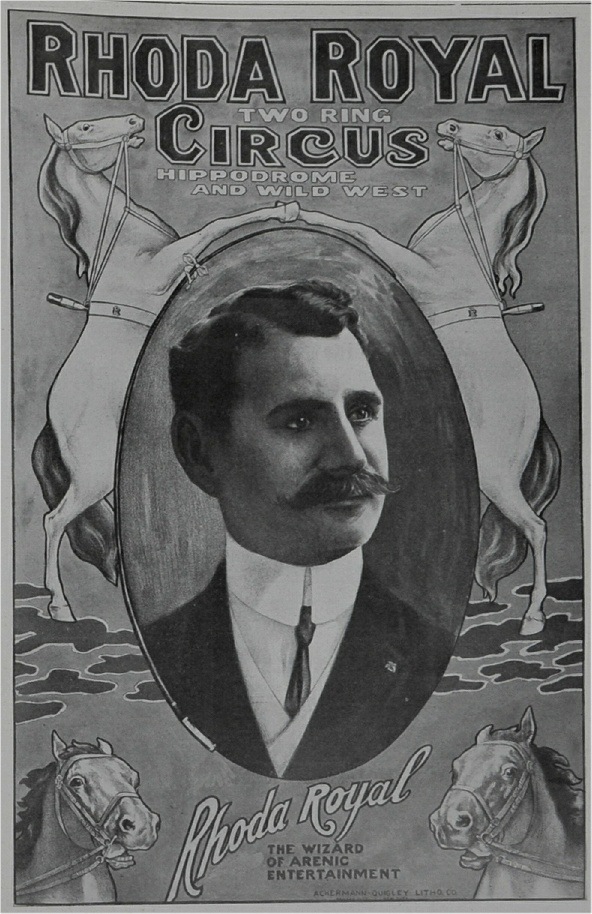
Cole Bros. Shows Auction
Show World, January 22, 1910 (Vol. V, No. 5), pp. 8, 16, 17. All information should be checked with additional sources.
Salvail Gets Desk Room
Salvail, who is a representative of the Yankee Robinson circus, has secured desk room with the National Producing Company on the fifth floor of the Crilly building at 167 Dearborn street. Salvail expects to meet all the circus men and artists who care to call.
Advance of 101 Ranch Show Now Organized
Edward Arlington Has His Publicity Campaign Mapped Out and His Band of Workers in Line
Bliss, Okla., Jan. 20. Even at this early day the advance of the 101 Ranch can be said to be about organized. The crews for the three advance cars are fully made up, and the staff with which Edward Arlington will surround himself for 1910 selected. There is not a novice in the organization, and the majority of them have already won their sours for what they have done. Two opposition crews will work in connection with the regular car billing, and in all there will be nearly one hundred men in advance of the show. When the show closed last season there was very little paper left on the shelves, and the coming season will see what will be admitted to be the finest line of new paper ever designed for a wild west show. Not only is this true when design is considered, but it is equally true as to assortment. In every department of the great show everything is progressing satisfactorily. Edward Arlington his hustling matters from his New York office, Fred Backman is working overtime in East St. Louis, where the winter quarters are situated, and Joe Miller on the 101 Ranch here does not know the definition of leisure. Everything is progressing so rapidly that the show will be in shape to take to the road by March 1. This is not saying that it is intended to open that early, but merely to show what is being accomplished. It is customary for all writers from winter quarters to tell that the show will be larger and better than when it came in. This claim will be omitted by the writer, who prefers to put such assertions up to The Show World's own correspondent on the day of the opening. It will be a show made up of a whole lot more than Indian whoops and pistol shots, and will be not only an netertainer but an educator.
Cole Bros.' Shows Will Be Sold in Lots Only
Erroneous Impression that Circus is to Be Disposed as a Whole is Corrected By Sellers
New York, Jan. 17. An erroneous impression has gone forth that the Cole Bros.' Show, which are to be sold at auction by Fiss, Doerr and Carroll Horse Company of this city, are to be sold intact to the highest bidder. This is absolutely incorrect. Messrs. Fiss, Doerr and Carroll state most emphatically that the show will be sold in lots only. They desire, particularly to emphasize this point, as sales of this kind in the past, which have drawn many well-known showmen to the auction rooms, have been practically settled before the opening of the sale, so that show properties have been sold in whole and competitive bidding was eliminated. The firm has received a number of offers to sell the show in toto, but have refused these. "Everything will be sold at public auction on the day, and at the time and place mentioned, in lots only, and nothing will be sold any other way," said a member of the firm, "and showmen may be sure of a square deal."
Cole Show Sale Is Down for a Big Event
Circus Men from All Sections of the Country Will Make Pilgrimages to Corry, Pa.
Corry, Pa., Jan. 20. Fiss, Doerr & Carroll, the New York Horse dealers, have become the owners of the Cole Brothers' show. They do not intend to put it out, however, but will offer it for sale at auction next week, and it will be sold in lots to suit the buyers. The show was sold for $25,000, but with the purchase of the show the buyers were compelled to buy in $12,000 worth of paper that was on the printing house shelves in Erie. During the existence of the option that James Downs had given the New York buyers an additional offer was made, carrying with it $5,000 more than the amount given in the option, but Fiss, Doerr & Carroll refused to release Downs from his option as given them. It is said that he wired an offer of $2,500 to be released. The sale was consummated Jan. 14, and only a few days previously James Downs was engaging people for the coming season. All the options that he had previously given had expired, and it looked as if he would be compelled to take the show out. Undoubtedly every show in the country will be representated at the sale and spirited bidding may be looked for on the horses and animals, but outside of this only ordinary interest is manifested. - Kerwin.
Bosses Are Engaged for Circus Season
Some of the Men Who Will Make the Sells-Floto Shows a Success This Year
W. E. Franklin, general manager of the Sells-Floto shows, was in Chicago Thursday, and to a Show World representative stated that the following bosses had been engaged for the season of 1910:
William Curtis, superintendent of canvas; Geo. Brown, superintendent of transportation; George Stumpf, superintendent of baggage stock; James Clough, superintendent of ring stock; Joe Dan Miller, superintendent of properties; Wilford Embleton, superintendent of lights, and Fred Shafer, superintendent of wardrobe.
Mr. Franklin and other representative circus men will attend the sale of the Cole Brothers' shows at Corry, Pa., Jan. 28.
Regarding the arenic performance for the Sells-Floto shows, Mr. Franklin refrained from giving out any definite information at this time, but stated that an announcement would be made in the near future, and that the big show performance would eclipse the previous efforts made by this organization.
Ringlings May Open Season in Danville
Big Circus May Start out in Uncle Joe Cannon's Town - Representative of Big Shows Making Preparations
Danville, Ill., Jan. 19. A representative of the Ringling Brothers' circus was in Danville recently conferring with the convention section of the Hundred Thousand club concerning the proposition to open the next season in that city, the same as was done two years age. If the arrangements are completed, the circus will ship its paraphernalia from Chicago, set up its tents, and remain there for three days, giving the opening performance of the season "on the road" on April 28.
Wagner Not with Sells-Floto
Peru, Ind., Jan. 20. Your correspondent can state positively that Fred Wagner will not be with the Sells-Floto shows the coming season, as has been announced in various amusement papers. With Charles Hagaman, Mr. Wagner will take J. O. Talbott's place with Hagenbeck-Wallace shows. Mr. Wagner was married in Denver Dec. 22 to Miss Pearl Matlock, and the happy pair are now on their honeymood in the east. Prior to joining the Sells-Floto shows as business manager last season, Mr. Wagner was identified with B. E. Wallace for ten years.
J. O. Talbott will retire from the circus business and make his home in Denver, where he has extensive business interests. As adjuster Mr. Talbott has been identified with leading circuses for many years and enjoys a host of friends in the profession.
Shuts Out Circuses
Savannah, Ga., Jan. 17. It is a cinch that this city will not see a full-fledged circus for sometime unless the present exorbitant license fee is reduced. The city dads have stuck to their determination to maintain a $1,000 a day license fee. W. E. Franklin, a well known circus man, in speaking of the local situation, said: "Savannah is a good circus town. Our show (Sells-Floto) had big receipts for a few days' business, but after paying the city its tax there was no profit left. The license then was $500."
Ex-Champion Rider Quits Bijou Theater
William O'Dell, Former Premier Bareback Rider, Leaves Well Known West Side Playhouse
William O'Dell, thirteen years treasurer and superintendent of the Bijou theater, and for over thirty years the champion bareback rider of the worlk, a title which he recently gave up, has severed his connection with the Bijou. O'Dell is one of the best known theatrical and old circus men in the west, and years ago won many honors together with his wife, who is now dead. The O'Dells were called the "king and queen of bareback riders." A few months ago O'Dell gave up his title of champion bareback rider on account of advancing years, when he received a challenge from an Australian rider to defend it, being past the half century mark. He will take a rest now and has made no business plans for the future.
Short Circus Notes
Fred Warrel will be on the business staff of the 4-Paw-Sells Show this season.
Al G. Barnes of the Barnes Trained Animal Shows was in Denver Monday and Tuesday and purchased from H. H. Tammen three tiger cubs and one sleeping car. Mr. Barnes paid four thousand dollars for the tigers and car, and in return sold Mr. Tammen a fine gnu. The car and animals were immediately shipped to Mr. Barnes' winter quarters at Spokane. Mr. Tammen recently sold to Frank Hall, the animal trainer, who is now located at Los Angeles, two tigers that the Sells-Floto Shows have at the City Park at Los Angeles. It is understood that Mr. Hall is breaking a mixed group of lions, tigers, leopards and pumas for a vaudeville act.
Foster Burns, who has been connected with the Wallace Shows, and the Hagenbeck-Wallace Shows for a number of years as manager of their number one advertising car, will be with the Sells-Floto Shows this season back with the show. Mr. Burnes will take Colonel Robertson's place as treasurer.
The Eddy Family, who were the feature act with the Gentry Bros. last season, have been engaged by Manager Mugivan for the coming tenting season.
The John Robinson Show is being thoroughly overhauled at the winter quarters, Terrace Park, Ohio, and the report emanating from Cincinnati is to the effect that "John G." is sparing no expense to put the show in first class shape which bears the title of "the oldest circus in the world."
W. B. (Soapy) Menefee, who has charge of the painting at Sells-Floto winter quarters, has finished the painting of all of the cages and tableau wagons with the show and has already started on the baggage wagons. Everyone who has seen the cages and tableau wagons pronounce them to be the finest lot of show wagons ever seen. In addition to the regular amount of gold leaf that is usually put on such wagons, Mr. Menefee has used gold leaf on all of the fans on the wheels, and they will certainly be one blaze of gold when they appear in parade.
H. H. Tammen, while in the east recently, with Mr. Franklin gave orders for six new handsomely carved eighteen-foot animal cages, these cages all to be delivered in Denver not later than March 21. The Sells-Floto Shows now have en route from Germany a shipment of animals from Carl Hagenbeck, which will greatly augment their menagerie. It was for this shipment of animals that the new cages were required.
William Curtis, superintendent of canvas with Sells-Floto Shows, with his staff of assistants, started work the first of the year at overhauling and repairing his department of the show. He is building an entire new set of grandstand seats which will have several improvements which are the invention of Mr. Curtis.
George Brown, the trainmaster, is a busy man these days overseeing the repairs to his train, as the flats and stock cars are being repaired at the Colorado & Southern shops, and the coaches at the Pullman shops. Mr. Brown again will have charge of one of the finest circus trains in the country - the Sells-Floto.
George Roddy, who has had an advertising car for the past four years with the Norris & Rowe shows, will be connected with the advance of the Sells-Floto Shows the coming seasohn. Mr. Roddy now has the agency for the Denver Post at Colorado Springs.
Frank Tammen, who for several years was the manager of the Sells-Floto Shows, but who now is the proprietor of the Majestic theater at Colorado Springs, was a caller at the Sells-Floto winter quarters last eek, and spent several pleasant hours in talking over old times with the boys. Mr. Tammen cleared over eighteen thousand dollars with his Colorado Springs house last year.
The Gollmar Bros., it is rumored, are negotiating for a herd of elephants.
Foster Burns, last season in advance of the Hagenbeck & Wallace Shows, has accepted a position with the Kansas City Post. He will have charge of the outdoor advertising, such as bill posting and sign painting, for the above paper.
C. M. Conner, the well known circus agent, is in advance of Leslie Carter this winter.
Bill Curtis, superintendent of canvas, started the first of the year with his staff of assistants to get the show property of his department in shape for the coming season. In addition to an entire new set of blue seats which will be sixteen tier high, Mr. Curtis will also build an entire new set of grand stand seats. An entire new set of canvas has already been ordered according to specifications containing several new inventions of Mr. Curtis for the Sells-Floto show.
The entire train of Sells-Floto cars has been put in the Pullman repair shops and while the Pullman people will do the work, it will all be done under the supervision of Mr. Browns, Sells-Floto's trainmaster.
Phoenix, Ariz., Jan. 20. W. H. McFarland, manager of the Sells-Floto sideshow, is spending the winter in this city. To your correspondent today he declared that he will introduce many new ideas this coming season, and that the Sells-Floto annex will be a representative one in every way. McFarland has probably introduced more original novelties than any other man in the sideshow business, and his assurance for 1910 will carry weight.
Mrs. A. G. Campbell,wife of A. G. Campbell, one of the proprietors of Campbell Bros. shows, died at Fairbury, Neb., Jan. 14, from a complication of diseases. She had been in poor health for a year, and little hope was held for her recovery. She was widely known in the circus field, and well liked.
Campbell Bros. are figuring on opening their shows early in April, the initial performance having been scheduled to occur either in Texas or Oklahoma. The show will carry twenty-eight cars, including the advance.
Lamy Bros., acrobats and aerialists, will be identified with the Sells-Floto shows the coming season.
Show World, January 29, 1910 (Vol. V, No. 6), pp. 3, 6, 24. All information should be checked with additional sources.
Gentry's to Enlarge
Bloomington, Ind., Jan. 26. A bunch of several trained wild animals for the Gentry Brothers show arrived last Saturday, accompanied by a woman trainer. It is said that the Gentry's will put out only one show next season, with a number of animals and circus features added, making a twelve or fourteen car show. - Feltus.
Located in Chicago
Alfred Witsenhausen, for many years identified with the Ringling Brothers World's Greatest Shows, is temporarily identified with the Olympic theater, Chicago, pending the opening of the circus at the Coliseum next April, when he will again assume his position with the Ringling shows.
Governor and Mayor Open the Royal Show
Distinguished Officials Inaugurate a Gala Week in Ohio Town - Shows Meet With Big Success
Columbus, O., Jan. 26. Governor Judson Harmon sounded a shrill blast on a golden whistle Monday night, from his box at the Goodale theater, and set in motion the multifarious glittering features of the Rhoda Royal circus and wild west show, which has been playing the week in this city. Interesting ceremonies attended the opening. Mayor George Marshall appeared on the stage, and received the whistle, which contains the following inscription: "Presented to Governor Judson Harmon by Alladin Temple A. A. O. N. M. S. Rhoda Royal Circus January 24, 1910"
The mayor then gave the whistle to Miss Nellie Carroll, one of the prize beauties of the circus, who acted as a page and bore the whistle to Governor Harmon, who sat in a private box. At the signal, the great show began under the most auspicious circumstances. The auditorium was packed with the wealth and the fashion of the city, and it was a brilliant assemblage that viewed the great show, on the opening night. Since the opening, business has been remarkably good, and the whole city has apparently been trying to witness the glittering spectacle.
Last week the circus met with great success in Cleveland where it did a big business, and drew the most fashionable people of the city. The press has been especially favorable to the attraction and has given it a large amount of space. To Lon B. Williams, the general press representative of the show, belongs the credit for much excellent publicity.
Show World, February 5, 1910 (Vol. V, No. 7), pp. 17, 18. All information should be checked with additional sources.
Kansas City All Agog for the Royal Show
Big Business is Looked for the Circus When it Opens in Convention Hall After a Fortnight's Layoff
Kansas City, Feb. 1. The followers of the spangles and sawdust are all aglo at the present time, in anticipation of the arrival of the Rhoda Royal show. That famous organization will lay off for the next two weeks in this city. They have cancelled all their dates between Columubs and here owing to strikes and other obstacles too hard to overcome. Mr. Harris, one of the advance guards, got in on Sunday night last, completing all arrangements for the stabling of the horses and the housing of the artists.
Kansas City is one of the favorite spots for the Royal tour and a great business is looked forward to when the engagement opens at Convention hall. Hank Wakefield, who is looking after the program for the show says that plenty of advertising is in sight. He was somewhat handicapped by "Buster" Cronin, who undertook to solicit ads, and then in the dark of night deserted the ship, leaving an upaid board bill for Wakefield to settle. That kind of business, however, alwyas reacts on the party doing it, and Cronin may find that some day "Cheese" may lay a straw in his path.
During the stay of the Royal show the children of the Nelson troupe will be the guests of Harry Lay, "the circus barber." Harry has been dieting on sawdust ever since he heard the show was coming.
[Kansas City] Charlie Haggerman returned from Peru, Indiana, after completing arrangements with Uncle Ben Wallace for the privilege car for the coming season. He will be associated with Fred Wagner in the venture. Friends of Jerry Mugivan expect him in K. C. shortly to close up a real estate deal.
[Kansas City] Tom Ryan, who is going to look after the "kid top" with the Campbell Brothers the coming season, passed through Kansas City last Saturday on his way to Hot Springs, where he will rest for a few weeks. He says that the Fairbury show is rounding to in in splendid shape and will be bigger, better and stronger than ever.
[Kansas City] If queries at the Rock Island in K. C. are any criterion then some of the big ones are going to take Oklahoma and part of the south for their spring openings. The M. K. & T. offices have also been asked for a list of shows that intend heading south. The 101 Ranch will open there, of course, and the Campbell Brothers will head there also. Who else is going is not positively known at this writing.
Cole Sale Notes
George E. Robinson, contracting agent last year with Cole Brothers, will be with the Yankee Robinson Shows this season.
Edward Arlington got enough rolling stock to make up a two-train show of 101 Ranch. This he will do the coming season and put out three advance cars.
An attempt was made to organize an independent show owners' association. The aldermanic chambers were secured, but the showmen seemed to take more interest in discussing circus around the hotel stoves. The movement fell through.
J. Augustus Jones is authority for the statement that he will put out a fifteen-car show. He has started in with what he had and what he bought at the auction.
The "pest" was in evidence in the form of a candy butcher from Jamestown, N. Y. He got his "bun" on and became so nasty that he was chased away from the sale. Down town he got worse and was beautifully and deservedly beaten up.
Every hotel in Corry was filled and obliged to turn away. One proprietor had the nerve to jump his rate from $2.00 per to $3.00 per. He never intimated the change of rate until it was time to settle.
More agents, grooms, bosses and canvas men had jobs offered for 1910 than they can fill in three seasons.
If the churches were almost deserted on Sunday it was because many would rather see a circus loaded in winter.
The freight and express agents in Corry worked harder after the sale than they ever did before. They encountered rates they never before heard of.
It was intended to make the Cole Brothers Show the nucleus for the revived Sells-Forepaugh Show, it did not go through.
James Downs still has the $12,000 worth of paper on his hands and an unpaid paper bill of $9,200. Taking $21,200 from the price obtained for his property he will not buy many steam yachts.
J. Augustus Jones will organize his new show in Corry. He will use the same quarters as did the Cole Show.
Join the Bill Shows
Vincennes, Ind., Jan. 30. The Musical Bradbury's have signed with the Buffalo Bill and Pawnee Bill show for the season of 1910. - Bell.
Miller Brothers' Staff
East St. Louis, Ill., Jan. 29. The following ahve been engaged for the different heads of departments of the "101 Ranch" for the season of 1910: Superintendent of canvas, Ed. Lacey; first assistant, Mike Quinlan; superintendent of side show, Harlin Hall; master of transportation, Roy Hackett; master mechanic, Blackie Williams; superintendent of blacksmith shop, Mike Walsh; superintendent of lights, Shanty Raymond; head car porter, Frank Stone; master wardrobe, John Thrsher; master properties, James Jackson.
The cook-house will be under the supervision of Arthur Davis, with William Mulldoon as assistant and Ed. Cowan as head waiter. Donato La Banca, the celebrated cornetist and conductor will furnish the band, consisting of thirty-two musicians.
Everything from canvas to seats will be new and the show greatly enlarged. - Geo. Arlington
Nolan in Leavenworth
Leavenworth, Kan., Jan. 28. Andy Nolan, who was in this city last fall with the "101 Ranch Show" as announcer, is here this week attending the poultry show in the interests of the Orange Judd Farmer. He was also transacting business for the 101 Wild West while here. Nolan will be with the show next season at his old job. - Corlette.
Robinson Show Notes
W. B. Davis, lot superintendent, has just returned from Duluth, Minn., after an extended trip of six weeks. This is a trip which Mr. Davis takes every year, after the return home of the show.
George Aiken leaves in a few days to make railroad contracts for the coming season. Several new advance men have been engaged, also several performers, which leaves but few vacancies in that line.
Everything is moving along nicely at winter quarters, and on Monday work will be started on the train.
Mr. Robinson's trip east is principally for animals and some paraphernalia, a steel advance car and oneor two Pullmans.
Circus Notes
John Rudolph, formerly connected with the Courier Company, Buffalo, N. Y., has accepted a position in Gaskett & Wilhelms, lithographers, New York.
The Erie Lithographing Company, now under the management of that ever good fellow, George Bleistein, will do the printing for the new Dan Robinson show.
Miss Josie De Mott was the only lady bidder at the Cole Bros. sale.
The Nelson Family, ten in number, will be one of the features with Sells-Floto Shows the coming season.
Charles Cory and his bride are occupying their new home in Peru, Ind.
The Rhoda Royal Show had good business, both in Cleveland and Columbus. They lay off two weeks in Kansas City, opening there February 14th.
Walter Main kept flirting with the red wagons and mixing with the "circus children" at the Cole Bros. sale.
J. Augustus Jones & Bro. will have out a circus and wild west. They were large purchasers at the Cole Bros. sale.
Mr. and Mrs. Jerry Mugivan will remain at Hot Springs, Ark., for some time.
W. H. Godfrey will be with the Sells-Floto Show the coming season.
Edward C. Knupp will be on the business staff back with the Hagenbeck-Wallace Show, season 1910.
The Dougherty Bros., the wll known Wabash (Indiana) horse dealers, are financially interested in the new circus and menagerie that Danny Robinson will direct season 1910.
Cas Sipe, circus barber, lost his suit against the Sells-Floto Show at Columbus, Ohio, recently.
Ed Burke will be identified with the new Danny Robinson Show on the road the coming season.
Messrs. Klein & Kohl who are widely known in the circus profession and established an enviable reputation in years gone by as caterers with the Barnum & Bailey and Buffalo Bill Wild West Shows, are prospering in the hotel business, having long since severed their connections with traveling aggregations. After returning from the European tour of the Barnum & Bailey Show, Charlie Kohl purchased the Morgan House at Poughkeepsie, N. Y. Upon Mr. Klein's returning to America, he accepted the management of the Continental Hotel, operated by Louis E. Cooke, at Newark, N. J. Klein then went to Erie, Pa., and purchased the Reed House upon which he has expended $150,000 in improvements, making it one of the finest hotels in Northwestern Pennsylvania. Mr. Klein married a niece of Mr. Frank Hyatt, who for many years was general superintendent of the Barnum & Bailey Show.
Cole Brothers' Sale Proves Huge Success
Greatest Gathering of Circus Men Ever Known Attends Auction at Corry - Square Deal Declared.
Corry, Pa., Jan. 28. The largest gathering of circus and carnival men ever known attended the auction of the Cole Brothers' circus in this town today. The sale was conducted by the Fiss, Doerr and Carroll Horse Company of New York, who purchased it in its entireity of the Downs' estate for about $25,000. Nearly twice this sume was realized by the company when they sold the property in lots to the highest bidders.
The bulk of the property went to J. Augustus Jones and brother, of Warrren, Pa. The Jones Brothers had tried to buy the show at private sale but were not successful but determined to secure what they wanted at auction.
They purchased the band wagons, chariots, animal dens, ticket wagon, calliope and other paraphernalia and most of the small trappings of the show. Cars and baggage horses went their way, and they proved to be the opposing bidders to Ringling Brothers in all instances.
John Evans of New York was the aucitoneer and the way he sold the stuff made circusmen look up and wonder. No one expected one man to dispose of such a vast amount of property in one day but Evans accomplished this.
Joe C. Miller of 101 Ranch was conspicuous by his commanding appearance, and remained over after the sale to ship the cars and other property purchased. The two Arlingtons, George and Edward, both aided Miller in the purchase of property.
John and Laf. T. Ringling attended the sale, but took no personal part in the bidding. Their commissioner was old Bob Stickney of Cincinnati. Their veterinary accompanied them.
The circus kings purchased most of the ring stock for the Forepaugh-Sells outfit, John G. Robinson opposing them, but unsuccessfully. Miss Josie Lamont, Robinson's sister-in-law, was here and purchased an old-time horse, ridden by her years ago. She will use him with the Ten Big outfit the coming season.
Ben Wallace also graced the assemblage by his presence but took no part in the bidding, nor did any representative purchase anything, so far as known.
Fred Mitchell, representing the Bartell Animal Company of New York, bought most of the cage animals, at prices ranging from $200 to $600, also two of the elephants. Dan Robinson of Birmingham, Ala., paid $1,200 and $1,400 for two of the pachyderms. He shipped them by express to his home, which cost him a pretty penny.
W. E. Franklin, general manager of the Sells-Floto shows and George Stumpf, represented that show, but purchased nothing. They simply renewed acquaintances at the gathering.
Every big show of any consequence was represented except Gollmar Brothers, and this caused some comment. The property was only purchased by a few but there were over 200 in the city for the sale.
The flat, stock and sleeping cars were sold to John G. Robinson and the Jones Brothers. Frank A. Robbins took one or two, as did Fred Buchanan, who pruchased the first two flats put on the block.
Owners May Organize
The circus owners held several informal meetings while here, to effect an organization for the protection of their shows. They charge that various communities take delilght in holding up a showman, either with high license, requests for passes or in some other way. These evils must stop is the slogan of the men of the "white tops" and by a permanent organization they belive they will be stronger to combat the evils which confront them from day to day.
All the owners expressed themselves as willing to stand by any association or agreement affected, and it is probable that something will come of it. It was a rare opportunity to get all the showmen together, as this was the largest gathering since the auction of the Forepaugh-Sells property in Columbus, Ohio, and several state the attendance here was even larger.
Walter L. Main was expected to be a factor in the bidding. Illness prevented his attendance until a late hour, when he purchased a camel.
One of the interesting features of the day, pointed out by all present, was Ben Wallace in conversation with John and Alf. T. Ringling. The trust representatives and leader of the independents seemed to bear no animosity towards each other, and laughed and joked for a time. Whether they discussed business was one of the things they would not divulge. Mr. Wallace left early for home.
Among Those Present
The Show World representative may have missed some of the prominent men in attendance, but noticed:
John and Alf T. Ringling of the Ringling Brothers and Barnum and Bailey shows; B. E. Wallace, of Hagenbeck-Wallace show; Joseph C. Miller, George Arlington and Edward Arlington of Miller Brothers' 101 Ranch Wild West; John G. Robinson and W. B. Irons of John Robinson's Ten Big shows; W. E. Franklin and George Stumpf of Sells-Floto circus; Tom Smith of the Two Bills Wild West; Fred and C. E. Buchanan of Yankee Robinson circus; Dr. Theodore Crosby of Campbell Brothers; Walter Shannon of Norris and Rowe; Ernest Haag of Haag's Mighty shows; Jerry Mugivan of Howe's London circus; J. Augustus Jones and E. T. Jones of Jones Brothers shows; Dan Robinson, a carnival man; Fred Mitchell of the Bartell Animal Company; Frank A. Robbins of Robbins' circus; Al. F. Wheeler fo the New Model shows; Tony Lowande of the Mexican circus; Andrew Downey McPfee, owner of Circus and Tom shows; Frank McCue and Robert Stickney of Ringling Brothers; Walter L. Main of the Main show; Doc Anderson of the New York Hippodrome; Otis Loretta of the Loretta shows; William Munn of the Elzoe and Munn circus; J. R. Lowe of the Erie Lithograph Companey; Col. John Welsh of Welsh Brothers' circus; Edward Anderson of Circus and Tom shows; Leon W. Washburn of Circust and Tom shows; A. J. McCafferty of United States Tent and Awning Company; Rhoda Royal of Indoor circus fame; Jo. Barris, and animal trainer; J. W. Rush of the Gentry Brothers; Ed. Burke of the Robinson Carnival Company; A. F. Jenkins and Benjamin Surjeck of a light company of Baltimore; J. J. Weyer of Bolte & Weyer Light Company, Chicago; W. McCaffery, J. C. McDonald, W. A. Yager, J. S. Ransom, Earl Burgess, J. D. Connell, M. E. Kunkely, T. F. A. Griffen, H. E. Elliott, A. L. Salvail, Dr. W. H. Turner, Edward C. Knupp, James Downs, G. E. Robinson, R. M. Bickerstaff, Edward F. Dold of Jacob Dold & Sons' packing house; P. M. Grist, Frank S. Hawkin, J. David Bram, W. Forbes and wife, of Toronto; George Robinson, John D. Carey of Miler Brothers' 101 Ranch; P. Blank, H. B. Craig, John Welsh, J. L. Springer, J. D. Carroll, J. Evans, P. Peterson, A. s. Englert, M. H. Mizner, J. Tigbolt, Sol Waxelheim, J. Shannon, H. E. Allott, George E. O. Merritt and representatives of New York, Pittsburg and Cleveland daily papers. - L. T. Berliner.
Intimate Side of the Corry Sale
"Fiss, Doerr and Carroll Co. can take credit for conducting the best managed sale ever given for circus people." - W. E. Franklin.
The foregoing statement made to your correspondent by W. E. Franklin, general manager of the Sells-Floto Shows, splendidly epitomizes the opinion of practically all the showmen who were present at the sale of the Cole Brothers' Shows, held here today by the Fiss, Doerr and Carroll Horse Company of New York City.
As early as three days ago, circus men began to arrive in town and many of the buyers intend to remain over until Monday to attend to the shipment of the property they have purchased.
Notwithstanding that there were over four hundred lots, there was not the slightest complaint made by any of the bidders.
John Evans, the auctioneer, started the sale promptly at 10 o'clock in the morning and before 9 o'clock at night he had everything cleaned up. It is estimated that in the neighborhood of one hundred showmen touched elbows with twice this number of ruralites. The latter were anxious to buy "a few of them circus fellows horses," but they only stood with mouths agape and the rapidity with which Johnnie Evans rattled them off. They could not have got in an offer if they wanted to and they did not want to juggle with dollars the way "them circus fellers" did.
When the sale opened and odds and ends of junk were offered, it did not require any predictions to tell that business was ment. Among the early bidders was one of the local merchants who was bidding against a neighbor, ran up to $27 a lot of 5,000 cigars, which can be purchased anywhere for $3.00 per thousand and when the "circus fellows" laughed at him he was "wise" enough to think they were glorying in his success, over his neighbor. He will be just one man who will brand showmen as cheaters.
Among the earliest and most anxious bidders was J. Augustus Jones. Experience taught those who kept tab on him that J. Augustus and his brother, Elmer, were in the game for more than glory and that the King and Tucker show was to expand. Three tableau wagons, a steam calliope, several lot wagons, a lot of seat planks, stringers and jacks put up were "sold to Jones" and "sold to Jones" soon became the slogan of the sale. However, Jones was not the only one who was expanding. Little Danny Robinson and Big Ed. Burke were not idel and were corralling a lot of harness, poles, whittle-trees and lot paraphernalia and capped the deck by getting the two best elephants. John G. Robinson, devoted his attention to the baggage horses, but found time to gobble up an advance car, an elephant car and a few wagons. Fred. Buchanan, without any noise, secured a lot of the cages and a few good cars, while Ernest Haag raised his finger often enough to get a couple of bagggage wagons. Edward and George Arlington and Joe C. Miller of the 101 Ranch Wild West Shows, did not seem to take much interest in the sale, but when an inventory was taken it was learned that they had secured the best of the rolling stock and baggage horses. Walter L. Main left a sick bed in Geneva and arrrive in time to separate himself from enough money to pay for a camel. Fred. Mitchell, representing Bartel, the animal man, got a few of the feline family, but found he was having everything his own way when he started bidding on "Queen," the big elephant. He got her for $500. Andrew Downey [Downie] bid easy, got what he wanted and what he wanted most was "Chief," the smallest elephant, for $1,400. Burke and Robinson got the elephatns, "Lil" and "Babe," for $2,600. It is hard to get an elephant when Burke wants it, and no matter what he may have said about them before the sale, he would not part with them now.
Alf. T. Wheeler bought some small stuff, including animals. John and Alf. T. Ringling made their offers through "Bob" Stickney for ring stock and got eighteen of them. Highest price, $350 for "Pete." Doctor Potter of the New York Hippodrome, encountered little opposition when he made a bid for the menage horses, and he got four. Rhoda Royal, who was at the ring side, and whom the doctor feared the most, did not want them. A. T. McCaffrey bid in the tops and all canvas in sight. "Tom" Smith, of the Buffalo Bill Shows, bought horses for J. Augustus Jones and in the excitement raised $30 on his own bid. Jerry Mugivan circulated among the bidders, "officed" Johnnie Evans when he wanted anything and got everything he bid on. The average price paid for horses was $200 and it is considered good. Previous to the outfit being bought by Fiss, Doerr & Carroll, those who looked the horses over averaged them at $125. After the sale, J. D. Carroll said they should have averaged $225. There has been a whole lot of speculation as to the price paid by Fiss, Doerr & Carroll, and figures have been quoted from $23,000 to $30,000. When The Show World says it was $25,000, it is given as coming from those who handled one end of the money.
As to the total result of the sale, the keenest of tab keepers give it as a little over $42,000. This difference, however, is not all velvet, as the expenses both before and at the sale will cut a generous slice off the gross.
The old raidiator building in which the sale took place was heated by steam and not until the sale of animals was announced were overcoats buttoned. The cars were tracked right in the rear of the building and this was not so bad. They sold rapidly and the highest prices were paid for two coaches. One of them brought $1,400 and the other $1,375. The highest price paid for an advance car was $400. Jones got it, and John G. Robinson got a better one for less money. Flats and stock cars broke about even, with an average of $400. Three-quarters of a mile drill is no fun through the snow that has been accumulating all winter in Corry, but this was necessary to reach the buildings on the fair grounds where the animals were housed.
At the animal sale, Fred Mitchell got the major part for Bartel. Ringlings paid $1,500 for a pair of Bengal tigers. The highest price paid for a lion was $660. Camels sold at from $65 to $375. Two lonely monkeys were bought for $9 and a solitary hyena went for $115. The llama sold for $120. When the condition of the animals is considered the prices obtained are good.
When the sale was at an end there were many who took occasion to congratulate J. D. Carroll and P. Peterson for the masterly manner in which it was carried out. It must not be inferred from this that Frank A. Robbins and Johnnie Evans did not come in for a share of honores, for they surely did. - Kerwin.
Show World, February 12, 1910 (Vol. V, No. 8), pp. 1, 3, 16, 22, 27, 30, 31. All information should be checked with additional sources.
James Patterson, Manager Great Patterson Shows
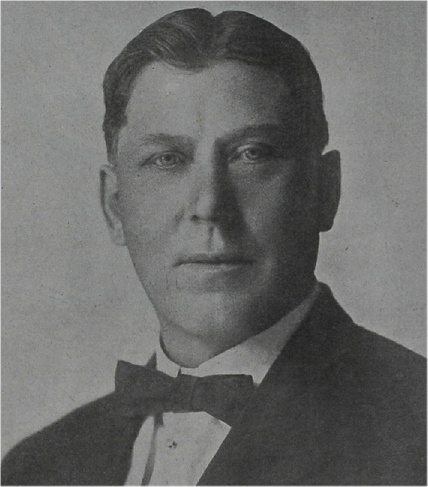
Aerosplanes for Sells-Floto
Denver, Colo., Feb. 4. It is said here that the Sells-Floto people have arranged for two flying machines to be carried with their show next season. - Vay.
Kansas City Appears Like a Big White Top
Whole Town is Alive with Circus Men and Gossip of the Show Season is at its Height - Other Tent Items
Kansas City, Feb. 8. One would imagine by the appearance of our streets that this hustling bustling town was just in the height of the circus season. Scarcely an hour passes but you run into an old sawdust acquaintance. The cause of it all is the presence of the Rhoda Royal aggregation of arenic artists. The interest in the coming engagement at Convention hall, has sort of lagged up to this time. With Fredericks and Hank Wakefield each going about with a bundle of lithographs under their arms, slowly but surely there is a revival of last season's enthusiasm and by the time the opening day rolls around, all Kansas City will again pay homage at the shrine of the Royal entertainment.
Harry Lay's barber shop assumes the appearance of a dressing room top, while the performers are laying off. It is here that the gossip flies thick and fast and I've come to the conclusion that if the managements of the Sells-Floto, Ringling Brothers, the Two Bills or Wallace-Hagenbeck care to know anything about their future movements, the people they have engaged, how much money they made last season - in short anything at all concerning their private affairs - they have but to sit around the famous tonsorial parlor and get it red hot off the griddle. It does seem strange, but nevertheless a fact, how much more the performer knows about the show business than the men who own the shows and have made a success of them.
Park Prentiss "the Sousa of the white tops" mingles with the merry throng of local wind-jammers each evening and can be generally found at resorts where the frankfurter barks and the Pilsener flows. He will be found back with Sells-Floto again this season and leaves for Denver when the Royal tour ends.
Johnny Carroll has given it out that he is to take the place of Johnny Baker next season with the Two Bills show. Carroll has had much experience in that line and should be able to make more than good.
Since all the circus people have come to town Frank Lemen looks ten years younger. He just can't keep away. Although he has been out of the business for some years now, he still loves to talk "shop" expecialy with the old timers of the aggregation.
Fred Lincoln the general manager of the Sullivan & Considine circus was in the city last week looking after the new Empress which is building here. It's to be Kansas City's finest play house.
Phil Darling "Denver Kid" goes with the Barnum show next season and is rehearsing some clever stuff during the lay-off of the show here. He gives the promise of becoming one of the best fun makers in the business.
Mrs. Ty-Bell, looking younger and handsomer than ever, is spending much of her time while here visiting friends of which she boasts many in this city. The act goes with Forepaugh-Sells next season. Col "Ty" keeps busy chaperoning his friends about the Century hotel.
Saw Charlie Siegrist the other day. He had a roll of music in his hands and was sweetly murmuring to himself "The wedding bells are ringing." Announcements as to day and date will be made in the near future. - Willie Knott.
Jones Bros.' Circus to Start from Corry
Pennsylvania Town Still Alive with Circus News - Gentry to Enlarge His Show - Other News
Corry, Pa., Feb. 7. Jones Brothers' circus and wild west will start out from this city, early in April. J. Augustus Jones is hiring six and eight horse drivers that were with the Cole outfit last season, and indications are that he will have one of the best aggregations ever put out in the smaller towns.
Andrew Downey McPhee [sic Downie] of Medina, N. Y., is arranging to bring his surplus stock from Medina and will start out from Corry.
Local people are thinking that Corry will become a regular Baraboo or Bridgeport, as a result of these two shows starting from this town, but it is believed Jones and McPhee will stick to their home towns for winter quarters.
Watch for the circus that Gentry Brothers start out from Bloomington, Ind., this season, is what men of the "white tops" are talking. J. W. Rush, a former trainer, states that they will have a good sized circus this season, if plans materialize. - L T. Berliner.
Buys Valuable Horse
Rhoda Royal was in Chicago this week and purchased from Dr. C. Z. Jackson at the Union Stock Yards, Don Pedro, a Kentucky thoroughbred high-school horse for $850. Don Pedro has won a number of blue ribbon prizes at the leading horse shows where he has been exhibited by Dr. Jackson. He is a beautiful cream colored animal, with white mane and tail, and will be included with Mr. Royal's equines, which are to be a feature of the Buffalo Bill-Pawnee Bill Wild West Show this coming season.
Engaged for Two-Bills Show
Among the engagement for Buffalo Bill-Pawnee Bill Wild West Show for the season 1910, are Rhoda Royal and wife; John Carroll and wife; Captain Walter C. Sharpe; Austin King and wife; Charles Daly and wife, and Aldine Potter. Rhoda Royal will put on a massive equine number, utilizing twenty of his high-school and trick horses. This feature will be an innovation for a wild west aggregation and will undoubtedly attract considerable attention.
Rhoda Royal Engagements
The Rhoda Royal indoor circus will open a week's engagement in Kansas City, Mo., Monday, Feb. 14, at Convention hall, under the auspeces of the Mystic Shrine. Following this engagement, the Rhoda Royal show will appear under the auspices of the Shriners at St. Joe, Mo., with a week in Milwaukee for the Shriners to follow.
Circus Case Dismissed
Cadiz, Ky., Feb. 7. In the Trigg Circuit Court here last week the case of the Commonwealth against George Sun of Sun Bros.' Circus, upon the charge of grand larceny, was dismissed upon motion of the Commonwealth after all the evidence for the prosecution had been heard. The circus showed here last summer, at which time Ira Alexander, of this county, claimed to have been robbed of $160 by some of the people with the show. Sun was arrested at the time at Bardwell, Ky., and brought back here, where he gave bond. - Barnes.
[Indiana] Bloomington, Feb. 2. Gran Circo Shipp is now playing the canal zone in Panama and doing big business. This is their fourth season in that contry. The show made two stands in Costa Rica, and did good business in spite of the fact that the performances were given during drenching rains. They will start for New York about March 1, stopping at Kingston, Jamaia. - Feltus.
Thomas Goes Shopping
Charles Thomas (The Arcola Kid) and Mrs. Thomas were in Chicago last week from Mattoon, Ill., on a shopping trip. Thomas is conduction a "store" at Mattoon, and says he is making money during the winter months. It is quite probable that he will be identified with the Norris & Rowe circus this summer.
Redskin Grows Tired of the Show Business
Sam Walk-In-Day Who Was with Buffalo Bill, Goes Back to the Winnebago Reservation
Omaha, Feb. 3. "Ugh, Me for big eat. No more travel show!" With this up-to-date slang expression Sam Walk-In-Day of the Winnebago tribe and lately with the Buffalo Bill show walked into the police station here, and, his story corroborated, the United States marshal gave him transportation back to the reservation to get his dreamed-of "big eats." Sam Walk-In-Day grew tired of the gay and glittering life of posing before the paleface about two months ago at Fort Worth, Texas, and forthwith made up his mind to hike back to his native heather and dog soup. He immediately struck the long iron trail to Omaha, tramping the ties, and just arrived after being on the road for two months and some days. Sam was all in and hungry as a dog. "Me for big eats. No travel show for me!" said the plodding example of the stoical race. - Smyth.
Marriages
Paul R. Martin, formerly dramatic editor of the Indianapolis Star, now a press representative on the Ringling circus staff, and Miss Lillian Buckman of Indianapolis, were married Friday, Feb. 4, at St. Philip's Catholic church, Indianapolis. The service was read by Rev. Father George Smith. Immediately after the wedding Mr. and Mrs. Martin left for Notre Dame university to spend their honeymoon, where the groom spent his student days. Mr. Martin is well known in newspaper and amusement circles. He is a dramatic critic and feature writer of recognized ability and is an authority on ancient Celtic literature.
For Norris and Rowe Shows
Harry Ferguson, steward of the Norris and Rowe shows has engaged the following for the cook camp: Ed. Cowan ("Rubber") head waiter; Chick Cornell, chief cook; Bert Morris, first assistant; Chas. Hank, second assistant; John Rowe, steam table man; Lee Franklin, butcher; John Carroll, pastry cook; Harry William, commissary man; John Jones ("Baby"), camp fire, and the following waiters, Pat Malloy, Wm. Adlery, Frank Chambers, Art Patterson, John Gibben, Ed. Mack, Tom McCale, Chas. Ross and others.
It was erroneously stated in last week's issue that Ed. Cowan had signed with the 101 Ranch.
Col. O'Brien in New Venture
Fairbury, Neb., Feb. 8. Colonel J. C. O'Brien, who for many years has served as privilege manager and license adjuster for various tented enterprises, will put out two small shows the coming season, each to be known as "J. C. O'Brien's Famous Colored Georgia Minstrels." Col. O'Brien states that he is putting about ten thousand dollars into the venture and intends to make the shows the finest in the field.
Show World, February 19, 1910 (Vol. V, No. 9), pp. 12, 25, 26. All information should be checked with additional sources.
Dode Fisk Weds
Winona, Minn., Feb. 14. Dode Fisk of Wonewoc, Wis., well-known circus man and head of the Dode Fiske shows, was married here February 7 to Ella Bartlett of Merrillan, Wis., by Judge D. E. Vance of the probate court. They left for Wonewoc, the winter quarters of the shows. The groom gave his age as fifty and the bride thirty-four.
Das Program Warns Against Circus Evils
Organ of German Vaudeville Artists Alleges that Performers are Badly Treated by American Managements
The following article appeared in a recent number of Da Program, the organ of the German vaudeville artists', and was reproduced in this country in The Player, the organ of the White Rats of America. It contains so many vital expositions of circus life in this country, that we deem it worthy of reproduction in these columns. Much of it is fact, known to every circus performer, but as each season brings new recruits to the circus ranks from vaudeville and other fields of entertainment, these statements may be of value:
Every year when the circus season in America has closed and the performers who were out with one of these tented cities come back to New York and exchange experiences a lot of complaints and stories of unfair dealings reach the professional papers and the committees of the various organizations. The fact that many well-known artists travel season after season with these big tent shows would apparently prove that everything is nice and pleasant, the treatment of the artists splendid and everything fair and above board or else they would not be found so ready to join the show again the next time it leaves its winter quarters. It is another fact of note that the complaints always or, at least, most generally come from those who were only out one season with the show. They report many wrongs that should be righted, of many abuses and trifling chicaneries which should be abolished, before all can be content and satisfied.
"But if these two facts really do prove anything it is, that most of these wrongs and petty impositions can be put up with if they are known beforehand and taken into calculation and consideration before contracting. Therefore it appears but just and proper that the principal complaints lodged regularly with the organizations should be dealt with publicly in these columns for the benefit of those who have never been with one of these circus enterprises but are under contract to do so or are seeking an engagement with them. To be forewarned is to be forearmed.
"The Ringling Show is apparently the one least criticised of the 'big' shows, but with the Barnum & Bailey show, which is also under the Ringling management, there seems to have been considerable trouble and disagreeableness. In fact, the performers even had to appeal to the Order of White Rats and the general secretary of this organization, Mr. Harry Mountford, had to travel all the way to Joplin, Missouri - a two day trip each way - to straighten out some of the difficulties. The principal complaint with which he had to deal was this: The Barnum & Bailey show had lost several half days during the season, that is, only one show a day instead of two was given. In addition three whole days were lost on account of storm or train delay. The management deducted one-twelfth of the weekly salary for every half day lost and one-sixth for every whole day, on the principle of no play, no pay. On the other hadn, while in the Western States the show gave eight Sunday performances, for which the artists received no extra pay. This, in comparison, was considered unfair and unjust. Mr. Mountford compromised matters by getting the management to pay the half days lost in return for the extra Sunday work so that the artists were out only the amount of salary for the three full days lost. The Ringling show, though belonging to the same management, had no such trouble, but it should not be lost sight of, that artists engaged for the one show may at any time be turned over to the other. The Ringling show paid a full week's salary irrespective of how many days or half days were lost and irrespective of extra Sunday work. This shows bette than anything the unfairness of the treatment of the various artists with their other enterprise. Sauce for the goose was not considered sauce for the gander.
"Considerable grumbling is heard about the numerous petty deductions from salary made each week, most of them bearing the earmarks of compulsory tips or obligatory gratuities. Agents in Europe or the representatives of these shows who came across from America to engage acts, try to impress the artists that their contracts are for so much salary and all expenses. Yet for each person fifty cents (two shillings) a week is deducted for the 'bed,' a certain amount is charged for the use of the wash rooms and toilets, for the ice water which is furnished free on all American railway trains, and in all hotels and boarding houses, etc. Aside from these compulsory charges, which are deducted on the pay slip, there are all kinds of tips to the property men, the car porters, the table waiters, etc.
"A rule which seems rather unreasonable is: One show, one meal only! If the artists on days where but one show is given feels like eating more than once he has to see where he can get food and pay for it himself. On days when long trips are made, which generally happens on Sundays, no arrangements whatsoever are made for meals. The artists must take along a supply of cold victuals at their own expense or go without eating. The food altogether leaves a good deal to be desired even for people who are not over-particular and are not looking for a Frascati or a delmonico dinner with a tent show. A lot of money has to be spent privately by every one of the artists for food purchased outside. For the time which the shows play in New York and Brooklyn, which so far has been four or five weeks a season with one or the others of the shows, no board at all is given the artists being left entirely to their own resources. In New York and Brooklyn they must also furnish their own lodgings, as the special railway cars are sidetracked somewhere out in Jersey City across the Hudson and cannot be used. The same is the case in Chicago. These complaints about the food apply to all the tent shows, though eating with the Ringling show is said to be slightly superior in quality.
"Quite a prolific source of complaint is the method of distributing the berths in the sleeping cars. Invariably two persons are made to occupy one berth together, exceptions being made only in the case of the big stars. Unless two people are fairly slim adn are quiet sleepers the narrowness of the berths renders a commodious rest impossible. There are eighteen such berths to a car; nine upper and nine lower ones, occupied by thirty-six people mixed up rather promiscuously, married and single, male and female. Perhaps the lower berth will be occupied by a married couple while the upper berth accommodates two young girls. Across the aisle, which is only a little over two feet wide, another married couple may have the lower and two young men the upper berth. The upper and lower berths together, which is called a section, have only one curtain hanging from the ceiling and for modest young women to have to climb up into the upper berth which is five feet from the ground is rather an inconvenient and indecorous proceeding when a man has already gone to bed below. Two small wash rooms, with five basins in all, must serve for toilet purposes in the morning. From fifteen to twenty ladies must dress and comb themselves in a room about three by six feet large, using two basins and two towels. Such accommodations are fairly convenient for travelers who spend a night on a train once in a while, but they leave much to be desired when they form the sole habitation for seven months night after night. Breakfast is only served till 9 a.m., and since the cook and meal tents are often an hour or more away from the railway siding on which the train has been switched - all the tents being, of course, together on the 'lot' - anyone who wants to be sure of getting breakfast must rise at about 7 a.m. to await his turn in the wash roon and get out of the car and down to the 'lot' in time.
"At half-past nine the parade begins. Every artist, male or female, must take part in this, rain or shine. A place is assigned to each, some ride in wagons or on top of them, some on horseback, others on camels or elephants and so on, and of course each in a costume specially furnished for the purpose. In small towns the parade may be over within an hour but in large cities it often lasts two and one-half or three hours. Dinner is served after the parade. At two o'clock the afternoon show begins, and at 2:15 all performers must take part in the 'grand entry' or the tournament, as it is called. Then each does his act on the program. From 4 till half-past five supper is served. At 8 o'clock the night show commences and at 8:15 all take part in the tournament once more. After his act each packs his trunk, for the show travels every night, and then he may go to the train and hunt up his berth. Sunday is generally a day of rest, but only in the Eastern States, and then it is being made use of to make the 'big jumps,' the long trips, on which, as stated above, no meals are served. All this, of course, irrespective of the weather, rain or storm, heat or cold, all extremes of temperature, but especially sizzling heat, are met with during a season.
"An expense which most artists do not figure on is that they have to pay their own fares, with bag and baggage, back to New York from the point of closing, whichis generally 'way down South,' somewhere near New Orleans or Galveston, two or three days journey from the East coast. For large troupes this expenditure for transportation is quite costly, it averaged this year $25 per head ( 5 pounds) without excess baggage or sleeping car accomodations. Those engaged for the Barnum & Bailey show had to pay their fares to Chicago at the opening of the season ($18 per head), the show starting out on its tour from that city.
"Special expense is incurred also because only trunks of a certain make and size are permitted to be carried along and must be bought by all artists.
"A circus against which complaints have been especially numerous is the Hagenbeck-Wallace show. It may be mentioned, by the way, that the Hagenbecks have no interest in this show, though the picture of Hagenbeck, Sr., the founder of the firm, appears on all advertising. The present management of this circus, to whom Hagenbeck sold out his interest years ago, has no consideration or regard for the artists or their rights whatever. All the faults found with the other shows are found here too, only a little more pronounced and more abundantly; the food, for instance, is much more unsatisfactory, especially in quality. The sleeping car accommodations are very poor; the extra charges and deductions very high, each person having to pay, for example, $1 a week (4 shillings) for the use of his half of the berth.
"In addition to this fines for some infraction of the abundant rules and regulations are very frequent with the Hagenbeck-Wallace show. Any artist requiring an advance on his salary before salary day comes around is charged 25 per cent for the accommodation; if $20 is drawn, $25 is deducted from the salary. In many other ways are the artists mulcted of their earnings. A troupe which was accompanied by its manager, who did not work in the act, was charged $25 a week (5 pounds) for his board and lodging, although when signing the contract this impresario had expressly stated, that he would have to travel along with the show to look after his troupe. This had been agreed to, but no mention had been made that if he did so he would be charged $25 a week.
"Any artist who finds that the management wants to get rid of him before the season has only fairly begun, might as well leave at once of his own 'free will.' If he tries to 'stick it out,' depending upon his written contract, he might have rather troublesome and trying experiences, for the working crews, the canvas men, property men, animal men, porters, etc., are a rather rough lot, ready for anything that is asked of them. Accidents may therefore happen to the 'obstreperous' artist; his trunk may accidently be smashed by a tent pole, his live stock may die off as if carried off by an epidemic - a dog trainer found five dogs dead one fine morning - or on some dark night he might find himself accidentally 'fall' off the train.
"Another thing to look out for is 'short change' in the envelopes on salary day. A $10 bank note may be missing, a roll of coin marked $10 in silver may contain $1 in copper by 'mistake.' This, of course, is not the management's fault, iti s the cashier's personal 'rake-off.'
"Forewarned is forearmed. The artists who knowns what he will have to contend with during a season with an American circus can figure it up beforehand. And that is the puropose of this article; to forewarn. When the proprietor or the representative or some agent comes to Europe and describes in glowing colors the glorious life with the 'big show' in America, figures out for you how much money you can save, take out a pencil and a bit of paper and figure it over for yourself. By all means, though, do not allow your fancy to rush away with you with the regard to the glory and beauty of this sawdust and spangle life in America. One thing is sure: Life with an American circus is all work and mighty little play; there is no time for leisure and quiet, no opportunity to pick flowers by the wayside or to spend your days angling and fishing."
Scott Quits Circus
Rock Falls, Ill., Feb. 7. Harry Scott, the strong man, who has been doing shows for the past few years, has made up his mind that there is but little money in the business and has concluded to quit it. He has been made a good proposition with the Hagenbeck-Wallace shows for the coming year but he has refused the offer. Harry is going into the poultry business on an extensive scale. He has rented the Sturtevant island west of town a few miles for as many years as he wishes it, having leased the ground for the privilege of raising poultry and the fishing privilege as well. He will move his family on in a short time and will start with a lot of chickens, ducks, geese and will fish as well, while the fowls are growing into money. Several years ago he was on this same island and he did a good business and made money. - Rock Fall.
Vogt in Chicago
William E. Vogt, for a number of years treasurer of the Ringling Bros., John Robinson and Walter L. Main shows, and identified with the financial department of the Barnum & Bailey Greatest Show on Earth during its European tour, and for a season following its return to America, renewed acquaintances in Chicago last week on his way to Des Moines, Iowa, with an indoor circus aggregation. At one time, Mr. Vogt was considered by many to be the fastest big show ticket seller in the world.
Circus Men in Denver
Curtis Rueckert, boss chandelier man, and Frederic Iseli, ticket seller, have been spending the winter in and around Denver disposing of their mine holdings. Both have signed up with the Ringling Bros. for the coming season.
Kansas City Cheers Rhoda Royal Circus
After Two Weeks Lay-Off the Big Indoor Attraction Wins Immense Favor in Missouri Metropolis
Kansas City, Feb. 15. Under the most auspicious circumstances possible, the big Rhoda Royal Two-Ring Circus and Wild West opened their annual engagement at Convention hall last night. After a lay-off of two weeks it was thought that the performance might not be given with that smoothness and machine-like manner for which Royal has become noted. But not a hitch of any kind occurred to marr the entertainment.
It proved a great night for those of the big white top family who make Kansas City their winter abode. They were all out in force, without an absent member and arrayed in their best. Hank Wakefield was busier than a beaver. He was here, there and everywhere, giving orders and shaking hands with his friends. His "mug" was presented on the title page of the program, while Royal and Fredericks simply looked on. He's a great "cheese," this Wakefield boy.
Among those in the boxes were Jerry Mugivan, Charlie Hagerman, Bill Smith and brother, Bobby Cain, Fred LaMont and the Carmean troupe, Otto Floto and wife, Mrs. Wakefield, William Floto, Mrs. Fredericks, Harry Lay, Frank Jones and many other show folks.
Something like eight thousand people attended the initial performance and all pronounced it one of the best circuses that has ever shown in Kansas City. The Segriest family were the strong hit of the show. The riding numbers of the Rooneys and Duttons and the Nelson family also scored heavily. Rhoda Royal's balloon horse proved a sensation. The entire show went with a snap and vim that was refreshing. The only drag apparent in the program with the wild west part which closes the show. The waits are too long and instead of sending the people away with a hurrah, dismisses them with a sort of quietude which should be avoided. The circus performance in itself is strong enough without the wild west feature added to it. Good old-fashioned hippodrome races would have proven more satisfactory. But then this is simply a little difference of opinon.
Mrs. Ty-Bell and her two charming daughters came in for a good share of complimentary comment. The young ladies are improving fast and within a year or so will rival their accomplished mother in their iron-jaw act.
Several of the Wild West contingent who are making their first trip this side of the Missouri river took Harry Lay out for a horse back ride the other day. The result: Col. Levelle had his shoulder bone broken. A team of horses ran away, throwing the owner and breaking his leg. Three stands of vegetables at the city market upset. Two dozen bottles of Diamond Dandruff Cure demolished - and Lay had palpitation of the heart. And yet we credit these broncho busters with great horsemanship. Just what Royal said when he learned of it would not look well in print. Fortunately John Talbot, the king of fixers, was in town at the time and soon straightened out matters satisfactorily to all concerned. Charlie Hagerman, "Butch" Fredericks and "Cheese" Wakefield were also called into the case. Can you imagine what chance the poor farmer had with this quartette at work?
Jerry Mugivan is here to buy about forty head of horses for his show. He left on Tuesday noon for Lancaster, Mo., where Col. Hall awaits him with the required number of horses, only needing Jerry's O. K. to make a sale.
101 to Entertain Taft?
Associated press dispatches from Washington, D. C., tell of President Taft going to be the guest of the Miller Brothers on the 101 Ranch at Bliss, Oklahoma. The President is to enjoy a buffalo hunt. Possibly "Teddy" will not have much on "Bill" when it comes to hunting, for if he can bring down a buffalo, he will have accomplished something "Teddy" never did.
An uncomfirmed report has it that the Forepaugh-Sells Bros. Shows are to open the season under canvas at Milwaukee, Wis.
It is reported that the Morgan Lithograph Co., of Cleveland, Ohio, is getting out a million sheets of special paper for the Forepaugh-Sells Bros. Shows.
Otto Ringling in Chicago
After an illness of five weeks, Otto Ringling is in Chicago from Bridgeport, the winter quarters of the Barnum & Bailey Show, and is the guest of his brother, John, at his Lake Shore Drive residence. During Mr. Ringling's enforced incapacity the rehabilitation of the Barnum & Bailey Show has been conducted under the supervision of Alf. T. Ringling. Otto Ringling shows the effect of his long illness, but his friends are hopeful that he may fully recover his wonted vigor to enable him to assume active charge of the Barnum & Bailey aggregation.
Ringlings Lease Columbus Lot
Columbus, O., Feb. 16. Ringling Brothers have leased the Neil lot in this city and it is reported that Columbus will be made their headquarters. - Graf.
Sells-Floto Booked
One of the first shows that will make Kansas City this year will be the Sells-Floto aggregation. Already preparations are being made for their exhibition here and it will be a regular "home-coming week" among the folks, as the people here have looked upon it as their own institution since Bonfils and Tammen have acquired the Kansas City Post.
Col. W. E. Franklin was a visitor here during the week on his way to Denver. As usual, he and Frank Lemen had quite a chat. Mrs. Franklin accompanies her husband on this trip.
The La Belle Carmen troupe at the Orpheum this week go with the Hagenbeck-Wallace show next year. Its a wonderful act and easily tops the bill at that theater. - Willie Knott.
Circus Notes
Albert Pick & Co., of Chicago, are building a new cook house outfit for the Forepaugh-Sells show.
The Norfolk and Western Railway have closed contracts for moving a circus over their line in October from Bristol to Norfolk with a thirty day clause.
C. H. Gilbertson and wife have gone to Denver for the winter. Mr. Gilbertson will manage the privileges with the Sells-Floto show the coming season.
George F. Holland and family, seven in number, have been engaged by the Sells-Floto Shows for the coming season.
Walte Nissen will be on the advertising force of the Sells-Floto show.
W. J. Lynd, Jr., of Philadelphia, was in Chicago this week conferring with W. E. Franklin. He will probably have the contract for boarding the people with the Sells-Floto show.
C. S. Wright, known as (pop) for so many years associated with W. E. Franklin, has purchased the Sawyer Bros. bill posting plant at Muncie, Ind., and will not be on the road this season.
Frank Purcell, press agent, back with the Sells-Floto circus came to Chicago this week to do the automoble show.
Ernie Waters has been engaged as twenty-four man with the 101 Ranch Wild West Show for the coming season.
Ben Fink of Sharon, Penn., is among the first billposters to be cancelled for 1910. He had signed contracts with the Barnum show and with the 101 Ranch Wild West. John D. Carey who signed him up with 101 Ranch promptly cancelled him and the Barnum show will do the same. International President Lowery has put the usual fine of $25 against him and this will have to be paid before he can join out again. The clause in the agreement governing this promising signing of contracts is one that should be lived up to.
Fred J. Bates will handle the first car for the Norris and Rowe shows the season coming. Bates will need no instrucitons for he has been there with the goods for many a year.
Edward Arlington of the 101 Ranch Wild West is resting on his oars for a little while. He has his advance framed up so that he can take to the road whenever he decides to do so and his paper is coming from the printing houses in good shape. His territory has been gone over and his railroad contracts are nestling snugly in his desk in his New York office.
Henry Pullman will be with the Campbell Brothers' shows as purchasing agent the approaching season. Time has dwelt kindly with Henry of "Me and Giles fame."
Andrew (McPhee) Downey [Downie] will be in the field for 1910 with one of the best dog, pony and trained animal expositions ever put out. He is framing up one of those kind of shows that will please his patrons and give him a chance to get big money.
The 101 Ranch new winter quarters purchased at Lake View, New Jersey, will be ready for occupancy when the 101 Ranch comes home in 1910. Mr. Edward Arlington who purchased them from the New Jersey Car and Equipment Company, will have converted into the most commodious quarters in the country. The quarters will be sufficiently large to house the entire show and not one of the cars will be exposed to the elements during the winter. This will not only be a great saving to the rolling stock, but will give the working men the opportunity to thoroughly overhaul the cars irrespective of the weather conditions.
Uncle Ben Wallace, a rumor says, is sharpening an axe that will fall before the 1910 season is over. The Show World is not given to predictions on this occasion, but the fact that it will not predict, is not going to prevent the axe from falling. Every showman in the country knows where it will fall, but they tell it in whispers.
Paul Harrel will have the first advance car with the 101 Ranch the coming season. John D. Carey will follow him on the excursion car and do the press contracting and Al Reil will come up on the third. Rather a strong combination and one that will surely make them all sit up and take notice.
Harry Craigs, George Robinson, Will Forbes and Kid Smith, all of whom were with the Cole Brothers' shows last season, will be with the Yankee Robinson shows the coming season.
Andrew McPhee has shipped his "Chief" elephant from Corry to his winter quarters in Medina, N. Y. He has purchased a number of trained dogs, ponies, goats and monkeys, and is still on the road looking for features. He is in the market for a sixty foot baggage car.
W. C. Thompson is doing some fine winter press work in New York and there is a whole lot of the notices that are being given the 101 Ranch that are unsolicited and emanate from the regular writers who treat it as news. When this is the case there is value in what is said. Showmen who have watched the phenomenal growth, both in magnitude and merit of the 101 Ranch wild west are not surprised at these notices, for they have long since realized that it was a comer and would eventually land in the front. It will break into New York this spring and then it will be up to some one's alarm clock to go off.
Show World, February 26, 1910 (Vol. V, No. 10), pp. 3, 7, 8, 20, 21. All information should be checked with additional sources.
Circuses Shut Out of Canada
Under the Payne-Aldrich tariff law, no American circus can cross the line into Canada without paying a return import duty on every animal in the circus. This is a prohibitory tax and means that Canada will see no American circuses so long as this feature is unchanged.
Wild West for Jones?
New York, Feb. 23. It is said here that J. Augustus Jones is putting otu a wild west show instead of a circus.
Al Wheeler and Tom Hargreaves are both reported to be practically ready for opening. - Storey.
Broncho Buster Is Lassoed by Cupid
Young cowboy of "101 Ranch" Show Fame Weds University of Chicago Girl
Oklahoma City, Feb. 21. When Harry C. Wolfe, son of a Kingfisher county farmer, started out with the "101 Ranch" show as roper and broncho buster, he didn't know he would himself be roped by Mr. Cupid. But he was. One day while the show was playing in the Coliseum at Chicago a newspaper man introduced him to Miss Lillian Raymond, of 2223 Michigan avenue, and that was his finish.
Letters to the Editor
Denver, Colo., Feb. 2, 1910. Editor "Show World." In an article lately clipped from your publication dated Kansas City, Feb. 1st, you inadvertently do me an injustice which I am sure you are ready to correct. The article to which I refer is in reference to the program for the Royal Tour, and reads as follow:
"Hank Wakefield, who is looking after the program for the show, says that plenty of advertising is in sight. He was somewhat handicapped by Buster Cronin, who undertook to solicit advertisements, and then, in the dark of the night, deserted the ship, leaving an unpaid board bill for Wakefield to settle. That kind of business, however, always reacts upon the party doing it, and Cronin may find some day that Cheese may lay a straw in his path."
The truth of the matter is that Mr. Wakefield repudiated his contract with me, he having agreeed to pay me 20 per cent on all contracts secured, but after I had secured about $800 worth of contracts, he offered a compromise which amounted to about 7 per cent instead of the 20 per cent promised. Naturally, I demanded the compensation agreed upon for my labors already performed, and offered to hand in some of my contracts for an advance of expense funds, the balance to be paid at some future date, but even this Mr. Wakefield refused to do. Becoming disgusted with Mr. Wakefield's manner of doing business, I handed to Mr. Harry Lay, the "Circus Barber" as he is well known among circus people, $300 worth of contracts, legitimate contracts, with instructions for him in turn to hand them to Mr. Wakefield, with the request that Mr. Wakefield accept them, and out of commissions due,settle the $21 hotel bill, for which he originally endorsed.
The balance of the contracts I secured, I destroyed because it was self-evident that Mr. Wakefield did not intend to pay me for the services as agreed upon, and I concluded that the quicker I severed my connections with a man of this character, the better it would be for me.
My reputation for honesty and integrity is well established and if this controversy is carried any further, I will cheerfully furnish you with a host of names, to which I will ask you to refer.
It is Mr. "Cheese" Wakefield and his methods that deserve investigation, and I trust that you will give this communication space in your valuable journal in order that those who know us both may judge between us. Very respectfully yours, S. Cronin.
Harry Earl
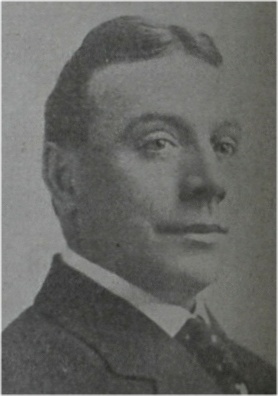
Harry Earl has been engaged by the Ringling brothers for the season of 1910 and will have charge of the press department for one of the three shows conducted by this enterprising firm. Mr. Earl was general agent and general press agent with the Sells-Floto show last season, and for several years preceding that was general press agent of the Hagenbeck-Wallace circus. He has entertained offers from the Ringling Brothers in the past, but never made up his mind to join that firm until a few weeks ago.
Circus Notes
Peru, Ind., Feb. 23. Tom Dunn, superintendent of lights of the Hagenbeck-Wallace shows, has arrived in the city from Cumberland, Md., to remain until the opening of the show season. He is stopping at the Daly, and is incidently getting affairs in shape for business, says the Chronicle.
It is reported that Tom North will not be with the Hagenbeck-Wallace the coming season, as previously announced, but will take a place with the Gentry shows. He will be succeeded as press agent by Frank McDonald, a man of many years experience.
Prof. Charles Z. Bronson, formerly bandmaster of the Hagenbeck-Wallace shows, is organizing a concert band at Kalamazoo, Mich., to take the road this summer to fill park engagements. Professor Bronson was at one time with Sousa's famous band and is well known throughout the country as a musician. The position of the bandmaster of the circus the coming season will be filled again by Professor Merrick.
Biggest Week Ever for the Royal Show
Kansas City the Most Profitable Stand in History of Indoor Circus - Other Items
Kansas City, Feb. 22. The Rhoda Royal show has gone. On Sunday morning last they quietly folded their tents, put a shawl strap around the balloon horse and departed for St. Joe after one of the most profitable weeks in the history of the show. Under favorable circumstances of this kind all was rejoicing. Candidly Kansas City regretted their leaving. All had many friends before they came, and added new ones to the list while here.
There is no gainsaying the fact that Royal gives the best indoor circus in the land. His performance would be high-class for any of the big tented organizations that tour about the country in the summer time. All of his acts are of the headliner variety and outside of his wild west annex as referred to in last week's issue of The Show World, were of the highest caliber.
Quite a contingent of show folks were in evidence at every performance. It is a cinch bet that "Cheese" Wakefield did not miss a single act, to say nothing of a performance. "Manager Wakefield," if you please, is what his title was during the week. Rhoda Royal and Fredericks realizing the popularity of the former "mender" in Kansas City, transferred all responsibilities to his broad shoulders. Candidly it must be said that from a managerial standpoint Wakefield covered himself with glory. True, he boosted White Rock a little strong, but he was entitled to that, for it was probably his only compensation for his week's labor.
Balloon Horse Ill
Here's something in confidence. On Thursday night of the engagement of the show the "balloon horse" was taken with colic, which placed the show management in quite a quandary. The ever fertile brain of Franklin Jones, however, was equal to the emergency. Jones suggested that Wakefield be substituted; that he had known Chester for a long time and would guarantee that he would stand without hitching - but, and here comes the awful but - Jones feared Hank would shy at the fireworks. The horse railied, however, and Cheese failed to make the ascension.
Here's another piece of news. For years Harry Lay has posed about these diggings as a barber. The dark secret is out at last, however. During the show week he tipped his mitt. The way he handled the children in the Nelson family led Nell Carroll to remark, "I love my barber, but Oh you trained nurse." Harry's fondness for children was never better illustrated than on this occasion.
Dan Leon and wife were continual visitors at the show, as was Charlie Hagerman, who will act as guide and pilot of the Hagenbeck-Wallace refreshment annex the coming season. "Chick" Bell and his handsome wife are touring with the troupe and certainly have no complaint to make at the business they did in K. C. The natives fell for the "juice" in a manner that gladdened the heart of the dispenser.
Three weeks is a long time to remain in a town, but the troupers seemed to enjoy every minute of the time. Park Prentiss not only blew his cornet full of melodious tones, but he blew his summer bank roll entertaining other members of the "Onion." Johnny Carroll had a swell time, as did Mr. King and John Agee.
During the visit here Mrs. Fredricks presented Mrs. Royal with a very handsome Scotch collie. Mrs. Wakefield and Mrs. Fredericks were almost inseparable while here.
"Oklahoma Bill's" runaway cost the show $150 to fix. Some day these rough riders will have to pay their own bills and then it won't bee such a joke. During the week Charlie Segriest [Siegrist] turned a double somersault for a lot of show folks just to show it could be don. - Willie Knott.
Elephants Run Amuck Thro' Frisco Streets
Two of Al G. Barnes' Pachyderms Play Havoc and Entail Lawsuits
San Francisco, Cal., Feb. 19. It was jungle day along Montgomery avenue Thursday, and Bwano Tumbo nine thousand miles away. Three badly scared elephants ran amuck, knocking over cable cars, wrecking wineries and smashing butcher shops. Elephants, as a usual thing, seldom become excited in Montgomery avenue. But these elephants were different. They were excitable elephants.
This trio belonged to a compnay exhibiting at the California vaudeville theater on Broadway. The were being paraded along the avenue, each in charge of a Swedish mahout wearing red pants. Before them marched a brass band emitting blareful melody. Behind them came the adolescent populace. When the parade reached Chestnut street the yelling and shouting of the million and one or less street urchins of the neighborhood proved too much for the elephantine nerves of "Babe," the leader. With her trunk high in the air, she broke away and fled, trumpeting, down the street, searching her soul for sounds to tell how scared she was, as Red Saunders would say. "Babe" is a timorous beast, with the dimensions of a load of hay and the heart of a mouse. In another instant the other elephants joined in her flight, with the brass band a close second - going the other way. At Mason street an innocent unsuspecting cable car rounded a curve just as the trio of living haystacks dashed up at full speed. The passengers piled off in affrighted confusion and scattered none too soon. There was a clatter of shattered glass, the car toppled over, and the elephants swept down the Mason street hill like an affrighted avalanche, their pathway strewn with runaway horses and running pedestrians.
Break Into Wineshop
Near Chestnut street the door of the winery of the Lombardi company stood invitingly open and "Babe" sauntered in with the gentleness of a run of saw logs coming down on the Spring rise. The door was inadequate to "Babe's" linear and cubic dimensions, but the frame, posts, sills and lintels with her. The other elephants followed the blazed path. Once inside the winery the pachyderms had the place to themselves, and more wine was opened in the next few minutes than was ever opened in the San Francisco cafes on New Year's eve. Casks, vats, barrels, cases, baskets and bottles were all smashed in riotous confusion.
Again the big fellows made of the street, after which they made for a near-by butcher shop. The doors were open. The elephants went in, the proprietor went out. They did a medley of sausages, pork chops, beef, mutton and liver. When they left the place was a wreck. Again in the open they took refuge in a vacant lot at the corner of Powell and Chestnut streets. Here, completely exhausted, they were surrounded, captured and chained. They were so thoroughly frightened that two performances of the show had to be passed without them. The manager was still more frightened next morning by the suits for damages that came his way. - Karl.
Show World, March 5, 1910 (Vol. V, No. 11), pp. 11, 26, 31. All information should be checked with additional sources.
Four Famous Londons, Aerial Marvels
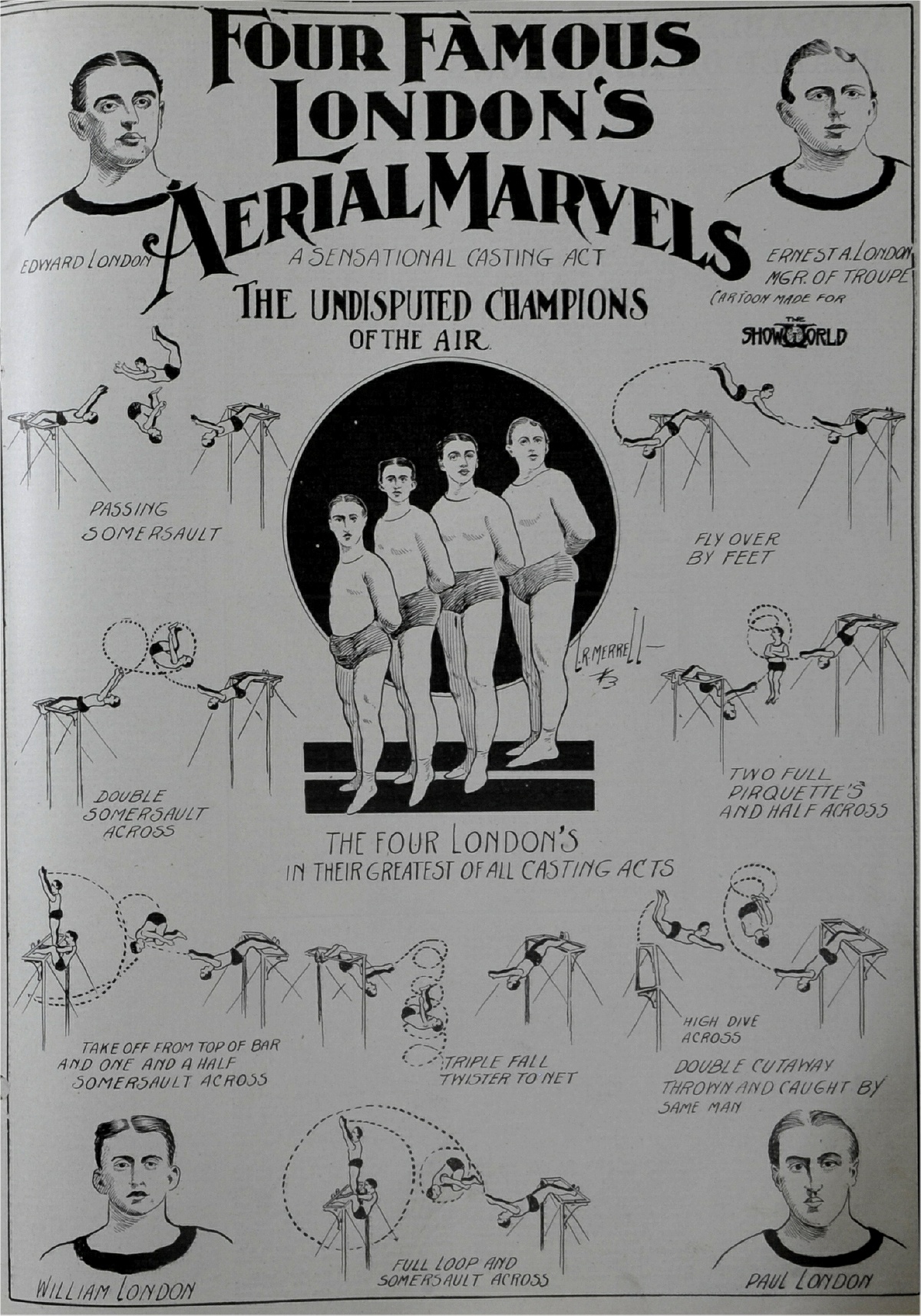
Wild West Wants Help
On another page of The Show World will be noted the call for help by the Young Buffalo Wild West Show, formerly the Lone Bill Wild West. The show is owned by Vernon C. Seaver, who also operates the Al Fresco Park, Peoria, Ill., and the Alcazar theater, Chicago.
There will be at least 175 people in the aggregation, which already has thirty weeks routed, three bands, calliope, burros, bronchos, two ox teams, buffaloes, finely matched dapple gray, baggage stock, and new features.
Mr. Seaver has chosen as his chiefs veterans of the show world. E. L. Brannan is the general agent; H. I. Ellis contracting agent, and T. E. McNew will manage the side shows. Special lithographs are now being prepared, and the opening date will be announced shortly.
Canadian Circus Tax
Corry, Pa., Feb. 22. When the Cole Brothers' circus entered Canada last summer, the tariff on horses had not gone into effect. On their return, the treasury department imposed a duty of $2,400 on the circus horses. Just before the recent auction here, this charge promised to tie up the sale, but a guaraty avoided the difficulty. Now, Congressman Arthur L. Bates of this district is pressing the treasury people at Washington for a decision as to whether they intend collecting the duty from the Downs estate. The officials do not seem to be disposed to hurry the matter any, and, meanwhile the Downs family are on the anxious seat. - L. T. Berliner.
Sign With Ringling's
Michael E. Fitzgerald and his English juggling girls have closed a contract with the Ringling Brothers' circus for a tour covering a period of thirty-three weeks. They will join the Ringlng aggregation early in April, when the circus is expected to open its season in Chicago.
Hank Wakefield Denies Charges Made by Cronin
The following letter has been received from Hank W. Wakefield, well known to the circus fraternity:
"Kansas City, Mo., March 1, 1910. Editor, the Show World: In answer to the statement made by S. Cronin, better known as "Buster" in your issue of Feb. 26th, I wish to state that there was no misrepresentation made by me to him regarding the amount he was to receive for his services on the program for the Shrine Rhoda Royal Indoor Circus, and will say that he received all that was coming to him and more, too, regarding the contract. He thoroughly understood the agreement, but got dissatisfied and left me without a man. I made no statement regarding him leaving in the dark of night, neither did I say he owed any board bill. This statement was unknown to me. As to the character of myself and Mr. Cronin this will be decided later on. As I have been a showman since 1883 and have been in the official capacity of the best tented organizations, will leave it to the showmen to decide and go by their decision as to I or him.
"I have done work for the Sells Floto show in the official department and I can refer you to Mr. H. H. Tammen, one of the owners, and one of my mutual friends. I would like to know what Mr. "Buster" Cronin has done to give him a rating regarding his character in the show business, but I care not about this matter, and he should leave the character part out. As showmen, we are all trying to make a success and should boost each other instead of knocking. Yours very truly, Hank W. Wakefield."
Show World, March 12, 1910 (Vol. V, No. 12), pp. 25, 26. All information should be checked with additional sources.
Water Prices Incite Circus Men to Anger
North Adams, Mass., March 7. J. B. Stowe, advance agent for the Barnum & Bailey show, the Ringling Brothers and Forepaugh & Sells shows, who booked the Ringling Brothers show in Pittsfield and the Barnum show here May 25, left the city in anything but an amiable frame of mind. The matter which aroused him was that the city insisted upon charging him $15 for water where last year it had charged him but $10.
He has made a contract with the Hoosac Valley Argicultural Society for the fair grounds as a show lot for a fee of $200 if the grounds are used. All circus contracts are drawn in like manner. He had not absolutely decided to take the fair grounds as a show lot, for he spent a day looking over other sites.
Signs with Hagenbeck-Wallace
South Sea Island Joe and wife, Beno, have been engaged for the 1910 season of the Hagenbeck-Wallace shows.
Abrams and Rogers Engaged
Robert Abrams will again have charge of the stock, and "Slim" Rogers the canvas annex of the Hagenbeck-Walalce shows the coming season.
Beatty Home from Europe
Frank H. Beatty arrived in New York last week from Europe on the "kaiserin Augusta Victoria," and will shortly come to Peru to remain until the opening of the Hagenbeck-Wallace shows. Don E. Wilson, of the show, was also abroad this winter and arrived home on the same boat with Mr. Beatty.
Fergusons Sign Up
Frank B. Ferguson and Irene Ferguson have signed with Norris and Rowe for next season. Miss Ferguson is booked solid by Washburn & Irving until opening time. Harry Ferguson and his assistants will leave Chicago for Evansville March 28 to prepare the cook house.
Shipp's Circus Returning
Bloomington, Ind., Mar. 9. Shipp's circus sailed for New York March 5, and arrived March 10. During the winter the show visited Central America, South America, Panama and Jamaica. They report a prosperous season, but returned early in order that the owners, Edward Shipp and Roy Feltus might resume their duties with the Barnum & Bailey shows. Mr. Shipp has his former position as equestrian director of the big show, and Roy Feltus will do the press contracting again this year.
White Top Battle Due in Southwest
Sells-Floto and Campbell Brothers Shows' Route in Close Proximity
Things have been stirring in the circus world during the past few weeks, and the indications point to a mighty battle in the west between the Campbell Brothers' circus and the Sells-Floto shows. A. H. Barkley, traffic manager of the Campbell shows made a quiet trip to the coast in January and laid out his route, contracting with the Southern Pacific Railway.
In the meantime the Sells-Floto show was making its arrangements to cover the territory via the Santa Fe. It now develops that the two shows will clash along the line, in some instances being only a day or two apart. The first serious trouble is looked for at Santa Ana, California, the Sells-Floto aggreation showing there on April 25 and the Campbell Brothers on April 27. Shortly thereafter the Campbell Brothers will jump ahead of the Sells-Floto show.
Considerable significance was attached to the fact that Ed. C. Warner, general traffic manager of the Sells-Floto shows and A. H. Barkley, traffic manager of the Campbell Brothers' circus, were in Chicago this week. When interviewed by a representative of The Show World Mr. Barkley was rather non-committal, but admitted that he was looking for a tremendous struggle. "The Campbell Brothers are thoroughly aroused," said Mr. Barkley, "and are determined to make their aggregation popular in the far west. The show is in fine shape, and prepared to hold its own with anything. This Pacific coast territory has been rather monopolized by the Sells-Floto and Norris & Rowe shows, and we intend to break into this field and establish ourselves."
Al. Campbell has the reputation of being a fighter when aroused, and Mr. Barkley's statement would indicate that no stone will be left unturned during the coming season.
Mr. Barkley left for Kansas City Tuesday night, and Mr. Warner departed for Denver the same day. The Sells-Floto shows will open in Alburquerque April 16, instead of at Denver on April 11, as originally planned. The Campbell Brothers will open at El Reno, Oklahoma, April 2.
Dode Fiske Signs Tarkington As Agent
W. O. Tarkington, who was general agent of the Yankee Robinson Shows last year, will be general agent of the Dode Fiske Show of Wonnewoc, Wisconsin. Mr. Fiske has turned over the entire advance to Mr. Tarkington, who will order all printing and route the show. It is rumored that a Mr. Cooper is to replace Tarkington with the Yankee Robinson Show. This is Cooper's first venture in the circus field, though he has had experience in the theatrical line.
Sannon Buys Horses
W. A. Shannon, general manager and associate proprietor of the Norris & Rowe Show, came to Chicago this week from St. Paul, where he purchased forty head of baggage horses from the Hamlin Company, paying therefor $12,000. The contract provides that each shall weight 1600 pounds on delivery at Evansville, Indiana.
Gollmar Arranges Route
Fred Gollmar, general agent of the Gollmar Brothers' shows, was at the Windsor-Clifton hotel, Chicago, this week, where he was joined on Wednesday by his brother Charlie and C. D. McIntyre, Mr. Gollmar's assistant, to decide the route. It is rumored that the show will open at Joliet, Illinois,and then play several weeks in southern Indiana.
Lon Williams Busy Here
Lon B. Williams, general agent of the Gentry Brothers' shows, was in Chicago this week visiting the various railroad offices and getting rates. The Gentry Brothers' show will go south on the Monon, and will open at some local point which has not yet been decided. The winter quarters are located at Bloomington, Indiana. Mr. Williams just closed as general agent of the Rhoda Royal circus. It is quite likely that there will be a clash in Kentucky between the Gentry Brothers and the Norris & Rowe shows.
Potter for Official Adjuster
Harry Potter will be the official adjuster back with the Young Buffalo Wild West Show. H. E. Allott will have the privileges, it is said.
Burns with Sells-Floto
Notwithstanding conflicting rumors regarding Foster Burns' connection during the coming season, Mr. Burns left Kansas City Monday night of this week for Denver to join the Sells-Floto shows. It is understood that Mr. Burns will have charge of the ticket wagon.
Dan Leon with Campbells
Dan Leon, formerly of the John Robinson Ten Big Shows, will be equestrian director of the Campbell Brothers shows. Dan left Kansas City for Fairbury, Nebraska, last Sunday night.
Perri Joins Show
B. Perri, the ballet impressario, left for Fairbury, Nebraska with twenty-six lady dancers for the Campbell Brothers' shows, which will make a feature of this ballet. Sig. Perrie had charge of the ballet for a number of years.
Earl Does Special Work
In addition to his numerous duteis as general press representative of the Forepaugh-Sells' shows, it is reported that Harry Earl is preparing a special line of press work for the Gollmar Brothers' circus.
C. A. Sherman in Conference
C. A. Sherman, manager of the Standard Printing Company, of St. Paul, was in Denver this week conferring with general manager W. E. Franklin regarding the "soft" work for the Sells-Floto shows. From the broad grin on his features it would appear that Mr. Sherman secured a pleasing order.
Warner Arranges Transportation
Ed. C. Warner, general traffic manager of the Sells-Floto shows, visited the Rhoda Royal circus at Milwaukee last Saturday and Sunday, and arranged for the transportation of Park Prentiss and his band of twenty-seven people to the Sells-Floto shows on Monday.
Herbert Maddy Here
Herbert S. Maddy, general representative of the Rhoda Royal Circus, is in Chicago following the close of the Royal tour in Milwaukee. He has not annouced his plans for the coming season.
Mrs. C. B. Fredericks Ill
Charles B. Fredericks passed through Chicago Monday night following the close of the Royal show, en route to Wichita, Kansas, where his wife is very ill in a hospital. As soon as Mrs. Fredericks is able to be moved he will take her to his home in Cheney.
Witt with B. and B.
A. M. Witt has closed with the Rhoda Royal circus as treasurer, and will be identified with the Barnum & Bailey show during the coming season at the front door.
Big Receipts for Royal
The Rhoda Royal Indoor Circus closed the season of fifteen weeks at Milwaukee, Wisconsin, last Sunday night. The receipts for the closing week were $16,264.25, which broke all records for the season. Mr. Royal and his horses will be a feature with the Buffalo Bill Pawnee Bill Wild West Show this season. The horses were shipped from Milwaukee to Trenton, New Jersey, the winter quarters of the Two Bill Show, and Mr. Royal came on to Chicago.
Among the visitors at the Royal show during the Milwaukee engagement were Charles and Albert Ringling and C. E. Cory, and Fred Wagner, of the Hagenbeck-Wallace shows.
101 Ranch Notes
The show is rehearsing on the 101 Ranch at Bliss, Oklahoma and the moving picture men make an attentive and remunerative audience. It is the only show that makes money during rehearsals. J. C. Miller has secured some of the very finest of horses for baggage stock this year and the stable of arena horses will be double what it was the season past.
Edward Arlington has put the final touches on the preliminary work for the season and the advance is ready for the road. The opposition crews are in readiness to go out in an hour's notice and the advance agents started on their regular work this week.
Fred Beckman reports from East St. Louis that the new canvas for the show has arrived and has been loaded ready for transportation to the first town. It is one of the largest canopy tops ever built and made on specially designed plans. The canvas used last season will be used this season as an emergency canvas. It is still in good condition, but the new canvas was found necessary on account of increased seasting capacity.
Ringling Opposition Crews
The Barnum and Bailey and the Ringling Brothers opposition crews were called this week. No big jumps are looked for during the early part of the game, but there will be enough near home to keep them all busy for some time. Pittsburg and the territory adjacent is where the big come off may be expected.
Downie's Enlarged Show
Andrew Downie will open up his season with his enlarged dogs and pony show at Medina, New York. It will be a full fledged circus this season, minus the riding acts.
Hackaliah Bailey, Circus Man, Dead
New York, March 7. Hackaliah Bailey, who died of paralysis at the home of his son, Oscar Bailey, at Brewster, N. Y., in his eighty-ninth year, was a member of the famous Bailey family who founded the circus of that name many years ago. His brother was George S. Bailey. He leaves a large estate.
Famous Clown Will Join Sells-Floto
Spader Johnson, who is considered by many to be the greatest comedian in the circus business, has been engaged as principal clown with the Sells-Floto Show. Spader is now meeting with success in vaudeville, and prior to assuming his position with the Sells-Floto Show will play two weeks at the Hippodrome, Cleveland. It is understood that he has in preparation a number of original clown numbers for the Sells-Floto big show performance.
The Mighty Haag Opening
Montgomery, Ala., March 9. The Mighty Haag Shows will open here on March 22, under the auspices of the Anti-Tuberculosis League. The following artists have been engaged: Tan Araki and Imperial Troupe of Japs; the Lindsleys, triple bar experts; Jessie Weaver, trapeze artist; the Le Sages, double somersault and tight wire walkers; the Flying Melnots; the Millers, equestrians; Gayle Boyd and his company of clowns, including Spider Mardello; Holzer and Goss, society acrobats; the Powels; Birdie Martino with the rolling globe; William Johnson, aerial numbers; Miss Carrie Showers, the human top; Lamberta, bicycle wire artist, and the three Irwins. Among the animals are Haag's performing elephants and ponies, and the racing camels. Prof. Harry Rhodes will have charge of the ban of 25 pieces.
Where the Circuses Open Their Seasons
The Barnum & Bailey Show will open at Madison Square Garden, New York, and will make Brooklyn, Philadelphia, Washington, Trenton and eastern points. It will go to the coast, playing Butte, Mont., during the first week in August, thence to Missoula, Spokane, North Yakima, Tacoma, Everett, Bellingham, Seattle (two days), Centralia and Portland (two days). It will then go over the Southern Pacific, making the same route that the Ringling Show made through California last year, showing in Portland on Aug. 29.
The Two Bills Shows will follow the Barnum & Bailey Show through California, three weeks behind it. It will appear in Chicago for two weeks at Riverview Park in June.
The Gollmar Bros.' Show opens at Joliet, Ill., and will then route throught southern Indiana.
The Yankee Robinson Show opens at Perry, Ia., April 30, making Humboldt May 2, Forest City 3, Albert City 4, Hampton 5, Montezuma 6 and Eldora 7.
The Norris & Rowe Show will open in Evansville April 24, following with Morgansfield, Dixon, Paducah, Murray, Elizabethtown and other Kentucky points.
The Forepaugh-Sells Show opens in Springfield, O., April 25, then Zanesville 26, Lancaster 27, Wellston 28, Portsmouth 29, Ashland 30, Huntington May 2, Charleston 3, and then makes last year's route of the Hagenbeck-Wallace Shows, town for town, through Pennsylvania.
Show World, March 19, 1910 (Vol. V, No. 13), pp. 24, 27. All information should be checked with additional sources.
Demuth Joins Sun Circus
Charles Demuth left for the south to join the Sun Brothers circus. He will be a member of the band, which is now being organized.
Ringlings Are Freed From Damage Suits
St. Joseph, Mo., March 14. Federal Judge Phillips, on a demurrer filed by J. M. Kelly, of Barboo, general attorney for the Ringling Brothers' Circus company, has dismissed the cases of Florence Robinson and Pearl Lucile Booth for damages against the circus company. Mrs. Robinson, who is the widow of Editor Robinson, the Maryville Republican politician, was suing for the death of her son, Charles Robinson, who was killed on the night of September 17, 1905, when the center pole of the big top hit Robinson as a small cyclone struck the tent. At the same time the father of Pearl Lucile Booth was killed.
In both the case of Mrs. Robinson against the Ringlings, Judge Phillips found that the Missouri statutes formerly held that a widow or child of a killed person might sue for damages or that in cases where the person killed was unmarried and under age, the parents might sue. The law enabling an administrator to sue for an estated of an intestate adult person was not passed until after Robinson was killed. Judge Phillips held that the Missouri constitution prohibits the retroactive or expost fact application of any law.
In the Booth case Mrs. Booth had six months in which to sue for the loss of her husband and failed to do so. Her daughter, and the daughter of the man killed had the same right for a period of one year and did not avail herself of the privilege, hence Judge Phillips ruled that the statute of limitations had run against both, and that, as in the Robinson case, an administrator had no right to sue, as the law giving this power was not enacted until after Booth's death.
Each of the plaintiffs were suing for $10,000. Some of the personal injury suits growing out the the wrecking of the tent remain to be tried and will be called in the federal court.
Circus Notes
W. E. Ferguson, traffic manager of the Norris & Rowe circus, conferred with railroad officials in Chicago Wednesday on his way from Kansas City to the winter quarters of the show at Evansville, Ind. According to Mr. Ferguson, the Norris & Rowe equipment is to be first class in every department and the management anticipates a big season. The show will open at Evansville about the middle of April.
Following the close of his winter circus tour at Milwaukeee, Rhoda Royal went to Baraboo and negotiated a contract wiht the Ringling Bros. for the presentation of Omar, "The Airship Horse," with the Ringling Show for the season of 1910, opening at the Coliseum, Chicago. The Airship Horse act was a big feature with the Rhoda Royal Show this winter. Arriving from Baraboo, Rhoda Royal spent a few hours in Chicago last week and then left for Trenton, N. J., the winter quarters of the Buffalo Bill-Pawnee Bill Show. Mr. Royal's troupe of 20 high school horses will be one of the leading features with the Two Bills Show, opening at Madison Square Garden, New York City.
E. L. Brannan, general agent for the Young Buffalo Wild West Show, is making his headquarters in Chicago and is shaping up affairs for the 1910 tour. The show will open at Peoria, Ill., May 7.
Frank Purcell, of the Sells-Floto Shows, transacted business in Chicago Wednesday returning to his home in Valparaiso, Ind., that evening. Mr. Purcell will assume active duty in Denber within a few days.
It is reported in Baraboo that the Ringling Bros. have inserted a clause in the contracts made with performers engaged for the Ringling Bros., Barnum & Bailey and Forepaugh-Sells Shows, stipulating that they (the artists) are not to enter into any contract to appear with indoor circus organizations next winter. Considerable significance is attached to the visit made by Charles and Albert Ringling to the Rhoda Royal Indoor Circus at the Auditorium, Milwaukee. While it is not at all likely that the Ringling Bros. will launch a winter organization under their firm name, it would not be surprising if they decided to have a finger in the winter circus pie. Rhoda Royal's visit to Baraboo adds weight to this prognostigation. With others who have given the matter close study, the Ringling Bros. must be convinced that the winter indoor circus has become an institution to be reckoned with and which can be made a big profit making proposition.
Jamestown, N. Y., March 14. Edward C. Knupp, formerly of the Cole Brothers' circus, evidently is not attached to any tented outfit for the coming season. He has just arranged to run vaudeville in the Samuels' Opera House in this city, joining hands with James J. Waters, local manager for the M. Reis circuit.
Erie, Pa., March 14. Barnum & Bailey will arrive Sunday in this city, July 3 and play the holiday on July 4 on the south side grounds. There was a chance of going in another part of town on account of the owner of the lot refusing to permit the agent to secure subscriptions from merchants to pay the cost of the lot, $200. This was amicably agreed upon, and now the big tented aggregation is expected, unless the route is changed in the mean time.
John Agee, who will have charge of the rough riding section of the Ringling Bros. big show performance this season, is making his residence in Chicago, awaiting the opening of the season at the Coliseum.
Lon B. Williams, general agent of the Gentry Bros. Circus, is making his headquarters at the Windsor-Clifton, Chicago. The Gentry Bros. Show will open at Mitchell, Ind., Saturday, April 23, and will play French Lick Springs, Monday, 25th.
W. E. Franklin, general manager of the Sells-Floto Shows, has established headquarters at the Auditorium Hotel, Denver. The show will leave Denver, April 9, opening the season at Albuquerque, N. M., April 16.
Col. Lavelle, who bears a striking resemblance to Col. W. F. Cody (Buffalo Bill), is a familiar figure in the foyer of the Windsor-Clifton these days. It is reported that he may be identified with the Forepaugh-Sells Bros. Shows this season.
W. W. Parmlee, who has charge of the official program of the Sells-Floto Shows, is in Denver, making his headquarters at the St. James Hotel.
Willard D. Coxey, for many years general press representative of the Ringling Bros. Shows, and more recently story man for the Barnum & Bailey Show, is making his headquarters in New York City. Mr. Coxey has not announced his plans for the coming summer season and whether or not he is to be identified with one of the large circus organizations is a matter of conjecture.
Edward Arlington of the 101 Ranch Show is busily engaged in his offices in the Times building, New York, shaping up the movements for the 1910 tour of his organization. W. C. Thompson, general press representative for the 101 Ranch Wild West Show is with him in New York and is turning out some very creditable publications for the advance.
Guy Seely and Jay Rial are in New York for the Barnum & Bailey opening at Madison Square Garden, but there has been practically no publicity as yet. The Barnum Show will open at the Garden on a week's billing.
It is reported that Dick Little, who had been engaged as general press representative for the Ringling Bros. Shows, will not be identified with that organization and that the Ringlings have been negotiating with Glenmore Davis, recently with Frederic Thompson. Charles (Pink) Hayes goes with the Ringlings as contractor.
Louis E. Cooke has been making the headquarters of the Two Bills Shows at his Continental Hotel in Neward, N. J., and Major Burke has been getting up his publications there. Lester Murray, manager of Car No. 1, is to make the newspaper contracts, thus saving the necessity of paying a contracting press man.
Sam McCracken is in New York, making the preliminary contracts for the New York engagement of the Barnum & Bailey Show. Nagle is handling the billing.
Matthew McKay, an animal attendant employed by the Barnum and Bailey show, was found dead in the elephant house at winter quarters. He was 42 years old and unmarried.
Sells-Floto Staff
Denver, Colo., March 14. The executive and department staff of the Sells-Floto Show has been determined as follows:
Proprietors, The Sells-Floto Shows Co., W. E. Franklin, general manager; manager, F. B. Hutchinson; treasurer, Foster Burns; auditor, Vay Hampton; general agent, W. E. Franklin; railroad contractor, Ed. C. Warner; local contractor, C. W. Finney; special agent, Fred McMann; press agnet, W. J. Anderson, (contracting), Frank Purcell, (back with show); excursion agent, Geo. Roddy; manager side show, W. H. McFarland; manager side show No. 2, W. Kane; equestrian director, G. Holland, G. F.; supt. privileges, C. H. Gilbertson; musican director, Park B. Prentiss; supt. reserved seat tickets, F. B. Hutchinson; supt. canvas, William H. Curtis; boss hostler, George Stumpf; supt. commissary dept., George Dynan; supt. lights, Wilford Embleton; supt. harness, Frank Baker; supt. properties, George Richards; supt. wardrobe, Fred Shafer; supt. ring stock, James Clough; supt. stock, George Stumpf; supt. working men, J. Logan; twenty-four hour agent, W. E. Haines and J. Barrett; supt. elephants, F. C. Alispaw; boss carpenter, J. Seastone; supt. animals, F. C. Alispaw; blacksmith, Joe Copeland; mgrs. advertising crs, W. E. Sands and Geo. Roddy; checker up, W. B. Menefee; advertising solicitors, W. W. Parmlee and Fred Coleman; show opens at Albuquerque, N. M., Saturday, April 16.
Sells-Floto Herald 1910
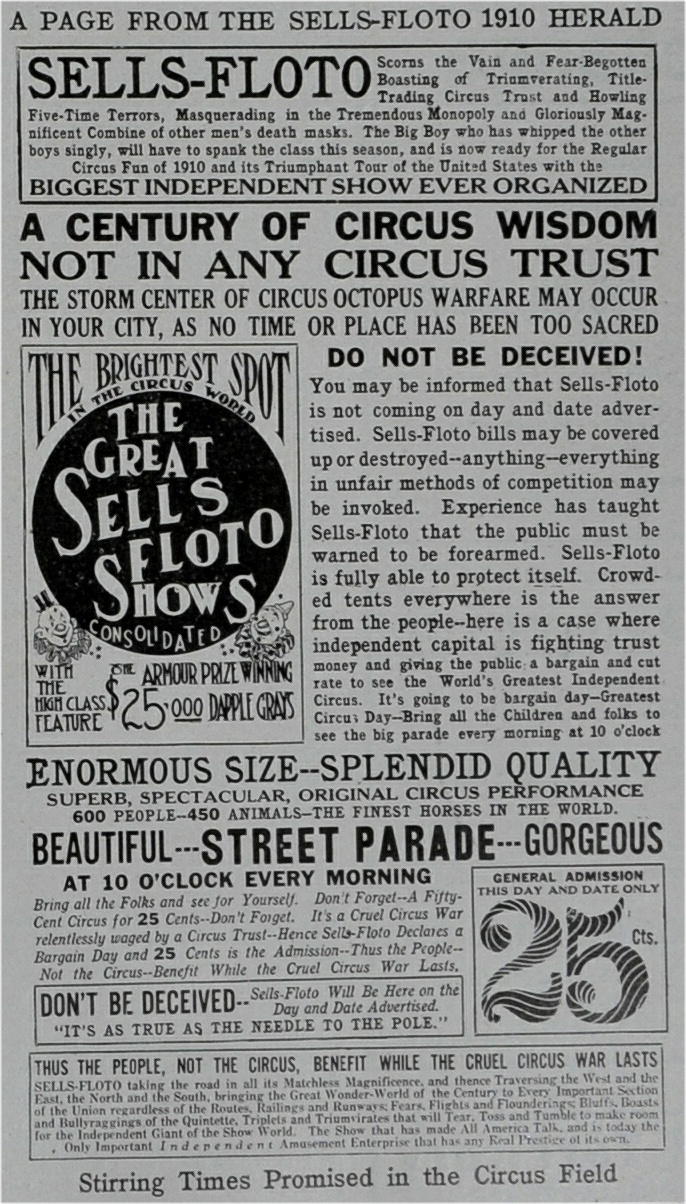
Show World, March 26, 1910 (Vol. V, No. 14), pp. 3, 5, 24. All information should be checked with additional sources.
John W. Kelley, of Baraboo, Wis., who represents the Ringling Bros.' circus in its legal battles, has gone to Austin, Texas, where he will clash with the attorneys there in their efforts to make Ringlings pay a small fortune, which is said to be due for showing there. The license tax is exhorbitant, says Kelley, and the attorney expects to fight the case to the bitter end. With Kelley goes Eddie Delevan and M. T. Kirkendall, who will act as witnesses when the case is called the last of this week or the first of next.
No Circus Hauling Say Big Railroads
According to a letter received by a prominent circus general agent in Chicago this week from C. R. Brent, assistant general freight agent of the Louisville & Nashville Railroad, the L. & N. will not handle circuses over any portion of its system in 1910, and it is reported that the C. B. & Q. Railroad will not handle a circus of any kind, from three cars up, for less than $250 a movement.
That the death knell of circus graft has been sounded is evidenced by the fact that but one aggregation is knonw which is to countenance it this season, and it may have a rocky road before it according to the attitude of the railroads which are taking cognizance of this element which has existed in the circus business to some extent in the past, but which cannot much longer militate against this popular branch of amusement endeavor. The railroads will consider the existence of graft as a ground for cancellation of any contract for the movement of the aggregation. According to a well known circus traffic manager, a railroad official with whom he was negotiating put the question to him point blank: "Is there any graft with your show?" and would have refused to enter into a contract with this circus had the railroad not been assured that there was no graft.
Edward Arlington, associate proprietor of the Miller Brothers 101 Ranch Wild West Show, arrived in Chicago Wednesday, and will make his headquarters at the Auditorium hotel for several days. It is understood that general press representative W. C. Thompson is to establish quarters here shortly.
Frank Hurst, manager of car No. 1, and Frank Harris, contracting agent, of the Gentry Bros. Shows, are at the Windsor-Clifton hotel, Chicago, and will report for duty at Bloomington, Ind., within the next few days.
Ringlings Get Verdict in Big Damage Suit
St. Joseph, Mo., March 19. The trial of James Orme against Ringling Brothers in the federal court here resulted in a verdict for the defendant. The trial of the case consumed three days and about eighty witnesses were examined on both sides. The case went to the jury at six o'clock Saturday evening and within fifteen minutes the verdict was given, there being but one ballot and the verdict was unanimous. Orme was suing the Ringlings for $10,000 damages for injuries alleged to have been received by the blowing down of the circus tent during a performance given there five years ago next September.
This is the third and last of the cases against the Ringlings that were filed for trial in the federal court. In the cases of H. E. Robinson and Pearl Lucile Booth the court sustained a demurrer filed by the defendants and threw the cases out of court, but B. R. Martin, local attorney in these cases, said at the time that an appeal would be taken to the United States court of appeals in these cases.
The Orme case is the first tried before a jury and there seems to have been a clean-cut victory for the Ringlings as a result. Attorney John M. Kelley, general attorney for the Ringlings, said he had offered to make a settlement in this case prior to the trial on a basis of what it would cost to try the case, but that he at no time had any doubt about the result of the case if it went to trial. "You may say," said Mr. Kelley, "that the surprise which we announced before trail was fully sustained."
There were several state cases yet pending against the Ringlings and it is understood Mr. Martin has a large number of claims yet to be presented.
W. E. Wells will be the equestrian director of the Gentry Show this season.
Guy Steeley and Charles A. White are handling the advance press work for the Ringling Bros. Chicago engagement.
H. E. Butler, manager of car No. 3 of the Two Bills Show, is in Chicago and expects to go east in a few days.
Victor Bedini is rehearsing a pony act for vaudeville at Dexter Park Pavilion, Chicago.
Arthur Bennett, a well-known newspaper man, has been engaged as general press representative for the Sells-Floto Shows.
M. S. Bodkin will manage three or four sensational acts which he will place with circuses, parks and fairs this season.
J. B. ("Buck") Massie, who will be R. L. Harvey's right-hand man in advance of the Hagenbeck-Wallace Show, is in Chicago.
Henry Gilbertson, who will have charge of the candy stands with the Sells-Floto Shows this season, will leave Chicago for Denver Saturday night.
J. B. Austin has closed his animal act on the Orpheum circuit and will join the Gentry Bros. Shows as adjuster, official announcer and manager of the concert.
Beverly White, who will help to mold public opinion in favor of the Forepaugh-Sells Show this season, had his hair cut in Chicago last Tuesday.
Edward Jackson, who has acted as assistant manager of the C. S. Primrose attractions, has signed with the Gollmar Bros. Circus for 1910.
W. W. Weaver, for the past fifteen years equestrian director of the Gentry Bros. No. 2 show, has retired from the circus field and has gone into the insurance business at Joplin, Mo.
The Three Duttons are rehearsing in Chicago at Davenport's ring barn on the west side preparatory to opening with the Ringling Bros. Shows at the Coliseum.
Fred Wagner, manager of the Hagenbeck-Wallace privilege car, will leave for the winter quarters, Peru, Ind., next Monday to get his car in shape for the coming season.
Ed Brown and Frank Purcell will leave Chicago next Monday for Denver to join the Sells-Floto Shows. They will take general manager Franklin's pet canine, Major, with them.
May Kreimbrinck (Prairie Rose), with her bucking horses, and Montana Jack, a champion roper, have been engaged by manager Seaver for the Young Buffalo Wild West Show.
Charles White, chief of detectives with the Ringling Bros. Circus, has arrived in Chicago and will be on hand when the doors of the Coliseum open for the season of 1910.
The Ringling Bros.' billing started last Monday for the Chicago engagement, which will commence at the Coliseum April 7 for three weeks. The first stand out of Chicago will be Danville, Ill.
Tom North, the contracting press representative for the Gentry Bros. No. 1 show, is in Chicago with "The Newlyweds," and will join the Gentry Bros. upon the conclusion of the theatrical season.
Bob Tyler died at Bellevue Hospital, New York, on March 11, aged twenty-six years. Mr. Tyler entered the circus business in 1901 with Walter L. Main and will be mourned by many friends both in and out of the profession.
C. W. Finney, who has had the management of the "White Squaw" company, left for Denver on Monday to join the Sells-Floto Shows. He has been for a number of years past identified with the Gentry Bros. organization.
Glenmore Davis, one of America's best known publicity promoters, has been engaged by the Barnum & Bailey management and is busy with the New York papers. The Barnum show opened at Madison Square Garden Thursday.
Frank O'Donnell, contracting press representative and story man, will join the Hagenbeck-Wallace staff at Peru, Ind., next Monday. George Atkinson is to handle the press work back with the Hagenbeck-Wallace show this season.
James Eviston will have the No. 1 car with Hagenbeck & Wallace this season, succeeding Foster Burns, who will go with the Sells-Floto. F. O. Rossman will be in charge of the paper on the car. Al Osborne will be in charge of the No. 2 car again this season.
Spader Johnson, principal clown with the Sells-Floto Shows, is one of the heavily billed features of the indoor circus at the Hippodrome, Cleveland, and upon the conclusion of that engagement will leave at once for Denver to assume direct charge of several clowning numbers which he has created for the Denver aggregation.
Grover Rollins and his wife, Maude, have been engaged by the Ringling Bros. for 1910. Mr. Rollins will direct the mechanical apparatus for Omar, the airship horse, which Mrs. Rollins will ride. Omar was a big hit with the Rhoda Royal Circus and will be featured heavily by the Ringlings.
Stillson's buffet in Chicago was the scene of a reunion of well-known circus men last Monday night, at which James Jay Brady, Herbert S. Maddy, Guy Steeley, Ed Delevan and John Sheahy were present. There were frequent excursions to the popcorn bowl and enough conversation to let loose about the good old days in the circus business to fill twenty columns of The Show World.
The Holland family of riders, seven in number, will join the Sells-Floto Shows in Denver, leaving Chicago on April 5. George Holland will be the equestrian director of the circus. The Hollands have been playing fairs and parks under the management of M. S. Bodkin. They will be a valuable addition to the Sells-Floto organization.
Homer Hobson and wife, equestrians, have been engaged by the Sells-Floto Shows.
E. L. Brannan, general agent of the Young Buffalo Bill Wild West aggregation, is one of the busiest men in Chicago these days. He is in daily conference with Manager Seaver, who is firmly determined to make his wild west organization a first-class one in every respect. Mr. Commodore is a born leader and has commanded attention. His friends predict as much success in the tented amusement field as he has gained in other branches with which he has become identified.
The Bolte & Weyer Company have received an order for a complete new set of arena lights from Miller Bros. 101 Ranch Wild West Show, consisting of 9 generators with three 12,000 candle power Search Lights attached to each, making a total of 324,000 candle power. In making the contract with Geo. Arlington, it was specified that the lights must produce double the candle power compared with the "B. & W." lights made last season.
Contrary to a freely circulated report, which seems to have gained credence among showmen, H. E. Allott ("Bunk Allen") will not have the privileges or be connected in any way with the Young Buffalo Wild West Show, according to general manager V. C. Seaver. "Bunk" intends to operate the Lombard Hotel at Lombard, Ill., if opposition to the project by the citizens is withdrawn or overcome. "Bunk" says that he is through with the show business for goos; that he is to purchase a bungalow in the south, where he will spend his winters; that he has sold his apartment house in Chicago, and during the summer will make his headquarters at the Lombard Hotel.
Fred Gollmar, the debonair, has switched his Chicago headquarters from the Windsor-Clifton, where he has been a familiar figure for a number of years, to the Wellington Hotel. The latter hostelry is becoming quite popular with showmen transacting business in Chicago. Sam C. Haller is numbered among the guests. There is quite a rivalry between the Windsor-Clifton, Wellington, Saratoga and Grand Pacific for the patronage of circus and carnival men. The circus magnate is generally accorded very gracious treatment by hotel keepers for the reason that his presence in the foyer brings business to the house. As the great distributing center of the country there is scarcely a day that half a score of prominent showmen cannot be seen in the lobbies of Chicago's hotels.
Col. "Bill" Lavelel has been engaged as a feature for the Young Buffalo Wild West Show. Manager Seaver has purchased a thoroughbred horse for him and is having special accoutrement built, including bridles, saddles, trappings, etc. Col. Lavelle bears a striking resemblance to Buffalo Bill and is often mistaken for that idol of the American public. Manager Seaver has demonstrated this shrewdness in securing the services of Col. Lavelle for his wild west show, as his heroic figure will prove a drawing card. The Colonel was a feature with the Royal Indoor Circus this winter, and lost no time in making satisfactory arrangements for the summer season.
After twelve consecutive years of association with the Ringling Bros.' circus, acting as downtown ticket agent, Alfred Witzenhausen no longer listens to the call of the white topes, but has located permanently in Chicago, having assumed the treasurership of the Olympic theater at Clark and Randolph streets.
Show World, April 2, 1910 (Vol. V, No. 15), pp. 1, 4, 12, 25, 26. All information should be checked with additional sources.
Spader Johnson, A Man Who Has Made Millions Laugh
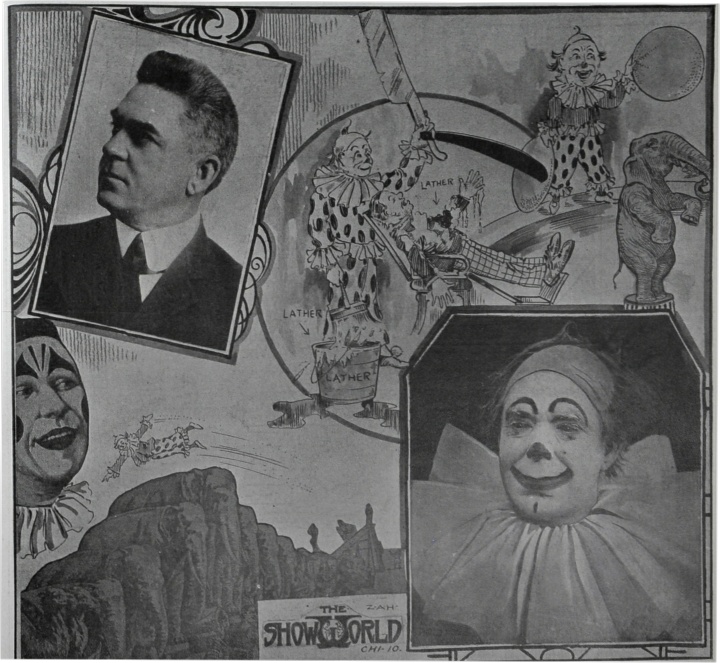
After an absence of a year, devoted to vaudeville, Spader Johnson has re-entered the circus ranks as premier comedian with the Sells-Floto Shows, which is to open the season at Albuquerque, N. M., April 16. Spader has played an important part in arenic entertainment in America for the past twenty-five years. While he has kept pace with modern requirements, he probably more than any one else in the circus field, represents the old-time school of pantomime.
Clowning with a circus is an art which has been mastered by few. In fact, the real circus clown stands pre-eminent as an artist. Every traveling organization boasts of forty to fifty clowns, the great majority of whom are merely imitatiors. Spader Johnson's work embodiees the creating of clown numbers, which retain the element of old-time circus fun coupled with novel characteristics. He is being heavily billed by the Sells-Floto Shows, which secured his services not only by the most flattering financial inducements, but through appeal to Spader's inherent love for circus battle.
He was enticed from vaudeville realizing that the Sells-Floto Shows was to play in important part this year in the making of circus history, and took advantage of the opportunity to be in the midst of the fray.
It is no exaggeration to say that Spader has made millions laugh. His comedy is clean, and his ideas sparkle with originality. Mrs. Johnson will not travel with her husband this year, but will remain at their beautiful home in Brooklyn, N. Y.
Uniform Circus Tax Is Urged
Kansas City Has Ideal Ordinance Based on Number of Cars and Admission Price. - Other Cities Levy License in Haphazard Fashion.
The licensing of tented aggregations by municipalities has been a perplexing question, the lack of knowledge of the legislators regarding the circuses resulting in widely divergent regulations in various parts of the country, of so felxible a nature that in many instances injustice has been done to the smaller shows, and therefore a uniform tax is urged.
The tendency has been to include all circuses into one class, thus placing upon the small shows the burdens that should be carried by the larger ones. Circus licenses, as a rule, are not uniform, and, in most places, discriminative, there being no difference in the license charged the larger shows that have a receiving capacity of, say, $20,000 a day, against the smaller ones having a receiving capacity of from $750 to $3,000 a day, or uniform scale for still smaller organizations consisting of two or more cars.
The largest circus, charging fifty cents admission and fifty cents and upwards extra for reserved seats, admittedly takes considerable sums from the towns it visits without making an adquate economic return in the way of local employment and local trade. The largest circus bears heavily upon the up-keep of the streets it passes through, without contributing to their maintance. It seems just, therefore, that the license charged should bear some comparison to these facts.
Other branches of amusement have been considerable dealt with by the various municipalities, and the amount of the license fee is graded from the humble picture show to the first class house. This is probably owing to the fact that theaters are local institutions and have been properly represented before the legislative committees enacting the legislation, but the circus, on account of its nomadic nature, has been judged without representation. It is not strange, therefore, that tented shows are taxed $30 a day in one city, and $1,500 in another.
The city of Kansas City has given this subject most careful consideration, and has passed an ordinance which will prove the solution of the mooted question, and its adoption by other cities will prove a boon to the circuses themselves. By charging a certain rate per car it has an absolute check upon the circus, and by grading this rate according to the number of cars carried it equalizes the taxation, and the largest circuses which take away the greatest amount of money from the city and bear heavily upon the maintenance of the street pay a heavier fee. . . .
Frank J. O'Donnell
General Press Agent the Carl Hagenbeck
Jones Bros.' Wild West
Corry, Pa., March 28. Everything is hustle at the winter quarters of the Jones Brothers' wild west here and things are shaping themselves for the opening April 16 here. Warren is the second stand.
Pop Evans is the boss hustler of the outfit. The "rough necks" are already drifting in and a band of Indians are expected during the next two weeks.
J. Augustus Jones recently received all his circus outfit, which had been stored in Atlanta, Ga., and this combined with the Cole material will supply him with a good start.
It is understood that Col. John Welsh of Philadelphia is laying out the route for the show and as near as possilbe the outfit will try and steer clear of the Two Bills and 101 Ranch aggregations.
An artist is expected from Chicago this week to letter all the cars. Jones bought a fine advance car from Gentry Bros. He also got one of the Cole cars when the sale took place here. As yet no announcement of his press force and agents has been made.
Five Herberts Rehearsing
The Five Herberts of the famous Flying Aerial Act, who for the past three years have been with the Worth [sic Wirth?] Brothers' Australian Circus, have reached Denver and are now polishing up their act at the winter quarters of the Sells-Floto Shows.
Carlos L. Sassee has imported a big Mexican act for the Sells-Floto Shows. They will join the big independent circus at Albuquerque, N. M., for the opening on April 16. The trains will leave the Denver quarters on April 10 for that city.
W. E. Franklin has presented Mrs. Franklin with a big seven passenger Ramble auto as a birthday gift. Mrs. Franklin will visit the circus during its California tour, after which she will return to her home in Indiana.
Arthur Bennett, formerly dramatic critic of The Denver Post, and until recently business manage for Henry Miller's Associate Players, has joined the Sells-Floto Shows in the capacity of chief press representative.
Charles Adams, of Alexandria, Ind., aged 75, was in Chicago this week, having visited his daughter Bessie Clifton, of the vaudeville team of Eldon & Clifton. It was his first visit here since 1854 when he passed through Chicago with Van Amburg's circus of which he was principal clown.
Harry Lindley, another Ringling press agent, arrived in Chicago Friday, joining Guy Steely and Charles A. White. Another press agent, Paul Martin, will be here next week. Lindley was formerly manager of William Faversham, "The Merry Go Round" and more recently was with Liebler & Co. He is new to the circus business.
The Gentry Bros. Shows will open at Mitchell, Ind., April 23, with the following dates to follow: French Lick, April 25; New Albany, 26; Louisville, Ky., 27-28; Frankfort, 29; Lexington, 30, with a week to follow at Walnut Hills, Cincinnati. There will be eleven cars back and one car ahead. Don McKenzie will manage the advertising car.
The Hobsons and Ledgetts have joined the Sells-Floto Show at Denver and are daily practicing a companion carrying act.
C. I. Morris, formerly of Norris & Rowe Shows, has an animal act on the Pantages circuit.
A. H. Barkley, railroad contractor of the Campbell Brothers' Shows, spent Sunday in Denver and visited the winter quarters of the Sells-Floto circus.
George F. Holland and family, seven in number, arrived in Denver at the winter quarters of the Sells-Floto show, this week.
Tribute to the Late Geo. S. Cole
Chicago, March 28. Editor, The Show World:
The death of Geo. S. Cole, which occurred at Jacksonville, Fla., March 21, deprives the circus world of its oldest, and I can truly say, its best loved member.
Mr. Cole held positions of importance with many of the leading circuses in the early days of the wagon shows, his experience covering a period of over half a century. He was treasurer of the "Montgomery Queen Show," when it made its trip on wagons from the Atlantic to the Pacific in the early sixties. Of late years he was connected with the Walter L. Main Shows, when they were on wagons as well as on rail. Also with John H. Sparks, and for the past five or six years with the Jno. Robinson Circus, and at the time of his demise had just joined Howe's Great London Shows.
For several seasons he was interested in the Cole & Lockwood, afterwards the Geo. S. Cole Shows, which toured New England. Mr. Cole was of aristocratic appearance, courtly manners, and generous to a fault, besides being one of the most entertaining talkers I ever met. It was a genuine treat to sit and listen to his interesting circus reminiscences of days gone by.
The last time I met him was in Wilmington, North Carolina, a few years ago. He asked me to come with him to get a pair of Christian Endeavor shoes. I asked, "Why Christian Endeavor?" He replied, "Shoes that fit the feet make Christianity easier." We went together. During the purchase of the shoes he requested the shoe man to give him an ad to put on the elephants. The latter replied, "We have been established here for over thirty years. Everyone knows us." Mr. Cole promptly answered, "Undoubtedly, my dear sir. They crucified our Savior hundreds of years ago, but they are still building churches to tell us about it, aren't they?"
On another occasion he was taking tickets on the big show door, where I noticed an unusual amouth of silver stacked up on the ticket boxes. I asked the reason. He replied, "That represents the difference of opinion." Just then a woman with a girl eight or nine years old, in her arms, attempted to get by on a single ticket. Mr. Cole asked her for one for the young woman. The lady got angry and became abusive, remarking, "Why, the very idea, that child is not yet five years old." In her excitement whe opened her mouth a little too wide and some artificial teeth fell out. Mr. Cole promptly seized the opportunity and retorted, "Madame, that statement is as false as the teeth in your head."
I once asked him how he made out financially with a prominent circus he was at one time interested in. He thought for a moment, laughed, and said, "After liquidation I found I was broke for five years and didn't know it."
There are few men in the profession that had so many warm friends in all branches of the amusement world, as Geo. S. Cole. He never failed to be present each session at the opening performances of the important circuses and this will be the first time in many, many years when the ever welcome and deeply regretted guest will be missing. - F. C. Cooper.
Circus Opening Is Marred by Accident
New York, March 25. Several serious accidents to performers marred the opening of the Barnum and Bailey circus at the Madison Square Gardens here yesterday. Chas. Thrall of the Lamar troupe, fell from the dizzy heights near the roof when his brother, Peter, leadped from a large trapeze to a smaller one held by Charles in his teeth. Charles broke both wrists on falling, knocked out several teeth and was injured internally. He is not expected to live.
It was scarcely a minute later when a trapeze upon which two women, the Nobliss Sisters were performing, gave way and precipitated them to the net many feet below. It was stated that they were not seriously injured. Codona, another trapeze artist, was dashed to the net, breaking the ropes that held it.
B. and B. Car Route
New York, March 29. Reported No. 1 car, Barnum & Bailey jumps to Philadelphia to remain 12 days instead of usual week. No. 2 and No. 3 to bill Brooklyn. Special opposition gang Barnum and Bailey left New York unexpectedly. Destination unascertainable. - Storey.
Sells-Floto Getting Ready
Denver, Colo., March 29. All is activity around the winter quarters of the Sells-Floto Shows, now being put in readiness for the season of 1910, which is to open at Albuquerque, N. M., April 16, leaving Denver April 9. The appearance of the aggregation would indicate that no pains or expense has been spared in making it ready. The wagons will be resplendent with gold paint, and the brand new trappings and costumes prsent a dazzling appearance. The sleek coats of the baggage stock indicates the fine fettle it is in, and the zoological department is a feature of which the circus is proud.
Your correspondent believes that the Sells-Floto management anticipates a great deal of opposition this season, and has inaugurated a striking innovation in the split admission price. It would appear to be the intent to give the public a big show for a little money, which should appeal to the masses in these times of high cost of living. The coming season will be bargain day in the circus world.
A large army of artists is being marshalled, and they are arriving on every train. Many are rehearsing at the winter quarters. A special line of lithographic paper is particularly attractive.
The management is determined to carry on a spirited campaign, regardless of anyting which may arise, and will play every date on its route.
Sells-Floto Hearld
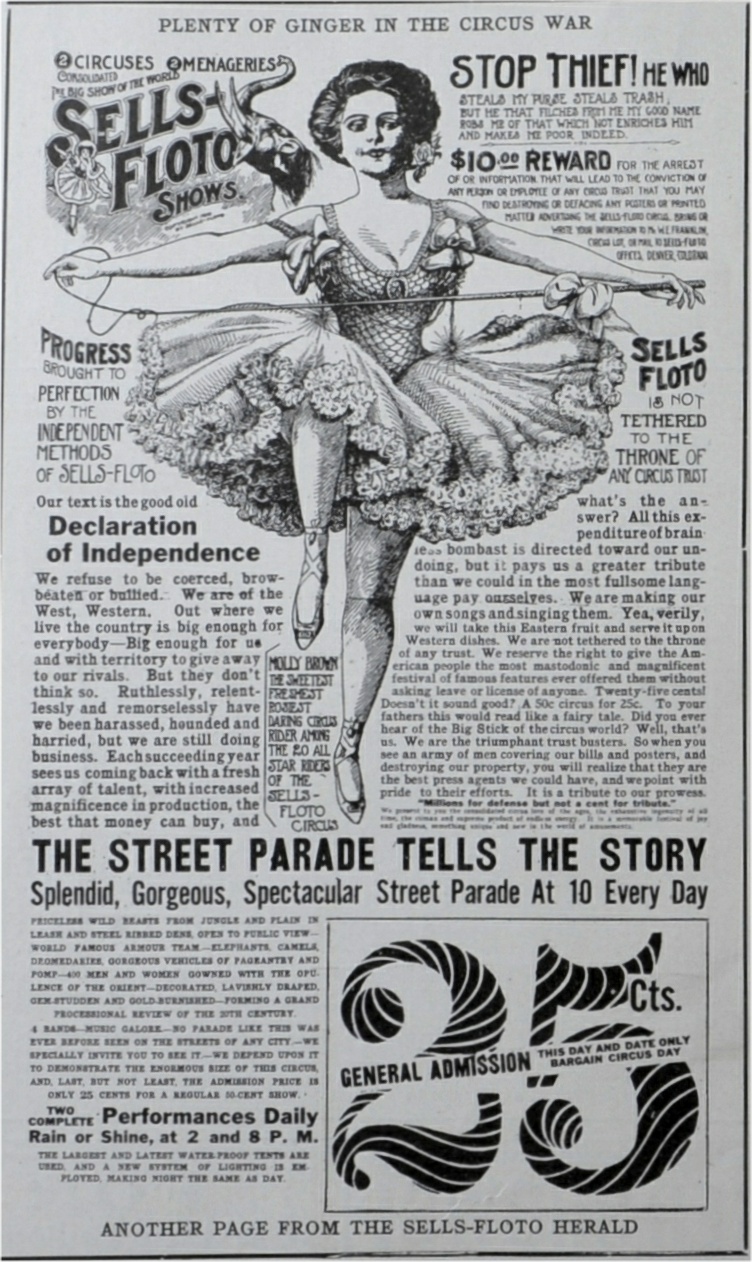
Cody in Chicago
Col. W. F. Cody (Buffalo Bill) arrived in Chicago, Wednesday, and left for New York Friday of this week. To a Show Worl representative, Colonel Cody expressed his firm belief that the coming season would be the most prosperous ever experienced by the Wild West aggreation and that his show this season would eclipse anything heretofore attempted by him and his associates.
Miller Bros.' Opening
The Miller Bros. 101 Ranch Wild West show open at St. Louis, Mo., on April 16, for eight days. Rehearsals will commence April 12. George Arlington, general manager, has issued a call for all people engaged for the coming season to report at St. Louis in accordance therewith. Indications are that the show is framed up for a strenuous campaign and a big season is looked for.
Rhoda Royal Dickers With Hall Says Rumor
Prominent Equestrian Director Figures on Putting Out Rail Show in 1911 with Lancaster, (Mo.) Man.
Baraboo, Wis., March 31. It is rumored here that Rhoda Royal is flirting with W. P. Hall of Lancaster, Mo., to put out a circus on rails in 1911. Considerable significance is attached to Mr. Royal's recent confab with the Ringling Brothers in this city. With the Royal-Hall circus proposition in mind and not looking with favor upon the institution of another circus factor in the field, it is said that the Ringling Brothers have made a proposition to Rhoda Royal to become interested with him in a winter circus proposition for a fall and winter tour in 1911. It is said that Otto and John Ringling are against the project, but that Charles Ringling is in favor of it. It is generally believed here that Mr. Royal to insure the complete success of a winter show, thoroughly appreciates the absolute necessity of confining his personal efforts to the conduct of the arenic department and leaving the business end solely to experienced men in this line. It would appear from present advices that Mr. Royal will not put out an indoor show next winter and that if he, with W. P. Hall, does not put out a circus on rails in the summer of 1911, may have the co-operation of the Ringling Brothers in putting out under their business management an indoor circus in the fall and winter of 1911.
Parmlee Begins Work
Denver, Colo., March 31. W. W. Parmlee, who has been making his headquarters for the past few weeks at the St. James Hotel, leaves for Albuquerque tomorrow in advance of the Sells-Floto show. Mr. Parmlee, who is recognized as the lead in his branch of amusement endeavor, is most enthusiastic over the prospects for the coming season.
The Robinson Roster
Cincinnati, Ohio, March 28. The following is the list of performers to be with the John Robinson's 10 Big Shows the coming season:
Oscar Lowanda's Troupe of 8 Brazilian Equestrians; Wm. DeMott & Miss Eunice Stokes, Valentine Troupe of Aerialists; Horace Webb & wife; the Legits; Warren Travis; Debolian Trio; Prince Luca Russian Troupe; Howard Troupe; Fank LaRose; Holloway Bros. Okomato Tourep; the Nelsons; Al. Miaco, wife and daughter; E. C. Sweigert; 20 Indians; B. S. LeClair troupe of trained dogs and ponies; Geo. Burk, Wild West; 10 cowboys; Leach & Vance; Billy Stewart and wife; the Beals; 2 Ramones; W. D. Glasscock and family; the Coyles; the Van Skaiks; Sid DeClariville and wife; Robertsons troupe of trained dogs and monkeys; Geo. Beckwith, Hal. Newport, J. H. Merkel, Walter Young, Wm. Day, J. Burns, Ed. Sonnestein and Chas. Hildero.
Show World, April 9, 1910 (Vol. V, No. 16), pp. 3 ,10-11, 12 16-17. All information should be checked with additional sources.
Circuses and Shows Favored by Decisions
Washington, April 1. Theatrical companies and circuses got material concessions today in rulings announced by James F. Curtis, assistant secretary of the treasury.
The privilege of bringing into the United States free of duty scenery and costumes of theatrical companies which they have taken to Canada or Mexico from this country for exhibiton purposes has been extended to an American opera company, which is going to Europe for a tour.
Another ruling sanctioned the free entry to the United States on their return from Canada of domestic animals taken there for exhibition in a circus.
Battle of the Circus Giants
Trust and Independent White Top Organizations Are Lined Up for Gigantic Struggle This Season. By Warren A. Patrick.
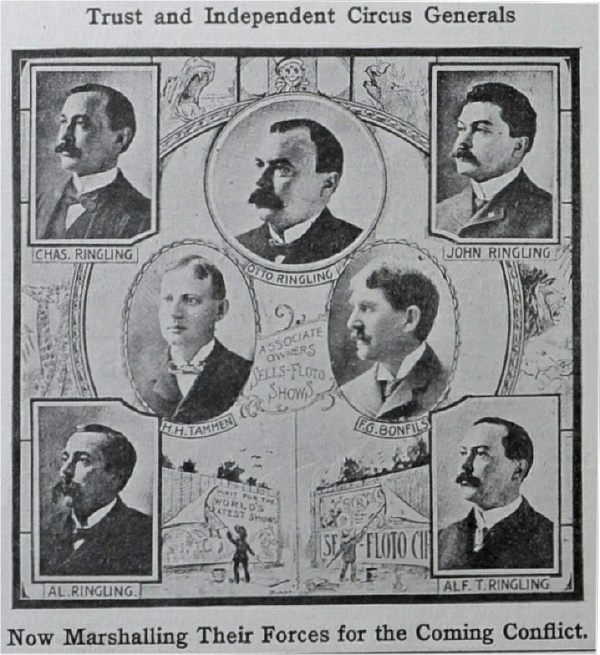
The year 1910 will undoubtedly go down in the annals of circus history as the most strenuous experienced by tented organizations in the way of opposition. The evolution of the circus, during the past years, has carried with it incidents and conditions which have reached the climax and as the result will burst into a storm of conflict upon which depends the future of this branch of amusement.
Flushed with their wonderfull success, the Ringling Brothers, proprietors and managers of Ringling Bros.' World's Greatest Shows, the Barnum & Bailey Greatest Show on Earth, and the Adam Forepaugh-Sells Bros. Shows, seek to dominate and absolutely control the circus business of America, according to the Independents.
THE HISTORY OF THE WORLD HAS SHOWN THAT UNLIMITED POWER HAS ALWAYS RESULTED IN TYRANNY, and with their increasing strength, should the Ringlings attain their ambition of becoming the monarchs of the circus world instead of being only self-styled kings, as they now proclaim themselves to be, their next step would undoubtedly be to lower the standard of and cheapen their exhibitions, while at the same time increasing their prices for admission, as is done by every trust dealing in the necessities or luxuries of life. In short, is a complete circus trust any less objectionable or less criminal than a Standard Oil trust or other monoply in the necessities of life?
Are Amusements Necessities?
Are not entertainments and public amusements to be deemed necessaries in the stage to which civilization has now reached?
During the first period of centuries, mankind throughout the entire world wer perpetually engaged in purely physical warfare with only fists, teeth, clubs and stones as weapons of attack and defense; during the next succeeding period of centuries the same state of warfare was universal with the added weapons of swords and guns. Today, such warfare is only occasional and exceptional, but there is a conflict of money and brains, the latter, however, being ineffectual both for purposes of attack and defense without money. In other words, the present state of civilization is one of combat everywhere of money against money. Money today is ruling every country in the universe.
Against this regime of money rule, a mighty moral force has already developed in the minds and hearts of millions of people, and this force is increasing rapidly throughout the world, particularly in America, and the next great step in civilization will be the organizatoin of this force against money power, and back of this organized force, and associated with it, money will be and must be centralized and thus properly used instead of being misused and abused for purposes of oppression.
Ringling History Almost Fanciful
The history of the Ringling Brothers reads like an Arabian Nights' tale. Scarcely thirty years ago in Baraboo, Wis., they were humble harness makers and have, step by step, risen to the very pinnacle of the circus world.
After having attained a powerful position in the circus realm as the owners of the Ringling Bros. shows, they purchased the Adam Forepaugh-Sells Bros. Shows, and following the demise of the late James A. Bailey, absorbed the Barnum & Bailey Shows, thus obtaining the sole proprietorship of three of the leading circuses of America.
Their present wealth is conservatively estimated at twenty million dollars, and according to dispatches which were published in The Show World some weeks ago, THE RINGLING BROS. DECLARED A DIVIDEND OF ONE MILLION DOLLARS ON LAST YEAR'S BUSINESS, representing the profits from the Barnum & Bailey and the Ringling Bros. Shows - the Forepaugh-Sells Bros. Circus not being on tour last season.
Barring a tremendous outlay which may be occasioned by opposition this year, THE RINGLING BROS. MAY SAFELY FIGURE ON PROFITS OF AT LEAST A MILLION AND A HALF IN 1910, taking into consideration the more prosperous condition of the country and the fact that the Forepaugh-Sells Bros. Show is going out, and that during its active existence it had a reputation for earning power second to none in the tented field.
Competition Is Killed
Prior to the acquisiton of the Barnum & Bailey and Forepaugh-Sells Bros. Shows, these aggregations necessarily were operated in competition with the Ringling Bros. and it was necessary to uphold an executive staff of high calibre and a separate army of employes for each organization. The employes were able to maintain a standard of competitive ability and were free to accept employment with any of such competitors, and demand and receive a reasonable compensation for their services and talents. IF THE CIRCUS TRUST IS SUCCESSFUL IN ITS ENDEAVOR TO ACTUALLY DOMINATE THE CIRCUS WORLD, THESE ARMIES OF EMPLOYES WILL BE AT ITS MERCY. As it is, the taking over of the various interests by the Ringling Brothers necessarily, and as a natural consequence eliminates the services of men who had devoted the major portion of their lives to circus work. For instance, in making contracts, the several shows now flying the Ringling banner were compelled to maintain an executive staff of competent representatives. Now ONE HEAD OF A DEPARTMENT OCCUPIES A TRIPLE CAPACITY.
It is reported that they have taken the first coercive steps to dominate the actions of the artists whom they condescend to employ by the enforcement of an arbitrary ruling that PERFORMERS SIGNED WITH THEM FOR THIS SEASON, AND WHO HOPE TO BE ALLIED IN ANY WAY IN THE FUTURE WITH ANY OF THE RINGLING SHOWS, MUST NOT CONTRACT TO APPEAR WITH ANY TRAVELING WINTER CIRCUS ORGANIZATION WITHOUT THE CONSENT OF THE RINGLING BROTHERS, thus seeking to control the actions of men whom they only engaged for the summer months, but depriving them of circus engagements during the winter. This, if true, must of necessity militate against the excellence of the Ringling performances, for high-class artists with acts not suitable for vaudeville, but which can find ready bookings with traveling winter circuses, cannot bow their heads to the Ringling yoke. This would also coroborate the story pringed in The Show World that the RINGLING BROTHERS, ALARMED AT THE INROADS BEING MADE BY INDEPENDENT WINTER SHOWS, REALIZING THAT IT AFFORDED A FURTHER REVENUE FOR LUCRATIVE INVESTMENT, INTENDED TO ALSO GOBBLE UP, IF POSSIBLE, THIS BRANCH OF THE CIRCUS BUSINESS.
The Big Stick
With the tremendous patronage which they are able to give or withhold from lithographers, printers, etc., they swing a mighty club and are able to practically dominate the people from whom they purchase supplies.
The independent circus men are not unmindful of the ever growing Ringling power, and its menace to the life of their organizations. In following the procedure of trusts in commercial life, however, the Ringling Brothers have overlooked one salient point, and that is that the independent shows are indepents in spirit as well as practice. In commercial life when a man is hard pressed by a trust he usually makes the best terms possible and withdraws from the field. From recent declarations, made in good faith, by the owners of independent show it would appear that THE ROAD TO ABSOLUTE DOMINATION BY THE RINGLINGS WILL BE INDEED A ROCKY ONE, AND WITH THE INDEPENDENTS FULLY AWAKE TO A REALIZATION OF THEIR DANGER EVERY MOVE AGAINST THEM WILL BE BITTERLY CONTESTED.
During the past winter months the independent shows have been preparing for the impending struggle, and they are ready to launch upon the circus world aggregations that will astonish not only the trust but the public,and will meet the issue, whatever it may be.
Independents Prepared
The advance hearld of a leading western independent show discloses the undercurrent which is about to burst forth, when it says: "Our text is the god old Declaration of Independence. We refuse to be coerced, browbeaten, or bullied. We are of the west, western. Out where we live the country is big enough for everybody - big enough for us,and with territory to give away to our rivals. But they don't think so. Ruthlessly, relentlessly and remorselessy have we been harassed, hounded and harried, but we are still doing business. We are not tethered to the throne of any circus trust." The circular then offers a reward for information that will lead to the conviction of any person or employe of any circus trust that may be found destroying or defacing any posters or printed matter advertising this organization.
The fact that the independent circuses are supplied wiht practically unlimited capital, and are fully determined to protect their rights adds a decided zest to the approaching conflict. The trust has an advantage in being able to control its three organizations without opposition against each other, with a corresponding economy in management. To offset this, each independent show is prepared to spend dollar for dollar, if necessary.
In competition last season, it was charged that the Ringling Brothers posted bills in towns where independent shows were billed to appear that "one or the other of their circuses was 'coming soon'" and asking the public to "wait for the big show," when, AS A MATTER OF FACT, THEY HAD NO INTENTION OF EXHIBITING IN SUCH PLACES. Public memory is not so short that it will not remember these occurences, and it may redound to the disadvantage of the trust in such towns where they may really intend to appear this season.
The Canadian Tax
The crisis in the battle of the circus giants was hastened by the threatened narrowing of the field through the barrier which had been raised on the Canadian frontier, making it prohibitive for a big American show to exhibit in that country, by reason of the impending rule of the treasury department against the free importation of live stock, including wild or domestic animals that a circus might take over into Canada for exhibition purposes. It appeared that no big American circus could afford to include Canadian points in its itinerary, and the routes were laid exclusively in the States.
The trouble was caused by the construction of the treasury department of the clause in the Aldrich bill against the free importation of live stock, and on the sale of the Cole Brothers Shows, which exhibited in Canada last summer, an officer of the treasury department attached the proceeds of the sale, but with the understanding that if the department ruled against the free importation of live stock, including wild or domestic animals that a circus might take over for exhibition purposes, the treasury department then would have made its money. THE RULING WAS MADE THIS WEEK SANCTIONING THE FREE ENTRY TO THE UNITED STATES ON THEIR RETURN FROM CANADA OF DOMESTIC ANIMALS TAKEN THERE FOR EXHIBITION IN A CIRCUS - too late to affect the preparations for the circus war, which included routing in the States, and means a bitter opposition. It cannot be avoided, and may revive the old time methods when Tody Hamilton, Willard D. Coxey and James Jay Brady wrote the bills and evolved in their minds the stories which filled the newspaper columns for the edification of the public.
Ignores the Press
With the advent of its newly found power the circus trust has snapped its fingers at the public and the press. It maintains that the need of the public is for entertainment, and that the attitude of a newspaper cannot retart their progress, forgetting that newspaper publicity was instrumental to a large degree in the success they have attained. The question arises now, what will be the outcome? Have they reached their maximum, and have they gotten to the turning point which leads to the minimum?
What is the meaning of the term maximum? It means the greatest quantity or degree fixed, attainable, or attained, in any given case, as opposed to the minimum, the smallest. In physics and mathematics the term is used to express the value of a varying quantity at the moment when it ceases to increase and beings to decline.
This brings me to the point, namely that everything in life, men corporations, principalities, nations, commonwealths, all perishable things ADVANCE TO THEIR MAXIMUM GROWTH and that when this degree has been reached, THE RETROGRESSION TO THE MINIMUM FROM WHENCE THEY SPRANG BEGINS. The reason for this is obvious, for it is the invariable law of the universe that men and things progress to a given point, then decline and ultimately cease to be. IT IS THE LAW OF THE MAXIMUM AND MINIMUM, AND IT IS AS UNCHANGEABLE AS THE COURSE OF THE STARS TRAVELING IN THER DISTANT ORBITS IN SPACE.
Causes Which Lead to the Fall
There are contributing causes which lead to this result. In human affairs, the rapacity of men and corporations, the pride of race, the consuming love of power, are directly responsible for the fall of the superstructure of wealth and strength they have builded for themselves. There was a time when ancient Rome was mistress of the seas as England was a century since. Rome ahd progressed unceasingly to her proud station as a dictator of the world and might have remained pre-eminent and invincible for centuries to come but for the aggressive policy of her rulers which brought her face to face with Carthage and Hannibal. Then came the Punic wars, the fall of Carthage, and the conquering of Macedonai and Asia Minor. A century before the Christian era Rome was in her zenith of her power and glory. In other words, ROME HAD REACHED HER MAXIMUM GROWTH AND HER DECLINE BEGAN.
Civil wars centralized the governing power of Rome in the hands of a few leaders - Marius, Pompey, Caesar, Tirumvirates. With Caesar the decline was accelerated by Marcus Aurelius and in A. D. 395 the empire was dismembered, and glorious Rome, once all powerful and strutting with the arrogance of strength, was no more. THUS HAD ROME DEMONSTRATED THE ABSOLUTE INVINCIBILITY OF THE LAW OF THE MAXIMUM AND MINIMUM.
Centralization of Power
This is an age of trusts. It is an age which will direct the attention of thoughtful men and women to the strange but unvarying operations of the law of the maximum and minimum. The corporation which, by following the accepted rules of advanced finance, becomes all powerful, is advancing in accordance with the principals of the law of maximum and minimum to its era of greatest power and then - what? IT HAS REACHED ITS MAXIMUM GROWTH AND THEREFORE MUST FALL BACK TO THE MINIMUM. Such has been the fate of numersou once powerful individuals and corporations and all enterprises that advance to stations of pre-eminence over the wrecks of smaller concerns ruthlessly wiped out by their more powerful competitiors, ARE DESTINED TO MEET THE DOOM THEY METED OUT TO OTHERS.
When Napoleon was crowned Emperor of France, he had reached the maximum period of his glory and power. The day after that even the shadow of St. Helena was descending upon his escutcheon. England had reached her maximum stage when George III sanctioned the taxation of the American colonies without representation. Spain's fall from her maximum state began with the expulsion of the Jews from her domain. The law is working today as it did a thousand years ago, and to the thinker who reads between the lines, its immutability is absolutely fixed. THE LAW APPLIES TO ALL AFFAIRS, ABOVE, UPON AND BENEATH THE EARTH. IT IS ONLY A MATTER OF TIME WHEN IT EXACTS THE UNVARYING PENALTY FROM ITS DEBTORS.
Application of Law to Amusements
How does this all apply to the circus trust? Let us see. In recent years we have heard much talk of theatrical trusts and circus trusts. Unquestionably there has been a centralization of power in circus affairs as there has been in oil, sugar, cotton, leather, coal, and other commodities indispensable to the human race. Centralization of power means economy and consequent increase of profits. It likewise means that this centralized power, whether it be in the management and control of circuses or the markets of the world, IS EQUIVALENT TO THE MAXIMUM THOUGH IT MAY NOT YET HAVE BEEN ATTAINED. The greater power and the wider its ramifications, the nearer IS THE MAXIMUM WHEN THE DECLINE BEGINS. If this is true, if the law of maximum and minimum is not a fallacy, THE DOOM OF CENTRALIZED POWER IN CIRCUS MATTERS IS AT HAND.
A snowball rolling down a declivity gathers weight and momentum with speed and it is precisely these very agencies which combine to shatter it to fragments when its greatest bulk and highest speed have been attained. In other words, THE PRINCIPLES OF THE LAW OF MAXIMUM AND MINIMIM HAVE BEEN IN THIS INSTANCE PRACTICALLY APPLIED. The structure of power reared by individual enterprise and backed by capital, is, according to this law, destined to crumble to dust by the retroactive operation of the very agents which called it into being. It is the reign of law in the universe and all perishable things animate and inanimate are subject to its stern dictates and msut pay its unavoidable penalties.
When the Ringling Brothers occupied a niche in the affairs of life as lowly tradesmen, they no doubt were in their minimum; as the owners of three large circuses, at the present time, have they reached their maximum? Or will they continue to absorb and expand to more giant proportions before the inevitable disintegration takes place?
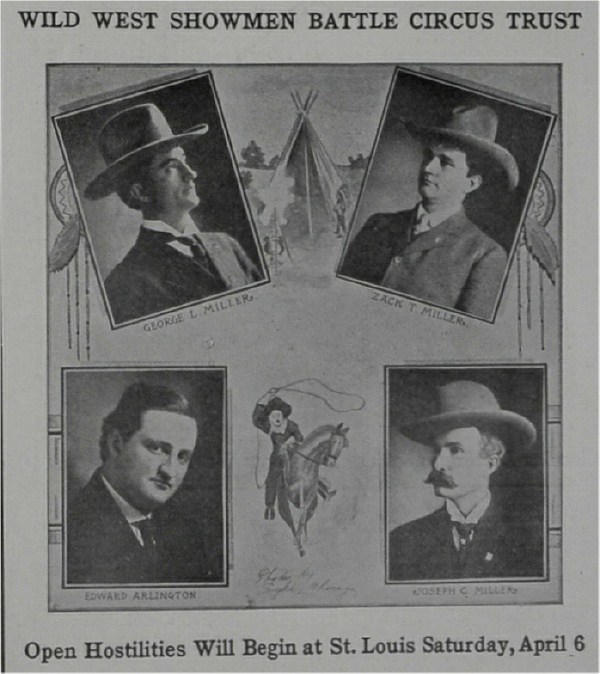
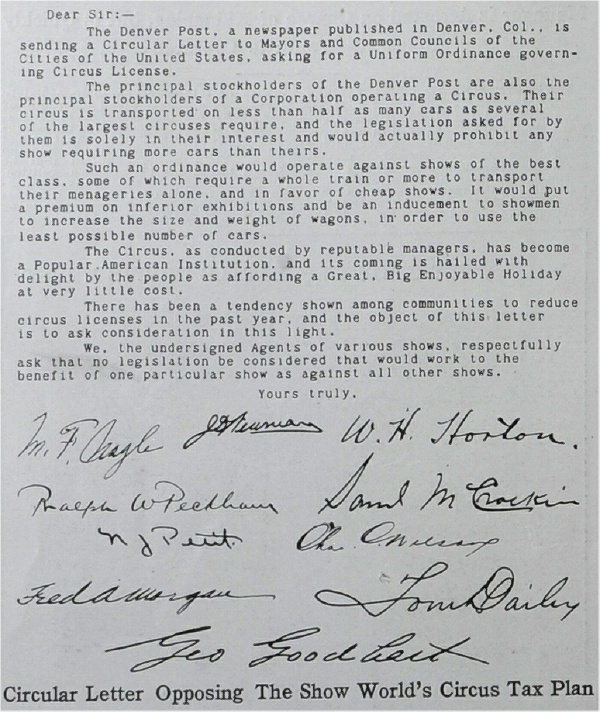
Round Robin Would Offset Circus Tax
Ringling Employes Sign Letter and Send it Broadcast, Objecting to Reasonable Tax on Shows
The circus license ordinance recently passed by Kansas City is occupying the attention of circus men throughout the country, as it is being considered by a number of municipalities with a view to its adoption.
The trust has taken congnizance of it, and sent out a circular letter, signed by employes of the Ringling Brothers, Barnum & Bailey and Forepaugh-Sells circuses, a copy of which is presented in this issue of The Show World. It is peculiar, to say the least, that the Ringling Brothers do not sign the letter, and that the employes whose signatures are attached do not state the circuses they are identified with.
M. F. Nagle is the general agent for Barnum & Bailey; J. D. Newman, general agent for Forepaugh-Sells; W. H. Horton, general agent for Ringling Brothers; Ralph W. Peckham, general excursion agent for Barnum & Bailey, Forepaugh-Sells and Ringling Brothers; Samuel McCracken, general contracting agent for Ringling Brothers N. J. Petit, contractor of Barnum & Bailey; Charles C. Wilson, traffic manager for Barnum & Bailey, Forepaugh-Sells and Ringling Brothers; Fred A. Morgan, locl contractor for Forepaugh-Sells, and Tom Dailey and George Goodhart, managers of Ringling Brothers' advertising cars.
Does Not Answer
The letter does not attempt to answer the argument which has been put forth in favor of the Kansas City ordinance, to-wit, that if an eight-car show came to a city and the total admission fee was 25 cents, and its draft for obtaining business was in the neighborhood of $500 a day, if they had good luck,it would not be fair to charge the same license for an eight-car show that charged $1 total admission, while the other show charged 25 cents general admission and 25 cents for reserved seats, and that the big shows of eighty or one hundred cars, where the wear and tear on the streets and its money income possibly ranging, say, up to $20,000 in a day, is an entirely different proposition from even a thirty-car show with a price of 25 cents general admission and 25 cents for reserved seats, where the total income could not possibly be over $2,800 to $3,000.
The circus trust says that if such an ordinance was generally adopted it would result in subterfuge on the part of owners of big circuses to evade the tax, by increasing the size and weight of wagons, in order to use the least possible number of cars.
The public would benefit by the opportunity to see a show for 25 cents admission, and the Sells-Floto Show is going to show for that price. "Steam roller methods will not be permitted without a protest," said H. H. Tammen, president of the Sells-Floto Shows Co., "and the Sells-Floto circus will demonstrate to all showmen that there is a chance for the fellow who has the courage to go into business and fight his way to the top, if he has the brains and capital. This year will disclose the survival of one of two ideas- that the trust owns the U. S. A., and its public, or that the other fellow has a chance."
Circus License Ordinance Now in Force in Kansas City, Mo.
May Be Generally Adopted By Leading Municipalities
An Ordinance relating to the giving of circus performances, exhibitions of menageries, combined circuses and menageries, caravans and like entertainments or amusements, the licensing of the same, and repealing all ordinances and parts of ordinances, in conflict therewith.
BE IT ENACTED BY THE COUNCIL OF THE CITY OF ...................................................................
Sec. 1. Each and every circus, menagerie, circus and menagerie, or other amusement being transported upon railroad cars from place to place, when such cars exceed two in number, shall, before unloading said cars or before giving any performance of entertainment within the city limits or any territory adjoining over which the city authorities have jurisdiction, pay a license, as follows: When the number of cars used in the transportation of the circus, menagerie or other show or amusement exceeds two and is not greater than thirty-six cars, there shall be paid for each exhibition day, whether one or two performances are given, ten dollars ($10.00) for each car when the general admission fee does not exceed fifty cent and twenty-five cents or more is charged for reserved seats. If the general admission fee does not exceed twenty-five cents and the charge for reserved seats does not exceed twenty-five cents, the license shall be five dollars ($5.00) per car.
All such amusements requiring in excess of thirty-six cars and under fifty cars for their transportation shall, for each exhibition day, pay a license of twenty-five dollars ($25.00) per car when a general admission fee of fifty cents or over is charged and a charge of twenty-five cents or over is made for reserved seats. If the general admission fee does not exceed twenty-five cents and the charge for reserved seats does not exceed that amount, the license for such shows or amusements requiring in excess of fifty cars for their transportation shall, for each exhibition day, pay a license of fifty dollars ($50.00) per car, when a general admission fee of fifty cents or over is charged and a charge of twenty-five cents or over is made for reserved seats. If the general admission fee does not exceed twenty-five cents and the charge for reserved seats does not exceed that amount, the license for such shows or amusements shall be twenty-five dollars ($25.00) per car for each exhibition day.
Sec. 2. No extra license shall be paid for sideshows or concerts where the same are bona fide under the same management and ownership as the greater show or amusement.
Sec. 3. All other ordinances or parts of ordinances in conflict herewith are hereby repealed.
Boy Causes Trouble for the Haag Circus
Montgomery, Ala., April 4. John Scott, a 15-year-old boy, living in Montgomery, joined the Mighty Haag circus when the season was opened in this city. The boy was a minor, and, not having his parents' consent, caused the management of the show much trouble.
The father of the boy swore out a warrant for the manager of the circus, the specific charge being kidnaping. The warrant was placed in the hands of the sheriff of this county, who immediately dispatched a deputy along the route of the show, overtaking them in Tuscaloosa, Ala. The manager was placed under arrest, but easily proved that he had no hand in securing the boy to join the show. Young Scott admitted that he joined the circus of his own volition. The boy refused to accompany the deputy back to this city, making it necessary to place him under arrest to bring him back to his parents. - Long.
Harry La Pearl Weds at Clown Luncheon
New York, April 4. The clowns of the Barnum & Bailey show gave a luncheon to a number of press and other guests in one of the rings at Madison Square Garden yesterday. One of the hosts was John Ford, who claims a clown career of forty-five years. An unexpected feature was the wedding in the ring of Harry La Pearl and Frances Magindly of Chicago, a non-professional. Rev. Samule F. Gordiano, of the Calvary Baptist church, officiated, while the attendants were Julia Shipp, Zella Florence, Mary Olifant, Bill Scott and Spot Jerome, with Al Olifant as best man.
Campbell Bros. Notes
Fairbury, Neb., April 4. Campbell Brothers' Circus will leave Fairbury on the 6th. Their company will assemble at El Reno, Okla., and their first performance will be given at that place on the 9th instant. They have added new features to their show, one of which is a bevy of beautiful ballet dancers, who have been practicing here for some weeks under the supervision of Prof. B. Perri and wife, of Kansas City, Mo. The circus will go through the southern states into California and reach Fairbury some time in July.
Grace Campbell, daughter of A. G. Campbell, was married to John Lchner, of Grand Island, Neb., on the 29th of March. The newly married couple will live in Grand Island, Neb. - Denney.
James Patrick Fahey, of Walnut Hills, Ind., was about to board a train when he fell and was crushed beneath the wheels. Mr. Fahey was a circus performer and was on his way to Evansville, Ind., where he intended to join Likens' Circus. - Runey.
James Duval, a well known clown, signed with Ringling Brothers, did not open with the Barnum show at the Madison Square Garden, New York, owing to illness, but expects to be ready for work in a few days.
When Ringling Brothers' circus arrived in Chicago they were the proud possessors of one more animal than they had when they left their former quarters. A camel was born on the train and was promptly christened "Popcorn Jim," in honor of a circus man.
Jules Tournour is coming into a great deal of prominence in connection with the story of his life written by Isaac Marcosson, of the Saturday Evening Post. Next to Al Miaco he is the oldest clown in active service. He has been with the Ringling Brothers for 18 years. Al Miaco has been with the Ringling show twenty years.
The Hines-Kimball troupe is at the Marlowe theater in Chicago this week and after another week in this city will report for rehearsals with the Forepaugh-Sells show. The act lost two weeks recently through the illness of J. G. Hines.
Cody to Quit Arena in Two Years' Time
New York, April 4. Col. William F. Cody ("Buffalo Bill") annouced his retirement from show life last night at the Friars dinner to George M. Cohan. For thirty years Colonel Cody says he has been presenting Wild West exhibitions and after this season the Buffalo Bill Wild West and Pawnee Bill Far East will be handled solely by Major Lillie ("Pawnee Bill").
The announcement came as a distinct surprise and will be received with genuine regret the world over. Invitations had been sent to Col. Cody at Cody, Wyo., about ten days ago, just prior to the announcement of reconciliation between the veteran Indian scouth and his wife. The citizens of Cody urged him to retire at once to a rest well earned after long service, and the fact of his newly made domestic conditions were used as arguments. As arrangements had been made for the coming summer tour, it was impossilbe for Cody to acquiesce. Immediately upon arriving in New York Col. Cody and Major Lillie went into session, the outcome of which was an amicable arrangement whereby this season's tour was determined upon as Buffalo Bill's farewell to America. . . .
The Young Buffalo Wild West Show has issued a call to the people engaged to report for the opening at Peoria, Ill., May 7. The bosses are as follows: E. L. Brannan, general agent; George Applehans, treasurer; Jose Gonziles, arena; T. E. McNew, side shows; J. Selleck, pit shows; M. C. Crookston, trainmen; James Allen, canvas and seat men; John Parker, side show canvas men; R. C. Wade, drivers and grooms; C. R. Gerdes, privileges; E. P. Wiley, cook house. Show people are still being engaged. V. C. Seaver is proud of the horse flesh, which includes six matched Arabian blacks, sixteen dapple gray baggage horses, a special team of six whites and a fine collection of bronchos. Some of the stock was purchased from W. P. Hall, "The Horse King," of Lancaster, Mo., including the thoroughbred bought for Col. William A. Lavelle, who will be a feature.
Alf T. Ringling arrived in Chicago Wednesday morning for the purpose, it is said, of bolstering up the showing in the Chicago newspapers, which, up to this time, has been very meagre, to say the least. Chicago people are accustomed to big things, and it has been a matter of considerable surprise to the reading public, as well as to showmen who have commented upon it, that the Ringling Brothers' inaugural announcemnts in the Sunday papers did not compare favorablly in size to the regular standing advertisements of the local theaters.
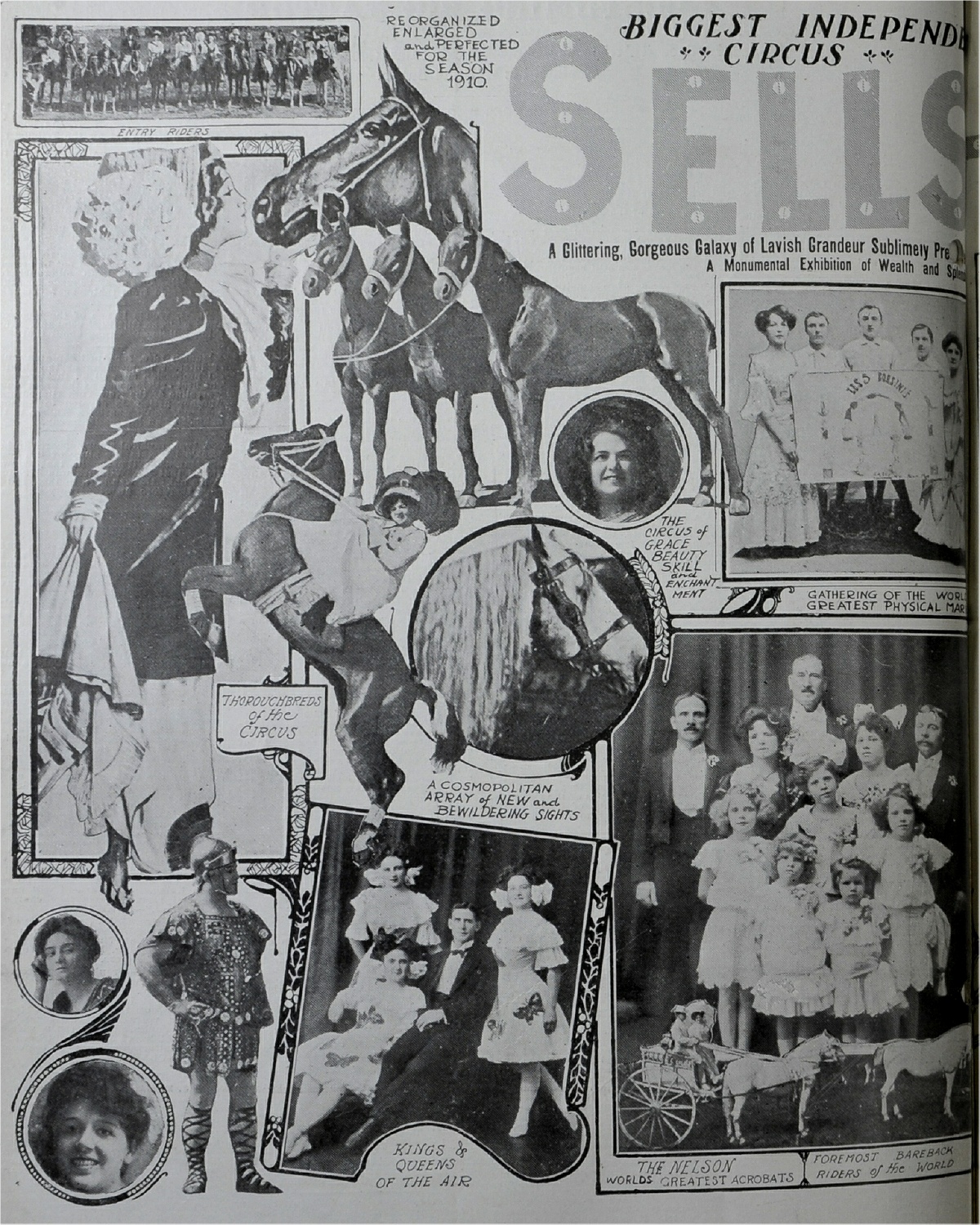
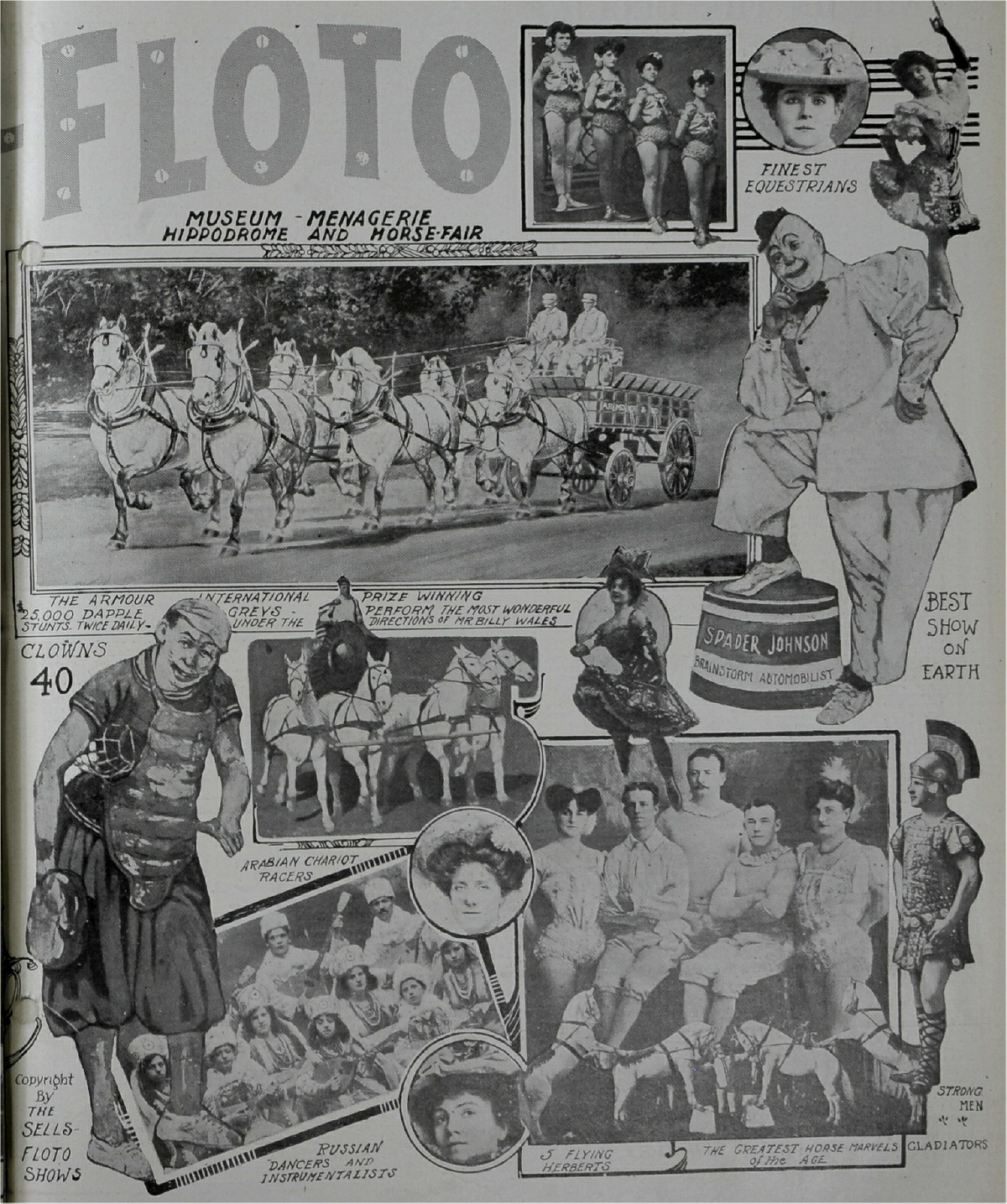
Show World, April 16, 1910 (Vol. V, No. 17), pp. 3, 6. All information should be checked with additional sources.
Webster City, Iowa, April 11. A. E. Root, treasurer of the Yankee Robinson shows, was granted a divorce in Des Monies last week from his wife, Minnie Root. He declares his wife deserted him because she prefers life behind the footlights to that of the sawdust rings. - Tucker.
Wallace Is Independent in the Circus Warfare
Peru, Ind., April 13. B. E. Wallace, the owner of the Hagenbeck-Wallace Shows and one of the most successful of the independent showmen does not admit that he contemplates any change in the management of his show or in its policies. He will persist in routing the Hagenbeck-Wallace Show in territory where he thinks its visit will be most profitable. On account of the great magnitude and the established prestige of the show he refuses to consider the routes of competing attractions or to be influenced by any plans of other managers.
Mr Wallace personally directs the building of his show from the ground up every year, and he does not worry as much about the route or the territory or threatened opposition as does the average billposter. With able lieutenants employed in each department he leaves the details of the publicity to them, the only manner in which he interferes is to the extent of chosing to take his show where he pleases in spite of the actions of others. He says he does not believe in personal law suits, in injunctions, in any form of spit work or in harassing other showmen in any way. If there is a conflict in any town he wants his shows to be well billed and their prestige maintained, and if any questionable work or reckless opposition is started by a competing show he wants his advance to adopt the same tactics in retaliation, but further than this he does not want his own advance to start any such work and will not encourage anything by legitimate opposition. Mr. Wallace zealously guards what he thinks is to be the interest and mutual benefit of all circus managers and proprietors and he will not sanction any movement financially or with his moral support that is sure to re-act on the business as such. If left alone the Hagenbeck-Wallace Show does not propose to interfere with other shows or to infringe upon their rights, but if it is attacked by any other attraction that does not come for many weeks after its date, then the management is determined that a dignifed fight shall be successfully maintained.
The above is the platform for the Hagenbeck-Wallace Show for the season of 1910, which opens in this city Saturday, April 23.
The following is the official roster of the show:
Executive Staff: B. E. Wallace, owner and manager; C. E. Cory, assistant manager; Bernard L. Wallace, treasurer; Edward C. Knupp, adjuster; George Atkinson, press agent; J. Delmar Andrews, press agent; Fred Wagner, special agent; Charles Hagaman, privileges; Jno. R. Andrews, assistant treasurer; J. H. Atkins, accountant; Don E. Wilson, treasurer privileges; F. H. Beatty, candy stands; Frank Ferleman, ticket inspector; James Davis, steward; Chas. Pheeney, twenty-four-hour man; E. E. Goodell, twenty-four-hour man; Arthur Hoffman, manager side show; Bert Cole, banner department; I. M. Southern, program; C. H. Sweeney, equestrian director; Chas. Crooks, assistant equestrian director.
Superintendents: Wm. Olknown, canvas; Chas. Herman, train; Wm. Winner, animals; Robt. Abrams, draft stock; Andy Dobbins, ring stock; Carl Nygaard, trainer; Chas. Curtis, wardrobe; Al. Woods, banner man; James Davis, cook house; Edward Springer, sleeping cars; Harry Goins, ponies; Percy Phillips, elephants; J. J. Rogers, side show canvas; Ted Weitzel, properties; N. H. Walker, assistant boss hostler.
Advance Department: R. M. Harvey, general agent; J. P. Fagan, railroad contractor; Frank J. O'Donnell, contracting press agent; H. L. Massie, local contractor; Jack Beck, local contractor; W. T. Murphy, special agent; Geo. Murray, brigade agent, Russell Davis, brigade agent; J. E. Eviston, manager No. 1 advance car; Alton Osborn, manager No. 2 advance car; Al. Farrar, advertising solicitor; M. L. Digman, advertising inspector; F. O. Rossman, boss bill poster No. 1 car; C. N. Munson, boss billposter No. 2 car.
Los Angeles Invents New Circus License
Los Angeles, April 12. The city council here, about six weeks ago, enacted a new tax on nearly all business concerns. This ordinance was passed and is now being published; the thirty days being required by law, and becomes effective Saturday, April 30. This new law makes the license on circuses, regardless of size, $500 the first day, $300 the second day, and $25 per day for each side show. As the Sells-Floto show will exhibit here on April 27-28, it will escape this new license. The Sells-Floto license is based on $5.00 per car for the first day and $3.00 a car the second day, and $25 per day for the side show. - Stuart.
Circus Notes
Mabel Vernon goes with the Gentry show the coming season, and will offer her snake dance in the Annex.
John White is in charge of the "front door" during the engagement of the Ringling Brothers Circus at the Coliseum in Chicago. He will divide his time this summer among the three Ringling shows.
Doc Springer, who has charge of the Hagenbeck-Wallace sleeping cars, has arrived at Peru, Ind., after spending the winter in Cuba.
Jay Thompson will be with the Hagenbeck-Wallace show again the coming season. He came from Denver to Peru last week.
George F. Cable left Chicago last Saturday to join the Gentry show as special agent.
Another of the famous "hops" held by the folks of the Hagenbeck-Wallace show will come off April 21 at Peru, Ind. "Governor" B. E. Wallace will be there and perfomers and executive staff will mingle for social delights.
The Gentry show will open April 23 at Bloomington, Ind., instead of at Mitchell, as has been printed previously.
The Danny Robinson show will open the season at Birmingham, Ala.
The Lamont Family have concluded their vaudeville engagements and open with the Hagenbeck-Wallace show on April 23. There will be twenty-six clowns with the Hagenbeck-Wallace circus the coming season.
L. P. Wilcox was in Chicago last week looking after ads for the Gentry elephants the coming season, as he has the advertising with that show.
Jerry Mugavin's Howe's Great London Shows is doing nicely in the extreme south.
Eddie Sauer is assisting John Helliott with the big animal acts of the Hagenbeck-Wallace show.
The Hagenbeck-Wallace show plays Peru, Ind., April 23; Marion, 25; Anderson, 26; Muncie, 27; Dayton, 28; Columbus, 29; and Newark, Ohio, 30.
Bernie Wallace has purchased a neew auto and may take it on the road this summer. John Ringling frequently makes the trips from town to towm in his machine when visiting the circuses controlled by the Ringling Brothers.
John R. Andrew has leased his "A Breezy Time" to Cooley and Thom and they are presenting it on the boat this summer. Mr. Andrew will be assistant treasurer of the Hagenbeck-Wallace circus again this summer.
Bob Terry, the veteran circus man, favored the executive offices of The Show World with a call while in Chicago this week and stated that he had recently visited the winter quarters of the Norris & Rowe circus, at Evansville, Ind., and was most agreeably impressed with the appearance of the general equipment. The show opens at Evansville, under the auspices of the Shirners, Monday, April 18. According to Terry, who has had forty years' experience with circuses, big and little, the Norris & Rowe aggregation is one of the prettiest ever assembled in this country.
Bob Terry and J. R. W. Hennessy will put out a wild west show on wagons this spring if present plans carry. The gentlemen were in Chicago Wednesday discussing the project. Hennessy returned to St. Louis Thursday, and Terry is to go to Cincinnati Saturday to look after the printing. The show is being built in St. Louis and will open in that vicinity, playing small towns in the middle west and south.
Corry, Pa., April 12. Jones Brothers' Buffalo Ranch Wild West will start active rehearsals here the last of this week. They open here April 23 and the town was billed last Saturday. The advance car, newly painted, left in the night for the season's campaign. J. W. Campbell is car manager and Col. John Welsh, the general agent. John Crook of Corry, has signed as steward. The equipment of the train, as near as can be stated at this time, will be one advance, three flats, two stock, four sleepers. - Berliner.
Show World, April 23, 1910 (Vol. V, No. 18), pp. 3, 5, 6-7, 16, 21. All information should be checked with additional sources.
Notice to Show Folks and Others Interested in an Independent Newspaper
It is understood that the Ringling Brothers, Barnum & Bailey and Forepaugh-Sells Bros. circuses, all owned by the Ringling Brothers, refuse to permit The Show World to be sold in the customary way to their employes. The Show World therefore suggests that such people arrange to have this paper delivered to them each week by subscribing direct, or by securing it at the news stands in the various cities. Circus artists cannot afford to miss the weekly news budget presented in The Show World, covering the current events in the amusement field including all circuses, be they large or small.
Tammen Flays the Circus Trust
The uniform circus license ordinance is occupying the attention of the entire circus world. Following the lead of Kansas City, the city of Denver has adopted it by unanimous vote of the supervisors and city council.
In the Billboard of April 16, B. E. Wallace, Louis E. Cooke and John F. Robinson express violent disapproval of the ordinance. Mr. Tammen was interrogated by The Show World in regard to the arguments advanced by the above named circus men, and replied as follows:
Tammen's Statement
"I generally prefer, if an answer is at all of public interest, to answer it in the paper in which the statement may have been published. But, as the Billboard is the organ of what is commonly known as the Circus Trust, and refuses to print any matter from those who are opposed to its policies, the rule that I have made in this matter has to be broken. I am laboring under the assumption that The Show World prints both sides of every controversy, regardless of whom it benefit or hurt.
"I can readily understand that the Ringling Brothers, owning the Ringling Brothers Shows, Barnum & Bailey Shows, and this year having rehabilitated the Forepaugh-Sells Shows - who boast of earning a million dollars yearly, and expect to earn a million and a half of dollars this year - would condemn, malign, and, if it were in their physical or financial power, destroy anything or anybody who would interfere with their obtaining their regular million or million and a half stipend each year.
"If the records of the licenses for their circuses which they have paid throughout the United States were investigated, a thing which I am now doing, it would be found in seventy-five per cent of all the towns that they visit each year that their fixers and agents are glorified and endorsed by their employers every time they succeed in having an official violate his oath of office and defraud the public in the town in which they show of what is its right under the law and the ordinaces of the town, county or state.
"That Mr. Cooke, of the Buffalo Bill Show, should condemn the Sells-Floto Shows is quite apparent, because his particular sphere in the circus world has been to say, 'Me, too.' But he is a good fellow,and the less said about him the better.
"In reference to the Hagenbeck-Wallace Show, everybody throughout the United States knows Mr. Wallace. Rightly or wrongly, he is at leas credited with having carried on the biggest graft outfit that ever exploited a community or a country, and that he should find fault with being compelled to pay a respectable license will surprise nobody, because that has been his alleged business pretty nearly all his life.
"John Robinson is a good big fellow, the son of his dad, with a circus one hundred years old, started by his great grandfather and handed down to him. As I don't know the gentleman personally, there is no occasion to say anything, excepting that he has a right to his opinion.
Eight Years for Sells-Floto
"The Sells-Floto Circus has a half million dollars invested and is now eight years old. It was ordained some seven years ago by a combination of circus owners, with the Ringlings at the head, that because ample capital was at the back of this show, it should not continue to exist, if it were possible, through the steam roller methods they had at their command and their expertness in a guerilla warfare dating back a good many years, to carry them out. Knowing this, shortly after the Sells-Floto Show was in the field, its practical owners, Messrs. Bonfils and Tammen, as much as a matter of curiosity as the making of money, endeavored to see if they could not solve the problem that he who works and is honest, with sufficient capital, migh succeed against any combination, provided the merchandise or amusement enterprise he presented to the public was of a character that the public desired. So we have been going along from one year to another, growing bigger and better and stronger each and every year, and, not as a defiance but merely as a statement, we expect to continue along the lines we have gone forever and ever.
"The circus licenses charged are different in almost every community, and in some places a circus with twelve cars is charged a license as high, or higher, than a circus with eighty cars; all of which may be fair for the big show, but certainly not for the little one, and with that point in view, and to remedy this injustice, and in the spirit of American fair play, the Sells-Floto Show is using all of its efforts to make a uniform license - that is to say, an eight-car show should not pay nearly as much as an eighty-car show. Nor should a show that charges 25c admission be charged the same price as a show with 50c admission. While the scale as suggested may in some instances be out of proportion, if applied to the smaller town it is certainly not if applied to metropolitan cities such as San Francisco, Los Angeles, Portland, Seattle, Denver, Kansas City, etc. For that reason, Sells-Floto's efforts, under the direction of Messrs. Bonfils and Tammen, will continue to work for license reform until it is clearly showsn that the licenses as now proposed are wrong, and that can only be shown by trial and discussion.
Interstate Commerce Commission to Make Rates
"While on this subject, it may not be out of place to say that this same rule applies to the railroads. Every circus man knows that the Interstate Commerce Commission has made no ruling as to fixing a uniform rate for the carrying of a circus train. The reason for that is probably that the railroads themselves, as well as the interested big circus proprietors, at the time the Interstate Commerce law went into effect, August 27, 1907, arranged this on account of the excursion business that came to the railroads; the other excuse being that no one could classify a circus train to make an equitable rate. And so it was ruled and is now an accepted law that the railroad company may make any rate it sees fit for transportation of a circus, irrespective of its size. For instance, an eight-car show may be charged $200 a movement and an eighty-car show may only be charged $300, or they could make it $200 if they so desired.
"Now, Sells-Floto proposes, through the efforts and direction of Messrs. Bonfils and Tammen, to bring before the Congress of the United States and the President of the United States, and the Interstate Commerce Commission, this injustice also and endeavor to have a ruling made - this under the direction of the Interstate Commerce Commission - which will be equitable to all.
"And it is here and now suggested that this can be easily done by, we will say, using a flat car with a capacity of 50,000 pounds, to be billed as a 40,000 pound car; and a 60,000 pound car to be billed at 50,000 pounds. This, in so far as the transportation of the actual freight is concerned, would be equitable,for the reason that, as every circus man knows, every circus train is loaded to capacity.
"In reference to the people carried with each circus, a uniform rate could be made, just as excursion rates are allowed. For instance, one cent per capita per mile for each and every person carried on the circus train would be fair. This is not suggested as being the actual method that should be adopted, but this is what we have under discussion with our attorneys in order to evolve a method that will be equitable to all, in comparison to the present manifestly unjust method.
"Of course, the Ringlings, with their combination shows, fight this fair proposition of Messrs. Tammen and Bonfils, and so will probably some of the others that are earning a million or more a year. But the forty small shows, traveling by rail and performing under canvas, certainly will joyfully appreciate that there is an opportunity to be taken out of bondage, because such a penalty as is now charged against them destroys any possibility of great success before they begin."
Wallace Opposes Ordinance
In the Billboard article referred to B. E. Wallace made the following statement:
"I do not approve of the methods that are being adopted by some so-called independent showmen. There is undoubtedly a movement now abroad that is actuated entirely by malice and spite. It was originated by certain showmen who are willing to wreck all other shows as well as their own if they can thereby destroy the prospects of their business rivals. Such methods are foolish in the extreme, unbusinesslike and savor of baby play.
"These men who are back of the high license movement for circuses do not pose as philanthropists, neither can they claim to be successful showmen, for never have they had a successful or profitable season and yet they would raise the circus license a hundred fold - that is malice run wild. Because they have been unsuccessful they would destroy all possibilities for others.
"Circuses give more for the money than any other form of enterainment. People pay from 50 cents to $2 to see a theatrical entertainment given by perhaps six to thirty people, occasionally a few more. Their receipts may amount to upwards of a thousand dollars, most of which goes out of town. The circus comes along with its almost thousand employes, its hundreds of horses. It gives a grand free street display and brings a zoological garden right to the doors of the public. It has several bands of music and its program of entertainment is so varied that it pleases every one. Thousands of people attend the circus daily who never attend any other form of entertainment, because they can not afford to do so. The circus is truly the bargain counter of amusements, and yet this very fact of public approval is proposed to be used as an argument why it should be put out of business by prohibitive licenses.
"If it were not for this liberal patronage and unlimited popularity the circus could not exist, even if license was free. The most expensive and most hazardous business proportionately is the circus, and the names of successful showmen in the history of this country can be counted on less than ten fingers.
"Towns void of amusement, where it is not encouraged are invariably dead towns. In a short time they make an effort to create amusement excitement by collecting hundreds of dollars from the merchants to induce a carnival or some form of amusement to come there, all for the sake of drawing a crowd. The circus saves the local people that expense, and at the same time brings the crowd. If a vote could be had on circuses, whether a license fee be charged or not, if the coming of a modern circus was at stake the populace would vote almost unanimously for a no license.
"License is all right, and the circus should usually pay one, but it should be nominal - it cannot be considered a source of revenue. City parks, public zoological gardens, play grounds and the like are not supposed to be productive of revenue but are a source of expense. What if possibly the coming of the circus should entail some expense to the city, is that expense by the city a good investment? If the circus did not come there, hundreds of their own people would go to the nearest place, where they do welcome the circus, for they will have amusement, if not at home then elsewhere and where they go for amusement they will spend money.
"It would be right to grade a circus license by cars, perhaps that is the most equitable way - but the fee per car should be nominal, and should be the same. It is ridiculous to assert that the man with the forty or eighty-car show should pay more per car than the man with the ten-car show. The man running a billiard hall pays the same rate if he has ten tables as does the man who has two tables, the rate is the same per table. The liveryman may pay a tax according to the number of stalls, but the man with the largest barn does not pay more per stall than the man with the little stable. The waterworks department may regulate the water rent on the number of rooms in the dwelling but the man with the mansion does not pay any more per room than the humble resident in the cottage, or if the rate be fixed by the thousand gallons, the concern using a thousand gallons a day or an hour does not pay any higher rate than the concern that uses one-tenth as much. The proposal to increase the circus license as the ratio of cars increases is absurd and without any precedent in any business, and circus business is legitimate.
"The fact is a dollar a car is enough for any circus to pay, and at that rate when the total licenses paid during the season are added and to it is added the taxes paid on the property itself in the usual way, it will be seen that the circus proprietor is hard hit for the privilege of conducting a busniss that has a right to fair profits, but which would be impossible under the proposed increased licenses.
"I am constantly receiving letters from towns and cities wanting a visit from the Hagenbeck-Wallace show. they offer to throw off the license entirely or agree to make it extremely nominal. I will go to such towns and stay out of cities that try to place an embargo on a circus. Others may do as they see fit, but my circus will not be taken to any city that adopts any such license scheme as it being agitated by a faction of men who want to ruin the business.
"However, I will not worry. The people will not tolerate such license demands and those officials who shut circuses away from their constitutents will find themselves unpopular. They forget that not everyone can afford to go to a city on a pleasure trip, that not everyone can go to the seashore, that not everyone can go to the better class of theatricals but that most people must attend the popular-priced attraction such as a circus or stay away from all amusement.
"Finally such license ordinance as is proposed would be illegal and so declared by any court as fast as such cases could be presented. Cities cannot assess prohibitive license nor discriminate in the same line of business. Every city that adopts any such license scheme will find itself with some lawsuits on its hands and will eventually be the loser financially, while in the meantime the people who want the circus will be deprived of the privilege of enjoying their chief form of amusement."
John Robinson's Views
The Billboard then presents an interview with John F. Robinson, as follows:
"In the first place, 'dammit,'" says the Governor. "A universal adoption of this blankety blank excessive license would mean either the immediate extirpation of all circuses carrying more than 36 cars, or that the proprietors of the big shows would necessarily eliminate the towns adopting these exorbitant rates, from their route."
Further, he continued: "In addition to materially doing the larger shows a great injustice, considerable loss would be felt by merchants, dealing in food stuffs and other lines of daily necessities; as a circus being virtually a moving city, requires a great amount of supplies that are purchased in the towns where the show is playing. Hotels, etc., will also lose some trade they now enjoy."
"The fairest license code of any state is the one now employed in Virginia," explained the Governor. "Its system is to charge twenty dollars for each performance, in addition to five per cent of the gross receipts. This method is absolutely equitable to all circuses, be they small wagon shows or aggregations, whose proprietors by dint, energy and good fortune, have brought their business up to the requirement of fifty, sixty, or more cars. By this method the license is charged, is made commensurate with the amount taken in by the circus."
"How about the statement made that the larger shows have a receiving capacity of twenty thousand dollars per day," the Governor was questioned. "This is ridiculous," he answered. "The cases are very rare when a show will take in that much money in one day. The only case on record where a show took in more than twenty thousand dollars, was of the Buffalo Bill Wild West Show, which at one time, when playing Dallas, Texas, took in twenty-one thousand dollars in a day. The Barnum & Bailey circus one time played Philadelphia to seventeen thousand, in one day. These two cases are exceptions, and I do not believe any other show can truthfully say that it ever made as much money in one day."
Do you consider the present license charges of different cities discriminative and must the small circus now pay as much as its larger contemporary?
"Some are, and others are not. In most cities, the price of admission charged, fixes the license. In other communities the population affects the rate of taxation."
How do theater and other local amusement license compare wiht circus licenses? was asked.
"The license charged a theater is very much lower than that levied upon the transient amusement enterprises, but people do not stop to think how much more money is spent at theaters in a season than is paid to circuses.
"This unjust and vindictive agitation by the paper which has fathered the projected exorbitant taxation states that a transient business of this character (circus) laying its heavy tribute upon the savings of the community and leaving no recompensing benefit save that of amusement, is wrong, and I want to repudiate it at once. A circus never charges more than $1.00 for admission, while the first-class theater prices range from $1.50 to $2.00 per seat. A man can take his wife or daughter to see a circus and occupy two of the best seats in the tent for $2.00, while if he attends a theater, he must pay double this amount. The only difference between a circus and theater, is that the former comes but once a year, while the theater is open at least eight months."
How do you account for certain mayors thinking favorably of this new code?
"That is a very simple question to answer," said Governor Robinson. "They have not fully considered the question from all angles. Let every fair-minded official understand that the big shows have expenses in proportion to their earnings, and he will immediately concede that the proposed tax is entirely too high. If a new license code is contemplated, let all city and state officers first consider the Virginia law before adopting any other. Stop and consider the fairness of this license. If a big show takes in $10,000, the city gets five per cent in addition to the regular tax of $20.00, but if a small show comes along and only does $1,500 business, the city gets its per centage just the same. Isn't that a fair law?
"Now let me ask you a question," said the Governor. "Why do you suppose the paper sponsoring this new tax is so much in favor of its adoption? Do you suppose that through a realization of its ethical responsibilities this publication is exploiting a philanthropic scheme? Emphatically no," he hastily added, not allowing an answer. The fact is, as every showman knows, the publication is subsidized, or owned by a certain faction in the circus business, that is after their scalp of another company, and in order to wreak their vengeance on this latter concern, are unjustly advocating a measure that will jeopardize the business of every other proprietor of a large circus. Is it not quite a remarkable conincidence that the circus owning the belligerent journals, has a few less than 36 cars?"
Would a uniform license fee be welcomed by circus men?
"Yes," he answered, "if it were a just one, such as the Virginia law. The statement, however that a general law would aid circus proprietors in estimating expenses, is the epitome of ridiculousness, for conditions vary in almost every city. A circus owner does not expect to pay the same amount for commodities. As for the damage done to streets by the large circuses, I'll venture to day, with the excellent improved wagons now used by the big shows, less wear and tear on thoroughfares, is made than with the wagons of the smaller shows that are usually overloaded."
Cooke's Statement
Louis E. Cooke, general agent of the Buffalo Bill-Pawnee Bill Wild West Show, has this to say in the Billboard:
"My attention has just been called to a circular inquiry which has been promiscuously mailed to various parts of the country, suggesting a sort of blanket ordinance for a 'uniform' (?) circus license throughout the country. As a matter of fact, the ordinance proposed, which is now in effect in Kansas City and one or two other municipalitites in the West, has a jolly little joker of the Ethiopian variety, such as is usually found lurking in obscure fence corners and wood piles, and was evidently framed up in the interest of a few parties who had an axe to grind in the way of a small show of '30 cars or less' as this form of ordinance simply offers a premium on small shows and practically places a fine upon the larger ones because of their magnitude and superiority. In other words, the larger and better a show becomes, the more onorous the tax as under the proposed regulation a show of 36 cars or less may exhibit under a license fee of $10 per car, but anything over that number of cars must pay $25 per car.
"That graduated circus license is desirable must be conceded as a show of two to ten cars, usually exhibiting for twenty-five cents admission, could not and would not be expected to pay as high a license fee as a larger show, but at the same time it is anything but fair to 'fine' one of the larger enterprises for trying to give the public a little more for their money than the small fellows. And in my opinion the licenses as they now exist and average throughout the country are generally fair and equitable wiht the exception of a few cities, where the local authorities have taken it upon themselves to frame up exorbitant laws or regulations governing the license fees for exhibitions, parades, and other conditions whihc the ordinary circus has to confront. It happens, however, that there are only a few cities of this kind, situated in diffrent parts of the country, and if the circus people choose to do so they can easily avoid any of the hold-up towns and at the same time find plenty of good show stands where they will be treated fairly.
"Personally, I rather favor an elastic ordinance, giving the mayor or license committee of each city the right to use their discretion as to a license ranging from $10 to $75 per day, according to the size of the show, number of cars, and importance of the exhibitions. This would enable a small show with from one to six cars to exhibit at the minimum fee and all other shows could be graduated according to the number of cars carried or the admission fee charged. And after a long practical experience in the matter of handling the license proposition I am of the opinion that there will be little difficulty in getting proper treatment and consideration from the local city authorities everywhere as it is the tendency to nearly all municipal corporations to welcome any enterprise that appeals to the amusement-loving citizens or in any way interests the public at large.
"It is equally trune that in some instances the local authorities seek to resent certain misrepresentations and lack of courtesies on the part of some of the show people, and for this reason the innocent are made to suffer for the short-commings of those who have gone before. This usually accounts for the exorbitant fee in certain cities, and in all sorts of restrictions and obligations which one has to confront in the matter of street regulations, demands for tickets and other obstacles which are put up as 'hurdles' for the advance agent to get over.
"On the whole I am of the opinion that it would be a great mistake to agitate the matter of licenses as a general proposition throughout the country, and until the time comes when all such matters can be regulated by the government or state laws it will be impossible to get any concerted action or establish a uniform scale of llicenses in the various cities as each individual city must always have its own views upon these subject, and whenever it is found impossible to treat with the local authorties in a satisfactory manner I suggest that the traveling shows pass them by and make it a point to visit such towns and cities as give them fair treatment and a cordial welcome. But it will be a mistake to undertake to frame up a license fee based on the seating capacity or the probable receipts of any show since I have one or two instances in mind where a show was assessed a certain license fee after a surveyor had measured up all of the number of seat planks and made a mathematical estimate as to show many people they could seat, notwithstanding the fact that when the performance was given notover one-half of the seating space was occupied. Therefore it is easy to see how difficult it is to base a license fee upon the capacity of a canvas, and it would be equally as preposterous to think of counting the admisssion tickets in order to determine how many paid admissions were actually received at each performance.
"If any concerted action is taken in this matter, I suggest that a sliding scale be adopted for various-sized shows, the exact standing of which should be based upon the number of cars and admission charged regardless of the seating capacity, number of people, horses or wagons. This would give the small shows an equal chance with the 'big fellows,' and no misrepresentations could possibly occur."
Player's Opinion
The Player, a New York publication, makes the following criticism upon the ordinance:
"A circular printed in letterheads of the Denver Post has been sent to the mayor of every town of any importance in the country. Its purpose is evidently to increase the rate of license for fifty cent shows. As the circular is signed by the Denver Post, 'per H. H. Tammen, President,' it is taken to be one of the steps which Tammen has taken to revenge himself upon the Ringling Brothers. If the circular is taken seriously it will react on independent shows as well as trust shows. With the exception of the Sells-Floto show (which will appear at 25-cent top prices this summer) every tented enterprise of any size in the country resents this action and showmen generally think that Tammen has evidenced bad judgment by this move. It is not so much the danger of having licenses increased, say the showmen, as the spirit which prompts a fighter to pull down the roof on his own head and the heads of his friends to revenge himself upon someone else.
"The circular points out that licenses as a rule are not uniform and that in places they are discriminative as there is no difference made in shows charging 25 cents and shows charging 50 cents. The letter says that the 50 cent shows have a receiving capacity of $20,000 a day, while the smaller ones can only take from $750 to $3,000 a day. The fact that the large circus injures the streets is also emphasized and the aim of the circular is to increase the license of the big shows.
"Contractors say the mayors of most towns look upon the circular as a joke. They do not believe it will have any influence. It may be true that circus licenses are not always as high or as low as they should be. City councils and circusmen will ever disagree on just what is right."
McCraken Worried
The license question is evidently as irritating one for the Ringling Brothers, according to Samuel McCracken, general agent. The following article appeared in the Minneapolis, Minn., Tribune, last week:
Fee Too High For Circus. Ringling Shows May Pass Up City Unless Daily License Is Reduced.
Minneapolis may be eliminated from the circus map unless it reduces its license fee for such attractions to $500 a day, to conform with the license price in other large cities.
When Samuel McCracken, general agent for the Ringling Brothers and Barnum and Bailey shows reached the city yesterday and learned that the fee had not been reduced, as he had been assured it would, he declared the Ringlings would not exhibit here this year unless it was cut. It is a question of principle and precedent with the circus company, said Mr. McCracker, and not a case of the show's fear of bankruptcy if it paid $1,500 daily to Minneapolis during its exhibitions here.
At the last meeing of the city council a resolution was introduced calling for a reduction of the circus license. This was referred to a committee made up of one alderman from each ward. It is reported that a majority of the councilmen favor cutting the fee, as they have been informed the big show companies will refuse to come here unless the license is reduced and that the city would lose thereby. The committee is expected to meet this week.
Mr. McCracken declares that many people mistake the purpose of a circus license. It is not levied, he says, to gain revenue for the city, because the attractions are few and the total sum yielded annually is not great. The real object of the fee is to insure the people against roving shows which deceive the public with fake exhibitions, he avers. Only the better shows can afford to pay even the $500 license price, he says, which is sufficient to guard the citizens against undesirable "outfits."
[Notice] Following its policy of presenting all the news in the amusement world, without fear or favor, The Show World will print each week pertinent comments upon the red hot controversy now raging in the circus field. Communications are solicited from all sources which may be of interest, whether in favor of the Ringling Brothers, Hagenbeck-Wallace, Sells-Floto, H. H. Tammen or F. G. Bonfils, personally, or against them. The Show World is the only amusement journal in America following this policy, and to secure all sides to the controversy you should read it. From time to time The Show World will express its opinions editorially. Join the ever increasing army of readers of the paper that prints all the news.
First Guns in Circus War Fired in the West
"Coming Soon" Heralds Make Their Appearance
San Bernardino, Cal., April 18. The circus trust has begun its guerilla warfare against independent shows, and the "Coming Soon" herald is being distributed broadcast throughout Arizona and California, where the Sells-Floto Shows are billed to appear.
Nick Petit, contracting agent for the Barnum & Bailey Shows, arrived in Phoenix, Ariz., last week. That the public at large has become familiar with these tactics is shown by the comments in the daily press. The Phoenix Democrat says:
"Nearly two years ago the war of the circuses of the United States was begun in Phoenix, and from all appearances has been waged continuously from that time on. It seems that the merry fight continues, and Phoenix is promised her share of the fray this season.
"Some time ago it was announced that the Sells-Floto circus would appear in Phoenix on April 21. Today the fine Italian hand of the so-called "trust" made its appearance in Phoenix, thousands of dodgers, stating that 'The World's Greatest Shows,' the Barnum & Bailey attraction, would 'positively appear in Phoenix, the exact date to be given later.'"
"To the casual reader this seems but part of a legitimate campaign of advertising being carried on by two rival attractions, but under the surface it in reality means but the first move in a war to the death being carried on by the circus trust and the backers of the Sells-Floto Show.
"No sooner does the Sells-Floto circus get its paper posted, announcing the date of its appearance in any town, than comes along a representative of the Ringlings, advertising that some one of the big attractions controlled by the syndicate is 'coming soon.' Sometimes it comes and sometimes it does not, but the effect is generally the same - more or less people remain away from the smaller show, with the expectation of seeing something bigger and better later on in the season."
The circus war in the far west is being waged with much bitterness. In this issue of The Show World is reproduced the "Coming Soon" opposition herald, mentioned above.
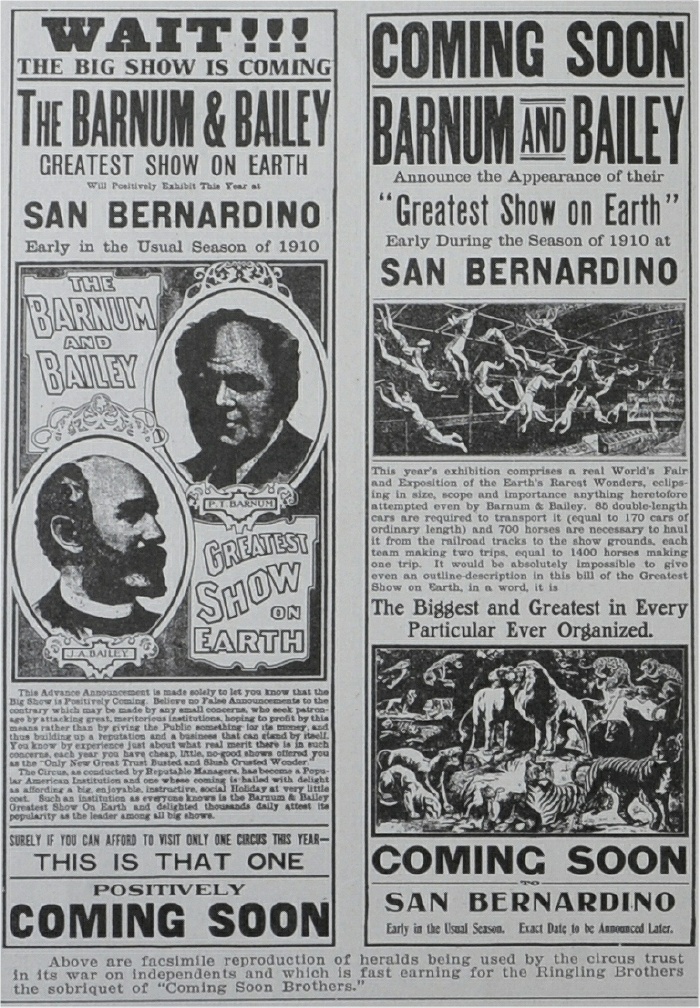
Bill Posters Are Interested
Secretary of Organization Suggests that Billers Electioneer City Officials
The Associated Billposters of the United States and Canada have interested themselves in the proposed legislation. Secretary Charles Bernard sent out five hundred telegrams to city billposters throughout the country, reading as follows:
"Chicago, April 12. Denver Post owners Sells-Floto and Show World wrote your mayor, requesting lecense ordinance to be regulated according to cars used. Ordinance framed to prohibit big shows and would shut you out of their posting. You should explain to mayor and prevent ordinance passing. Charles Bernard."
A representative of The Show World called upon Mr. Bernard and asked him if he thought it fair that the Sells-Floto Shows should be allowed to live and pay their bills, and follow the law of the land. It was also suggested to Mr. Bernard that the Billposters might draft an ordinance to their liking and have same adopted. Mr. Bernard said that in his opinion the Sells-Floto shows had a perfect right to live and conduct its business, but that the Associated Billposters were not in favor of the uniform license, as promulgated. He was for a number of years treasurer of various circuses before assuming his present position, and in commenting further upon the circus license ordinance, as passed by Kansas City and Denver, said:
"Any form of license ordinance which would compel a circus using twenty-five or more cars for transportation to pay to a city any amount in excess of $200 per day is in my opinion detrimental to the interest of the circus proprietors generally, and to billposters, merchants, individuals and firms regardless of what business they my be engaged in, in the city where such exorbitant license is in force. My views on this subject are based on facts. My experience as treasurer of circuses and in connection with the advertising department of circuses through a period of sixteen years demonstrates beyond a question of doubt that the cities or towns which show a disposition through their city ordinance to encourage circuses and other legitimate amusements paying reasonable license ordinances were the towns and cities where progress was stamped on every line of busines. On the other hand the towns and cities having exorbitant license as a rule were not desirable from a business point of view for the amusement enterprises.
Savannah Case Cited
"Further, I will cite the experience of the past year at Savannah, Ga., which had prior to December, 1909, a city license of $500 for the larger circuses. After the exhibition of three of the larger circuses in October and November the license was increased by the city council to $1,000 per day. After this license had been passed, I made inquiry of W. E. Franklin, general agent of Sells-Floto Shows what business had been done by the Sells-Floto Show in Savannah and the effect of the Savannah license on the show business. He stated that their day's receipts for the Sells-Floto Show in Savannah were as good as they had hoped for, and all they could expect to get in a city of that size, but after paying the exorbitant license they left Savannah with no profit on their day's business. If there was no profit after paying a $500 license, most assuredly there would be a loss after paying $1,000 license, which must now be paid under the Savannah ordinance by any of the larger circuses visiting that city. I am very frank in expressing my opinion that every member of the Associated Billposters and Distributors, regardless of the size of his city, should urgently and earnestly make every effort possible for his mayor and members of council to adopt and enforce a permanent circus license ordinance, which would regulate the payment of license based on price of admission, with the maximum amount of this license for one day's exhibition not to exceed $200. I consider the circus a legitimate business enterprise, beneficial to the towns and cities visited and believe that any local legislature which compels the circus to pay a greater license thanis charged the local amusement places is both arbitrary and iscriminating. My only object in taking an active interest in the matter of regulating license ordinances for circuses, either in my official capacity for the Associated Billposters or as an individual intersted in out-door advertising business, is to serve the interests of my associates in the organization of which I have been the secretary for ten consecutive years, as well as every billposter who has capital invested in billposting plants and needs the necessary protection and support from local interests and legislaltion as well as the patronage of this class of out-door advertisers. A license so large as to make profits impossilbe on the day's business of the circus must necessarily prohibit the circuses from visiting the cities where such license is in force, and prohibiting the exhibition of circuses by high license necessarily prohibits the billposter from receiving any circus patronage. Experience teaches the billposter that the circus is a liberal customer, prompt in payments and invariably friendly to the interests of the billposter; therefore, it is only an exchange of courtesy and a duty that the business owes to its patrons to make some effort when occasion requires to assist in promoting the best interests of the customer."
Circus License Ordinance Now in Force in Kansas, City, Mo., and Denver, Colo. and Being Considered by Many Municipalities
An Ordinance relating to the giving of circus performances, exhibitions of menageries, combined circuses and menageries, caravans and like entertainments or amusements, the licensing of the same, and repealing all ordinances and parts of ordinances, in conflict therewith.
BE IT ENACTED BY THE COUNCIL OF THE CITY OF ...................................................................
Sec. 1. Each and every circus, menagerie, circus and menagerie, or other amusement being transported upon railroad cars from place to place, when such cars exceed two in number, shall, before unloading said cars or before giving any performance of entertainment within the city limits or any territory adjoining over which the city authorities have jurisdiction, pay a license, as follows: When the number of cars used in the transportation of the circus, menagerie or other show or amusement exceeds two and is not greater than thirty-six cars, there shall be paid for each exhibition day, whether one or two performances are given, ten dollars ($10.00) for each car when the general admission fee does not exceed fifty cent and twenty-five cents or more is charged for reserved seats. If the general admission fee does not exceed twenty-five cents and the charge for reserved seats does not exceed twenty-five cents, the license shall be five dollars ($5.00) per car.
All such amusements requiring in excess of thirty-six cars and under fifty cars for their transportation shall, for each exhibition day, pay a license of twenty-five dollars ($25.00) per car when a general admission fee of fifty cents or over is charged and a charge of twenty-five cents or over is made for reserved seats. If the general admission fee does not exceed twenty-five cents and the charge for reserved seats does not exceed that amount, the license for such shows or amusements requiring in excess of fifty cars for their transportation shall, for each exhibition day, pay a license of fifty dollars ($50.00) per car, when a general admission fee of fifty cents or over is charged and a charge of twenty-five cents or over is made for reserved seats. If the general admission fee does not exceed twenty-five cents and the charge for reserved seats does not exceed that amount, the license for such shows or amusements shall be twenty-five dollars ($25.00) per car for each exhibition day.
Sec. 2. No extra license shall be paid for sideshows or concerts where the same are bona fide under the same management and ownership as the greater show or amusement.
Sec. 3. All other ordinances or parts of ordinances in conflict herewith are hereby repealed.
Salaries Proctor Missed
From $45 a week joint salary as ordinary "Joeys" with the Ringling Brothers' Shows in 1896, to $1,100 a week as premier comedians with "The Silver Star," is a far cry, but this is Bickel and Watson's record of achievement. Frank ("Silvers") Oakley received the munificent wage of $16 a week with the Ringling Brothers' Shows in 1895, and he is now principal clown at the Hippodrome, New York, at a salary around the half-thousand mark.
Spader Johnson, for the nonce has deserted vaudeville to re-enter the circus ranks, as principal fun-maker with the Sells-Floto Shows. It is reported that he has in preparation an original act for vaudeville audiences next fall and winter.
Truly, this is a golden age for the circus clown of ability, who keeps pace with the trend of modern demands. The day of the slap-stick is over. It takes brains to be a good clown, who can almost name his own salary, either in vaudeville or with a circus.
Here for Circus. Bert Delno and Ida Miaco were here Tuesday from Indianapolis to see the Ringling circus at the Coliseum. They returned to Indianapolis before reporting at Peru for the opening of the Hagenbeck-Wallace circus on Saturday of this week.
Circus Woman Shoots Alleged Indiana Peeper
Evansville, Ind., April 16. James Simpson, married,is reported to be dying today as a result of being shot on the Pottery grounds, where the Norris & Rowe circus was opening the season. It is said several men and boys had been hanging around the dressing tent of the actresses, and one of the actresses became enraged and shot through the canvas. The ball struck Simpson in the left temple and entered the brain. Mrs. Jennie Mallor of Danville, Ill., wardrobe mistress, was arrested and confessed to the shooting.
Frank C. Bostock's Wild Animal Circus will be a feature at Dreamland, Coney Island, this season.
Ranch Show Opens in Rain
St. Louis, Mo., April 16. Despite the dampness, many persons poured through the gates at Handlan's Park, St. Louis, Mo., for the initial performance of the Miller Bros. 101 Ranch Wild West Show last Saturday. While the arena in which the feats of horsemanship are exhibited is without shelter, the audience is amply protecterd by canvas covering. The show is a unique exhibition in that it combines the features of circus and wild west. Among the performers are noted horsemen, expert lariat throwers, fancy shots, daring broncho busters, cowboys and Indians. A street parade was given here today.
Gentry Bros. Opening
H. B. Gentry, of the Gentry BRos. Famous Shows, transacted business in Chicago Tuesday and Wednesday, and to a Show World representative stated that in his opinion the coming season would undoubtedly be the best experienced by tent shows in many years. The Gentry Bros. will open at Bloomington, Ind., Saturday, April 23.
Sells-Floto Opening
Albuquerque, N. M., April 16. The Sells-Floto Circus opened the season here today, playing to two big audiences. The opening was auspicious in every way, the weather fine, and the performance went with a vim and snap which indicated careful preparation. Albuquerque has a population of 17,000, and the split-price of admission took the town by storm.
Hagenbeck-Wallace Opening
Peru, Ind., April 21. The Hagenbeck-Wallace Shows are in readiness to open here Saturday. Following is an addition to the roster, published in The Show World last week:
Bill Posters, No. 1 Car. F. O. Rossman, boss billposter; Gilsey Abrams, J. M. Admire, Jake, Backer, Zona Cope, Walter Curier, Chas. Cross, Frank Conn, W. B. Carson, Joe Cors, Jno. D. Comer, Ed. Forester, L. Hauser, R. J. Jones, J. P. Keegan, R. H. Lindsay, Harry Leslie, F. H. Pollock, Bert Reiss, Chas. Secor, Danny Sheehan, John F. Wingo, E. F. Webb, Arthur Eidnour.
Bill Posters, No. 2 Car. C. N. Munsen, boss billposter; Walter Clifford, C. R. Fulton, D. T. Judge, E. C. Bucher, Willis Bloom, J. N. Burget, L. H. Egan, J. F. Fenton, T. L. Harper, Chas. Holmes, Frank O'Brien, Lawrence Powers, J. A. Peterson, Wm. Perrault, Joe Scheenbeck, H. W. Thoma, W. R. Thompson, Chas. A. Martin, R. Scott, Albert Hoffmand, Horace DeGrush.
Brigade Men: Odee Abraham, I. C. Admire, Joe J. Disele, J. W. Foreman, Cliff Guy, Rufus Irons, Chas. A. Koster, Wm. A. Lane, R. D. Leister, J. W. Dedrowe, H. C. Newman, James F. Powers, Fred Stewart, Chas. E. Mikesell, Fred Cox, C. T. Crippen, Ernest Eisfeldt.
Side Show Department: Arthur Hoffman, manager; Lew Morris, assistant manager; Geo. Tarbox, ticket seller; J. Grear, ticket seller; D. Miller, ticket seller; Delmar Andrews, ticket seller; Rose Monroe, musican act; Sig. Arcaris and daughter, impalement act; Neil Scranton and wife, marionettes; Grace Gilberts, lion-headed woman; South Sea Island Joe and wife, natives of South Sea Islands; Mrs. Delmar Andrews, snakes; James Harto and wife, magic, bag punching, etc.; Andrew Sturtz, tattooed man; J. G. Lowery's famous minstrels; Abe Bodine and partner, Oriental musicians; Princess Fatina, dancer; Beatrice Leslie, dancer; Bessie Earl, dancer.
Clowns: Arthur Borella, Jim Rutherford, Ernest Girard, Dick Rutherford, Al Singer, Tom Hart, Henry Stantz, Everett Hart, Three Harddigs, Kid Kennard, Fred Jenks, Ed Kennard, Fred Delmont, Joe Kelley, D. W. Kelley, Specks Enos, Geo. Conners, Jim Savoy, Bill Savoy, Louie Plamondon, Harry Stokes, Bill Griffin, Tony DeKock, Petie Spadoni.
Big Show: Delno Troupe (8), aerial bars; Flying Meteors (4), areial bars; Merodias (7), bicyclists; Wm. Heumann Troupe (5), bicyclists; The Althos (3), Risley act; Ida Miaco, contortion; Carman and Roberts, contortion; Melvilel Stantz, frog act contortion; Charles Marvelle, frog act contortion; Elmer Querry, frog act contortion; Galarmo Ladies (5), aerialists; Anna Conners, aerialist; Cecelia Fortuna, aerailist; Two Plamondons, aerialists; La Troupe Carmen (6), high wire act; The Lamonts (7), acrobats; Tasmanian Sisters (6), acrobats; The Van Diemans (4), aerial teeth act; The Orloffs (3), areial teeth act; The Savoys (3), with 7 acrobatic dogs; Geo. Holland and Rose Dockrill, riders; Great Conners Family (6), riders; Charles Crooks, rider; Mary Bedini, rider; Winnie Sweeney, rider; Mlle. Thalero, rider; Gustave Thalero, trained ponies and dogs; Transfield Comedy Circus (5), with ponies, donkeys, dogs and cats; Four DeKocks, head and hand balancers; Kullervo Brothres, Swedish gymnasts; Kennard Brothers, comedy acrobats; The Harts (2), comedy acrobats; Delmont Troupe, comedy skaters; Fourteen trained elephants, in charge of Percy Phillips and Frank Gardner; Enos Family, rolling globe equilibrists; The Kelleys, rolling globe equilibrists; Juggling Harddigs (3), comedy jugglers; Eight Dellameads, living statuary; Inez Smith, swinging ladders; The Great Wallace School of Menage and High School Horses (14); Jenks and Clifford, eccentrics; John Helliott, animal trainer; Edward Sauer, animal trainer; Madam Dinus, chariot driver; Mary Abrams, chariot driver.
"Two Bills" Begins Movement
Trenton, N. J., April 20. The Two Bills show will leave here on April 24, in eighty-four cars, and will open in Madison Square Garden April 24. Among those rehearsing at the winter quarters are the Thompson, with their high school horses; Rhoda Royal; Rossi and his musical elephants; the Arabian troupe; Cossack riders; cowboys; Cingalese; Bedouins and Japs. Colonel Cody and Major Lillie have purchased a large tract of land here, providing a permanent home for the show.
Ringlings in Oil City June 2
Oil City, Pa., April 19. The Ringling circus is booked to show here on Saturday, June 11, being the first circus of the season. Circus men who have visited Oil City in the past will note with approval that West First street, which was almost bottomless in wet weather, has been paved with brick. Heretofore the wooden crossings on this street would not stand up under the weight of the heavy wagons, and many of them were broken. - Contino.
Sparks in Little Rock
Little Rock, Ark., April 16. The first circus of the season to visit this city is John H. Sparks' world famous show, billed to appear here April 19. - Duttlinger.
Copyright © 2011
Circus Historical Society, Inc.
No part of this information may be reproduced in any form or means
without written permission of the author and the Circus Historical Society, Inc.
Last modified November 2011