


Circus Historical Society
Bandwagon, May - June 1974
Back to Bandwagon Index
Bandwagon, Vol. 18, No. 3 (May-Jun), 1974. Note: Only some articles are included in this online edition. Many illustrations are not included. The Circus Historical Society does not guarantee the accuracy of information contained in the information in these online articles. Information should always be checked with additional sources.
Foreword:
This article, presented in five installments, will cover the circuses owned by the late Ray W. Rogers beginning with Burnett Bros, in 1928 and continuing through 1944, the final season for Wallace Bros. Rogers made an important contribution to circus history and it is felt his story should be told as completely as possible. He was one of the pioneer owners of a completely motorized circus and was the first person to ever bring a fully organized circus into the United States from another country (Canada) and remain here with it. The late William H. (Bill) Woodcock, noted elephant trainer and circus historian, who put in five seasons with Rogers, once told the author that he was the best motorized show owner he ever served with. The fact that Rogers was an outstanding circus operator is attested by the fact that he kept his show on the road for 17 seasons, through the great depression of the early 1930's, the severe recession of 1938 which just about killed off all circus business in this country, and on through the trying times of World War II, and he prospered at it. Very few showmen could adjust to changing times and conditions as could Rogers. He could operate a show one season almost as large as any of its kind on the road and the next year go out with a greatly curtailed outfit playing smaller towns on a limited route. For several seasons after the regular tour closed he would take out a small show playing little communities in the south and keep it out well into the new year. He could make money with a big one or a smallie.
We have been fortunate in gathering considerable information about Rogers and his various shows, much of it coming from his four surviving children, Walter, Helene, Norma, and Connie, all of whom were with his show from beginning to end. Some information has come from local sources in and around New Glasgow, N.S., Canada where Rogers made his home and launched his first circus, Barnett Bros, in 1928. The numerous credits for both information and illustrative material will be given at the conclusion of the final installment.
It is planned to illustrate this article with as many photos and other interesting items as is practical. Although it would be desirable for each installment to carry illustrations only of the years covered in the text this is impossible due to the over abundance of photos for some seasons and the dearth of shots for others so in many installments some photos will appear taken in seasons not covered in the text. This problem will only be of temporary inconvenience as everything will be in order when all installments have been run and the history of the Ray Rogers shows has been printed in its entirety.
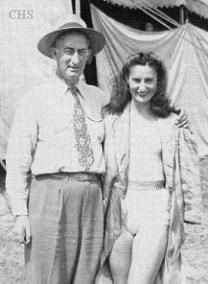 Photo No. 1 - Ray W. Rogers and daughter, Helene Rogers Hartzell, on Wallace Bros. Circus lot, season of 1942. Circus World Museum Photo.
Contrary to popular belief Ray W. Rogers was not a native born Canadian, instead he was born near Newport, Vermont in 1888, the son of Herbert W. (Bert) Rogers. From Vermont the Rogers family moved to New Glasgow, Nova Scotia. The exact date of this move is not known but it was probably in the very early 1900's. When Rogers' circus played Newport in 1929 he told a Billboard reporter that he had seen his first circus in Newport 31 years ago (1899).
Bert Rogers and his brother, Al, went into the livery stable business in New Glasgow and the Directory of Nova Scotia for 1914-15 lists Rogers and Company, livery, on Archimedes Street in New Glasgow. With the coming of more automobiles and trucks in the early 1920's the business was converted into an automotive garage. Ray worked for his father and uncle for many years and acquired a firm knowledge of trucks and motors which would serve him well when he later got into circus business.
As will be seen later Ray left New Glasgow permanently in 1928 but his father, uncle, and other relatives remained there through their lifetimes. A copy of the will of Herbert W. Rogers which was filed following his death on July 23, 1937 is in the Public Archives of Nova Scotia in Halifax in which he is named as a Canadian National Railway agent and left to his son, Ray Walter Rogers, the sum of $10.00 and the remainder of his estate to his wife, Christie A. Rogers, and his two daughters, Margaret Rogers and Edna Rogers Turner. (Pictou County Wills, Volume 16, 1930-1941, page 397).
How did this man, Ray Rogers, who seemed destined to follow his father and uncle's footsteps in the livery and automotive repair business ever get into show business? James M. Cameron some years ago wrote a very fine history of New Glasgow entitled, "About New Glasgow" and in this book he covered the story of entertainments and the circus in particular in the city, including the fascinating story of Ray Rogers entry into show business. Mr. Cameron very kindly furnished the author with a copy of his book and gave permission to quote from it in this article. Here is what "About New Glasgow" has to say on this subject.
"— the town gave to show business a complete circus, the product of the dreams and work of Ray Rogers, son of livery stable operator, Bert Rogers.
"Rogers became infected with show fever with the capture of an eagle in the Gairloch district and its removal, alive, to New Glasgow by a former policeman, Kenneth Matheson. The caged bird attracted hundreds to Rogers' livery on South Archimedes Street (which was the site of Munro's Service Station in 1962) and Rogers, noting the public interest, began to charge a modest admission fee of ten cents. The bird, with a wing spread of fifty-two inches, was once exhibited on the Provest Street sidewalk. That was in the spring of 1922. Before the snow flew that fall, Rogers, had accumulated a half dozen "carnival concessions". These games of chance, chiefly 'fortune wheels' paid off with prizes such as kewpie dolls, chocolates, and bright colored blankets. There were games of skill such as ring tossing and ball throwing, and a refreshment booth. A year later, 1923, Rogers took his "fair" to the Hector Celebration in Pictou and the following year found him with still more games at McNabb's Island in Halifax, where Bill Lynch was catering to picnics with a merry-go-round. Rogers and Lynch brought their respective equipment to the small field between the Arena Rink and the river in the late summer of 1924 as a benefit for St. John's Parish. The "fair" as it was billed played a week and the financial return was enough to establish Rogers carnival and another travelling show, one that grew big and became a by-word in the Maritimes, Lynch's Shows."
Fred H. Phillips, well known Canadian circus fan and currently connected with the Provincial Archives in Fredericton, New Brunswick, recently informed the author that in researching an article on the life of Bill Lynch which he later published in the Maritime Advocate, August 1946, he had discovered that Ray Rogers and Bill Lynch were in active partnership with a show in 1925. Phillips wrote in this article as follows.
"In the spring of 1925 Lynch and the late Ray Rogers framed a humble outfit that played the small villages (of the Maritimes) and travelled the railroads in one baggage car. Lynch had a merry-go-round and Rogers a string of concessions. They dissolved partnership, however, at the end of one season."
For the 1926 season Rogers was back on his own and his carnival became known as Rogers Exposition Shows. It is believed to have travelled on a single, possibly two, baggage cars which was the customary mode of transportation of shows of that size in those days. Doc Miller, well known circus and carnival man, says that Rogers purchased a second hand merry-go-round from Paddy Conklin for his show and noted that this ancient ride is still going strong at a Canadian park to this date. (1973) Miller also said that Rogers Exposition Shows was in a bad storm and blowdown and he once had a set of photos showing the wreckage. (Author's note. We are still trying to track down these photos and should they later turn up they will be printed in a future installment).
Cameron mentions in "About New Glasgow" that Rogers in the early days of his show played picnics and natal days, always as a benefit for local organizations. Generally he played indoors, in rinks and halls and in the Annapolis Valley in an apple warehouse. He later added a small sideshow featuring a midget woman and a fat man "Baby Jack", a four hundred pound Californian named George Hackett, who had been a pro ball player before a glandular disorder afflicted him with obesity. Cameron also mentioned that Rogers exhibited animals, a quite harmless dog billed as a "grave yard robber", and a cage of dog faced baboons. Rogers' sideshow also featured a Harlem jazz band, a cooch dancer, sword swallowers, fire eaters, and the like, typical carnival bill of fare in those days.
A short time after terminating his partnership with Bill Lynch, Rogers acquired a new partner, William Hamilton, formerly of New York City. Hamilton, perhaps a few years older than Rogers, was no stranger to show business. He started as a song and dance man in New York City theaters. At one time he worked with Morris Lloyd of the Dancing Lloyds and later was with Barnum & Bailey and Buffalo Bill Wild West Show, employed on these shows by George V. Connors, sideshow manager. In 1916 Hamilton in partnership with Joe Hughes and Sam Kitz launched a carnival under the banner of World's Standard Shows which opened in Derby, Conn, and closed in Sydney, Nova Scotia. Hamilton and his partners found New England and the Maritime Provinces just ripe for collective amusements at that time and they reaped a golden harvest. Looking for more loot as soon as the season ended they sent their show to the Canal Zone where they netted a good profit. Later a tour of Ecuador proved profitable but the show met disaster in Peru where a railroad strike, revolution, and other adversities ruined them. Hamilton later returned to the Maritimes where he became acquainted with Rogers and the two of them pooled their resources and made a nice bankroll with a carnival.
In 1927 Rogers and Hamilton took the carnival to Newfoundland. "About New Glasgow" says, "Newfoundland was starved for entertainment and proved to be a financial bonanza and that with the season finished Rogers found himself back in New Glasgow with money in his pocket and show fever in his blood. In the show world he would shoot for the limit in big time — whole hog or nothing — and so Barnett Bros. Circus was born."
Yes, Ray Rogers was now headed into big time showbusiness and was willing to risk it all in his desire to succeed with a newly framed circus but as his daughter, Connie Rogers Gatlin, stressed repeatedly in a recent interview, her father was still primarily a business man and always kept his finger in some other venture, such as real estate, stocks, and various other businesses. At one time he operated a Hudson Super Six Agency and in the midst of the depression even had a turkey farm. It was through these other activities he was always able to come up with fresh money to pump into his circus when it ran into financial difficulties as it often did. Ray did love his circus and held onto it until his health failed him and he was no longer able to actively manage it.
In the winter of 1927-28 Rogers and his partner, William Hamilton, set about to frame a new circus which would take to the road the coming 1928 season. When the circus was organized, Rogers' daughter, Helene Rogers Hartzell, recently said in an interview that she felt the partnership with Hamilton was fifty-fifty, however when it was terminated some years later Rogers held three-fifths and controlling interest. Possibly Rogers always held that amount for in any event he always seemed to be the head man calling the shots. A decision was made as soon as it was decided to launch the new circus that the carnival, Rogers Exposition Shows, would continue on the road in 1928. Rogers would travel with the circus, Hamilton with the carnival.
It was further decided the new circus which was to be framed in New Glasgow would be completely motorized and at the time and place this was a pretty wild idea and certainly constituted a major risk to the partners. In 1928 the Maritimes had few paved roads of top quality, the vast majority of roads in the provinces were either gravel or dirt and this fact alone would chill the thoughts of a motorized show in that area for most potential show owners or investors. Although motor trucks had been used by some overland circuses in the states since the early teens the first attempts at a fully motorized show in 1918 and 1919 were financial disasters and it was not until Andrew Downie put his Downie Bros. Circus on the road in 1926 did a one hundred percent motorized show prove successful and this was only two seasons before Rogers and Hamilton organized their show. Certainly Downie had better roads to travel for the most part than the New Glasgow duo could expect, so it can be clearly seen that Rogers and Hamilton were taking a real gamble and stood in danger of losing it all. To emphasize the situation more fully let it be recalled that the popular Charles Sparks whose railroad show bearing his name played eastern Canada and the Maritimes nearly every season the last few years he had it on the road but after he acquired the large motorized Downie Bros. Circus he never ventured once into the Dominion during the years he owned it, 1930-38. Actually it was not until 1949, over 20 years since Rogers and Hamilton first introduced a motorized show to the Maritimes, that another such show ventured into the area, this one being Robbins Bros. Circus owned by Robert "Big Bob" Stevens and C. C. Smith.
It wasn't road conditions alone which made motorized show trouping precarious in those days. The lack of standardization in regulations governing trucks, their length, weight, specification, licensing etc. in the various provinces also tended to place eastern Canada "off limits" to motorized shows. This is another reason there were no more Canadian motorized circuses organized or any that ventured in from the States until several years following World War II when the road net was dramatically improved and regulations standardized. The fact that Rogers and Hamilton were able to successfully organize and operate a motorized circus as early as 1928 definitely will class them as true pioneers in the field.
The first step of course in framing a motorized show was to acquire trucks. Rogers and Hamilton purchased a fleet of Chevrolet trucks, most of them ton and a half, from the late J. J. Hoare, a rather flamboyant car dealer, who once held the entire General Motors franchise in the New Glasgow area, one of only two in Canada at the time.
Through the help of Mr. J. R. Harry Sutherland, publisher-editor of The Evening News in New Glasgow, the author received information from Mr. J. K. MacLennan, a retired automobile salesman who worked for J. J. Hoare and recalled the beginning of the circus as follows.
"Ray's father was Bert Rogers, who with his brother, Al, ran a livery stable where the Fina Service Station now stands at the junction of Archimedes Street and East River Road (1973).
"Earl Rogers, who ran the bakery on MacDonald Street, was a son of Al. In time the Rogers went across the street where the Imperial Oil Service Station is now and they picked up a building formerly another livery stable and set up a garage servicing automobiles.
"It was in the back of this they began to assemble their circus trucks. They bought Chevrolet truck chassis and built the bodies bringing in some French wood workers from the Guysboro area. They had to cut out all the scrollwork, circus style, and painted these circus colors.
"When they finished they had the largest motorized circus in the world at the time." (Authors note: Certainly Rogers' show was the largest in Canada and bigger than many in the States but historians usually conclude that the largest motorized circus at the time was Downie Bros. Circus.)
Mr. MacLennan's family operated a boarding house at the same time in a house beside the livery stable which later became the garage and site where Rogers and Hamilton's circus was built. By the time the circus was organized Mr. MacLennan was an employee of J. J. Hoare and was in on the sale of the trucks to the showmen.
Rogers and Hamilton decided against using their own names in the title for the new circus and instead came up with a completely new one, Barnett Bros. Selection of this name is rather unique in circus history. There was no one by name of Barnett connected in any way with the new show, it was not a so called "paper house title" (Billing material on hand bearing the title of a former show) and so far as can be determined there had been no circus in history using that title. Ray Rogers was often asked how he decided on the Barnett title and his answer was always the same. According to him the title was just selected at random from the telephone book. It was a good sounding circus title he felt so they went with it. Strangely enough a new carnival in the States was framed the same winter by a R. E. Barnett and E. T. Schultz which went on the road in 1928 for the first time using the title of Barnett and Schultz Shows. It had seven shows, 3 rides, and 20 concessions but there was absolutely no connection between the two Barnett shows that season.
From the beginning and throughout the years Rogers would operate his circus his family would be very closely associated and would travel with it. His wife, the former Josephine Gaudet from Prince Edward Island, made the initial wardrobe for the show and later the spec blankets when elephants and camels were added and she looked after the wardrobe department throughout the following seasons. She did not perform other than in the opening spectacle where at times she sang in the early years. A son, Walter, likewise did not perform but was active in the ticket department, business office, and generally helped his father oversee all departments. The three Rogers daughters, Helene, Norma, and Constance (Connie) were all talented and appeared in the very first performance and through the years became mainstays in the big show program. They did all kinds of aerial work, ladders, bar, and trapeze acts, with Helene later appearing in a flying return act. The girls rode menage, worked horses and other animals, and were "generally useful" throughout the entire performance, in fact the three Rogers girls could almost put on a program entirely by themselves. Ray Rogers' family was a close-knit group which worked in harmony and all former troupers contacted by the author spoke highly of the family spirit and friendliness which encompassed this show.
The Jan. 7, 1928 Billboard broke the news of the new Barnett Bros. Circus to the show world and said at the present time new cages were being built at the New Glasgow quarters, the trucks were to arrive on January 10 and then would be placed in carpenter shops for body construction. Neither Rogers nor Hamilton were very well known outside their particular area but the Billboard article said both were experienced showmen in the indoor and outdoor fields. It further stated that at the Barnett Bros. quarters Hamilton was handling the office and Rogers the mechanical department. Incidentally this was the way the partners generally functioned, Hamilton usually connected with the business end of the show whereas Rogers with his knowledge of mechanics in general and motors in particular looked after the physical aspects of the show. In later seasons Hamilton would often be out with the advance while Rogers nearly always remained back with the show making the day by day decisions as the circus proceeded on its tour.
Hamilton, now dead for several years, is not remembered with particular fondness by members of the Rogers family, indicating no doubt that friction later developed between him and their father. However, Hamilton had his good points and his vision in convincing Rogers to expand the route of the show and move into prime stateside territory helped establish the Barnett Bros. Circus as a major motorized show. No information has been found concerning any family Hamilton might have had, and apparently none were ever connected with the show.
Robert Pallem was in charge of building the truck bodies which were mounted on the truck chassis and Paul Allred was the chief painter and decorator.
The exact number, style, or contents of the various vehicles is not known to the author but a report appearing in The Billboard during the season put the number of trucks at 29 plus several privately owned automobiles. Let it be mentioned that throughout this article various counts of trucks will be given and oftentimes these counts will be contradictory and hard to reconcile. These so called counts were sometimes made by the show itself, by Billboard reporters, or other people visiting the show. Some counters would include only the show owned vehicles while others would count every vehicle on the lot, some counts would include the four, five or more trucks on the advance while others would count only those back on the show. Unfortunately we don't have any official roster of vehicles so must depend on these so called "counts" which appeared from time to time in the trade publications or in someone's private unofficial records.
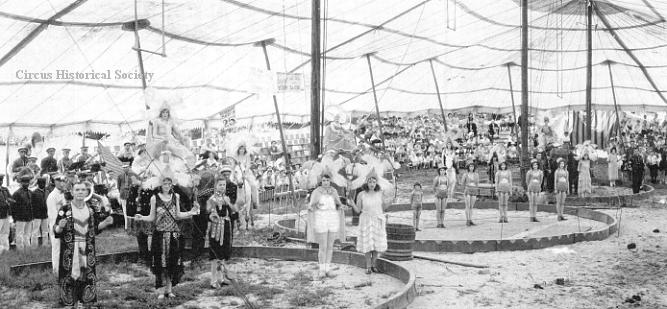
The few photos taken during the initial season which have emerged show the trucks to have been straight bed with custom built bodies including an enclosed cab area. A closeup photo in the April 28, 1928 Billboard pictures Barnett Bros, truck No. 38 which is beautifully decorated with a portrait of a rhino on the side and reports indicate all vehicles were very attractively painted and decorated. (Unfortunately this photo is not suitable for reproduction).
The group of newly built truck bodies included a number of sleeper compartments for the show's personnel. Not only was space provided for performers and staff but every workingman had a bunk and former troupers are high in their praise of Rogers' concern for even the lowliest workingman. He also carried at all times a first aid department operated by a competent person. During the first few seasons Rogers insisted that all personnel, performers included, be quartered in show owned equipment and he stuck to that policy for several seasons even after house trailers became popular with performers on most motorized shows. Only in later years did any sizeable number of individually owned house trailers appear on a Rogers owned show. He found it worked better not to get into the individual deals it required when performers had their own housing and transportation.
On one truck a new 12 KW electric light plant was installed. The initial show had at least four cages mounted on trucks, each vehicle having one or more individual dens. Photos taken a few years later indicate the show had two small cage wagons which could be loaded on a flat bed truck and these were pulled by ponies in the parade but whether or not these were present in 1928 is not known. Barnett Bros. planned to present a daily street parade so a number of trucks were designed to serve as bandwagons and one was equipped with an air calliope.
In the early months of 1928 as work on the motor equipment was progressing Rogers and Hamilton were also making rapid strides in other areas. F. D. Berst was signed as advance agent and three trucks to carry 3 men each were constructed for the advance. William Gibney known as the "one man brigade" was placed in charge of the billing.
From the beginning the show established a reputation for using a good line of billing paper and posting liberal amounts at each stand. Erie Show Print Co. was contracted to furnish the billing material. A line of paper was selected which included a special streamer in two sizes.
New canvas was purchased from Driver Bros, of Chicago which included a big top, about an 80 ft. round with one 40 ft. and two 30 ft. middle pieces and a sideshow/menagerie, 50 ft. round with two 30's and equipped with ten double decked banners. Seating was said to be about 1800. Not many details are available on the initial seating used but it probably included star back reserves on the long side and blues on the short side and ovals. Performance was presented in two rings and a stage.
When the show began there were a number of horses and ponies but no elephants, camels, or other "lead" type stock. "About New Glasgow" says Barnett Bros' first menagerie consisted of one lion, one leopard, two bears, and two baboons which came over from the carnival.
A number of local people were hired to tour with the new show but many, especially performers and key staffers, came from the U. S. Jake Friedman was named sideshow manager and George Pierce was put in charge of a small pit show which operated across the midway from the regular sideshow. An important personality came on, one who would be prominent with the show for the remainder of its days. He was Jack Fox, a broker from New York City, who took charge of the concessions and throughout his relationship with Rogers handled all big show and sideshow concessions paying the owner a percentage which was the standard way of operation for most shows in those days. The concession chief hired his own people, purchased his own stock, and more or less operated in the manner he saw fit.
Jack Moore joined the new show in March to serve as equestrian director and also present several acts in the performance. Moore set about immediately to help lineup the program for the coming year. An aerialist, Millie Vortax, was also signed about the same time as Moore and Howard Fink was hired as bandleader and authorized ten men.
Two local men who joined the show and remained with it throughout its history can be credited as much as anyone for the early and continuing success of the show. They were Dave and Alex (Deacon) McIntosh. These young mechanics would keep the trucks in good running condition over the rough roads the circus had to travel and through the years their reputation would grow and until this day you can ask almost any old trouper who the two best mechanics in the early truck show days were and the answer will always be, "Dave and Deacon McIntosh".
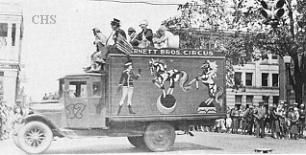 Photo No. 6 - Barnett Bros. No. 17, clown band truck, in parade, season of 1931. Pfening Collection.
The rest of the official 1928 Barnett Bros. staff consisted of E. Rodemer, supt. of properties; Walter Rogers and Ryeson Gaudet (a relative of Mrs. Rogers), in charge of big show tickets; F. W. Cramer, supt. animals; Jack Crocker, supt. lights; D. "Hook-rope" Rodimer supt. of transportation; Alex McIntosh, supt. of motors, and Alex Fraser, boss hostler. (Note, evidently this job involved looking after the various ring horses and ponies and term not used in its traditional sense as the show was completely motorized and carried no baggage stock), and Edwin S. Heath, asst. manager, and press agent back with the show.
Opening date was Fri., May 11 and Sat. 12, 1928 at the show's home town of New Glasgow, N.S. The show was set up on Washington Street field with the tents being up several days in advance for final rehearsals.
Unfortunately not much information concerning the opening of the new Barnett Bros. Circus could be found in the local newspaper files however Miss Phyllis R. Blakeley, asst. archivist of the Public Archives of Nova Scotia, Halifax, who kindly searched the files for the author did come up with this little gem which appeared in the May 8, 1928 edition of the Eastern Chronicle which was evidently a paid advertisement for the show's opening.
"No woman who goes joy-riding or cabareting when she ought to be asleep can train leopards the next day, and the man who tries to put a sulky lion through his paces after 'makin a night of it', is reasonably certain to qualify for the coroner. Respect the circus. Though guided by a salesmanship almost uncanny, it is based upon hard work, high courage, clean living and sound temper. If it supplies an element of romance and glamour in otherwise drab lives, all the better..." (Author's note: All of which proves the circus of that day was eloquently equipped to wrestle with any adverse utterings from the pulpit against the show by comparing showfolk with hard work and clean living.)
The May 26, 1928 Billboard with an article headlined "Barnett Bros. Circus Begins Season at New Glasgow, Canada" reviewed the new show and said in part, "On the program are the Flying LeRoys, casting and return act; Jack and Clara Moore, tight wire dancers; Taylor and Moore, on the flying trapeze; Melcher and Alfred in 'Fun on the Bounding Bed' (trampoline); 'Tom', performing monkey; P. C. Hepperle and his clown band; Misses Hart and Rose on the flying ladders; posing horses, Snow Kiss and White Boy; Brooks and Soares, on the slack wire; La Zora, on the Spanish web; the Plourdes and LaCross, aerial gymnasts; Cramer and Dickson with their trained goats; Mlle Vortex, iron jaw; Miss Soares, Miss Oswald, and Farrell, contortionists."
The following issue of Billboard listed these additional acts in the Barnett Bros. program; "Misses Helene, Rose, and Norma, swinging ladders; dog acts by Misses Drado and Plourde and Messers Dickerson and Cramer; L. and R. Plourde and Farrell, single trapeze; Mr. Cramer and Miss Norma, menage horse; Mr. Brooks, juggler; Mr. Dickerson, pony drill; and posing horses by Mr. Cramer and Miss Norma. In clown alley are P. C. Hepperle, producing clown, Pop Melcher, Alfred Billy "Dutch" Thomas; Roy "Hoop" MacDonald; Danny Cavanaugh, "Skinny" MacPherson, "Curley" Jackson, Andy McMasters, and Whitney Creamery. In the concert are Capt. Jack Codden, rope and whips, L. Plourde, escape artist; Prof. Dickerson and his educated pony, and Roughhouse Smith, wrestler."
The sideshow roster included Prof. Morrison, band and minstrels; Capt. and Mrs. Codden, impalement act; Edna, sword walking; Five McCleods, bagpipers and Scotch dancers; Grace DeLong, snake enchantress; Alex King, torture board; Jack Wilson, punch and magic; and Ethel Delmar and Hilda Williams, Hawaiian dancers.
James Camerson in "About New Glasgow" says that the first admission ticket to Barnett Bros. opening was purchased by a man then in public life, John Doull, MLA, afterwards Attorney General of Nova Scotia and later appointed to the Supreme Court bench. Cameron also noted that although the majority of the performers and bandsmen were from the U. S. there were a number of young men from New Glasgow who worked for Rogers, first with his carnival, and some later with the circus. Among them were David Beaton, Owen, William, and Hugh McCarron; Anthony and Jack "Hoxie" McMillan, Lawrence Chisholm, Cameron Crowell, Carl Fitzgerald, Amos McPherson, Ronald Malcolm, Jack Fraser of Trenton, Henry and Fred Gaudet, brothers-in-law of Rogers, and Dan Farrell, the only man who had been on the road before, and others.
J. L. MacLennan also recalls that local men who left New Glasgow with Barnett Bros. included Andy Gorman, Jim Tibbetts, Doug Clish, Davy and Hughie Nicholson, and their wives, and of course the McIntosh brothers. With exception of only a few most of the New Glasgow troupers came home after a season with the show or when it moved into the U. S. permanently in mid-season 1929.
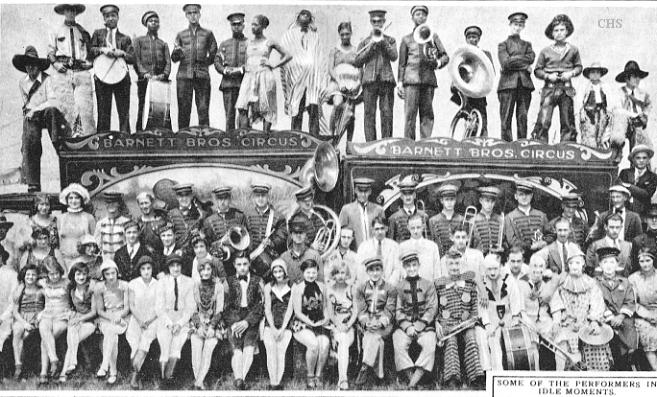
After the season's opening in New Glasgow the show next played Antigonish, Monday, May 14, followed by Westville, 15; Pictou, 16; Shubenacadie, 17th; Windsor, 18; Wolfville, 19; Kentville, 21; Bridgetown, 22; Digby, 23; Yarmouth, 24; Barrington Passage, 25; and Shelburne, 26; all in Nova Scotia. The first few days of the season saw very bad weather and it was not until the show was at Pictou on May 16 that it had fair weather and a dry lot.
The show continued to make Nova Scotia towns and the tour of the province concluded after stands at Lunenburg, May 30; Chester, 31; Halifax, June 1; Truro, 2; Oxford, 6; and Amhurst, 7; and then it headed into New Brunswick with the first stand coming at Sackville on June 8.
During the early weeks of the season the show had no very close competition but the popular 20 car Sparks Circus was routed into Nova Scotia in mid and late July, including a stand scheduled for New Glasgow on July 19.
Additional dates in New Brunswick came at Sunny Brae, June 9; St. John, 13; St. George, 14; St. Stephens, 15; Harvey, 16; Perth, 20; Grand Fall, 21; St. Leonards, 22; and Edmundson, 23.
The July 7, 1928 Billboard reported that Barnett Bros. was playing to good business now that the weather had warmed up. A later report said that Barnett after encountering some of the worst weather imaginable finally got some real circus weather at Sussex, N.B. which resulted in two packed houses and since then both the weather and business have continued good.
While at St. Leonards, N.B. on June 22, a baby female Indian elephant, named "Junie", was received. According to The Billboard the animal was shipped from England. Arrangements for the sale was probably handled by Benson Animal Farm of Hudson, N.H. Whitey Cramer was given the job of breaking the elephant so as to work her into the performance as soon as possible. Sparks Circus would also follow Barnett into New Brunswick and was scheduled to play St. John on July 30.
The show next went into Quebec playing stands at Beauceville, June 27; Lambton, 28; E. Angus, 29; Coati Cook, 30; Magog, July 4; Cowansville, 5; Bedford, 6; St. Johns, 7; and then entered Ontario July 11 at Morrisburg.
A lengthy tour of Ontario was planned, in fact the show decided to remain in the province for the remainder of the 1928 season.
The Aug. 25, 1928 Billboard said that Barnett Bros. had both good weather and business in Ontario and commented that General Agent J. B. Swofford (indicating that a change had been made here) had booked the show into some good towns. The Chevalier Trio, a hand balancing act, joined while the show was in Ontario as did Billie Dick, female impersonator, to dance in the sideshow. It was evident a number of changes in personnel had been made and the Billboard article mentioned that "Blue Jay" Smith was now supt. of transportation and had kept the trucks moving okay during some long jumps over rough roads. It also said that "Tropical Slim" Mitchell, boss canvasman, and his assistant, Ralph Brown, "The Nova Scotia Kid", always had the big top up before parade. W. M. C. Thomas was the show's Billboard correspondent that first season and the information he sent in on the show's happenings often contained the colorful nicknames carried by most outdoor showfolks.
While in Ontario the show had its first taste of close opposition from another show when Sparks played four of Barnett's stands and was nearby at several others with billing paper of the two shows overlapping. Barnett played Brockville, July 16 with Sparks there August 8; Perth 17th with Sparks August 9; Amprior, July 19 and Sparks August 10, Pembroke, July 21 and Sparks August 11. When Barnett was at Hanover on August 16 Mr. and Mrs. Charles Sparks, whose show was at Owen Sound that day, came over and paid a visit to Ray Rogers and his people. Sparks and Rogers were always friends and there was never any charge of unfair opposition tactics raised towards either of them although many times in the future their shows would be in very close competition.
The Sept. 1, 1928 Billboard reporting on recent Barnett Bros. activities said the show's working crews were all shorthanded since many men had left to work in the harvest fields of Western Canada. Dickerson and Thomas, a comedy slack wire act, had been added to the performance and good business had continued for several weeks but a heavy rainstorm ruined the take at Shelburne on August 18.
August 31 at Seaforth, Ont. was a big day for the show, the occasion being the "christening" ceremony for Junie, the popular baby elephant. The rites were performed by Mayor William Golding of Seaforth and the show reaped a wealth of publicity.
In early September Barnett added two trucks which aided in the loading and moving of the show. Also in September during the illness of Clara Moore, Helene Rogers did her loop act and was a big hit with the audience. As the month wore on the show continued to experience good weather and fine business. At Amherstburg on September 10 practically all of the personnel went across the river to visit Detroit. At Kingsville the next day there was a severe electrical storm which hurt business but at Leamington, 12th, there were two capacity houses.
In the late summer William Hamilton closed the carnival, Rogers Exposition Shows, for the season and then joined his partner, Rogers, on the Barnett show. Shortly thereafter the carnival equipment was sold and funds put into the circus operation as the partners felt it had passed its test and would become a profitable venture for them.
Some confusion exists as to the closing date of the 1928 season. According to The Billboard the show was scheduled to close October 6 at Dunnville, Ontario but the Oct. 13, 1928 issue reported that Jack Moore, Barnett's equestrian director, had paid a call to the publication's Chicago office and said Barnett closed September 29 at Caledonia, Ontario (evidently blowing Grimsby, Thorold, Welland, and Dunnville, probably due to cold weather) after a profitable season in which the show traveled almost 4,000 miles, was out 122 days, and failed to show at only three stands, two of them on account of storms and one a bad lot.
In any event the show went into winter-quarters at Grimsby, Ontario. The quarters were located in a fine new brick building which had steam heat and there was a concrete barn close by to house the horses and ponies.
Soon after completion of the season Hamilton signed a contract with the Elks Club of Guelph, Ontario for the show to furnish a number of acts for its charity circus to be held in November. Later Hamilton went to New York City for a visit and told The Billboard office he and his partner were well pleased with the results of the first season of their motorized circus and that they had aspiring plans for 1929.
(Note: Although it is not planned to run the complete route of the show for succeeding seasons, for the benefit of the numerous Canadian archives which have requested a copy of this article, all of the known stands the show played in 1928 will be listed. The dates for Nova Scotia, New Brunswick, and Quebec have all been listed elsewhere in the text, and the stands played in Ontario are as follows)
July
11 - Morrisburg, Ontario
12 - Cardinal, Ontario
13 - Kemptville, Ontario
14 - Prescott, Ontario
16 - Brockville, Ontario
17 - Perth, Ontario
18 - Carlton Place, Ontario
19 - Amprior, Ontario
20 - Renfrow, Ontario
21 - Pembroke, Ontario
25 - Napanee, Ontario
26 - Picton, Ontario
27 - Trenton, Ontario
28 - Campbellford, Ontario
August
1 - Bowmanville, Ontario
2 - Lindsay, Ontario
3 - Uxbridge, Ontario
4 - Beaverton, Ontario
8 - Gravenhurst, Ontario
9 - Midland, Ontario
10 - Collingwood, Ontario
11 - Meaford, Ontario
13 - Wiarton, Ontario
14 - Port Elgin, Ontario
15 - Chesley, Ontario
16 - Hanover, Ontario
17 - Flesherton, Ontario
18 - Shelburne, Ontario
20 - Allston, Ontario
21 - Bradford, Ontario
22 - Orangeville, Ontario
24 - Fergus, Ontario
25 - Arthur, Ontario
27 - Mt. Forest, Ontario
28 - Palmerston, Ontario
29 - Listowel, Ontario
30 - Wingham, Ontario
31 - Seaforth, Ontario
September
1 - Exeter, Ontario
3 - Forest, Ontario
4 - Petrolla, Ontario
5 - Dresden, Ontario
6 - Wallaceburg, Ontario
7 - Tilbury, Ontario
8 - Essex, Ontario
10 - Amerstburg, Ontario
11 - Kingsville, Ontario
12 - Leamington, Ontario
13 - Blenheim, Ontario
14 - Ridgeton, Ontario
15 - Thamesville, Ontario
17 - Dutton, Ontario
18 - Aylmer, Ontario
19 - Tillsonburg, Ontario
20 - Norwich, Ontario
21 - New Hamburg, Ontario
22 - St. Mary's, Ontario
24 - Parkhill, Ontario
25 - Strathroy, Ontario
26 - Ingersoll, Ontario
27 - Paris, Ontario
28 - Simcoe, Ontario
29 - Caledonia, Ontario
(Season closed at Caledonia, but the following had been originally booked and billed.)
October
3 - Grimsby, Ontario
4 - Thorold, Ontario
5 - Welland, Ontario
6 - Dunnville, Ontario
1929 Season
During the winter of 1928-29 a number of improvements were made. Fred C. Walker was in charge of construction and several bodies were built and mounted on new truck chassis purchased by the show. Walker also remodeled a number of old ones and general repair and renovation was done on all equipment. Paul Allred again did the paint and decorative work on the rolling stock and Dave and Deacon McIntosh were in charge of overhauling the motors. Also during the winter Johnny Judge, newly signed equestrian director, took over the personal training of the Rogers' daughters giving them instruction in all phases of aerial work and helping them perfect new routines for the coming season. Some of the personnel signing up early for 1929 were Jake Friedman to head the sideshow, Tommy Burns, who remained busy during the off season training new animal acts and several head of new ring stock purchased by the show, and Thomas Abbott, bandmaster, who was authorized a total of 8 musicians for the coming season.
A new big top, an 80 ft. round with one 40 and two 30 ft. middle pieces was purchased from the Martin Tent Co. and again the performance would be given in two rings and a stage. Seating consisted of 16 lengths of blues and 12 of reserves (star-backs) with a total capacity of 1800.
Rolling stock consisted of 30 trucks, including the advance, 7 trailers and 14 passenger cars.
The official roster for the 1929 season included Ray W. Rogers, manager; William Hamilton, asst. manager; Walter Rogers, treasurer; Ryerson Gaudet, secretary and supt. of reserve seat tickets; M. Ryan, auditor; James Swofford, general agent; W. Thomas, contracting press agent; Jake Friedman, sideshow manager; Johnny Judge, equestrian director; F. O. Walker, general supt.; Alex Fraser, boss hostler; H. Green, supt. commissary dept.; J. Crocker, supt. lights; J. T. Burns, supt. elephants; Alex McIntosh, chief mechanic; J. A. Harris, legal adjuster; Jack Coddins, announcer; George (Whitey) King, supt. cookhouse, and E. E. James, car manager of the advance which used a passenger coach automobile for the general agent and three trucks for the crew. A new line of billing paper was used.
The menagerie remained about the same and the elephant "herd" consisted of Junie and would do so until additional elephants were acquired in 1931.
The 1929 season opened May 4 at Grimsby, Ontario with a good attendance at both performances. The performance was reviewed by The Billboard as follows:
"Spec, Festival of the Flowers, produced by Johnny Judge, equestrian director with Lillian Thelma Alton as prima donna. Other acts were The Flying LeRoys, aerial act; Chevalier Trio, hand balancing; Rogers-Gaudet (the Rogers daughters and Ryerson Gaudet), tight wire artistes; Hayes and Hayes, double trapeze, Roman rings, and slack wire; Miss Alton, prima donna; Mr. and Mrs. Oswald Plourde, double and single trapeze and trained dogs; Mr. and Mrs. Floyd Dickinson, domestic animals, slack wire, and menage; Miss Vortex, iron jaw and single traps; Starsses and Dino, comedy acrobats; Norma Rogers, swinging ladder, loops, and tight wire; Helene Rogers, swinging ladder, loop, tight wire, and double a traps; Flo McIntosh, menage, swinging ladder, and tight wire; Ryerson Gaudet, tight wire and double traps. Paul C. Hepperle is producing clown with nine joeys. Concert is handled by Texas Jack Wild West with Capt. Jack Coddins in charge".
The sideshow lineup had eight acts which included Prof. Eddie Morris, band and minstrels; Ethel Friedman and Billie Dick, Hawaiian dancers and others. The pit show had Jolly Ada, fat girl, a six legged sheep, midget pony, a variety of monkeys, and Elaine-Albert (half and half), with C. C. Smith manager.
Very little information on the show and none of the route appeared in the trade publications during the early weeks of the 1929 season. The show is believed to have spent several weeks in Ontario before finally moving into Quebec. The June 15, 1929 Billboard stated that when the show was at Wallaceburg, Ont. Manager Rogers drove over to Detroit to catch the John Robinson Circus. Wallaceburg was the home town of Tom Hayes of the Hayes and Hayes act and he made his first visit there in 40 years. It was mentioned that the past week's business had been only fair and it is generally believed the show's business as a whole had been considerably off from the previous season. Possibly this was due to playing the territory the show had so extensively covered in 1928 or it could have been economic factors although the latter was expected to be good as a number of circuses from the States visited and competition was close at times, including a day and date between Sells-Floto and Christy Bros, at Chatham, Ontario on July 22.
Reports given at end of the season say that Barnett Bros. played in three Canadian provinces so a few stands must have been played in New Brunswick but the show definitely did not venture into Nova Scotia, the land which gave it birth.
Mainly thru the influence of William Hamilton, Rogers agreed to route the show into the United States. Hamilton was convinced that New England would provide a good take for the show and probably other areas. Although not realized at the time circuses in the States would be getting their last taste of lucrative business before the great depression set in beginning in the late fall of 1929.
When it was announced the show would be entering the U. S. a number of people left and returned to their Canadian homes and there was a considerable turnover not only in working departments but also in the staff and performers.
Hamilton made all of the preliminary arrangements for crossing into the States and the show played its first stand at Newport, Vermont on July 9. The show had reached Newport after a 75 mile run and passing immigration and custom authorities without a hitch. The July 27, 1929 Billboard hailed the coming of the new Barnett Bros. Circus and said it was the first motorized circus ever to come into the U. S. from Canada.
The next day the show played Barton and followed by other Vermont stands, including Hardwick, where Andrew Downie, owner of the Downie Bros. Circus visited and Morrisville where William Ketrow of Ketrow Bros. Circus paid Manager Rogers a call. A Billboard note said that Ryerson Gaudet had recovered from injuries received in a recent fall and was now back in the lineup and that Jack Friedman had added a new minstrel show to the overall sideshow array.
The last Vermont stand was July 18 and then the show went into New York with first date at Granville, 19, followed by Greenwich, 20, Warrensburg, 22, and Corinth, 23. Later New York stands included Rhinebeck, July 31, Millerton, Aug. 1, Canaan, 2, and Litchfield, 3.
Leaving New York the show went into Connecticut and while at Canaan was visited by Mr. and Mrs. Earl Chapin May who were collecting data and color for a circus book. May of course later went on to write the celebrated "Circus From Rome to Ringling" which was the first major attempt at recording circus history in a printed volume and one which served as the bible for historians for many years.
The general area was now full of circuses and although there would be tough competition and struggle to get your share of the loot many pleasant visits were exchanged between the various shows. Walter Rogers visited Downie Bros, when it played Bennington, Vermont and on August 4 a goodly number from the Barnett show visited Christy Bros. at Port Jervis, N. Y. For several weeks Hamilton was with the advance where several changes were made and after getting everything adjusted for the stateside modus operandi he returned to the show, however from then on Hamilton would be in very close touch with the advance and oftentimes would travel with it for days or weeks at a time.
At New Canaan, Conn, on August 6 the local CFA members held a meeting in the Barnett Bros. big top and on the occasion Rogers and Hamilton announced to the group they were highly elated over business encountered so far in the U. S.
At Spring Valley, N. Y. on August 24 a representative of The Billboard visited the show and wrote an interesting and comprehensive account of it, giving the readers their first in depth look at the new Barnett Bros. Circus. The reporter counted 30 trucks and 7 trailers back on the show and 130 personnel. He said the nut (daily operating expense) was approximately $900.00 and admission prices were 50 cents with 25 cents extra for reserves. There were 35 performers and Homer Lee had a band of 12 musicians. The performance consisted of the Flying Leroys; Rogers-Gaudet troupe on tight wire (4 different numbers); Hayes and Hayes, double trapeze and rings; Mlle Vortex, iron jaw, web, and traps; Starsses Hudders trio of acrobats; in clown alley were 8 joeys, and Lillian Thelma Alton was prima donna. Other acts included Misses Lee, Norma, Cole, and Dickinson working menage, traps, and stock; Claire Illington, iron jaw and toe dancer, who had recently joined. Capt. Jack Coddins Wild West had 7 people and 3 head of stock. The sideshow under Jack Freidman had 23 people and in the pit show was Doc Gibson's one man band, and Ken Revel, leatherskin boy. The sideshow had 9 double decked banners and the pit show 5.
Further notes from this report said there were 5 open dens of animals and one elephant, the latter of which works in the big show, and this was the first account that Junie had been sufficiently trained to appear in the performance. Some personnel listed included Arthur Lewis, general supt., Jap Brown, asst. boss canvasman, Alex McIntosh, mechanical supt., Willis McAwley, supt. of transportation, Frank Green, cookhouse manager, and Tommy Burns, equestrian director. It can be seen there had been several major changes since the season's opening. Working departments had 43 men.
The reporter gave the first detailed account of the street parade and said it consisted of 19 trucks, including 5 open dens, and also 2 chariots, 6 ponies. 4 bands, and a calliope. (Note: The 4 bands evidently were the big show band split into two sections for parade as was customary with most shows, the sideshow band, and clown band.)
A most interesting account was given of the way the show was transported over the road. It moved in three separate caravan (or convoy) formations. The first section consisted of 7 vehicles which carried poles, canvas, and other equipment. The second section had 14 vehicles and carried the stock, working animals, and props, and the final section had the office truck and other misc. equipment. It might be mentioned that it was customary for the early motorized shows to move in convoy as the trucks could be controlled much better and this practice continued up until the mid 1930's when state highway patrols banned such convoys and required the vehicles to move separately.
Leaving New York again Barnett went south into Pennsylvania and played a number of stands including Lansdale, Aug. 29, Phoenixville, 30, and Marcus Hook, 31.
Very little news appeared in the trade publications after that until the Sept. 21, 1929 Billboard stated that business for the show had been excellent in Maryland and Delaware according to Hamilton who also opined this was especially gratifying since the Barnett show was new in the area. Other Billboard notes said that Bessie Hayes was recovering from an accident caused when a bale ring broke while she was doing a double trapeze number, that Ray Rogers had recently purchased a new house trailer, and that Connie Rogers was now working the feature dog act using a total of 15 canines. Speculation was that the show after playing in the south would probably winter close to New York City.
The show next moved down through Virginia and into the Carolinas. In South Carolina Barnett was in close proximity at several stands to the Honest Bill-Moon Bros. Circus but there was no heated opposition. In early November Billie Dick and Art Powell left Barnett to go with that show.
The 1929 tour ended at Easley, S. C. the last week in November and the show went into winterquarters at York, S. C. a town of about 3000 located in the north central part of the state only a few miles from the North Carolina line. A fairly new building made of stone and located practically in the heart of town was secured to serve as the quarters. (Details on the site and structure will appear in the next installment).
The Dec. 14, 1929 Billboard summed up the Burnett Bros. tour as follows.
"Few shows can boast a season's tour in which so many things were done for the first time. The crossing of an international border with an all motorized show that originated in Canada was the initial feat of the season. A season without an accident, nothing worse than tire punctures or broken axles is remarkable. Some 7,000 miles were traversed in 12 states and 3 Canadian provinces. One parade and one afternoon show was missed during the season of 28 weeks which opened in May and closed the last week of November."
The "count" of vehicles continued to vary and this time the article said the show had a total of 35 trucks, 7 trailers, and 5 passenger cars. This coming from the show's winterquarters would in all probability include both the advance vehicles and those back on the show and the total should be considered reasonably correct.
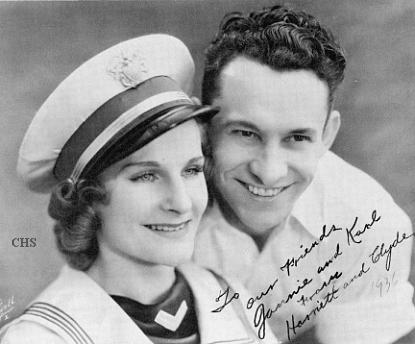 Harry Atwell took this studio photo of the Beattys in 1935 or 1936. It was used on the cover of Billboard magazine. Pfening Collection.
When Harriett Evans married Clyde Beatty on September 16, 1933, in Bristol, Virginia, she was taking a big step from the ranks of the Hagenbeck-Wallace ballet. Within a few years she was to become a circus star in her own right. And, until her death seventeen years later, many would consider her "the first lady of the circus."
Harriett and her sister Jean had come to America as artistes of the classical ballet with a Russian company. The troupe folded in Canada and the girls ended up in Chicago. When, after a few years, she found herself a young widow with a tiny daughter, she accepted a second-rate job with a first-rate circus, the famous Hagenbeck-Wallace outfit out of Peru, Indiana. When she married Beatty in 1933 she was working in aerial and equestrian numbers and making herself "generally useful," as the contract read.
Circus tradition has always held that Harriett was the daughter of Chick Evans, one of the few amateurs ever to win the U.S. Golf Association's Open. Actually Evans has no daughters and the Evans girls' family name was Iwicke. But, Evans' name did appear on the marriage license as Harriett's father, so there the story was born.
As both she and Clyde had been married previously, the congregation of Rev. Donald McIver, who conducted the ceremony, were slightly shocked to hear of the Saturday afternoon wedding. Rev. McIver's daughters recently told me that he felt he had no right to refuse to conduct a marriage when the Commonwealth of Virginia had already approved it.
Just when Harriett first thought of entering her husband's steel arena, we cannot be sure. Apparently she was smitten with the idea shortly after becoming Mrs. Beatty for, as is related in Jungle Performers, she insisted on coming into the training arena in Peru the following winter.
She also came close to making a movie debut in Clyde's picture "The Lost Jungle." Some scenes of this thriller were made at winter quarters and Harriett was to double for the co-star Cecelia Parker in a few jungle shots. However the animals became so unmanageable that Beatty insisted on the scenes being done by "processing" whereby Miss Parker merely appeared to be in the jungle with the animals. This way, no girl actually had to come into contact with the beasts.
During the Detroit Shrine date early in 1934, Beatty announced that Harriett would soon be working a mixed act consisting of fourteen lionesses, tigers, bears, pumas and leopards (both black and spotted). This sounded very much like a "prelim" act that Beatty had worked several years before when Pete Taylor still had the big lion and tiger act with Hagenbeck-Wallace. After Beatty took over Taylor's act, John Helliot and later Jules Jacot had worked this highly-mixed "prelim" number.
Although this plan never progressed beyond the talking stage, photos did appear in a number of newspapers that year showing a young lady wrestling a tiger. The caption stated that this was Mrs. Clyde Beatty with Rajah the tiger.
When the Beatty's moved to the new Cole show the following year, the performance followed the same format as had the Wallace show: that is, Beatty's act was preceded by a smaller though very good act of assorted cats. This was worked by Allen King, a trainer of some years experience who had handled Beatty's act during the winter of 1932 while Beatty had been laid up with a severe infection which almost took his life.
The theory of this format was that a smaller act before Beatty's emphasized the number of cats Beatty worked. When Allen King left the Cole show on July 27, 1935, Harriett's career took an upward turn. Beatty felt that the same format should be followed, so on August 8, Harriett debuted with an act of 3 lions and 3 tigers featuring a male lion in a series of fire hoop leaps.
In February of the following year. Harriett and Clyde began developing the act that was to be her trademark for the rest of her life: Anna Mae, the elephant who was to become a mainstay on the Beatty Circus, was taught to carry a lion and tiger on her back. This mixture of three enemies of the jungle attracted the attention of the press and public from the time the act was first shown.
The occasion was the annual press day which the Cole show had every spring in Rochester. The hit of the 1936 press day, no doubt, was Anna Mae raising merry hell and dumping several hundred pounds of jungle kittys in Harriett's lap. That was on March 28. By April 11, the act was smoothed out and officially debuted with no major hitches at the Chicago Stadium. Anna Mae, it was discovered, was kept calmer by having another elephant, Sydney, stand outside the arena during the act.
The new act worked well for several years but still caused occasional problems. Like the spring of 1937 when they were rehearsing the act for the Hippodrome show. Old Syd bumped into something backstage in the converted theater that dropped a heavy batten within feet of Harriett's threesome. Anna Mae panicked and the act had to be left out of the opening performance.
During 1938, Simba, the lion of the group, began to lose his sight. Shortly thereafter, he was dropped from the act and Primba, the tiger, rode Anna Mae alone. The great three-animal act was ended forever but Harriett continued to work the act with Anna Mae and a tiger (not always Primba) for many years.
In the meantime, Harriett still worked her small mixed act on occasion. Once at the Milwaukee Shrine date, Beatty came down with a bad cold which made it impossible to perform. Harriett made the headlines by proving that the show could go on. She pulled her small group from Clyde's much larger act and put them through their paces at several shows.
Also when the Beattys worked at Hamid's Pier in Atlantic City for the entire 1939 season, Harriett worked her mixed act, alternating with her husband.
The tiger-elephant act was revived and was featured at the Jungle Zoo in Fort Lauderdale and with the Johnny J. Jones carnival. I saw the act in 1943 on the Beatty-Wallace show.
Her last elephant-riding tiger was Singapore, who remained in Beatty's act for many years.
During the mid-'40's, Harriett began to develop a heart ailment which slowed her down a great deal. In 1947 and 1949 she had operations and was hospitalized for long periods.
After many bouts with her heart, Harriett Beatty passed away on the train of the Clyde Beatty Circus on October 25, 1950 while the show was playing Kusciusko, Mississippi. She died shortly before the matinee but her husband was not notified until after the performance. In accordance with her wishes, Harriett was buried in Fort Lauderdale, Florida, where she and Clyde had operated their famous Jungle Zoo for several years.
Harriett's daughter Albina, who had traveled with her mother and step father for a number of years, worked her mother's act for a time. Today she works under her mother's name with a cat act.
Harriett was once described by a newspaper reporter as a "beautiful petite Russian-born blonde." She was certainly that but we prefer to remember her as "the first lady of the circus."
(Thanks to Bill Atwater and John Draper for their help in preparing this article.)
By Tom Parkinson. Bandwagon, Vol. 18, No. 3 (May-Jun), 1974, pp. 18-26.
Only the first several years of William P. Hall's business career were devoid of circuses. And he always was involved with horses. Even before adopting the mantle of circus press agentry, he modestly admitted to being the Horse King of the World.
Documents in the William P. Hall Papers at the Circus World Museum indicate that in November, 1889, he bought the central tract of what became a circus landmark, the Hall Farm. In a subsequent U. S. Census Report he stated that the business was founded in about 1890. As noted earlier in this series, he was selling horses to circuses by 1903 and perhaps earlier.
In that time he was busily establishing himself in the horse and mule business. Action which first broadened his horizons beyond Schuyler County was association with the Mengs of Philadelphia. This began when the senior Meng struck up a deal by which Hall consigned carload lots of horses to the Meng sales barns, a move of enough import to young Hall that he accompanied his first shipment to Philly.
A surviving document tells of a sale by Andreas Meng's Sons' Tioga Horse Bazaar, Philadelphia, in 1894. It may or may not represent Hall's first association with them. Included was a carload of "pacers and trotters, saddlers and drivers, also coachers purchased by Hall & Meng." In keeping with the directness of business language then, the flier says ". . . we know times are hard. So come along and don't bid too much." The Mengs also did business with a Tom Hall, as the flier indicates, but Diamond Billy now was in the national horse markets.
In 1894, Hall branched out to establish a sales barn at Richmond, Va., with his brother, Louis J. Hall, in charge. The Hall Papers contain several cancelled checks from that operation, including Number 2, which paid $7.50 for an ad in the Richmond Dispatch. The check design has a woodcut portrait of a young William P. Hall. While it has been said that whole trainloads of horses were shipped from Richmond to Lancaster, the Virginia operation was discontinued after about a year.
Continuation of both depression time and Hall's association with the Mengs comes out in a letter dated August 29, 1898. George Meng wrote that he would try to send some cash to "My Dear Friend William." Whether Hall was dunning Meng or seeking a loan is not clear. But in response, Meng hit the streets. He couldn't find any of those who owed him, so he tried a bank loan. It is apparent that he got ahold of something — and that both Meng and Hall were hard pressed for cash:
"I feel sorry that you are tied up so and I can't give you money, hoping that this will help you out some," George Meng wrote. For his part he explained that the Meng Estate was tied up, and for Hall's part Meng said, "I hope it will come out all right for you this winter for you have been a friend to us."
Hall also was dealing with other metropolitan horsemen. He sold stock through the commission stables of John Kirk, St. Louis, marketing 21 horses for $1527.90 in May, 1898, for example. In 1899, the Sloan, Nims & Bratton horse dealership at National Stock Yards, Ill., was urging shippers like Hall to send "export chunks and big work horses" for their September 21 sale. They looked for an upturn in the mule market, too.
Export also caught Hall's interest. There is a document concerned with the shipping of 22 mules and 4 horses to Honolulu, via the Spreckels steamship agency.
Having traveled with his horses to Philadelphia, and now that he was getting orders from foreign lands, W. P. Hall determined to accompany his first order to Europe. Subsequently, he lived in Hamburg, Germany, for about a year.
But it was South Africa that really occupied Hall's attention. There is no indication in the Papers as to how he came to choose the site, but while on a longer trip he set up Hall's Horse & Carriage Repository at 30 Darling Street in Cape Town, South Africa. Again, he turned to his brother to manage this emporium.
On May 18, 1898, Louis J. Hall wrote on stationery of the White House Hotel, Cape Town, that the cable company there had been unable to locate "Hall, Lancaster, Missouri", to deliver a cablegram. So Lou was telling W. P. that it would be well for him to register a name — or cable address. He suggested "Horseman, Lancaster, Mo." It's a little difficult to see how that differed much from the first attempt.
At least, L. J. took his own advice. On letterheads for the Cape Town business he listed his own cable address as "Horseman." Only a year after L. J. wrote from the hotel, the Boer War broke out in the British colony. Other accounts of Hall's career have reported his big business in supplying horses to the British Army in that war. Nothing in the Hall Papers confirms or expands upon that report. No doubt the Cape Town office was a big factor in getting the orders.
Accounts of the war state that the British Army made prodigal use of cavalry and therefore horses. Moreover, the long shipping distances and outbreak of an epizootic caused more loss of horses. In all, the British used some 200.000 horses and mules, figured at about 5,000 per month. William P. Hall furnished his share of those as the war continued into the Twentieth Century.
It was in an undated letter probably after the war that L. J. said that he could not send all of the money due his brother. But he urged William P. to ship "all you can, everything that you think will sell. Always put on more horses and mules."
Horse deals were Hall's big thing early in the century, of course. Typically, he listed horses named Ben Harrison and Grover Cleveland along with 13 others and 30 mules in a $5500 deal. Another list represents the sale of 21 horses for $2325 by George Meng in Philadelphia.
Brother Louis wrote from Cape Town on August 13, 1903, that "Young Hall got in on Saturday morning. His stuff landed good but poor ... If they will only feed as I have told them, I think they will land fat as butter." Presumably, this marks the arrival of horses or mules from Missouri under care of another relative.
Still another memo made out by Hall bears some comments added later at Philadelphia by George Meng. Hall had noted that a bay mare was "a little windy", but Meng was more direct when he said "this one will die." Moreover. Number 8 had only one eye. Meng said "Old Friend, this load (is) a little high, but I can't get them all cheap." Then he noted that he owed Hall $7185 earlier and now owed $3075 more in November, 1904.
William P. Hall was not a principal figure in the famous Missouri mule business. The Missouri Historical Society cites the Monsees family as the principal mule dealer. That business all began when the Santa Fe trail terminated in Missouri. Traders took goods to Mexico and exchanged them for money and mules. One trader in 1832 came back with $98,000 in gold and silver, 7 tons of beaver fur and about 1300 mules. Not only could they sell the mules in Missouri but also they found that teams of mules could haul heavier freight wagons along the trail, outdoing both horses and oxen. There were many types of mules, but Missourians bred the Mexican or Spanish varieties to get tall, heavy mules and thereby create a draft animal that was in much demand over the world by the 1890s. The Monsees exhibited at the 1893 fair in Chicago and at the St. Louis World's Fair, where Hall, too, was a major participant.
It was in fact that St. Louis Fair which either created or put into prominence the name or phrase "Missouri Mule". It came out of the great success enjoyed there by mule exhibitors. William P. Hall is not listed among the exhibitors whose mules created such a sensation, nor among others most prominent in the Missouri specialty. But Hall was dealing in mules then. Perhaps show historians will see it as more fitting for Hall to be selling draft stock to the fair management rather than exhibiting for ribbons.
One of the puzzles arising out of the Hall Papers is raised by the next document. It will be recalled that in an earlier chapter of this series Ben Wallace was quoted about Hall's plan to ship horses from his William P. Hall Circus of 1905 to South Africa. Included in the Hall Papers now is a list of these circus horses.
On a letterhead proclaiming him as the "Most extensive dealer in horses and mules in the world", Hall wrote a heading, "Cape Town Horses", and then listed them:
Fifty horses worth $200 each; 40 mules; 25 horses worth $25 each; 12 chariot and race horses; 1 buffalo; 4 roan horses; 2 cakewalkers; 1 spotted riding horse; 4 spotted Roman standing horses; a 4-horse act, presumably for bareback riding; 1 speckled cake-walking horse; LaPlata dunn horse; white Roman standing team; hurdles mules; spotted mules; bay horse; gray horse, and a "black horse Louis bought at Centerville." So his brother was at home.
More, Kitty Kruger's principal mare was listed. So was a "pair black horses pullover team" — a show train team! And to top it off, the list included "Wardrobe, saddles and paper". All of this valued at $25,440. Does it mean that the Halls set up a circus in South Africa? Or supplied one?
Writing in January 1907, Hall described the numerous horses and mules he offered in response to a Mr. Baker's inquirv.
"Now, Mr. Baker, if you will give me this order for this stuff I will get you as nice a bunch together as money will buy ... I think you want nice horses, so I have given you prices on same . . . Please wire me on receipt of this whether you will accept my offer or not so I can begin at once getting them together." It is a puzzle at this distance to know how a dealer gave rather full descriptions of horses he would supply even before he had them in stock.
For his letter of November 29, 1911, Louis Hall was a little distraught:
"Your cable received saying that you did not ship by the November ship. I know that you would have shipped if you could have done so. This is very bad luck for us and heart-breaking, Brother, as I have advertised very extensively. All of my old friends are working for me most faithfully, and I ... had the November shipment sold to arrive, and orders corning in briskly. After all of this promising business I find that I have got no mules coming. And the St. Louis people have got 50 coming on this same November ship . . . Those St. Louis dogs will fall into one of the hungriest markets I ever saw, and I have worked it up for them to reap the harvest. If only mine were on this ship it would be my chance to do for them once and for all ... They will soon kill me here, for me to have advertised all over that I have the stuff coming . . . and now for it not to arrive. They are all tender-skinned and get sore at these sort of things very easily. It looks to them here like misrepresentation. This is a small country and news gets over it very fast and they are a class of people who will be fooled but once. But I know you could not help it and that you have done the best you could, Brother.
"With the best of wishes to you and all, Your brother, Louis."
That happens to be the last letter from Cape Town in the Hall Papers, but the business continued.
And Hall was not through with the export efforts. Other sources have referred to his German horse business. The nearest thing to that in the Hall Papers is a letter from a horse dealer in Hamburg, M. H. Ahrens, who castigates Hall for handling a deal wrongly. This was November, 1920, and runaway inflation was the dominant factor in Germany.
Ahrens complained that Hall did "not thoroughly understand just how we have to do business in these times of unsettled conditions.
"We instructed you not to draw and by your doing so we were compelled to buy dollars at a very unfavorable time, which caused quite a heavy loss . . . Mr. Rowe has the accounts with him and will explain everything to you; we have not received a check from him for the amount of the loss; we preferred to leave the amount in your care because we intend to have some trotters bought . . . We better make arrangements to cable money before hand. I also will not omit to mention that it is only possible to make some money on direct shipments. The transhipment at Antwerp caused expenses and heavy losses in consequence, as you will be aware of concerning the 110 horses . . ."
There were other listings, usually for about 20 to 26 horses. A man named Shafer got 26 one March for $3910. Apparently, this was another commission dealer with whom Hall did frequent business. He also wrote to a Gene Anderson and referred to a Mr. Rich and a Mr. Keith, again as commission agents.
Known more widely for his circuses, elephants, horses and mules, William P. Hall also was renowned in Lancaster for his pony business. A newspaper clipping from about 1914 says that one Henry Green was in town to buy a pony from Hall, who then maintained a herd of 100 ponies. It also is recalled in Lancaster that Hall allowed local children to keep his ponies at their homes until he needed them.
The same newspaper clipping notes that Hall had "bought and sold to England, since the beginning of the European war, 10,000 horses and is now filling an order for 3,000 head for Greece . . ." This is the first recollection that he sold heavily to England in World War I, and it is a reference to the Greek order which came to him through the Miller brothers, as mentioned in the chapter about his dealing with the 101 Ranch.
Hall's horse and mule business continued. The Papers include a lease by which he furnished 30 mules to the Wm. O'Neil Sons Co., Faribault, Minn., for use in road construction work at Good Hope, Ill. That was in 1927.
On the letterhead of the Wilson-Hall Motor Co., the Ford dealer at Lancaster, the Larson Construction Co., of Albert Lea, Minn., leased six mules from W. P. Hall. Finally, there is a memo noting the sale of horses in 1933. These are identified with an appraisal, apparently of the Hall estate. Included on the same page is mention of two camels and a puma, plus a steer sold to one Z. Miller — perhaps Zack Miller of 101.
St. Louis World’s Fair
Thomas Jefferson had purchased Louisiana Territory in 1803, but efforts to commemorate the centennial of that event were running a year late in St. Louis. And since the Boer War — thanks in part to horses from William P. Hall — was concluded in 1903, there proved to be time as well as reason to create a Boer War Show for the Louisiana Purchase Exposition.
The idea, according to Rick Pfening's Bandwagon article of 1966, originated with one Capt. A. W. Lewis. He planned a show in which the Boer War would be recreated before the very eyes of the fair beholders. A group of St. Louis businessmen sailed for his idea and formed the South African Boer War Exhibition Co. Lewis then went abroad to recruit his two armies. He would bring 650 veterans of the British and South African military and a hero of the Boer army, reportedly General Piet Cronje.
The William P. Hall Papers at the Circus World Museum, pick it up from there. The South African Boer War Exhibition Co. included C. F. G. Meyer, Sr. as president; C. F. G. Meyer, Jr. as secretary-treasurer; Boer guerilla hero, Gen. Ben Viljoen, vice-president; Frank E. Fillis, managing director of exhibition, and Captain Lewis, general manager.
In February 1904, Lewis wrote William P. Hall:
"Confirming my conversation with you, I hereby authorize you on behalf of this company to deliver to me in St. Louis as I may direct, on or before the first day of May, 1904, four hundred (400) head of horses . . ."
He detailed the specifications — 13.3 to 14.3 hands high, serviceable, sound, good condition, broken to saddle, not more than 12 years old and delivered at St. Louis for $75 per head. All were subject to Lewis' inspection.
Lewis arranged with Hall for time payment of $7500 out of the indicated $30,000. He would pay $2500 of it by June 1 and the final $5000 by July 1. All 400 horses were to be a guarantee for payment of the deferred amount. (AWL-WPH, 2-2-04).
Thus, Hall not only furnished horses for the Boer War but would also supply those for its recreation. Put another way, Lewis, in striving for accuracy and the original cast, even got horses from the right place. Handily, Lancaster was not far from the fair; otherwise, authenticity might have had to yield.
Hall set about to assemble the horses. He also wanted to take a few bows in Lancaster for his prominent role in all the action down at St. Louis. So he set up a program at which Capt. A. W. Lewis was to be the principal speaker. Hall's friends gathered for the big event. But Lewis blowed the date.
He sent a letter of explanation, and characteristically Hall did not acknowledge it, so then it was Lewis who was upset.
"I sincerely trust that you will accept my explanation in the matter and that you will not deny me the opportunity later on of delivering the address to your friends in Lancaster," he wrote.
"You will be interested to know that the Steamer Doune-Castle, chartered by this company to bring our people and property from Cape Town, left that city on Saturday, the 12th inst., at sunrise. I dare say there will be many messages aboard from your brother which you will be glad to receive. The ship stops at St. Vincent en route, for coal, and she will arrive in New York on the 7th of April and that will make our people get here about the 10th prox.
"For this reason, I think it would be better for you to take your time with the horses, and get them in slowly, inasmuch as we certainly will not require any of them before the 15th prox., but as I promised I will try to give your inspection before the 10th.
"I hope you are enjoying good health again . . ." (AWL/WPH 3-17-04).
On May 4, Lewis wrote about another delay in his coming to Lancaster. But on May 7 they executed a $15,000 chattel mortgage covering the purchase of 375 horses and 20 mules at Lancaster on May 6. The money, it was now agreed, would be paid in three equal installments. Hall held three promissory notes for $5000 — one due the first of June, another July and the last on August 1. Presumably, the other $15,000 was paid on May 6. General Ben Viljoen was to have been in town to affix the corporate seal, but the typed statement of the notary public never was thus completed. (Chattel Mortgage, 5-7-04)
That busy time in May was climaxed by a letter almost certainly from Lewis to Hall but now lacking a final page or signature. It said the horses had all arrived. A couple of them were lame, probably because of traveling. Then Lewis conjured up a picture of skylarking Boer War veterans herding loose horses through the streets of St. Louis in such a manner that some got away.
"The boys still have eight of them missing through their damned carelessness in taking them through the streets. I don't know whether we will recover them or not. I hope so. I am anxiously waiting to hear from you re the cattle so we can close that deal up." (AWL-WPH 5-11-04)
Then Lewis put the arm on Hall. He said all of his own cash was tied up in the company and that the firm was so short until the show opened that it was not paying salaries. "How are you fixed for money?" he asked. "If you are not tight and can lend me $500 until June 25 or July 1 I should greatly appreciate it... I want this to be a matter between you and me only . . ."
By the time of Lewis's next letter, Hall had been to St. Louis, the Fair and the great Boer War Show. Lewis said he was sending for the horses that day, apparently an additional group. Hall was to receive a check within ten days. "Thank you very much for your kind compliments regarding our show. We have tried to make it a success and are pleased if we succeeded." (AWL/WPH 7-10-04)
The next day brought another letter from Lewis to "Friend" Hall:
"It is with very great regret that I have to report that the horses have all been refused, and they are being returned to you today by freight. Of course, the matter of accepting these horses is entirely in the hands of Mr. Fillis and General Viljoen. I am exceedingly sorry that I have caused you the trouble and expense of sending them down, with no result. .." (AWL-WPH 7-11-04)
Two days later there is another letter covering a bill of lading on the Burlington Railroad for the return of six horses; a seventh was kept after all. Obviously, these were not part of the initial order and delivery.
A final letter from Lewis says that the show office had received from Hall a demand draft for $130 and "while I was absent from the office" it was returned unpaid. Now Lewis was asking what it was for.
"I have been looking for you to be down to the Fair again and trust that you will be able to make us a visit before long. I hope that yourself and all of my friends in Lancaster are well . . ." So perhaps Lewis had even made that speech in Lancaster and gained friends there. (AWL-WPH 8-4-04)
It appears now from the Hall Papers that William P. had a simultaneous and separate deal elsewhere at the fair. Surviving in the Hall Papers are just the second pages from two letters that came from the backstage General Service Company, authorized agents of the Louisiana Purchase Exposition.
This company was "for the handling of exhibits to allotted space, storage of exhibits and empty packing packages, and general service business requiring warehousing and teams."
Its president, J. M. Allen, was writing to Hall about leasing horses for those teams his firm would offer exhibitors. "What kind of proposition will you be willing to make to me to send, say sixty (60) horses . .. The horses will have the very best care and attention and the best of feed. We would want horses that could go right to work on short notice." Allen seemed to think the exercise would do them good, saying that when "work of installation of exhibits is over, they ought to be in better condition than when we get them." (JMA-WPH, undated)
Hall seemingly made an offer which they would accept. Allen's second letter says in part the "we will not have the ready cash to pick up the thirty big horses for the next two or three months, unless we could make some kind of an arrangement to carry part of it until we could take care of it." So it was the old money dodge again. "We do not want to ask the banks for a loan and neither do we care to offer our stock on the market so long as we can get along without it." (JMA-WPH, undated)
The Papers give no further indication as to whether Hall leased the horses for the exhibit transporters. Nor do they confirm any of the several reports that he bought his first wild animals during the fair. There is only the evidence of the next 28 years that around that fair he became afflicted with the incredible urge for show business.
Rick Pfening's 1966 article reports that the Boer War Show was among the strongest winners of the Fair and that subsequently it was taken to Lancaster and the Hall Farm for the winter. He states further that it went forth in the spring as a railroad show for a tour in 1905. Though a financial success, the show was not continued, largely because the British and Boer troops were into quarrels that threatened to set off the war again.
That raises the interesting picture of Lancaster's initiation into what was to come during the next quarter century. For in that winter, Hall bought both the Harris Nickel Plate and Walter L. Main circuses. The Nickel Plate was reframed there as Cook & Barrett; the Main show wintered in Ohio and came to Lancaster in the spring to launch its tour. And the great Boer War Show was there as well. Quite a jolt for what had been a sleepy north Missouri hamlet. Quite a jump from the bright lights of St. Louis. And a world away from the cavalry charges of Mafeking and Kimberley.
Harris Nickel Plate Shows
Perhaps the most perplexing of all the documents in the William P. Hall Papers is a pair of contradictory items from the transaction in which Diamond Billy Hall bought his first circus.
This series of articles already has reviewed several points of history involved here. First of course, is the fact that Hall came away from the St. Louis World's Fair with circuses on his mind. And we have noted the Hall Papers pertaining to his purchase of the Walter L. Main Circus, followed by its appearance in 1905 as the Wm. P. Hall Circus. Until now we have not examined the matter of Hall's buying the Harris Nickel Plate Shows and immediately leasing it to others for operation.
But that's how it was: Fresh from the Fair, Hall bought the Nickel Plate Show, rented it out to the Schiller brothers, then bought the Main show and painted his own name on those wagons.
We also have known how the old Harris Nickel Plate came to this juncture. Venerable W. H. Harris died and his son-in-law, Charles C. Wilson, took over as manager for the season of 1904. In that time the Ringling brothers needed new executive power and hired Wilson to be traffic manager — their railroad man. So the old family heirloom, the Nickel Plate Shows, suddenly was a little something extra around the house. Wilson wanted to sell this ten-car throw-back and get on to the big time.
Well, true to his reputation before and since, William Preston Hall was just the one who could help. They met at Evansville, Ind., and Hall bought the Nickel Plate. He became a circus man.
We've got the documents now that prove it. Amazing as it is that these fragile papers survived various degrees of abuse in the Hall office and home from that day to this, some 67 years, two bills of sale for the Nickel Plate came to the Circus World Museum from the Hall home.
That's the problem: Two bills of sale.
Also two dates and two amounts. But one clutter of show plunder. Here is the rundown:
On September 5, 1904, at Evansville, Ind., Charles C. Wilson took in hand a sheet of Nickel Plate letterpaper, lined like a schoolboy's, and penciled this message:
"Received of W. P. Hall ($5,000) Five thousand dollars in full for 25 horses, 24 ponies and mules, with all harness; 1 advance car with boiler, cook stove, utensils, etc.; 1 dining car with utensils, etc.; two sleepers with bedding, etc. safe, etc.; 3 flat cars loaded with 5 pony rigs, ticket wagon, stake & chain wagon, stringer wagon, property wagon, jack wagon, canvas wagon, pole wagon and contents, also mule wagon & trap. All contents in cellars except personal belongings.
"Charles C. Wilson, owner."
Then on the next day, September 6, 1904, but now with a Chicago home address indicated, he wrote a second bill of sale on a second such sheet:
"Received of W. P. Hall $10,000, Ten Thousand Dollars in full for four coaches and contents, 25 horses and harness, 23 ponies and harness; 3 flat cars loaded with 8 wagons and contents and 5 pony rigs, all rigging, bedding, etc. just as used (on the) day the show closed.
"Charles C. Wilson, sole owner."
Why double the price? Why the two documents? Why a second transaction? And why two locations?
First, let it be established that these don't represent two halves of the Nickel Plate Shows. W. H. Harris never had that much. His was a 10-and-20-cent circus, always in the ten-car class. They didn't have 50 horses or 20 cars. This was it.
But it wasn't all of it. There are some things obviously omitted from the sale. Hall didn't buy the stock cars that clearly would be needed. He doesn't seem to have gotten any elephants or wild animals. In fact, unless "pony rigs" can mean dens, Hall apparently didn't buy any cages. Yet, when he later leased the show as Cook & Barrett, that show turned up with cross cages that were photographed at Lancaster quarters.
Moreover, the documents list nothing that sounds like the elaborate combination bandwagon and lion cage that the Nickel Plate was reputed to have had. And what happened to the camel team which pulled that parade wagon? If Hall got them, it means there were other papers that did not survive. But the stuff probably went to someone else, not Hall.
These bills of sale have to be talking about the same set of circus gear. Both mention 25 horses, three flats and five pony rigs. One mentions four coaches and the other itemizes them as bill car, diner and two sleepers. One mentions a total of eight wagons and the other lists eight separate wagons. It's the same stuff.
But on one day Hall buys it all for $5,000 and the next day he buys it again — for $10,000.
If it were Wilson who held two such papers, we could conclude that one was drawn for a deal that didn't come off and he simply kept the unused copy as well as a final version. But Hall held these, and Wilson would not have given him two receipts — or so it seems.
Was there hankypank—two sets of books to satisfy? There were virtually no taxes then, no income tax to induce such fictions. Did one party want to show someone else that he got more or less than actually? That's hard to believe and not very well handled if true. Did Wilson, in his eagerness, sell too cheaply to the shrewd Missouri horse trader, renege, and put a convincing arm on Hall before the train could be moved the next day? Unlikely for anyone who grew up on a grift show.
So the puzzles remain. And the documents lie in state at the Circus World Museum, hiding still the secrets of the circus transaction they purport to cover.
Thirteen and fourteen days later that month, the wily Walter L. Main wrote to Hall, offering his circus for sale. That letter, too, is at Baraboo now. We know that Hall bought that circus, leased the Harris paraphernalia to the Schillers, and took his one-year fling as governor of a circus.
At season's end, he had it all at Lancaster — the Main and Nickel Plate outfits. And with that stock in trade he launched the second-hand circus business which is the reason any of us cares now about tracing the ins and outs of his fabulous career. We have answered a lot of questions about Diamond Billy Hall. But the first is last, and still to be answered is the puzzle from the first: Why two cities, two days, two prices? Why two bills of sale?
Importing Elephants
William P. Hall's dealing in wild animals included the importation of camels and elephants, as has been covered in other chapters. In addition, a few more documents record his transactions in this area.
In November, 1908, Hall received this letter from a man in Dhubri, Assam:
"Sir, I have come to understand that you want about 20 elephants for you and I therefore have to inform you that I have about 50 elephants to be sold in my hand in the Upper Assam side where the elephant owners told me that they will sell their animals in case they get buyers. I was sent by the Rami of Bejini Estate to buy elephants on that opportunity in all the places of Upper Assam up to the middle of October last... I shall without question be able to buy elephants for you too at reasonable prices if you kindly appoint me as an agent to do so, under the terms at ten percent commission as was done by the Rami of Bejini Estate . . ."
"Kamalakauta Bhatta Charjija."
There is no indication here that anything came of the negotiations. But with the letter was another addressed to J. Ingle from a third party in 1908.
Five years later Hall was doing business with the same man. Mr. J. Ingle — whose cable address was "Jingle" — operated an import-export agency at 11 South Parade, Bangalore. Hall was dealing with Ingle for the purchase of elephants and sent Joseph Hall, presumably another brother, to represent him.
But the representation left a little something to be desired. On December 11, 1913, W. P. Hall cabled this message to Joe:
"Why did not you answer cable? You left duty out of price elephants. If you are not going attend this business you had better start home. You have not quoted me anything. I know about the business there. Want to know exact cost delivery New York. If would pay five thousand on elephants would government hold until last March. What would be additional feed bill. Prefer to ship then account landing here warm weather."
It was Ingle who signed the reply, not Joe Hall:
"No export duty. Average per head $500. Ocean freight $90; Commission, voyage feed freight attendance rail freight $180. Government trained fed last March $30. Duty New York $120. Total $920.
And then Ingle sat down to write a disquieting letter to Hall, one which survives now in the Hall Papers at the Circus World Museum:
"W. P. Hall, Esqre, Lancaster, Mo., Dear Sir:
"I enclose copies of telegrams sent you since writing, and to the last, we have no replys yet. The Conservator of Forests cannot keep the contracts open for us, and if you do not decide by Saturday next, the 20th instant, you must take your chance as to how many elephants will be available of those selected and contracted by us on your account. I have had no end of trouble and expense over this business, and if nothing comes of it I fear Government will have a very poor opinion of me, as I have asked for so many concessions for your benefit.
"Special feeding for elephants runs to Rs 3/ per day, for two months this would be Rs 180/. I have arranged for Rs 90/ for the two months, or half cost, entraining them and marching them from Jungles to Railway station accompanied by Government Mahoots and their trained elephants."
Then Jingle brought Hall up to date about Brother Joe, and he raised the awful spectre of money problems:
"I regret to say that Mr. Joseph Hall is enjoying very poor health. His nerves seem quite upset and he says he sleeps but little, and he is very little good in his present state of health. I have advised him to see a doctor, but so far he has not done so, I believe. He seems worried about something. I believe he does not want his home folks to know that he is poorly, in case they might worry, but he is far from well.
"I am surprised that you have not supplied him with funds to pay for various out of pocket expenses. I have paid for the motor car to go into the jungle, hotel bill, railway fare, telegrams, etc. and as he assures me he has very little money, I have not liked to worry him to pay me as he seems so out of sorts. I expected he would come out with a big letter of credit and conduct matters on business lines.
"I have been detained here all this time, instead of going up touring in North India, and I have been put to very much loss and inconvenience. I trust we may have a satisfactory wire from you shortly. In any case you might wire out funds to pay for the current expenses please."
In an added note, Ingle said he had just seen J. H. Hall "who says he has no instructions to pay me out of pocket expenses or even those I have incurred on his behalf. This is very strange. I cannot therefore move further until I get money for our expenses. I send you two photos taken at the jungle during the kheddah operations."
Again, the Papers give no indication as to how this matter turned out.
Another proposal began with a cablegram in which Carl Hagenbeck offered four elephants for $5800 in December, 1913. Hall said no but offered to trade mules for them. Hagenbeck declined but suggested a transaction in camels. And there it died, if the Papers are complete, although the German and American dealers did do business on other occasions.
Two letters from American animal dealers remain in the collection.
In November, 1921, I. S. Horne, of Horne's Zoological Arena, Kansas City, wrote to ask if Hall had any lions, leopards, camels or llamas for sale.
And on May 29, 1925, Louis Rhue's company secretary sent to Hall a receipt for $10,750 in full payment for five elephants.
Several other animal transactions have been touched upon elsewhere in this series, including the purchase of numerous camels in conjunction with Sells Floto Circus.
What the Hall Papers Don’t Include
The remarkable situation is that the thousand documents which inspired this series have survived at all and that now so much more is known about William P. Hall's circus business. Yet, at the risk of looking that gift horse in the mouth, it must be noted that some obvious matters in the Hall history are not covered by any documents that yet have come to light. If one is looking for the answers to several rather prominent questions of show history, it should be noted here that the William P. Hall Papers at the Circus World Museum do not hold those answers.
For openers, there is just no mention of one William Hoogewoning. This man with the unlikely name also had a likely bankroll and would unlimber if there was an off-beat circus in which to plant cash. Usually such cash went to W. P. Hall. The papers do mention the Coulter show of 1911, for which Hoogewoning was angel, but there is nothing to document his part. Nor is there anything alluding to subsequent shows that were outfitted by Hall and underwritten by Hoogewoning.
It lacks record of Hall's buying part of the Rice Bros. Circus in 1910, as well as several other known purchases.
There is no mention of Hall's buying that set of beautiful parade wagons from Norris & Rowe and selling them to the Ranch Show. No surprising bandwagon history is revealed.
Nor do the papers bare any secrets or shed any light on the sale of the Robbins Bros, steam calliope to the Reynolds Tobacco tycoon.
There is the barest mention of Hall's dealings with the Cody Show. A letter from Johnny Baker says he'll be along to buy horses. But there is nothing about the Hall elephants with Buffalo Bill, except from competitors.
No documents here help much in filling out the story of Art Eldridge's commitment and debt of gratitude to Hall after the unpleasantness of a fatality on the Coulter show. These papers allude to the red-lighting on the Robbins circus and the sale of the Yank show to Jerry Mugivan, but they don't add much about Fred Buchanan's role in these capers.
There are, of course, other points that circus historians will seek among the Hall Papers. It has been the aim of this series to compile a thorough guide to the Papers and no significant material has been omitted. But it's the lesson of history that an item of insignificance today can become the key to all tomorrow. Who knows what fascinating circus history is yet to be gleaned from these papers?
Finale
Transactions in the late years of the Hall farm, as reflected by the Hall Papers, thinned out because of the depression and other factors.
There was the folding of the Buck Jones Wild West Show in 1929 and the aftermath in 1930. That outfit had collapsed at Danville, Ill., and the train was taken to the Hall Farm for storage. In the chapter about Jerry Mugivan is mention of his efforts to have Hall collect a debt for him from the man who took over the Jones outfit.
Two surviving items then tell the story of how the Buck Jones cars came to stay at the Hall Farm. In February, 1930, Hall got a telegram from the attorneys who represented Buck Jones. They asked if Hall were interested in buying the show's equipment which had been stored with him. And merely in passing, so as not to attract too much attention, they asked if Hall was making any claims for storage costs.
So in a reply dated February 19, 1930, Hall tells them how things stood. He said he had an attachment suit pending for care of the property and feeding of the stock from the show. Further, Hall recently had bought the horses at a sheriff's sale in Lancaster. His winning bid was $800. The balance of the property was to be sold at a second sheriffs sale ordered by the court for February 26 — a week away. This would be to settle Hall's claim for $2500.
Thereafter, things are winding down. In March, 1930, F. J. Taylor made a deal to use a Hall elephant, Mona, and the subsequent lease, dated June 27, 1930, is in the Papers. There are other similar papers about dates played with Hall elephant acts. Mostly, he booked fair dates with the Barnes-Carruthers agency in Chicago and some of their contracts survive.
The flamboyancy of the old days was faded. Where once he was the self-proclaimed Horse King of the World and he wore gloves and top hat as the distinguished proprietor of Col. William P. Hall's giant amusement enterprise, now his operation was billed ignominiously as Pop Hall's Elephants.
Among his last major activities was foreclosure on the Robbins show and the resulting sheriff's sale on February 6, 1932. He may already have known of his final illness. William P. Hall died on June 30, 1932.
The Hall Papers at Baraboo include no reference to Mrs. Hall's sale of the Robbins equipment to the new Cole Bros. Circus during the winter of 1934-1935. But they do include the bill of sale executed by Jess Adkins for Mrs. Hall to cover the purchase by Cole Bros, of Hall's notorious trio of outlaw elephants, Tommy, Ding and Boo, in 1934.
A telegram dated merely July 1, but undoubtedly from 1932, expresses sympathy to Mrs. Hall the day after her husband's death and came from the Heart of America Showmen's Club at St. Louis. With that, the William P. Hall Papers go silent.
Henry Mayhew made it his business in the 1840's and 1850's to wander the streets of London interviewing workmen and criminals about their lives. It was the first sociological study of a sub-culture and when it was published in 1861 under the title London Labour and the London Poor it ran to four volumes. It is available today in a reprint by Dover Publications.
Among the street people of that time that Mayhew talked to were the various types of entertainers, jugglers, acrobats, wire walkers, who played in halls, circuses or on the street as fortune dictated. One of these was a man whose wife and daughters were stilt-walkers and rope-dancers. His account of their life we give here somewhat edited.
I am the father of two little girls who perform on the tight-rope and on stilts. My wife also performs, so that the family by itself can give an entertainment that lasts an hour and a half altogether. I don't perform myself, but I go about making the arrangements and the engagements for them. Managers write to me from the country to get up entertainments for them, and to undertake the speculation at so much. Indeed I am a manager. I hire a place of amusement, and hire it at so much; or if they won't let it, then I take an engagement for the family. I never fancied any professional work myself, except, perhaps, a bit of sculpture. I am rather partial to the poses plastiques, but that's all.
Some people, when they teach their children for any entertainment, torture the little things most dreadful. There is a great deal of barbarity practised in teaching children for the various lines. It's very silly, because it only frightens the little things, and some children often will do much more by kindness than ill-usage. Now there are several children that I know of that have been severely injured whilst being trained for the Risley business. Why, bless your soul, a little thing coming down on its head, is done for the remainder of its life. I've seen them crying on the stage, publicly, from being sworn at and bullied, where they would have gone to it laughing, if only they'd been coaxed and persuaded.
It took (a while) to teach the children to do the tight-rope. They were five years old before I first began to teach them. The first thing I taught them to walk upon was a pole passed through the rails at the back of two chairs. When you're teaching a child, you have not got time to go driving stakes into the ground to fix a rope upon. My pole was a bit of one of my wife's broken balance-poles. It was as thick as a broom handle, and not much longer. I had to lay hold of the little things' hands at first. They had no balance-pole to hold, not for some months afterwards. My young ones liked it very much; I don't know how other persons may. It was bred in them. They couldn't stand even upright when first they tried it, but after three months they could just walk across it by themselves. I exercised them once every day, for I had other business to attend to, and I'd give them a lesson for just, perhaps, half an hour at dinner time, or of an evening a bit after I came home. My wife never would teach them herself. I taught my wife rope-dancing, and yet I could not do it; but I understood it by theory though not by experience. I never chalked my young ones' feet, but I put them on a little pair of canvas pumps, to get the feet properly formed to grasp the rope, and to bend round. My wife's feet, when she is on the rope, bend round from continual use, so that they form a hollow in the palm of the foot, or the waist of the foot as some call it. My girls' feet soon took the form. The foot is a little bit tender at first, not to the pole, because that is round and smooth, but the strands of the rope would, until the person has had some practise, blister the foot if kept too long on it. I never kept my young ones on the pole more then twenty minutes at a time, for it tired me more than them, and my arms used to ache with supporting them. Just when they got into the knack and habit of walking on the pole, then I shifted them to a rope, which I fixed up in my back-yard. The rope has to be a good cable size, about one-and-a-half inches in diameter. I always chalked the rope; chalk is of a very rough nature, and prevents slipping. The sole of the pump is always more or less hard and greasy. We don't rough the soles of the pumps, for the rope itself will soon make them rough, no matter how bright they may have been. My rope was three feet six inches from the ground, which was a comfortable height for me to go alongside of the children. I didn't give them the balance-pole until they were pretty perfect without it. It is a great help, is the pole. The one my wife takes on the rope with her is eighteen feet long. Some of the poles are weighted at both ends, but ours are not. My young ones were able to dance on the rope in a twelvemonth's time. They weren't a bit nervous when I (raised) the rope in my yard. I was underneath to catch them. They seemed to like it.
They appeared in public on a tight-rope in less than a twelvemonth from their first lesson on the broom-stick on the backs of the chairs. My girl had done the stilts in public when she was only three years and six months old, so she was accustomed to an audience. It was in a gardens she made her first performance on a rope, and I was under her in case she fell. I always do that to this day.
Whenever I go to fairs to fulfill engagements, I always take all my own apparatus with me. There is the rope some twenty yards long, and then there's the pulley-blocks for tightening it, and the cross-poles for fixing it up, and the balance poles. I'm obliged to have a cart to take them along. I always make engagements, and never go in shares, for I don't like that game. I could have lots of jobs at that game if I liked. There's no hold on the proprietor of the show. There's a share taken for this, and a share for this, so that before the company comes to touch any money, twenty shares are gone out of thirty, and only ten left for the performers. I have had a pound a day for myself and family at a fair. At the last one I went to, a week ago, we took somewhere about 25 shillings a day. When it isn't too far from London, we generally come home at night, but otherwise we go to a tavern and put up.
I only go to circuses when we are at fairs. I never had a (tent) of my own.
In the ring, their general performance is the rope one time, and then reverse it and do the stilts. My wife and the girls all have their turn at the rope, following each other in their performances. The band generally plays quadrilles, or a waltz, or anything; it don't matter what it is so long as it's the proper time. They dance and do the springs in the air, and they also perform with chairs, seating themselves on it whilst on the rope, and also standing up on the chair. They also have a pair of ladders, and mount them. Then again they dance in fetters. I am there underneath in evening costume, looking after them. They generally wind up their tight-rope performance by flinging away the balance-pole, and dancing without it to quick measure.
One of my little girls slipped off once, but I caught her directly as she came down, and she wasn't in the least frightened, and went on again. I put her down and she curtsied and ran up again. Did she scream? Of course not. You can't help having a slip off occasionally.
When they do the stilts, the young ones only dance waltzes and polkas and so on. They have to use their hands for doing the graceful attitudes. My wife does the gun exercise besides dancing, and it's always very successful with the audience and goes down tremendously. The performances of the three takes about twenty minutes, I think, for I never timed it exactly. I've been at some fairs when we have done our performances eighteen times a day, and I've been at some where I've only done it four or six, for it always depends upon what business is being done. That's the truth. When the (tent) is full, then the inside performance begins, and until it is, the (ballyhoo) is done. There are generally persons engaged expressly to do the (ballyhoo).
I have been abroad, in Holland, travelling with a circus company. I've also visited Belgium. The children and my wife were very much liked wherever they went. I was on an engagement then, and we had eleven pounds a week, and I was with them seven weeks. They paid our travelling expenses there, and we paid them home.
No part of this publication may be reproduced in any form or means
Last modified February 2006.
without written permission of the author and the Circus Historical Society, Inc.