


Circus Historical Society
Bandwagon, May - June 1971
Back to Bandwagon Index
Bandwagon, Vol. 15, No. 3 (May-Jun), 1971. Note: Only some articles are included in this online edition. Many illustrations are not included. The Circus Historical Society does not guarantee the accuracy of information contained in the information in these online articles. Information should always be checked with additional sources.
Author's Note: Whatever life the following article breathes into the Tom Mix Circus was supplied by two former troupers who graciously sat down with me and told what they remembered of it. Boots Sallee (Mrs. A. W. Simpson), whom Tom Mix once described as his favorite cowgirl, and Carl O. Robinson, bandleader on this show and bandsman on many others, both now live in retirement in Jacksonville, Florida. They have memories of the show and now share some of them with the rest of us.
The Roundup Amusement Company had operated the circus in 1935, but in 1936 Tom Mix became sole owner. Apparently, Roundup Amusement had consisted of Mix and other interests, possibly Mrs. Sam B. Dill. Staff changes for the new season included P. N. Branson as general agent; Ed Conroy, contract agent; Grace Baker, press back; Rhoda Royal, equestrian director; Louis Schwartz, boss canvasman; Homer Cantor, connection; Herman Nowlin, superintendent of stock; Philip Labrea, props and this season Carl Robinson led his own band.
The 1936 canvas was impressive and deserves listing here. The big top was 150 with three 50's, possibly the largest ever carried by a truck show. It had red and white vertically striped side-walls and a white top on the inside ridge of which Mix' TM monogram was affixed at intervals. Poles were white and blue and the marquee and black curtain were striped. All the other big tents had the same striped side-wall. The menagerie was an 80 with three 40's, the sideshow (still Metz' carnival set-up) was 130 by 20 with gable ends. In addition there was a cookhouse top, a 20 by 20 sleeping tent, a 16 by 20 usher's tent, a 20 by 20 clown dressing tent, a 20 by 20 icehouse and supply tent, two 12 by 14 candy stand tents, four 9 by 9 donnikers and a tent for Mix' CMC bus.
Bert Myers painted the show again and among the new items was an office wagon, the old one being converted to a wardrobe trailer. Also, one new light plant was added and it and the three previously used were all mounted on a single trailer (#63). The grand stands were painted orange and blue and a new band stand, glided and canopied, was constructed.
The menagerie was increased by two elephants, one of them Max Gruber's who used it in an act with a camel and a zebra. The other bull was named Queen. The caged menagerie was the same as it had been, monkeys and baboons, lion and lioness, deer, dogs. A chimpanzee named Sally was with the show, but was kept and acted in the sideshow. George Surtees presented the act which was well received all season. Again the huge herd of horses was tethered in the menagerie tent.
Mix acquired a white Arab named Chief Warrior, a beautiful horse which he rode in the spec. Apropos of Mix' horse flesh the original Tony travelled with the show every year it was out, but he was not saddled or ridden. He (actually it, Tony was gelding) was a sorrel with four white stockings that Mix originally bought for $12.50. The horse was 25 years old in 1936 had not been ridden since 1929. Tony, Jr. was a horse with similar markings which had appeared in the later movies by his owner and appeared in the circus ring on both Sells-Floto and the Tom Mix shows. The original Tony had been paraded in 1934 in the trailer used to haul it overland (so, too, Babe, the elephant) and in 1937 was a feature in the sideshow. During the season he was given free run of the lot under the eye of "Stubby" Sims his lifelong Negro groom. As it happened, Tony outlived his master by four years, being chloroformed in 1944.
The program for 1936 was similar to that for 1935 with some strong additions such as the costuming of the spec riders as Canadian Mounted Police, Rhoda Royal's liberty act, Max Gruber's trained animals and a very popular clown act by Jose Lopez and Jack Knapp consisting of dogs dressed as bulls in a burlesque bull fight. The entire performance went like this:
1 Parade of the Royal Mounted
2 Garland riding
3 dogs and monkeys (Homer Hobson Sr., Helen Ford, Joe Bowers)
4 aerial ballet
5 clown number
6 lady principal riders (Ella Linton, Juanita Hobson)
7 concert announcement
8 Tom Mix and Tony Jr.
9 Tom Mix sharpshooting act
10 clown boxing match
11 liberty act (Rhoda Royal); menage riders on track
12 headstand trapeze (Charles Arley)
13 Irma Ward, one arm planges
14 acrobatic knock-about (Les Colettis)
15 second concert announcement
16 Ford packed with clowns
17 aerial ballet
18 Max Gruber's trained animals
19 acrobats (Bell-Jordan-Marks troupe)
20 The riding Hobsons
21 clown bullring
22 clown walkaround
23 The flying Arbaughs
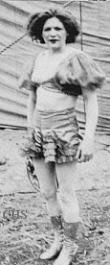 Photo: 1934, Irma Ward, featured with her one arm planges. Sverre O. Braathen photo.
Of the acts held over from 1935 the Hobsons, the Arbaughs and especially Irma Ward were again very well received. The combination of the very strong performance and the fine look of the show made this one of the more memorable ones to troupe. Public reception was good and Mix, to whom circus performing must have been as child's play compared to the effort required of a movie cowboy, seemed to enjoy being a circus performer. He was fifty-six years old and wrote that he was looking forward to the season.
Early rain and Barnes opposition was the first dish served up for 1936. The Al G. Barnes railer made its presence felt all through the 54 California stands. However, the routes were not as close as they had been in 1935. Mix went into Stockton on April 21 and Barnes on April 27; Mix went into Medford, Oregon on May 5, one day ahead. For the rest it was more chafing that elbowing. In the Los Angeles area (Inglewood, Pasadena, etc.) Mix' business was up 30% from the year before. By the third week, approaching San Francisco, the weather was cool and business good. Mix left the show, as he was occasionally wont to do, for the four day San Francisco stand. He rejoined at San Mateo on April 6, but left again April 10 to come back on at Stockton April 21. Sometimes one of the other cowboys imitated him when he was gone.
Other truck shows out in 1936 were Downie, Rice, Robbins, Walter L. Main, Russell, Lewis and Barnett. Of these the Mix show was the largest, being on over fifty-five trucks. The equipment was largely the same during the whole five year life of the title and it listed in this order:
Advance (car and five trucks)
#1 1934 Ford Stake (all the 1934 Fords were delivered at Davenport in 1934)
2 1934 Ford delivery (junked after 1937 season)
3 1934 Ford delivery
5 1934 Ford tractor and trailer (slept ten men)
6 1934 Dodge delivery
7 1935 Chev coupe (general agent)
Back with show (forty-four trucks, eight cars, one bus, twenty-nine trailers)
32 1932 CMC Tom Mix props
34 1933 Intl ticket wagon
36 1933 Dodge horses (junked after 1937 season)
41 1934 Ford cage
43 1934 Ford cage
46 1934 Ford cage
48 1934 Ford cage
49 1934 Ford cage
51 1934 Ford props/ring curbs
52 1934 Ford trappings
54 1935 Ford semi platforms
55 1934 Ford semi jacks
60 1934 Ford semi stake & chain
61 1935 Ford semi big top poles
62 1935 Ford sidewall/poles
63 1935 Ford lightplant
65 1934 Ford planks
67 1935 Intl heavy repair truck
68 1935 Ford delivery wardrobe
69 1937 Ford delivery light repair truck (added for 1937)
70 1931 Chev candy stands
73 1935 Ford semi cookhouse
74 1935 Ford delivery calliope
75 1934 Ford semi sideshow
77 1935 Ford bus workingmen's sleeper
78 1935 Ford sedan asst. mgr.'s car
80 1934 Ford semi stringers
81 1934 Ford semi props
82 1934 Ford concessions
83 1935 Ford semi horses & ponies
84 1936 Ford stakedriver
85 1934 Ford concessions
86 1934 Ford semi planks & seats
87 1935 Ford semi props
88 1934 Ford semi menagerie poles
89 1934 Ford tank gasoline
90 1935 Intl semi elephants
91 1935 Intl semi horse & elephant
92 1936 Intl semi horses
95 1935 Ford semi chairs
96 1935 Intl semi canvas
97 1934 Ford semi horses
99 1934 Ford semi cookhouse
102 1934 Dodge semi bandsleeper
103 1929 Lincoln sedan (sold after 1937 season)
104 1936 Ford station wagon performers
105 1936 Ford station wagon performers (traded after 1937 season)
106 1934 CMC bus Mix' personal vehicle
107 1934 Ford sedan performers
108 1930 Cadillac sedan performers
109 1934 Dodge sedan performers
110 1934 Ford sedan performers
111 1933 Ford sedan advance agent
The twenty-four house trailers included the advance office (#10) and a trailer for candy butchers which slept eighteen, a trailer for the clowns, the ticket department trailer which slept eight and Tom Mix' trailer.
There were two closed trailers, one for candy stand stock and one for ladies donniker. There was a dog cage trailer, an open prop trailer and a hamburger stock trailer. Ted Metz' sideshow equipment was not numbered and was carried in a 1930 Ford semi, a 1931 Ford housecar, a 1930 Chevrolet house-car, a 1930 Aero trailer and three homemade house trailers. Max Gruber carried his stock in his own truck while he was with the show.
The bad floods in the east in 1936 restricted everyones territory until after August 1, both because of damaged highways and the necessity for people to return to normality in order to buy show tickets.
Mix moved into Oregon on May 4 and Idaho on May 14. In Medford, Oregon he was one day ahead of Barnes to good business. On May 19 in Burley, Idaho the only cancellation of the season occured when a dust-laden wind blew down the menagerie after the matinee. The big top was lowered immediately under the handicap of poor visibility and it was then decided to proceed with the tear down. Mix was slightly hurt by flying debris during the storm and three employees suffered various minor injuries. Generally, Idaho was good to the show with a turnaway in Boise on May 15.
Wyoming and Colorado occupied the last week in May and they went into Kansas at Hays on the 1st day of June. Kansas was not believed to be a good show state in early June, but Kansas City donated four capacity houses during a two day stand. Iowa, South Dakota and again Iowa took up two weeks to only fair business. The drought of 1935 had lasted into 1936 and affected pocket books in the prairie states.
June 29 was the first day of a ten day stand at the Chicago Coliseum that was one of the more memorable in circus history, not for what happened, but because of its unusual organization. Goldblatt's, the department store chain, hired the circus to play the stand. Reportedly, the show received $30,000 for the ten days. For this amount Goldblatt's was allowed to sell reduced rate tickets in their stores. No purchase was required for the 15c and 25c tickets (regularly 25c and 50c), but Goldblatt's expected the ticket sales to generate traffic. The stores were decorated in a circus theme, much newspaper advertising was purchased in 24 Chicago area papers and 12,000 sheets of paper were posted. In addition there were 200 24 sheet billboards and 2 million 42 page rotogravure heralds utilized.
The performance was buttressed by the addition of the Albert Powell trapeze act and Kenneth Waite's clown troupe for this stand only. The menagerie and side show were housed in the north hall of the Coliseum. Goldblatt's set up booths throughout the Coliseum and sold everything from neckties to flatirons during the run. Business was slow initially, but built up during the week until 102,875 people had paid to get in, a mark Billboard said was a new summer indoor record. The only negative aspect of the stand was the intense heat that lasted the entire ten days.
From Chicago the circus moved east quickly, across Ohio and northwest Pennsylvania into New York. Jamestown on July 17 was the best under-canvas business the show had ever done. By the end of July they had been out 19 weeks, covered 8000 miles to good business with no serious accidents. The heavy equipment was moving at night to avoid late setups and missed dates. New York state proved excellent with the banner concert at Niagara Falls.
They played Stamford, Connecticut on August 10 and thereby completed a coast to coast season. It is possible that this was the first truck show to do this. Unfortunately, the nutmeg state was very hot and business suffered in all four stands. The last week in August the great Alfredo Codona came on as assistant equestrian director. With him came his wife, Vera Bruce, who did a single trapeze act. Codona, of course, was no longer able to work aloft. The family tragedy was to take place the following July.
From New England the circus went into New Jersey on the last day of August. John Ringling visited the lot in Newark and politely pronounced it to be a fine show. He also went out of his way to compliment Carl Robinson's band. Robinson had been drummer in the Ringling band in 1916. A new elephant trailer was delivered in Stateville, North Carolina on September 19. On the 28th the city fathers of Savannah, Georgia urged the circus to winter there, but the show had decided to go into Aniston, Alabama. They ran into heavy Ringling paper while playing the Macon Fair on September 25; Ringling was due in on November 6. A polio epidemic in Georgia halted business in the state after only four stands. Unheard of today, these epidemics resulted in children being forbidden attendance in crowds and even adults were advised against it. Mix went into North Carolina, Virginia and Tennessee to use up the season. On November 5 they reached Aniston and closed. There had been 217 stands in 25 states to good business over 12,235 miles. It was the last good season the show was to have.
The 1937 Season
The quarters in Aniston were in the former US Pipe Company plant, forty-seven fenced acres with a guard at the gate and everything under a roof. Unfortunately, on February 6 a fire did $5000 damage to several trucks, the cookhouse top and some miscellaneous equipment. Head mechanic Joe Ford had everything back in shape by opening day. The same week that the fire occured a bad flood hit Gadsden, Alabama, and many other places for that matter, and the show responded to a Red Cross appeal by sending a top, a light plant and 1500 chairs.
Animals for the new season included twenty-nine horses, eight ponies and two mules, down a dozen from the past seasons, although it was the peculiar history of this show that, like the old wagon shows, people regularly came on the lot with horses to sell. Babe and Queen were the elephants with Max Gruber's punk as a third. The caged animals were the same with the addition of a sun bear. Led stock included three zebras and a llama.
Opening day was March 31 in Aniston then a day en route to a two day, Shrine sponsored stand in Birmingham. The terrible floods of 1937 affected business all the month of April in Arkansas, Tennessee, Illinois, Missouri and Indiana limiting its description to satisfactory. In Youngstown, Ohio they hit their first good weather plus a payday in the steel mills and did excellent business. Akron was straw on April 28 despite the eight week old strike against the Firestone Company, but the lot in Mansfield was too wet and the show blew the stand. Scranton on May 7 was heavy with Ringling billing for its June 11 date. Lots were still wet and the weather cold in Pennsylvania, but business was touted as good. While en route from Youngstown to Oil City some of the truck drivers picked up opposition arrows and followed them to another show's lot in Sharon, Pennsylvania.
Mix had yearnings toward a rail show by this time. Such a rumor was to rise again the next year. He cited economics as a good reason for conversion. It cost $2000 to buy an elephant and $4500 to truck him. A bull car on a rail show only cost $3500 and would haul six or eight elephants.
The New England tour from mid-May to late June was wet throughout, but Mix was first in and got the business. Worcester, Providence, New Bedford and Brockton were all excellent stands. Then the first week in June they started repeating 1936 stands and scored their biggest week. In Portsmouth, New Hampshire a sea lion was born and the next day in Portland, Maine the mother died. Dail Turney bought a female goat that became foster mother to the infant.
The 1937 performance was almost the same as that of 1936. The Riding Hobson's had been replaced by the George Hanneford Family and Ray Goody's slide for life was added, but everyone else had returned.
The route book listed the show as follows:
1 Grand introductory pageant
2 Garland entry
3 ponies and dogs (Homer Hobson, Sr. Helen Ford, Joe Bowers)
4 aerial ballet
5 Hanneford family
6 Tom Mix and Tony Jr. marksmanship, Liberty and menage acts
7 clown boxing number
8 Charles Arley, trapeze head balance
9 clown walkaround
10 Ray Goody, slide for life
11 comedy acrobats and contortion
12 Irma Ward, single trapeze
13 Liberty horses (Max Gruber, Homer Hobson Sr., John Agee)
14 single traps
15 iron jaw (Joy Myers, Bud Asher) teeterboard (Five Bucks)
17 George Hanneford Troupe
18 clown walkaround
19 Flying Arbaughs
Anyone seeing the Mix show in 1935, 1936 and 1937 would have discerned little difference in the programs. Two good, strong acts were added in the first week of June in 1937, Frank Shephard with his heel catch aerial act and the ten Abdullahs, a whirlwind tumbling and pyramid turn. With Shephard the show was unusually heavy with aerial acts, presenting them five times excluding the iron jaw routines.
Staff changes for 1937 included J. Hervey as contract agent, Fred Emythe as press agent back, Herb Duval as adjuster, William Flowers in the connection, Fred Shaeffer as menagerie boss; Russell Kelly returned as prop boss and Red Parker as electrician.
The CIO tried several times to contact the employees while the show was in New England in an attempt to organize them. Other shows agreed that the union was having no effect. That would come in 1938. Two small shows had closed by July 1 and Jack Hoxie folded June 26 to reopen later for a few days. Yankee Patterson closed for good on July 10. Business was described in mid-season as pretty good, nothing-more. The weather was affecting crowds just as it had in 1935.
Leaving New England the Tom Mix Circus went into New York and Pennsylvania to be greeted by indifferent business. They dipped into Ohio for three stands and back into West Virginia. Here Rhoda Royal resigned and John Agee once again became equestrian director. Virginia was fair, but Washington D.C. was excellent for a three day stand at 25th Street and Bennings Road. Three days in Baltimore held two straw nights and then came a six day stand in Philadelphia. The weather was hot by this time.
On the morning of August 20 en route from Stroudsberg to West Pittston, Pennsylvania there were three truck accidents, one of which was the overturn of a horse trailer. Neither man nor beast was injured in any of the mishaps.
August 27 was the initial date of a 14 day stand in Toronto at the Canadian National Exposition. Truck shows were not allowed in Canada, ordinarily, so this was an unusual contract. It was unusual in another way, in that the circus was expected to give a show constantly while the midway was open. The performers, used to two a day, were suddenly doing eleven a day as the tent was emptied only to be opened again and a new show started once enough people had gathered. The show was cut to something over a half hour, but with the usual doubling that such a show called for there was little time to rest. With this and oppressive heat and a polio outbreak in Ontario the show broke even for the two week stand.
The remainder of September was spent in Ohio (4 stands), Indiana (2), Illinois (5) and Missouri (4). The weather had gone back to cold and income was irregular. The starback truck was lost in Ravenna, Ohio on September 17 when it was demolished in a train accident. A replacement was secured in Akron.
October was split between Kansas and Arkansas, Kansas being satisfactory and Arkansas wet. As in 1935 Kansas City came up with four capacity houses during a two day stand October 4 and 5. Little Rock was played on the 18th with Cole Brothers billed in for the 21st. It rained on the 18th so Cole Brothers did the better business of the two.
The Mix show arrived in El Dorado, Arkansas on November 6 to play the last date of the season after the shortest milage of its history, 10,251. The multi-day stands in Chicago, Toronto, Philadelphia and Baltimore were the reason for this low figure. Winter quarters were established in Texarkana, the season was pronounced only good and the equipment was put away.
The 1938 Season
The worst season in American circus history since 1875 began for the Tom Mix Circus on April 2, 1938 in Texarkana. No one predicted it, least of all showmen, and before it started optimism was high. New shows such as Tim McCoy's Real Wild West and the Parker & Watts Circus went out. Adkins and Terrell saw enough room to put out a second railroad show, Robbins Brothers. But by the first week in May Billboard was reporting poor crowds everywhere.
Mix' business was slow in Texas the first week. They went up into Oklahoma and Missouri and there was little improvement. The show was on the same number of trucks as in 1937, but some of them were larger, the show heavier. Changes were as follows:
New in 1938 - #56, 1937 Dodge semi carrying chairs; #80, 1935 Ford semi carrying stringers; #104, 1936 Ford station wagon replacing same number.
Offlisted - 7, 36, 70, 78, 103, 105, 108.
Renumbered - 62 to 54, 54 to 102, 74 to 2, 60 to 65.
Load shifts - stake and chain from 60 to 62; wardrobe, from 68 to new utility trailer; calliope, from 74 not carried; chairs, from 95 to 56; increased ring stock to 95.
The performance was expanded to the point where it was the longest the show had ever had, over two hours. On the basis of reports and rumors there would soon be many acts at liberty. The McCoy show folded in Washington, D.C. and P. N. Branson came back to be Mix' general agent. May 14 and 15 there was opposition from Cole Brothers in Springfield and Columbus, Ohio, the other show coming in three days behind in each town.
The program, again heavy with aerial numbers, went as follows:
1 Tournament
2 Garland entry
3 ponies and dogs (Homer Hobson, Helen Ford, Ruth Mix)
4 high wire monkey (Joe Bowers)
5 ladders
6 juggling (Les Uniques)
7 clown firecracker act
8 backward foot slide (Ray Goodie)
9 comedy acrobats (Bumpsy Anthony, Gregg trio, Jimmy Davison)
10 Iron jaw (Joy Meyer, Jessie Shepherd) trap head balance Charles Arley)
11 bareback, twelve people (The Clarkes)
12 clowns
13 heel catch, no net (Frank Shephard)
14 liberty acts (Herman Nowlin, John Agee, Homer Hobson)
15 clowns
16 Irma Ward, arm-over planges
17 concert announcement (Tom Mix, Tony, Jr., cowboys, cowgirls)
18 principal acts (Elizabeth Hanneford, Miss Ernestine, Percy Clarke)
19 perch pole (Charles and Dan Arley)
20 revolving whirl (Mildred Asher, Dorothy Taylor)
21 Tom Mix revolver marksmanship
22 Tom Mix two horse liberty act, menage on track
23 clown car
24 wire acts (Miss Fredericka, Goody, Miss Alethea)
25 comedy boxing (Bumpsy Anthony, Jimmy Davison)
26 elephants (John Alexander, Joy Meyers, George Wallace)
27 clown walkaround
28 elephant carrying dog and pony around track
29 Clarkonians flying act (Ernest Clarke, Percy Clarke, Ernest Clarke Jr.)
In reading the rosters of the Tom Mix Circus one is impressed with the number of long famous names they contain. Mix, perhaps concerned with the fact that his own career was in its twilight, seemed to hire a disproportionate number of people in similar circumstances. Rhoda Royal, Alfredo Codona, the once great Clarkonians (who had starred for the Ringlings in 1904) were the performers, but others, ticket takers, prop men etc. were often people who had once helped Mix or were friends of his friends. It was as if he tried to gather a family about him, instead of a circus.
Staff changes were minimal for 1938. William DeCamp was the new adjuster, Gladstone M. Shaw the general superintendent and Herman Nowlin superintendent of the menagerie. John Agee retained the equestrian director's whip he had assumed in late 1937.
Indiana, Ohio and New York were no improvement over the west. Downie Brothers closed on May 31 and Cole Brothers cut salaries that week. The Tom Mix show cut admission price from 50c to 20c in an attempt to make the nut. Wages were falling behind as tickets were unsold. One trouper collected his hold-back and was told that after the payment there was $40 in the till. Forty-five people were released in an economy move. There was a slight upturn in attendance in June, especially in northern New York. The banner day came on June 14 in Altoona, Pennsylvania.
Circuses seemed to be about to have a convention in the eastern states in June so the Mix show doubled back. By June 18 they were in Painesville, Ohio, heading west. About this time Tom Mix announced that he would be satisfied if he broke even on the season. He was asking too much.
The weather improved in late June. Evanston, Illinois was played to good business on the 28th. A blowdown occurred in Neenah, Wisconsin on July 10. There were 1000 people in the big top watching the liberty acts when the tent came down upon them. One rigger received a broken arm, but there were no injuries to the public. Of the thirteen horses in the ring one was injured when a pole broke its back. It had to be destroyed.
The show lurched on doing indifferent business in Wisconsin, Iowa and Missouri. By August 11 Mix had grown so disconsolate he decided to quit. He had a European theatre tour booked to begin September 12 and he left the show in August, putting it in his daughter's hands. He went to Chicago, ostensibly to rest up and return, but he never saw his circus again.
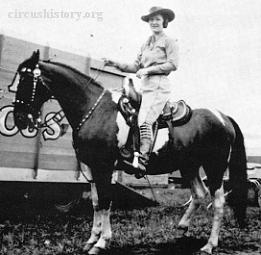 Photo: Ruth Mix with a horse truck in the background in 1938. Wilson Collection.
Ruth Mix had been with it since opening day and even appeared in the ring with a pony act and as a decoration in the wild west concert. However, she had no circus management experience and the actual operation of the show was left to Dail Turney.
The first three days after Mix' departure the show was in Kansas City for the third time in its history and for the third time the public stormed the ticket wagon. Even without Mix - whose absence was not advertised - 21,000 people bought tickets and all six performances were strawed. But from there the circus gradually fell apart.
By the 19th of August in Wichita the show was cut to one ring as performers and workingmen began to drift away. Ruth Mix kept it together through Oklahoma and into Texas where it finally foundered in Pecos on September 10.
The equipment was run into the City-County Exposition Building in El Paso and the Tom Mix Circus had played its last date. From El Paso the equipment was dispersed to many hands. A used car dealer bought most of the trucks, a promoter bought the office wagon and wardrobe, Bud Anderson bought the bull, Babe and US Printing and Engraving took Queen for the paper bill. They also took two of the semis. Dail Turney and C. W. Warrell received the light plant and the calliope, perhaps for back salaries. The major buyer, however, was J. W. Conklin, the carnival operator. Twenty head of horses remained under attachment by Gladstone Shaw, general superintendent. By March 1939 all but the livestock was moved out of El Paso. What might have been has no place in this chronicle. The show fell apart at the end, but for over four seasons it was a lusty, thriving thing and brought great circus to millions of people. Few shows survived the debacle of 1938 and this one outlived most of them. To people to whom Mix was a childhood hero, the Ralston straight-shooter of films and radio, the wish might occur that the show had a neater, less ignominious end, but that is the stuff of fiction, not history.
Bibliography:
Billboard Magazine 1934-1938
The Western, by Fenin & Everson, Bonanza Books (New York, 1962)
The Fred Pfening, Jr. Collection, Columbus, Ohio
The Robert Parkinson Collection, Circus World Museum, Baraboo, Wisconsin
information in litt from:
C. A. Sonnenberg
Ralph Skidmore
Gordon Potter
Joseph Bradbury
George White
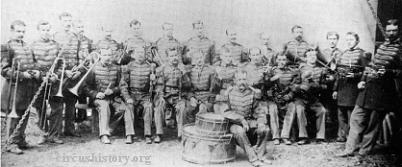 Photo: One of the older band photos available is this shot of the 1881 Barnum & London Circus band lead by J. S. Robinson. Wilson Collection.
It is impossible to determine the exact number of circus bands that have toured this country but a fair estimate would be around 3,000. Not until the 1870s did an American circus issue a route book. A perusal of these books yields interesting and valuable data concerning circuses. They vary as to content but invariably contain the itinerary of the circus that issued them. They may also include such items as the mileage between towns and cities that comprised the season's route, the population of such, quality of hotels and hostelries, weather conditions, business done each day, number of railway cars and other information regarding trains, number of wagons, horses, tents and their sizes, et cetera. Many of these little books list the entire show personnel, including band rosters. Prior to the time that printed route books were issued, an occasional enterprising trouper would keep a hand-written record of the itinerary of the show, with perhaps the mileage between towns and a comment or two concerning unusual happenings during the season.
There were a few periodicals that recorded considerable data concerning circuses, chief among these being the New York Clipper, published from 1854 through 1924, and The Billboard, first published in 1894 and still being issued weekly but under the name of Amusement Business. These magazines each year published the names of the band rosters on all circuses that supplied them. Because of the intense competition for good musicians during the era that tented circuses flourished in this country many of the band directors refused to divulge the names of the men in their bands. This was done in an endeavor to prevent other circuses or minstrel shows and theaters from enticing the musicians to join their organizations.
A search of all known route books and other show publications has made it possible to compile rosters of 1015 different circus bands. These disclose that approximately 12,000 different musicians played with these bands at least some portion of a season. In most instances a band roster compiled at the start of a season would vary greatly from one issued in the middle or at the close of the season. A thirty piece band might have used as many as fifty different musicians during the course of a season because of the frequent changes in its personnel. The vast majority of musicians joining out with circuses did well to remain an entire season, many quitting the road after a week, a month, or at the summers end. However, a not inconsiderable number made the circus a career, playing with these bands from twenty to forty years, and an occasional one can boast of more years of following the tanbark trail. Most notable of these is Henry Kyes, who either directed or played with circus bands 61 years of which 22 were with Merle Evans on the Ringling Barnum Circus. Henry started his career with the Parker Amusement Company, a carnival in 1909 and has also played with rep shows. This is a record any circus musician can be proud of.
Musicians have joined out with circuses for a variety of reasons - some to see the country, some to earn money to complete college educations, some for pure adventure, some to satisfy a wanderlust, and yet others because they had sawdust in their veins. For the most part those who failed to become troubadours of the road lacked the physical stamina that the life required. They simply did not possess the lips of steel with the toughness of leather required to endure the terrific grind of a circus musician. The drummers did not possess the hands and wrists required to beat out one-to-the-bar galops, the fast marches, the long drum rolls. Many lacked the ability to pick up the fast cues that were essential in the long, ever-changing circus programs.
In bygone days the most difficult job in the music world was that of playing with a circus band and it was likewise the most exacting work demanded of any member of a circus organization, at least as far as physical stamina was involved. Consider the street parades alone. These usually started about ten o'clock in the morning and lasted two to four hours, often over cobblestone pavements or muddy or dusty streets in the days before paved streets, with the jouncing and bouncing these entailed. Many of the bands would play a large number of marches during the parade, and these of the solid type played at very fast tempos. Some bandmasters would select but half a dozen marches, repeating these along the route. Invariably all the directors would choose those marches with screaming cornet parts and solid bass sections, such as Gentry's Triumphal, and The Screamer by Fred Jewell, From Tropic to Tropic or Colossus of Columbia by Russell Alexander or Olevine or Bombardment by H. A. Vandercook.
For the musicians the street parades possessed a number of hazards that added greatly to the grind imposed upon them by circus life. The rutty streets and cobblestone pavements often resulted in cut lips. Now and then a runaway bandwagon would tip over, hurtling the occupants into stone walls or rock strewn ditches and occasionally putting bandsmen into hospitals or cemeteries. The runaway bandwagon might crash into a low bridge, crushing the musicians between wagon and bridge and demolishing the bandwagon. Frequently these accidents meant the instruments, too, were in need of "hospital" attention. Always there was the necessity to dodge telephone and electric light wires stretched across the streets if the musicians wished to avoid decapitation in the line of duty. On many days the sun beat down unmercifully, melting the high celluloid collars of the bandsmen. In the "grand and glorious" street parades, musicians wore uniforms of heavy wool, with stand-up collars buttoned tightly, augmented by tall hats or braided caps that were warm and heavy. If the sun failed thus to shine the parade might wend its way beneath drizzle or through a torrential downpour, with crashes of thunder vieing with those of drums and cymbals. Returning to the lot the musicians were often soaked to the skin, with the choice of going to the cookhouse for food or to the dressing tent for a change to dry clothes before hurrying into the big top there to give an hour long center ring concert. When a good western hail storm took its toll of instruments the bandsmen usually paid a price, too, in injuries of varying degrees. No circus musician, performer, or teamster who ever graced a "million dollar" street parade of yesteryear would vote for the return of this glorious segment of circus day!
In the circus band were musicians who had played with the big business concert bands that for many years toured this country, such as Sousa, Kryl, Pryor, Conway, Creatore, Liberati and others. These bands made transcontinental tours, and the Sousa band made several trips to Europe and one tour of the world. Their usual schedule was to play two concerts a day, some times in two different cities. Musicians who played with both the concert and the circus bands are agreed that the concert band tours were rugged but without exception they are emphatic in asserting that the circus was the more demanding of physical stamina and reserve energy and no less demanding of musicianship.
Edward J. Heney played clarinet and saxophone with both the Sells-Floto and the Al. G. Barnes Circus bands and with the Arthur Pryor band and for some years saxophone soloist with the Sousa Band. In comparing circus and concert work he has written: "So far as circus bands were concerned when I traveled with them, I should say that 'trouping show band experience was mandatory. Endurance, musically as well as physically, speaking was most necessary in circus bands. Without these two a circus musician could not stand up under the daily grind. In those days we were on the bandwagon for the usual two hour morning parade in the towns and cities. The main performance was always preceded by an hour concert in the ring. The big show lasted two to three hours during which time we played constantly, only resting during the clown frolics. In addition, we had to play the 'after show' or wild west performance - and collect tickets for same in the bleachers. All the foregoing twice a day from 8 A. M. to 11:30 P. M. - on the go the entire time.
"Concert band experience plus the ability to stand long transcontinental tours yearly and a general idea of solo work before the public were the 'certain something' a Sousa bandsman had to have. Playing in different towns every day, some times two communities a day (one in the afternoon and one at night) resulted in some strenuous living, playing and traveling.
"To conclude and to answer your pointed question, I should state that considering everything, the most difficult band jobs in those days were the circus bands."
Cleveland Dayton of Ottumwa, Iowa, was a trombone player with the Barnum & Bailey Circus for a number of years and served as assistant director under Edwin H. "Ned" Brill. On leaving the Barnum Circus at the close of the 1915 season, he took over the direction of the Ottumwa Municipal Band and has held this position ever since. His comment regarding the playing in circus bands: "There was no harder work for musicians than a big circus band during my time. Parade at 10:00 A. M., two hours at least. Into the big top at 1:30 for the concert and program until 4:30. Back at 7:00 for the concert and program until 10:30, and very little rest did you get during that time. There were no silent acts. That should explain why it was so hard to hold musicians."
Another musician with both concert and circus experience wrote: "The quality of musicians was good and bad. The old timers were pretty rugged and could hold their own with any one. Most of the one year boys couldn't take it. The grind was terrific. I have seen a number of excellent musicians go to pieces as a result of this tortuous grind. That was one reason why so many musicians remained in the circus business for only one year."
Karl L. King, one of the best baritone players that ever traveled with a circus, former director of the Sells-Floto and of the Barnum & Bailey Circus bands asserted: "Qualifications for musicians for a good circus band were: 'Good technique, power and endurance, good attack, etc. No place for a 'panty-waist' type of performer. Had to play it out good and strong all the way through."
The life of circus people, including the bandsmen, was far from glamorous during the early mud-wagon show days. None of the circuses provided either sleeping accommodations or meals. Everyone had to put up at a hotel or rooming house, getting their meals where they could. On a hot, sunny day it meant plopping through dust and on a rainy one sloshing through mud and water. After the night show it was up to the trouper to find his way to hotel or lodging house without so much as a street light to direct the way. It was not uncommon for the town roughs to rout the band from a sound sleep and to herd them to the square or commons there to give a concert before they left for the next town on the route. Everyone on the circus would be called at two or three o'clock in the morning, eat a hasty breakfast, then repair to buggy or wagon for the trip to the next town. Those who could often sought out some spot on top of the canvas or amid trunks and props where they might gain another hour or two of sleep the while the horses jogged along, teamsters sometimes hard put to decide which turn to take at the crossroads and occasionally choosing the wrong one to the frustrations of all concerned.
Before the days of the "million dollar" street parades these little shows would pause outside town or village to polish up their wagons, clean the horses, and tidy up generally. The musicians, donning bright colored caps and coats before mounting to the top of the bandwagon, would launch into a mighty march and continue to blast away until the lot was reached, thereby announcing to the local citizenry that that day they were to be afforded the wondrous opportunity to witness marvels of arenic skill and splendor. Arrived at the lot, bright uniforms were quickly doffed and overalls donned, as bandsmen turned to the tasks of erecting tents and putting up seats trusting to divine Providence to escape serious injuries to their hands.
Other problems confronted them during the course of a season. If their circus went broke they were quite as stranded as were the performers and workmen. In that event one of them might find a current copy of The Billboard and discover in its columns an ad for a trombone player, let us say, Butler Bros. Circus. The trombone player might decide to try his luck again whereupon he would study railway schedules and ascertain the best way to get to the city where Butler Bros. would be showing the following day. If he were fortunate enough to have the price of a ticket he would probably elect to ride a day coach but lacking the wherewithal to provide this luxury he might choose to ride "blind baggage." Finding the lot he might stand dismayed to discover all the show's wagons were painted with the name Norton Bros. Circus. As he stood in his perplexity the chances were that a begrimed workman might approach him and ask, "Need some help?" with some such dialog as this ensuing, "Well I guess I've hit the wrong town. I was looking for Butler Bros. Circus." With a spat of tobacco juice, the workman might reply, "Oh that. Don't let that bother you, mister. We've been in a mite of trouble with some of the doggone sheriffs in these parts so we've been changing our name about every week or so. If you're looking for a job the boss is up in that yellow ticket wagon."
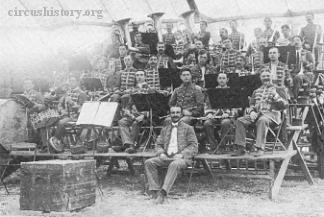 Photo: Carl Clair is shown seated in front of his band on the Barnum show around 1905. Wilson Collection.
In the mud wagon years musicians received from $3.00 to $4.00 per week to both play in the band and to help "put 'er up and take 'er down." By 1900 the salary scale had risen to about $8.00 per week, with the band director receiving $18.00 to $20.00. When the Barnum & Bailey Circus toured Europe from the fall of 1897 through the 1902 season. Carl G. Clair had a thirty-one piece band with the Show. A weekly allotment of fifty-five pounds sterling was made to pay this band and there was an additional grant of twenty-four pounds per week for lodging.
After the advent of the railroad circus musicians had little of which to complain regarding their living conditions on these shows. Always they were provided with sleeping berths, usually two high, although on some of the smaller circuses they were required to sleep in three-deckers. The band director was provided with a stateroom on the train. The cookhouse fare was simple but adequate, and the musicians shared the same table throughout the season. Like everyone connected with a circus they were required to pay their own transportation to winterquarters or the city where the show was to open the season.
For several years prior to the First World War the salary scale on the Ringling Bros. Circus was according to the ability of the individual musician. Solo or first chair men received $20.00 a week and the second and third chair men $12.00. Gentry Bros, for years carried some of the best circus bands in this country and paid the men $15.00 per week in 1918. During these years the better circuses paid their musicians about $17.00 a week.
In the spring of 1919 the newly merged Ringling Bros, and Barnum & Bailey Circus opened in Madison Square Garden in New York City. Their band was unionized during the first week of this season's engagement with a salary of $17.50 per week. In 1922 the salary was increased to $25.00 per week; in 1925 to $32.50, in 1938 to $46.50 and in 1955 the salary was increased to $96.00 for a six day week and to $112.00 for seven days. The Barnum & Bailey, the Ringling Bros, and the Ringling Bros, and Barnum & Bailey Circuses always defrayed the living expenses for their musicians in Chicago and New York and on the road in addition to the salaries listed above. The present indoor circuses pay their musicians the union scale in all cities they exhibit in and these will vary from city to city.
To some the salaries of circus musicians prior to unionization may appear to have been absurdly low, but our study indicates that in most cases they were comparable to those paid musicians in other branches of the show world in the larger cities of our nation. In 1918, for example, the year prior to the unionization of the Ringling-Barnum Show's band, the musicians in New York commanded the following union salaries: theaters, musical comedy $30.00 to $33.00 per week; dramatic shows $24.00 to $26.00; vaudeville $33.50 to $35.00; the Winter Garden $35.95, and the Hippodrome $39.75. These musicians were required to pay their own living expenses which was not true on circuses.
In discussing both living conditions and salaries of circus musicians it is essential to keep in mind the general living conditions and salaries paid in the country at large at any given time. Society had not yet arrived at the "push button" era of ease and comfort. Living was much more rugged then than now, and earning that living taxed physical capacities beyond that which is generally considered either desirable or tolerable today. Very few escaped these rigors and most of those few who had known the life of toil as they climbed to higher pinnacles of power and comfort.
Edward J. Heney compared the salaries and living conditions of musicians in circus bands with those in the big concert organizations thus: "In 1919 I was a member of the Al. G. Barnes Circus Band, Eddie Woeckner, director. Salary for playing B flat clarinet was nine dollars per week and 'cakes.' That meant all meals in the circus cook house and a berth with another windjammer in the circus sleeping car . . . In the 1920 season I was a member of the Sells-Floto Band, Don Montgomery, Director. My salary was eighteen dollars per week for playing first chair solo clarinet. Salary included all meals in the cook house and the usual bunk with another musician in the sleeper."
Mr. Heney was a member of the Arthur Pryor Band in 1928 where he received $65.00 per week for playing saxophone solos and doubling on B flat clarinet with the band. He was required to furnish his own uniform and pay his own living expenses.. As saxophone soloist with the Sousa Band from 1924 through 1931 he received a salary of $110.00 per week and again furnished his own uniform and paid his own living expenses.
John Jaquish was a member of the bands on the Gollmar Bros., the Hagenbeck and Wallace and the Ringling Bros. Circuses. He wrote: "The sleeping quarters were comfortable, clean and well regulated. The performers rated the highest and had the best berths and state rooms. The band, ticket sellers and some single male performers were usually housed in one Pullman. The meals were very good. Ringling was the best. Every one had to tip the circus employees for services rendered. We tipped the porter of our Pullman and the table waiter. The latter, in turn, would tip the cooks, so naturally the table which tipped the most got the choicest cuts from the cooks. The meals were not bad though. The time of serving was often irregular due to poor train connections, bad weather, long jumps, etc. One practice was very bad. We were served dinner immediately after the afternoon performance and yet we had another show in the evening. After the evening show we were as hungry as we were before dinner. Most of us looked for the cheapest lunch room we could find at night, because this meal came out of our own pocket. The bands were not unionized, and the top salary was about $15.00 a week. I think I got $12.00. We paid our own laundry, baths, transportation to and from the lot and tips."
Present day truck circuses provide sleepers for their bands. This is driven overland, usually by one of the members of the band either after the night performance or early the following morning.
For years there was to be found in the backyard of the Ringling Barnum Circus a wagon or truck fitted out to dispense tea, coffee, soft drinks, sandwiches, pie, cake and other snacks. By some it was called a "Juice Joint", by others a "Grease Joint." It was not circus owned but operated under leased concession rights, and every one who patronized it paid for what he obtained. Needless to say the place was busy at all times of the day and until about nine at night.
Many of the old time circuses carried on their trains what was known as the "Pie Car," where lunches could be obtained after the night show. The present day Ringling-Barnum indoor circuses carry lunch cars on their trains to feed their people from everything from coffee to steaks and these can feed the people throughout the day and most of the night.
The unionization of circus bands followed many earnest discussions among the musicians. Many of them belonged to local unions in their home cities and were not forbidden to play with non-union circus bands. Many of the musicians counseled against organizing any union that would favor either themselves or the circus owners, insisting that the welfare of both must be given equal consideration if success was to be assured. Musicians traveling with the various circus bands at the time union agitation was prevalent shortly after World War I were well aware of the fact that a number of circus owners were not financially situated to warrant their greatly increasing the salaries of their bandsmen. Some of these circus owners sincerely desired to pay higher salaries both to the men in their bands and to the better performers, but the competition for business was great and overhead costs had to be carefully controlled if the show was to remain on the road.
Once circus bands were unionized there was a tendency for the control of union affairs to become more highly decentralized and after a time the management lost contact with the day-today realities of circus life. The struggle for a circus owner to remain in business was not always fully comprehended by the union managers in some distant city office. The natural urge of these union organizers and managers was to seek always to improve the salary scale of the men on the road though they have not always been equally concerned with the living conditions afforded their members. The result has been that today the owners of truck circuses find themselves unable to carry twenty or thirty piece bands. At the present day there are only two truck circuses with bands. One of these has five pieces and the other eight. When a circus has to resort to phonograph records or an organ or has a band but does not play circus music nor cue a performance you just have a show that lacks the zip, the pep and the dash of a performance that is backed by a good snappy circus band.
This is unfortunate, for the absence of a good band costs a circus performance much appeal. A competent band under an able circus band leader, even though the unit must be limited in size, is essential to properly cue acts, to inspire performers, and to build each number on the program to its rightful climax. A well balanced circus performance presented to the accompaniment of a competent band possesses a sparkle, a luster that is sadly lacking when music is furnished by a non circus musical organization. A circus performance tendered without adequate band accompaniment resembles a dinner served sans sugar and salt.
On the other hand it must be remembered that trade and craft unions came into existence only as the result of long years of real need for such. Today it is doubtful if any circus musician would willingly forego his union affiliation. The musicians union has greatly improved the lot of these troubadours of the road. Not alone does the circus musician get a decent salary but he is assured of prompt payment, for failure on the part of any circus owner to meet this obligation on a given date means a union official immediately pulls the band off that show. Another benefit the circus musician has reaped from his union member ship is a rule that forbids him to do any work about the lot other than to play in the band. No longer does he help to erect the tents, put up the seats, build the bandstand, or the like without his consent and extra pay for such services. This rule was designed to safeguard the musicians' hands against injuries which might incapacitate him either temporarily or permanently. One rule of the circus musicians' that may be legitimately challenged is that which require the indoor circuses to employ a certain number of local musicians in each city in which they show regardless of their ability to play the music. Too often this results in the band director being compelled to accept an undue proportion of men who can play only saxophones and, too frequently the local musicians cannot play circus music as it should be rendered - they simply cannot 'cut it,' to use the colloquial phrase. Common sense would seem to dictate that if a circus is required to engage a specified number of local musicians it should at least have access to those qualified to meet its particular requirements! Unfortunately the one weakness of the grand and glorious Milwaukee circus parade is that the bands on the band wagons do not play band wagon marches nor with the tempo of the old time circus bands. Neither do they straighten out what they do play. For this reason there is no difference between the music of the marching-bands and the bandwagon bands. This takes a lot of pep, zip and go out of the parade that should be full of circus spirit.
In 1922 Frederick Alton Jewell, an excellent baritone player, outstanding circus band composer and a very competent band director for both center ring concerts and the performance, wrote a march he entitled "That Old Circus Band." One wonders if in writing this march Mr. Jewell foresaw the end of the great circus bands in our country.
The Golden era of the American Circus is dead, but one glorious segment of this great amusement enterprise lives on in the music composed for it by some of its most famous Knights of the Road. The ranks of the old time circus bandmasters is fast thinning, and when the last one has passed on from the scene such circus performers as are left will have to carry on as best they can with music furnished by men more familiar with dance halls than with circus arenas, by men who have never felt the call of the tanbark trail, by men through whose veins no sawdust courses.
The circus band has always provided the pulse beat for every performance, but it has been the arenic stars that have had their names and pictures in the printed program. Occasionally a band director's photograph has appeared in the advertisement of some manufacturer of band instruments in the program. In the 1890s the Barnum & Bailey Circus did use posters of the Carl G. Clair Band, and one season Merle Evans and his band, seated atop the Liberty Bandwagon, was featured in the billboards by the Ringling-Barnum Show.
The hundreds of thousands of Americans who through the years have thrilled to the music of circus bands may be interested to learn a little about some of the leading musicians who have graced these.
H. Benne Henton, one of the greatest saxophone soloists to appear with the Sousa, Kryl and other bands, was at one time a member of the band on the John Robinson Circus. Benjamin Vereecken was a member of the Ringling Bros. Circus band for a time and he made the five year tour of Great Britain and the European Continent with the Barnum & Bailey Show before becoming a saxophone soloist with Sousa. Samuel Albright played with several major circus bands prior to appearing as soloist with the Alessandro Liberati organization.
Bohumir Kryl, whose cornet playing was sheer magic, was for many years a brilliant soloist with Sousa, Frederick Innes, and the Kryl concert bands. He likewise toured our country with his two talented daughters, Marie, the pianist, and Josie, the violinist. Mr. Kryl displayed a delicacy of tone which has seldom been equaled. Music lovers who had the good fortune to hear his solo work will never forget his brilliant technique and splendid triple tongueing as exemplified in such compositions as Carnival of Venice by J. B. Arban. Critics were always amazed at the ease with which Mr. Kryl played the high notes and the extremely low ones in this particular piece. It will undoubtedly come as a surprise to many to learn that Bohumir Kryl was at one time a member of a circus band, but let him tell of this in his own inimitable style:
"When I was a boy of eleven years, while living in Bohemia in a town by the name of Horice, a circus came to our town, and as I was the leading acrobat in the town I of course went to see the show. Name of circus was Rentz Circus. This was the leading circus in all Europe at that time. After the afternoon performance I stayed at the tent when all the people have gone. I wanted to show off some of the best tricks which I knew. Managers have seen me doing these acrobatic tricks and the result was that I left my home with circus the following day. I was engaged as an acrobat but a few days after being on the road the manager have heard me practice on my trumpet and so next day I was playing the circus parade and at the performance I did my tricks. I was with the circus seven months and after having bad accident at one of the evening shows, I left the circus and walked home from Warsaw, Poland, which took me two weeks to get home. On way I stopped at many places of large restaurants, inns, etc. and by giving my own performance I have made enough money to pay all of my expenses and have had plenty left when I got home. I went back to school and studied very hard on my violin and trumpet. This was when I was eleven years of age and was back in 1886, and when I was fourteen we left for America where my father was engaged as a sculptor. I took up the same profession and when working in Indianapolis, Ind., on the Soldier's monument Mr. Sousa came to Indianapolis and after my audience with him he liked my playing and same result as with the circus, I left with Sousa band the next day, giving up sculptoring. Have been traveling with band for thirty-five years and after that fifteen years with the Kryl Symphony orchestra." Mr. Kryl also wrote that the Ringling show tried to prevail upon him to bring his band on the show to play center ring concerts. Kryl related that he refused to do this because he did not think circus audiences would like his kind of music. The Sells-Floto Circus also tried to contract the Sousa Band to play center ring concerts without success.
When Patrick Gilmore brought his famous band to Indianapolis one year one of his cornet soloists was Ben C. Bent, whose work was well known and admired. As Bent walked to the concert hall that day one Herbert L. Clarke walked behind him wishing that he might be given the truly great privilege of carrying the noted soloist's cornet case. Clarke would have then thought it strange, indeed, that when Bent walked around a circus lot none of the youngsters carrying water for the elephants abandoned that avocation to carry the cornet case of the great soloist. That same Herbert L. Clarke later became the greatest cornet soloist of all time. In fact there were three Bent brothers, all outstanding cornet players traveling with a circus.
 Photo: Everette James lead the band on the Christy Bros. Circus from 1919 until 1930. He is shown in 1922 with his son Harry James, a well known present day orchestra leater. Braathen Collection.
Near the turn of the century Everett James was smitten with the circus fever. The lure of the street parades and the music of the circus bands held him for many years. He played cornet and directed bands on the Mighty Haag, Lee Bros., Golden Bros., and Christy Bros, circuses. In 1916 a son was born to Everett and his wife Mable, at Albany, Georgia. As an old circus saying goes Harry James "was born in a red wagon." When this boy was six years old, Everett gave him a snare drum and taught him to play it. Before his seventh birthday Harry was a member of his father's band. By the time he was ten his father had taught him to play the cornet, and Harry could "cut" the music in the circus program with the best men. in the band. He had a very fast tongue and could "straighten out" the fast one-to-the-bar galops like a veteran. In his tenth year Harry led the musicians on the second bandwagon in the street parade, in which his mother played a steam calliope. She also did a stint in the arena, and her young son would leap from the bandstand to assist her in the ring.
Harold B. Bachman chanced to be in Mason City, Iowa, the home town of Meredith and "Dixie" Willson, when the Al. G. Barnes Circus played a one day stand there on July 7, 1913. He watched the street parade, captivated by the band racing through the fast marches. He went to the lot, hunted up bandmaster Eddie Woeckner, and asked if he could use another cornet player. Mr. Woeckner was happy to have another musician, so Harold Bachman left Mason City to tour with the Barnes Circus the balance of the season. When this show played Fargo, North Dakota the following year young Bachman found he could not resist the land of sawdust and spangles and again joined the circus's band.
As the days wore on Harold Bachman came to the conclusion that if he were to make music his profession he needed additional instruction. He went to Chicago where he studied cornet under an old circus cornet player and one time director of the band on the J. H. La Pearl Circus, H. A. Vandercook. Acquiring proficiency on his instrument, Mr. Bachman became a member of Bohumir Kryl’s Band.
Bachman was born in Atlanta, Illinois on September 2, 1892, and moved with his parents to North Dakota when he was seven. They took up a homestead in the western part of the State, twenty-five miles from the nearest town. Harold's first musical instruction was given him by his mother on an old reed organ. He purchased his first cornet from a Chicago mail order house. After graduation from the local country school he went to Fargo and enrolled in the North Dakota Agricultural College and studied music. In 1917 he was directing a band at Harvey, North Dakota when the governor prevailed upon him to organize a band to serve with the Second North Dakota Infantry, a new regiment being raised for duty in World War I.
When this infantry band arrived in a training camp it was transferred to the 116th Engineers, 41st Division, with which it went overseas. On Christmas Day, 1917, Bachman's band gave a concert for the troops. General Hunter Liggett studied the response of the men to this concert and was so impressed by it that he remarked, "That band is worth a million dollars to the American Army." Bachman did not forget this comment. It was his inspiration to organize a concert band when his army unit returned to the States after the war. He named this new organization Bachman's Million Dollar Band and with it made a number of concert tours of the nation and played various parks. Later Mr. Bachman became director of bands first at the University of Chicago and then at the University of Florida. He is a past president of that distinguished musical organization, the American Bandmasters Association. He is now known as Col. Harold B. Bachman.
Cornetist Joseph W. Dobie spent fourteen years with circus bands, no less than thirteen of them with Merle Evans on the Ringling-Barnum Circus. Henry C. Werner played cornet with circus bands seventeen years, of which fourteen were with the "Greatest Show On Earth." Philip Garko had a career of thirty-one years with circus bands, thirteen of these under the direction of Merle Evans. Among other cornet players that have possessed the lips of steel with the toughness of leather that enabled them to meet the exacting demands of circus bands may be mentioned O. A. Kirchies, Thomas P. Fallon, and C. M. Frankiser. One of the all time cornet greats was Bobby Sturgell. He was really an artist but unfortunately he died in his early 30s.
Shortly after the five brothers from Baraboo, Wisconsin, founded their circus, each of the Ringlings began to specialize in one or more departments of their show. For many years Al., the eldest, was the equestrian director and laid out the program at the start of each season. Like all circuses of that era the Ringling show presented an aftershow concert. This was usually made up of a series of stunts and acts similar to those presented on the vaudeville stage. During the 1906 season this aftershow failed to attract sizeable audiences and was in other ways displeasing to Al. Ringling. It so happened that Albert C. Sweet was directing the Ringling band for the first time that year. Al. Ringling approached Mr. Sweet one day with the problem of the make-up of the after-show.
Mr. Sweet mulled the matter over in his mind and for a few days and then broached the subject to his first chair clarinetist, one Tom Brown. They discussed the matter at some length, making and vetoing a number of suggestions. Finally Tom Brown asked Mr. Sweet what he would think of a saxophone unit as the core of a new after-show routine. They took the suggestion to Mr. Ringling who gave the green light to give it a trial.
Brown had a couple of brothers on the show and Tom knew they could give a creditable performance on saxes. He also also arranged with a Mr. Hopkins to work in this unit, thus organizing a saxophone quartet. Together these men worked out a clever routine, with Tom acting as the black face comedian. After several rehearsals the group felt they were ready to appear in the concert after the main performance. Most of the circus performers were among the audience for that initial show, so it was a critical crowd the new sax quartet played to. They won a good deal of applause interspersed with much hearty laughter, so Mr. Ringling knew he was on the way to building an aftershow that would have audience appear. He was right and business continued to improve for the balance of the season.
The Ringlings were not the only ones to profit by this venture of Tom Brown. By the close of the 1907 season Brown had decided to make a bid for vaudeville engagements. He had been receiving $15.00 a week as first chair clarinetist with the Ringling Circus and an additional $5.00 for his work in the aftershow concert. On December 9, 1907 the Four Brown Brothers opened on the Considine Vaudeville circuit in Minneapolis, Minnesota. A "Doc" Kealey was a member of this quartet, apparently supplanting the Mr. Hopkins who had joined the three Brown brothers to comprise the original saxophone group. The Ringling Circus band roster for the 1907 season discloses neither a Hopkins nor a Kealey, but the arenic program does list a Doc Kealey working on elephants in one of the end rings.
From the very start the Brown Brothers Saxophone Quartet proved to be a popular favorite and was almost immediately given headline billing. This musical unit ultimately evolved into the Brown Brothers Saxophone Sextette, with Tom still cast in the comedy role. It toured this nation on the various vaudeville circuits and with minstrel and musical shows. For some years there were two Brown brothers saxophone sextettes touring the country but no family relationship existed between them. The second of these, was founded by C. L. Brown who was at one time the circus band director of Sells-Floto Circus and in 1949 of the Cole Bros, band. C. L. Brown's Sextette was known as the Original Brown Brothers. No one who heard the Tom Brown Sextette on Phonograph records would ever forget them.
Tom Brown married one of the show girls on the Ringling Circus, and she became a dancer with the Dillingham musical show. She remained with this show while her husband took his unit to Great Britain. Mr. Dillingham found himself in need of an outstanding attraction for one of his productions and inquired of Mrs. Brown as to how her husband was faring abroad. She assured him that they were doing very well in England. Dillingham thereupon sent Tom a cable tendering him a long time contract at $2,500.00 per week if he would return with his unit to this country to be featured on one of the former's shows. While working for Dillingham, Tom procured a goodly number of club dates which he and his group filled after the conclusion of the musical show. An appearance of a short time at a club date brought the sextette an additional sum of $500.00 in an evening and no doubt brought additional patrons to the Dillingham musical with which the brown unit was currently playing.
E. A. Lefebre, the greatest saxophone soloist of all time played center ring-solos with the Liberati band on the Ringling Bros. Circus during the 1895 season.
Many outstanding clarinet players have trouped with circus bands but few of these have attained to the heights Tom Brown reached. Antonio J. Ramarez played clarinet in J. J. Richards band on the Ringling Bros. Circus in 1918 and played for Merle Evans on the Ringling Barnum Circus for 21 years from 1929 thru the 1949 seasons. He also played for Merle for a number of years in the Garden only after John Ringling North closed the show as a tented circus. One had to be a died-in-the-wool trouper to give twenty-two years of his life to that of a circus musician, but some of them did including Nicholas Althroth and Wiley B. Scott. Joseph Pomolio had a record of twenty-three years, Frank Tonar twenty-four years and Arthur Cox twenty-five years.
 Photo: Russell Alexander was a fine baritone player and composed many circus tunes. Braathen Collection.
One of the most illustrious of circus musicians is, ironically, one of the least known. Russell Alexander was born in Nevada City (now known as Nevada), Missouri on February 26, 1877. His father, James W., was born in the State of Pennsylvania, and his mother, Belle Wired, in Illinois. At the time of Russell's death two brothers survived, Woodruff ("Woody") and Newton, both outstanding musicians. Nothing is known of Russell's early life, his musical training and professional experience. At the age of twenty he signed a contract to play baritone with the Barnum & Bailey Band, under the direction of Carl G. Clair, for the five year tour of Great Britain and Europe, the winter of 1897 through the 1902 season. His name does not appear on the roster of the Barnum & Bailey Circus for the 1897 summer tour of the United States. With Russell Alexander in the Barnum & Bailey Band were Walter P. English, an excellent bass player, and Henry F. ("Hank") Young, perhaps the best bass drummer in the history of the circus.
As a member of the Barnum & Bailey Circus Russell rode the first bandwagon, the ornate but beautiful Five Graces. With fabulous Jake Posey clutching the reins this bandwagon was drawn by forty splendid, matched horses through the narrow streets and around the sharp corners of the principal cities of Great Britain and the Continent. Alexander arranged all the music used by the Barnum Band during this foreign tour, and those five years seem to have his period of greatest creativeness as a composer.
At the time the United States was involved in the Spanish-American War. The battle of El Caney in Cuba raised great enthusiasm among Americans everywhere and inspired Russell Alexander to write his greatest galop, - The Storming of El Caney. He dedicated this to the 2nd and 8th Infantry Regiments and to the Rough Riders of the 8th Brigade, 5th Army Corps in recognition of their valiant fighting on the slopes of El Caney. At least one American who participated in this battle revealed in every minute of the combat and in his later years liked nothing better than to relate its details to his sons. This man was, of course Theodore ("Terry") Roosevelt. Alexander's galop captures in rich measure the fury of that battle and requires an excellent band to properly execute it. Merle Evans has referred to it as a musicians number where the basses, trombones, cornets and every one really take off.
Among Russell Alexander's great compositions one must note the following marches: Colossus of Columbia, Memphis the Majestic, The Southerner, Olympia Hippodrome, Bedford's Carnival, Burr's Triumphal, and the galops, Bastinado, Shoot the Chutes, and Steeple Chase. These are to be found in the libraries of all circus, college, university and municipal bands and are as popular today as the day they were written. The best rendition of many of Alexander's marches and galops has been made by Merle Evans and his Ringling-Barnum Band for several of the recording companies.
When Russell was touring Europe with the Barnum Band his brother Newton, was playing trumpet with theater orchestras in Philadelphia and Atlantic City. Sitting in a theater orchestra pit day after day watching vaudeville acts and other shows Newton Alexander conceived the idea of a musical unit. He organized a troupe that was to gain great popularity as the Exposition Four. At first it was comprised of Newton, his brother, Woodruff, James A. Brady and Willie Patton. As a tribute to this musical group Russell wrote his march, The Exposition Four. He also wrote Salute to Seattle, dedicating it to James Brady, who came from Seattle. Returning from Europe in 1903 Russell became a member of his brother's troupe, supplanting Willie Patton. All four of these men were very talented musicians on strings, reeds and brass, and were good vocalists as well.
This musical combination quickly gained a national reputation and was given top billing with the headline spot in vaudeville programs. It played a surprising number of repeat engagements year after year in all the leading theaters. One of the men worked blackface - the other three worked straight. While the comedy part of their act was never overdone and was not the slapstick variety it always provoked riots of laughter. Newton Alexander was featured in "duets" in which he played two brass instruments simultaneously and could make up an endless number of variations with both single, double and triple tongueing. Many critics contended that Newton could play two instruments at the same time better than many musicians could play a single one.
The Exposition Four was always presented against a beautiful creation of settings and costumes. The set was of pale blue velvet, with canopies and with monograms on the backdrops. Numerous quick changes of costume were effected by means of drawstrings and these in themselves won popular approval.
Like Mozart, who died at the age of thirty-five, in the prime of life of tuberculosis, Russell Alexander succumbed to the same disease at the age of thirty-eight at Liberty, New York on October 2, 1915. He is buried in this New York recreational center. Both Russell and Woodruff had been in sanitariums from time to time for treatment of this dread killer.
When The Exposition Four was disbanded, Newton continued on the stage with a unit known at Alexander and Lightner Sisters. Prior to her marriage to Newton, Thea Lightner was doing a "sister" act with Dolly Jordan, and they were one of the hits on the Sullivan-Considine Vaudeville Circuit. Winnie Lightner, a sister of Thea, became a theatrical star through the training and instruction received from Newton. Like Russell, Newton was a composer but unlike his brother he was a writer of songs and never had the good fortune to win popular success in this field.
Russell Alexander must be ranked with Karl L. King, Frederick Alton Jewell, Charles Sanglear, Hugo Helander and Noble Howard as a great baritone player.
Unlike musicians in circus bands who played wind and reed instruments which required tremendous lip endurance, drummers had to have strong wrists and supple hands to meet the demands made upon them by the fast marches and the one-to-the-bar galops that comprised the main portion of the lengthy programs.
William F. Ludwig, founder of the Ludwig Drum Company of Chicago, often looks back on the experiences he had with a circus band and other show bands. Like Bohumir Kryl, Ludwig was of foreign birth. He was born in 1879 in the Rhine River Valley of Germany and was eight years old when his family moved to the United States. Shortly after his arrival in the new country William saw a spectacle that left lasting impression and led him to the study of drums and eventually to the founding of the drum manufacturing company that bears his name. This spectacle was a political rally held in a tent. He had only just arrived on the scene when a torch-light parade started up the street. This was headed by the drum corps of the first Regiment of the Illinois National Guard. A drum major led twelve drummers, one beating a bass drum.
Watching and listening to this drum corps Ludwig then and there determined to become a drummer. His father sought to disuade the boy, suggesting that he study instead the trombone or at least one of the wind instruments. Failing in this elder Ludwig prevailed upon his son to take instruction on the piano and the violin. Again it was the old, old story - the son remained adamant in his determination to become a drummer. He purchased his first drum for $3.00 and never missed any opportunity to practice, practice, practice.
In 1895, when William was sixteen, he and his father joined the Wood Bros. Circus as members of its eleven piece band. His salary was $10.00 per week and "cakes". There were sixteen acts in the show program and of these seven required galops. Despite practice young Ludwig's hands had known he wondered how he managed to remain the season with his first circus band.
Autumn came and the Wood Bros. Circus headed south. As the days grew shorter the owner decided to move the Show to the next days town immediately after each evening performance. In those days it was necessary for a member of the show troupe to ride at the head of the wagon train carrying a lantern to guide the caravan along the unmarked roads. Since sixteen-year old Ludwig was the smallest and lightest member of the show troupe he was put astride a pony, a lighted lantern strapped to his back, and assigned to the lead position. The weary lad often grew drowsy and several times came near to falling from his mount. This was remedied by tying him securely in the saddle, and he quickly learned to get a fairly good night's sleep while the pony plodded on through the night, a sputtering lantern the beacon for the teamsters that followed.
When the Wood Bros. Circus went into winter quarters that year the Ludwigs, father and son, returned to Chicago. The young drummer then joined the Chicago Federation of Musicians, and his father obtained a position with a theater orchestra. With the return of spring the "young man's fancies turned lightly to the thoughts" of the tanbark trail and soon he was again drumming the fast marches and the one-to-the-bar galops as pretty girls performed on the high trapeze bars and horses raced around the rings. Unfortunately William chose the wrong circus and after playing for twelve weeks with nary a pay day he returned home.
A theatrical production, Lost in Egypt, was advertising for a drummer, and Ludwig decided to try his hand in a different phase of show business. With this Show he had first to play with the band for an hour in front of the opera house then go into the orchestra pit for the overture and then perform a few numbers on the stage. When the Lost in Egypt Company went into Wisconsin the manager absconded with the funds, and Ludwig found himself lost in the Badger State. He was determined to recoup his losses and joined another show that was taking to the road from Bloomington, Illinois. After playing to capacity houses for two or three weeks this show company awoke one morning to discover their manager had gotten lost in "Little" Egypt," all the cash assets in his possession. The show people voted to reorganize and continue the tour under the management of the trombone player. They spent some of their personal funds for increased advertising which resulted in yet better business. The trombone player manager lacked his predecessor's glib excuse for skipping pay days; he could think of nothing better to do than skip out with the weeks receipts. By this time the sheriff had caught up with the show and began attaching its physical assets. Ludwig was getting familiar with the ways of sheriffs and decided not to tarry. He had his trunk and drums taken to the depot and caught the first train to Chicago. His trouping days were over. Henceforth in addition to band work he played with theater and symphony orchestras until he could devote all his time and energies to the manufacture of drums.
Two other drummers eventually left the sawdust world to engage in drum manufacture. They were Haskell W. Harr and George W. Way.
In addition to great hand and wrist endurance the prime requisites for circus drumming was a mental alertness that enabled the musician to pick up the many and fast cues in the lengthy and constantly changing program and to add the innumerable incidentals the arenic artists desired to emphasize certain feats.
A competent drummer remains a "must" with every circus band director. Today all the indoor shows are required by union rules to engage a certain quota of musicians for their bands, but the bandmasters insist that they be permitted to carry their own circus-experienced drummer. They fully appreciate how insipid is a circus performance without a drummer capable of spicing it with almost endless cues and curlicues.
W. Ray ("Red") Foyld, who was with Merle Evans for twelve years under the big top and an addition of eight years in buildings, was during all of that time Merle Evans' right hand bower, is conceded to be the most gifted of all snare drummers. Many musicians have credited Floyd with adding greatly to their knowledge of and facility with the snare drum.
Two of the best bass drummers the circus world had known were Henry F. ("Hank") Young and Roland Sherbondy. Young had the longest circus record of the bass drummers, no less than thirty-six years. He began his career with the Sells Bros. Circus in 1883, and spent twelve years with the great Barnum & Bailey Circus, including the five year tour of Europe. He was also with the Sells Floto Circus for a number of years as well as other circuses and finally crowning his career by playing under the direction of Merle Evans the 1919 season. Even as this was Young's last year of circus trouping it was Evans' first as director of the combined Ringling Bros, and Barnum & Bailey Circus Band. Roland Sherbondy was another musician stranded when the Tim McCoy WW folded in Washington, D. C. in 1938 after their disastrous nineteen days tour. Following this Sherbondy was a bass drummer for eight years on the Ringling Barnum combine. Albert Yoder played bass drums for a total of thirty years with the John Robinson, Walter L. Main, Hagenbeck-Wallace, Cole Bros., Clyde Beatty and Ringling-Barnum Circuses.
Many bandmasters have stated that the trombone is the backbone of any circus band. A few masters of this instrument have written excellent circus music. Among these may be named Fred Buffer and Charles E. Duble. Like so many of the circus musical fraternity Huffer came from the Central States. He was born in Stewardstown, Illinois, in 1879 and moved with his family to Helena, Montana. There his father played violin in the theater orchestra, and Fred began the study of music. When he was studying under A. F. Weldon in Chicago he chanced to see an ad of the Ringling Bros. Circus for a baritone player for their side show for the Chicago engagement only. He filled this engagement and when the Ringling Show left the Windy City for its road tour Huffer discovered that sawdust had been injected into his veins. He left for Omaha to join Royal Shows. After "tromboning" with this circus for six weeks he became a member of that large group of musicians who had at least once in their career been stranded when their show went broke. He had received no pay check but he had drunk deep of the cup of circus comraderie, and the absence of a few pay checks did not discourage him from joining bands on other shows. He proved himself a versatile musician who could hold his own on the trombone, baritone or cornet with any circus band. In his leisure time he found vent for his circus music enthusiasm by composing several marches and galops of which the best one is possibly Gollmar Bros. Triumphal. Much of his music never got into print and is in the Circus World Museum in Baraboo.
Charles E. Duble came from Jeffersonville, Indiana. He left home to play with the Gentry Bros. Circus Band after he had mastered an old brass trombone. He trouped with many different circuses including Barnum & Bailey and was with Merle Evans on the Ringling-Barnum Circus. His Bravura March can be heard year after year in programs of circus bands and his Old Glory Triumphant March is one of the best ever written for the Grand Entry of by gone years. Some of his other outstanding marches are Barnum & Bailey's Royal Pageant, Battle of the Winds, The Circus King, Wizard of The West, and Ringling Bros. Grand Entry, all standard repetoire with circus bands.
Henry F. Fillmore played trombone with a circus band and was one of the founders of the Fillmore music House. He also served as President of the American Bandmasters Association. He chose to write music under at last nine different names, of which Will Huff, Al Hayes and Harold Bennett are the best known after that of Fillmore. This propensity may have had its inception in a comment of one of his musicians who contended that the Sousa marches sold solely because the composer's name was so well known in the band concert world. Fillmore challenged this statement and urged the musician who made it to select from the Cincinnati telephone directory any name he desired, asserting that he, Fillmore, would then write a march under the name chosen and wager that it would sell. His contention was that a piece of music won on its merits rather than because of the name of the composer. Among Fillmore's better composition are the Marches Circus Bee, Rolling Thunder, Americans We, and his trombone smears, Miss Trombone, Dusty Trombone, Teddy Trombone, Lassus Trombone and others.
Frank Holton, the founder of the Holton Band Instrument Company at Elkhorn, Wisconsin, was a member of the trombone section of Bands of Sousa, Brookes, the Barnum & Bailey Circus and Minstrel shows. After he retired from trouping, whenever a circus came near Elkhorn there was nothing Mr. Holton liked better than to don the bright coat of the band and play for the two performances. Whether they be doctors, lawyers or merchants former circus musicians will always sit in with circus bands whenever possible. Lee Hincle formerly with the Buescher Band Instrument Company never missed the opportunity to do drumming with a circus band. Circus musicians no less than circus performers "can shake the sawdust out of their shoes but they can't shake it out of their hearts," as that ardent circus fan the late Cecil B. De Mille once observed.
Andrew ("Andy") Granger was born April 3, 1886 at Sturgis, Kentucky. His mother had an excellent voice and played the organ in a little church. When his father died while Andy was a very young lad he had to go to work in the coal mines to help support his mother. He learned to play trombone and gained experience with a coal miners band. When the opportunity came to join the Gollmar Bros. Circus Band in 1913 he was happy to escape the coal mines. For thirty-six years Granger rode the circus bandwagon and played the center ring concerts, the performances and the after shows. Eighteen of these years were spent with Merle Evans and his great Ringling-Barnum Band. He is now living in Kokomo, Indiana.
Louis D. ("Lou") Bader came from a musical family. When they lived in West Lebanon, Indiana an old German barber came to the town in 1906 and found board and room with the Bader Household. This man was not alone a barber but a music instructor as well. To pay for his board and room he taught music to several members of the Bader family, which included Lou's four brothers and two sisters. (Incidently, this itinerant barber and music teacher was the father of Tom Gott, the original trumpet player in Paul Whiteman's Orchestra.) After playing trombone with several local bands and orchestras Lou Bader decided to become a professional. His first engagement came with a carnival band. At the suggestion of Ellis ("Skinny") Goe Bader wrote to Al. Massey, a director of the Sells-Floto Circus Band and asked for a job. After a playing with this circus band he joined the band on the Ringling-Barnum Circus and played under Merle Evans for twenty-nine years. He is living in Springfield, Ohio.
Other trombone players who have followed the tanbark trail year after year are Stanley Czwrwinski with Ringling-Barnum for fifteen years, Herbert Cliffgard from Graf ton, North Dakota twenty-two years and Rudolph Anderson thirty-two years.
Clinton R. (Johnny) Evans and Harvey G. Phillips were two bass players whom Merle Evans could rely on to carry the bass section when his band was executing that demanding galop, The Storming of El. Caney. These two men were two of the best musicians that ever graced circus bands. Clinton Evans gained his first experience on the John Robinson Show in 1923. He enjoyed a career of 16 years with Merle Evans under the big top. He has also played with Merle in Madison Square Garden for a number of years and some times in Boston and Detroit. He also played with the bands on Golden Bros. Christy Bros, and Mills Bros. Sousa's Band, and U. S. Coast Guard bands.
Harvey Phillips was but fifteen years of age when he began playing bass on the Ringling-Barnum Band. After six years with Merle Evans Phillips was ranked as one of the most brilliant players in this country. He has played with the Goldman Band, Band of America and has made frequent radio and television appearances. In 1960 James F. Burke, the brilliant cornet soloist, referred to Mr. Phillips as a bass player of Impressive professional stature and accomplishments.
Only the larger and better bands have employed horn players. Some of the bands had as many as four horns in their instrumentation while smaller ones used but one. The Blue Unit of Ringling-Barnum Circuses use no horn players regardless of size of bands. For some reason horn players did not pursue circus careers as long as did other musicians. Of these Paul S. Davis is the leader. He was one of the very select group that could play after beats in a circus galop. Paul was with Merle Evans for seventeen years on the Big Bertha, "The Greatest Show on Earth." He was also a member of the Arthur Pryor Band that some musicians have said was a better band than the Sousa Band and the Houston Symphony Orchestra. Fred A. Jewell referred to Davis as the most brilliant horn player he had ever known. Al. S. Baker played after beats with major circuses for twelve years. Fred E. Bates spent all his fifteen years in the horn section of the Barnum & Bailey Band including the five year tour abroad. Charles Wetterman remained with circus bands for seventeen years. Hilde "Swedie" Lindor, the horn man was a Swedish musician who jumped ship in New York and spent the rest of his life in this country and played with various circus bands. He could play the most difficult wagner horn passages like a C scale.
Ruth King, widow of Karl L. King, was one of the first calliope players in a circus band. During the war years of 1917 and 1918 King, as director of the Barnum & Bailey Band played an intriguing if sometimes frustrating game. Each morning he would guess how many men he had lost to the armed services since the last circus performance. There were weeks when he had so few men that had it not been for Ruth's eager and competent support on the calliope Karl doubts that the arenic artists could have heard the music. There was, of course, no electric amplifying devise then known.
In later years the calliope became the mainstay of many circus bands but not because of their losing men to the military services. Rather it was due to the great increase in salary schedules and the spiring costs in general and the smaller bands. Some of the present day truck shows have substituted the electric organ for the air calliope. Louis Grabbs played the air calliope for thirty-one years with the bands on Sells-Floto, Dailey Bros., Cole Bros., Downie Bros., Rogers Bros., Mills Bros, and Al. G. Kelly Miller Bros. Circuses. Fred Mullins played either a calliope or an organ with circus bands for twenty-three years, of which ten were with the Ringling-Barnum Show under Merle Evans.
As a rule only the larger circus bands included a flute and piccolo in their instrumentation. The greatest master of the piccolo was Max Ring, who played with Merle Evans for twelve of his fifteen years on the road. In 1938 Max had the experience of being stranded when the Tim McCoy WW folded after only nineteen days out.
The bassoon and oboe were instruments used only by the larger bands and primarily for the center ring concerts. Saxophones were used by a number of circus bands but invariably musicians who played the saxophone also played the clarinet and are invariably listed as playing the clarinet rather than the saxophone. Only the Ringling Bros, and Barnum & Bailey bands made use of all the percussion instruments. When Ray H. Weisbrod who still lives in Fort Lauderdale, Florida, played with the Ringling and the Barnum & Bailey Circus Bands he carried six trunks with the Ringling show in 1913. Two of these were for tympani, one for tall chimes; one for the xylophones, two for traps and personal belongings and he used them all. He was at that time only twenty years old. He remarked that the Ringling band was a wonderful band. When he played with the Barnum band in 1915 it was a larger band but "Ned" Brill had a noiser band and not as good as the one on the Ringling show. Weisbrod commented there was an added attraction on the Barnum show. When the show was in the Garden John Ringling had gone to see "Watch Your Step", a musical show starring the Vernon Castles. Vernon had been a drummer of considerable skill and he engaged in the use of many contraptions assisted by a man in the pit. After seeing this show John Ringling wanted Weisbrod to have the works, and he got it, including electric chimes strewn over Madison Square Garden.
It is interesting to note that with few exceptions all great circus music, - the marches, galops, waltzes, rags and novelties was written by musicians who played with the Barnum & Bailey Circus. Interesting, too, is the fact that for the most part this music was written by men who played bass, baritone or trombone. William Paris Chambers an excellent cornet soloist wrote a number of very excellent marches including his well known Chicago Tribune and Hostrausor. It has been said that he was a member of circus bands but we have not found him listed on any of our band lists nor in all the route books, Billboards and New York Clippers we have checked. That Chambers loved circuses is evidenced by his generosity in helping and giving cornet lessons to many circus cornet players, in most cases without any charge for the lessons. One of Chambers' students was Charles W. Storm who was born in Lexington, Kentucky on December 23, 1879. He became an excellent cornetist, playing with circus bands and was a soloist with some leading concert bands. Storm, too, wrote a number of stirring circus marches including Rhoda Royal, Hagenbeck-Wallace Grand Entry, and Under The Big Top, and a lilting waltz for Lillian Leitzel which he entitled Queen of the Air.
As our forefathers pushed farther and farther west they continued to accept pioneer conditions of living. Uncharted roads, water obtained from lakes and springs, crude dwellings, Indians and lawless whites, prairie fires and wild animals were but a few of the problems that daily challenged the ingenuity and hardihood of these men and women. Circuses followed the westward expansion of our frontiers, their musicians and other personnel sharing many of these hardships. More than one bandsman found himself either fighting a prairie fire or fleeing before one. More than one awoke to a new day to find the circus owner in a frenzy because during the night thieves had made off with all or most of the horses. Probably no musician who tooted a horn or beat a drum with a circus prior to about 1920 failed to learn the significance of the phrase "Hey Rube," for the youths growing up on the frontiers of this nation were an amusement-hungry, daring lot who found it fun to descend upon a circus with bowie knife and six-shooter.
Accepting the uncertainties and hardships of this pioneer life it was circus bands that brought to pioneer Americans stirring marches and lilting waltzes and kindled in many of them an undying desire for music, which eventually found satisfaction in the formation of local municipal bands. The life of a circus musician was a strenuous one but for those who made it a career it was also a peculiarly rewarding one.
The following is a short history of William H. Harris and his circus. This article appeared in the April 1930 issue of the White Tops and was written by Col. C. G. Sturtevant, who was then CFA historian.
 This original letterhead of the Harris Nickel Plate Shows was used in 1897. It is printed in black with no color, perhaps because it was a form letter sent to the post master. The letter asked that the enclosed package of bills advertising show be hung in prominent locations and placed in boxes and distributed through general delivery to those whom you think would be likely to attend. The post master received one free ticket for this effort. Pfening Collection.
Forward
The famous "Nickel Plate Show" was one of the most successful small railroad circuses that ever traveled in America. William. H. Harris, its founder and proprietor, was born February 23, 1841, at Cooksville, Ontario. As a young man he came to Chicago in 1867, where he began that struggle to earn a living which all young men, alone and without resources in a city, find a matter of "sink or swim." He was at times a picture peddler, stencil cutter, showman, and grain dealer, but it was in the bill posting and advertising business that he made his first success. He later made considerable money as an amusement promoter, and had two retail stores. Unfortunately the great Chicago fire of 1871 swept away his property and left him penniless.
Mr. Harris married Miss Clara Sargent, who proved a great help to him in retrieving his fortune, which he did in about ten years in various manufacturing enterprises.
In the fall of 1882 Mr. Harris met Dan Castello, the old clown and showman, who persuaded him to embark in the circus business. Castello was the same man who had lured W. C. Coup from retirement a number of years before to come back and organize the P. T. Barnum show.
Everything in the new show was brand new, and built of the best materials. From its spic and span appearance Mr. Haris called it "Nickle Plate," which continued as a trade mark throughout its existence. Starting out at Benton Harbor, Michigan, the spring of 1883, the show was routed to the Northwest and Pacific coast, playing at one dollar admission on account of the long railway jumps that had to be made in the sparsely settled country. The tour was a great success, both as to financial earnings, and to the experience Mr. Harris received in operating a railroad circus.
Later in formulating his policy, Mr. Harris decided to bring the price of admission to his show to ten and twenty cents, with an additional charge of ten cents for reserved seats. His circus never got beyond eight or ten cars of show property, but the performance was of such an excellent character, and so skillfully managed, that in spite of the small admission fee, it went along for years as a big money maker on account of the immense patronage it received. .
Needless to say this policy of Mr. Harris was imitated by scores of circuses. In fact, the country literally swarmed with ten and twenty cent shows during the eighties and nineties. Very few of them were successful for any length of time as their proprietors in many instances were get-rich-quick gentlemen, who imposed poor performances on the public, and introduced questionable policies of "Grift," which eventually met the just reward they deserved.
The "Nickel Plate" carried a small menagerie of ten cages or so, and one or two elephants, and other led stock. The program included some fine performers, such as the Orton Family, the St. Leon Family, and many others under such equestrian directors as Al Aymar F. A. Sparks. One of the best executives introduced by the Harris show was Charles C. Wilson, a young man who had married Mr. Harris' only daughter. When Mr. Harris died at Chicago, February 10, 1901. Mr. Wilson carried on the show. In 1903 the roster was as follows: General Director, Chas. C. Wilson; General Agent, C. D. McIntyre; Advertising Agent, Wm. Glasby; Adjuster, Clem Kerr; Supt. Tickets, Jas. Keenan; Privileges, Frank Shafer; Supt. Props, Red Scarrett; Boss Hostler, Chas. Palmer; Supt. Train, Tom Powers; Supt. Lights, Geo Staples; Musical Director, Alex Bowley; Equestrian Director, Dan Castello; Performers: William F. Melrose, somersault equestrian; Millette Family, equestrians and gymnasts; Jennier Family, acrobats and gymnasts, Lombard Sisters, aerialists; Antonio Brothers, acrobats; Ernesto Mooney, aerialist; Bonny Shea, Bobby Mincer, Ed Marasco, Casper Bitting and John Sweeney, clowns.
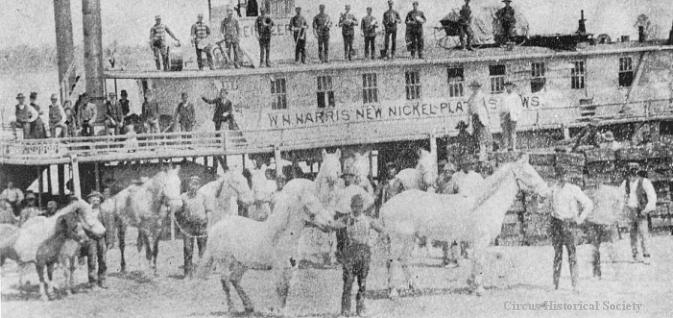
It was a typical 1885 winter evening at the crowded Chicago beer garden. Above the congenial hum of conversation could be heard the mechanical piano jerkily banging out a popular tune. Suddenly with a bone chilling scream a hairy monster bounced into the tavern. With astonishing jumps, sometimes on all four feet, it leaped from the tables up onto the bar, then with vicious teeth exposed and jabbering madly, it flew upward and swung by one hand from the ceiling chandelier.
For a moment the stunned patrons stared in hypnotic horror, then, fairly raising the roof with shrieks of fright, they knocked over tables and chairs in their mad rush to reach the blustery February outdoors. The saloon keeper grimly grasped a stout club conveniently located under the bar and prepared to battle the creature. When the intruder noticed this armed enemy, it snarled and leaped at the man. Turning pole and dropping his club, he too raced for the door. Bundled up strollers wading through the snow were astonished to see the crowd of yelling couples, lacking hats or coats and apparently completely unaware of the near zero temperature. Soon the road was blocked with sleigh loads of people flabbergasted at the group pointing and yelling "The Monster!, The Monster!"
Meanwhile approaching at a fast trot were a trio of determined grim faced men carrying staffs, large fish nets and a huge canvas bag. They had just departed from the nearby winter quarters of the W. H. Harris Nickel Plate Circus seeking an escaped mandrill ape. All had been quiet and serene as the various wild animals were enjoying their meal of the day. Two employees were dozing on convenient bales of hay, while a third sat reading the Chicago Blade.
In a stout cage was housed the newest arrival, a ferocious full grown ape. None of the Harris animal men had been foolish enough to venture within reach of his long powerful arms, as he frequently, in anger, made the sturdy cage rock in an alarming manner. Unbeknown to the cage men, his sharp animal eyes and brain had been intent on the harness snap which held the cage door secure. On this particular evening, noting he was safe from attention, he'd begin playing with the strange thing that prevented him from precious freedom.
Suddenly he was astonished to learn the secret by pinching the spring section of the snap and slyly removing it. With stealth he slowly pushed the door open and peered out at the men. Ever so silently he crept out towards the friendly glowing stove. His crafty mind hold him that only by jungle instinct could he hope for freedom, so when almost upon the man, he screamed, beat upon his chest, and leaped, bowling the man over as he raced onward, pushed the barn door outward, and vanished. The intense cold and deep snow, for a moment, stopped his flight, then with bounding leaps he raced up the lane and out onto the street where he could hear the faint tinkling of the saloon piano. As he paused for a moment to peer into the frosty window, someone opened the door and before it could slam shut, he dived into the warm room. Pushing through the hysterical crowd, the circus men entered the tavern, fully prepared to do battle with the ape's sharp teeth and powerful arms, but stopped in astonishment. There sat the animal, with an ornate hat perched upon his head, his lips well suds'd with beer foam, calmly swinging a lady's red handbag. Noting all this, one of the men quickly remarked, "Ya know, I think this monk has been trained, at least collar broke, and I'm going to take a chance on putting a rope around his neck". No sooner said than done! The animal was completely docile, proving he was at least partially tamed, and had no doubt resented being continually caged.
This incident was one of many that winter as the Harris Circus prepared for its annual tour. The various gaudy wagons had been rebuilt for another season of strenuous use, and painters were busy putting the finishing touches to the ten railroad cars. The show's ancient elephant was beginning to miss her cues, so Harris had been forced to secure a replacement. Purchased from the deep South's W. W. Cole's Circus, she proved to be a huge brute that put fear into everyone. Charley Curran, the trainer, examined her tusk stubs and noting many notches there-on, exclaimed, "I knew it!, this is Pogie O'Brien's notorious outlaw and as she has nine notches filed into her tusks, she has killed at least that many people". "Well", dryly commented Harris, "we bought her as Gypsy, so don't anyone mention her bloody history".
Circus routes are always a jealously guarded secret and the absence of posters in and around Chicago lent suspicion that the show would make a long jump to California. Train call came on a foggy cold night and after several hours of switching, no one had any sense of direction, so retired to their chilly berths. Early morning found the show train rolling along at a merry clip and as dawn gave a glimpse of the country-side, a station flashed past with the town's name visible. "Three Rivers!" shouted some one, "Hey! we're Canada Bound!"
Rules on the circus were very strict, no flirting or drinking, and good behavior demanded at all times. Thus it was most surprising to arrive one morning in Orillia and note the town placarded with announcements that a certain religious group would drive the show devils from the village commons. Both towners and showfolk were puzzled as to just what sort of war the fanatics would wage against the show. As parade time drew near, several troupers sauntered off the lot. Looking down the road they noted a large group advancing, carrying base drums and musical instruments. Closely following appeared to be the entire town's population, evidently curious to see the show folks' forced retreat. Arriving at the edge of the show lot, members of the organization lay aside their instruments, and kneeling began to pray loudly for the devils on the show to come forth and sin no more. Pop Quinett, the side show manager, noted the huge crowd, and not wanting to lose business, let out a blood curdling scream. Running towards the kneeling people he cried out "Run!, - Run for your lives, the lions are loose". This broke up the prayers and the more timid souls departed in haste. When the leaders found out the escape was a hoax, they started praying loudly for Quintett's lying soul.
Chewing nerviously on peppermints, Harris brought out the side show musical trio, consisting of a flagolette, harp and violin. The hecklers sang hymns and beat frantically on their drums, drowning out the feeble music of the side show. Harris then decided to make the din complete so ordered out the Big Show brass band, which walked over briskly until it faced the troublesome people and cut loose with a lively circus tune. This infuriated the singers and they promptly shouted and beat a thunderous tatoo on their drums. Then Harris nervously wiped his near-bald pate and decided such tomfoolery was too much. He ordered Curran to unchain Gypsy, and give her a tent pole to disperse the howling hecklers. Rapidly mounting Gypsy's head, the trainer prodded her to 'Mule Up', a circus command to run, and with ears flapping, and a shrill squeal, she fairly flew at the praying saviors. This time shrieking with terror, the do-gooders dropped the Lord's drums and rushed back to town.
To such heights of comedy had the affair reached, that the on-lookers felt nothing in the show could compete in the way of entertainment, so they departed homeward, and the circus tore down in disgust. Losing the day was a serious loss to Harris, but it resulted in priceless publicity, as the story was picked up by the newspapers, and the lurid Police Gazette carried a full page story with burlesqued cartoons about the incident. For years afterwards, all along the routes, newspaper men eagerly plied the circus press agent for details of the hilarious clash.
 Photo: Sam Dock is shown on Silver Bros. Circus, a small truck show he toured in 1936. Pfening Collection.
At Berlin, many of the troupers took advantage of a sulphur bath house and the following day several came down with chills. Doctoring did not seem to bring any relief and one victim, Sam Dock, was in such agony that he fairly shook. Anthony Gofre, the contortionist from South America prescribed a cure that was guaranteed sure-fire. "To eliminate chills," he said, take a piece of shoe maker's wax, wrap it in cloth and place it under one's sock on the ball of the foot." All of the men in the dressing room gave Tony the Ha! Ha! at such a silly remedy, but he became indignant and told how troupers in Mexico and the islands always used it with success. So serious did he become that he offered any one five dollars in gold if it failed to cure them. Dock drank in the conversation, then sneaked out, hunted up a shoe maker and applied some wax to his foot. In a couple of days his chills had vanished, while others continued to complain for many weeks. Nearly fifty years later, Dock, in relating the incident, laughed and remarked, "You know, I've never had a chill since that crazy wax cure."
Salaries around a circus were always meager, thus it was the accepted habit for everyone to seek out ways of increasing his wealth. The menagerie men were real artists at picking up the odd penny by schemes that appealed to the gullible public. The Harris circus proudly exhibited a cage of beautiful Egyptian pheasants, which drew considerable attention. Their keeper kept well supplied with bantam hen eggs, which he stippled with a wet cut of tobacco to give them an unusual appearance. Fashioning a nest in the corner of the cage wagon, he stocked it with two or three of the dressed up eggs, so as to draw attention. When some one expressed an interest in the birds, he would lean over and whisper that the boss had gone down town, so if they wanted to secure an egg or two he would be willing to pass them along on the "Q T" for twenty five cents each. Seldom did the spiel fail to make a sale, the purchaser already counting his profits from raising such rare birds.
The Irish camel attendant, dark skinned from liberal applications of walnut husk juice and wearing a Arab costume, would speak out in broken English, - "Buy a real camel's tooth for good luck." They sold rapidly for watch charms, and the seller was often busy seeking a new stock of old horse teeth.
Pink lemonade was a great seller, though made with water from questionable sources, - even pails of it swiped from horse watering troughs. To handle the vast horde of thirsty buyers, the "Juice Man" would prepare his batch of tempting lemonade in an old wooden barrel under the counter, to which was attached a small pitcher pump. A hole was cut through the counter for both the pipe and for running back into the barrel all excess "juice" that poured from the pump. For some reason large black ants would go wild over the sweetish mixture, race up the barrel, and down into the citric acid, sugar and pink-dyed water.
When business became brisk, the operator would work the pump handle furiously which usually resulted in an ant or two being sucked up the pipe and into the glass he was filling. Occasionally an observing person would exclaim - "Hey!, there's an ant in my lemonade," Hearing this, the vendor would look up at the awning and glibly remark, - Hmmmm, it must have fallen off the tent." In spite of the seldom washed barrel, or its questionable contents, the show's working men went to great lengths to divert the vendors attention, while they raised the canvas side wall and dipped out whole jars of the sticky mixture.
Although the mandrill ape, now christened "Jake", had become a regular pet, he would fly into a rage at the sight of a clown in white-face make-up. For some reason he still had a passion for ladies' flowery hats and woe to any female that ventured too near his cage! Out would stretch his long hairy arm and some damsel would shriek as Jake calmly donned her head-gear and smirked at the by-standers.
Continuing Eastward, the circus ran into bad weather which caused the wagons to sink axle deep in the soft mud. On the Brockville lot, the center pole wagon became so mired that all available teams were hook roped to the wagon tongue and the front running gear. With horse flesh straining belly deep in the mud, the wagon's king bolt broke, resulting in the teams falling into a horrible kicking tangle of cruel hooves and snarled harness. It was morning before a replacement heavy bolt could be fashioned and the front axle forced into place.
As per circus custom, the Harris show carried a pair of hyenas, not only for an attraction, but for their value as weather prophets. On occasion when the sun was shining brightly, foul weather seemed impossible. Yet the hyenas would commence to howl and soon the entire menagerie joined them in an uproar of jungle cries. This was advance warning to the circus boss canvasman to drive extra stakes, tighten all tent guy ropes, and make things ship-shape for a real blow.
The performers would carefully put away their elaborate costumes and pull forth old faded ones as they too were in for a drenching. Often the storm would hit during the evening performance, starting with a lazy flap of the big top, and a gentle patter of rain. Already working men had swiftly lowered and unlaced the side show and menagerie tops, packing them away in the wagon before they became water soaked.
With a flash of lightning and a thundering crash the deluge would descend, beating upon the big top like a thousand snare drums. To avoid alarming the audience, the band would play with all possible volume, hoping to drown out the noise of the storm. All aerial acts would be eliminated, and the ring master would cry out "John Robinson" which was a circus term denoting that the performance was to be curtailed as much as possible.
If the storm became worse and the wind vicious, the centre poles would begin to dance, banging away on the mud sills and forcing them down into the mire. At such times it was questionable just how much longer the big top could stand the abuse, so the ring master would blow his whistle, yelling - "All Out and Over!" while the band loudly played "God Save The King". Usually the towners were so thrilled by the performance that they little realized the extent of the storm and were astonished to walk out into the quagmire of mud. Seldom did they notice the drenched working men hurrying about, yet these faithful employees, working for a mere pittance, were directly responsible for keeping the big top in the air and preventing a "blow-down".
Arriving at Riviere Du Loup, the show ran into a few trouble hunting who persisted in cutting holes in the side wall of the ladies' dressing room. Quickly ordered to move on, they became belligerent, brandishing knives as they slunk off the lot. Soon they returned with a score of reinforcements and were caught inching one of the baggage wagons towards the brow of the river cliff. Circus men rushed to the wagon's rescue and again the ruffians slunk away. Harris advised English Charley and his three card monte gamblers to take the day off, and issued orders to both working men and performers not to antagonize any of the towners. Both matinee and evening performances were capacity and applause generous with the Dave Costello riding act doing several encores.
No further trouble was experienced until the night show was nearly over, then the lot was suddenly surrounded with rough appearing men toting sticks and throwing stones at the troupers. The teamsters, having hauled most of the wagons to the train, had returned for the leading of the big top wagons. Harris realized they were in for a rough and tumble fight, so ordered them to hitch up, but wait on the lot until the final stake was pulled, then for everyone to make a rush for the rail road cars.
In the past, the show had played the most troublesome places in North America, the Pennsylvania coal mining towns, so carried a good supply of "trouble Squelchers". These cruel whips were fashioned from a two foot length of broom stick with a hole bored at one end. Through this hole were pushed several long whip lengths of hay wire. With such a weapon, one man could swing it in wide circles and easily disperse half a dozen rowdies.
It's doubtful if any town ever saw a circus dismantled and packed away in such haste. Uncle Dan Costello claimed it was exactly twenty seven and one half minutes from 'All out and Over' till the last stake was tossed up on a wagon. The ladies with the show were crammed into wagons, the boss hostler blew his whistle and the grim rush for the train stalled. Teamsters, defenceless up on their high seats and with full attention needed to guide their nervous horses, were an easy target for stones hurled from the darkness. Pour drivers were knocked senseless and fell off their wagons, but the teams continued onward, unguided. Dropping their whips, Sam Dock and three other performers half carried and dragged the injured men to the coaches. Angry yelps were plentiful as the hoodlums received slashes from the hay wire, and they beat a hasty retreat to the nearest thicket from where they continued to throw sticks and more stones.
When the first wagon reached the runs and was 'hook-roped' up on the flat cars, the sight seemed to strike the fancy of the trouble makers. They dropped their clubs and gazed in admiration at the fascinating sight. When the last wagon was loaded and the wheels locked, eager hands assisted in loading the 'pull-up' teams, while others pitched in to throw the runs up on the flat car. Harris gave the train crew a nod and soon the 'Orange Special' was rolling down the main track to everyone's relief.
A few days after the disturbance, old Gypsy surly and took a dislike to one of the working boys. As he would hurry past her during the performance, she'd attempt to grab him with her trunk, uttering a blast of wrath as he jumped out of her reach. On the day in question, she sapped him with her trunk, knocking him end over end, before Curran could jab her with his elephant hook. The terrified boy jumped to his feet and dashed out of the tent with Gypsy only a few feet behind, determined to trample him to death. It so happened this show lot was especially small and a giant pine tree was just out side the side wall of the big top. With head lowered and squealing with rage, Gypsy hit the side wall, tearing it to shreds, and crashed head-on into the tree. Never did an elephant come to a more sudden stop, - in fact she bounced back and collapsed in an unconscious heap. It took a quart bottle of ammonia to bring her around, and for days she was a very docile critter.
Onward went the show, each day brings new sights, strange customs and turnaway business. The marvelous system of moving and erecting the show made a big impression, with hundreds of spectators always on hand to watch the final wagon loaded on the train. Turning westward, the jumps soon became longer and the towns pioneer-like in appearance. A record 1,095 mile run to the newly laid Northwest rails brought out settlers, trappers and the usual wilderness riffraff. This had been Louie Kiel country and his rebellion was still fresh in everyone's mind. Everywhere could be seen placards tacked on trees announcing rewards for certain bad men up from the States and on the dodge.
One morning as the show train was switched to a siding, two dead men were noted lying along the tracks. No one appeared to give them the slightest notice, and upon inquiry, Sam Dock learned that two enemies had caught sight of each other, promptly raised their Winchesters, fired and fell dead. Some hours later the rail road section crew came along and buried the bodies along the ties.
The American troupers were astonished to see such a vast Indian encampment, including most of the Sioux nation, peacefully awaiting the circus. With the famous Custer's Last Stand massacre fresh in everyone's mind, the Harris folks could not understand an army of soldiers not on had to preserve peace. Conversation with a town merchant disclosed that the entire Sioux nation, which had fled to Canada after the Custer incident, had since been governed calmly and peacefully by just a half dozen Royal Northwest "Mounties". Further questioning brought out the facts than Canada had profited from the errors and broken promises the States had made in dealing with the Indian nations, and was attempting to honor all promises and treaties made with their Indians.
Fall arrived early that year, but September business continued big even though snow flakes often covered the ground, and everyone expected a long season down in the southern states. On October first the show jumped back into the States with early winter predicted. October third saw the train unloaded in sleet covered Minneapolis with hardly a soul circus-minded. Even before the big top sections could be laced together, they became ice coated and unmanageable. In disgust, Harris called everyone into the dining tent and inquired if they had enjoyed the season. Most everyone smiled and nodded yes, where upon he gruffly announced that the show had closed. Then with head bowed, he slowly walked away. For a moment the troupers sat there stunned, then with consternation they hurried to the pad wagon and proceeded to unload their trunks and exchange ideas on where to winter.
A Supplement
(Note: Denny Berkery has furnished the following additional details on some physical aspects and methods of operation during the 1913 season when he was with it)
Canvas Layout. The wild west show was probably the original "topless performance". It's performance was presented under the open sky. The seating areas were under a canvas canopy which shielded them from sun and rain but the performers took the weather as it came - wet or dry.
On page 43 of Fred Pfening's book about the Tim McCoy 1938 show there is a photo of the inside of the McCoy arena. The arena of the Tompkins show in 1913 looked just the same - Except - that it was about half the size and the canvas, instead of being brightly striped in white and blue, was a mud-stained khaki. My guess is that it was approximately 75' wide and 150' long. Entrance to the arena was thru a traditional type marquee, which was placed at the right hand corner of the arena. Nothing unusual about it, same mud-stained khaki with the lettering "Main Entrance". I have no doubt it originally had been used on a Wheeler show.
Seating consisted entirely of bleacher type seats - no chairs, no starbacks, no foot rests, just nice smooth, sturdy planks. General admission seats were along the two sides of the arena, extending about 75' along each side about 7 high and about six lengths along each side. The seats under the canopy across the front of the arena - again about 6 lengths, 10 high, consisted the "Grand-stand". Only general admission was sold at the ticket wagon. Grandstand seats were sold for an extra tap from a portable track-stand just inside the entrance. Depending on how you calculate this type of seating ("big pratt people" or "small pratt people") the capacity was about 1500. Between the front rows of the grandstand and the arena performing area a rope netting barricade was stretched on iron stakes. This left a walkway across the front of the grandstand to the general admission seats on the left side. It also left space along the front of the grandstand where canvas backed chairs could be placed for visitors and local "brass". The band sat on folding chairs, on the ground, at the left end of the grandstand. The backdoor was in the center of the real-wall.
I doubt if any of the canvas was new. I do recall that when I first got to winterquarters men were working on what seemed to be new or very clean canvas but it was for the arena sidewall.
My guess on the side show - a 20' round top with a 20' middle piece, a 20 x 40 push pole. I have no picture of the dressing-room top but would put it as a square end 20 x 20 push pole. It was strictly for performers other than the male western riders, and a shelter for fancy saddles and the band instruments. No animals were kept under cover at any time. We had an Indian family, parents and some teenage kids, and they had two tepees in which they lived. About 12' in diameter at the ground and about 10' high in the peak. They were made of regular type white duck with some symbols painted on them. They dug a small hole in the center directly under the peak and on rainy or cold days kept a fire burning in it and it was remarkably cozy and the smoke went straight up and out at the peak.
We had a pair of Russian (real) riders - man and wife, and they had an 8 x 10 "A" type tent in which they slept and dressed. They slept and dressed on the lot as did the Indians. Also the unattached male riders slept on the lot in several A type tents which they put up and struck themselves. The "staff", band, married couples and other performers slept in the hotel or rooming house in town. Working men who went over with the heavy train during the night slept in the arena canvas (or under it) which was hauled in the bandwagon.
Cookhouse. On a small tent show and to a degree on a big one the cookhouse or dining department was a most important part of the operation. A show owner who acquired a reputation for "feeding good", frequently had less difficulty in keeping performers and especially working-men than a show without a good name in that respect. This was particularly true of the working men. They were poorly paid, had indifferent living and sleeping accommodations, and the work was hard - often brutally so. If the "chow" was good and plentiful it made up for much of the discomforts of the job. Tompkins was a show that fed good.
The cookhouse - the entire "dining dept." - loaded on one wagon. It was built for the show and was in fact a big wooden box, about 8' long, 6' high with no top or cover of any kind. Like most wagon show vehicles the running gear was high so that the floor of the vehicle was at least 3' above the ground. It was also the heaviest wagon on the show. Into it was loaded a big cast-iron range with an oven and a wood burning grate; a device commonly called a "campfire", which was a gridiron made of flat bars of strap-iron, about 5' long and 4' wide open at the ends but with sides of the same material which held it about 10' above the ground; tables and seat boards and "horses" to hold the table tops, the chests holding dishes, cutlery, pots, pans, non-perishable food (cans), tent stakes, ropes etc. etc. The top and sidewall was loaded on top of all this. Poles were carried in racks along the sides. I put the top size at a 20 x 20 push pole square-end.
The rear end of the wagon was not attached to the body, but was lifted into place after the loading was done. It rested on it's bottom on the floor of the wagon and was held in place with strap hinges attached to the sides of the wagon, held in place on the rear end by iron pins. Across the bottom rear of the floor was an iron rod. On the top edge of the rear and 3 iron hooks were evenly spaced. When loading or unloading the rear end became a ramp by hooking them into the iron bar. This made it easier to load the range and heavy chests by dragging them up the ramp, rather than having to lift them. The camp fire gridiron rode on the rear end hanging there on several hooks, after the back end was secured in place.
This wagon made considerable noise over rough or bumpy roads. It was painted white and had no lettering of any kind on it. It was pulled by a two horse team which never moved faster than a brisk walk. It left the lot about 7 P.M. and arrived in the next town anywhere between 5 and 7 A.M. The route had been marked by the wagon-master (boss hostler) who rode over it on horseback in the afternoon. He marked the turns by placing pieces of date strips torn off window paper picked up after the matinee on show day, under a rock or tree limb. Utility poles were few and far between in those times and road markers were non-existant, except on the outskirts of a town or village. Also the roads were not lighted and once the outskirts of a town were passed the was absolute. Wagons that moved at night had a kerosene lantern hanging on the rear axle and another hanging on the side at the front.
Picking Window Lithos. The business of picking up window lithos was still in use when I came back to the outdoor field in, 1931. Someone on the show, usually a bandsman, went thru the town after the matinee and picked up all the window lithos he could find. These were stripped of the date strips and once a week were shipped ahead to the advance. The picker-up in 1913 got a nickel a sheet for all he brought back and in the 30's on the Wheeler shows, anyway, the fee was still a nickel - no inflation there.
Campfire. The manner of using the "campfire" was to dig a pit about 12' deep about 6 feet from the sidewall of the cookhouse. The pit size was slightly smaller in it's dimensions than the iron grating. As soon as the cookhouse top was up the pit was dug and a wood fire was laid in the bottom. Wood was ordered by the General Agent to be delivered to the lot on show day, but the custom was to carry wood over from the previous town so as to be sure to have enough dry wood to start the fire. Once started the fire was kept burning all day. A canvas fly was attached to the cookhouse side poles and guyed out to other poles so it formed a roof over the campfire. On the iron grating there was room for a big coffess boiler, an oatmeal boiler, and for big pans for frying bacon, eggs or hot cakes etc. Once the fire was going it furnished terrific heat and things cooked quickly.
The iron range was placed in the cookhouse and from about 10 A.M. to 4.00 P.M. it was used to prepare the noon-day dinner and to roast meats or for baking. The fire was then killed and by the time it came to load the range it was cool enough to handle.
The campfire was used until the supper was over - about 5:30 P.M. Then the fire was drowned, the pit filled in, and the grating itself was wet down. When it was time to load it, it too, was cool enough to handle.
The general agent had contracted for hay, grain, and staples like bread etc., but it was the usual thing to have farmers come to the lot offering' chickens, eggs, and fresh milk for sale. In retrospect I am often amazed at how well we were fed, and how well the food was cooked and prepared considering the conditions that prevailed.
No part of this publication may be reproduced in any form or means
Last modified February 2006.
without written permission of the author and the Circus Historical Society, Inc.