


Circus Historical Society
Bandwagon, September - October 1970
Back to Bandwagon Index
Bandwagon, Vol. 14, No. 5 (Sep-Oct), 1970. Note: Only some articles are included in this online edition. Many illustrations are not included. The Circus Historical Society does not guarantee the accuracy of information contained in the information in these online articles. Information should always be checked with additional sources.
Author's preface: This is the first of a two-part biography of Rufus Welch. I believe it represents the first recent attempt to provide some sort of definitive research on the era so long identified as that being dominated by the "Flatfoots." The following research on Welch produced much additional information and I hope that the result will be additional articles in the future. There is much, actually a great amount, that needs to be learned (in several cases, corrected) of the circus before the Civil War. Needless to say, this author would appreciate correspondence with those interested in this era or who have information or material relative to it.
Acknowledgments and an evaluation of the sources for this article will appear at the end of the concluding part of this biography. However, I do wish to single out the aid and information provided by Richard E. Conover of Xenia, Ohio, certainly the dean of American circus historians, for copies of the four previous biographies (one by him) of Welch and for several leads in the initial stages of this work. I hope this article represents some worthy building on his solid foundation toward a modern history of the circus.
In 1852, I strolled casually out of the house after dinner one pleasant Saturday afternoon. Once around the corner, I girded up my lions and ran four miles to a neighboring town, saw the combined forces of Raymond & Co's and Herr Driesbach's Menageries and Welch's Circus (Welch's National was traveling on another route) and was able to amble gayly into the yard with a pole and a small string of fish in hand barely in time for supper. I caught the fish in the morning though and kept them fresh in a tub of water at a friendly neighbors. Langworthy was ringmaster; Bobby Williams and E. Davis clowns; Davis Richards, bareback rider; McFarland, principal tumbler; Cadwalder, four horse rider; L. J. Lipman, scenic rider; J. Sweet and a yellow dog did the Indian act, and Driesbach and Hideralgo performed the lions and tigers. Had there been a female rider, I would have wagered that this was the best traveling circus I ever attended. (1)
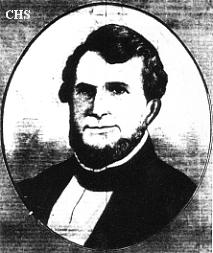 Rufus Welch is pictured here in a cut that appeared in the March 10, 1883 issue of the Clipper. Courtesy of Richard E. Conover.
The boy's story of going to the circus may be perennial but the show was an unusual one since it combined some of the larger shows in the country at that time. Welch's was consistently a large one but the enterprises and travels of its owner, Rufus Welch, indicate that it, and he, contributed greatly to the development of the circus and menagerie in America.
Rufus Welch was born in New Berlin, Chenango County, New York, in 1800, probably September, or possibly in 1801. (2) The census of 1810 lists several Welch families in the country and three in New Berlin. Two had male children through age ten and Rufus may have been the son of Nine (or Vine, writing illegible) or Arruna, each family having five members. Neither family, however, was listed in the 1800 census of Chenango county. (3) The Welches first moved into the county from Connecticut beginning in November, 1795. In 1803, the first of the Chenango County Welches were settling in Delaware County, Ohio. (7)
When Rufus was eleven years of age, his family migrated west. He was taught the trade of a chairmaker and was possessed of considerable mechanical skill. While in his teens, he was first connected with the circus business and, according to James Rees, an associate of Welch, he was manager of a circus company in 1818. (5) This is questionable but there was one "Welsh" who was among the additions to Pepin and Breschard's company in Philadelphia on August 19, 1816. (6)
About 1824 Welch was manager of the traveling circus and menagerie of John Miller, an early showman from Allentown, Pennsylvania. Miller later sold his menagerie to a Mr. Crosby of New York for $4000. (7) Crosby may have been Lewis Crosby, later associated with the Zoological Institute, a group based in Somers, New York. (8) The Institute group dealt as early as 1821 with Miller (9) and in 1827 Miller was arranging routes for Somers shows. (10) Through Miller, Welch probably first had contact with the powerful Flatfoots and later he was to be a stockholder in their Institute as were many of his business associates.
In the fall of 1824, Welch and two Somers circus men, John Handy and Jonas Bartlett, imported Tippoo Sahib, a large and valuable elephant who was the first to possess tusks seen in this country. Joseph Martin was his trainer but due to the elephant's viciousness and temper, he was not a profitable investment. (11)
In 1824, there may have been a firm of Welch and Handy that traveled through the eastern states. (12) Supposedly, in 1828 Welch made his first appearance in Philadelphia at Maelzel's Hall but a close check of Poulson's American Daily Advertiser of Philadelphia for 1828 indicates no circus or menagerie appeared at Maelzel's Hall. (13)
In the fall of 1828 the Washington Circus was in Philadelphia and featured "Horsemanship by Master North, the wonderful prodigy" and Mr. Stickney, the flying horseman. (19) The Washington Circus and Amphitheater was again opened on June 18, 1829, by Fogg and Stickney. (15) In the latter half of the year, Welch was forming a circus troupe for the West Indies and he offered young Levi J. North, with the Washington Circus, an engagement. North, who had just completed his apprenticeship, and Charles LeForest were the riders in Welch and Handy's company that exhibited in the West Indies during the winter. Cuba had been without a circus for twelve years and the show did well there until the performers tired of the tropics and the troupe then left Matanzas on a Yankee schooner for the states. (16)
By the end of the decade, Welch was a member of the firm of Purdy and Macomber as both a partner and "advertiser". The firm was well known throughout the country and reputedly did a thriving business. After his return from the West Indies tour, Welch relinquished his circus affairs and worked toward assembling a menagerie show. It opened, about 1830, in Maelzel's Hall, Philadelphia and returned to that locality for several winters following. (17)
Whilst they were exhibiting there, a vessel from the East Indies, having on board the celebrated elephant "Caroline," entered the Delaware, and ran aground on a shoal, and was likely to become a total wreck. The animal was consigned to Purdy, Welch & Macomber, and the insurance companies, despairing of getting the animal out alive, were disposed to abandon the risk. General Welch (a title of tribute only) rigged a derrick with slings, and succeeded in hoisting the animal out. A well-trained and faithful dog was thrown overboard as a pioneer, who swam towards the nearest shore. The elephant followed and both animals got safely to land. (18)
Purdy, Welch, and Company, while principally calling itself a menagerie, also carried a small circus performance as was typical of the shows at that time. And, too, there occasionally was a child who would run away from home to join the show. Such was the case of a young Vermonter, Eaton Stone. Stone had run away to join a circus first in 1828 when he was ten years old but his father soon retrieved him. He made a second and more successful attempt two years later when he joined Purdy, Welch and Company's circus and menagerie. With the show, he did a plate spinning act. However, one day the ringmaster, William Brown, led in an animal named Buckskin and asked Stone to ride him. He did, satisfactorily, and afterwards he received two hours instruction each day and within a year he was performing the climatic closing act of the ring. Later, Stone became a celebrated bareback rider. (19)
In the winter of 1832-1833, "Purdy, Welch & Co.'s Immense Menagerie of Living Animals" was exhibited at Maelzel's Hall in Philadelphia and the proprietors felt confident " . . . (with their addition since last season,) that it contains the most rare, gigantic, and beautiful collection of quadrupeds ever offered in this city . . . "Among the collection was "The Shipwrecked Elephant Caroline. A pair of Royal or Bengal Tigers, lately arrived from Asia . . . ", a lion and lioness whose Keeper entered their cage twice daily, and an orchestra. (20)
In 1833, Purdy, Welch and Company exhibited in Albany, New York, (21) but by the time it exhibited at Newark, New Jersey, on October 15, (22) it was Purdy, Welch, Macomber, and Company's New Menagerie. The menagerie occupied "Eleven Spacious Wagons," featured the ten member LaFayette Military Band of New York, the performance of Jim Crow on his Shetland pony, and the usual "Rare Beasts and Birds."
There may have been two shows out in 1833 unless great distances separate close dates one cannot say conclusively. Title and property switches were common and little material from this period survives on the circus. There is evidence Welch was connected with two shows in 1834 since descriptions differ for two shows as well as their titles.
Macomber, Welch, and Company was the larger show and appeared in Hingham, Massachusetts, on August 22, 1834, featuring the elephant Siam, (23) who came to this country about 1829. (24) By September 26 the company, with an unidentified male elephant, was in Willimantic, Connecticut, and a handbill for the engagement described the company:
This splendid collection of Natural History, containing upwards of one hundred different varieties of zoological subjects, far exceeds any establishment ever exhibited in America. This magnificent display of the works of Nature requires the assistance of no less than seventy-five horses aided by fifty men, including the celebrated Tremont military band, from the city of Boston; the whole arranged in three extensive pavilions, containing 120,000 square feet of canvas. Likewise, a splendid gallery with seats, arranged and exclusively appropriated for the accommodation of Ladies.
The band will be drawn in a splendid music carriage, and the arrival of the grand cavalcade at each town or village will be announced by the band playing a number of popular airs. The performance of the circle to commence at 3 P.M., after which the animals will be fed. (25)
The show was one of the first to have a bandwagon and feature a parade and may well have been one of the finest in the country at the time. As late as November 11-13 it was at Salem, Massachusetts. (28)
A second and slightly smaller show, Purdy, Welch, and Company, appeared in Newark, New Jersey, on October 27, 1834. This show, which also "far exceeds any other establishment now traveling" as did Welch's other show, was conveyed by sixty splendid gray horses, aided by forty men, accompanied by a military band of music (the Washington Band from Philadelphia), and arranged in three extensive longitudinal pavilions, adequate to contain six thousand persons at the same time; with a comfortable arrangement of seats for ladies and children. (27)
The menagerie contained seventy-five animals, featured Mr. Sherman's performance of Major Jack Downing - a creation of the Main humorist Seba Smith - and Jim Crow. This show also featured "a splendid musical carriage" in which the band heralded the company's arrival. In addition, this show featured the forerunner of the first circus side show, "a splendid collection of paintings and engravings . . ."
By 1830, there were many circus and menagerie shows touring and, by their own rivalry, they hurt each other's business. At about this time or before a combination was formed and a manager mapped routes directing the many shows as they toured the country and arranging it so as not to compete with one another. The plan, however, was successful for only a few years. (28)
Later, there was another combination formed but with the express purpose of running the smaller shows out of business. (29) The group was formed on January 14, 1835, and the "Articles of Association of the Zoological Institute" were signed at the Elephant Hotel in Somers, Westchester County, New York. Purdy, Welch, and Company was among the seven joint stock companies in the merger and Welch, Leman Handy, Zebedee Macomber, and Eisenhart Purdy and 128 others signed the corporation papers. Among the 128 others were many who would be associated with Welch in future years. The stock was valued at $329,325.00 and the Institute's headquarters were at 37 Bowery, New York City. (30)
The association of 1835 was also a merger with the Boston Zoological Association, an organization that had an extensive network of hunters and trappers in their employ for the previous three years. (31) In early 1835 they had at least four parties in Africa, one numbering forty members, and their movements were chronicled with great regularity. One Massachusetts newspaper appropriately labeled their extensive operation a "Yankee Enterprise!" (32)
For the season of 1835, Welch headed the Institute's branch number ten which was based in Boston and known as "Macomber, Welch, & Co.'s New England Zoological Exhibition." It was essentially the 1834 show of Macomber and Welch. (33) When in Boston on June 1 it claimed one of two rhinoceroses then in the country. (34)
On April 4, 1835, an agent for a Boston menagerie company purchased at public auction for $3,350, in cash, a lion presented to the president of the United States by the emperor of Morocco. The gift was an unusual one to the government and President Andrew Jackson consulted Congress on the matter. Contrary to Congress's advice, the lion was sold at public auction to the Boston agent, probably representing Welch's branch of the Institute, and the money went to three orphan asylums. (35) The lion made its first appearance, however, in Baltimore, in the "Last Days of Pompeii" where "He enacted the arena scene to a wonder." (35)
A Welch show for 1836 is unknown as are the showman's activities for that year. Welch is next known as the general manager for the second winter season of the Lion Theatre, Boston. The theatre was rapidly built and completed by December, 1835, by James Raymond and other principals in the Institute. It first opened on January 11, 1836, with both an equestrian and dramatic company "which as a whole was a poor company." (37) E. C. Weeks of the Institute managed the first winter season. Welch's season began November 7, 1836, and continued until April when the theatre was closed and offered for sale or lease.
"Purdy, Welch, Macomber & Co. Proprietors," toured a menagerie "From the Zoological Institute, New York" in 1837. The season had begun by late April for they were in Newark, New Jersey, on April 27 and 28. By May 12 and 13 they were advertised to be in Albany and indicated they were traveling west to Buffalo. However, at Albany they did not advertise "The National Gymnasium and American Arena or Circus Company, near the Menagerie" to be shown in the evening. However the performance of the "pony (sis) and monkey" as well as other entertainments by various animals including the elephant, were still advertised. The featured attractions were Mr. Van Amburgh who would enter the cages and the Boston Brass Band led by Edward Kendall. (38)
This company also published an illustrated twenty-four page pamphlet advertising the show. An indication of public prejudice which circuses and even menageries encountered is found in the statement that the animal collection had proved to be the "chief attraction" to the "enlightened inhabitants and strangers" who had visited New York City during the previous winter. The pamphlet indicated the collection contained a rhinoceros and that the band of eighteen men would ride on horses in the street parade except for a few who were carried by the elephant Tippo Sultan. (39)
The Institute was successful for a time in forcing menageries and circuses to sell out and take stock in the company for payment. However, they were not completely successful and the would-be monopolists failed about 1837 according to Charles J. Rogers, a retired circus manager, in 1883. (40) Probably, too, the Panic of 1837 may have caused their dissolution.
Soon after this Welch and Caleb Weeks - or "Kale" Weeks, as he was called in New York - sailed for the Cape of Good Hope, and in connection with John Clayton, a Scotchman residing in Cape Town, secured several giraffes and some small animals, which they brought to this country. (41)
These giraffes were the first live ones seen in America. The Boston Museum - museums in the early 19th century were businesses and not public trusts - had a stuffed one which was believed to be the only one the country in 1835. (42) In the same year the united Zoological Institute of New York and Boston Zoological Association were expecting the ship Susan, from Africa, with several animals never before seen in America, among them a "Camel Leopard" or giraffe and a two-horned rhinoceros. (43) Neither animal arrived as far as is known.
For five years Macomber, Welch, and Company had been outfitting expeditions into Central Africa (44) and they may very likely have been the "Boston Company" that had four expeditions in Africa in 1835, one in search of a giraffe. (45) Clayton had captured many giraffes but not until his expedition of 1835-36 did he succeed in bringing any to Cape Town alive. Of eleven which he caught in the Kaliharri Desert, seven died during the 1200 mile journey to Cape Town. One died at Cape Town from an abscess and another from an injury received while being loaded on ship for the journey to America. The two survivors arrived in New York on June 7, 1838, in the barque Prudent after a voyage of fifty-one days. The three giraffes had cost about $10,000 each and one had already died on the way. (46)
Twenty years later, a New York theatrical newspaper recollected of Welch as "the enterprising gentleman that went to Africa . . . to bring the 'Giraffe' to the United States":
He hired the plot of ground for their exhibition - he had three of them - where now stands the St. Nichols Hotel; and, in order to spread the fame and excite the interest of the public in these rare and very curious quadrupeds, he offered and paid to the editor of a daily paper one hundred dollars for an article on their natural history, habits, etc. The article in question was written between the hours of six o'clock at night and the same hour in the morning, in a close, hot room, over a printing-office in Theatre Alley, and after the author had been busily engaged writing two political leaders for his daily paper. It was an eminent success, and the General (Welch) caused it to be copied all over the southern, and western country, after its first appearance in the old, but then famous, "Mirrir." (47)
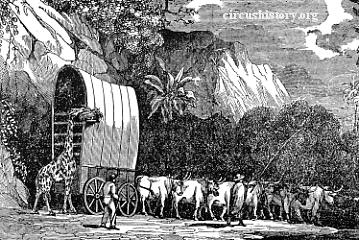 A final illustration from the 1839 courier shows the high covered wagon used to transport the giraffe to Cape Town for shipment to the United States. Pfening Collection.
There is evidence to suggest that about this time Welch and the Zoological Institute had a parting of the ways and rivarly increased due to the giraffes. Welch was the first exhibiting his giraffes in 1838 but for 1839 June, Titus, Angevine and Company was exhibiting an "Egyptian Giraffe, or, Cameleopard" and they emphasized that:
The one now offered for inspection, was brought from the vicinity of the White River, the remotes (sis) branch of the Nile, a part of the world which has never been visited by a white man, and was transported to the Mediterranean, a distance of nearly 3,000 miles, and shipped to the United States in 1838 by G. R. Gliddon, Esq., American Consul at Cairo. (48)
This giraffe appeared in Newark, New Jersey, in early May (49) and, when appearing in Springfield, Massachusetts, in late May, "arrived in town . . . drawn by a coach and six, with a long retinue of attendants . . . He carries his head high in the world, and obtains the attention of thousands." (50)
The arrangements for having this giraffe shipped to America are not fully known. Benjamin F. Brown of Somers, New York, and an old Institute figure, left for Egypt in late 1838 equipped with letters of credit and introduction, one of which noted he "is rushing his way to Egypt as quick as he can get there . . . " (51) He may have arranged the shipment of the June, Titus, Angevine and Company giraffe in order to compete with Welch's but nonetheless he himself went after giraffes and brought four to this country in the fall of 1840 only to take them to England that December. (52)
On a Friday in early November, one of Welch's giraffes in his menagerie fell, broke its neck, and died almost instantly on the way to Newark, New Jersey. (53) The giraffe had gained wide fame and the national Niles' Weekly Register noted the death:
A Giraffe. The beautiful giraffe, imported from Africa by Messrs. Welsh (sic), Weeks & Co. at an immense expense, some two years since, and which was for a time on exhibition in this city (Baltimore), died at Newark, (N. J.) on Friday last. It was probably the effect of the cold weather which caused the animal's death. (54)
The whereabouts of Welch's other giraffe is not certain but it may well have been the one with Macomber and Handy in Hingham, Massachusetts, on September 15, 1838. (55) This would indicate Welch was still, in some arrangement, a business associate with his old partners.
When the menagerie and circus of June, Titus, Angevine and Company exhibited in Newark, New Jersey, on June 4 and 5, 1841, they exhibited a full grown, stuffed giraffe that had died shortly after its arrival in this country. (56) This was probably the animal shipped by Gliddon. The same firm had a second show that was in Portland, Maine, on June 9 and 10, 1841, that exhibited a giraffe, presumably alive. (57) This giraffe was either a recent import, one of Benjamin Brown's that did not go to London, or the "only surviving giraffe, of those which have been exhibited through this country . . ." which Niles' Weekly Register reported in its August 15, 1840, issue as being in Flemingsburg, Kentucky. "All the rest," it noted, "have yield to the unpropitious climate." In 1842 June, Titus, and Angevine were still advertising a giraffe, "the only one now living on the American continent." (58)
For 1838, Welch toured his giraffe and some other rare animals; they were in Philadelphia from October 8-20. (59) In 1839 Welch and Bartlett exhibited in Albany in May, (60) Jonas Bartlett of the Branch Hotel, Bowery, New York City, being Welch's new partner. (61)
On April 21, 1838, Ned Derious bought, for $2,500, a half interest in Bacon's circus. (62) The next year, 1839, Bacon and Derious, however, must not have had financial success for in Richmond, Virginia, George J. Cadwalader, a rider with the circus, foreclosed his mortgage on the equipment.
The entire circus was bought by Welch and Bartlett who had sent to Richmond a Mr. Hopkins to buy the concern and act as manager. The show opened briefly in Fredericksburg, Virginia, but left in early July by horseback for New York. The show pitched its tents for ten days in Brooklyn but soon set off for a summer tour.
The show left by boat for Providence, Rhode Island, showed three days, and went to Woonsocket Falls. It was there that several cages of animals, including the giraffes, joined the circus for the rest of the season. (63)
"The Giraffe Exhibition & Circus united," as this show was known, was in the Springfield, Massachusetts, area on August 5 and 6, two months after June, Titus, Angevine, and Company with their giraffe. The Welch show had difficulty securing a location in Springfield and so defiently noted in their advertisement that:
Her Ladyship is in the habit of receiving tall company, but the honorable Board of this side are too tall, so we locate on the opposite (of the Connecticut River), in West Springfield, at T. Bartlett's . . . (64)
The show traveled into New York state where rider John Glenroy noted that:
At Newburg we showed in opposition to Sam Nichols' circus, and although they had a splendid company, they had a very bad day, we completely knocked them out . . . Although we had showed in opposition in Newburg, there was no hard feelings between the members of either company, and next morning both companies crossed the Hudson on board of the same boat, at the same time . . . (65)
The show then appeared in New Jersey and Pennsylvania and closed in Newark, where the giraffe died.
Welch and Bartlett opened in New York City in November as the Broadway Circus. They built a circus with board sides and a canvas top, the whole of which was heated. Several performers were added to the company, Colonel Alvah Mann and his troupe of Indians joined in the latter part of the winter, and the entire show received good business until their closing in late March, 1840. (66)
The summer show opened with the usual riders, acrobats, and clowns in the Military Gardens, Brooklyn, and then was shipped to Providence, Rhode Island. After exhibiting at several stands, it opened below the Old South Church, Boston, for five weeks. At Sand Lake, Albert A. Brown, the driver of the bandwagon and "one of our best people," was drowned while bathing his horses in the lake. The show was in Albany for the Fourth of July and continued a circular trip returning to Albany and then traveling south to Sing Sing, New York, where the season ended. At separate times during the season, Mons. LeTort, rider, James F. O'Connell, tatooed man and clog dancer, and William Chestnut, jig dancer, joined the company. (67)
On November 16, 1840, the Bowery Theatre, formerly under the management of the great actor Thomas Hamblin, opened with productions of " 'those magnificant spectacles presented at the Royal Amphitheatre, (Astley') London, and Franconi's Paris.' " (68) Welch and Bartlett were the producers and the show, three hours in the ring and one-and-a-half on the stage, featured, at one time or another, Richard Sands, two and four horse rider, Edwin Derious, rider and vaulter, William O. Dale, the great somersault thrower (that winter he threw as many as fifty-nine), T. V. Turner, rider; Alexander Rockwell and the Englishman John Wells, clowns; Henry Ruggles, slack wire; Mr. Davis, harlequin; and Thomas Barry, stage manager and in charge of the spectacle.
Two historical spectacles, four melodramas, and other pageants were staged, among them, at great expense, was the "Battle of Waterloo" involving fifty horses and two hundred supernumeraries. The battle occupied the entire stage and as long as it ran drew full houses. Also produced was "Napoleon Crossing the Alps." On New Year's Day a full house was treated to a six hour performance. (69) On November 23 the ring performances had been strengthened by the engagement of the great rider Levi North, young Glenroy, and the entire New York Circus. (70) North was the first to turn a somersault on a bareback horse that carried a broad, flat pad. The feat was first performed in Henley, England, in the summer of 1839, and first in America at Welch and Bartlett's circus at the Bowery Theatre during the winter of 1840-41. (71) Glenroy was later to do the same but on the bare back of a horse while with the Welch and Mann circus in 1846.
The Bowery Theatre hippodrama shows met with stiff competition from the old Institute's strictly circus shows in the Amphitheatre, 37 Bowery. On January 11, therefore, the Bowery Theatre re-opened as a circus under the management of Welch, Bartlett, and Company. About April 1 the establishment closed. (73)
Welch's activities in early 1841 are not exactly clear. In appears that very early in 1841 Welch sold out to Bartlett, Joined Colonel Alvah Mann, and the two formed a circus and started for New Orleans. (74)
Bartlett, meanwhile, went to the National Theatre, Philadelphia, with some of the Bowery Theatre performers, and showed stage spectacles for a month followed by another month at the Front Street Theatre, Baltimore, where North, Cadwalader, and others joined. A summer tour then opened in Washington, D.C., but at Richmond, Virginia, on July 5, "Colonels" (the honorary title the two claimed, or were given, during this period) Welch and Mann bought the concern from Bartlett. The show soon went by boat to Baltimore where a week was spent overhauling the wagons before the season recommenced. After a tour of Pennsylvania and New York, closing at Troy, the circus went by steamer to New York for a two week engagement. (75) It opened Monday, October 25, at the Bowery Amphitheatre and was such a success that circuses continued to operate at the Bowery for the rest of the winter. (76)
At about this time, Rufus Welch was used as a business reference by a then budding showman, Phineas T. Barnum. Barnum was arranging to buy a museum building in New York City from Francis W. Olmstead. Olmstead inquired of Barnum's references and he replied:
Any man in my line from Edmund Simpson, manager of the Park Theatre, or William Niblo, to Messrs. Welch, June, Titus, Turner, Angevine, or other circus or menagerie proprietors; also Moses Y. Beach, of the New York Sun. (77)
They all spoke well of Barnum, he bought the museum, and with it gained his fame as a showman.
Welch and Mann proceeded to Philadelphia where they opened the Walnut Street Theatre as a circus on November 22 for a season of forty nights. Nevertheless, they closed on February 28, 1842, Cadwalader having been equestrian director. (78) During the winter stay, two boxing champions, Benjamin Caunt of England and Charles Owens of America, showed with the circus in a series of boxing matches. Also engaged with the company was Harvey Leach, the man-monkey later made famous by P. T. Barnum as the "What Is It." (79)
At the end of February, Welch's company played at the Holiday Street Theatre in Baltimore, managed by F. C. Wemyss. Wemyss had asked Welch to bring in his horse company in order to drive out a competitor, W. E. Burton, because, as Wemyss knew, "the horses had the power to draw away all his customers . . . " (80) Among the company was George J. Cadwalader, two and four horse rider; John Wells, clown, and his family of riders and dancers; Charles Bacon, rider and acrobat; Benjamin Jennings, ringmaster and juggler; Richard Risley and son, contortionists and acrobats; and others. While in Baltimore, Philip Charriskie fell sixty feet from his slack wire, breaking his leg in three places and also fracturing his thigh. His leg was amputated but he died several weeks later. (81)
After the two-week Baltimore engagement, the troupe returned to Philadelphia for ten nights opening March 30 and featuring Levi North. (82) The company then left by rail for New York City and opened at the "Old Bowery" for two weeks. There, Charles J. Rogers, one of the best scenic riders ever in the states, Madame Louise Howard, one of the best female riders of the time, and two others joined.
The summer tour resembled the New York tour of the previous season and they crossed into Pennsylvania and then Baltimore, Maryland, for one week. Here part of the company left due to a disagreement with the managers who wished to reduce the salaries. Departing were Wells and family, and three others. The show proceeded to Washington, D. C., and headed to Harrisburg, Pennsylvania, where John Gossin joined and the show was in opposition to Nat Howe's circus, both canvases being placed within five yards of each other on Capitol Hill. The rivalry was friendly and no bad feelings resulted. The season ended in Bristol, Pennsylvania. (83)
In the fall, Welch took a long lease on the property at the corner of Ninth and Chestnut Streets, Philadelphia, and opened in the building which was erected by T. Cooke for his English circus company and afterwards by W. E. Burton as a theatre. (84)
Welch and Mann converted the theatre into a splendid circus and amphitheatre and "Reaped the harvest which Burton planted; to them his ruin has been the source of emolument." (85)
Welch opened October 1 with his usual company and closed in January, 1843, to travel to New York and open at the Park Theatre with Rockwell and Stone's circus. With Rockwell was Hiram Franklin, one of the best performers of the time, and Dan Emmet, Frank Brower, Billy Whitlock, and Richard Pelham, the first members of a minstrel troupe. The formidable array of talent received immense audiences during the five week stay. (86)
The Park Theatre was among New York's finest and New York stage historian George C. D. Odell thought of "Old Drury" falling "into the hands of the Philistines." "On January 5th," he writes, "R. Welch's Olympic Circus moved into desecrate the high places of the drama." It was a great success but perhaps due to the constant change of program. March 1 was a benefit and last appearance for the Virginia Minstrels.
Whitlock, Brower, Pelham, and Emmet. Having first opened in early February at the Bowery Amphitheatre, then at the Park, the minstrels would soon be carrying the new art to England. (87)
The new art was created when a quartette of friends, headed by Dan Emmett, developed an ensemble performance of their individual minstrel acts. The group's first show was presented either in Bartlett's billiard parlor in the Bowery, or in the Branch Hotel, a favorite rendezvous for showmen in New York City. Some of the leading circus men of the day, including Nathan Howes, were present to witness this first minstrel performance. It took place in either December, 1842, or early 1843. (88)
Previous to Welch's exhibition in the Park and with the same company, he was involved in converting the old Richmond Hill Theater into a circus but the people refused to come. Little evidence supports this and it may have been earlier, perhaps 1836 or '37. Nevertheless, he did occupy "the theatre, 'the Park,' and made a heap of money." (89)
The show returned to Philadelphia for a month, then to Baltimore for three weeks at the Front Street Theatre, and finally back to the National, Philadelphia, where, after three weeks, the company broke up in April. (90)
In New York, Welch and Mann assembled two companies for the season, one under Welch for the Mediterranean ports and Brazil, and the other under Mann for the United States and the West Indies. An account of this tour, of Welch's National Circus building in Philadelphia, and of Welch's later partnerships and foreign tours until his death in 1856 will appear in a subsequent issue of Bandwagon.
Footnotes
1. Charles L. Briarmead, "The American Circus,'" New York Clipper, xxiii (17 April 1875.)
2. 1 December 1856. This is taken from the Philadelphia Evening Bulletin of 29 November 1856 says September, 1800, as does an obituary in Porter's Spirit of the Times, I (6 December 1856) 232 ; the Philadelphia Public Ledger and Daily Transcript, 1 December 1856, p. 2, says only 1800. John Daly, archival examiner for Philadelphia in a letter, 6 December 1968, to the author cites a cemetery return for Rufus Welsh (Welch's name was often incorrectly spelled this way), who died 29 November 1856 that gives his age as 55 years.
3. Third Census (1810), New York 1:241; Second Census (1800), New York, 7.
4. Alexander McMillan Welch, Philip Welch of Ipswich, Massachusetts 1654 and his descendants (Richmond, Va.: William Byrd Press, 1947), p. 118 ff. No Rufus Welch for the time and locality is given.
5. Times, 1 December 1856; Clipper, 10 March 1883 ; see also Ledger.
6. T. Allston Brown, "A Complete History of the Amphitheatre and Circus," New York Clipper, viii (19 January 1861), 320.
7. Brown, "Complete History," (19 January 1861), p. 320.
8. Articles of Association, 14 January 1835, Somers, New York; Westchester County Historical Society, White Plains, New York. Signers totaled 132 and they serve to identify those associated with the Flatfoots.
9. Charles E. Culver, History of The Town of Somers (n.p., [1959?]), pp. 481-482. This is chapter vii of J. Thomas Scharf, History of Westchester ["County, New York "I. (2 vols., ?, 1886) according to a forward by Otto E. Koegel.
10. Petition to the Postmaster General of the United States in support of the claim of Somers, New York as the Birthplace of the American Circus (n.p., [1966]) quoting Asa T. Smith, Raleigh, North Carolina, letter, 23 January 1827, to Messrs. Browns, managers of the circus. New Bern, North Carolina.
11. John A. Dingess MS history of the circus, chapter 5, p. 89-90 ; typescript photocopy in the author's collection. Original MS in the Hertzberg Circus Collection, San Antonio Public Library, San Antonio, Texas. This may be an incorrect name. Tippoo Sultan may be the correct name.
12. Ibid., chapter 30, p. 689.
13. " 'Gen.' Rufus Welch," New York Clipper, xxx (10 March 1883). A "Conflagration of Moscow" and automated figure show appeared in early 1828 (Poulson's, 8 January 1828) and the hall was to close April 3 (Poulson's, 2 April 1828). A panorama show appeared in the fall (Poulson's, 18 October 1828) and was to remain through December 8 (Poulson's, 29 November 1828).
14. Poulson's, 1 September 1828; the last advertisement appears 24 October 1828 but no hint was given that the circus would be closing.
15. Charles H. Day, "History of American Circus and Tented Exhibitions," Billboard, xiii (29 December 1906), 32; J. Thomas Scharf and Thompson Westcott, History of Philadelphia: L. H. Everts; 1884), II, 979.
16. Brown, "Complete History," (19 January 1861), p. 320; Dingess MS, chapter 16, p. 312; Day, "History," p. 32; Clipper, 10 March 1883. Note the discrepancy in Brown and Dingess regarding North's apprenticeship.
17. Brown, "Complete History," (19 January 1861), p. 320.
18. Ibid.
19. Dingess MS, chapter 23, p. 463.
20. (Philadelphia) Daily Chronicle, 15 December 1832.
21. Charles G. Sturtevant, "Who's Who in the American Circus” White Tops [inserts], xxxvi (January-February 1963) insert number 2, p. 6, citing the Albany Argus.
22. Newark (New Jersey) Daily Advertiser, [October?] 1833. One of several photocopies of circus advertisements from the Newark Daily Advertiser furnished by Gordon M. Carver, Ocean City, New Jersey. The date of issue was not given but the month is ascertained by the show's scheduled appearance. Hereafter cited as Carver photocopy.
23. Sturtevant, "Who's Who," p. 7, citing a handbill in the T. Walsh collection. The Walsh collection was divided and went to the New York Public Library ; the Hertzberg Circus Collection, San Antonio Public Library, San Antonio, Texas ; and elsewhere.
24. Dingess MS, chapter 9, p. 185-186.
25. Handbill, Connecticut Historical Society, Hartford.
26. R. W. G. Vail, "Random Notes on the History of the Early American Circus," Proceedings of the American Antiquarian Society, new series, xlii (1933), 151, citing the Essex Register, 30 October 1834.
27. Carver photocopy, 1834; handbill, American Antiquarian Society, Worcester, Mass. The locations and exhibition hours differ but the undated handbill describes the 1834 Welch show and fits no other known show. See illustrations.
28. Dingess MS, chapter 5, p. 88.
29. Ibid., p. 91. The year given is 1836
30. Westchester County Historical Society, White Plains, New York.
31. Newport Rhode Island Republican, 8 July 1835.
32. Springfield (Massachusetts) Republican and Journal, 28 February 1835.
33. Sturtevant, "Who's Who," p. 7, citing a unique route book of the Zoological Institute, Branch No. 7, Noell E. Waring, manager, in the Hertzberg Circus Collection, San Antonio Public Library, San Antonio, Texas; Day, "History,"' p. 32; George L. Chindahl, A History of the Circus in America (Caldwell, Idaho: Caxton, 1959), p. 38, citing a newspaper advertisement reproduced in White Tops, December-January 1937-38, p. 18.
34. Richard J. Reynolds, "Circus Rhinos," Bandwagon, xii (November-December 1968), 10.
35. Niles' Weekly Register, 11 April 1835; William Frederic Worner, Old Lancaster: Tales and Traditions (Lancaster, Pa.: the author, 1927), p. 184; Dingess MS, chapter 30, p. 688, gives a slightly different account than Worner.
36. Springfield (Massachusetts) Republican and Journal, 23 May 1835, The complete story of the fascinating diplomatic arrangements, which are outside the scope of this study, can be found in the Dispatches from U.S. Consuls in Tangier, 1797-1906, microcopy no. T61, roll no. 5, June 12, 1831 - June 7, 1837, in the National Archives; and Niles' Weekly Register, 8 November 1834.
37. William W. Clapp, Jr., A Record of the Boston Stage (Glasgow, Scotland: James Munroe & Co., 1853), pp. 420-422; Dingess MS, chapter 30, p. 688.
38. Carver photocopy, 1837; Albany (New York) Argus, 9 May 1837.
39. Chindahl, History, pp. 38-39.
40. Clipper, 10 March 1883.
41. Ibid.
42. Springfield (Massachusetts) Republican and Journal, 4 July 1835.
43. Newport Rhode Island Republican, 8 July 1835. James A. H. Murry, editor, A New English Dictionary on Historical Principles (Oxford: Clarendon Press, 1893) III, 49, notes that the correct spelling is camelopard. The origin of this word for a giraffe is Greek and the spelling is French. "Confusion with leopard led to the early spelling cameleopard in medieval Latin, French, and English . . ."
44. "To be exhibited in Chestnut Street Philadelphia, ... the Gigantic Giraffe or Camelopard, . . ." (n.p., [1838?]), p. 1. A copy of this four page pamphlet is in the New York (City) Historical Society. It is not believed to be a unique copy.
45. Springfield (Massachusetts) Republican and Journal, 28 February 1835; Niles' Weekly Register, 16 June 1838.
46. "To be exhibited . . .", p. 3 ; Niles' Weekly Register, 16 June 1838.
47. "Death of Gen. Rufus Welsh [sic.]," Porter's Spirit of the Times, I (6 December 1856), 232.
48. "June, Titus, Angevine & Go's. Splendid Collection of Living Animals . . .", large handbill at the Connecticut Historical Society.
49. Carver photocopy, 1839.
50. Springfield (Massachusetts) Republican and Journal, 25 May 1839.
51. Petition to the Postmaster General . . . quoting John L. Stevens, London, letter 21 November 1838, to Charles E. Anderson, Esq., U. S. Leg., Paris in a reproduction of an inventory of a private Somers, New York, collection.
52. Croton Falls (New York) News, 17 July 1879.
53. John H. Glenroy, Ins and Outs of Circus Life (Boston: M. M. Wing & Co., 1885, p. 27; Springfield (Massachusetts) Republican, 16 November 1839, quoting the Newark Sentinel.
54. 16 November 1839.
55. Sturtevant, "Who"s Who," p. 8.
56. Carver photocopy, 1841.
57. Chindahl, History, plate II, citing the Portland, Maine, Daily Eastern Argus, 22 May 1841.
58. Vail, "Random Notes," p. 134, quoting an unidentified source. To add to the confusion, Jos. M. Hobbys' Circus and Giraffe exhibition was to be at Harrisburg, Pennsylvania, according to Sturtevant, "Who's Who," p. 8, citing the Keystone Advertiser of July 24.
59. "To be exhibited . . .", p. 1.
60. Richard E. Conover, Xenia, Ohio, letter, 1 April 1969, to the author.
61. Clipper, 10 March 1883.
62. George L. Chindahl, ed., "Joseph Blackbarn's Diary," White Tops, XXIX (January-February 1956), 3.
63. Glenroy, Life, pp. 24-26.
64. Springfield (Massachusetts) Weekly Republican, 3 August 1839.
65. Glenroy, Life, p. 26.
66. Ibid., pp. 27-29 ; Dingess MS, chapter 30, p. 689.
67. Glenroy, Life, pp. 29-32.
68. George C. D. Odell, Annals of the New York Stage (New York: Columbia University Press, 1928) IV, 473. The story of these exciting productions is fully detailed in A. H. Saxon, Enter Foot and Horse: A History of Hippodrama in England and France (New Haven and London : Yale University Press, 1968).
69. Glenroy, Life, pp. 32-36.
70. Odell, Annals, IV, p. 474.
71. Chindahl, History, p. 39 citing Billboard, 10 January, 1914.
72. Glenroy, Life, p. 62.
73. Odell, Annals, IV, pp. 474-476.
74. Glenroy, Life, p. 34. The Clipper, 10 March, 1883 implies Mann bought out Barlett.
75. Glenroy, Life, pp. 36-3.
76. Ibid., p. 38; Odell, Annals, IV, p. 588.
77. Phineas T. Barnum, Struggles and Triumphs of, Forty Years Recollections (Hartford: J. B. Burr & Co., 1870) p. 112.
78. Brown, "Complete History" (12 January 1861), p. 312.
79. Glenroy, Life, p. 38.
80. Francis Courtney Wemyss, Twenty - Six Years of the Life of an Actor (New York: Burgess, Stringer & Co., 1847) II, p. 365. 81. Glenroy, Life, pp. 38-39.
82. Brown, "Complete History" (12 January 1861), p. 312.
83. Glenroy, Life, pp. 39-41.
84. Dingess MS, chapter 30, pp. 689-690 ; Scharf and Westcott, Philadelphia, II, 979 ; Casper Sounder, The History of Chestnut Street, Philadelphia, from the Founding of the City to the Year 1859 (Philadelphia: King and Baird, 1860) chapter 76, the work is limited to five editions, two of which are in the Historical Society of Pennsylvania, one being an extra-illustrated; Clipper, 10 March 1883; Arthur H. Wilson, A History of the Philadelphia Theatre, 1835 to 1855 (Philadelphia : University of Pennsylvania Press, 1935), p. 20.
85. Wemss, Life, II, p. 377.
86. Glenroy, Life, pp. 42-43. Handbills for the circus at the Park seem not to be uncommon. There is a mutilated one in the Hertzberg Circus Collection, San Antonio Public Library, San Antonio, Texas, for February 2.
87. Odell, Annals, IV, 614-615, 674-67B.
88. Carl Wittke, Tambo and Bones: A History of the American Minstrel Stage (Durham, North Carolina: Duke University Press, 1930), pp. 43-44.
89. Porter's Spirit of the Times, I (6 December 1856) p. 232.
90. Glenroy, Life, p. 43.
91. Dingess MS, chapter 30. pp. 690-693.
Program 1946
Display No. 1
A radiant New Spectacle of Color, Beauty, Joy, and Glorious Pageantry in which the Performing Personnel of the Circus Passes in Kaleidoscopic Review.
Circus on Parade, Conceived by Mel Rennick
Display No. 2
Admirable Achievement Exemplifying the Fruit of Practice, Patience and Perserverance. De Wills Trio, Acrobatic Supreme; Escalante Troup, Aerial Bars
Display No. 3
Mrs. Harriett Beatty. Presenting together in the steel Arena two Hostile Lords of the Jungle - A Ferocious Royal Bengal Tiger Riding and Performing on the top of a Huge Asiatic Elephant.
Display No. 4
Here they come! Those Perennial, Inevitable, Indispensable, Harbingers of Happiness - The Clowns! At this point and at other intervals they Punctuate the Proceedings with their Playful Pranks and Absured Antics. Kenneth Waite - George Barnaby - Jose Soleras - Charles Bathes - Thomas Rouse - Mel Rennick - Alva Evans - Tommas Ontko - Arthur Cooksey - Lou Walton - Bob Seely.
Display No. 5
Breath-Taking Feats at Lofty Heights. Babe Siegrist, Jean Evans, Deft and Dextrous Demonstration on the Single Trapeze.
Display No. 6
Natural Enemies of the Jungle Depts Educated Beyond Belief. The Finest Collection of Jungle-bred Trained Wild Animals Ever Assembled in one Arena. Black Maned African Lions and Lionesses, Royal Bengal and Siberian Tigers Featuring the Only Spinning Tiger in the World. Trained and Presented by the one and only Clyde Beatty, Greatest Wild Animal Trainer of All Times
Display No. 7
Graceful Unison at High Altitudes - Joanne Day, Bebe Siegrist, Cloud Swings
Display No. 8
Line up on the Hippodrome Track and Introduction of the Personnel of the Wild West After Show featuring Billie Hammond and Johnny James Hollywood's Forthcoming Western Stars, Assisted by Rex Rossi, Margi Hoffman, Phylis Cannon, John Cline, Bobby Peck, Jimmy Groves, Jimmy Essex, Chas. LaMont.
Display No. 9
A Diversified Offering of Skill, Fun and Pep. The Temples, Trampoline Capers; The Bedfords, Risley Experts
Display No. 10
Three Troupes of Four-Footed Entertainers in all three Rings. Sancho Morales and His Hollywood Canines; Martha Joyce, Military Ponies; Jack Joyce, Military Ponies
Display No. 11
Equine Intelligence and Expert Horsemanship in the Rings and on the Hippodrome Track Presented by Bobby Peck, Jimmy Groves, Jean Evans, Joanne Day, Martha Joyce, Josephine Madison, John Cline, Bebe Siegrist, Milonga Escalante, Sue Staley, Margie Hoffman, Jeannie Sleeter, Albina Beatty, Dorothy Cox.
Display No. 12
The Famous Morgan Stallion "War Cloud," Trained and presented by Jack Joyce
Display No. 13
A Peerless Presentation of Equilibristic Skill, The Great Olveras, World's Foremost Head-Balancing High Perch Act.
Display No. 14
Clown version of the Human Cannon Ball
Display No. 15
Daring, Dancing, Dextrous Daredevils of the Slack Wire in Simultaneous Performances Phil Escalante, assisted by Yolanda Escalante; Don Francisco, assisted by Mary Francisco
Display No. 16
Clowns Clowns Clowns, In a laugh Provoking Skit, "The Strip Tease"
Display No. 17
A Mid-Air Rhapsody in Yellow in which Dainty Feminine Aerial Gymnast exemplify grace and precision in the Cloud Ballet, Produced by Joe Siegrist. Aerial Ballerinas - Gracie Genders, Bobby Peck, Bebe Siegrist, Joanne Day, Sue Staley, Milonga Escalante, Jeannie Sleeter, Esther Escalante, Anita Olivera, Albina Beatty, Jean Evans, Josephine Madison and Margie Hoffman. Webb Sitters - Martha Joyce, Red Sleeter, Fay Alexander, Elden Day, Joe Siegrist, Mel Renick, Bill Snyder, Bob Butler, Henry Monzello, Ruben Olvera, Art Cooksey, Al Darrah, Lou Walton and Jimmy Groves.
Display No. 18
Huge Masses of Brute Strength Completely Subjugated to the Will of Man as the Elephants are Presented in Fascinating Routines of Maneuvers, Dances, and Pyramids. Trained by Slivers Madison and Presented in Ring 1 and 3 by Jean Evans and Josephine Madison. Walking Mount on Hippodrome Track
Display No. 19
The Sensational De Waynes Acrobatic Marvels Formerly Featured by Rudy Vallee in his U. S. Coast Guard Revue.
Display No. 20
The Epitome of Equestrian Excellence and Elegance. The Liberty Horses, Presented by John Cline - Black & White Troupe, Jack Joyce - Palomino Troupe
Display No. 21
Miss Estrelita, Top-Ranking Exponent of Thrilling Heel and Toe Catches High in the Dome of the Tent.
Display No. 22
Farewell Appearance of our Friends, The Clowns, Wherein the Hippodrome Track is Surrendered to Their Final Parade of Mirth, Merriment, and Monkeyshines.
Display No. 23
World's Foremost Company of Mid-Air Marvels in a Thrilling, Spine-Tingling Series of Breath-Taking Exploits on the Flying Trapeze. The Flying Concellos. Absolutely Fearless Performers Who Scoff at the Laws of Gravity and Fly Through Space Like Winged Birds. Jeannie Sleeter, Elden Day, Joe Siegrist, Red Sleeter
Display No. 24
The National Anthem Henry Kyes' Celebrated Circus Band.
Dailey Bros, had a very good 1945 season. The war was now over, and the help shortage was soon a thing of the past. The number two show, Austin Bros., gave up the rails after an adventurous season, to say the least. Harry Hammill returned all of the equipment to Gonzales, sans the cookhouse department. This and an old-model Diamond-T truck were the nucleus of a 1946 tour by truck that never materialized.
With the Austin equipment and animals back "home" Ben and Eva Davenport began expansion plans for Dailey. Contrary to any popular beliefs, none of the Austin wagons or trucks ever went out on the Dailey show. These pieces didn't have the bracing to stand the gaff of nightly moves, having originally come from a carnival. That type show moves weekly at the very most.
The Davenports added five cars to the train. These included one stock, two sleepers and a pair of flats. During a winter visit to Gonzales, Ben was looking for someone to swap the old Austin "whale hearse" to for an extra sleeper.
Clyde Beatty was just such a man. He had just gone into partnership with Art Concello to form the Clyde Beatty Pan-Pacific Circus. The "Pan-Pacific" was strictly an identification mark, as they did Not open in that Los Angeles building in 1946. The old Russell show had only seven flats. This was very tight for a fifteen-car train, so two sleepers got dropped from the lineup, one per year. Concello still kept his private car, "Randy", on the train in 1946.
Circus and carnival railroad cars aren't something that you can pick up at the corner supermarket.
The train makeup problem solved, the next step was to build and buy some excellent wagons. Lewis Diesel, of Memphis, turned out a fancy $14,000 aluminum light plant. This unit had two 45 kw. generators. The Dailey shops rigged up one of the finest centerpole wagons in history that winter. Pole slots were grooved right into the framework, this eliminated the usual hooks on the sides.
Two custom-built concession service wagons (midway diner and popcorn, etc.) helped to flash up the front end. "Tiger Bill" Snyder and his crew built several more prop wagons and converted another Ford tow truck to round-out the needed vehicles for the expanded show.
An aside on the city of Gonzales. The first shot for Texas Independence was fired here on October 2, 1835, with an admonishion to the Mexican army to "come and take it if you want it." Historians gave the town the title of "The Lexington of Texas." A museum stands between the town square and the winterquarters site at the fairgrounds. The Gonzales Warm Springs Rehabilitations Center always got a free performance from the circus people.
The Davenports paid about $1,200 each for having their semi-trailers converted to wagons at the Fruehauf factory branch in San Antonio. This figure seems rather high for that day and time.
The Davenports always left the final routing decisions to their veteran agent, R. M. Harvey. His experience in such matters date back to the old Barnum & Bailey show. Texas weather, and unpredictable entity to all but "fools and newcomers", had served up a tornado in 1945. The three decided on a mid-April opening date.
Wagon painting went on under one of the square tops erected at quarters when the weather permitted. Dorms for the help were old rail cars with the trucks and possums removed, similar to the Ringling press office at Sarasota. The troupers felt right at home in these.
The return of "Lucy" and "Jap" from the Austin show gave Dailey ten bulls for the coming season.
Quarters work progressed on schedule, while Ben had the bull herd walking around Gonzales, tailed-up, to "loosen them up" in his words. This was a way he had of legally parading without a permit. On tour, it was awfully easy to have the bulls blow the arrows. Half of the show would usually go out caravan-style to get them to the lot.
Zero hour was Saturday, April 13. This was the first season that the show opened with a big top large enough to require two sets of quarterpoles. While this top was added to the show in late-season 1945, it would do better to go into details about it in this segment.
Said top came from the ill-fated S. L. "Buster" Cronin Circus of 1945. Cronin had suspended the canvas from external rows of utility poles in lieu of regular circus tent poles. This was too cumbersome to erect and dismantle, so he lost out to Russell and the Arthur Bros, shows.
Ben had the old top's quarterpoles (single set) cut down to form the short, or red, row. All the new canvas and improved front yard layout gave the Dailey show the air of a small Sells-Floto. Not satisfied with a mere sign painter to letter the 1946 wagons, the Davenports engaged "Tex" Stewart as their scenic artist. Stewart decorated each unit in a separate style. The scrolls and animals gracing the baggage wagons made many of them attractive enough to parade.
All in all, the Gonzalesites seemed so inspired by the circus that they gave the Davenports two hefty houses at opening.
The big top interior sported a patriotic color scheme with new masking on the reserved seats and red and blue trim on the white top.
In line with the increased electrical power than available, a knife-switch control board was set up near ring #3. A much improved system than before.
The 120' w. three short 50's round top gave ample track space between the ten-high plank seating and the three wood and sheet metal ringcurbs. As stated in the first installment, Dailey Bros, never used reserved chairs or even starbacks.
Norma Davenport now worked five bulls in her personal act, and Mildred Pyle rode Jean Allen's beautiful rearing mount in the manege display. No attempt was made to advertise or carry a cage act in 1946.
Freddie Fredricks joined Tiger Bill in producing the Wild West Concert that season. He exhibited "Lipstick," the $25,000.00 palamino stallion. Bert Wallace, Hazel King, The Drane Sisters and Ernie Burch made up the backbone of the show along with those previously mentioned.
Harry Hammill came down on opening day to look it all over. One could tell that he still had a yen for the circus.
Gonzales had now taken its place with such centers as Peru and Sarasota.
1946 saw fewer rail shows entour, but only a nine-car retrenchment. Arthur Bros, and the Austin show threw in the towel after a single train season. Art Concello made the season and, sold to Clyde Beatty. On the plus side, Ringling jumped from 80 to 86; Cole Bros. finally added five, and likewise, the Dailey show. All four shows played Texas that season, as did the six in 1945.
The railers all did good business, as did most of the "mud shows." Floyd King and Harold Rumbaugh gobbled up the Beatty truck show and Bud Anderson's Victory Circus for their new King Bros, motorized circus.
James Edgar and associates had planned an ice show under canvas for 1946, but found after they had bought canvas and trucks that such an operation wasn't feasible. A tent couldn't stay cool enough in the summer to keep the ice solid. To make a good story brief, they put out the Sparks title on trucks. The Sparks Circus made its first and only tour of Texas that season.
Unlike such contemporary showmen as the suave John Ringling North the Great Clyde Beatty, and marquee-watching Col. Zack Terrell, Ben Davenport preferred staying in the background as just plain "Ben" to his associates on the Dailey Bros. Circus. Even the show's title had no real significance in earlier circus history. Many times a show assumes the name of a predecessor who left a large stock of lithos at one of the poster houses. Ben and Eva seemed to have just coined the Daily title among themselves.
A slouch hat and work clothes were Ben's personal "uniform" around the lot during these times. He had his own brand of law and order around any show he owned or managed. It was rough and tumble in those days. He had no prima donnas with it.
A book was based on Ben and his show. "Cat Man," by Edward Hoagland portrayed the Ringling show physically, but it's moral implications were definitely those of Daily Bros. Read it if you can stand profusion of four-letter words.
Teardown was fairly smooth at Gonzales except for one lion refusing to go into a menagerie wagon that night. It seems that they decided to transfer him from the cat barn at the last minute. He had a ladyfriend that they were keeping behind, and he wanted to stay with her. I rode that rig down to the bus station. The runs were just a couple of blocks from it.
From Gonzales, the show train wended its way to Columbus for a Monday stand. By Thursday (18) it rolled into Temple, where Ted Bowman visited and covered the day's events on film. He also made the 1946 train make-up list printed in these pages.
The show played its usual long stretch in Texas. A nation-wide rail strike was brewing that spring, so it was very important that the show stay within a reasonable distance of quarters. The other "rattlers" also geared accordingly.
Wednesday, May 8 found the show at Abilene. Not to be mistaken for Abilene, Kansas, this Texas metropolis thrives off cotton and the many by-products of its seed. Merle Evans spent nearly a school year here in 1942-'43 as bandmaster at Hardin-Simmons University. This was when he was on strike from the Ringling-Barnum show.
A Sunday lay-off came at Wichita Falls in preparation for two shows on the 13th. Press stories here flaunted the show as rolling on 25 cars, instead of the actual 20. The Sunday release also indicated that the big top wouldn't go into the air until Monday morning. This usually meant going through all of the erection steps through lacing the canvas sections and securing same to the bale rings, then windrolling it overnight.
Prom here the outfit rolled across the Texas Panhandle and on out to California, for its first and only stand ever in the Golden Gate State. This was at Needles.
All jogged along until the first week of July.
Dailey was on a reported collision course with the Beatty railer at Butte, Montana, on Monday (1). Two days later at Billings, the show lost its big top when a 60-mile-an-hour wind struck the lot between performances. No animals or people were injured in the storm, but the local airport reported destruction of two light planes.
The night show went on "topless." This doesn't mean the same as contemporary showmanship where the gals work bare-bosomed. Ben burned the shredded canvas to salvage the hardware. A brand-new 120' w. 3-50' was rushed to the show at Great Falls. The tent was olive drab and had a $15,000.00 price tag.
The July Fourth stand at Lewiston was the big event of the local holiday celebration. The late P. M. Silloway, a circus authority of note, visited the show here and had a critical review in White Tops. He felt that the 24-foot animal wagons might conserve train space, but didn't look as good as the cages on other shows. Silloway showed a sense of objectivity in bringing out both good and bad points about the 1946 edition.
Another negative point that he brought out was that of not cutting the grass and weeds in and around the rings. This usually falls to the lot owner. Many are either too tight or lazy to have the land mowed. They would rather burn it off. This is no good for the circus, because black stubble can soot-up the ladies' hosiery mighty quick. Rather than run the risk of the soot, many shows just leave the grass high.
Both Silloway and Walter H. Hohenadel, who caught the show at Dixon, Illinois later in the season, marveled at the growth of the show since last seeing it about five-years previously. Quite a change since "Nemo" and "Rosie" constituted the bull herd on the tiny truck show!
Dailey Bros, stayed on the road until Nov. 16, then made a 230-mile home-run jaunt to Gonzales.
In a final wrap-up of the 1946 season, we will note that Cole and Beatty both went to the West Coast, and Sparks made one of the most unusual jumps when it was ferried from the Bolivar Peninsula over to Galveston Island. The ferry must give priority to emergency vehicles. Many ambulances use it getting to and from the University of Texas Medical Branch on the island.
The winter of 1946-'47 saw Norma Davenport become Mrs. Corky Plunkett. This gave the show its first trampoline act in history. The Plunketts were a rep show family who put in a year on the Cole show, in 1944, to gain some circus experience.
Ben had expansion ideas, again. This time he decided to field a five-ring show by adding a couple of middles to his existing big top. Original plans called for adding five cars to the train, as had been the custom in the last two seasons.
An even bigger project was in the wind, so the idea was scrapped for another year.
Equipment adjustments were minor in order to fit the five-ringer onto flats. The dogs got their own wagon, #43, when all of #40 wardrobe wagon was needed. The extra canvas, seats, poles, and props worked into existing wagons carrying the same loads.
Cole Bros, had had tremendous acceptance of the America steam calliope wagon going downtown as an historical feature in 1946. This gave the Davenports the idea of rigging up a horse-drawn air calliope and ticket wagon combined.
This unit, several feet shorter than its predecessor, gave some extra loading space on the train. Driver Jim Boyle and Jimmy Williams, his brakeman, took the calliope for a daily spin uptown behind an eight-up hitch - just like the old days, with plumes and banners.
The Dailey triple stakedriver was in its second season. This idea also came from the Cole Show.
Pre-dating the airlines by a decade or so, Ben had his beautiful, shiny light plant wagon painted in show colors. Braniff, Continental, and Texas International have all recently painted over the dural skins on their jetliners.
Other major tops mushroomed in proportion to the big top. The menagerie was now a 70-round top w. five 40's. This had the appearance of a cigar. Their sideshow blossomed-forth under a 50' w. 4-20's and it had the usual attractive canvas bannerline.
Some readers may wonder why we have gone so heavily on physical details in this series, and present a smaller proportion on the performance. The reason is that the big top-flatcar style of show is gone. Most any magazine-program or route book tells the tentative program, but fails to give more than just some "canned" background on the show.
This Dailey Bros, series is in but three parts, and it was planned to give the highlights of the Davenport family's nearly 40 years in outdoor show business. We are showing the Dailey Bros, circus in comparison to its contemporaries each season.
The Ringling Family had bounced the Big One's presidency back and forth between Jim Haley and Robert Ringling since the Hartford Fire (July 6, 1944), and John North got into match as a vice-president of the show. One of his subtle touches was to reinstate the blue and red big top, while still leaving it a six-poler. This satisfied both styles of circusgoer. They also brought over an entirely new performance, except for Tebor's sealions, the clowns and bulls. This took the largest number of rail cars in history to move it. The late Col. C. G. Sturtevant claimed that it was 107 back and one advance.
With five rail shows out in 1947 (total cars - 183) and a generous handful of mud shows, Ben had to think up more than just the six-pole tops to garner his share of the circus dollar. A huge elephant herd would do it, so he sent Louie Reed over to India to see what he could scare up. This was the reason for saving the freight bill on the extra cars that season.
Bad weather plagued the Saturday, April 12 opening at Gonzales, but both Bowman and State Rep. Harley Sadler (of circus and tent show fame in Texas) reported the natives slogged through the mud for both shows. The Bowman photo set shows that the bannerline was half-masted, but all the tops stayed up.
Joe Horvath, a Czech native, had come onto the show as the cat trainer, working the ten lions. Reviews indicate that the arena steel sat continuously in an end ring during both shows. At opening Tom Scaperlanda said that they had used a platform at the other end of the top. Later on in the season they replaced said stage with a bally cloth ring.
The people of Gonzales never got to partake in the show's big mainstay - the various forms of grift. Ben always played his quarters opener "Sunday school”-style.
Clyde Beatty had sliced across Texas about a month earlier, so the area wasn't virgin as in past seasons. By tradition, the Lone Star State saw most shows on their way back to winter-quarters.
The Dailey show headed toward the East Coast, a routing innovation. Reed had planned to bring the new bulls in at New York City. The New York Times gave him a nice feature story on this expedition.
"Nemo" went into must early in June and had to be destroyed at Chambersburg, Pa., on June 12. This was quite a blow to Ben and "Red" Frievogel, as that bull elephant pretty well symbolized the Davenport showmanship style. Both were lusty, rugged, and ruthless. "Red" had kept him since the truck show days. It was like losing a member of the family.
A question arises as to the number of pachyderms actually imported by the show that year. The June delivery was reported as ten. With the demise of "Nemo," this would give the a net of only nineteen.
Other releases told of a 25-bull herd, with infant mortality whittling the number to 21.
Speaking of elephants, one reviewer questioned the use of only a center ring bull display presented by Norma. Simple, was Beatty ever flanked by other cat acts on his own show? After breaking into new husband Corky's trampoline act, Norma could do just about anything in the big show.
Bill Elbirn sent along a semi-aerial view of the 1947 show taken at Bridgeton, New Jersey. It shows about a 30' x 80' stable top, and a couple of about 40' x 80'ers for the dressing rooms and the cookhouse respectively. A scaled-down version of the Hagenback-Wallace show of 1934. The "Live Merry-Go-Round" pony sweep top was always spotted by the marquee. This at least got everybody deep onto the midway. The 1947 program ran:
1. Spec-"parade of all Nations".
2. "Hank," the hula dancing bull.
3. Joe Harvath's lions in the steel arena - Ring one spot.
4. Dog and pony show in all other rings.
5. Ivanoff Trio, horizontal bars.
6. Twenty-girl aerial ballet.
7. Clowns.
8. Dogs in rings 2, 4, and 5.
9. Principal riding by Mr. and Mrs. Eddie Hendricks.
10. Norma and Corky Plunkett's trampoline troupe.
11. Ten gals up on webs.
12. Bulls, ponies, horses, and dogs working together in rings 2 and 4.
13. First Concert announcement, starring Freddie Fredericks and Chief Sugar Brown.
14. Rings 2 and 4, wire walking by Alfredo Sanchez and Pena Medel - Foot juggler, the Great Ricco, in the center ring.
15. Clown "World Series."
16. Nine High School horses and riders.
17. Mario Ivanoff in a Hubert Castle take-off on the wire.
18. Clown stop.
20. Norma's Dancing and Baseball-playing Elephants. The most widely publicised act on the show.
21. Liberty horses - 6, 8, and 6.
22. Cloud swing and aerial perch.
23. Second Concert announcement.
24. Si Ritchie (the Japanese performer until WW II, then billed as a Filipino), Head-balancing traps: and Emma Valdez, trap.
25. Clowns.
26. A grand finale of balancing, juggling, contortion, and acro.
Tragedy struck the show at LaFayette, Ind., Sept. 18, when a couple of elephants combined talents to sap down and step on Mrs. Gertrude Burton, the wardrobe mistress. She died instantly.
The Dailey show stayed on the road until mid-November. Texas had about as many circuses lured in during the 1947 season as a dog has fleas to scratch. Beatty made four forays into the state. Cole only sliced a corner off the northeastern sector after cancelling some early September dates that Ringling was to make after a five-year hiatus.
Bailey Bros, and Jack Mills badgered about, and Mills even day-and-dated the Polack-Shrine show at San Antonio. Si Rubens brought his Roger Bros, down to winter at the old Dailey quarters in La Grange.
Ben closed at Seguin, just a few miles from Gonzales, on November 14.
The 1948 circus pot started boiling when John and Henry North finally regained control of the Ringling-Barnum show during that winter. Art Concello tired of his brief "retirement" and made a deal with the Norths on the Artony Bowl seatwagons in return for the Big One's general managership. This also entailed bringing back some of Concello's former Russell Bros. Pan-Pacific staff, namely Roland Butler and Bill Antes to head up the press and radio-TV publicity.
Such a move meant that the Ringling-Haley publicity heads were suddenly "at liberty." Ben and Harvey decided to go for broke and try to hire the duo of F. Beverly Kelley and Frank Morrisey to boost the Dailey Bros, image. Allen J. Lester and Sam Stratton also went with the deal when it was finalized.
Kelley went right to work getting national hits in Look and the Saturday Evening Post on the baby elephants, "Butch" and "Eva." "Little Butch" lived in the Davenport home. The Houston Chronicle Magazine Section ran a story on this about the time the national plugs hit the stands.
Plans went ahead to put the show on twenty-four cars back and an advance advertising car. This unit gave the press boys and car manager Bill Oliver's paper crews the needed space to let the countryside know about the "Big 25-Elephant Railroad Circus" coming to town.
Kelley and company worked up a new magazine-program format that was to be only slightly changed until the show left the rails. The newspaper ads finally took on a big show look. The Speed-ball lettering was now replaced by a Ringling-style logotype.
With Ringling going back to the four-pole big top, Kelley seized the idea of flaunting the new Dailey top as "The Longest Main Tent in America." This was something similar to comparing the sizes of hot dog and hamburger buns.
To rate with the top shows, Ben ordered a blue big top with orange and blue striped sidewall. Reportedly quite a colorful canvas coliseum to cover the five rings.
Two more Warren-built flats, another bull car, and an extra sleeper complemented the advance car for the five-car addition to the show train. The new flat loads were a Caterpillar tractor, a straightbed Chevrolet truck for the arena steel, a special wagon to haul little "Butch", an extra menagerie cage, a stake and chain wagon, and a jack and stringer wagon.
Breaking all Dailey rail show tradition, they did not open at Gonzales in 1948. Rubens had opened his circus at LaGrange very early and headed for the Rio Grande Valley. He made San Marcos on March 13. The Dailey "visiting firemen" swarmed on the lot that Saturday, but there was no inkling of a rail jump straight from quarters.
Rather than play a "death march" to the coal country, Harvey had made arrangements to open at Paducah, Kentucky on Monday, April 12. Everything had gone up a couple of days early, so the opening matinee didn't go flat.
With Kelley and Co. "tooting the advance calliope" the Dailey show with a flying act and some more sophisticated seating could have played any city that it chose. Ben liked the "big duck in a pond" role instead.
1948, an election year, made a natural for the circus. Kelley worked out a deal for Senator Robert Taft to use baby "Eva" in his Republican campaign. Other plans used both an elephant and a circus donkey at the same time.
Dailey's route carried it from New York to Washington State and back to Texas. This meant virtually a Coast-to-Coast jaunt. They kept shying away from California, because of the strict fire laws.
The Ringling agents turned down the San Francisco Fire Marshal's scheme to "railroad" them into the Cow Palace, but finally relented. How ironic in comparison with 1957!
From Paducah, the Dai1ey show wended in and out of Kentucky and Tennessee until the 23rd, when they lost Marysville to high water. West Virginia, Ohio, Pennsylvania, and Maryland came next. Jim Harshman had high praise for the show at Hagerstown, Md. He reported that the cat act wasn't working because of a help shortage.
The caravan on rails moved into Vermont for a couple of stands in early June. This was the only New England foray of the season. From there they yielded little ground in their westward trek.
One of the magazine hits that Kelley certainly did Not want came out in a Detective-type publication. This dealt with an alleged murder on the show. " 'Nuff said".
Checking back, it seems that King Bros, came into Hagerstown three days ahead of Dailey. Both units did well. Floyd King was now on his own. He and Harold Rumbaugh had gone their separate ways the previous winter. Indications were that King truly had the equivalent of a fifteen-car railer on his 38 trucks. This refers to the Dailey 1945 edition.
By mid-July Dailey Bros, was back in familiar territory. Since Harvey still lived in Perry, Iowa, the show always drew well in that state. Cedar Rapids folk turned out well in spite of a cloudburst, but the really big day came at Burlington, on the 16th, where the sun helped draw two full ones.
Davenport had quite a bit going, so not too many towners went out to see the Davenports and their circus. Confusing?
Cole had suffered a derailment going into the CFA Celebration at Delavan, Wisconsin, so this slowed them for awhile. Ringling was starting its "express run" to the West Coast with a couple of Iowa stops. Beatty had just arrived in the Mid-west via the Coast and Canada.
Eva Davenport had just returned from an extended hospitalization to help "Butch" Cohn on the revenue end of the show. Ben then went into the Mayo Clinic for a routine check.
Dailey followed the Ringling show into Montana by a week and did great business at a matinee-only stand in Whitefish. Kalispell had a local fair in progress, so the little burg of Whitefish go the feed stop. The stores closed a la the gold rush days.
Canvas boss Ralph Noble died recently. Mitt Carl ran meals on top of each other during the westward trek, but the show kept going. George Smith had recently came over from the Ringling show to manage the Dailey outfit.
Many plaudits went to Joe Rossi's excellent band that year. Rossi, of Italian extraction, had a love for good music. In earlier seasons he had to leather lip it, playing the only trumpet in his band, and leading simultaneously. Louie Grabbs was his main backup man for years. He ranked right up with Mike Doyle on the air calliope. Rossi had fourteen men with him in 1948.
Speaking of circus band, Henry Kyes, the "Paul Whiteman of Spangleland," had taken over the Cole band after the Sparks railer folded in 1947. Eddie Woeckener retired from active circus life that past winter.
The veteran Bert Rickman took over the Dailey big top mike, but Leo Snyder continued as equestrian director. The Rossi-Snyder-Rickman trio kept the performance rolling.
Elephant mortality began to cut into the herd. "Jap" died early in the season, as did some of the babies imported the year before. "Little Butch" was destined to die from the malady that killed all of elephants born in America. A sort of putty-like substance would build a complete blockage of the digestive tract, literally starving the little elephants. There was no known cure for this condition.
Hazel King wrote the weekly "Dressing Room Gossip" column for the show in the old Billboard. Such news was chatty and informal, but kept folks close to what was going on behind the scenes.
Dailey's big top was 130' w. 5-40's as reported in midseason. All other canvas was apparently held over from 1947.
Most of the staff had stayed over down thru the years. For 1948 it included:
The Davenports, Owners.
R. M. Harvey, General agent.
Bev. Kelley, Publicity director.
Ray Morrison, Concessions.
Leo "Tiger Bill" Snyder, Equestrian director.
Bert Rickman, Announcer.
Joe Rossi, Bandmaster
Ralph Nobel, Boss canvasman.
Paul Pyle, Assistant canvas boss.
Milt Robbins, Sideshow manager.
Frank "Mitt" Carl, Steward.
Chas. "Butch" Cohn, Treasurer.
George Smith, General manager.
Louie Reed, Menagerie and bull superintendant.
Back in those days September usually meant the start of the home-stretch for most circuses. Ringling usually made the Arizona-New Mexico trek between the West Coast and Texas. Cole had dropped almost straight down from the Chicago area and beat the Big One into Central Texas by almost three weeks. This fired the Ringling ire enough to use half-page wait ads against Terrell and Co. at Waco, Austin, San Antonio, and Corpus Christi. Something caused the Austin paper to run no free stories on the Cole show that year. Florree Gait, the Cole press representative, finally bought space for some art and cut-lines.
Barbara Beale, one of Digger Pugh's English ballet girls fell during the matinee web act. She suffered a compound fracture just above the right ankle. The paper figured it was just a publicity gag, and treated it thusly until police officials and the emergency hospital reports showed them differently.
The two big shows took a few more glancing blows at each other in Louisiana. Nothing serious.
Meanwhile, Bud Anderson acquired a big chunk of the C. R. Montgomery Wild Animal Circus equipment and fielded a one-ringer under his Seal Bros. title. This little trucker played down thru the Panhandle and West Texas on into the Giddings Fairgrounds. This is just north of LaGrange.
Dailey showed its last month in Kansas, Missouri, Oklahoma, and Texas. They made a Sunday run from Lawton, Oklahoma to San Angelo, Texas. Here, the matinee coincided with a brisk "norther." At that, an estimated 4,000 went thru the marquee. A couple of monkeys escaped during the unloading and garnered a sidebar story for Kelley in the local paper.
A very good season ended at Cleburne on Veteran's Day. The Cleburne lady editor was lecturing to one of my journalism classes, when I asked her how she covered the Dailey closing. Her reply was a curt: "The sheriff arrested everybody for questioning in that murder case."
The 1948 route book published by the show included some interesting statistics for the season.
The show traveled 1,069 miles from Gonzales, Texas to the opening stand in Paducah, Kentucky, on April 6. The closing stand was Cleburne, Texas on November 11. The show train had traveled 16,329 miles for the season as compared with 12,442 miles in 1947. No performances were lost in 1947 and no Sunday stands were made. In 1948 the show exhibited seven Sundays and lost one complete day at Hawarden, Iowa due to a bridge wash-out. Two afternoon shows were lost and several stands were contracted for only one performance.
There were no railroad accidents, but several minor accidents happened, the most serious being the upsetting and burning of one of the cookhouse wagons while loading at Ft. Madison, Iowa.
An unusual amount of sickness hit the show during the 1948 tour. Eva Davenport was taken to a hospital at Lockport, N. Y. on June 10, and underwent a major operation and did not return to the show until July 13th. On July 26th, Ben Davenport was rushed to a hospital in Trenton, Missouri. He was later transfered to a hospital in Mason City and again moved to the Mayo Hospital in Rochester, Minn., where he remained for 10 weeks. After a long battle with typhoid fever Mr. Davenport returned to the show in Liberal, Kansas, on October 14th.
There were five deaths on the circus in 1948. Tom Henry, a contracting agent died in Los Angeles just as he was about to leave for Gonzales for the opening. Raymond Fonner was injured in Newark, Ohio and died on May 10. Duke Walker, a member of the side show band died suddenly. Ed Julius, of the big top canvas crew was run over and killed by a passenger train at Liberal, Kansas on October 15th. Ralph Noble, the general superintendent of the show, died in Watertown, S.D., on August 18th, following a 10 day illness.
Bandwagon reader William L. Oliver joined the show in 1945 as the manager of the advertising car. He has sent the following information:
In 1947 the Dailey advance car carried 12 men, 14 days ahead of the show. There were two men on the number 2 car. There was also a 3 man brigade. The show ran into opposition from "Big Bob" Stevens' Bailey Bros, truck show in Maine during the 1947 season. In Houlton, Maine the Dailey show ran half pages newspaper ads in opposition to Bailey, for six days ahead of the stand. There was no billing war here, but in Millinocket, Maine, the two shows slugged it out with paper. Two men from each show were jailed for assault and were released after spending 14 hours in the pokey, and each was fined $50. Bailey blew five days of towns billed and cold turkeyed into Easton, Pa.
The Dailey show ran into many battles in 1947 and 1948, but always had manpower to protect their paper. Oliver said there were very few locations that the paper did not live until the show train pulled in. The 1948 season is the only year a rail car was used on the advance.
Mr. Oliver also advised that the final season on trucks in 1943 was unbelieveably profitable, with fantastic grosses many days between 10 and 15 thousand dollars. So it is clear to see Ben Davenport coined plenty of money to finance a new railroad circus the following season.
Bill Oliver is now retired and living in Bedford, Virgina.
Credits for this article go to Ted Bowman, Tom Scaperlanda, Al Stencell, Bill Elbirn, Red Sonnenberg, many of The Dailey Bros. staff, Paul Butler, Jim Harshman, and especially to Joe Bradbury and our Editor.
Part #3 will conclude this series.
Dailey Bros. Circus 1946, April 18th - Temple, Texas
Stock Car No. 98 - 10 Elephants, 2 Camels, 2 Zebras, 3 llamas, 2 Oxen, 1 Brahma Bulls.
Stock Car No. 81 - Draft Stock.
Stock Car No. 10 - Ring Stock.
Flat Car No. 51
Several letters have been received containing most interesting and valuable comments on the 1947 Sparks Circus article which appeared in the Jan-Feb and Mar-Apr 1970 Bandwagons. Most concerned the fact not mentioned in the article that a number of the Sparks wagons are still in existence and are currently on the Strates Shows, a large railroad carnival. These wagons were sold to Strates by the Clyde Beatty Circus in 1957 when it switched from rail to motorized transportation.
CHS Howard Tibbals of Oneida, Tenn. sent the following along with a number of photographs of which a few are printed here.
"While going to school in Raleigh, N. C. in the years 1956-57-58 I lived only two blocks from the State Fair Grounds. Each year I watched and observed carefully the growth of the Strates Shows. In 1958 the show had removed considerable very old wagons some of which had been replaced with several wagons which had been purchased from the Clyde Beatty Circus and were formerly on the 1947 Sparks show. These were first used by Strates during the 1958 season."
CHS John C. Corson of Monroeville, Pa. also wrote concerning the former Sparks wagons now on the Strates Shows as follows.
"About two years ago (1968) I visited the Strates Shows quarters in Taft, Fla. while they were getting ready for the season. They had nine former Sparks wagons which they had purchased from Clyde Beatty Circus. Two were in the wagon junkyard but the rest were in use and I assume still are. They were:
Clyde Beatty Number; Sparks Number; Strates Number
1. No. 82; No. 64; in junkyard
2. No. 97; No. 54; in junkyard
3. No. 31; No. 32; No. 4
4. No. 40; No. 26; No. 56
5. No. 84; No. 38; No. 65
6. No. 90; No. 128; No. 344
7. No. 41; No. 20; No. 330
8. unk; unk; No. 332
9. unk; unk; unk
"Wagons 8 and 9 are unrecognizable as to either Beatty or Sparks origin because the bodies have been stretched and rebuilt. Only the undercarriages identifies their Sparks show heritage."
Ross "Doc" Hankins who was on the 1946 Sparks truck show and later on the Strates Shows wrote these interesting lines.
"At least four, possibly more, of the former Sparks-Beatty wagons ended up on the Strates railroad carnival and to my knowledge they are still there. Either the pole or the stringer wagon is used to haul the motordrome long mud sills and uprights and serves as a bally platform while the drome is in operation. The bandstand wagon with a small chain lift on one side is used to haul the mud sills and platforms of the Pretzel dark ride. Then there are two rather short box style wagons. One was used as a "shanty" wagon for the train crew and one was used as candy wagon or wardrobe by Jack Norman's big girl review. They are readily distinguishable by the ladder up the front end and the two hand grips on top possible for the benefit of a "brakee". I well remember an incident in 1962 on a Sunday afternoon just outside the fairgrounds at Hamburg, N. Y. I was riding a tractor out to the fairgrounds that was pulling three wagons with a former Sparks wagon in the middle. Just before we got to the grounds we turned a corner and "lost" No. 3 wagon. But for a huge tree on the corner of the property the wagon was headed right for a front porch. The pole hit the tree and stopped it dead. Another tractor and crew were there in no time, also bringing Mike Olson who was general Manager. I remember well Mike telling the driver, "Tell Red Kelley (the trainmaster) not to hook anything behind those Beatty wagons". Apparently the rear hook up was faulty.
"I was with the 1946 Sparks Circus from day we opened in Arcadia, Fla. till the latter part of August. Edgar had originally planned an outdoor under canvas iceshow and had bought all the equipment to move on trucks. However, after several trials it was found that it was impossible to freeze ice hard enough in one day under canvas so Ralph Clawson, Edgar' manager and adviser, finally induced him to form a circus. That is why we started the season with only 3 center poles and worked that way for two or three weeks before another center piece arrived. The Esqueda flying act while under contract did not work until the new center piece was added. Edgar got use of the Sparks title for $1.00 a year. It was a very, very successful season, right from the start. There were some fine experienced people around the show. The sideshow had a very good season. There were only two or three spots where we did not wait for the night "come out", these usually due to bad rains or stormy weather. In my opinion if Edgar had followed the regular route up the east coast to Maine as we did in 1946 the ending would have been different."
John Staley, who had the cookhouse on the 1947 Sparks show, wrote this interesting letter.
"On page 24 of the Mar-Apr 1970 Bandwagon article on the 1947 Sparks Circus you mentioned that a complete inventory of all properties was taken with exception of the cookhouse. That season I was cookhouse steward on the Sparks Circus and in Renton, Wash, on Sept. 9 I turned in two inventories to the office wagon; one inventory from iron stakes to the cookhouse flag and the other was for all food I had left over.
"We had rumors of the show closing in Everett, then in Auburn heard the show would close Sunday in Tacoma. In Aberdeen the official notice was posted that the show would definitely close Sunday in Tacoma.
"Sunday in Tacoma it rained off and on. Supper was the last meal we fed to the performers in the cookhouse. After supper we took a complete inventory of all equipment as said before except the food. Monday we fed the workingmen breakfast and lunch, then we scrubbed every piece of equipment in the cookhouse from silverware to blue seat planks, packing everything away clean.
"Tuesday in Renton we unloaded the canvas wagon, No. 32, stacked all the equipment outside the wagon except canned foods, then covered with side-wall. Then we inventoried all the food in wagon No. 32 and No. 44. All inventories were turned into the office wagon." (Author's note: Evidently the cookhouse portion of the inventory got detached from rest of the document leaving me to erroneously assume no inventory was taken).
Mr. Staley also offered further comments on the show.
"The Edgar family were my best customers in the cookhouse. Had the circus closed at the regular time of the season I would have presented the cookhouse flag to them.
"That year had my Fourth of July dinner in Charlottetown, Prince Edward Island, Canada. I had purchased everything I needed that would not spoil before we left the Mainland. Arriving early that morning in Charlotte town I went shopping for fryers and believe it or not I could not buy any Spring chickens in town. I sure was in a jam so I made a fast trip by cab to Edgar's sleeping car and told him the bad news. He wired a friend in Moncton and before noon I was cutting fryers in halves. They were flown in and Jimmie had his car at the airport waiting for the chickens.
"One day the latter part of July between meals Edgar came over to the cookhouse and we had a long chat. He told me he was up a tree and did not know which way to turn, whether to proceed to Vancouver or go south at Kenora. At the time he asked me not to repeat our conversation. Jimmie Edgar was one of the best, if not the best, circus owners I ever worked under."
No part of this publication may be reproduced in any form or means
Last modified February 2006.
without written permission of the author and the Circus Historical Society, Inc.