


Circus Historical Society
Bandwagon, July - August 1970
Back to Bandwagon Index
Bandwagon, Vol. 14, No. 4 (Jul-Aug), 1970. Note: Only some articles are included in this online edition. Many illustrations are not included. The Circus Historical Society does not guarantee the accuracy of information contained in the information in these online articles. Information should always be checked with additional sources.
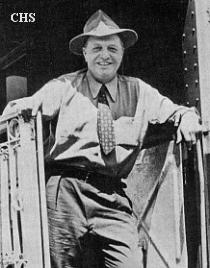 Photo: Ben Davenport, the modern day Jerry Mugivan as he stepped off his private car during the 1947 season of Dailey Bros. Circus. Atwell photo.
In the fall of 1914 a young boy arrived in Delaware, Ohio, to attend the Methodist College, and study for the ministry. His parents, in Friendly, West Virginia, had planned for their son a career in the Methodist Church.
But one semester was all he could take and he took off. Opening and closing in one semester, Benjamin C. Davenport, joined out with a circus. The record is not too clear as to which show he went, but it is thought that it was Robinson's Famous Shows, first in the winter quarters and then on the advance car.
A few years later he bought "the smallest horse in the world" and exhibited it fairs and indoor circuses. The next adventure was in partnership with Jimmy Sullivan on a carnival, where Ben framed a one ring circus for the midway. This did not work out and the stock went back to Sullivan at the end of the season.
In 1923 Davenport went out with the LeRoy Motorized Circus, from Fostoria, Ohio. He drove one of the seven Ford trucks. During the 1924 season he was with William Peters (Ketrow) on what was the first tour of the Ketrow Bros. Circus. Ketrow bought an elephant from the Hall farm and after the elephant man left Davenport took over the bull.
Davenport took his assemblage of horses, ponies, dogs and monkeys to the Lindemann Bros, four truck Seils-Sterling Circus, out of Sheboygan, Wisconsin, in 1925. He was just about the whole show that season, appearing in 13 of the 26 acts, and on some days worked knives and magic in the side show. He stayed with the Lindemanns through the 1928 season. This was his training ground for a later career as a circus owner.
For the 1929 season he moved to the Princess Iola's Medicine Show, playing week stands. Princess Iola, was really Eva Billings, daughter of Gay Billings, who had operated "Gay's One-Horse Circus" in the early 1900s. Princess Iola became Mrs. Davenport and in 1931 together they took the med show out again but it went broke in Sugar Creek, Ohio. Eva Davenport and her infant daughter Norma, returned to her home in Quincy, Illinois, and for a time took up residence.
Meanwhile Ben watched the ads in the Billboard and joined Milton Holland in framing a indoor circus to play Elks' Club auspices in the Pacific Northwest. They stayed out 26 weeks.
He later went back to med shows playing halls for five and six day stands. For the next two years he was rassling bears and selling medicine. By that time his trucks were worn out and he replaced them with a couple of old Chevrolets.
This was the start of the Davenport Society Circus, in 1935, using a side wall corral, two trucks and an air calliope as the physical property. This little show grew, and continued under that title through the 1939 season. In 1940 the title was changed to Dailey Bros.
Ben and Eva bought Honest Bill Newton's elephant, Nemo, their first elephant. They later bought a second bull from Newton, Rosie, as well as two camels and a manage horse. The 1940 season lasted until December 14th, and a small winter unit toured for six weeks, prior to the opening of the 1941 season. R. M. Harvey was now general agent, and the show was destined to grow fast from that point on.
The following reprint is the most complete story about the show in 1941.
From Billboard August 23, 1941 page 43:
Dailey Going East; Biz Uniformly Good.
Roundup, Montana, Aug. 16 - Dailey Bros. Circus played here Monday to fair business. Manager B. C. Davenport states that the show has toured seven states, covering about 7,000 miles to date. It has been making Montana stands for about three weeks but is now heading eastward towards the wheat raising regions. Davenport reports business uniformly satisfactory.
The elephant truck carrying Rosie and Nemo has turned over three times recently but without serious injury to the truck or the bulls. Lately the calliope was wrecked and the pipes were turned in on a new machine to be picked up at Miles City, Montana. Two new large motors have been just added to the equipment and a big truck for utility purposes.
Personnel of the show includes Mr. and Mrs. B. C. Davenport and daughter Norma; Butch Cohen ticket office, Harry Fitch legal adjuster; Joe Levine candy and novelties; Ray Morrison, popcorn and pit show; Dutch Le Blair, Grease stand; Vernon Hurd, side show with Willie Rawls and Charles Parker in ticket boxes; Johnny Stephens and Kid Cummins inside concessions; R. M. Harvey, advance and Harry Doran, brigade leader.
Members of the band are Ovila LeBoeuf, cornet and leader; George Gardner, baritone; Buck Sawyer, trombone; Blackie Woods, bass; Sam Barham, drums; Bertha Drane, calliope. The band is costumed in Western cowboy style.
Highlights of the big show performance are the six circus Girls in Roman rings and trapeze; wire walking, Leon Woods; cloud swing, Billie Gillem; Rosie largest bull worked by Roy Beavers; silver whirl, little Norma Davenport; iron jaw and web acts, Hazel LeBoeuf and Frenchie Woods; high trapeze, Virginia Smith and Mildred Pyle; Nemo, posing and dancing bull, worked by Copenhagen and principal clown, Walter Schuyler, known as Annabelle.
The side show is very attractively framed housing the two elephants, two splendid camels, a pair of lions, a hyena, two black bear cubs and a group of large monkeys. The outside pit show contains a sloth so called upside down animal. The side show is not opened until after the big show matinee is over.
The year 1941 saw a new era among the big rail shows. Both Ringling and Cole Bros, used blue big tops and horse fair exhibits on the lot. Ringling even went all-out with multi-colored tops, a new menagerie configuration, a streamlined performance, and a spruced - up front yard. This was the last circus season before World War II restrictions and rationing hit the nation.
"Calliope Bill" Green wrote that Dailey never covered up anyone else's paper in that era, but rather placed its one-sheet dates among the other show's pictorials. One such stand at Washington, Kansas, had Dailey Bros., Barney Bros., Eddie Kuhn's Trained Animal Show, and Joe B. Webb's Circus. Green's report also stated that Eva ran the show at that time, and while the show was a small trick with just a fair performance, it sported a very attractive bannerline on the kidshow. Eva's other daughter, Billie Gillem, performed in the big show.
The BB Under the Marquee column for September 27, 1941, stated: "Dailey Bros. Circus is enjoying fine business and is headed south from North Dakota to winterquarters at Aransas Pass, Texas."
Living in Houston at this time, my family and I passed the Dailey caravan headed down US 90 around Thanksgiving on our way to San Antonio, and saw the show on the lot at Seguin on the way back home.
One big reason that this series has been held up for several years is that we have tried to no avail to secure truck and canvas lists of seasons 1941-43. If anyone can help with this information, please mail it either to me or the Bandwagon editor. Your services will be greatly appreciated. What little route information we have from BB and other sources is as follows:
March 20, Grapeland, Texas. March 27, Bertram, Texas. April 1, Marble Falls, Texas. April 2, Harper, Texas. April 3, Sonora, Texas. April 4, Eldorado, Texas. April 5, Mertzon, Texas. April 10, Iraan, Texas. April 24, McCamey Texas. April 25, Rails, Texas. May 28, Washington, Kansas. Sept. 9, Cavalier, N. D. Sept. 10, Park River, N. D. Sept. 11, Grafton, N. D. Sept. 12, Larmore, N. D. Sept. 13, Mayville, N. D. Sept. 18, Wyndmere, N. D. Sept. 19, Hankinson, N. D. Oct. 10, Sececa, Mo. Nov. 30, Seguin, Texas.
Season of 1942
An early spring issue of the Billboard contained an ad for help wanted on the show and used a Huntington, Texas address for reply. This raises some speculation as to whether the show actually spent the entire winter at Aransas Pass. Huntington is in the Piney Woods country of East Texas.
A third, and more likely version of the winterquarters site is that they wintered at Yoakum, Texas. This is the headquarters of the Tex-Tan leather goods plant. Many pieces of harness and other like goods was purchased by the show from Tex-Tan down through the years.
The show left on sixteen trucks from quarters to open on March 2, 1942. A 75 foot big top with three 40 foot middles was used. Late in the season the Adele Nelson elephants were purchased with the Nelson semi. Just before the show closed on December 5 Davenport purchased a couple of semi-trailers, some canvas, rigging and seats that had been on the Parker & Watts show in 1940.
Tires, gas, and certain foodstuffs were hard to come by at this time, and it was especially hard on truck showman who had to move everyday.
Money was plentiful if you could get to the war plant areas. The Dailey program went heavy on bull acts at this time just as in later years. Billy Rose came on as press agent about this time.
The show was known to be a grifter, and the Davenports wisely used the extra money to enlarge the operation, year to year. They were huddling with R. M. Harvey on how to profitably expand into the big league.
The year 1942 saw the same two railers on the road, and the big truck shows included Russell Bros., Wallace Bros., Mills Bros., and Arthur's Mighty American shows opened in mid-season. Cole went to the West Coast, and Ringling stayed east of the Rockies. Ringling suffered two major setbacks that season. First, the Merle Evans band was called out on strike by the American Federation of Musicians during the Philadelphia stand. Secondly, an arsonist burned down the menagerie tent in Cleveland, O., prior to the August 4th matinee. Scores of animals burned to death or had to be shot by police. There were no human casualties.
Season of 1943
The fairgrounds at La Grange made an ideal winterquarters site. All buildings are still kept up in fine style even today. Cotton is the main crop around central Texas, so most fairs are held in the fall after the picking and bailing are over. This means that the grounds are still freshly painted when the trucks roll in. Several circuses have wintered there through the years.
The show opened the 1943 season on 16 show owned trucks, 14 of which were semis. Four new semis were added. The line up of rolling equipment at the opening was as follows:
#44 Semi trailer - Dining Dept.
#77 Semi trailer - Stringers etc.
#10 Semi trailer - Office, pulling stake driver
# ? Semi trailer - Big top poles and canvas
#20 Semi trailer - Side show
#71 Semi trailer - Elephants
#? Semi trailer - Elephants (Adele Nelson truck)
#33 Semi trailer - Camel, brahma bull, zebra etc.
#49 Semi trailer - Horses
# Semi trailer - Cage for baboons & lions
#40 Semi trailer - Properties
#12 Semi trailer - Light plant
#? Semi trailer - Sleeper
#? Straight bed - Seats
#14 Straight bed - Dogs, pulled pony trailer
#50 Straight bed - Cage
In addition to the above a semi trailer was used by the Davenports as living quarters. This unit had been purchased in 1942 from the Sol Liberty Shows.
Live stock carried by the show included: 6 elephants, 1 dromedary, 1 camel, 15 horses, 5 ponies, 3 bears, 1 hyena, 15 monkies, 29 baboons, 2 lions, 1 zebra, 1 brahma bull, 1 mule and 12 dogs. Eight palomino horses were left in quarters, as they had as yet not been trained.
The canvas consisted of a 70 foot big top with three 40 foot middles. The side show menagerie was a 60 foot round top with three 30 foot middles.
The new color scheme parlayed red, white and blue. One of the bull trucks used in 1943 had an extension over the cab.
Joe Rossi came on to take over the bandmasters chores. He had Sam Barham on drums; Clyde Burkett, trombone; George Gardner, baritone; Joe Pamillio, clarinet; Louis Grabbs, air calliope; Jack Fogg, bass; Cruse Amsden, cornet, and Rossi on trumpet.
The first road stand was at Gonzales, where the Davenports found that the fairgrounds was up for sale. They toured eleven states before returning to Gonzales in December to winter and set up what was to be their quarters on a permanent bases.
Twenty-three 2 day stands and one three dayer interspersed the season. It lasted a total of 253 days, just over 36 weeks, and they had 28 Sunday runs. Dailey Bros, covered 11,064 miles that season by truck.
Harvey and the Davenports were really getting down to brass tacks over the transportation problem brought about by the war. Even the Greatest Show on Earth was forced to retrench in 1943 to 70 cars. The main cutback on R-B was in the menagerie. Robert Ringling took over the helm that season and immediately called for a return to the oldtime circus format. This meant a real circus parade used as the opening spec and a six pole big top. Said tent was a 190 with five 50 foot middles.
The Cole show played the West Coast, again that year, and still rolled on 25 cars. Their train consisted of 12 flats, 4 stocks, 8 sleepers and one advance car.
Late in the season Dailey acquired the five Weir elephants and their trainer Louis Reed. This brought the total to 11, a very large complement of elephants for a mud show. This made it more imperative than ever to switch to rails the next season.
Circus history was finally in the making again two decades-plus since George Washington Christy had shelved his big rail show in the early '30s.
Season of 1944 - On Rails!
Unlike Adkins and Terrell's assemblage of Cole Bros, physically from scratch in winter of 1934-'35, The Davenports had a fair amount of equipment to draw from their truck operation. Ben paid Christy a visit at South Houston and bought some harness for the train team and other miscellaneous items, but he didn't take any of the remaining wagons. Instead, the Dailey semis were driven over to the Fruehauf Trailer plant in San Antonio for conversion to regular four-wheeled wagons.
The next problem was acquiring the rail cars needed for such a venture. Ben became the first showman in circus history to switch from trucks to rails. He and Harvey secured five flats, two stocks, and a pair of coaches from carnival magnate Sam Solomon. Harry Hennies sold them another flat. One of the Solomon coaches burned in the Dallas yards from what Ben described later as a bum trying to get warm inside the car. This incident made it necessary to acquire another sleeper - this time from Terrell's Cole show.
Gonzales is on a spur of the Southern Pacific mainline (Texas and New Orleans division). This meant a mixed train didn't require very heavy rails, but the circus train was different. They stored the flats on a country siding each year until time to load the wagons. The fairgrounds is still a couple of miles from the rail yards downtown.
The rail facilities didn't pose too much of a problem, so the Davenports bought the fairgrounds and the adjoining residence.
Livestock exhibit buildings soon became cat barns and elephant kraals, as well as wardrobe and carpenter shops. This was a natural for a winter home for America's Newest Three-Ring Railroad Circus. A new spread of canvas was ordered and the old Parker and Watts steam calliope found its way into a bobtailed chevy truck - the only concession to old-time parade equipment on the show at anytime.
A novel train loading system had virtually all of the wagons 24 feet in length. This meant that any three would fit on a 72-foot flat, thus taking them as they came down to the runs.
The Dailey Bros, wagon poles were enough to make the old-timers revolve in their graves at the speed of a turning lathe. These tongues were nothing more than steel pipe sections with the necessary hooks, etc., welded on for the snubbing rope and the tow vehicles.
Business offices for the show were in a small building just inside the main gate and to the left. A panoramic view of the old Seils-Sterling circus graced the back wall. One might say that that show was Ben Davenport's alma-mater. He had engaged a good slate of department heads just as they had done on S-S.
The season finally got underway at Winterquarters on Saturday, April 1st. Good houses and weather were reported for the premier. Canvas included an 80' w. 3-40s big top; a 60' w. 2-30s menagerie; a 50' w. 2-20s sideshow; as well as candy tops, cookhouse, and padroom.
1944 train makeup:
Flat #38
Two stock cars and two coaches - Gonzales and Texas.
The advance and one other semi (contents unknown) went overland. Color Scheme was red, white, and silver.
About midseason the show added a private car for the Davenports and a stock.
The Roy Bros, and Dorothy Herbert Circus using Dailey Bros. 1943 canvas and some leased bulls opened at La Grange moving on trucks. There wasn't too much released on this show.
The Dailey Show was so constructed that Ralph Noble and his crew could have the big top up in 90 minutes. All seating lumber was planks during the entire history of the Davenport shows - never any starbacks or chair bibles. This cut down on the amount of "cherry pie." To you younger, or otherwise uniniated readers this was the way the fellows used to get the girls to help get the show up in wartime. The standard request was: "Hi, 'Sweetie-Pie,' will you help set up the chairs? After so long a time, it boiled down to announcing "cherry pie!"
Yoakum was the first road stand. By highway it's only about 30 miles. The rail run is closer to, because of having to go up to the mainline at Harwood thence eastward to Flatonia and finally turning south to Yoakum. The routebook gives this as a 30-mile jump.
This may bring rise to the fact that a show could conceivably travel more miles in a year than is actually logged for posterity.
The Davenports admitted that rail transportation was quite a bit more expensive than moving the show over the highways. Their consolation was that the natives throng to the runs to watch the train unload in just about every town. This also gave them a free parading of the bulls and other lead stock.
After a three-week circuitous tour of Central Texas the show played its first Sunday date of the season at the Coleman, Texas, Flying Field. This was the first of two such dates bought and paid for by civilian flying contractor Harry Hammill, a man soon to help guide the destiny of Dailey Bros. Circus. This was April 23; the other was May 7, at Stamford, Texas' Flying Field.
The train finally left Texas on the night of May 15. Kansas next saw the show for a couple of weeks. From there the "show me" folks of Missouri were shown the delights of the newest railer. Jefferson City was booked for a Sunday and Monday stand on June 4 -5. Two weeks later at Burlington, Iowa, played another Sunday and Monday date under quite different circumstances. The big top blew down in a storm that struck between shows on the first day, but everything was reset by evening. The night show went on as per schedule, but just a bit late.
Reports stated that one side of the big top was shredded, but emergency repairs did the job to get it back in the air. No blowdown is ever clean and pleasant. Death looked the other way during this one. Property damage estimates ran into the thousands. The bulls had already been marched out of the menagerie top which reportedly suffered only minor rips.
Routing laced the show in and out of Iowa and Illinois before hitting Wisconsin and the Michigan peninsula. Sunday, July 23, saw the longest jump of the season - 244 miles from Ashland, Wisconsin, to Wadena, Minn.
Money flowed like water in most parts of the country, so the little 20-50-mile jumps were back in vogue. BB announced early in the year that Ringling would add ten cars and reinstate its full menagerie. This in the same story that broke the news of Dailey Bros.' switch to rails. The season went along smoothly for most shows until July 6, at Hartford, Conn., when the Ringling big top was allegedly torched. Nearly 170 spectators lost their lives in this fire, unlike the one in 1942. The entire circus industry immediately felt the "shock wave" of fire inspectors at nearly every stand.
Ringling was only partially to blame for the tragedy, but political pressures forced them to shoulder everything. The city had no fire units on the lot, only a policeman designated to "pull the alarm." Federal officials had denied a priority for flameproofing materials at the beginning of the year on grounds that they statistically wouldn't have another fire so soon after the Cleveland blaze!
Arthur Bros, had their big top so slathered with the flameproofing material that it actually ate into the canvas. The tent was just about rotten by the time that they made it here, to Austin, on Sept. 16. They suffered from "lack of labor" pains, sidewalling the menagerie and setting up only about half of their seats.
The biggest gripe from Austinites was the West Coast-style 25c tab on nickel cokes. A dime was the very tops paid in this college town at the stadium, so that's what they expected under the big tops that came through during the war.
My cousin, Bill Antes announced in the Los Angeles paper that the Clyde Beatty-Russell Bros, tops had received their requested flameproofing material at the beginning of the season, because of California State fire prevention laws designed to protect their timberlands.
Cap Curtis had better luck than Arthur when he flameproofed the Cole tops.
Somehow, Dailey escaped having to flameproof the tops, by playing mostly in the sticks. This could easily have been a part of the Dailey "fix" necessary to operate the grift.
Bonham "Big Bob" Stevens fielded a medium-sized truck show in mid-season using the Bailey Bros, title. This was destined to cause much confusion whenever the two shows crossed paths. Dailey's biggest day netted four straw houses at Fort Dodge, Iowa, on August 18. This is still the hometown of Karl L. King, dean of circus march composers and former big top maestro on Barnum and Bailey, just prior to the combine with Ringling Bros.
Only two performances, both night shows, fell victim to the weather. Quite a record for that long a season. The menagerie didn't fare so well. Two camels died in an auto-animal accident at Bowie, Texas, on May 2. A zebra, one llama, and several monkeys fell victim to the tigers when a cage partition came loose during the run on May 23.
The circus acquired a string of carnival cars and wagons from the defunct Frank West Wonder Shows on the swing back toward quarters. They then announced in BB that they had enough equipment for a 30-car train in 1945. This brought about a lot of speculation in spangleland circles. The biggest question was whether or not Harvey and the Davenports would try to battle it out in 1945 with Cole, as Terrell had planned to add five cars, himself.
Dailey Bros, had no really big-name performers until the last couple of years. The 1944 program had, including the opening spec, no less than six displays using bulls. Norma Davenport, naturally, received top billing in all advertising media with her three baseball playing elephants. These were the former Adele Nelson trio.
Nemo, the only male performing elephant on the road at that time, made a robust addition to the herd of eight. Rex Williams, of recent Beatty-Cole fame, worked as first assistant to Louis Reed on the bull line, while Raymond "Red" Freivogel had personal charge of Nemo.
Hazel King had come on earlier to work various horse and pony routines. She had worked similiarly on the Parker and Watts Circus back in the late '30s. Tommy O'Brien also starred in the equestrian acts.
While the big top was rather small for a rail show of this magnitude the use of plank seating for the seven-high reserves allowed more track width.
Joe Rossi added Owen Boggs, a baritonist, to his band and switched George Gardner back to the trombone. This gave him seven pieces. Rossi in later years described the electric organ as being out of place on a circus when used instead of the air calliope. He felt that such organs were fine for churches, supper clubs, lounges, and funeral parlors - not the circus.
Equestrian director Leo Snyder once toured Tiger Bill's One-Ring Circus. In the words of A. C. "Tony the Clown" Prince, "He had one of everything - One lion, one light plant, one bull, etc." Snyder's son and daughter-in-law both performed on Dailey that year. Clown alley included Ernie Burch, now known as "Blinko." Burch claims to have started his pro clown career at Georgetown, Texas, during the show's stand there in 1941.
The 1944 executive staff included:
Mr. and Mrs. Ben C. Davenport, owners
R. M. Harvey, General Agent and Traffic Manager
Ralph Noble, Superintendent
Bertha Drane, Purchasing Agent
Jack Knight, Special Representative
Leo "Tiger Bill" Snyder, Equestrian Director
Joe Rossi, Director of Music
H. V. Newton, National Ad Representative
Joe Simpson, 24-hour man
Ken Drake, Legal Adjuster
Chas. "Butch" Cohn, Office Manager
Alta Drake, Private Secretary
Howard Saunders, Public Relations
Milt Robbins, Sideshow Manager
Billy Rose, Advance Press and Radio
Dutch Lober, Contracting
Agent Dorothy O'Brien, Press with Show
Ray Morrison and Fred Brad, Managers of Concessions
Louis Reed, Menagerie and Elephant Superintendent
Kell Brodie, Chief Electrician
Jimmy O'Dell, Baggage Stock Boss
Blackie Martine, Trainmaster
Tommie O'Brien, Ringstock Chief
Jack Harrison, Producing Clown
Show reportedly fed 120 in the cookhouse, and had another dozen, or so, working ahead that season.
Season of 1945
One of the biggest joys and surprises in a circus enthusiast's life comes when he suddenly discovers that a circus is wintering in his own hometown. Such was the case with this author when riding around town and spotting a string of orange flats and a stock sitting in the SP yards. The obvious impulse was to rush home and make a call to the railroad office to find out what was going on.
In the meantime, the postman had left the latest copy of BB with all the details on the new Austin Bros. Circus. This was the Dailey second show made up in great part from the Frank West Carnival rolling stock and wagons acquired for a possible 30-car show in 1945. WW II was still going on, so The Davenports and Harry Hammill huddled one night and decided that two shows could make double money.
The decision to set up separate quarters for the shows gave them more individuality. Austin Bros, used wagons of various lengths, while Dailey stuck to the 24-footers on the whole. A very complete and comprehensive rundown on the Austin show was done by Bill Elbirn and myself in the January-February 1962 issue of Bandwagon. This should answer many possible questions on said circus. If not, please drop me a line concerning any specific part of the operation.
Meanwhile, the shops were buzzing in Gonzales adding enough wagons to outfit a fifteen-car edition of the Dailey show. Ben bought a cat act for Eddie Kuhn to work. This required two extra cages and a steel and prop wagon to load it. Crews also turned out four more baggage wagons, all on pneumatic rubber tires. A couple of short wagons were dropped and the two small stakedrivers were loaded on a prop unit to make way for an extra Ford truck and one of the seven new wagons.
Under the loading system only six new wagons could be accomodated on the two added flats. The steam calliope truck was one unit dropped.
The show secured the Parker and Watts big top, claimed by Ed Grady to be a 98' w. 3-40s, added a new 30' middle. This gave the layout a much heftier look than the year before.
New performers arrived from time to time. Kuhn's wife worked a novelty cage act of her own, consisting of puma, wolf, and wolf-monkey. Veteran trouper Bert Wallace took over the ring horse department, and slack wire artist Maurice Marmolejo came on to do solo in the center ring. Bertha Drane, Mildred Pyle, and six-year-old Donna Dee Pyle (now Mrs. Joe McMahon) worked up a novel three-generation aerial turn that winter. The Conley family came on to work riding acts.
The staff stayed about the same as in 1944, but Jean Allen retired as a Cole Bros, elephant girl and came over to work with E. J. "Red" Rumble on the pie car. Said car had the pay desk in one end and the exit at the other, while a long string of "one-armed bandits" graced an entire wall. Ben used to feel that this kept the money "In the family."
Fred Loeber moved into the 24-hour man slot, and Tom Heney joined as contacting agent. Charles White and Nora O'Rourke took over the Drakes' positions. Bill Oliver took over as car manager.
A tornado hit winterquarters just a couple of nights before 1945 World Premiere, and it flattened all of the tops. The horse top was shredded, and the big top suffered minor canvas damage but had two centerpoles snapped. In true circus fashion, everybody pitched in and the show went on opening day. It rained enough to wash out both shows on the 30th, and the teardown on the next night, March 31, came in a downpour. Most everyone had gone to the Austin Bros, opening on the 30th, so the Gonzales washout didn't matter too much.
Pulling out on eight flats, three stocks, and four coaches (named Ben, Eva, Norma, and Butch) the show headed for more mud at Eagle Lake. BB showed a picture of a cage mired to the hubs. The "Cat" sank, requiring a five-bull hitch to rescue it. Only four wagons made it onto the lot. Everything else was hand-gillied from the road. It was touch and go the first few weeks of the season.
Kingsville and Beaumont, Texas, were blown because of mud and rain. The show then swung up through Louisiana into Arkansas where the cookhouse wagon was wrecked at Helena, on April 28. Waco, Texas police refused to allow two of the tow trucks to haul wagons back to the train because of poor headlights, etc.
This threw them into Taylor late the next day. The show got up on time, because it was Saturday. This was my first visit to the show, so I joined all the other punks to get the old rag in the air. They let me lace some of the big top sections. Ben had gone back to Gonzales to return the steel arena and take another Masonic Degree. Labor was too short to set the steel each performance.
Eva was running the show and Ed Grady played "Mr. Dailey" for any problems that were to arise. Norma was very cordial, introducing me as her friend to everybody on the show. The kidshow had an attractive bannerline and a good set of acts inside including such niceties as a snake charmer, mitt camp, a den with a blue mandrill, a shell game, and of course - the annex dancers. There was always three-card monte when the natives gave up on the pea.
The Dailey menagerie always had a good variety of caged animals and lead stock to complement their bull herd.
The loading order that year went this way:
Flat #51
1945 saw a sudden surge in the number of railroad circuses. Martin Arthur rounded up enough cars out on the West Coast to put out a fourteen-car edition of Arthur Bros., and Art Concello contracted a case of rail "fever" that sent him to Shreveport to assemble the fifteen-car Russell Bros. Pan-Pacific Circus from ex-Beckman and Gerety Carnival rolling stock and wagons.
Both men followed Ben's footsteps in switching from trucks to rails. Even Ted La Velda had made plans to convert his tiny Monroe Bros, to a two-car railer ala Elmer Jones. He dropped the idea when his wife, Freida, became gravely ill.
Robert Ringling did not fall in love with the idea of playing in stadiums forever. He put the big show back under canvas in a very austere manner. The steel chairs were painted battleship gray, and the bibles had flameproofing instead of any color of paint, as did the blues planks, also. Ropes took the place of the traditional canvas seat masking in front of the reserved sections. It looked more like a funeral chapel than a gay circus tent.
Six circuses rode the rails in 1945. Ringling used 80 cars; Cole rolled on 25, instead of the proposed 30; Russell had only 15, versus the projected 22.
Dailey packed on 15; Arthur fielded 14; and Austin squeezed onto 10.
This made a grand total of 154 cars. The largest number of circuses and show cars on the rails since 1938.
Dailey made a Sunday run from Taylor down to Laredo, then followed a curve close to the Rio Grande on out to a two-dayer at El Paso. The train next unloaded at Deming, N. M., a later winter home of the Clyde Beatty show.
From there, the show wended on up to Carrizozo, N. M. where high winds caused them to sidewall the performances. A through train hit and killed Clayton Aaron here, for the year's only fatality.
August 7 was a big day for Harvey when the show played his hometown, Perry, Iowa. It seemed that everybody in town knew him. He had a big interest in the Chief Printing Co. there. They are the ones who specialize in mailing out circus newspaper heralds.
V-J day, August 14, caused the blowing of Decatur, Illinois. They lost Fulton, Kentucky, to bad weather, and had to by-pass Charleston, W. Va. and ten unlisted dates also in the state due to chilly weather. Rossi's band played "Home Sweet Home" at Atmore, Alabama on November 24. Total mileage - 16,325.
Installment number two will appear in the next issue of the Bandwagon and will cover the 1946, 1947 and 1948 seasons. Installment number three will follow telling of the 1949 and 1950 seasons of the Dailey show and Davenport's subsequent truck shows.
An event occurred during the 1934 season of Ringling Brothers and Barnum & Bailey Combined Shows which affected the health and safety of this great traveling city. The event also demonstrated the need to evaluate the sanitary practices of the circus.
The Ringling Circus has been in operation for some 50 years, during which time it is said that only one epidemic occurred among the circus personnel. This was a smallpox epidemic in Mexico about 1910. Since that time no one has been permitted to join the circus without proper smallpox vaccination. Having encountered no trouble heretofore in which faulty sanitation was particularly involved, sanitary factors had never been brought under critical study. The circus is perhaps dominated by traditional custom more than any other great enterprise. Being a little self-contained world of its own, the circus has perpetuated outgrown sanitary practices without being influenced by modern sanitary advancement. (1)
On July 19, 1934, four Ringling Brothers and Barnum & Bailey Circus employees reported to the circus physician, Dr. William Shields with what appeared to be symptoms of typhoid fever. This was while the circus was set-up at Cincinnati, Ohio. Widel specimen tests were performed on the four men and while the circus was playing Detroit, Michigan on July 23, 1934, the results of the Widel tests were returned as negative for the disease. However, on the same day, a large number of employees reported for sick call, all with typhoid symptoms. The physician in charge immediately realized that he was confronted with what appeared to be a typhoid fever epidemic. He called in the Detroit City Health Department and the State of Michigan Department of Health. The two departments ordered a daily check of all circus personnel. The circus was engaged in interstate operations so the United States Public Health Service was invited to participate in the investigation. This was on July 25, 1934, after the circus trains had pulled into the railroad yards at Flint, Michigan. On sick call that morning were nine more circus men whom it was later proved had the disease and they were sent back to Detroit where already 77 persons were ill with the disease. At Lansing, six more were taken out and at Kalamazoo three more were ill. Now there were eighty-three confirmed cases, fifty of which required hospitalization.
Practically all segments of the circus were affected by the disease. Some of these included Charles Lee, animal man; Tom Willard, cookhouse; Clarence Saunders, usher; James Gleco, candy butcher; Carl Stephen, side-show; John Stone, props; Joseph Hayes, animals; Kent Lewis, tickets; Kalazinski, light department; Abe Smolowitz, wardrobe; Edward Casper, barber; Ray Hartford, trucks; Frank Schelock, baggage stock; and the following performers - Robert Yacopi, Charolle Shive, Helen Wallenda, Eugene Fleck, Henrietta Wallenda, Victoria Rumlana, and Lawrence Lermond, clown.
It should be noted that acute diarrhea enteritis is not at all uncommon in circus experience and that on July 7th, while the circus was at Pittsburgh, an explosive outbreak of diarrhea broke out but none of the personnel were sick enough to be confined to bed. Nothing further occurred which would have led anyone to suspect a potentially alarming typhoid fever outbreak between July 7th and July 19th at which time the circus had arrived at Cincinnati.
At the conclusion of the epidemic, it was estimated that between fifty to seventy percent of the circus family had been infected with the typhoid bacillus.
In a detailed report written by K. E. Miller, Senior Surgeon, and H. E. Miller, Special Expert, U. S. Public Health Service, the following was reported in regard to the latrines and cookhouse of the circus: ... (2) Latrines - Nothing worthy of the name of latrine was found. It was customary to dig a shallow trench or none at all over which was installed a straddle bar, or, in a few instances, a seat arrangement, with no attempt to exclude flies. The principal function of the so-called 'latrine,' however, was to afford privacy from public view by means of a canvas side wall ... (3) Cookhouse - (a) Dishwashing - The equipment in each instance consisted of 2 tubs of water, 1 for washing the dishes and 1 for rinsing. The temperature of the water was ordinarily little more than lukewarm. Both wash and rinse water became heavily charged with food particles, so that the solution commonly resembled a thick soup . . . Dish towels soon became water-soaked and laden with grease and food particles, (b) Protection against flies - Bread and other food supplies on the tables and in the kitchen were not sufficiently guarded against flies, (c) Food handlers - Cleanliness of outer garments and personal cleanliness were found below standard. The custom in serving meats and many other foods to the plates was by the hands direct, without the use of serving forks or other instruments. Physical examination of food handlers had not been carried out and no stool examination of food handlers had been made. . . (2)
Furthermore, the report states that: The advance men, or so-called '24-hour men,' make a contract in each city for water to be furnished on the day or days that the circus is to be at that locality. Usually it is a municipally owned water supply, but sometimes it is one owned by a private water company under municipal control. No specifications as to standard of purity were included in the contract. (3)
The report also goes on to say that: Each sleeping car is equipped with overhead tanks averaging about 300 gallons per car. Water from these tanks is said to have been used for lavatory purposes only. These tanks are filled from the railroad yard supply, which is separate from that from which the circus lot supply is derived. Water for filling the car tanks is secured by means of direct hose-to-hose connection with the city supply. There is a permanent hose line installed on top of cars so that the nozzles emptying into the storage tanks never comes in contact with surface dirt or filth.
Drinking water on the cars was said to be derived entirely from ice placed in the coolers and allowed to melt. There are abundant indications, however, that, during extremely hot weather, the melting ice did not furnish enough water to meet the demands, and that it was supplemented by water from the storage tanks, which was in all probability necessarily subjected to contamination by handling. Water drawn from the coolers was served to the individuals by means of cups and glasses used more or less in common with other occupants of the car. (4)
As to the possible cause of the epidemic the report states: The presence of a carrier or carriers among the waiters could not account for the epidemic, as each water served only a small group of persons. It is noted in this connection that the dining room from which the greatest number of typhoid-infected waiters were taken was the laborer's dining room; and yet among the laborers the incidence of typhoid was lower than in any other large group. If the infection had come from carriers or infected waiters, the greatest number of cases should have been found among the laborers, not only because the greatest number of infected waiters came from the white laborers' dining room, but because it was here only that any given carrier could have infected more than the normal seating capacity of his table. It has previously been pointed out that, in the laborers' dining room, there is no fixed seating plan carried out, as in the case of the performers' dining room, and so it would have been theoretically possible within a few days' time for any given waiter to have served all the white laborers. Of the two food handlers reported by the Indiana State laboratory as positive for typhoid, one was a colored waiter employed in general service in the colored dining room, while the other worked at the steam table in the white working men's side (long end). A third man reported as positive for dysentery bacillus served soup to the white working men. The only place where a typhoid carrier could affect the entire circus personnel would be in the kitchen. It is interesting to note that the incidence of illness in the kitchen personnel is extremely low, there being only two cases of typhoid found in that group. But, assuming that there were carriers in the kitchen, it is noteworthy that typhoid did not occur in the present epidemic.
The circus had been on the road for about 3 months before the first appearance of sickness, with exceedingly small turn-over in the kitchen personnel. With a carrier in the kitchen, the distribution would almost certainly have been quite irregular with respect to different groups and classifications in the circus.
An investigation as to the purchase of certain foods, such as lettuce, celery, cabbage, does not reveal anything significant. Fresh milk can be readily ruled out for the reason that its use is not general. Among the few who did use it there were no cases of typhoid.
Ice has also been considered as a possible source of infection. During the hot summer months, ice is used in large quantities, averaging around 10,000 pounds per day. It is, moreover, an article used in common by all, in ice water, table beverages, and the drinking water derived from melted ice in the coolers on the sleeping cars. In the last-named instance any infection that might have been present would have been in concentrated form, whereas it would be subject to considerable dilution in all others. Contaminated ice, therefore, would be expected to give the heaviest typhoid infection among the train crew and porters, whose drinking water was derived almost wholly from melted ice. There were no cases of typhoid, however, among these two groups . . .
Since food and ice contamination can apparently be dismissed as quite improbable, if not impossible, the study narrows down to a consideration of water . . .
Here again the same question arises as with contaminated food supplies; namely, how could the circus personnel become affected from a public water supply while the local community was free? Some cities, and especially in lightly industralized areas, there are two water supplies, 1 for drinking and domestic use and 1 for fire protection. The latter is commonly raw, untreated water which may be highly polluted. The water supply for a given day might have been derived by mistake from such an accessory supply. One of the most dangerous practices in the public water supply business is the useable cross connections between the domestic supply and the raw, untreated accessory fire protection supply. It is entirely possible that the water supply might have been derived from the domestic supply hydrant which had become polluted by drawing raw water through a nearby leaky cross connection. The usual location of the circus lot is far removed from the residential section of a city. It is therefore, probable that infection might have been picked up in the manner indicated without similar infection appearing among the local domestic consumers. Another possibility, which, however, could appear to be remote is that the water might have been drawn from a deadend main lying in close proximity to the leaky sewer. In this case there would also have to be a leaky joint in the water main through which the pollution could be sucked in when the water was being taken from the water line . . . (5)
The investigative report concludes the following in respect to the circus typhoid fever epidemic:
(1) The nature of the epidemic is such as to establish the hypothesis that infection was shared in common by practically all groups in the circus that it was received by all simultaneously and at one time only, that it came from without rather than from within the circus, and that it was a heavy dosage of contamination consisting of sewage organisms super-imposed on typhoid infection.
(2) The evidence is such as to make it highly improbable, if not impossible, for the epidemic to have been caused by infected food, typhoid carriers, infected ice, or bathing in polluted water.
(3) The characteristics of this epidemic are in all respects typical of and consistent with water-borne infection. The fact that the trainmen and porters, whose drinking water supply is separate from that of the others of the circus, had no cases of typhoid fever tends to support this view.
(4) While the conclusion that the epidemic had its origin in polluted water appears to be reasonably certain, the exact place where the infection was picked up cannot be positively determined, through the facts indicate that it was probably somewhere in western Pennsylvania. (6)
The circus, after the issuance of the above report, instituted the following sanitary measures: Although the findings fail to indicate any source within the circus itself which could have been held responsible for the epidemic, the following sanitary measures were instituted by the circus management, upon recommendation of officers of the United States Public Health Service, to safeguard against secondary cases and provide the maximum protection for the future through precautionary practices applicable to conditions under which the circus operates:
1. The advance men are required to secure statements from the local health officer certifying that the water supply conforms to the standards for interstate traffic, that the ice contracted for is from an approved source, and that the milk is of a safe quality and pasturized.
2. Water was required to be taken only from hydrants designated by a responsible employee of the water company and opened by him personally or by his representative.
3. Water tanks were remodeled so as to prevent the insertion of a hose into the tank.
4. All water tanks, storage tanks on cars, and cooler tanks were chlorinated once each week.
5. All containers for dispensing drinking water were replaced by covered coolers with spigots. The coolers were so constructed that ice should not come in contact with the drinking water.
6. The common dipper or cup was prohibited, and replaced by single service paper cups.
7. Each unit of the circus was equipped with adequate latrine facilities. Also suitable latrines were provided for public use. The latrines consist of an earth pit, usually 3 feet deep, and covered at the top by a fly-proof steel latrine seat. When placed over the latrine pit the earth is banked around where the bottom rests upon the ground so as to insure against the entrance of flies. The seat openings are covered with fly-tight lids. Sufficient chloride of lime is used so as to repel flies, destroy odors, and disinfect the latrine contents. In the men's latrines there is an accessory urinal trench, which is also generously treated with chloride of lime. These latrines were placed under constant supervision by circus attendants. The location of these latrines must be satisfactory to the local health officer.
8. In the cookhouse, temporary improvement in the dishwashing arrangements was effected requiring all dishes, after being rinsed, to be passed through a chlorine sterilizing bath. As a permanent measure, however, the order was placed for a dishwashing machine to be mounted in a special truck, together with its own power unit and water tanks, whereby hot and cold water can be supplied under pressure. This unit was delivered at St. Louis on August 11, and is reported to have been in constant and efficient use ever since.
Food on the table and in the kitchen was guarded against flies by covering insofar as practicable. Food handlers were placed under rigid supervision as regards clothing and personal cleanliness. The serving of food by means of proper utensils was required. All food handlers were physically examined for tuberculosis, venereal disease in communicable form and all other communicable diseases. In addition, two samples of stools and urine were taken from each to rule out any typhoid carriers. All reported positive were immediately discharged and returned home in custody of local health officers.
As regards garbage disposal, the first requirement was a. separation of food refuse from tin cans and combustible material. The latter was burned before the site was abandoned. All other kitchen waste was disposed of by either burying carefully or being hauled away by local authorities.
The entire circus personnel was subjected to antityphoid injections.
As a safety precaution every phase of health protection for the circus personnel and the public will be adequately guarded in the future the circus engaged two additional employees for the remainder of the season. One of these is a medical man to have charge of the medical phases of health protection, and the other a highly trained and experienced sanitary supervisor . . . (7)
As indicated in the quoted medical report of the typhoid fever epidemic, Ringling officials took quick action to prevent any future disease outbreaks. The circus could not afford to sit idly by because human life was at stake besides the potential financial loss to the show.
Therefore, in 1936 permanent dishwashing equipment was ordered and it became a part of the cookhouse facilities on the circus lot. The machines were the standard type and they were installed on a wagon chasis by Bill Yeske, then superintendent of the mechanical department and his Sarasota crew.
The circus also ordered an oil-fired Cleaver-Brooks boiler for the circus cookhouse and related facilities. The sides of the wagon could be raised so that steam hose lines and other fittings could be connected from the boiler wagon to steam tables and large kettles and the dishwashing equipment. Some of this equipment could be moved out of the wagon and set-up outside on the circus lot. The boiler wagon also housed a small electric power plant which was connected to a refrigerator wagon which was used to hold cuts of meat and other perishable foods in a more satisfactory state and more cheaply than by ordinary chunks of ice as in the past. On December 14, 1959, Mr. William Bailey, Cleaver-Brooks Company informed the writer that:
The Cleaver - Brooks Company on August 15, 1936, shipped an internal light oil fired four-pass Package Boiler, mounted on a four-wheeler trailer to Ringling Brothers at LaCrosse, Wisconsin, to be used in the commissary and constructed for pressure of 125 pounds per square inch. Under operating conditions this mobile unit burned approximately 70 gallons of oil per day. Each morning it took 10 to 15 minutes to raise the steam pressure to required operating level. The model number of the unit is DA125. W.P., dated 8-14-36, Unit #282-36. (8)
Actually this boiler was built by the Reliance Boiler Works of Milwaukee, Wisconsin. The Cleaver-Brooks Company was organized in 1931 and for approximately ten years contracted with Milwaukee Reliance for the "basic boilers or pressure vessels" only. Cleaver-Brooks provided and installed "refractory, burner, boiler trim, and similar items."
Thus started a long association between Cleaver-Brooks and the Ringling Circus. Mr. Bailey continued by writing that:
On December 1, 1941 the four-pass Package Boiler, mounted on trailer, was returned to the Cleaver-Brooks Company for overhauling and changes. This was ordered by Mr. George J. Blood, Superintendent, Cook House C/O Ring-ling Brothers. The enclosed photographs will be of interest, and according to our records show the unit rebuilt in 1941. (9)
This boiler is the 1936 (282-36) model mentioned previously.
Mr. Bailey kindly provided all available correspondence between the company and the circus in regards to all orders. The aforementioned correspondence began on November 6, 1941 and ended on May 9, 1942.
Likewise, Mr. Bailey continued his December 14th letter by indicating:
On April 3, 1946 another Cleaver-Brooks light oil fired four-pass Package Boiler was shipped to Ringling Brothers and Barnum & Bailey Circus . . . Correspondence began again on October 19, 1945 and was concluded on December 18, 1945.
And again on:
December 17, 1954 a Cleaver-Brooks Light Oil, 20 horsepower boiler was shipped to Ringling Brothers and Barnum & Bailey Combined Shows, Inc., (Cleaver-Brooks Model CB 127-20, 150 lb., Unit #13376). This unit was installed in a utility wagon accompanying the kitchen with the circus. (10)
The circus also carried two large range wagons with sides which opened out and hinged so they could be placed on the same level as the floor of the wagon. The ranges were oil fired. Therefore, the circus, in 1936, eliminated all wood burning facilities. One of the range wagons housed a small power plant for electric lights and other electrical equipment for the cookhouse and dining tent area.
For a moment let us look at the cookhouse of an earlier day. In the 1900's the steamboiler wagon has been described as a "Donkey-engine" affair and the steam was generated by coal in a moderate-sized fire box. There was always a fireman to tend the fire to make sure the steam pressure did not fall. As soon as the wagon was spotted on the lot, the fireman started the fire so that breakfast would not be delayed for the hundreds of workmen. In the mid-1930's coal was replaced by oil on many shows. The circus cookhouse always had a number of large copper kettles or caldrons and pipes were laid on the surface of the ground, from the steam generating wagon to the huge kettles. The conveyed steam occupied the space between the walls of the kettles. The steam thus provided the necessary heat for cooking stew, vegetables, and coffee. Large coffee urns were a part of the cookhouse set-up in later years. In addition, in the 1920's many circus cookhouses had steam boxes which were used for holding food for lunch or supper as the case may be. Close by were tables where the butchers cut pork chops and other cuts of meat. There was also the circus bake shop were pies, bread and cookies were prepared by skilled chefs. Apple pie was a favorite of Ollie Webb, long-time cook-house chef on the Barnum & Bailey and Ringling-Barnum Shows.
Archie Campbell - a capable singing, talking and acrobatic clown, and close associate of clown John Lowlow on the John Robinson Circus - was cookhouse manager between 1875 and 1878 on the show.
However, in spite of a steam boiler in the earlier days, the steam apparently was not used to sterilize cooking and eating utensils.
Turning again to the purely medical aspects of the Ringling Circus, Dr. William Shields joined the Ringling Circus staff in 1918. He was a kindly man and was loved by the entire circus family. He retired in 1936 and in his place a small, rather retiring and soft-spoken man, Dr. Joseph Bergin, assumed the responsibilities as Medical Director of The Greatest Show on Earth. At this time not only were there medical facilities on the circus lot but also at the railroad yards. The latter refers to the now famous hospital car, the 'Florence Nightingale.' This car (formerly one of the advertising cars) came into prominence as far as can be determined after the untimely and serious outbreak of typhoid fever. Today, the circus has little information on this all important car. Henry Ringling North related, however, that in the wake of the epidemic it was deemed necessary to establish a hospital car. The editors of Today's Health, have graciously granted me permission to reprint a story about this famous and unusual car. This article also appeared in the 1937 Ringling-Barnum program. The author is Hugh Grant Rowell.
Imagine, if you can, a hospital which from mid-April to mid-November travels some 15,000 miles, north, east, south and west, in jumps varying from 14 to 284 miles, serving a traveling community of all classes and big top social castes of some 1,500 persons. That's the "Florence Nightingale," Number 99, the new hospital car of the "Greatest Show on Earth."
The hospital car is part of a fairly complete traveling medical service. In comes the "Squadron," or first train, sometime in the early hours of the morning. Quickly following it is the second section. From this train descends the medical orderly, Mr. Joseph McCarthy, valued aide with years of experience. He goes to the grounds, sets up the medical office and gets everything ready for the Medical Director Dr. Joseph Bergin.
In comes section three. And finally appears the fourth or performers' train where among sleeping cars named for various states, you will find the "Florence Nightingale," no mean tribute to that Crimean humanitarian.
Car 99 is one of the finest, structurally, on the four trains. It is painted, like the others, a true Pullman green, with the name of the show in gold letters where the word "Pullman" generally appears. The car is of standard length, some 70 to 72 feet, usual for both sleepers and circus cars of all types.
As you look at the sides of the car you wonder how you enter. There appears to be no door. Entry must be made at the end. Several feet usually devoted to vestibules is incorporated in the interior of the car where every inch of space is needed and used.
Up a short ladder you go, since the car is not attached in the yards to the rest of the train. In through a screen door, and you enter the operating and treatment room. Your escort, if you are an honored guest, may well be famous youthful Joe Dan Miller, in charge of the sleeping cars for some four decades or more. The car is his pride. In the operating room you will meet Miss Daisy Jones, head nurse, in a white uniform with a black band on her cap, and Mrs. Edith Housen, who combines nursing and Southern style cooking as a career. These two nurses are left in charge of the hospital when the doctor and his assistant maintain medical service on the grounds.
The interior of the car is fascinating. If you are fortunate enough to chat briefly with busy Mr. Samuel Gumpertz, general manager of the circus and the Elisha bearing the mantle of the Ringling brothers, circus prophets and leaders, he will smile with pleasure if you like the car. And why not! He designed it, supervised the building in the show's shops at Sarasota, Fla., found a physician to put in charge of the existing medical department, and already has the satisfaction of knowing that another winning feature has been added to the most beloved of his amusement enterprises - a feature, this time, that is humanitarian. If you have an opportunity to meet charming and friendly Mrs. Charles Ringling, minister's daughter, widow of one of the five famous brothers, she will tell you that they have wanted the "Florence Nightingale" for some time. Nowhere in the show do you find anything but praise for it. A visitor is amazed at what has been done in the comparatively small space available.
On one side of the entry, inside the car, is a linen and supply closet. Opposite is a wash room and shower bath. The adjacent operating and treatment room, small but well equipped, has the usual table, sterilizers, instrument cases and even an infra-red treatment lamp with which some dozen or more treatments are given a day, for sprains and sore muscles are inescapable in circus-land's program of feats of skill and daring.
Down the car, as in Pullman stateroom cars and in European passenger cars, is a corridor at the side. In the wards the passage is at the foot of the beds, which are placed across the car. Between the operating room and the wards is the doctor's stateroom, having a real bed and the usual comforts. The three wards have three, two and three modern hospital beds, respectively. Special "gadgets" make it possible to raise the heads of the beds and make various other adjustments as in any good hospital. Each patient has an individual locker, chart board and push button for service. Wash bowls and a flush toilet are available; in the latter there are special sterilization possibilities, if needed, and the container is concealed in a special compartment in the "possum belly" under the car. This "attic" is built as a cellar and has as vast a capacity as attics do in most homes "on land."
Next to the wards, at the other end of the car, comes the kitchen, planned like that in a modern city apartment. The nurses' boudoir is at this end of the car.
Overhead are tanks holding some 450 gallons of water, which is changed daily. Lighting is by electricity. Electric fans are supplied at strategic points, assuring, with the doors and windows, satisfactory ventilation. Heating is by portable oil stoves; coolness, not warmth, is the usual problem in a circus car.
The pleasing decorative scheme is aluminum gray and purple. The wall color is aluminum. All curtains for windows and cubicles are purple. The cubicle curtains, as in a modern hospital ward, are suspended from metal frames and make it possible to give each bed all the privacy that is needed.
The "Florence Nightingale," throughout, leaves you with the impression of its simplicity, practicability, attractiveness and thorough planning.
Why does a circus need a hospital car? The answer lies in observing the medical service "on the lot."
In the "back yard" the "back of the show" activities are carried on. Here performers have their individual or community dressing tents and wagons, and here they live and eat during the day. In easy access you will find a tent which is the busiest spot in the private streets of the circus - in the Village of Spangleland. This is the doctor's office and, in earlier days, some one often painted a crude "DOC" on the sidewall.
The waiting room is beneath a canopy about 12 feet square, separated by a canvas partition from a treatment room about 6 by 12 feet where may be seen the instrument table, cot and specially devised trunks for carrying medical equipment and supplies. Except for the lack of magazines of doubtful age and interest, the use of portable chairs and the circus atmosphere about, you might well be in any medical office.
This medical service on the grounds is comprehensive. New employees are examined. The circus does not want to add persons with heart trouble, ruptures and contagious diseases, including venereal disease. So it eliminates them from the start. In addition to the work of the sanitary department, which uses army methods, and in addition to the huge sterilizing dish washer, which is carried on a special wagon and does dishes for about 4,500 meals a day, the medical officer provides and requires routine protection against smallpox, typhoid and para-typhoid fever.
First aid service is provided to meet the needs of the twenty to thirty thousand daily patrons of the show, any of whom, in spite of precautions, might require first aid as a result of fainting or an accident. Safety methods galore plus the superior ability of circus employees to control crowds keep down the injuries. There are also to be remembered those racketeers who either fake accidents or exaggerate the slightest hurt. Here, for legal as well as professional reasons, the importance of a show physician is recognizable, if only to insure fair play to all concerned.
And now about the service to the show's personnel in times of illness or accidents. It is generally agreed that circus employees, as a group, are of a physically superior type. From professional if not moral necessity the performer leads a generally cleancut life and spends much of it outdoors. The food in the cookhouse on the Big One, both under the late Ollie Webb and the present steward, Mr. Blood, is excellent, and the menus would meet the approval of any nutritionist. A recent dinner consisted of clam chowder, codfish or mackerel with potatoes and green vegetables, slaw salad, fancy cake, with the usual accessories in drinks, bread and butter and condiments. Lettuce salads are sometimes served. Delicious baked custard puddings, with a touch of whipped cream on top have appeared as desserts. Variety is excellent, and there is always plenty of everything. The sterilizing dish washer adds another health feature.
Since one cannot control the weather, respiratory diseases are one source of illness, and injuries of the athletic types - sprains, strains, and even fractures - form the other common source of indispositions. Any other type of illness, however, may occur, and the circus must be prepared for it.
Here the Florence Nightingale becomes of real service. Previously it has been necessary to leave behind, in good hands, all but the mildly sick or injured. There they were, in strange communities, far from their tented home and friends. Car 99 makes possible improved service at lower cost. For, in addition to running up heavy hospital and medical bills, the temporarily deserted performer, who is often an important feature in the program, may not return to retraining and actual work as soon as possible. . . "Furthermore, it costs a great deal of money to transport the patient back to a show that is making mighty jumps all over the country.
Many patients, hitherto left behind, may now remain "with it," under their own family doctor in their own community hospital; for a circus is after all only a big village. Certain patients will still require special hospitalization and consultation service beyond what the show can make available from its own medical resources. Here enters the professional judgment of the circus doctor, as in the case of any family physician. Inevitably the patients with serious cases must still stay behind. Nor can those with contagious disease be carried. They must remain behind in quarantine.
Today the costs of medical service and hospitalization and how to meet them are always of interest. Here in the circus is a situation resembling that found in communities where a doctor has been procured and underwritten and provided with a suitable hospital. In the circus the augmented medical service is too new to have a fixed plan for meeting costs. Previously, sometimes, as on a ship, stated fees have been charged by the physician. At other times, some sort of weekly payment has been made to underwrite the costs, as in the present ten-cents-a-week hospital plans. While the new medical service on the Big One has already made good in terms of performance, time will be needed for cost analyses, though there is little doubt that it will give better service for less money than the previous systems.
Little has ever been told of circus health programs. Even though existing, they are missed by the visitor whose interest characteristically is in the glitter, glamour and amazing skills and feats in the arena. Furthermore, back yard life is and should be private. Even that erudite story hunter Roland Butler, general press representative, respects the private life of this community in a manner not found in other amusement circles. Nor, interestingly enough, have circus doctors, from the late pioneering and beloved Williams Shields to the present incumbent, sought or even desired personal spots in the limelight. Theirs, they have felt, is the privilege of service. They have, according to professional conferrees done well. Great clinicians like the late Neil Hoskins of Detroit have even served as locum tenens. As with all family doctors - and. that's what they are - circus medical directors have the satisfaction of knowing they have their own peculiar place in the hearts of their community.
That, after all, is what every physician desires above all else, whether he has his own practice and little hospital or whether he tours the country with the first circus hospital, the "Florence Nightingale," as medical director of the enormous caravan which has come, to most people, to be the true exemplification of the word "circus," the distinctively American amusement."
Henry Ringling North enroute to Chicago informed the writer that "As far as I know we always had a doctor and a medical department. Our doctors always had a small top in the backyard. At one time in the 30's a hospital car was incorporated in the train but this experiment was of short duration as we found that all serious cases were best sent immediately to local hospitals."
Dr. William Shields joined the Ringling Brothers and Barnum & Bailey Circus medical staff in 1918 and he remained through the season of 1936. Dr. Sheilds was one of the most loved and respected of all circus physicians. Dr. Joseph H. Bergin served Ringlings from 1936 until the end of the 1943 tenting season. During 1941 and 1942, Joseph J. McCarthy was the first aid man on the lot and in 1943, Charles Hohenschutz assumed the latter role. During the years 1944 to 1948, Dr. Robert P. Harris succeeded Dr. Bergin and his first aid attendants included (in sequence), Peter Young, Albert Gaudette, Donald Meyers, and John Harris. In 1948 Mrs. Harris served as the circus nurse and Gerald O'Connor served in the first aid capacity. Dr. Arnulf R. Pils (Arnulf R. Van Dyk), replaced Harris in 1949 and 1950. Henry Ringling North recalls that the circus obtained his services through the famed Mayo Clinic. In these years Mary Kovar and O'Connor were also on the staff. However, in 1951, Mary Kovar and Carlos A. Hanks were the only medical personnel on the show. In 1952, Hanks was the sole representative. Dr. Bryan M. Roberts was secured for the 1953 season but he left in November and was replaced by Betty J. Devereaux, R.N. and John E. Vincent, R.N. By 1955 William McKenna was the first aid man with no staff physician in attendance.
Doctor Pils spent three and a half years in orthopedic surgery at the famed Mayo Clinic. At the conclusion of this time he planned to open an office at Schenectady, New York, but while on a five week vacation in his native Holland, he was informed by Dr. Charles W. Mayo, that the position of Medical Director for the Ringling Circus was open. The young doctor contacted John Ringling North and he was hired immediately.
Dr. Pils has been kind enough to relate the following:
You have to admit that 1949-1950 is rather a long time ago and my memory that far back is fading.
But at the same time I have to agree with you that I was the last circus doctor still traveling under the 'Big Top.'
When I joined up in Sarasota in March, 1949, the performers were just warming up for the grand rehearsal. Practice was easy: skin 'burns' from the 'Web,' hand injuries and some sprains were common place but Sarasota and the circus were accustomed to circus people and so were the Druggists. In New York the enclosed old prescription form still indicates an old Hook-up with a Druggist, who printed my forms 'free.'
As soon as we went 'on the road' I discovered by surprise that I had no problems to get medication. Even in small town stops some pharmaceutical dealers came on board to try to be helpful. Parke-Davis was in the lead. They supplied free multi - vitamins for the undernourished children of performers, only recently released from European camps.
Yes, I practiced out of a 'Caboose.' It was #64. Medicine bottles secured in racks, very tight, to avoid breakage during the shake-up of loading and unloading flat cars. Instruments were kept in the 'Caboose' wagon too.
I had enough instruments to do the first aid suturing and even cast work. It was a small wagon, no place for more than one patient at a time and none for the fat lady or for Peterson, the Giant. We also used a canvas tent rigged up opposite the 'Caboose' with several stretchers set up. We also had buckets with fresh water to take a 'shower.'
As to my daily routine at Ringling Bros. The usual schedules were one-day stands. Thus, the Fourth Section of the train (performers, officials) left from the last night's stand about 1-2 a.m. and would arrive at the next play-date maybe at 8 or 10 a.m. Oftentimes, we were left on a railroad siding somewhere in the fields. I then had to look for the Personnel bus (two of them) which would wait somewhere near the train; get on board and drive to the lot. There, my helper, Jerry O'Connor, already opened the Caboose ready for business and some of the men who had been injured during the night, such as hard injuries or foreign bodies in the eye, would be lined up waiting for me.
At night, I would wait until the Big Top was down completely. By then, the electricity would be off and the lot dark. This usually was around midnight. Again, the bus would take us, the working men, back to the Fourth Section. The performers already had left at 11 p.m.
As indicated, my help was Jerry O'Connor - a real factotum and a product of circus life. He was an expert liar and was resourceful in obtaining cooperation from other circus departments and he was original in improvising.
I often wonder what ever became of Jerry.
Dr. Pils outlined briefly the usual type of injury he treated:
Foreign bodies, especially in the eyes (R.R. track cinders); splinters in the hands and fingers; black eyes and cuts due to fights among the roustabouts; shoulder dislocations, fractures, simple and compound; broken backs and hips; the common cold and flu were common during wet, cloudy, cold weather of autumn and many others too numerous to mention.
One of the things that impressed Dr. Pils was the fact that circus people usually don't complain until there is "surely something wrong with them." This stems from the hard, rigorous lives most of them have experienced since childhood.
One of the most anxious and concerned moments as circus physician was the day in Baltimore, Maryland, when the famed husband and wife team, the Geraldoes, hurtled to the ring from their high swinging perch. Both performers received broken backs but as soon as they were healed they were back at the top of the tent.
Dr. Pils left the world of the white tops at the end of the 1950 season and decided to settle in New London, Connecticut. As a native of Holland he prefers the seacoast cities. He spent eleven years with the Dutch merchant navy and it was after receiving his master mariner's certificate that he decided to earn a medical degree at the University of Amsterdam.
Researcher note: Studing your archive in order to get get some information about Dr Arnulf van Dyk (Pils) I found out that in your article is written about Dr Pils/van Dyk "Dr. Pils left the world of the white tops . . . " True ist that Dr Pils was born in the ancient k u k Monarchie in Austria and before he went to Holland he was an naval officer in the marine school in Pula. Dr Pils was my grand grand uncle if you want to you may correct your information. Mag Paul Gatternig, Austria.
The Ringling Circus does not have a staff physician at the present time (1969) because the show plays arenas and emergency help is readily available in all cities. Furthermore, a physician or first aid person is in attendance at each performance and this person is hired on a local basis in each city.
Turning our attention now to the Colonel Tim McCoy's Real Wild West, we learn that this show was organized in 1937 through the cooperation and interest of Merle Evans, Willie Carr, Carl Hathaway and Frank Braden, all on the Ringling show.
The circumstances surrounding the establishment of a hospital unit on the new circus are interesting and bear remembering. Tim McCoy's long-time boyhood friend and then Dean of the College of Medicine at the University of Michigan, Dr. Furstenberg, was a circus enthusiast and he was interested in circus hospital facilities. Dr. Furstenberg, after visiting McCoy on the Ringling lot offered to furnish the medical equipment necessary for the new circus after learning that McCoy planned to organize a show of his own. The good Dean supplied most of the instruments and examining material. It also occurred to him that possibly some of the young medical students would be interested in traveling with the circus for a month or two during the summer months. He was absolutely correct. So eventually, Dr. Kyril B. Conger, now chairman of the Urology Department at Temple University Medical School, and Dr. Walter Work, professor and chairman of the Department of Otorohinolaryngology at the University of Michigan Medical School, were selected to be the medical men with Tim McCoy's Real Wild West.
Dr. Conger related the following facts concerning his stint with the show:
I accepted this eagerly and reported to the winter quarters of Tim McCoy's Circus in Springfield, Illinois. After about a week this show opened in the Arena in the stockyards of Chicago. This was during the height of the depression and attendance was very scanty and the show appeared to be doomed to financial failure from the start. As I recall, sheriff's agents threatened to confiscate various pieces of equipment all the way along the route from Chicago to a small town in West Virginia, where I left the show. I had a number of common drugs available at that time as aspirin, quinine, sedatives, adrenalin, digitalis, etc. There were also a number of bandages, splints, ointment, etc. for treatment of injuries, of which there were plenty. These were all kept in a special room which served as a first aid area in the International Exposition area; later on I had a small tent when we were on tour. I had no assistants at all. I do not recall any serious cases that came up except that a small Indian child died of measles while we were in Chicago. She had been sent to Cook County Hospital as soon as the case was diagnosed, but apparently she had a severe attack. Fractures were sent to the nearest hospital; dislocations of the shoulder, a common sequel of fencing on horseback, were treated in my office on the lot. Black eyes, leg lacerations, bites, scratches, etc. were covered with grease paint and the show continued as scheduled. I was relieved by Dr. Walter Work who was with the show in Washington when it went broke. (12)
I contacted Dr. Work and he related that:
I joined the show in Wheeling, W. Va. At that time, they were having marked financial difficulties and were playing, mostly, to empty tents. The medical program, as I look back, was entirely up to the doctor who was presently serving. My only instructions were actually from the ticket taker who said I was expected to take care of the performer's family or the performers themselves. We could suture up small wounds, if necessary, or lacerations. I remember distinctly that one of the common injuries for the cowboys was a fracture of the distal end of the fibula. Sometimes the proximal end would also be fractured, although not in the same individual. It was not unusual for these performers to have the plaster cast placed on the leg and to continue with their performance. They must have been a hardy bunch, as I look back. Soon after arriving in Wheeling we pulled up stakes and took the long train ride to Washington. There, in less than a week, the show folded because of financial difficulties. As I recall, the crowds that attended the performance were certainly sparse. I had no license to practice in Washington, D. C. nor in West Virginia and it was difficult to get any sort of medicine by prescription. I remember one performer who was quite put out because I could not supply him morphine and codine. Apparently, he was somewhat of an addict but I had no narcotic license except in the state of Michigan. There was a large band of Mexican performers. Since the show did fold soon after I joined, we had no opportunity to establish any sort of health regulations or plans, such as x-rays of the chest, serological tests, sputum examinations, etc. I am sure that this would all be part of a modern program today and would even have been then, if there had been financial support. . . One thing that I remember very distinctly was that since the Tim McCoy Wild West Show was unable to pay me, that I was completely stranded in Washington without any finances whatsoever. I did have fifty cents and was able to call Ann Arbor and have one of my friends send me enough money by wire so that I could get back to the University Hospital. As far as I can remember, the show just disintegrated in Washington, D.C. and I left without so much as saying goodbye to anyone. . . (13)
It was indeed unfortunate that the program that was begun at the University of Michigan Medical School was so short lived. It is conceivable that if it had been successful with the Tim McCoy Circus in 1937 that the Medical School could have supplied the numerous circuses in America with staff physicians and first aid men on a regular basis. The experience for the young intern would have been invaluable and at the same time circuses would have had much less difficulty in securing medical personnel.
Certain other circuses in the past have been involved, in one way or another, with epidemics. In some instances, the circus has been wrongly accused as in the case of the epidemic to be discussed.
P. A. Older & Chandler Great Trans-Atlantic Exposition was scheduled to set up its tents at Shreveport, Louisiana, on August 15 and 16, 1873. At this time the city was experiencing the start of a yellow fever epidemic and the Times was most critical of the city's unsanitary conditions and the fact that one hundred cattle carcasses had not been removed from a steamer that had sunk near the city.
Soon Older & Chandler found themselves in the midst of controversy. The Times (Sept. 13, 1873) wrote:
The opinion has been growing in the community that the pestilence with which this city is afflicted was brought here from the vicinity of Mexico by the Trans-Atlantic circus, which broke up after its arrival among us, and the property of which is still camped in the heart of the city.
This disease, which is so rapid in its course and fatal in its results, is pronounced by some to be a malignant type of yellow fever peculiar to Vera Cruz and that portion of Mexico. It is alleged that a number of the attaches of the Trans-Atlantic Exposition belonged to a circus that has recently been in that region; it is regarded as remarkable that a circus with the splendid paraphernalia and valuable properties of this one and belonging to so influential a capitalist as P. T. Barnum, should have broken up here for want of money; it is affirmed that men connected with it abandoned it as an Infected show and not from pecuniary consideration, and it is stated with confidence that while the circus was exhibiting to our people there was a case of the present fever in the sideshows.
Now these are serious facts and although it is too late to remedy the evil, still we think the properties of this circus should be removed from our midst. We believe that all the trunks, clothes and other articles capable of holding infectious poison should be burned up, no matter what their value, and that the animals and tents should be removed out of the city and there kept until disposed of. The animals should not be burned for they are harmless, except that they are in a city nuisances. We counsel the city authorities to consult the physicians of the city, and if the faculty approves these views, to act upon them Fearlessly and Without Delay.
City records show that the circus did not argue with the Times or the city fathers because on September 14th the paper reported:
. . . the menagerie has been removed from the city limits at last. The authorities yesterday put their shoulders to the wheel and moved it, bag and baggage, and then fumigated the grounds formerly occupied by it. If nothing more results from it, the sick in the neighborhood will be relieved of the noise of the roaring of the lions and the howling of other beasts.
It is interesting that not everyone blamed the circus. Various reasons for the yellow fever epidemic were given by various groups in the city. One of the most interesting to a botanist is that an "electrical phenomenon beyond the comprehension of man" was responsible. One can only recall the great Irish potato famine in 1845 which was caused by the fungus disease known as Late Blight of Potato. The peasants attributed the disease to electrical disturbances such as in the Shreveport situation. Others in the city claimed the cause was the dead cattle and still others laid it on dead, decaying vegetation in the river, itself. However, the editor of the Times was sure the circus was to blame:
That it is the genuine yellow fever none can deny. That it was imported is very evident - and that, too, by the circus.
Mention was previously made of P. T. Barnum. Apparently, he had consented to let Older use the Barnum title in the south earlier in the year but Parkinson (who investigated this matter) says he had no connection with the show by the time it reached Shreveport. Nevertheless, Barnum did contribute $100.00 to help the city as the number of deaths had reached 226.
The epidemic raged on until on September 26, the editor of the Times suddenly turned tail and reported that "the circus theory of the origin of the epidemic, few if any of the statements were substantiated." The circus was blamed simply because it came from somewhere else and it was chosen as the scapegoat for the city's reputation and its chances for progress and expansion might be endangered if the cause were local. But by now many outside sources repudiated the claim that the cause came from the circus.
Finally, on October 23rd, a committee of physicians who had been appointed to study the matter reported their findings. "The epidemic had not been caused by the circus they said. The show had come to Shreveport via Kansas, Dallas and Houston. It had touched no infected point, left no trail of disease and had not a member of its troupe sick on its arrival." The yellow fever undoubtedly arose from natural conditions in the area that permitted the breeding of the mosquitoes which transmit the disease organism to human subjects. Yellow fever epidemics had been known before 1873 in various parts of Louisiana including the Shreveport and New Orleans areas and the Times should and undoubtedly did know these facts.
As far as is known to this day, Older Chandler did not have a staff physician in attendance at the time of this epidemic.
P. A. Older's Trans-Atlantic Circus folded at Shreveport for financial reasons before the yellow fever epidemic started instead of because of it. (14)
However, in spite of the initial improvements in the general sanitation of the Ringling Circus in 1936, toilet facilities remained grossly inadequate and it wasn't until 1952 that the circus finally inaugurated the use of two Sanitation Wagons. Wagon No. 96 was twenty-seven feet long and housed the men's toilet facilities; Wagon No. 95, also twenty-seven feet long housed the women's toilet facilities. These two wagons were large trailers with automotive power attached. They were placed next to one another in the area between the menagerie tent and the big top and to the right of the main entrance to the big top from the menagerie.
These facilities were a long time in coming to the circus and the public acclaimed them immediately. Women, perhaps more than men, always have complained about the inadequate lavatory facilities at the circus lot and one must admit that the open trench latrine is anything but comfortable and sanitary. The former innovation, probably more than anything else helped circus-public relations. The toilet wagons were built by the Hebeler Machine Shops at Sarasota. Hebeler, once a performer with the show, is also known as "Eddie Billetti".
Construction-wise, there was a double ramp that folded up on one side when not in use, and permitted an entrance and an exit from the wagons. The interior was white enamel on metal sheeting and each had eight cabinet-type private compartments with porcelain receptacles and paper racks. There was also a row of white porcelain wash basins along with running water and mirrors to make them quite complete. The men's toilet was also equipped with both high and low-type urinals. Each sanitation wagon had a full-time colored attendant who offered towel service for ten cents for those desiring it. The two sanitation wagons are now at the Circus World Museum, coming from Royal American Shows, who purchased them from Ringling-Barnum.
According to Karl Kae Knecht, John Ringling North, visited the Circus Knie in Switzerland in November, 1951, where he saw a primitive type of sanitation wagon. It was this one that gave North the idea of improving conditions on his own show in the United States.
But the Ringling Circus was not the first circus to have toilet facilities. In March, 1905, The Billboard carried the following advertisement:
The Buckeye Antiseptic Toilet Solves a Problem. Nestable, portable, practical, fly proof, odorless. It has been adopted by the Carl Hagenback Shows, and we are negotiating with other representative organizations.
There is no evidence that Hagenback used the toilet or that any other circus made use of it. Unfortunately, circuses generally regarded sanitation facilities as nuisances. Furthermore, most patrons were not on the show lot for more than two and one-half hours at the most so circus officials regarded elaborate equipment for its patrons unnecessary.
One of the few instances of public notice of future medical facilities for a circus occurred in 1937 when Russell Bros.' Circus announced that an innovation ". . . will be a hospital unit in charge of a competent physician and surgeon and nurse. Medical service will be provided for all members of the show's personnel and will be available in case of emergencies. The 'Hospital on Wheels' will be finished in white and completely equipped and will be spotted conveniently on the lot, with an awning canopy to add to its attractiveness." (15) Later in the spring, Dr. C. A. Conyers was hired as their physician and surgeon and he was quite pleased with the equipment supplied for his everyday duties. (16) Mrs. Conyers served as the circus nurse. Russell Brothers Circus was organized in 1929 and was sold to Art Concello in July of 1943. 1937 was the first season for the hospital unit and the show was praised for this innovation. The hospital truck was apparently inspired by the Ringling Florence Nightingale hospital railroad car.
Cole Brothers Circus in the 1930's carried a wagon which was designated as the first aid center but when it was en-route other equipment was carried in it. This wagon had a large red cross, on a white background, on the inside of the rear door so it showed only when the door was open. Several other circuses carried similar wagons. Fritzie Partello served as nurse on Cole and Sells-Ploto Circuses.
Generally speaking, however, most of the hundreds of smaller circuses on the road in the past were without the benefit of any type of medical facility or physician or dentist. Ill performers and roustabouts relied upon the services of local physicians, dentists, druggists or even quack doctors who were sometimes hired by showmen. In the case of broken bones or suspected serious illness local medical facilities were used. Cases of flu and colds usually were allowed to "run" their natural course. Most of the roustabouts and performers were a very hardy group of individuals and they did not seek medical help unless something seriously was wrong.
There are several instances on record of so-called "Honorary Doctors and/or Dentists" listed in the circus route book. One such instance occurred with the Al G. Kelly & Miller Brothers Circus. The circus route book lists Dr. John Wyche, dentist and Victor E. Watts, M. D. for the years 1950-1952 and again in 1959.
However, Dr. Watts told me that he "was never really a circus doctor" and that he "acquired the title because the Millers (Doris and Dale, and their Dad, Obert) and myself were very good friends." The circus had its beginning in Smith Center, Kansas where Obert Miller and Watts were neighbors. Dr. Watts became the family physician and he attended the family through births, illnesses, and the death of the elder Millers. Dr. Watts related that the title of circus doctor was merely an honor for his many years of faithful service. He did spend sometime on the road with the circus and found it the happiest time of his life.
Dr. Watts, at the time of this writing, (1968) was still living in Smith Center, Kansas, still a member of the American Medical Association, and still making children well in spite of his advanced age.
It was often the custom in the past to dub the manager of the circus sideshow "Doc", but the only probable reason is the fact that many of these persons had been associated with the old-time medicine show.
In the past some circuses have listed the name of the physician or medical director and dentist in the official route book. For those circuses, not listing the names, it has been very difficult to determine whether or not the circus(s) employed a physician and/or dentist. Many circuses have not issued a yearly route book and invariably, the physician's name was not included in the "Billboard's" roster of circus personnel even though the doctor was an official member of the circus staff. There appears to be no logical explanation for such omissions. A considerable period of time has been spent in an attempt to learn the names of circus medical men and a partial list follows: (17)
Al G. Barnes Circus - 1930-1937 - Geo. W. Boyd, M.D. 1938 - H. W. Dasse, M.D.
Barnum & Bailey's Circus - 1903 - R. W. Ivers, M.D. 1904-7 - R. W. Ivers, M.D. 1912-1914 - Dr. Keith (Dr. Keith left the show in Stamford, Conn, for Seattle, Wash., to open an office, June 30, 1914. A. F. McCurdy of New York then became the Medical Director.
Campbell Brothers Circus - 1911 - Theo. S. Crosby, M.D. and press agent.
Cole Brothers Circus - 1942 - Doris (Fritzie) Partello, nurse. 1947 - Doris (Fritzie) Wagran, First Aid and Hospital.
Clyde Beatty-Cole Bros. - 1947 - Delphinia Schanck, R.N. 1951 - Mr. & Mrs. C. Osburn, First Aid. 1960-Frieda Weinrich, R.N. 1961 - Same.
Hagenback-Wallace Circus - 1905 - Wayne Whitt, Chief, Medical Services. 1906 - Harry Greenfelder, M.D. 1915 - F. F. Partello, M.D. 1920-1923 - A. F. Roberts, M.D. 1922-J. B. Dossett, Dentist. 1938 - D. L. M. Cox, M.D.
John Robinson Circus - 1903 - Edmund M. Baehr, M.D., also compiler of the route book that year. 1904 - Edmund Baehr, M.D. Dr. Baehr was a graduate of the Cincinnati College of Physicians and Surgeons. The route book claims the circus was "the first to realize the fact that a skilled doctor was an invaluable addition."
Kelly-Miller Circus - 1948 - Wm. F. Taylor, Dentist. 1950-1952 - Victor E. Watts, M.D. and John Wyche, Dentist. 1959 - Watts and Wyche.
Walter L. Main Circus - 1920 - Wm. Glynn, M.D. 1937 - Mrs. Joseph Howorth, Sr.
Mills Brothers Circus - 1950 - Jimmy Ray, First Aid. 1962 - Rita Seagraves, First Aid.
Tom Mix Circus - 1935 - James E. Turney, M.D. 1937 - Same. 1938 - Geo. W. Boyd, M.D.
Pawnee Bills Wild West Show - 1898 - Butler C. Steward, Chief physician; Thomas E. Morrison, asst. physician.
Sells-Floto-Buffalo Bill - 1912-1916 - Karl L. King (9-6-67) reports the show had a physician but he is unable to recall the name(s). He does recall that the "Medical tent was near the cookhouse and everyone knew where to find him, if needed."
Ringling Brothers World's Greatest Shows - 1903 - Arthur H. Gollmar, M.D. 1929 - H. Watson Moore, M.D. "One of the busiest places in Madison Square Garden. Many performers suffering from colds."
The Billboard, April 13, 1929, p. 58.
1. K. E. Miller and H. E. Miller, A Report on an Epidemic of Typhoid Fever in a Circus
(Washington: U. S. Public Health Service, 1935), p. 792. Courtesy of F. S. Leeder, M.D., former Director of Disease Control, Records and Statistics, Michigan Dept. of Health, Lansing, Mich., and the Dept. of Health, Education and Welfare, Washington, D.C., September 4, 1962. There is no evidence to indicate the Ringling Circus ever visited Mexico.
2. Ibid., pp. 793-794.
3. Ibid., p 794
4. Ibid., 793
5. Ibid., pp. 790-792
6. Ibid., pp. 796-797
7. Ibid., pp. 794-796
8. Courtesy of Mr. William Bailey and Cleaver-Brooks Co., Milwaukee, Wis.
9. Ibid.
10. Ibid.
11. Today's Health, August, 1936, pp. 687-689 and the American Medical Association, August 30, 1962 by special permission.
12. Courtesy of Kyril B. Conger, M.D., Temple Univ. School of Medicine and Hospital, Philadelphia.
13. Courtesy of Walter P. Work, M.D., Dept. of Otorhinolarynology, Univ. Hospital, Univ. of
Michigan, Ann Arbor, Mich.
14. Much of the information about the Shreveport epidemic was obtained from Tom Parkinson's fine article in the White Tops, July-August, 1949, pp. 3-4.
15. The Billboard, March 6, 1937, p. 36
16. Ibid., May 1, 1937, p. 38
17. This list of the physicians who have been associated with various circuses over the years is embarrassingly incomplete. The writer examined hundreds of Route Books at the Circus World Museum, Baraboo, Wisconsin in 1967 and elsewhere and the names of doctors found in them are recorded in this list. The American Medical Association has been very helpful and has showed great interest in this area of medical science. They have supplied all the data on hand in their libraries. Dr. Bergin is still living but a very old man and the American Medical Association has not been able to correspond with him on my behalf. Apparently, all other recent Ringling Medical Directors are dead or contact with them has been lost according to the American Medical Association. If anyone has any information on the present topic their communication with the writer will most certainly be appreciated.
18. I wish also to thank Fred Pfening, Jr. for allowing material to be used from "Col. Tim McCoy's Real Wild West and Rough Riders of the World" (1955).
No part of this publication may be reproduced in any form or means
Last modified February 2006.
without written permission of the author and the Circus Historical Society, Inc.