


Circus Historical Society
Bandwagon, November - December 1969
Back to Bandwagon Index
Bandwagon, Vol. 13, No. 6 (Nov-Dec), 1969. Note: Only some articles are included in this online edition. Many illustrations are not included. The Circus Historical Society does not guarantee the accuracy of information contained in the information in these online articles. Information should always be checked with additional sources.
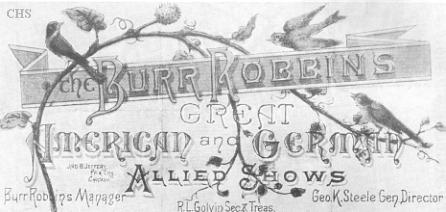
In the early years of his career, Burr Robbins, in a matter of fact way, said he desired three things: a farm with a windmill, a steamboat, and $50,000. Those who knew him never doubted he would attain his goal. They knew he was a determined man with great business acumen and high moral principles. His friends also knew him to be generous and kind.
Burr Robbins chose the circus field as a means of acquiring his desires. As a result, he stands, in all history, among a very small and select group of men who prospered and made a fortune in the circus business. (2)
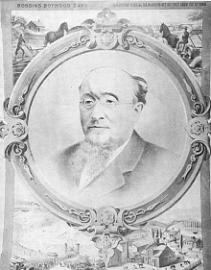 Robbins' picture was used on this courier cover. If also illustrated scenes from his life, the show and the winter quarters. The date is unknown. Author's Collection.
Burr Robbins was born August 13, 1837 in Union, New York. His parents wanted to make a minister out of him but it just wasn't in his blood to follow this profession. As a result when he was 18 years old, he ran away from home and landed in Milwaukee. In 1858 he joined the Spaulding and Rogers North American Circus in St. Louis. He was paid $15.00 a month to be a property boy to the great bareback rider, Charles Fish. (3) The main tent of this circus had one centerpole and a row of quarter poles - the first circus to have such. In 1859 he and four others formed a troupe called the Harmonium Bairds which lasted only a few months. He then bought McBullwell’s Panorama of the Revolutionary War which was more successful.
During the Civil War he left the show business and served under General George B. McClellan as a wagon boss and when mustered out he was Supt. of Transportation. It was in 1870 that Robbins got another taste of show business. He had bought a small magic lantern show and sought to enlarge it. So he purchased a side show from Jim McIver and made the Fair circuits in Michigan. They had two wagons, a buggy and five horses. Robbins purchased a spotted wildcat and renamed it an American leopard. The Sacred Fowls from India were ordinary white hens stained a bright vermillion. People insisted on buying the eggs from these birds, so they did quite an egg business along the route. Their greatest attraction was a mule with a deformed head. It was twice as wide as it should be and its snout turned up like a cup. It was billed as the Moorish Magi. On one occasion Adam Forepaugh came onto their tiny lot to inspect the layout. Upon leaving he offered the sound advice that they should increase the size of their canvas. He said that the larger the tent the more important the circus in the minds of the people.
In 1871 Burr Bobbins bought the defunct John Stowe Circus and established it under the name Burr Bobbins & Co. Circus and Menagerie. (John Stowe being the "company"). They had their winterquarters in Paw Paw, Michigan until the spring of 1873. At the end of that season they wintered in Janesville, Wisconsin where Robbins stayed during the rest of his circus days. Researcher note: the title was Burr Robbins & Co. Circus and Museum, not Menagerie.
John Stowe had worked for Burr Bobbins since he had bought him out. In 1873 they split up. Stowe took much of his old equipment and started a circus under his name again. Robbins, in the meantime, had purchased the great European Circus from Smith, June and Nathans. He changed the name to Robbins & Co.'s Museum, Circus and Menagerie, He claimed he had had the first cage full of trained hyenas ever seen on a circus as well as many other innovations.
Although the circus continued to grow Burr Robbins decided, during the season of 1888, to get out of the business and move to Chicago where he felt new and more fertile fields awaited him. So he traded his circus for a theatre in Chicago called Grenier's Gardens. The circus continued as a smaller one ring edition under the title Grenier Bros. Successors to Burr Robbins, Royal, European, Railroad Circus and Menagerie. Bad luck beset the new owners when the circus was practically destroyed by a hurricane.
While Burr Robbins was in the circus business he had only one losing season - 1884. Half of his season that year was in the Ohio and Pennsylvania iron regions. There was a great depression in the iron trade and many strikes. He lost $500 a day for three months. Barring 1884 Robbins could not complain. In 1887, for instance, he cleared $70,000.
After Robbins retired from the active circus business he continued to back many a show as a silent partner (French & Co. for one). Frequently he ended up with their equipment when the show failed. At one point Bailey was after him to manage his Barnum & Bailey Circus.
After Burr Robbins was established in Chicago he got into real estate. Also, along with W. W. Cole and R. C. Campbell (4) he bought the billposting firm of Broadway and Treyser Co. for $60,000. They changed the name to the American Billposting Co.
Burr Robbins had his fine farms, with windmills, in Wisconsin; he had his steamboat on the Rock River at Janesville; and when he died on January 29, 1908, at the age of 70 years, the papers said he left an estate valued at $2,000,000.
Burr Robbins was, indeed, a successful showman and business man.
Now, about his circus - he owned and operated it for 18 years. While it was a wagon show it ranked with the top 3 or 4 as the best circuses on the road.
After 1881 when it became a railroad circus it was topped in size and scope by only the two eastern giants, the Adam Forepaugh Circus and the Barnum & Bailey Circus. (5)
All the fascinating and exciting facts about the Burr Robbins Circus can best be told on a season to season basis. Trials and tribulations, growing pains, type of performances, description of the street parades, and the people who made up the show are all herewith recorded.
1871: Robbins left Paw Paw, Michigan in the sprint with his side show attractions playing fairs and other gatherings. During the season he purchased the John Stowe Circus which had gone broke. He re-titled the circus with his name and finished out the season successfully.
1872: Burr Robbins & Co. Circus & Menagerie left Paw Paw and headed into another good season. Back at winterquarters Stowe & Robbins split up.
1873. Robbins was now forced to purchase more equipment because Stowe had taken so much show property when they split up. He augmented his share by purchasing some equipment that was on the Great European Show owned by Smith, June & Nathan of New York City, including wagons imported by Howes' European Circus in 1864.
He bought animals and wagons including a large tableau wagon which was brought to this country for Howes Circus. A lion named "Old Parker" rode on top of the big wagon in parade.
The newly outfitted circus left Paw Paw in the spring of the year. It was a small show but a good one and the season was a financial success.
In the fall Robbins established a new winterquarters in Janesville, Wisconsin. In his new quarters he began to build a larger and better show that would soon bring him fame and fortune.
1874: Started the season May 2 in Janesville. The title was Robbins & Go's. Museum, Circus and Menagerie, Burr Robbins & Co., Proprietors and Burr Robbins Manager. The circus advertised that they would supply special patent chairs with cushioned and upholstered seats for those who wish them at 25c extra. A menagerie was set up in a separate tent. There were 20 mammoth dens including one with trained serpents, another with monster performing crocodiles. The show had a trained buffalo named Ben Butler who performed startling feats. Miles Orton, the best equestrian in the world was a featured star. Tickets sold for 50c and children under 10, 25c.
At the end of the season the circus again played Janesville. Half of the proceeds of this day was given to the inmates of the State Institution for the Blind in that city.
On September 18 Burr Robbins purchased a 100 acre farm from Mrs. Doty which was part of the old Fair grounds. The circus announced it would erect necessary buildings to house its animals and equipment. Included in the plans was a large indoor training ring. The newspaper reported this fact by saying "Really our city is putting on metropolitan airs fast. There are few other points outside of New York that can boast of a hippodrome."
1875: This year the title was again changed to an even more impressive sounding name - Burr Robbing Great Menagerie, Roman Hippodrome and Egyptian Caravan.
The winterquarters, Spring Brook Farm, was one mile south of the city on the Rock River. It was attractively laid out with a large fenced area at the entrance that was an animal park. In this enclosure the buffalos, Russian Reindeer, Steinbok and llama were pastured.
A new barn, two stories high was built. Painted brown with white trim it was very neat looking. In it were housed 80 of the show's horses, their harness and trappings. The second floor was a canvas loft. Nearby was another barn stabling 50 more horses. A third building was for Cleopatra, the elephant, the camels, cages of animals, birds, monkeys, baboons, and ibex. These animals were kept on the ground floor which was dug into a hill. This kept out the winter winds and the animals were in turn kept warm. The second floor of this building was a harness repair shop.
A fourth building was the indoor hippodrome for training acts.
Burr Robbins reported he had over $100,000 invested in his animals, birds, wagons, and other circus equipment.
In January Mr. Robbins returned from a trip to the east with some fine new animals. He brought a Royal Bengal Tiger at a cost of $2500, a yak from Tartary, a zebra, black maned lion, deer and a den of hyenas.
During the night of February 23, a zebu got loose and wandered too close to the cage of the tiger; whereupon, in one swift move, the big cat clamped its talons on the zebu's nose. Bellowing in fear the beast dragged the tiger, den and all, across the floor. The bars of the cage parted and with that the tiger, too, was free. The night watchman, terrified, climbed a post to the ceiling and hung on for dear life. The tiger and zebu were soon in a life and death struggle. Blood was spattered all over the walls and into the cages of the other meat eaters. The smell of fresh, warm blood enraged the lions and hyenas into maddening roars and hideous shrieks and barks. It was terrifying bedlam. Two brave employees, Brooks and Dickey, grabbing ropes strode into this gory furor and managed to lasso the tiger and drag him off the zebu. They were badly scratched and cut before they got the tiger into a cage. The zebu came out of the fight badly wounded but not fatally.
The parade for this season was 1/2 mile in length and was headed by a band chariot said to be more majestic in form, more artistic in construction, more elegant and dazzling in design than any similar chariot in all the country. Lions fighting serpents, carved in solid wood by master hands and overlaid with gold, decorated the vehicle. Large colorful landscape scenes were painted on the sides of the wagon. It was pulled by 10 white horses and contained Prof. Gilbert's Silver Cornet Band.
This chariot was followed by a magnificent tableaux car lavishly decorated with elegant carvings, handsome mirrors and paintings. During the parade a huge living lion (but an old lion being over 20 years old) was borne on the top of the tableaux. It was drawn by the elephants, two camels and a span of five horses.
All the cages had lavish employment of art decorating their sides. The paintings were rich and costly - one represented Moses in the Bullrushes, another Christ in the Garden. They were in oval form; 4 by 7 feet in size. Other scenes show the Widow Casting her Mite, Christ at the well with the women of Samaria. 50 such paintings decorate the sides of 25 cage wagons. The paintings were executed by F. A. Lydston of Milwaukee. Many of the wagons were built by Hodge and Buckholz of Janesville. Mr. William Foote, Jr. preceeded the show as advertising agent and Mr. G. K. Steele was general agent.
On Saturday, May 29, the circus was showing Janesville. During the matinee, just after the grand Entree was made, Rev. Jenk L. Jones Pastor of all Souls Unitarian Church presented, to a surprised Mrs. Robbins, a beautiful tea set. It was given on behalf of the citizens of Janesville. During the evening performance Burr Robbins was presented with a richly carved gold headed cane. During the presentation it was stated that the gift was evidence of the great esteem placed upon him by the citizens of Janesville. He was held in the highest esteem as a man of honor, an accomplished gentleman, a public spirited citizen and a showman of great industry and moral charter. He never resorted to any catch-penny schemes nor did he ever allow gambling or games of chance around his circus. Drunkenness was imperatively prohibited either at winter-quarters or at the show grounds, the eulogy proclaimed.
The show featured Miles Orton as a bareback rider. Also presented among other acts, was Prof. Daniel Bushnell, celebrated juggler; Dr. Thayer, a 320 pound clown; a fire eater who drank burning alcohol and melted lead.
The circus returned to Janesville October 15 after a financially successful tour. During the 24 weeks on the road the circus encountered 65 days of rain, two snow storms, two tornadoes which demolished the canvas. The show lost 40 head of horses, a zebra, leopard, sacred ox, two bears, a reindeer, elk, seven steinbok, two wolves, 5 monkeys, an ape, seven cockatoos and parrots, one silver pheasant, an antelope, three boa constrictors and two crocodiles during the tour all worth $12,000. As the menagerie was depleted over the road hardships, the sides of the cages and dens were left on the empty wagons during the parade and in exhibition tent to hide their conspicuous emptiness.
On arrival in Janesville, Burr Robbins immediately set to work on new shops and buildings and general repairing and rebuilding of his equipment. He then left for the east to attend a sale of animals by P. T. Barnum with the idea in mind of replenishing his depleted menagerie.
1876: At winterquarters, Mr. Robbins again had a retinue of well known painters to work on his chariots and cages. Mr. R. E. Pococke came up from Chicago and put some remarkable paintings on a number of dens and a tableau car. Messers La Grange and Van Kerwen of Janesville did the embellishing of the ornamental decorations while Mr. E. E. Burdick did several fine landscapes.
On March 22 an ostrich arrived but was dead in its cage the following day. Mr. Robbins was out $500. In addition there was in the shipment a collection of lions, monkeys, and a young elephant.
The title for this season was Burr Robbins Great American Menagerie, Museum, Circus, Aviary, Hippodrome and Caravan combined with Rentz Great Royal German, Zoological and Equestrial Exposition.
Performers, in part, for this season were the Lee Family, equestrians; White's Trained dogs; Miles Orton; Bushwell, slackwire artist; and George W. Murray, an Ethiopian, heading up a bevy of clowns. The show was made up of riders, gymnasts, aerialists, tumblers, and jugglers. The hippodrome features included Roman races, feats of strength, flat races, etc.
Tickets were 50c and 25c and the main tent held 4000 people.
The juice joints offered lemonade at only 5c a glass. Prominently displayed was a sign that read "he who deviates from this price does so at the penalty of being bounced."
The last show was given October 14 at Clinton, Illinois. The baggage stock headed for Janesville pulling the circus wagons over the country roads. Since it left Winterquarters it traveled through Wisconsin, Iowa, Minnesota, Nebraska, Kansas, Missouri, and Illinois. The circus showed in 137 towns and travelled 3,1332 miles, 2792 miles by horsepower and 340 miles by rail. The longest jump over the road was 36 miles between Seneca and Marysville, Kansas. The average distance travelled was 22 1/2 miles. The show missed but one stand, Parkersburg, Iowa, because of mud.
To give an idea of the expenses involved in operating a mud show of this era these daily requirements are listed: 3 tons of hay at $10 dollars per ton, 120 bushels of oats at 35c, average cost of license $75.00. The total cost for the season of these three items alone is $21,621.
1877: Great activity took place at winterquarters with a final rush of last minute work being done in April. The blacksmith shop was hard at work repairing wagons. The harness shop repaired and oiled over 200 sets at the same time making new elaborate harness for the parade.
Mrs. Robbins supervised the making of all new wardrobes in her home. With her crew of 2 or 3 girls they made a large amount of costly and artistic wardrobes.
The ring stock had been kept in the stables but the baggage stock were kept in the country. They were brought in for grooming and brushing in preparation for the coming season's work.
The title used this year was Burr Robbins' Great American and Royal German Allied Shows. The staff was as follows:
Proprietor & Manager: Burr Robbins. General Agent: George K. Steele. Press Agent: Matt Leland. Treasurer: George F. Selleck. Zoological Director: Richard Brooks. Master of Canvas: Ed Smith. Chief of Paste Brigade: Harry Broadway. Musical Director: John M. Smith. Clowns: Pete Conlslin, J. Leslie and H. Marks. Company Riders: Minnie Marks, George Holland, A. D. Van Zandt, Lottce Marks, Willie Marks, Harry Stevenson.
Gymnasts and Acrobats: Wm. Ashton, John Leslie, J. H. Jeffery, James Coyle, Geo. Holland, Ed Holland, Van Zandt, Shedman Bros., Millie Marreta, Rosa Renfrew.
The concert or after show consisted of Diabalo, the fire eater; Moody, the man of 50 faces; Rosa Renfrew, serio comic; Kate Morris, queen of song; Mlle. I'Deleta, mermaid; Prof. Shedman, Indian Club swinger; Messrs. Barker and Stow, song and dance; Geo. Shedman, Clog dance; Mons. Wallace, Man-fish; and J. C. Shipley, Manager. A skillful and daring acension from the street to the top of the tent by Mile. Maretta was a thrilling free act put in each day.
Two new cages were built by Hodge and Buchholz of Janesville. One of the wagons had its gearing painted white with carmine stripes. The body of the cage was painted car pink. On each corner was a 2 1/2 foot tall wood carved figure representing Charity, Maidenhood, Hope and Peace. On the right side was a painting of Lewiston Narrows, on the rear doors a scenes of sleepy Hollow and on the left side a landscape of the Shenandak. All the paintings are surrounded by artistic gold gilt scroll work.
The second cage had its running gear in yellow lake with carmine stripes. The body was carmine. It too had scenic landscapes and carved figures on each corner. The paintings were all done by J. B. LaGrange.
The complete parade line up for the season made an impressive pageant for a mud show.
1. The mammoth band chariot drawn by ten gray horses.
2. Four dens of animals, each drawn by four horses.
3. A Knight on horseback, in full armor and followed by five couriers in elegant and original costume.
4. King Hal, with his royal and glittering cortege of ladies and gentlemen.
5. A superb carriage drawn by eight diminutive ponies.
6. Seven two horse cages.
7. One large den drawn by four horses.
8. An open lions' den with a lady performer sitting with the lions.
9. A four horse den.
10. A two horse cage.
11. The grand tableau car, great in size, incomparable in beauty, and rich in its decorations, on the top of which was mounted the largest lion in America, accompanied by a lady, drawn by the 2 elephants.
12. One two horse cage.
13. An open Hyena den with a man performing with the animals, drawn by six white horses.
14. Trick horse with dog rider.
15. Four mounted Arabs.
16. Camel handsomely decorated and ridden by a man in frog mask.
17. Two horse cage.
18. Four horse den.
19. Elegant tableau car drawn by donkeys.
20. The grand car of liberty, covered with elegant mirrors on either side, and the top, ladies and gentlemen in glittering costume, waving flags and banners.
In September the show was billed for Dover, Ohio. The same day Van Amburgh's Circus was billed for New Philadelphia a neighboring town. It so happened that Robbins route brought them through New Philadelphia on the way to Dover. Likewise Van Amburgh had to go through Dover to get to New Philadelphia. Van Amburgh, in an attempt to wrest business from Robbins halted a half mile out of town and prepared to parade through Dover with banners flying, music playing and horses prancing. Robbins not be be outdone moved off the showgrounds with his parade a couple of hours later. He extended his route right on past Dover to New Philadelphia where their colorful caravan was met with great enthusiasm. Robbins' parade went to the Van Amburgh showgrounds, circled their tents and made another triumphal tour back through the two towns to his own lot.
This year the tour began May 2 and closed at Cairo, Ill. October 26. From Cairo it shipped by rail to Freeport, Ill. and from there drove to Janesville. 175 people were employed and they moved on 60 wagons pulled by 225 horses.
3093 miles were travelled, 440 by rail, the balance by horsepower. The longest drive was the 40 miles between Knightstown and Greensburg, Indiana. The shortest run was 1 mile, across the Ohio River between Connelton, Indiana and Hawesville, Kentucky. The average distance was 20 miles a day. Only one blowdown occurred during the entire season. They gave 297 performances in 151 town.
1878: On February 21 the Montgomery Queen Circus was sold at auction in Louisville. (6) Burr Robbins was on hand where he purchased a wart hog for $190, three kangaroos for $82 each, four hyenas for $21 each, an Eland for $305, a sacred cow for $32, and a leopard for $25. He also purchased four ponies for $421 and five horses for $290. When a reporter asked Mr. Robbins if this auction was evidence of dull times in the sawdust profession, his answer was an emphatic No!, adding that this failure was caused by poor management.
Over the winter Robbins also purchased for his menagerie a hippopotomus, lions, peccary, gazelles, tiger, jackals, wolf, and 10 Arabian camels.
The main tent for the season was 130 feet by 250 feet and had a seating capacity of 6000 said a newspaper account. This figure seems high by 2000 for a one ring circus. The main tent also contained the menagerie at one end. In addition there were 5 horse tents, cook house, side show tent and other miscellaneous canvas.
The title continued to be Burr Robbins Great American and German Allied Shows.
The show opened in Elkhorn, Wisconsin, May 1 and went on to Lake Geneva, the second; Burlington, 3rd; Waukesha, 4th; Milwaukee 6th and 7th; Cedarburg 8th; Hartford, 9th; Oconomowoc, 10th; Watertown, 11th; Jefferson, 12th; Sunday 13th, no show; Whitewater, 14th; Janesville, 15th.
All the wagons were painted either green and gold or red and gold making a beautiful and striking sight.
The show had 30 ring horses, 6 trick horses, 24 ponies, 16 of which pulled a chariot in parade, and a special act of 6 Borneo Ponies. Professor Dodsworth continued to climb in among the den of performing hyenas.
The Grand Entree was called "The Uprising of the Arabs." The entire compliment of performers partook in this pageant. The 10 new camels this year were the center of interest during the maneuvers.
Prof. Brooks worked the two elephants, Mogul and Cleopatra. King Sambro, a Japanese, performed the slide for life backwards, from the top of the center pole to the ring curb.
In leaving LaCrosse, Wisconsin, the caravan was overtaken by a fierce storm. The inkiest darkness enshrouded the men, horses and wagons when they were about 10 miles out of the city. It became so dark and stormy that orders were given to pull up and wait it out. The big bandwagon, in trying to get over to the side of the road, dropped into a ditch. The wagon was dumped over in the mud, spewing the band who were riding in the wagon, their music, and instruments out into the rain soaked field. The driver and bandleader, John Smith, were badly injured. While the driver was sent back to LaCrosse for care, Smith continued on, although he was able to use only one arm.
The season was a fine success; the circus not having blown a single date. The wagons travelled over 3000 miles and played 49 towns in Wisconsin, 43 in Iowa, 29 in Nebraska, 18 in Kansas, 6 in Missouri, 2 in Illinois, and only 1 in Minnesota. 296 performances were given in these 148 towns.
The advertising department claimed to have spent $4500 on lumber for making sign boards on which to paste their colorful lithographs. They used 7500 pounds of paste in putting up thousands of posters on barns fences and billboards. 175,000 couriers were handed out and 150,000 window poster, flyers, and other advertising was used. $4,440 was spent on newspaper advertising.
While enroute the circus purchased and consumed 592 tons of hay, 148 tons of straw, 14,800 bushels of oats and 2960 bushels of corn to feed their live stock.
1879: Burr Robbins continued to gradually enlarge his circus. While it was still a mud show it ranked among the top three or four in the country.
A few wagons were added to bring the total to 62. One of the outstanding additions was a very large and ornate musical wagon probably containing an organ, una fon, or perhaps a calliope.
A new Iron Jaw act was added, which was a sensation. The girl performer lifted a cannon with her teeth and while it was suspended in the air an attendant fired it off. The buildup was tremendous, and when the blast of the gun powder, plus the smoke, plus the fine paper wadding filled the air in the tent, the audience cheered loudly - Harry Armstrong was the Bandmaster.
1880: By now Burr Robbins had purchased his long dreamed of steamboat. He took great delight in cruising on the Rock River that flowed down thru Janesville and past his farm where he had established his winterquarters.
On the evening of Jan. 18th there occurred a terrible accident that nearly took the life of this master showman. While steaming down the river, and as the boat was about to pass under the Pleasant Street bridge it hit a pier wrenching the boat sideways. In the confusion Burr Robbins was caught between the braces of the bridge and the boiler of his beloved boat - producing horrible fractures of the skull. His entire forehead was crushed. For weeks on end he lay in an exceedingly dangerous condition. His struggle between life and death was reported throughout the country. His courage, strength, plus amazing surgical skill carried him safely thru this ordeal.
While he lay on the verge of death, the city lay a deep bed of shavings and straw on the street in front of the hospital to deaden the clatter of horses' hooves and the rumble of wagon wheels.
His circus went out on the road as usual, but Mrs. Burr Robbins acted as General Manager until her husband was fit and able to join the show later in the season.
While in Missouri this year, the circus purchased a bullet scarred horse for $400. It was claimed to have been owned by Jesse James. The horse was so billed and it made a great hit with the townfolk.
The title used on lithographs for this season was Burr Robbins Allied Shows, Triple Circus, Museum, Monster Menagerie, Aviary, and Caravan. Tickets sold for 50c and 25c to children under 9 years of age.
1881: Perhaps because of his serious injury of the year before, Burr Robbins was prompted to incorporate his circus and bring in some active partners who could assist him in the operation of his show. In any event, this was done. Robbins was President, and Mr. E. D. Colvin was Manager of Burr Robbins and Colvin Great American and German Allied Shows. Their letterhead stated they were the only duly chartered and incorporated tented exhibition in America. It further proclaimed that the show was controlled by a Board of Directors selected from the greatest amusement enterprises of both hemispheres.
This was the year this circus quit the roads and switched to railroad movements. Robbins and Colvin purchased 25 fifty-foot long cars and two bill cars for the new show. L. B. Lent was hired as general agent and Denny Stone was Equestrian Director. The cast of performers included Chas. Fish, rider; Ellen Cook; a group of Iroquois Indians; Prof. White Dog Circus; Prof. Doud, strongman; Herr Meygoards and his performing stallions; Molock, a giant sized horse; and Prof. Giblers' 15-piece band.
A reporter asked Burr Robbins in the spring of the year whether he had improved "his show. Said he, "Well, when I consider the difference between my bank account last fall and this spring I should emphatically remark that it had improved. The change from wagons to railroads involves large expenditures. We enlarged the show, menagerie and parade."
1882: This year Burr Bobbins went out of and then back into the circus business. The Janesville Gazette for Jan. 25th reported that there was being organized in Janesville a mammoth show, combination which will bear the name, "The big U.S. Circus, Museum, and Menagerie." It would travel on its own cars and will start out early that season. O. P. Myers, who has had years of experience in show business, would be the advance agent and one of the persons financially interested in the show. Mr. John S. Shorb, widely known by his long experience on the plains and daring adventures among the Indians, would be the other partner. These men, the story said, had capital, push, and enterprise to make the show a success.
Burr Robbins had sold the key units of his circus to these operators. They put out the Burr Robbins circus finally under the title, "Big United States and New Great Eastern Circus." Robbins received $10,000 cash and took a mortgage of $55,000 on the circus. This show owned 21 50' cars, 18 cages, 2 elephants and a hippo.
After the show left Janesville, Burr Robbins continued to dispose of his other circus assets. Geo. W. Hall circus purchased a hippo den, a camel and a lion for a total of $860. Hall paid $10 down and signed notes guaranteeing to pay the balance by November 30th.
It was apparent that Burr Robbins had had enough of the rough circus game. However, he didn't figure that Myers and Shorb would fail and fold their tents. This occurred in July. By order of the Chancery Court, the circus was put on the block Sept. 5 to satisfy the attachment suits filed against the owners. Burr Robbins went to Louisville determined to buy in and salvage what he could of his circus. Word got around fast that the sale would be held and many a circus owner showed up knowing the quality of the Robbins equipment. John Robinson appeared, one of the Sells Bros, was there, James A. Bailey and others. The court listed 18 animal cages and a complete menagerie. The other wagons included 1 ticket wagon; 1 chandelier wagon; 1 carriage, 9 baggage wagons, 1 carved bandwagon; 1 green and gold musical bandwagon; and 3 tableau wagons. The railroad ears were listed as 1 advertising car, 2 sleepers, 6 stock cars, and 12 flat cars. Other equipment included a 150-foot round top with a 50-foot middle, a five pole menagerie tent, and 3 horse tents.
In addition, horses, ponies, mules, harnesses and wardrobe were auctioned. The side show was not involved. George Fuesman, who was the proprietor of the side show connected with the circus, packed up his Circassian girls, wax figures, and mechanical contrivances as soon as the attachments were served and struck out for another show.
First the horses were auctioned and Robbins got them for $8,000. Next the Hippo - but the Sells Bros, wanted this beast, so before Robbins could get it he had run the bid up to $3,000. The Elephant Jennie cost him $4,000, a tiger $800, and so on down the line. When the auction was over, Burr Robbins had spent $25,000, but had practically bought back his whole circus. He was again a circus owner. The sale was to a certain extent a mere formal affair and only put the purchaser in possession of the property on which he had held a mortgage. As soon as the sale was over, the attorneys for Myers and Shorb filed a $50,000 damage suit in the Common Pleas Court against Burr Robbins and Jeffery Printing Co. (7) for conspiring to defraud. The plaintiffs claimed that none of the notes held by Burr Robbins were due and all that had matured had been paid. They claimed that of the $10,000 in printing done by Jeffery that only $3,900 was unpaid and of this amount $2,000 worth of material was still held by the printing company. The plaintiff alleged that Robbins and Jeffery conspired together to break up the circus to get possession of the property.
Myers and Shorb alleged, too, that Robbins and Jeffery forced the closing and sale of their circus during the show season, when the owners would not be able to attend; thus assuring their ability to buy in at knock-down prices.
Myers and Shorb admitted that because of continuous rains, the season had been unprofitable. This fact, plus the evidence of claims by performers, indicates that the show was in dire straights, indeed. In spite of this counter suit, all of Burr Robbins' purchases were shipped back to his Janesville, Wis. winterquarters. In the Spring of 1883 his circus opened again in its full glory.
1883: Burr Robbins again jumped into the thick of the circus business. He formed a corporation and brought in two partners - R. L. Colvin was editor and owner of the Janesville Gazette. Colvin sold the paper, purchased part interest in the circus, and signed on as treasurer. The other partner was Geo. K. Steele who was associated with Rob-bins from 1875 to 1881 as general agent. He, too, put in some money and took the job of handling the advance and advertising. The show was called The Burr Robbins New Consolidated Railroad Shows. Bobbins was billed as General Manager and financier. The number of wagons was increased to 120.
In an interview, Robbins in a burst of pride said, "There are only ten first-class circuses in America. All the rest have gone where the woodbine twineth. In order of their importance and size I will give you these ten - Barnum, Forepaugh, Burr Robbins, W. W. Cole, Sells Bros., John Robinson, Doris and Batchelor, Nathan & Co., John O'Brien, and Van Amburgh."
1884: The circus again enlarged. 22 fifty and sixty-foot long railroad cars were ordered from the United States Rolling Stock Co. The cars, costing $25,000 were being built at the Chicago, and Urbana, Ohio Works.
The Sebastian Wagon Co. of New York City was given an order for new chariots and cages, as well as the Ohlsen Co. in Cincinnati, and Hodge and Buchholz Co. of Janesville.
A new act of trained cattle was added to the performance.
John L. Davenport was both Ringmaster and clown. Spencer Alexander was Master of Horses.
The 2-ring big top was 110x160, the museum top 65 x 155.
This season the circus lost heavily, due to poor business conditions and strikes in their territory. This was the only year in Burr Robbins' circus career in which he lost money.
1885: The size of the show was again increased. It was now employing 295 people and had a $1500 daily nut. The performance included Charest, who rode a bicycle and roller skated on a high wire. There were rolling globe acts, numerous riders, double trapeze acts, menage act, and slide for life by teeth. The leaper, Wm. Ashton, dove over an elephant, camel, horse, and a ticket wagon.
On the evening of June 13th a blow-down occurred at Des Moines when 1,500 people were in the tent. Rain fell in sheets, lightning flashed and a tremendous gust of wind lifted the canvas off the poles and down it came. In the confusion a 6-horse hitch ran away with the side show wagon. While no lives were lost, many were injured.
Later in the summer while on the Grand Trunk Western Railroad near Saranac, Michigan, a broken rail caused the derailment of four cars. Two tableau wagons, bandwagons, 3 cages, 2 pole wagons were demolished beyond repair. Trunks were strewn about and the canvas torn. In spite of the delay, the circus proceeded to St. Johns where an evening show was given.
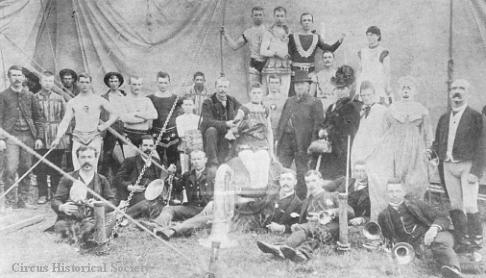 The performing personnel of the 1887 show are grouped around Burr Robbins (in derby, in center) beside the big top. John Davenport, ringmaster, is shown at the far right. Note the chains used as side ropes on the tent. Author's Collection.
1887: A huge stuffed whale was displayed in the aquarium tent at no extra charge. It was in a large glass sided tank over 30 feet long, according to the newspapers. The circus courier recorded the case as 70 feet long.
1888: Again Burr Robbins decided to retire from the circus business. He was interested in real estate and other business ventures in Chicago. He traded part of his circus equipment to a Thomas L. Grenier for a large theatre in Chicago, named Grenier's Garden. The greatly reduced in size circus continued on the road under the new title, "Grenier Bros., successors to Burr Robbins, Royal European, Railroad Circus and Menagerie.
The new circus advertised they were only a one-ring show. "One big old-time ring - no two or three rings to bewilder you," the ad said.
Robbins sold a great deal of his remaining circus equipment to the Ringling Bros. Included were Pete the hippo, Baldy an elephant, and the No. 1 band chariot.
This was the last year the great name of Burr Robbins was ever used in the circus world. For years later Robbins kept his finger in the circus pie with financial loans, either to get shows started, or to bail them out when in trouble.
Robbins founded on outdoor advertising concern that continues today as the General Outdoor Advertising Co., of Chicago.
He was the principal owner of French & Co. in 1889 and 1890. They burned out in Chicago over the Winter of 1890-91.
Thus ends an 18-year career of a great circus personage. Burr Rabbins was successful when the competition was the roughest.
1. Credit for the idea of recording the history of this Wisconsin circus goes to a former Janesville resident, Dr. Ralph F. Hartman, now of San Antonio. While living in Janesville Dr. Hartman did much research on this circus in the newspaper files. He did further research at the San Antonio Public Library's Hertzberg Circus Collection. Our sincere thanks to Mrs. China Louise Robbins Logeman of Chicago, daughter of Burr Robbins and to Mrs. Logeman's daughter, Mrs. J. J. Clark of New York. Their generous loan of scrap books, photos and other cherished Burr Robbins mementos have helped unmeasurably. Thanks also goes to Richard Conover, circus historian from Xenia, Ohio for assistance given.
2. James A. Bailey, P. T. Barnum, Adam Forepaugh, six of the Ringling Brothers, B. E. Wallace.
3. In later years when Robbins had his own circus he, in turn, hired Charles Fish at 250 dollars a week.
4. For 15 years Campbell was general agent for the Adam Forepaugh Circus. W. W. Cole owned a circus of his own as well as managing others.
5. More than 100 circuses were founded in Wisconsin. Only the Ringlings of Baraboo ended up with a larger aggregation. When Burr Robbins put his circus on rails in 1881, the five Ringlings had no circus. They had not even started their song and dance team. When Robbins sold out in 1888 the Ringlings were still a struggling wagon show.
6. The newspaper stories at the time said Mr. E. D. Colvin was one of the creditors to the tune of $6,525. Colvin, in 1881, became a partner of Burr Robbins and acted in the capacity manager of that circus.
7. The Jeffrey Printing house of Chicago had instigated the first attachment suit against Myers and Shorb, which was followed by innumerable smaller suits from performers on up.
Frank J. Walter was a unique individual. He owned a private collection of small circus wagons that would have made any Circus Fan's wildest dreams come true far beyond reality.
Frank was a descendent of one of the oldest families in Houston, Texas. As a boy he was greatly attracted to the Gentry Bros. Dog & Pony Show. Inspired by the performances, he tried his hand at training dogs, monkeys, horses, and ponies. After seeing Hagenbeck-Wallace and Al G. Barnes performances he decided he was going to see what he could do with wild animals. He acquired several lions and leopards and successfully trained them. He even broke a lioness, Congo, to both fight and wrestle with him in the arena.
Frank never had any particular plan in all this as it was strictly a hobby with him. He married and his wife took an interest in the animal training. His mother had always been sympathetic and soon he had quite a collection of animals around his place.
In 1932 Frank began presenting performances annually solely for the entertainment of under privileged children and inmates of children's hospitals in the Houston area. He titled his show the Frank J. Walter Original Underprivileged Children's Circus and presented one to a half dozen performances annually.
We are fortunate to have one of the printed programs for the season of 1936 and the performance ran as follows:
Frank J. Walter, Equestrian Director; C. G. Risley, Music Director; John Andrew, Announcer.
Display No. 1: Circus Band Concert
No. 2: Comedy trampoline.
No. 3: Here comes the clowns: Ambrose Quadruplets, Bum Henry, Connors, and Valentino.
No. 4: Riding bear.
No. 5: Novelty dog act, presented by the Schoonovers.
No. 6: Military ponies, presented by Capt. A. W. Kennard.
No. 7: Group of forest bred Nubian Lions presented by Capt. Mat Lovich.
No. 8: Clowns from every land with their funny capers.
No. 9: Walter's Wild Horses, "Pawnee," "Cherokee," and "Comanche." Featuring "Cherokee," world's greatest hind-leg horse. Presented at Liberty by Mrs. Frank J. Walter. (Three horses have never been saddled, and were raised on a ranch thirty miles from Houston.)
No. 10: "Pinkey", comedy mule. Presented by Harry Schoonover.
No. 11: We now present "Knee-High," age four years, height 29 inches.
No. 12: Riding monkey.
No. 13: Clown convention.
No. 14: Sky-Line goat.
No. 15: The famous Connors Trio; masters of the tight-wire.
No. 16: Clowns featuring the funny Ambrose.
No. 17: High Schooled and dancing horses, "Floto," "Wallace," "Frisco," "Don Juan," and "Whirlwind." Presented by Wilma Schoonover, Harry Schoonover, and A. W. Kennard.
No. 18: Sensational slide for life, Al Conners.
No. 19: Balancing globe, presented by the world famous Arthur Henry Duo.
No. 20: The deft defying whirling-slide, Mrs. Al Connors.
No. 21: Tons of entertainment, the Mighty Ruth.
No. 22: Clowns: this is the last appearance of the funny fellows.
No. 23: The Flying Vallentines; aerialists supreme.
No. 24: Exit march, Frank J. Walter Circus Band.
As you can see quite an excellent show was presented and many of these kids were thrilled and it was the next biggest thing to Christmas for them. These events were produced yearly through 1942 and each year seemed to be more elaborate.
An estimate was made that Walter poured $100,000 into his circus hobby and as one looks over all that he had this must have been an accurate figure. The most outstanding part of his collection was the historical circus wagons of which he was truly proud. A complete list of these wagons accompanies this article, but brief mention will be made here. This collection of old-time circus wagons began when he acquired one of the original ticket wagons of Gentry Bros. Dog & Pony Shows. He next obtained small cage wagons that had been on Christy Bros., Hugo Bros., and Gentry Bros, shows. One of his last additions from a barn in El Reno, Oklahoma was the Great Wallace shell-type bandchariot. In addition Walter had his own wagons and rigs made and added to this collection. He spent much money in having these wagons restored.
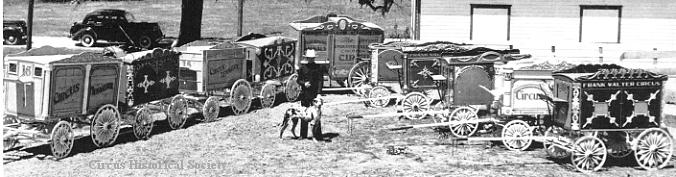
To house all these wagons and animals he acquired three and a half acres of land south of Houston. On this property he constructed ten buildings. Approaching from Houston one was first greeted by a herd of concrete elephants, their trunks raised in a salute.
The wagon collection was housed in two 100 ft. barns built for exhibition purposes as well as storage. The two story combination tackroom and training barn was the reception center. Walls were lined with autographed photos of circus stars and wagon wheels from circus vehicles were utilized as chandeliers. Nickeled horseshoes formed the center pieces of window gratings. A smoking stand was made from the foot and portion of the leg of an elephant. There was a kitchenette with a massive oak table and on the second floor were two bedrooms and a bath.
Other buildings included a 130 ft. one housing permanent cages for the dogs, monkeys, and other animals; a 60 ft. cat barn for wild animals; a horse barn containing 16 stalls; a pony barn housing nearly 50 animals; and a veterinary hospital, a blacksmith shop, commissary and harness and property rooms. There were living quarters for the full time employees to look after the property. In addition there was a large outdoor arena containing two rings and a steel arena. It was here that rehearsals were made for the circus acts presented later for the children.
His quarters were used during winters by some acts and it was while the Nettie Dutton act was wintering there that it lost its trained camel in a fire. This 1946 blaze also killed several of Walter's horses and ponies. A number of circus veterans in the Houston area frequented the Walter quarters and several well-known personages were entertained there.
When Downie Bros. Circus of 1939 was auctioned in Texas, Walter bought the elephants and sold them later to Wallace Bros. Circus.
Walter was a close friend of Clyde Beatty and mention has been made that he reportedly helped Beatty organize his show and became a partner in that organization. According to Perry Luth, Walter had lent Beatty money but never actually owned any part of his show business ventures. Frank Walter served on the front door of the Clyde Beatty Circus from the years 1946 through 1951.
After an extended illness he died at his home in Houston February 29, 1952 at the age of 49. His circus wagon collection passed into the hands of Clyde Beatty and a complete description of each unit appears in that listing.
The following sources were consulted for information used in this article:
The Billboard; 10/2/37, 6/4/38 p. 67, and 3/15/52 p. 34 & 48.
Hobbies: February, 1942 p. 42.43.
Houston Cronicle 3/1/52.
Houston Post 3/2/52.
White Tops: June-July, 1942 p. 7-8; Mar.-Apr., 1952 p. 10.
Most of all we are indebted to Perry Luth who furnished all of the basic wagon information, a copy of his inventory made for Clyde Beatty 11/15/54, and checked over the final draft before publication.
Frank Walter Circus Wagon Collection
Walter Number
#10 - Cage Wagon. A Christy built cage, one section. Used by Walter for his cat act and was disassembled by him. All that was left of this wagon by Nov. 15, 1954 was the platform running gear.
#16 - Cage Wagon. A Christy built cage, two section. Painted yellow.
#18 - Cage Wagon. A Christy built cage, two section. Painted blue with white trim.
#19 - Cage Wagon. Originally Gentry Bros.
#11. In its original state must have been a very beautiful and elaborate vehicle. Rather than the generally used square corner type wagon, this one was adorned by somewhat of an old time Greek column, on top of each was a carved wooden dog head. The painting which was discernable after much scraping tended to show artistry one finds in the temples of the old world. NOTE B
#20 - Gentry Clown Patrol Wagon. We let this wagon go. A doctor friend of Walter "Just had to have it". After restoring it, he used it on his ranch for kids. However, some years later it was found on the ranch of Bill Daniels, Liberty, Texas. He has a frontier section on his spread and the wagon is among those present.
#21 - Cage Wagon. Originally the Hugo Bros. Circus ticket wagon. It was rebuilt by G. W. Christy into a cage. Two sections, with a drop type frame.
#28 - Shell Bandwagon. Built for the Great Wallace Circus circa 1900. Used on the Norris & Rowe Circus in the period 1903-05. Lost from the records until it re-appeared on Phil Isley's Bailey Bros. Circut in 1935. In 1953 it was reconstructed by Perry Luth with auto truck wheels being substituted for the former wooden construction. In 1954 it was carried on the Clyde Beatty Circus and was used in the parades presented. Red body with white gear. Eagle was in silver and the rest of the ornamentation was in gold. NOTE B
#30 - Baggage Wagon. Built by Prank Walter. Painted red with white letters "Frank Walter Original Underprivelege Children's Circus."
#32 - Light Plant Wagon. Built by Frank Walter. Body construction and paint job and lettering similar to #30.
#34 - Water Tank Wagon. Built by Frank Walter. Painted red with white lettering.
#35 - Water Tank Wagon. Originally Gentry Bros, (probably Sipe). Used on Bailey Bros. Circus in 1935. Painted red with white lettering.
#39 - Cage Wagon. Originally on Gentry Bros. Built by Sullivan & Eagle, Peru, Ind. Two section. Painted red with gold trim. Was on Bailey Bros, when show was owned by Phil Isley. In 1952 was in a disassembled manner. 1954-55 Perry Luth, using #35 a duplicate in general design, came up with a restoration that parallels the original as much as possible. Now owned by Tommy Holmes, Houston, Texas.
#40 - Tab Wagon. Original Gentry Bros. Built by Sullivan & Eagle, Peru, Ind. White with gold scrolls and mirrors. Used on Isley's Bailey Bros, as an air calliope. When acquired by Walter the carvings were a mess. He salvaged as much as possible. It was his intention to have his name carved and mounted in the blank space.
#41 - Cage Wagon. Gentry Bros. Two section. Painted red with silver scrolls. Rectangular mirror designs on the sideboards. NOTES A & B.
#42 - Cage Wagon. Gentry Bros. One section. Painted blue with ornate silver scrolls across the sideboards. NOTES A & B.
#43 - Cage Wagon. Originally Gentry Bros. #35. Built by Sullivan & Eagle, Peru, Ind. Two section. Blue with silver trim. Rebuilt by Perry Luth. Now owned by Tommy Holmes, Houston, Texas. NOTE A.
#44 - Cage Wagon. Gentry Bros. Two section. Painted green with gold scrolls. Small circular mirrors on side panels. Corners are inset. Quite different in design and build from the other cages. Also a bit larger. To J. Pabst, Houston, Texas.
#45 - Cage Wagon. Gentry Bros. Two section. Painted blue with red trim. Square mirrors appear on the side panels. NOTES A & B.
#46 - Cage Wagon. Gentry Bros. Two section. Painted salmon pink with silver scrolls. NOTES A & B.
#47 - Air Calliope Wagon. Built by Frank Walter. Painted red with gold scrolls. Lion head carvings on sides. Rebuilt by Perry Luth with rubber tired wheels. Used 1954 on Clyde Beatty Circus parades. National Air Calliope installed. NOTE B.
#48 - Bandwagon. Frank Walter built on Model-T truck wheels.
#50 - Gentry Bros. Red Ticket Wagon. Built by Frank Walter. Painted red with gold scrolls. Lion head carvings on sides. Rebuilt by Perry Luth with rubber tired wheels. Used 1954 on Clyde Beatty Circus parades. National Air Calliope installed. NOTE B.
#48 - Bandwagon. Prank Walter built on Model-T truck wheels.
#50 - Gentry Bros. Red Ticket Wagon. Built by Sullivan & Eagle, Peru, Indiana 1902. Gentry Bros. 1902 -1922. Christy Bros. 1923-1930. Formerly owned by George W. Christy who had obtained it from James Patterson when he bought the defunct Gentry (Newman & Austin) show in Houston. The twin of this wagon is in the Hertzberg Circus Museum, San Antonio, Texas. Red with gold ornamentation. NOTE B.
Prairie Schooner. Built in Houston under Walter direction.
Prairie Schooner Similar to the above item.
Clown Auto Fire Wagon
Cannon & Caisson
Deadwood Stage. Walter built with bay sides as in the original version of stage coaches. It was built two-thirds the size of the prototype. The cabinet work was highly finished. Kept in the clubhouse and burned up in a fire.
NOTE A: Gentry Cage Wagons #s 41, 42, 45, 46, and 35 were more or less very similar in construction. The body size was 6 x 3 x 3 ft. Note that the corner posts are placed at an angle, rather than flat as is customary.
NOTE B: These wagons were lost in a fire at the Clyde Beatty Circus winter quarters in Deming, New Mexico in 1955.
No part of this publication may be reproduced in any form or means
Last modified February 2006.
without written permission of the author and the Circus Historical Society, Inc.