


Circus Historical Society
Bandwagon, May - June 1969
Back to Bandwagon Index
Bandwagon, Vol. 13, No. 3 (May-Jun), 1969. Note: Only some articles are included in this online edition. Many illustrations are not included. The Circus Historical Society does not guarantee the accuracy of information contained in the information in these online articles. Information should always be checked with additional sources.
In the January-February issue of the "Bandwagon" I note a letter from a Mr. William H. Schreiber regarding the Clyde Beatty motion picture "The Lost Jungle."
I would like to clarify the confusion that seems to exist, using the only authentic historical volume that has ever been written on the activities of Nat Lavine, one of the most remarkable motion producers in the Hollywood area. I refer to the 1968 hard cover volume entitled "Next Time Drive off the Cliff", by Gene Fernett, Cocoa, Florida and published by "Cinememories Publishing Company."
In 1934 Nat Lavine produced "The Lost Jungle" and it was released as a serial and, as Nat often did, he later edited the film and released it as a feature, probably under the name of "Darkest Africa."
Clyde played himself, using the Hagenback-Wallace Wild Animals. It is interesting to note that young Mickie Rooney was in the cast along with some old time players who most of you will have forgotten, like: Cecilia Parker, Syd Saylor, Warner Richmond, Wheeler Oakman, Maston Williams, J. Crawford Kent, Lloyd Whitlock, Lloyd Ingraham, Edward LeSaint, Lou Meehan, Max Wagner, Wes Wales, Ernie Adams and Harry Holman.
The Direction was under Armand Schaefer and Dave Howard, two of Nat's standbys and excellent fellows. I know for I often worked under them.
The book, "Next Time Drive off the Cliff" was written with the close cooperation of Nat Levine personally. You may remember that a roaring tiger was Nat's trademark. He tells us that this was one of Clyde's tigers. - Capt. J. King Ross
In October of 1892 at Centralia, Missouri, the Ringling Brothers Circus train was involved in a wreck. Details of the event are sketchy; but, according to the route books, at least six cages were demolished. Moeller Brothers Wagon Shop in Baraboo was given the job of replacing these, and the result was the beginning of a series of cages alike in size and similar in decoration which has presented an interesting task in identification.
The route book says that eight elegant cages were built for 1893; yet there are eleven tableau-dens, which could justifiably be classified as "elegant," and four open dens that can be identified with this production. That all fifteen could have been built over the same winter is unlikely, but there is no doubt that the entire group is of the same vintage. We can trace a few of them through fifty years of almost continuous use, demonstrating that they represented about as sturdy an example of circus architecture, as we are likely to run across.
The interrelated similarity that links this entire group together can best be displayed with a tabulation which will, in turn, make reference to a page of sketches diagraming the various styles of sunboards, corner posts, and mudboards. Included in this tabulation will be the cage numbers. In some cases, this was a hard determination to make since not all of them could be read from photographs. This left a few of them to be determined by the process of elimination, drawing on official parade lists which are available for most of the years between 1910 and 1918, the Moeller records for those same years, and other data. The last column in the tabulation carries a few historical notes which are expanded, as required, immediately following the list.
No.; Photo No.; Skyboard; Corners; Mudboard; Historical Notes
35 (open); 1, 2; K; B; Q; Used on Ringling-Barnum well into the 1940's
36 (open); 3; K; A; R; Went into Bridgeport in 1918
37; 4, 20; H; A; N; Sold to Floyd King (Note 1)
38; 4; H; A; N; Dismantled in Sarasota (Note 2)
40; see 5; G; F; M; Went into Bridgeport in 1918
41; 5; G; F; M; Went into Bridgeport in 1918, Twin of No. 40
43; 6; H; B; N; Went into Bridgeport in 1918. These two 43 & 44 were twins, except for mud-boards.
44; 7; H; B; Q; Went into Bridgeport in 1918,
45; 8; K; E; R; (See Note 4). These two were twins, one of which was sold to Hunt Brothers.
46; 9; K; E; R; (See Note 4). These two 45 & 46 were twins, one of which was sold to Hunt Brothers.
47 (open); 10, 11; K; E; Q; Sold to George Christy Note 3)
49; 12, 20; J; C; O; Sold to Floyd King (Note 1)
50 (open); 13, 14; L; D; O; Used on Ringling-Barnum well into the 1940's
51; 15, 16, 17, 20; L; C; P; Sold to Floyd King (Note 1)
52; 18, 19; I; D; P; Sold to George Christy (Note 3)
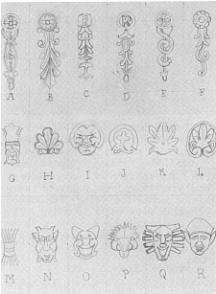 Sketches of carvings
Note that none of the carvings used on the last four appear on any of the previous ones, which indicates that the 1893 production ended with No. 47. Also, the last three tableau-dens (49, 51, and 52) were the only ones with the large frames on their side panels. None of these three, seemingly, ever had a twin. Therefore, the "eight elegant cages" referred to in the 1893 route book must have been the eight closed ones in the first eleven of the tabulation.
Note 1. The cages sold to Floyd King. When Floyd King and his brother, Howard, were framing their ten-car show of 1925 (which they toured the first year under the Walter L. Main title), they acquired the cages numbered 37, 49, and 51 from the Ringling inventory in Baraboo. These three, and the other two that were sold to George Christy late in 1925, had been left in Baraboo when the Ringling show went out of there for the last time in the spring of 1918. The three cages in question can be readily identified by the group photo (No. 20) which shows them on the lot with the King ticket wagon. Their Ringling numbers were determined partly by photographs and partly by logic which follows as a result of the omission, for the first time in 1918, of these numbers from the series of official parade lists that we are fortunate to have for most of the years between 1910 and 1918. Incidentally, the 1918 Ringling show train did not return to Baraboo but went directly to Bridgeport at the season's end when plans were afoot to combine the titles for 1919. After that point, I have been unable to detect any wagon transfers out of the Baraboo quarters to the quarters in Bridgeport. Thus, all those wagons that were not on that 1918 train were left stranded in Baraboo until they were sold off to lesser shows.
Also for his 1925 show, King bought the Tableau Russia and the slightly older one, Tableau No. 4, distinguishable by its large oval, frame which, in its later years on Ringling, was filled in with a painting. But these acquisitions had to have come out of Bridgeport where they went with that 1918 show train. King's show, which owned these five items, was eventually enlarged to fifteen cars; but in 1929, it got behind in its debt to the Donaldson Lithographing Company who foreclosed and sent the property to the American Circus Corporation quarters in West Baden, Indiana. The only fragment of it besides the calliope in the Ford Museum that is traceable away from there, is one of the sides of Cage No. 51. About 1938, this panel got to Harrison, Ohio, where one Vernon Soules was putting together a small parade which he hoped to book in pre-Christmas parades and other celebrations that might turn up. In his promotion, he billed it as "The Only Circus Street Parade in the United States Without a Circus."
From this panel, Soules used the birds and parts of the scroll on his small bandwagon (Photo No. 16) and the two "Wolves" and portions of the corner posts on opposite sides of a small tableau (Photo No. 17). Besides the illustrated two pieces he also built an air calliope and four cages. All of these units, except the bandwagon, were somewhat smaller than conventional railroad-practice cross cages; in fact, Soules loaded most of them crosswise on two semi-trailers. I first saw these at the Dayton, Ohio, sesquicentennial celebration in 1939. The next time I saw them was in the fall of 1945 at Terrell Jacobs' quarters in Peru, Indiana. They just happened to be there because, after the Chicago Stadium date of the previous spring, which Soules and Jacobs both played, Soules stored them with Jacobs, went away, and died shortly thereafter. So at this juncture, Jacobs "inherited," or possibly bought, the group. I narrowly missed seeing them once before in May 1942. On that occasion in Eaton, Ohio, Soules had arranged to bring his parade there to join up with Harold LeRoy who was to arrive with a four-pole top, some seats, a light plant, and barely enough else to frame a show; and, together, they were to launch the V&H Circus, the "V" and the "H" after the first letters in the partner's given names. George Hubler, of Dayton, Ohio, then a Flying Cadet in the Air Corps, happened to be on hand in Eaton with his camera and took the series of pictures that long ago were circulated as the V&H Circus. Hubler returned to Dayton that afternoon without waiting to see what transpired at the circus and that evening cajoled the writer into spending a few of his precious gas ration coupons to visit tomorrow's town. We made it, but the show did not, having opened and closed in Eaton the previous day. The reason seems to have been that the partners neglected to hire any performers. Anyway, as a result of Hubler's pictures, these Soules wagons have been labeled as V&H Circus. Perhaps they were for a day, or for part of one, but even so this was long enough to create a lot of confusion.
During the years that Jacobs owned them, he booked them whenever he could on winter dates. In 1954, the bandwagon and two of the cages became identified with Floyd King's big truck show; and that year and the next, the bandwagon was the horse-drawn attraction in the King Brothers parade. Since that show closed in 1956, these three pieces made their way to the Shelburne Museum just south of Burlington, Vermont. The Wolf Tableau, the air calliope, and the other two cages have been in the Circus World Museum since 1967, having been purchased from the late Lee Allen Estes of Lexington, Kentucky, who had acquired them from the Jacobs estate in 1958.
Note 2. Cage No. 38. This one was dismantled in Sarasota. Two of the winged lions and one set of the corner carvings are on display in the Ringling Circus Museum in Sarasota. Dr. Ralph Hartman of San Antonio has the lions from the other side over his fireplace. He also has a head from one of the mudboards.
Note 3. The cages sold to George Christy. On 14 November 1925, George Christy, for the sum of $4,000, purchased the Swan Bandwagon, the Lion & Mirror Bandwagon, two cages, and two pony floats from the Ringling, Baraboo, holdings. One of the cages was obviously No. 52, and the other was logically No. 47.
The pony flats were two of the following four: Cinderella, Mother Goose, Santa Glaus, and the Old Woman in the Shoe. (1) These all happened to be in Baraboo because they had been brought there from the Barnum show for use on the 1910/11 Forepaugh Sells. Following that, they were extensively renovated by Moeller and all used at one time or another in the Ringling parades from 1912 through 1915. Christy did not get around to picking up his purchases until 30 May 1927 when he routed his show through Baraboo. By that time, Fred Buchanan, the owner of Robbins Brothers Circus, had been there and bought the other two floats and, according to Christy, talked whoever was in charge of quarters into letting him have all four. This, I would liked to have known before I published my monogram, "The Allegorical Pony-Drawn Parade Floats," in the September-October 1960 Bandwagon. In that, I repeated with some hesistancy the generally circulated story that Buchanan got these out of Bridgeport at the same time he picked up the Two Hemispheres and the old Barnum & Bailey Horn Calliope, knowing even then that these four floats did not leave Bara-boo on that 1918 Ringling show train. Christy's story, even at this late date, is therefore a welcome bit of rationality.
1. Christy's document for this transaction calls for two pony floats, but he says it was understood that he was to get three of them. The document does not identify which ones they were.
Getting back "to the cages, Christy held No. 52 until he sold it to Adkins and Terrell when they were framing Cole Brothers in 1934. It was still around the Cole show with its original skyboard, mudboard, and corner ornamentation as late as 1942. However, all traces of its side panels were gone, having burned up in the Rochester quarters fire of February 1940, less than a year after they had been cannibalized to furnish part of the ornamentation for the new Cole calliope that made its appearance in 1939.
Right now, our only means for determining the identity of this second Christy cage is through later pictures that tell us which corner ornaments it carried. The first of these, taken by Walter Tyson in Gulph, Ontario, when it was with Christy in 1929, shows it in no different configuration than other, photographically superior, photos made in 1937 after it, too, had been sold to Adkins and Terrell. Prom these corner decorations, we can tell it was one of the three - 45, 46, or 47. But, unless it was more drastically modified by Christy than we have reason to suppose, the fact that the photos made in Rochester in 1937 show it with removable panels and bars on both sides narrows the identification down to No. 47. It should be injected here that the eleven tableau-dens in the series opened only on one side, and had bars on this side; but, when closed, they presented an identical appearance on both sides. The foregoing logic that fixes it as No. 47 is additionally confirmed by the fact that there was no cage so numbered on that 1918 show train. The 1929 Gulph and later pictures reveal that Christy did rebuild the entire rear end and came up with a skyboard that was oddball to the original Ringling series. After looking around a bit, we identified it as the one off of Christy Tableau No. 80 (Photo 21). This fits in with George Christy's disclosure to the author that he abandoned this tableau in Baraboo when he stopped by there in May 1927 to pick up his two bandwagons and two cages because he was short of room on his train. So now we know that he did not leave all of it. As can be seen in Photo 11, old Cage 47 still carried the Christy title in the fall of 1936, two years after the Cole show took to the road. Plans were afoot to enlarge Cole for 1937; and in the course of this expansion, quite a few new cages were built in the Rochester quarters. Joe Bradbury, in the sixth article of his Cole series (Bandwagon, March-April, 1966), identifies this cage as being transformed into Cole No. 11. It may have been so, but it seems more likely that at this point it completely lost its identity with no more than the iron, and perhaps the gear, ending up somewhere in the new construction.
Note 4. Cages 45 and 46. The number assignments for these two have been arrived at by the process of elimination. We are quite sure that they are correct, by pair, even if they cannot be assigned individually. It was only from the two 1900, A. T. Johnson, photographs (Photos 8 and 9), which differ only by the pictorials in their frames, that we were made aware that here was a fourth set of twins. Both of them went into Bridgeport on that 1918 Ringling show train.
From here on, the circumstances begin to get even more vague. Before 1937, one of them had been renumbered 67; and its original mudboard had been replaced by a "Q" style. Later, this one was sold to Hunt Brothers, a motorized circus, where it finished out its days mounted on a truck chassis. The fact that the one, then numbered 67, was the one sold to Hunt is traceable through some mutilation on the mudboard that is common in both Ringling-Barnum and Hunt pictures of it.
The other cage, of the 45-46 pair, may have been lost in the 2 February 1924 paint shop fire at the Bridgeport quarters. It is reliably reported that there were some cages, besides the hippo and rhino dens, that were lost at this time. Besides these Ringling dens, there were a number of the fancy, statuary, cages generic from the 1883 Barnum production by Fielding, as well as others from the pre-1907 Forepaugh Sells show, still in Bridgeport. Quite a number from these two sources have been traced by this conflagration, leaving it almost certain that a few from the Moeller production must have burned up at that time.
The authors wish to thank Sverre O. Braathen of Madison, Wisconsin, for making his records on the Moeller repairs available, and Gordon Potter of St. Joseph, Michigan, for coming up first with the key picture that made possible the identification of the second cage sold to George Christy.
For those who may wonder about the dual authorship for this monograph, as the first-listed author, I might explain that while I had accumulated an impressive file of data on the subject, it was not until Mr. Thayer came along with his superior command of logic that the perplexing identification of the non-obvious cage numbers was resolved. Without him, it's hard to tell when this would have been published. It was also Mr. Thayer who first realized that the four open dens were, properly, part of the story; and it was he who did the art work on the page of sketches. (R.E.C.)
The management problems that plagued circuses during World War II are well-known. Tires and gasoline were rationed. Workers were difficult to find and more difficult to retain. New equipment was almost non-existent and maintenance was a severe problem. Yet, in spite of these potential headaches, Arthur Concello, in the spring of 1943, became interested in acquiring the Russell Bros. Circus. This organization, one of the better known circuses of the time, was owned by Claude W. and Pauline Webb and at the date of Concello's initial interest was making a very successful stand at the Hill Street lot in Los Angeles. Talks between the Webbs and Concello continued after the circus left the big Southern California city and moved north through the coastal towns. During the San Francisco stand in Seal Stadium (June 4-27) the purchase price was agreed upon and Arthur Concello became the new owner of the Russell Bros. Circus.
The show continued its route north into Oregon and Washington and then moved south through Idaho. Unhappiness and dissension had been smoldering between some of the employees for several weeks, but this arid route through the high desert in August seemed to bring it to the surface. The friction and discontent hurt the daily movement of the circus and the new owner decided to close the season's route several weeks early. Jack Tavlin had joined about the time the show reached Salt Lake City and Concello directed him to have system flats and two box cars ready for the show at the Denver stand one week later. The notice went up between shows on the last day of the four-day Denver engagement. The equipment was loaded that night and it departed for Los Angeles the next day. It eventually arrived at the former quarters of the Russell Bros. Circus on Mission Road and Broadway - the location that once had housed the Selig Zoo.
During the winter Concello hired several persons from Sarasota to take over staff positions on the 1944 Beatty-Russell Bros. Circus. He also encouraged several performers to make the trip from Florida to California to strengthen that portion of the circus. Of the 1943 Webb staff he retained Wallace Love, Bill and Edna Antes, Francis and Elsie Kitzman, Norman Carroll, Elvin Welsh, George Werner, and Dan Dix. These people did not necessarily hold the same positions during both seasons of 1943-44; their 1944 tasks will be outlined later in this article.
Most of the information for this paper was obtained from Walt Matthie who clowned on the 1944 show for the entire season and served on advance for Arthur Concello's famous tour of Canada with the Clyde Beatty Circus in 1946. Matthie provided an excellent coverage of the transportation department for the 1944 season. "The show moved on a total of forty-two vehicles, plus approximately eight private living trailers," stated Matthie. "All the trucks," he continued, "and everything else paintable were painted during the spring. Trucks had red paint with white lettering. The only exception to this was Clyde Beatty's trucks. They were painted yellow and lettered with red and green."
The summary of trucks listed below contains the numbers as far as Matthie could recall them. All tractors were Chevrolets and all of Beatty's trucks were also Chevrolets except one. No. 5, the bull truck, was an International. (The vehicles not owned by the show will be mentioned first).
No. 201
No. 103
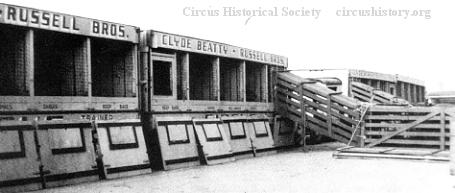
When asked about the problem of gas rationing, Matthie stated, "Off the highway gas was used. Coupons came from Los Angeles throughout the season. I understood at the time that it was Paul Eagles' job to get them to the show. Tires were bought wherever possible. George Smidtley was the boss mechanic and he had four, sometimes six, mechanics to keep things rolling. There were very few delays due to truck breakdowns. Only two tractors were replaced during the season."
The show opened at Santa Ana with a two-day stand on March 20-21 and then moved to Oceanside for a single stand of two performances. San Diego was next on the route with an eleven-day run. Clyde Beatty's big act arrived at the beginning of the second week while the circus was in the midst of its San Diego stand. It closed there on April 2 and moved 100 miles to Long Beach where it played three days. On April 6 the show pulled onto the Washington and Hill Street lot in Los Angeles but gave no performances.
During these first four stands it had been using the old Tom Mix khaki-colored top which had seen its better days years before. "It was very dark and shut out the light," commented Matthie. "It was like working in a tunnel." It was a 150 ft. with three 50 ft. middle pieces. At the Oceanside stand a new dressing top arrived. It was a push-pole, 20' x 40'. Since the new big top was scheduled to arrive in time for the Los Angeles date a day had been scheduled en route from Long Beach to give George Werner and his crew time to erect the new canvas in the City of the Angels. This top was a 140 ft. round top, white in color, with three 50 ft. middle pieces. The side show top was a 60 ft. with two 30 ft. pieces. During the season the Menagerie was always corralled except for two-day stands and long engagements. The three light plants were overhauled at Los Angeles. While this was being accomplished, the show used a light plant from the United Awning Co.
George Werner had been Lot Superintendent and Boss Canvassman on the Russell Show for nearly ten years and later became well-known in this position on the Ringling Bros. and Barnum & Bailey Circus. Walt Matthie states, "He was an extremely capable boss canvasman and during his supervision of the work on the lot he wouldn't say ten words. He seemed to be present exactly where he was needed at all times and never seemed to encounter any unnecessary delays - this in spite of the fact that in 1944 there were never more than a dozen working nine on canvas."
Matthie counted the show people at Portland, Oregon, on July 4. There were only 124. This shortage of help was a problem throughout the season and is best described in his words. "The web girls put up chairs and took them down during this season due to shortage of help. The candy butchers handled the two middle pieces of canvas and the bible-backs. The menagerie tent was put up by two big top men and the candy butchers. The clowns handled their trunks and props and put up the clown dressing tent and tore it down."
"It went along like this until we got to Pasadena," related Matthie, "when the clowns went on strike. We went to Jack Joyce and told him that we wouldn't move the trunks or put up the dressing top and tear it down anymore. He gave us a hard look and said it didn't make any difference whether we were on the show or not. So we went back to hauling the trunks and putting up the tent and tearing it down."
In addition to the above, Matthie's work consisted of setting up the bandstand, calliope and its motor and compressor, the P.A. system (this included tw 6 ft. stakes), ticket sales downtown, cigars, candy, and cigarettes, work the matinee and night show, and then tear down and load all of the above. He was paid separately for all of those jobs. Putting up and tearing down the clown tent and handling the clown props was part of the clown act and was included in his pay for clowning.
The performance in 1944 did not include any outstanding performers, except Clyde and Harriet Beatty, and perhaps the Flying Concellos, but it was a good, solid show with a great deal of strong circus talent. Several of the performers worked in Los Angeles only and did not make the long tour north and into the mid-west. Jack Joyce was Equestrian Director and Red Larkin was the Announcer on the road. Norman Carroll did the announcing chores during the 24-day Los Angeles stand. The performance opened with a review of the personnel in costumes with a Near Eastern flavor. The wardrobe was show-owned and seemed to favor India or Arabia - certainly the nine elephants and the single camel created an impression of India.
Display No. 2 featured Albert Fleet working a group of five lions in the arena and No. 3 included the Morales Dogs in Ring 1 and the Aerial Andersons on high horizontal bars over Ring 2. Morales used about 20 dogs in his act and many show people wondered if he had any control over them. Regardless of that, his act was one of the most popular in the program - the crowd loved it. The Aerial Andersons (Dick Anderson, Bernie Pisarski, and Mike Phillips) was one of the acts brought from Sarasota by Concello. They worked an aerial triple bar with a net.
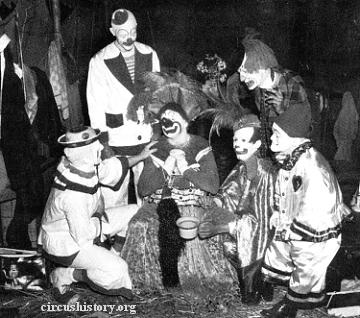 Photo #21 - Clown alley in San Diego. Dick Lewis is in the center with Walt Matthie at the upper left. Alva Evans is at the right front. Doc Hayden photo.
The clowns were introduced in Display No. 3. The Official Route Book for the season lists eighteen clowns, nine of whom were on the show for the road tour after the show left Los Angeles. The others were present only for the big 24-day stand; and one joined in Kansas to finish the tour. The nine who toured were Brownie Gudath, Rene Thezan, Dick Lewis, Walt Matthie, Alva Evans, Alex Lowande, Gus Lind, George Perkins (who left in Idaho), and Hughie Kyle.
Liberty Horses and Military Ponies were included in Display No. 5. The horses were worked by Martha Joyce and the ponies by Jack Joyce.
Harriett Beatty presented a Bengal tiger riding the elephant, Anna May, in Display No. 6. Pauline Penny and the Dancing Floyds, tightwire performers, worked the next display and the big act was presented.
This was, of course, Clyde Beatty and his "natural enemies of the jungle." This act more than any other feature made this circus a success at the box office. There had not been a featured "big cat act" like this one on the West Coast in several years. Beatty had not been available in the area since 1937 when the Cole Bros. Circus had made its tour and he was the Big name in the business. Patrons everywhere knew his name and reputation.
In the Ninth Display, Hope Guitterez did a loop-the-loop near the canvas roof and Lyle Chappell performed upside-down loop walking with his rigging in the ridge of the tent. These acts were followed by Dave Fullmore and the Unridable Mule, "Ajax," and Si Otis and the trick mule, "Abner." On the track, during this 10th Display, was George Perkins and his wire-walking dog, "Princess."
The riders were next and the expert horsemanship was presented by Della Ryan, Joe Ryan, Myrtle Goodrich, Dorothy Sky Eagle, Pauline Penny, Martha Joyce, Norma Rogers, Hope McLennon, and Jack Joyce.
Lind and Chappell with their Society Dogs; Harry Freehand, balancing chairs; and Concha Escalante, equili-bristic feats, worked in Display No. 12. This group was followed by the clown prize fight which featured Brownie Gudath and Dick Lewis as opponents; Walt Matthie as referee; and Alva Evans as attendant.
Then came Lloyd Senter, contortion), Myrtle Dunedin (unicycle), and Gus Lind (unsupported ladder). That was Display No. 14 and the Amazing Excellos were alone during Display No. 15. The Excellos were Mike Phillips and Harry Freehand and their feature was a very fine perch act.
The Ballet of the Sky, produced by Antoinete Concello, filled the air during the next display. This was another strong feature and each individual was costumed in golden yellow with silver trim and sequins. The performers were Antoinette Concello, Gracie Genders, Lou Ann Krause, Mitzi Sleeter, Doris Helms, Marge Bennett, Betty Escalante, Jean Sleeter, Concha Escalante, Milonga Escalante, Fanny McClosky, Pauline Penny, and Kay Burslem. Also working with the web girls were Mary Richards, Cleo Fleet, Dorothy Sky Eagle, Myrtle Goodrich, Norma Rogers, Eldon Day, Joe Remillette, Dick Anderson, Mike Phillips, Bernie Pisarski, Mono Guitterez, and Buddy Richards. This was certainly a strong list of performers for this type of act and some very famous people of mid-century circus were in this wonderful ballet.
Following the web act, Albert Fleet presented Clyde Beatty's two chimpanzees, "Mickey" and "Minnie." "Mickey," the male, was a powerful ape who hated clowns and often went into a rage at the sight of anyone wearing white clothing. This even included Beatty who always wore a white uniform when working. Since the clown fire-house number frequently followed Fleet's act, "Mickey" had a great opportunity to unleash his vengeance upon the men in white-face. Chairs, props, and an occasional axle flew through the air as the men in white entered, and the chimps left, the arena. Alva Evans wore a white clown suit and a monkey mask in one number and "Mickey" seized the bars of his cage and rocked it furiously every time he spotted the clown in this attire. To show that he was truly impartial, he bit off the end of Albert Fleet's thumb during the Los Angeles stand.
The Wild West concert was introduced and then Dick Lewis played the part of the frantic bride in the burning house. Brownie Gudath was inside with the fire pot and the rest of the poeys tried to put out the fire and catch the rather weighty Lewis as he leaped to safety. The fire pot, manned by Gudath, was constructed from a coffee pot which burned gasoline. Clouds of smoke were created by blowing through the tubing into the pot. Later, at Anacortes, Washington, the long grass inside the house caught fire from the torch and the clowns outside threw quantities of water into the enclosure to save Lewis and Gudath from being toasted. Upon emerging, these two smoked-up clowns berated the others for getting them wet!
Display No. 20 was a slack wire number with Mono Guitterez, Mario Ivanoff, and Floyd Crouch providing the thrills in three rings. The elephant acts were next. Jack and Martha Joyce worked Lucy and two ponies in one ring until the show left Chehalis, Washington. Bert and Marie Pettus worked Anna May, Mary, and Sidney, the three bulls owned by Clyde Beatty. The center ring act was presented by Mac McDonald and Norma Rogers. The five elephants in this act were Elsie, Margaret, Myrtle, Daisy, and Dixie.
Lucy had a long circus career which began with a two-car show entitled Campbell Bros. It was owned by Wm. P. (Low Grass) Campbell. She was sold to the Ketrow Circus in 1923 and was with it until she became Seils-Sterling property for the 1931 season. At the auction of that show in Milwaukee in September 1938 she became Louis Meitus property. The author was present when she, Billy Sunday, and additional animals and equipment from Meitus were delivered to Zoo-park, (ex-Selig Zoo) Los Angeles, in 1940. Lucy was at Goebel's in Thousand Oaks prior to the outbreak of World War II and was used by Jack Joyce through mid-July, 1944, when, after she killed attendant Gabe Tucker, she was sold. She became the property of Ben Davenport and was with his organization until 1955 when she was deposited with Gran Circo Union. She has been dead for a number of years.
Mary, Anna May, and Sidney became Clyde Beatty's property during the winter of 1938-39. Previous to this they were owned by the Cole Bros. Circus and came to that show in the series of purchases that transferred the elephants from the Hall farm to the Cole Show for the 1935 season. Mary and Sidney had arrived at the Hall farm in Lancaster, Mo., in a shipment of eight that entered port on the Pacific Coast in 1923. Hall had purchased Anna May and four others from Louis Ruhe in 1925. Mary died in 1950 before the Beatty Show left El Monte quarters for the opening stand of the Clyde Beatty Circus, the Clyde Beatty-season. Ann May has been with the Cole Bros. Circus, and the Sells & Grey Circus since 1944. Sidney followed the same route except that she continued with Beatty-Cole rather than making the Sells & Grey route in recent years.
Two of the elephants in the McDonald act had been with the Russell Show for a decade but the other three had arrived more recently. Margaret and Elsie were the oldest in Russell Bros. service, having been received from the Hall farm in 1933. W. P. Hall had obtained Elsie with 5 other babies from Louis Ruhe in 1926. She had been on the Orton Show for several years. Her search for liberty in August 1939 made newspapers across the nation. She absented herself from the show near Staunton, Va., for nearly 34 hours. Margaret, another Hall elephant (received in 1925) had spent several years on Robbing Bros. Circus.
The other three, Dixie, Daisy, and Myrtle, were all Christy Show elephants who worked on various shows and fairs after the Christy Circus closed in 1930. Two of these engagements were with Barnett Bros. Circus and Hagenbeck-Wallace. Dixie and Myrtle came to the Christy Show as punks in 1925 while Daisy, the best known of the trio, began trouping with the Gollmar Show during the World War I period. She remained with Patterson's Show and Gentry-Patterson and was sold to Christy in the fall of 1924. All three of these elephants arrived on the Russell Show during the early war years and were with it until 1946 when the group of five was sold to the Al G. Kelly-Miller Circus. Elsie went to the Hagen Show in 1955 and she died on that circus June 9, 1959. Dixie died on the Kelly-Miller Show in 1954. Daisy went to Gran Circo Union with Lucy, and Myrtle, with Kelly-Miller until 1956, has become well-known on the Famous Cole Circus in recent years. Margaret also was a respected member of the Kelly-Miller herd until recently.
The elephant acts were followed by Miss Estrelita with heel and toe catches. This was display No. 22 and the clowns appeared for their last turn as Display No. 23.
Display No. 24 was the flying act which featured Gracie Genders, Joe Remillette, Eldon Day, and, occasionally, Antoinette Concello. The act was listed as the Flying Concellos, and it closed the performance.
The concert, directed by Cy Compton, featured Compton's horse roping; Chief Sky Eagle, bow and arrow, rope spinning, and boomerang throwing; Si Otis, and the trick mule, "Abner"; the Chief Sugar Brown Family in War Dances and Ceremonies; and Dorothy Sky Eagle, Myrtle Goodrich, Rex Rossi, Jack Wright, Don and Hope McLennon, George Penny, Delia Ryan, Helen Sky Eagle, Dave Fullmore, and Bernice Dean, all cowboys and cowgirls. Delia Ryan and her Hollywood horses and the Chief Sugar Brown Family were engaged for the Los Angeles stand only and Don McLennon, who was in the army at the time, appeared at the Los Angeles stand whenever he could get leave. Cy Compton, of course, was a famous performer in this field and had been on the early Buffalo Bill Wild West Shows at the beginning of the 20th Century. He later was a featured concert performer for the Barnum & Bailey Circus and the Ringling Bros, and Barnum & Bailey Circus. This was, unfortunately, his last spring opening. He died at the Yreka stand on June 19.
The sideshow was operated by Pete Kortes and included Charles and Anna Le Roy as Manager and Secretary; Mabel Van Wie, lecturer; Shorty Hinkle, music; Homer Holye, electrician; and James Chambers, Andrew White, and Georgia Flournoy, ticket sellers and takers. The attractions were Eko and Iko, Sheep-Headed Men; Sealo, the Seal Boy; Athelia, the Monkey Girl; Sam Alexander, the two-faced man; Charles Royal, midget; Doria and Thelma Patton, Albino twins; Harry Lewis, stone man; Billy Mitchell, Zunda the quarter boy; The Great Lorenzo, mentalist; Frank and Grace Webb, magicians and jugglers; and the Ethiopian Gorilla people.
The staff of the 1944 Clyde Beatty-Russell Bros. Circus, as listed in the route book, included the following: Frank McClosky, manager; Grace Killian, secretary-treasurer; Wallace R. Love, auditor; Edna Antes, tax box; Jack Tavlin, Director of Public Relations; Bill Antes, General Press and Radio; Bill Moore, legal adjuster; Elvin Welsh, Purchasing Agent; Clyde Beatty, Director of Personnel; Duke Dukenbrod, Beatty's Manager; Red Sonnenberg, Big Show Tickets.
Waldo T. Tupper was General Agent and also in advance were Herb Pickard, Contracting Press Agent, and Dan Dix, 24-hour man. Dix dated from the earliest years of the Miller Bros. 101 Ranch Show (1908) and had seen many touring seasons with the Al G. Barnes Circus. Outdoor Advertising was handled by Francis Kitzman (Car Mgr.), Ray Smith (Boss Lithographer), and Henry Fisher (Boss Billposter). The crew consisted of eight people.
The Front Door was in charge of Ray Maxwell, Ralph Gentry, Bob Whiting, and Ed Rayecraft. Allan King, Supt. of Reserved Seat Tickets, had a half-dozen men under his supervision. Inside Ticket Takers were Josephine Rogers, Mary Richards, Mary Moore, Cleo Fleet, Mabel Smalley, and Elaine Lovell. Joe Kuta was Head Usher and supervised eight men.
Other department heads were George Werner, Lot Superintendent; Jack Burslem, Concessions; Jack Tavlin, Programs; Louis Smidtley, Transportation; Edward Kelly, Electrical; Bob Reynolds, Properties; Charles Oliver, Dining Tent; and Orin A. Gilson, Director of the Big Show Band. Gilson's musical aggregation consisted of fourteen members and Mike Doyle played the calliope. Lillian Compton and Ann Reynolds supervised the wardrobe.
The limited menagerie consisted of Clyde Beatty's stock and the ring horses and ponies. There was one camel named "Mac," which was used in the spec plus the nine elephants and the lions and tigers. Mac McDonald was in charge of all these animals. His assistant was Frenchie Durant. William Wilson was the Boss Hostler. Albert Fleet was in charge of the cages and his assistant was Wilson Fleet. McDonald was also Superintendent of the Elephant Department but his direct concern was the five Russell bulls. Bert Pettus handled the Beatty elephants and Jack Joyce was responsible for Lucy.
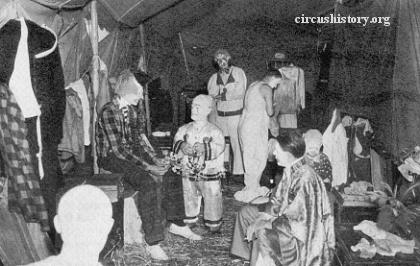 Photo #28 - Clown dressing tent at the San Diego stand. Doc Hayden photo.
The circus played its final Los Angeles performance of the year on Sunday, April 30, and began a very successful road tour. Walt Matthie reports, "Business on the coast was phenomenal in 1944. The only tour that topped it was the 1946 season in Canada. Ventura was the biggest day of the year with over $15,000 gross. Hot Springs, Arkansas, was the second biggest day of the tour and people were sitting on the ring curbs in that town. We never knew where they came from for the place seemed deserted during the morning."
Monday, of the seventh week, the show moved to Pomona for a single day and followed this with two days in San Bernardino and two days in Pasadena. "The afternoon performances in San Bernardino were played in the worst weather of the season," recalls Matthie. "It was unbearably hot."
The eighth week consisted of single stands in North Hollywood and San Pedro and two days in Santa Monica. The biggest day of the tour (Ventura) came on Thursday and Oxnard (one day) and Santa Barbara (two days) were next.
During the following week several stands on the central coast were made. These included Lompoc, Santa Maria, San Luis Obispo, Paso Robles, and Salinas. Matthie's summary of this week reported, "Lots of flowers but light houses in Lompoc." (It actually is one of the great flower growing centers of the world.) "The clown's trailer caught fire en route to Santa Maria and all our bedding was lost."
The run of 106 miles to Salinas was the longest haul of the season thus far. The show had a night performance scheduled for Friday, May 19, and it was followed by two shows on both Saturday and Sunday. However, this jump past small towns put the circus in close proximity to several fine coastal cities and the moves during the tenth week were similar to those in southern California. Monterey and Watsonville were one-day stands; Santa Cruz was played two days; and San Jose three days. The short moves continued on into the eleventh week as the show made single days at Palo Alto, Redwood City, San Mateo, and Hayward. Richmond on Friday and Saturday, June 2 and 3, concluded the week.
Single dates were the order for the next week in Valejo, San Rafael, Petaluma, Santa Rosa, Napa, and Pittsburgh. Then it moved 45 miles to Stockton for two days, where a near tragedy was averted when a fire broke out in the grass beside the menagerie tent. It was extinguished by the show's own forces using wet sacks.
Lodi, Roseville, Marysville, Oroville, Chico, and Redding finished the thirteenth week and the Beatty-Russell Bros. Circus was within two days of leaving California for its northwestern tour.
The fourteenth week was a test of endurance and a rugged experience for all. On Sunday, June 18, the show moved sixty-three miles to Mt. Shasta for an afternoon performance. Matthie recalls the cold, damp, disagreeable weather, and the misty rain that obscured the windshields and caused great discomfort. Although he felt that the cookhouse was the least efficient department on the show, Matthie does sing their praises for the hot, rich, vegetable soup that was served that day in Mt. Shasta. After the tear-down the circus moved on to spend another day in similar weather in Yreka. It was here that Cy Compton passed away. Another haul of fifty-five miles got the show to Medford, Oregon, for a two-day stand and here the mist turned to rain, the lot was soft, and mud covered everything. The next day was better - as far as the weather was concerned - but a 110-mile run to Roseburg wearied all hands. A performance was scheduled for that night and then the show moved to Eugene for two days.
The fifteenth week opened at Albany, Oregon. This was Sunday, June 25, and two performances were given. Corvallis was a one-day stand on Monday and Salem was played on Tuesday and Wednesday. Oregon City was Thursday's town and then the show made the short run to Portland where it began a ten-day stand. A bad accident was narrowly averted at Salem when the flying act frame broke and hit the pole that Harry Freehand was supporting. His top mounter had his foot in the loop at the top of the pole and could not escape. As the pole fell he grabbed a chandelier pole. Meanwhile, the perch-pole was driven into Freehand's leg and pinned him to the ground. Bob Reynolds and the prop boys rushed out and held the perch-pole up until the top mounter got his foot loose and then the chandelier was lowered to let him down to the ground. This perch-pole was made of pipe and weighed approximately 120 pounds.
July 6, 1944, was a tragic day in circus annals and, as soon as the word of the fire in Hartford, Connecticut, reached Portland, Arthur Concello went into action. The big top of the Beatty-Russell Circus was fire-proofed immediately after the night show. The top was covered as far as the first row of quarter poles and the side walls were also treated. When the top came down at the end of the Portland engagement, the entire canvas was fire-proofed. This was done several times during the season, usually on a Sunday. The treatment stiffened the canvas but it survived two seasons. This damage to the canvas was one reason the show did not complete its scheduled route in 1945 - the tent was gone. The menagerie top was not fire-proofed but its sidewalls were treated according to Matthie.
Another event that caused much consternation among the circus personnel occurred at Portland. The arena was always put up immediately after the concert and the lions and tigers were allowed to exercise in it. The two species were not permitted to use it together, however. They took turns with the lions usually being out of their cages before the tigers. One day in Portland the cage boy did not close the chute door and a tiger got back into the runs. He was followed by a second animal and a fight broke out between the two beasts. The stakes holding the runs lifted and the passageway fell apart. This permitted all the tigers that were in the arena to exit onto the lot. Most of the circus personnel were resting or were downtown so that the cats were not noticed at first. Harry Freehand happened to be returning to the lot when he saw one of the tigers which he assumed was a Great Dane that had been frequenting the lot for several days. When Freehand approached more closely he realized that a tiger was loose and, despite his bruised leg, he swiftly climbed to the top of a truck. The other tigers, meanwhile, had turned toward some willows at the far end of the lot. They were quickly sidewalled and returned to their cages before anyone was hurt.
The show left Portland after the Sunday date (July 9) and moved to Vancouver, Washington, for two days. Longview was next and then Chehalis. It was here, after the night show had broken, that Lucy killed Gabe Tucker. Concello immediately called C. R. Montgomery who had a mink farm outside Albany, Oregon, and urged him to shelter the elephant. At that time Montgomery was boarding five of Mabel Stark's tigers as well as caring for the minks. Jack Joyce took Lucy to Albany that night and left her there. Friday and Saturday of that week were spent at Hoquiam and Aberdeen, Washington - same lot for both towns.
The eighteenth week was marked by a three-day stand at Tacoma on Tuesday, Wednesday, and Thursday. At Shelton on Sunday at the beginning of the week there was one show only in the afternoon. Four new big top center poles were delivered there. Olympia was the Monday date and Auburn was played on Friday. At Snohomish, the Saturday town, one of the bible-back trucks became lost en route from Auburn. It took a wrong turn and the drivers, realizing they were miles from the lot, pulled over and went to sleep. They knew that they would be searched for and located when the show missed them. There were two of these trucks on the show and they loaded and unloaded on each side of the rings. As a result of the absent vehicle many of the fine folk of Snohomish sat on the ground at the afternoon performance. The truck was finally found that day by the highway patrol and was back on the lot by six o'clock.
During the next week the Beatty-Russell Show made stands at Mt. Vernon, Anacortes, Bellingham (two days), Everett (two days), and then rolled onto the lot in Seattle on Saturday for the opening of a nine-day stand. On August 7 it was in Renton, Washington, where, in spite of an all day rain, business was big. Cle Elum, the next stand, was 100 miles away and a night performance was all that was scheduled. Ellensburg was a single date and Yakima (two days) followed. Sunnyside concluded the week.
Pasco opened the twenty-second week and Walla Walla and Colfax were next. All were one-day stands, and Colfax, after a 100-mile run, was again a night performance only. Here the big top barely fitted inside the fairground fences. The rest of the equipment and stock were left outside and performers made their entrance through a gate in the fence. Moscow, Idaho, was the Wednesday date and then Spokane, Washington, was scheduled for four days. The stand at Spokane ended on August 20 and the show was loaded on seventeen system flats and three box cars (or cars used at that time to haul automobiles). Ten trucks were gillied overland and the train was moved by the Union Pacific. Everything went to Grand Island, Nebraska, where the show opened on August 27. It was en route six days and covered 1,500 miles.
When asked the reason for this move, Matthie gave these answers. "The show had played long engagements in all the worthwhile cities on the Pacific Coast and it couldn't go back there. It was too late in the year to go east through Montana. It would take too much time to move to the mid-west by truck and the towns worth playing were long distances from each other. Besides trucks were extremely valuable in wartime and that "death" route from eastern Washington to the mid-west would have worn them out. As it was the show got to central Nebraska at the ideal time of year."
So the Beatty-Russell Circus began the twenty-fourth week at Grand Island. Hastings, York, Schuyler, Lincoln, Plattsmouth, and Auburn in that state made up the rest of the week. At York there was a heavy rain during the night and a light drizzle throughout the next morning. When the trucks arrived in Schuyler it was discovered that the lot was under water and probably would stay submerged for many hours. The performances were cancelled. At Lincoln the lot was uneven and required the use of "cats" to level it Before the trucks could get on. Meanwhile, several outside tires on the trucks hauling the McDonald elephants disintegrated about five miles outside of town. By unloading the bulls enough weight was removed so that the trucks could limp in on the inside tires with those on the outside slapping and flopping against the pavement. The bulls were walked the remaining few miles to the lot.
Nebraska City was the next stand on Sunday, September 3. It was followed by Falls City, Beatrice, Fairbury, Marysville, Manhattan, and Emporia. The first four towns of the week were in Nebraska; the last three in Kansas. At Manhattan the Beatty-Russell Show day and dated Ben Davenport's Dailey Bros. Circus and due, no doubt, to the attraction of the Beatty name, Concello's show got by far the greater share of the business. En route to Emporia one of the "semis" hauling the bible-backs was wrecked and a new tractor was purchased at that Saturday stand.
The show moved the fifty-seven miles to Ottawa, Kansas, the next day hut no performances were given. On Monday, two shows were presented in Ottawa and then Chanute, Independence, Coffeyville (two days), and Pittsburg followed. Matthie related the experiences at Chanute with gleeful nostalgia since it gave him a chance to comment on the cookhouse which he and others avoided whenever possible. "Oliver used canned meat with everything he cooked," reported the former clown, "and everybody began to detest it and would not go to the cookhouse for meals. Most of the time there were only three tables set up because the only people eating there were the working men - they couldn't afford to go to town. In Chanute, it was 105 degrees and too hot to make our way downtown for dinner so the clowns decided to try the cookhouse. As we approached the cooks stared at us as though we had committed treason. They certainly didn't think that we should be eating on the lot. The meal consisted of chile beans and water melons. We ate some of the melons and that was all. This was the last time that any of the dressing tent people went to the cookhouse." He paused, and then added, "Come to think of it, we did go to breakfast at Fort Smith."
The twenty-seventh week began at Miami, Oklahoma. Monday and Tuesday dates were at Joplin, Missouri. Fayetteville, Arkansas, was scheduled for a night performance only, since the run was over 100 miles. However, the huge crowds on the lot forced the management to change its plans and a late afternoon show was given. The truck carrying many of the performer's trunks was wrecked en route which caused the performance to have less than its usual flash and glamour. Clyde Beatty, for one, did not work his act in the afternoon. After the tear down the trucks headed for Russellville, Arkansas, about 125 miles away since another night show only was scheduled for that town on Thursday. During the run one of the sleepers lost its engine at Lincoln, Arkansas, and a second tractor was purchased. Little Rock was the stand for Friday and Saturday of that week.
No performances were given in Hot Springs on Sunday but the second biggest gross of the year was recorded on Monday. As stated earlier the crowd was seated on the ring curbs and the pageant that opened the performance, and anything else that took place on the hippodrome track, had to be cut. Fort Smith was visited for two days and then Okmulgee, Oklahoma, for a night performance only on Thursday. The circus remained there for two shows on Friday and then moved to Shawnee.
On October 1 (Sunday) the Beatty-Russell Bros. Circus opened the twenty-ninth week in Seminole, Oklahoma. Here there was a near blow-down at night. A severe wind storm hit the lot. However, there was no rain at the time and no extensive damage. A John Robinson was given to get the crowd out and the top down. The rain held off until Monday night at Ada and then it began to pour. The next day the big top canvas truck went off the road on the way to Ardmore. "Camel Slim" was driving and fighting the slick highway with his vision nearly obscured by the blinding rain on the windshield. No severe damage resulted since it hit a large sign board before it was too far from the highway. It was almost impossible to make the two-day stand at Ardmore. The rain continued and tons and tons of cotton seed were used to make paths on which the patrons could travel. The rest of the lot remained a quagmire. "Cats" could not be moved onto the lot and the bulls were used to get equipment on and off the swampy acreage. Norman was the Thursday date and Oklahoma City was played on Friday, Saturday, and Sunday.
On Monday of the thirtieth week the circus made a stand at Chickasha and then rolled on to Lawton for a two-day date. At Lawton it was pouring rain as the circus trucks came to a stop on the street beside the lot. It was obvious to everyone that if a truck tried to pull onto the lot it would disappear from sight. As the personnel glumly sat in the rain staring at the mud and pools of water, they were startled by the sound of the deep roaring and belching of gigantic motors. To their amazement some huge "cats" from the U.S. Artillery units at Fort Sill roared to an earth-shaking stop beside them and began to hook-on to the circus trucks. The first artillery unit completed its hook-up and, with a roar and a cloud of blue smoke, it broke over the sidewalk and onto the lot. A spray of water and huge gouts of mud flew in the air beside the "cat." Behind the circus truck appeared a deep trench as its underbody plowed a furrow across the field. Soon additional trenches appeared with their muddy parapets as truck after truck was hauled into place by the artillery units. Tons of gravel and cotton seed were put down to make paths so that the public could walk from the street to the ticket wagon, side show, and big top. Four performances were given during the two days in Lawton.
As night fell on the first day, the clouds moved eastward and a stiff breeze began to dry the earth. The show personnel looked at the caked mud wedged deep into the axles and wheels of the trucks and wondered how they would ever move off the lot.
Just as the sun rose on Thursday morning they heard the rumbling, roaring, and throaty burping of the artillery "cats" again. With prompt dispatch the big units rolled onto the lot, hooked onto the circus equipment and skated the trucks back to the street. "Skated" is the correct term since the wheels were packed so tightly with dried mud that they would not turn. After layers of caked earth were chipped away so that the truck wheels were functional, the show hastened down the highway to Duncan, its last Oklahoma stand. Friday and Saturday the show played Nocona and Gainesville, Texas, but remnants of the mud at Lawton remained until the end of the season.
The first four days of the next week were filled with dates at Denison, Paris, Greenville, and McKinney. Then, the circus went to Dallas for four days with the last day there being a Sunday stand, October 22.
The thirty-second week was the last complete week of the 1944 season. Cleburne was the Monday stand. Waxahachie, Terrell, Tyler, Jacksonville, and Henderson followed. The next week opened at Kilgore with the worst dust of the season. Longview was the Monday stand and with that date the season ended after a tour of 7,184. miles. Marshall and Shreveport, La., had been contracted but were not played.
The show stayed on the lot until the next day at Longview and then the equipment was returned to Waxahachie for temporary quarters. It was housed there in a factory building constructed of red brick. Matthie and Thezan left to drive two sleeper trucks to Los Angeles while the rest of the equipment remained in Texas until December. At that time Arthur Concello made an arrangement to purchase the Beckman and Garrity Carnival equipment which was located at the fairgrounds in Shreveport, Louisiana. All of the Beatty-Russell Bros. Circus equipment was moved to Sherevport late in December and a 15-car railroad show was framed at that location for the 1945 season.
This article was written from notes taken during several interviews with Walt Matthie (arranged by Gordon Borders). The 1944 route book was consulted for some information but most of the material came direct from Mr. Matthie. By coincidence, the Editor of Bandwagon had received an article concerning the history of the Russell Bros. Circus just prior to the start of the interviews. This was published in the March-April issue. The author extends his gratitude to Matthie and Borders for their effort in making this report of the 1944 season possible.
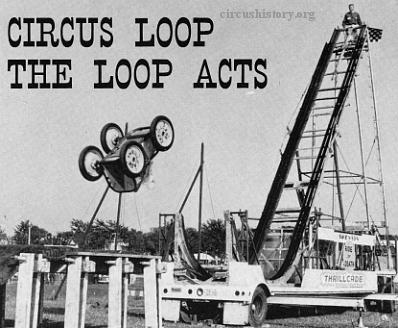 Photo: The Swensen "Ride of Death" is shown during a performance with the Thrillcade in recent years. Photo from Aut Swensen.
In the early 1930s a gentleman by the name of Fred O. Gregg, presented various "thrill" acts as outdoor attractions. He is probably best known as "Fearless Greggs", the human cannon ball, but he also built and performed in a loop the loop auto act.
Together with Dennie Curtis he operated the Curtis - Gregg Fashion Plate Circus for a few weeks in the spring of 1934. A ticket wagon semi from the Curtis-Gregg show later was used by the Seils-Sterling Circus. This unit was given to the Circus World Museum a few years ago by the Linderman family, who owned the Seils-Sterling show.
In March another link between the Curtis-Gregg circus and the Circus World Museum was made when an auto loop the loop rigging built by Fred O. Gregg in the early 1910s was presented to the Baraboo attraction by its most recent owner Aut Swensen, of Springfield, Missouri.
Swensen has been connected with thrill shows for many years, starting with a "flying circus" in 1926. He continued with motorcycle races, auto polo and other events presented in front of grandstands at fairs throughout the United States. Most recently he operated the "big one" of auto thrill shows the Thrillcade.
Probably the most elaborate auto stunt show ever the Thrillcade, clearly showed Aut Swensen's longing to own a circus. Season after season he presented circus type acts as part of the auto show program, bringing variety to the performance. An elephant was carried for a couple of seasons, being used to jump cars over. In addition Swensen has used balancing acts, escape artists, high wire acts, and jugglers and a cannon act.
It was only natural that he would seek auto related thrill acts to augment the crashing and precision driving on the track. About fifteen years ago he purchased the "loop the loop" auto somersaulting rigging built by Fred O. Gregg.
The rigging had been stored in a barn in Wisconsin, along with the Gregg cannon. The cannon had been retired following an engagement at the Steel Pier, Atlanta City, N.J. where a man was shot out into the ocean. It seems some heat was created when the "human cannon ball" was eaten by sharks.
The loop act appeared with the Thrillcade for a number of years, usually with one and sometimes two of the stunt drivers as the "passenger", and sometimes with a girl passenger. The act was shelved after a person was fatally injured while attempting it.
In order to hold the large fair dates each year Swensen changed his programs, and also would augment the shows at some of the larger dates with additional acts on a spot booking basis. When the "Ride of Death" loop act of his own was not used he booked two different European auto look acts. These were the Rasini and Cresso acts. Although presented on the Thrillcade different seasons they were identical in rigging and stunt, both being "one loop" acts. The Gregg rigging was built for a multiable loop. The rigging has two tracks and two cars. One car did the loop and the other passed under it.
After the 1967 season, following forty years in the business Swensen took the Thrillcade off the road to concentrate on his other business interests of real estate development, foreign car sales and sales representative of the Regalia Manufacturing Co.. (fair and horse show supplies).
By now the reader is beginning to wonder just what all this has to do with circus history. Actually auto loop the loop acts have a long association with the tented world.
The Rasini act was used on indoor dates by George Hamid and other circus producers in recent years and many will remember the "Great Florenzo" and his somersaulting car act on the Cole Bros. - Clyde Beatty Circus in 1938.
However the "golden days" of loop the loop and leap the gap acts was the period from 1900 to about 1912. All of the large circuses of that time used an act of this type as the closing number sensation one or more seasons. Sometimes it was on a bicycle and even on roller skates, but mostly by one or more autos. More frequently than not the passenger in the auto acts at the turn of the century were women, usually being billed as from France.
Mechanical thrill arts had actually been used much earlier. In 1880 Adam Forepaugh presented Mons. Loyal as "a human being shot from a monster cannon". That same year the P. T. Barnum show featured Zazel. The following season Zazel and her cannon appeared with the Batcheller & Doris show.
The big serge of thrill acts began in 1901 when, the John Robinson's 10 Big Shows presented a man riding a bicycle down a 60 ft. incline at an angle of 45° hitting a rounded tract at the bottom throwing the man 35 feet back into the air to catch a trapeze. This act was a variation of the cannon act and did not involve a loop.
However it was year before on July 14, 1900, in Nimes (near Marseille) France, that Allo "Dare Devil" Diavolo performed the bicycle looping the loop, in what Diavolo claimed was the first time ever.
It was Divaolo who introduced the act to America as the feature of the Adam Forepaugh & Sells Bros. Circus when it opened it's final stand in Madison Square Garden on April 2, 1902, after filling the big New York spring date while the Barnum show was in Europe. In 1901 Forepaugh Sells had presented an ofbeat act described in the 1901 courier as "Starr, the shooting star, in his dare devil dash down the ladder of flame". "Starr's" big trick was to ride a bicycle down a triple extension ladder placed at an angle of "52°" from a height of 60 feet, bouncing and jumping over the rungs, keeping upright all 79 feet of the way and riding on down the hippodrome track.
Diavolo created a sensation; the Forepaugh Sells show published a herald later in the season devoted entirely to this act, the reviews of the act in 13 different New York papers were quoted in the herald. Here is what the New York Sun, of April 3, 1902 had to say about the act.
"If you see it in the Sun it's so. The most remarkable feature of this year's circus exhibition was of course that of Diavolo, the loop the loop bicyclists. There was generally a pervasive idea inside and outside Madison Square Garden that his first performance would be his last. In fact there were two ambulances from the city hospitals present, one containing six surgeons who were anxious to have the first opportunity of examining the prospective corpse, and one filled high with air cushions on which Diavolo was to be carried in state, with so much life as remained in him, to Bellevue.
At about 10 o'clock the circus band began a series of long ruffles, which ended with the start of Diavolo for the bottom of his hair-raising convoluted incline. The rider, dressed in a suit of coruscating red scales like any unreformed devil, mounted a wheel high up under the uppermost incandescent lights which lined the roof of the Garden, and at a signal slid like lightning down to the tanbark and then, on the inside of an exaggerated barrel hoop 37 feet in diameter, up and around, himself upside down at the top and held to the track by the centrifugal force of his wheel, coming out right side up again on the down grade and caught finally in nets prepared to arrest his progress."
Diavolo apparently knew what he was doing, as he continued to perform the act the rest of the 1902 season and again for the 1903 and 1904 tours of the Forepaugh Sells show, and for many more years.
In 1904 Forepaugh Sells added a second bicycle act in the person of "Prodigious Porthos, the only chasm-vaulting cyclist". The 1904 courier described this act as "Diavolo's only rival in desperate deeds awheel." Porthos' act, brought from England, was new to the United States, in that he landed, following his fifty foot flight in space, on another track, rather than in a net.
By this time the other large circuses saw the drawing power of the thrill acts. James A. Bailey had two on the Barnum & Bailey show in 1904. One act "Volo, the Volitant", was a take off of the Porthos space jumping act on the sister Forepaugh-Sells show. But the big act was "Ancillotti - the man who loops the gap". The 1904 B & B Realm stated that this act now made the original loop act appear absurdly simple and tame. The Italian Ancillotti's rigging was similar to that of Diavolo except that he had cut away the top half of the loop, thus he looped the gap.
But it was the John Robinson's Ten Enormous Shows Combined that introduced to American circus goers the "loop the loop auto", in 1904. The "Great Mephisto" (Horace Mohn) circled the loop in an auto. Mr. Mohn appears to actually be he first person to do this stunt with an American circus, verified after a full search of newspaper ads, heralds, couriers and programs. However the Great Floto show came in second that same season when they presented "Kiro, monster African baboon looping the loop in an auto". Both of these acts used riggings with a barrell loop, and the cars did not somersault in the air.
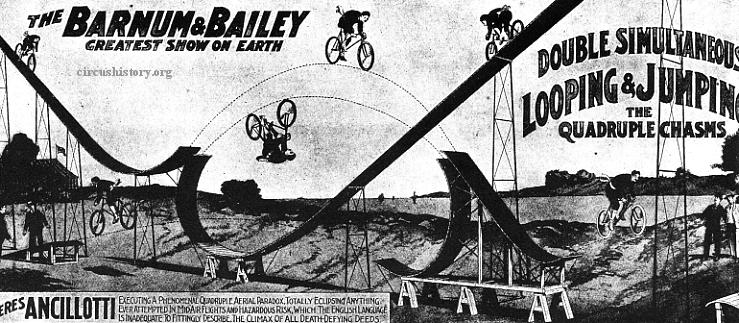
By 1905 Barnum & Bailey really sensed the value at the box office of the jumping bicycles and automobiles. Mr. Ugo Ancillotti added a brother and another ramp to his act for his second tour with the "Greatest Show on Earth". The 1905 Realm described Ancillotti's act as follows. "The construction of the apparatus consists of two inclines, or chutes, set wide apart, each at an angle of forty-five degrees. The continuity of one of these inclines is interrupted at about the middle of its length with a hiatus or opening, and at about the same place in the other incline is a break made by the loop the gap, which is the loop the loop with a section removed, leaving an open space. Near the extremities or breaks, over which the cyclists must leap before their feat is finished. Two iron-nerved artists - Les Freres Ancilliotti - start from the apices of these double inclines on staunch, specially constructed bicycles, and at a signal push their wheels from the 'rest' to a point where the decent begins and go coasting down the dangerous narrow way at lightning speed. One reaching the first gulf in the incline, takes a sudden turn upward and forward, seeming to soar away in space to a giddy height, clearing the forty-five-foot gulf and landing gracefully, but with a thundering thud, on the second section of the structure. From here without an instant's delay, acquiring additional speed, he continues on when he is again seen to shoot far up in the air, clearing another casm thirty feet wide, when suddenly striking the opposite side, or third section of the incline, he wheels down the hippodrome track.
The other rider, starting even with the first one, races down the incline, with even a more frightening momentum until reaching the loop with the gap, when, quick as light, and half circling the loop, flies across the deadly open space, while wheel and rider are upside down. By centrifugal force alone, the wheel and rider are propelled across the open gap in an inverted position, and striking the opposite of the open loop with a resounding thwack the finish of the broken circle is successfully accomplished amid silent wonder on the part of the spectators.
At the precise moment one brother is leaping the gap, in space in an inverted position, his body underneath the wheel, his head pointed to the ground, the other brother also in midair, is in the act of passing him while flying across the forty-five foot abyss. Both brothers are seen in this curious situation with not more than a few feet of space separating them. Both riders are seen in the air for a brief second of time, going the same direction, when, as a matter of fact, the exploit causes them to strike the earth at the end of the chutes and take opposite paths."
The act worked successfully during the New York 1905 Garden date, but a note in the route book of that season states that Ferdinand Ancillotti had a bad fall during the "loop the gap" act at the night show and sustained serious injuries at the opening under canvas in Brooklyn on April 24, 1905. This may well have been the final presentation of the act, as it is not listed in a program used by the show during early June dates in Ohio. Volo and his bicycle jump are listed, so he must have been placed back in the show with his 1904 routine.
The real sensation of the 1905 Barnum & Bailey performance was "L'Auto-Bolide, a dip of death which makes looping the loop a play-full pastime". This act was spotted by an agent in Paris, France.
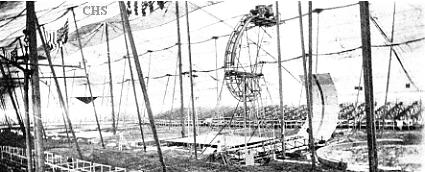 Photo: This rigging used for the "L'Auto Bolide" auto act on Barnum & Bailey in 1905-06-07 is shown between the end ring and a stage. Pfening Collection.
An immense amount of apparatus was required for this act. So much in fact, that it was the closing number in the afternoon, but was display Number 16 at night, so there would be adequate time to tear down the rigging before the end of the night show. The illustration best illustrates the path of the car. However the one big difference between this and other riggings was that a steel rail was used much like on a roller coaster to hold the car as it went underneath the curve before taking off into space to connect with the opposite curved section. The rider was a young French lady named Mlle. Mauricia De Tiers. The act was presented by an American girl Isabella Butler in 1906 and 1907.
Feeling the need of two thrill loop acts for the Madison Square Garden date in the spring of 1906 the Barnum show presented in addition to the "dip of death" a second auto act with a lady passenger.
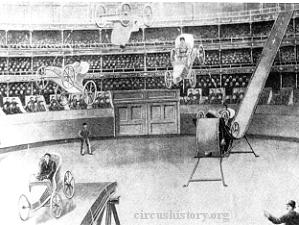 Photo: "The Limit" was the first mid-air loop the loop act to be performed by a woman. It was used during the New York stand of Barnum & Bailey in 1908.
This one called "The Limit" was the first true loop the loop in mid-air, using essentially the same type rigging as the one now at Baraboo. In this one Mlle. Octavia Le Tour, according to the New York Evening Post of March 23, 1906, risked her life strapped in an automobile, dashed down a dizzy incline and was hurled after turning a complete somersault in space, upon a padded aid railed gang way twenty feet away from the end of the incline. A four page newspaper size reprint of the various reviews of the 1906 New York date played up "The Limit" as the big act of the show. However the fate of Mile. La Tour and her auto following the New York date is unknown as she is not listed in the road program nor in the 1906 route book.
She may have been the lady presenting the same act on the Carl Hagenback show later in 1906.
In 1907 an identical mid-air auto somersault act appeared with the Forepaugh-Sells circus. The program lists Mlle. Yvonne La Roaque, weighing 150 pounds with her car weighing 1,200 pounds, racing down a 65 foot ramp and turning a somersault. Here again the big program climax at the matinee was presented between displays 2 and 3 at night to allow time to slough the rigging.
For the 1908 season Barnum & Bailey imported yet another auto thrill act, with yet another embellishment. This one presented the "Sisters La Rague" with two cars, using a 90 foot runway. Billed as an aerial auto race, one car painted red dashed down the runway striking an obstruction that tossed it into space for a mid-air somersault, while the other car painted blue followed closely, passing smoothly over the dropped obstruction and jumping under the red car, in a somersaulting position, to a landing ramp, just ahead of the red car that had left the top of the ramp first. These two French gals were back for the 1909 tour, which was the last year that the Greatest Show on Earth used an auto or bicycle thrill act.
The Gregg rigging at Baraboo, uses two cars in a similar fashion.
Although both the Barnum and Forepaugh shows were owned by the Ringling Brothers, the "World's Greatest Shows" did not use a thrill act of the loop type until the 1906 season. That year the Ringling Bros. Circus presented "Herr Fuss" and his bicycle mid-air somersault.
In 1907 "Mlle. La Bell Roche" presented an act in which she and her auto raced down a ramp to shoot off and up into space for a double mid-air somersault. She was back for the 1908 and 1909 seasons and that was the last appearance of an auto thrill act with Ringling.
The Frank A. Robbins Circus presented a bicycle ramp jump in 1909. Sun Bros. Circus presented "De Fio'' a chimpanzee in a double auto loop act, and featured it in their newspaper ads in 1907. Martin Downs' Cole Bros. Circus used "Mlle. D'Zizzi" in a bicycle jump act as a free attraction, presented right after the parade; she continued with the show in 1907. Later Cole show ads illustrated the bicycle jump, when the show was under ownership of W. H. Coulter, but these were no doubt "litho house" ads and may not mean that the act was actually there.
The final season, during this period, for an auto somersaulting act was in 1911 when the revived Adam Forepaugh & Sells Bros. Circus featured "Mlle. Marie Petardo" doing a double turn in mid-air.
In 1913 Downie & Wheeler Circus featured the "Great Reynard" in a bike aerial jump. Frank A. Robbins had a man coming down a ramp on his head on a single roller skate in 1915.
In 1938 Adkins & Terrell imported a French act the "Great Florinzo". Special paper was made up by the Erie Lithograph Co. and the act was featured in the show's newspaper ads, depicting a triple mid-air somersault. This act was beset with problems from the start, and although the rigging was set up each day, brother Florenze did not perform at every show. The writer remembers seeing the act, or rather the rigging, during the Columbus, Ohio stand in 1938. I don't believe he worked the matinee, and remember some excuse being given.
Bob Parkinson remembers seeing Florenzo in a wheel chair and "Mrs. Florenzo" actually doing the loop during the closing stand of Cole at Bloomington, Illinois in 1938.
The Rasini Rocket Car, was used on some of the Hamid-Morton Circus indoor dates around 1940.
So the "Ride of Death" has had a long and varied history with the American circus. It is interesting to note that the concentration of the auto thrill acts was in the period from 1904 to 1911. Perhaps this was due to two things, one - shows of that period traditionally closed their performances with a "thrill" type act, and two - the automobile in itself was a novelty. The bicycle loop and jumping act was a natural companion, and in fact it would appear that the auto acts were inspired by the bicycle acts. In either case most of the people, both men and women, performing these acts were French, and in all but a few cases the acts were originated in Europe with the rigging being built in Europe and brought to this country. In the case of the "L'Auto Bolide" act on Barnum & Bailey an American girl performed using the European rigging.
One might guess that a name like "Horace Mohn" sounds American and he appears to have been the first to perform the auto loop, in a barrell typo rigging, during the 1904 season on the John Robinson show. But the "free flight" mid-air somersaulting acts all came from Europe. All of the individuals performing these feats must have been truly unusual people, in fact one wonders if they were all nuts.
The news announcement from the Circus World Museum advises that the Swensen loop rigging will be completely reconditioned during this coming summer, painted and tested and starting in 1970 it will be presented on a daily basis at the Baraboo museum.
During the opening day of the 1969 season of the Circus World Museum on May 10, one wag was heard to say that he understood Hallie Olstadt and Paul Ingrassia planned to make the triple loop ride on alternating weekends during the summer of 1970.
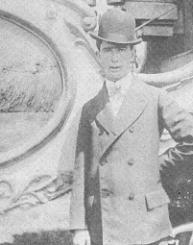 Photo No. 1 - Carey Elton who was steam calliope player on the Miller Bros. & Arlington's 101 Ranch Wild West Show from 1909 through 1914 seasons standing beside the old Adam Forepaugh steamer owned by Fred R. Castle. Elton played his calliope on the 101 show during the 1909 season. Tommy White collection.
This very difficult task of supplementing Chang Reynold's superb history of the "First" 101 Ranch show which appeared in the Jan.-Feb. 1969 Bandwagon by attempting to give the story of the show's various steam calliopes would have been impossible at this time without the help and cooperation of fellow CHS member, Tommy A. White of Jacksonville, Fla.
Shortly after the 101 Ranch history appeared in Bandwagon Tommy called me one Sunday afternoon and suggested that I write a supplement on the show's steam calliopes. He gave his permission to print any of his photos he had been reserving for his book on calliopes he hopes to have published in the future. Tommy said he felt these photos should be printed now so as to add further information to this great history of the Ranch show by Reynolds. I had previously seen these very rare and remarkable photos and informed him of my pleasure that Bandwagon could print them. Tommy also sent some notes he had on all of the Ranch steamers.
Even with White's information plus that from several other sources the full story of the 101 Ranch's steam calliopes is not complete. It seems strange but true that for some reason photographers neglected to photograph the calliope while there is no scarcity of shots of most of the other parade equipment - all except for the initial 1908 season when the show first became a rolling attraction on rails playing daily stands. As author Reynolds mentioned in his article no photos at all have turned up to inform the circus historian as to the nature of parade equipment that year so consequently there is no evidence available in photographs as to the steam calliope carried that year. In fact no real evidence has turned up that one was carried at all in 1908 despite fact show advertised for a calliope player in the Jan. 25, 1908 Billboard.
In Reynolds' article he quoted several sources of information which indicated that the first steam calliope used by the 101 show was an old Forepaugh relic. With the Tommy White collection of photos this can almost be proven with certainty to have been correct information. It seems for sure the old Adam Forepaugh steamer was used by the Ranch show in 1909, it's second season as a moving rail show, and unless some still "unknown" calliope was used in 1908 then it was definitely the first.
The reader is referred to "The Forepaugh Calliope and Fred R. Castle" by Fred D. Pfening III which appeared in the Nov.-Dec. 1965 Bandwagon and also to Readers' Comments in the Mar.-Apr. 1967 Bandwagon. In these two articles the full history and numerous photos are shown of this calliope which was obtained by Fred Castle and rented to many shows over a number of years. Since publication of the above named articles still further information has turned up in the Nov. 21, 1908 Billboard which stated that Fred Castle would have the old Forepaugh steamer on the 101 Ranch Show for the coming 1909 season. Some have suggested perhaps Castle also had his steamer on the Ranch show in 1908 but the same Billboard article said the calliope had been on the Parker Carnival for the 1908 season just concluded.
Tommy White became acquainted some years ago with the late Carey Elton (born April 8, 1885, died Sept. 13, 1963) who joined the 101 Ranch Show as a steam calliope player on April 4, 1909 and remained thru the 1914 season. Elton gave White a number of photos of the calliopes he played during those years with the Ranch show.
Please refer to Photo No. 1 which shows Elton standing in front of Fred Castle's old Forepaugh steam calliope. Enough of the wagon is shown to positively identify it as such. Regretably Elton had passed away before the matter of the 101 calliopes came up so that he could not be questioned for more details about this particular photo however White (and the author) are convinced Elton did play this calliope during his first season (1909) with the Ranch show. With information from the Billboard article mentioned before, this photo, and testimony of former troupers on the show it seems in all probability the "first" calliope ever used by the Ranch show was Fred Castle's Forepaugh steamer. However, it certainly didn't look old and dilapidated even if it did go back at least as far as 1880 (30 years before) as Castle kept it in the best of condition. The Forepaugh calliope was on the show only for the 1909 season. In 1910 it was replaced by the one shown in Photo No. 2. This shot pictures Elton and his unidentified fireman standing beside the steamer with a six horse hitch, driver and helper in the seat, and evidently all ready to make the daily street parade. This wagon as can be observed seems to be rather unprofessionally put together and it is my guess it was built by the Ranch's own forces using carvings supplied from one of several available sources such as Beggs, Spanjer's, Bode, etc.
Now it must be recalled that Reynolds in his article mentioned that Edward Arlington purchased in 1910 among other items from the sale of Norris & Rowe equipment at Peru a Kratz 37 whistle steam calliope and logically assumed it went on the 101 Ranch show. Conceivably the instrument did go into the wagon shown in Photo No. 2 however another Elton photo shows the interior of the wagon with detail of the whistles etc. and it doesn't appear to have had 87 whistles but still the Billboard description could be in error and the instrument could be from Norris & Rowe. Certainly it would not have been unusual to have constructed a new wagon to house the instrument. Here let me mention that the wagon historian has more problems in the tracing of calliopes from show to show than for bandwagons and tableaux. When the trade publications or some document will mention sale, purchase, or destruction by wreck or otherwise of a calliope the historian is often frustrated to know if it refers to a wagon and the instrument, the instrument alone, or even the wagon alone. In this case although no evidence in photos has turned up indicating the old Norris & Rowe calliope wagon was ever on the Ranch show and I don't believe it could have I shall readily conceed it possible the instrument did go into the wagon shown in Photo No. 2.
As mentioned in the Reynolds article and also in the Nov. 23, 1912 Billboard a train wreck of the 101 Ranch show destroyed several parade wagons including the calliope. The wagon in Photo No. 2 is almost certain to have been the one demolished but it is not without reason the instrument itself could have survived and with proper repair could have gone into the new wagon used for the first time in 1913.
The April 12, 1913 Billboard printed a photo showing the 3 newly acquired former Norris & Rowe tableau wagons the Ranch show got from William P. Hall. The same issue also said the 101 would have a new calliope. This is logical as one would be needed to replace the one lost in the 1912 wreck. Photos number 3 and 4 show the "new" Ranch calliope which was the final one used by the show. Possibly this wagon could have been built by a professional wagon firm but it probably was built by the Ranch's own forces using carvings from a supplier to decorate the sides. The overall result does look a little more like a professional job than did the wagon it succeeded.
Unless a last minute photo shows up of this calliope taken on the show during the years 1913-16 we will have to go along with Photo No. 3 which was taken in 1917 on the Jess Willard-Buffalo Bill Show which was the title of the show after the Millers sold their interest to Arlington following the 1916 season.
The Willard show operated a single season and the equipment was then sold to the Horne Zoological Gardens Co. of Kansas City which in turn sold it off piecemeal to various circuses and carnivals including Yankee Robinson Circus, Morris Miller Great American Shows (carnival) and Veal Bros. Shows (carnival). The latter purchased the steam calliope and Billboard references as early as the summer of 1920 indicate it as being on Veal Bros.
The late Frank Farrell took Photo No. 4 showing the former Ranch steamer loaded on a Veal Bros, flat car in the rail yards of Macon, Ga. in the Spring of 1922. Note the detail of the carvings especially the steers heads which was typical for wild west shows.
Following the 1922 season the calliope then drops from sight following a series of unusual events. During the 1922 season John "Slim" Veal owner of the show was murdered by gun fire 'and shortly thereafter the show found itself in financial trouble and several attachments were filed. In early 1923 the attachments were lifted and Mrs. Veal was given control of the equipment. In February 1923 she sold the show to the Lew Dufour Exposition. Some years back Tom Parkinson interviewed Mr. Dufour (who is still living in 1969) and inquired about the steam calliope. Unfortunately Mr. Dufour did not recall it and could give no information about what finally happened to it. Thus this steamer, the final one used by the "First" 101 Ranch Show, passes into oblivion, following a pattern of many other old circus parade wagons which once into carnival hands soon fade out of sight and knowledge of circus historians.
No part of this publication may be reproduced in any form or means
Last modified February 2006.
without written permission of the author and the Circus Historical Society, Inc.