


Circus Historical Society
Bandwagon, March - April 1969
Back to Bandwagon Index
Bandwagon, Vol. 13, No. 2 (Mar-Apr), 1969. Note: Only some articles are included in this online edition. Many illustrations are not included. The Circus Historical Society does not guarantee the accuracy of information contained in the information in these online articles. Information should always be checked with additional sources.
Foreword - This is the final installment of the overall article covering The Gollmar Bros. 1924-25 and Heritage Bros. 1926 shows. The two previous installments appeared in the May-June and July-Aug. 1968 issues. Since the 10 car Gollmar Bros, show of 1925 became the basic property upon which the Heritage circus was framed the extensive equipment lists which appeared in previous installments will not be repeated. Only the additional equipment added by Heritage will be discussed in detail. As mentioned at the beginning of the article CHS member William Elbirn planned this series and did the research. When it became impossible for him to complete it he turned over all of his files to me to do the actual writing of the articles. In the following installment Arthur Heritage, part owner and general manager of Heritage Bros, and Joe Haworth Sr., legal adjuster for the show, will be quoted often. Mot of their statements come from interviews conducted with these gentlemen by Elbirn in 1962.
After Jerry Mugivan closed and repossessed the 10 car Gollmar Bros. show in October of 1925 he shipped the property to the West Baden, Ind. quarters where the entire show was kept intact so that he could sell it as a complete unit ready for the road. It was advertised for sale in the Dec. 5, 1925 Billboard and it was sold in a little over a month.
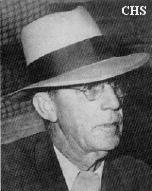 Photo: Arthur (Heritage) Hoffman was the side show manager on the Cole Bros. Circus in the middle 1940s. This photo of him appeared in the 1947 Cole route book. Pfening Collection.
During the early winter of 1925-26 a corporation was formed in Burlington, N. C. for the purpose of framing a railroad circus to go on the road during the coming 1926 season. Name of the new corporation was Heritage Bros. Circus Inc. and key man in the operation was Arthur Heritage who was in his middle 40's and had been connected with circuses usually in the operation of sideshows for many years. For almost ten years he had worked for Jerry Mugivan and Bert Bowers of the American Circus Corporation and in 1925 had been sideshow manager for Hagenbeck-Wallace. Although Heritage was his correct family name he usually went under the moniker of Arthur Hoffman. CHS member C. A. Red Sonnenburg, who was also active in circus business, during the same years as Heritage said that he knew both Arthur and his brother Al very well and described them both as being fine gentlemen and good people to work with or for. Red says he classes Arthur as one of the finest sideshow front men of all time and Al as one of the best 24 hour men ever. Al was also associated with his brother in operation of Heritage Bros, in 1926.
President of the new corporation was W. W. Workman, president of the Outdoor Advertising Company. Workman, a heavy investor in the show, stayed mainly in the background and his name was seldom used in the trade publications in connection with the show. Another major stockholder and one who was active in the operation was C. F. Neese. Both Heritage and Neese were from Burlington. The corporation was authorized to sell up to one hundred thousand dollars in common stock. Just how much stock was sold is not known to the author but a number of local Burlington residents were investors. Newspaper publicity played it up as "Burlington's own circus." The main individuals in control of the show were Heritage, Neese, and Workman. Arthur Heritage was named general manager and was given the primary job of organizing the show and taking it on tour in 1926.
In early January 1926 Heritage and his associates closed a deal with Jerry Mugivan of the American Circus Corporation for purchase of the Gollmar Bros, property which consisted of 2 stocks, 3 sleepers, and 5 flat cars plus all wagons, tentage, animals, equipment, in fact the complete 10 car show which Chester Monahan had operated for a month in the fall of 1925. The Gollmar title was not involved in the transaction although Mugivan still had another year to go on his 5 year lease of the title from the Gollmar family of Baraboo, Wis.
Title selected for the new circus was Heritage Bros. Trained Wild Animal Show.
The show world first learned of the developments concerning the new Heritage circus in the following article which appeared in the Jan. 30, 1926 Billboard.
"Heritage Interests Buy Gollmar Bros. Circus - from American Circus Corporation. Heritage show to have 3 Rings and Feature Animal Acts."
"Burlington, N. C. Jan. 23 - Arthur (Hoffman) Heritage, general manager of the Heritage Bros. Circus, recently organized here, and C. F. Neese, one of the stockholders, left Sunday for West Baden, Ind. to complete negotiations for the transportation to Burlington of a special train carrying the complete Gollmar Bros. Circus (10 cars) purchased by them from the American Circus Corporation. With the circus train will come a large group of trained wild animals, including lions, tigers, and pumas, and with them two well-known trainers - Capt. John Guilfoyle and Dolly Castle. It is now on it's way to Burlington. The show will be of 3 ring size featuring wild animals, and will also have a number of circus turns. It is expected that the show will open here some time in March.
"Ideal winter quarters have been established in a big electric lighted building 100 x 200 feet. There is also a separate building for the horses and other animals, quarters for the men and an up to date cookhouse. A large force of men is getting things in shape and laying 700 feet of track alongside of the buildings. A number of well-known bosses, trainers, and performers have already been engaged. Albert (Hoffman) Heritage is in charge of the office in the First National Bank Building.
"Eugene Patterson, of this city, will be the right hand man of Manager Heritage, according to an announcement made by him. He will be superintendent. Years ago he was known in the circus world as one of the few who could man the reins of a 16 horse team. Edmond S. Lyons will be master of transportation and D. Montgomery of Vancouver, Can. has wired his acceptance of a contract for concession rights."
Exact price paid for the Gollmar property is not known by the author. Heritage didn't disclose any info as to amount paid for the property nor any details of the transaction. Joe Haworth said that when his home (Haworth's) burned in 1958 all of his valuable momentos, notes, documents etc. were destroyed and he was only speaking from memory but if he recalled correctly the price was around $60,000 and there were three equal payments of $20,000 each. This figure sounds reasonable. In all probability Heritage made a down payment of 20 G's initially with the other two payments due at intervals during the season.
The Gollmar property arrived in Burlington on January 27. The train was unloaded and equipment stored in the quarter's buildings. Eugene Patterson was put in charge of all activities at the quarters. Joe Metcalfe was on hand to look after the 3 elephants, Mary, Prince, and Toto and Capt. John "Chubby" Guilfoyle was engaged to take charge of the menagerie and in training of the numerous wild animal acts to be featured in the program. Dolly Castle, who had worked some of the cats in an act on the Gollmar show in 1925, was also signed for the season and was now in quarters. The animals Guilfoyle was now working had been under the charge of Capt. Dutch Ricardo while on Gollmar Bros, the previous year.
In his interview Art Heritage in speaking of the program format for his show said that basically it was a wild animal show which was programmed on the lines of the then very popular Al G. Barnes Circus. He said, "we presented a nine male lion act, a five female lion act, eleven tiger act, a mixed group, tiger riding elephant act, and of course we had the usual dog, monkey, and elephant acts, one riding act, a five person wire act, a five person acrobatic act, girl trapeze number, and 8 or 10 clowns." As can be seen the show was heavy on caged wild animal acts and John "Chubby" Guilfoyle, one of the best trainers in the business, put together some outstanding numbers for a show of this size.
Although original plans called for keeping the show on 10 cars and correspondence in my files written by personnel of the show at the time definitely said the show would go out in 1926 on 10 cars it was later decided by Heritage and his associates to increase the size of the train to 15 cars. The Gollmar show had difficulty moving as a 10 car show the year before and Heritage felt it needed additional baggage stock, another tractor, and additional wagons to load it properly. A major need was also new grandstand seating.
A total of 5 cars were added. According to copies of railroad contracts for moving the Heritage show in the collection of Sverre O. Braathen the circus in 1926 had 1 advance, 4 stocks, 7 flats, and 3 sleepers making a total of 15. This would mean the 5 additional cars would be the advance, 2 stocks, and 2 flats.
It may be recalled Gollmar had no advance car, the advance travelling by box brigade, but Heritage felt he needed a car to bill his show adequately so he purchased a car right out of Pullman service for that use. It was an open end observation type and when Al Heritage, brother of Art, who was supervising the train and wagon painting at quarters got through with it the car was a beautiful sight. It was painted red, neatly titled, and was as attractive as any advance car on the road. The interior of the car was converted to provide ample living room for the 14 billposters and car manager and storage compartments and work areas. See Photo No. 1.
Unfortunately a scarcity of Heritage Bros, train photos make it impossible to get a look at the additional flats and stocks. It is not known definitely where the cars came from. Possibly from another circus or carnival or even from a railroad as did the advance car but best bet is that Heritage bought them from the surplus of the American Circus Corporation. Color scheme for the flats and stocks was yellow-orange and dark red for the sleepers according to Joe Haworth, who confirms the Billboard account that the Heritage train was painted orange and red. The Billboard states that the 3 sleepers were completely rebuilt and rearranged inside but it is doubtful much, if any, work was done on the former Gollmar flats as they had only been in use for one month the previous fall.
At least 3 new wagons were built at Burlington quarters by Supt. Gene Patterson and his crew. These included a wagon for a new light plant purchased by the show, a wagon for the dining department with an ice box on the front, and a 16 ft. arena wagon. A major item of construction at the quarters was new seating which included a 10 high grandstand. Possibly another wagon was added to load the new seats as space on the two additional flats would have been available. Definitely added was a new tractor to aid in moving the show on and off the lot.
One of the many woes that beset the enlarged Gollmar show in the fall of 1925 was the lack of adequate baggage stock and drivers. Heritage set about to remedy that and purchased two 8 horse teams before the show opened. Heritage recalled the show had 42 head of baggage stock in 1926 and about 20 wild west and ring horses, plus about that number of ponies.
Joe Haworth said that baggage wagons were painted a dark red, maroon color, and trimmed and lettered in gold (yellow). Photos indicate cages and tableau wagons to have been painted a variety of colors and shades.
In February the show purchased a large male one hump camel, a real whopper of an animal, who was named "Johar" according to the press boys but on the show he was called plain "Tom." He was a prize in the menagerie and even made an appearance in the performance.
Although it is assumed Heritage got all of the former Gollmar tentage it is possible some switching was done and he got a larger big top. This sounds reasonable. The Gollmar big top was only an 80 with three 40's but Heritage says he recalled the big top was somewhat larger, being a 100 ft. round with three 40's. The larger top would be more logical for a 15 car show and especially since the new seating could accommodate about 2000. The menagerie and smaller tentage was that of Gollmar's but Heritage, being an old sideshow man and knowing the value of a good top notch sideshow, purchased a new top and bannerline for the sideshow to give added flash on the midway. He recalls the tent was a 60 ft. round with three 30 ft. middles. In the July 31, 1926 Billboard there is a photo of the Heritage Bros, sideshow which pictures a large bannerline of ten double decked banners plus colorful entrance banner over the bally platform. Unfortunately the print is not of adequate quality to reproduce here but it does show that the Heritage show had a fine looking sideshow. A small No. 2 pit show was also carried.
Throughout the early months of 1926 the columns of the Billboard carried numerous accounts of the show's activities at the Burlington quarters. They mentioned the work being done, training of acts, staffers and other personnel being contracted for the season, in short the usual winter quarters chatter.
One of the first notices said that Bert P. Wallace, last season with Lee Bros. Circus, had been engaged as equestrian director and was now in quarters and in addition to lining up the performance was also busy breaking horses and ponies. Jack Bledsoe, signed as manager of the advance car, and Al Heritage, scheduled to be railroad contractor, were busy mapping the route and getting things in shape for the advance. Henry W. Link was hired as general agent a couple weeks later and he and Al Heritage soon left on a trip to line up the early weeks of the route. James Heritage was in charge of the wagon building and blacksmith departments and a force of thirty men were in quarters getting the show ready for the road.
The Feb. 13 Billboard said that the show had opened it's zoo to the public every Sunday afternoon and that 4000 visited the previous Sunday. The same issue also stated that Bert Wallace was working a 12 horse liberty act and that Mrs. Wallace was in charge of the wardrobe department with three assistants. A few weeks later Lawrence Cross took over the wardrobe department.
By late February staffers and bosses were coming on regularly now and the Feb. 20 Billboard stated that J. S. Muckle had been hired as steward, Frank P. Meister as bandleader, James (Frenchy) Healy, formerly with Hagenbeck-Wallace, as boss canvasman, and Jerry Talley as manager of the candy stands. Other notes of interest said that sideshow manager Harry L. Morris had hired Prof. Joe H. James band and minstrels for the sideshow, that Spot Conners, asst. to Bert Wallace, was training Shetland ponies, and "Barnum" Davis, domestic animal trainer, was breaking and training goats and dogs. A week later Mr. and Mrs. William Hopkins arrived in quarters with their dogs, monkeys, and trained mules which would appear in the big show performance.
In mid-March the show announced that Fred B. Hutchinson would be the assistant manager of the show. Hutchinson was a most capable and experienced circus man having been with most of the big shows including Barnum & Bailey, Forepaugh, Hagenbeck-Wallace, and Sells-Floto. In the years 1920-22 he had been part owner of the 10 car Campbell-Bailey-Hutchinson Circus. At same time of the Hutchinson announcement it was also told that Pete Neese, Heritage's brother in law, would be in the performance with his Australian whip cracking turn.
The March 20 Billboard stated that the show's opening date had been set for April 3 in the quarter's town of Burlington, N.C. News of training activities continued on until opening date and it was mentioned that Bert Wallace had his 6 high school horses and 12 liberty act in fine shape, and Chubby Guilfoyle had a mixed group of 10 tigers and 6 lions all ready. Dolly Castle had completed her act. Title of the show's opening spec was announced as "Tiger Hunt of the Maharajah" and the show claimed it would use all new wardrobe for it. Joe Metcalf had taught one of the bulls, "Prince," to do the Charleston, the dance rage of the times.
The complete Heritage Bros. 1926 roster of staffers was as follows:
Heritage Bros. Circus Inc., owner; Arthur Heritage, general manager; Fred B. Hutchinson, asst. manager; M. W. McPherson, treasurer; Z. V. McClure, secretary; Henry W. Link, general agent; Albert Heritage, railroad contractor; James Beach, local contractor and advance press agent; W. C. Clark, press agent with show; Harry L. Morris, manager of sideshow; Bert P. Wallace, equestrian director; Eugene Patterson, gen. supt.; N. J. Talley, supt. privileges; Frank P. Meister, musical director; Don Montgomery, supt. reserve tickets; James (Frenchy) Healy, supt. canvas; F. L. Smith, trainmaster; J. S. Muckle, supt. commissary dept.; H. L. Merwin, supt. lights; E. H. Davis, supt. props; A. J. Griffin, supt. ring stock; A. Gilson, supt. working crew; Joe Metcalfe, supt. elephants; Capt. John Guilfoyle, supt. animals; Jack Bledsoe, mgr. advertising car No. 1; W. C. Chapman, legal adjuster - later replaced by Joe Haworth; B. P. Wallace, announcer.
The show presented a colorful daily street parade which was on par with parades of a show this size. A Billboard reporter described the opening day parade as having 4 bands (probably big show band split into two sections, sideshow band, and clown band), a calliope (air), 8 open cages, 3 tableau wagons, a band of Sioux Indians, and Jack Rhinehart and his 10 cowboys and cowgirls. Also present were the 3 elephants, lead stock, and numerous mounted people. A reviewer who visited the show in June said the elephants were in the middle of the parade rather than at the customary place in the rear. Only real thing missing in the parade was a steam calliope.
It might be significant to mention that 3 more large railroad circuses eliminated their street parades for the 1926 season. These were the American Circus Corporation owned Sells-Floto, Hagenbeck-Wallace, and John Robinson circuses. Actually the Corporation had dispensed with parades at the beginning of the 1925 season but after a month restored them on all 3 units. Now the 5 largest circuses in the land had quit parading. In addition to the above mentioned Corporation shows Ringling-Barnum gave up parade after the 1920 season and Al G. Barnes quit the march in mid-season 1924. Despite the press propaganda of the non-paraders that the street parade was now a thing of the past actually there were still more railroad shows parading than those that were not. Railroads (flat car type) still parading included Sparks, Christy Bros., Lee Bros., Robbins Bros., Walter L. Main, Gentry Bros., Heritage Bros., and the 101 Ranch Wild West Show. Most of the mud shows still retained the traditional daily parade at noon.
As April came around the 1926 season was at hand and Heritage Bros, was ready to roll. The circus world optimistically awaited a new season. They expected good takes and very few were disappointed. History would later record that circuses were in the big money years of the middle and late 1920's. After the rough and sporatic seasons many shows suffered in the early 20's most circuses were now coining the dough and the lush years wouldn't end until the great depression came on in 1930. Of course as is true in even the best of seasons some show can't make it for one reason or another. Unfortunately Heritage as we shall see was one of these, but generally 1926 was a red one for circuses and all types of outdoor amusements. In addition to the flat car circuses listed above there were a goodly number of other shows ready to answer the starting bell, including Elmer Jones' 2 car Cooper Bros. Circus (gilly type) and fully 25 or more mud shows, most of them traveling with a combination of trucks and wagons. For 1926 Andrew Downie framed and put on the road a large completely motorized circus with the title of Downie Bros, and the success of this show would start a trend which by 1930 would see practically all mudders fully motorized.
The new Heritage Bros. Circus opened the 1926 season April 3 at Burlington, N. C. and the April 17 Billboard reported the event as follows:
"Splendid Opening for Heritage Show. Starts Season at Burlington, N.C. - Animal Acts are Major Part of Program."
"The Heritage Bros. Trained Wild Animal Circus gave its' initial performance of the season at Burlington, N.C. where the show had wintered, on April 3. The weather was clear and the show had two packed houses. Excellent business also was done at Durham and Raleigh, the next stands, weather conditions being good.
"The program is made up of the following: Spectacle; pony drills, Billy Hopkins and Billy Woody; clown number; bear act, Cleo Wallace; swinging ladder and perch; bucking mule; female lions, Dolly Castle; barber-shop elephant, Joe Metcalf, clown number; McKone Family of acrobats, and Billy Woody, contortionist; riding dogs, Billy Hopkins and Cleo Wallace, and riding lion, Peggy Carlton; clown number; Jack Rinehart and his Wild West; clown number; goat act, Dinkie Moor, and dog act, Billy Hopkins; clown number; hurdle mule, Billy Hopkins; posing horses, Cleo Wallace, Peggy Carlton, Jewell Rinehart; clown number, riding goat, Peggy Carlton; leopards and pumas, Dolly Castle, and riding dog and monk, Cleo Wallace; big elephant turn, Joe Metcalf; single trapeze, Billy Woody and W. C. Sykes; "largest camel" announcement; clown number; male lions, Clyde Welch; wire act, McKone Family; clown number; menage horses, Cleo Wallace, Jewell Rinehart, and Bye Rinehart; crazy number; big male lion and tiger mixed group turn, Chubby Guilfoyle.
"The News and Observer of Raleigh, N.C. in its issue of April 7 commented on the show as follows; 'Taking into consideration the fact that the performances yesterday marked the third appearance of the Heritage show before the public, the exhibitions were considered to be on a par with many of the better-known shows travelling the country. Animal acts are the big bets of the show and performers were applauded frequently for their ability to make the former inmates of the African jungles do their stuff."
Favorable comments poured in on the new show and Harry L. Morris wrote in Under the Marquee column of the same Bilboard that the show had a fine opening in Burlington playing to two big houses and also that his sideshow and pit show had a big day's business.
As can be seen from the opening review the show had a total of 6 wild animal acts in the steel arena which remained in place during the entire performance. The nut for the performance was evidently quite heavy. CHS A. Robert Hall has in his collection a Heritage Bros, performer's contract for Hansford Harvey. It specified Mr. Harvey was to do clowning and be generally useful for which he was to be paid the sum of $8.00 weekly.
As mentioned before Arthur Heritage was highly experienced in sideshow operation and saw to it that the sideshow was of top notch quality and framed to be a money winner. Lineup for the main sideshow had Prof. Joe James, band and minstrels; the Three Camerons, Scottish bagpipers playing 14 instruments; Mr. Knauff, sword-box illusion; Mrs. Kanauff, seance cabinet act; Miss Volcano, fire eater; Princess Helena and Hilsa, Hawaiian dancers; Miss Mentality, mindreading and horoscopes, and "Peggy from Paris" who danced in the Night in Paris spectacle. "Peggy" was one of several female impersonators with the show during the season. These "girls" danced in the sideshow, in the main show spec, worked the clown come-in, and appeared in aerial numbers.
By 1926 the largest rail shows had dispensed with joints and grift but most of the small and medium railers continued to carry the "traditional" grift, a notable exception being the 20 car Sparks Circus. When asked about grift on Heritage Bros., Arthur Heritage said as follows, "We carried joints and the best cooch, and all the trimmings. And just here I want to make mention of one who I think was the best fixer that I have known, and the first fixing he ever did was with the Heritage Bros. Circus, and that is Joe Haworth. My choosing him as my fixer was the smartest thing I did for my circus and for circuses to follow. Joe Haworth, was not only my fixer, but a loyal friend who fought every inch of the way for me."
Joe Haworth when questioned about this belittled his own talents as a fixer and said you would hardly know there was any grift around the show and there was no trouble while he was with it. Oddly enough there seemed to be little heat generated by the joints and no mention of any was made in the trade publications which never failed to play up reports of trouble along this line and did so many times on other shows in 1926.
Joints usually carried by circuses in those days included nuts (shell game) and broads (3 card monte) which were worked in the sideshow and slots which were carried in the pie car to siphon off the extra change in pockets of the performers and working crew. Also working in the sideshow were cooch dancers and the ever present blowoff. Heritage didn't say if the show had the connection racket or not which was usually present on grift shows, but show did work the reserve seat squeeze, a mild racket which persists on many shows even to this day, as he said the big top which would seat 2000 had mostly reserves. However despite the show carrying some grift Heritage did not run a rough and tumble red-hot grifter as did Chester Monahan with Gollmar Bros, the previous year. He was good to his people, paid them as contracted and on time, and was well liked by personnel on the show and in the industry.
At the season's second stand at Durham, N.C. Chubby Guilfoyle, who during his career had a number of series accidents in the steel arena including the loss of an arm, suffered a eye injury during the matinee performance. The April 17 Billboard described the accident as follows:
"Guilfoyle Painfully Injured. When Lion of Heritage Bros. Circus Clawed him in Eye - Leopard Killed in Fight.
"Durham, N.C. - April 8 - Captain John (Chubby) Guilfoyle's left eye was painfully injured by the slap of a lion, two leopards fought a death fight and two bears had a fierce round as unannounced thrills on the program of the Heritage Bros. Circus here Monday. Guilfoyle received the injury from the lion's claw during the afternoon animal act.
"The fight of the leopards followed their return to the cage after the afternoon performance. Attendants were unable to stop the encounter until one leopard had received his death wound, dying a few minutes later. The bear combat came in the morning during the parade, while one of the heavy wagons was mired in soft earth thrown up for a water main ditch. While it was fierce for a time, attendants were able to separate the beasts before either received serious injury.
"Despite its newness, the circus was admittedly of a high class and enjoyed by the large crowds."
The official route printed with this article is copied directly from the show's day by day ledger. Events listed by certain stands are reprinted exactly as they were entered on the ledger. The sequence of stands during a few weeks is somewhat different from the Heritage route circulated by the late E. W. Adams, however Adams compiled his mainly from that printed in the Billboard and since the route here is from official show records it is considered to be accurate. It is a valuable documentation for this article.
The first two weeks of the season were spent in North Carolina to only fair business which was considered to be okay due to some very rough Spring weather at many stands. As indicated in the notation on the route the show had a blowdown at Sanford on April 8 causing loss of the matinee and Monroe on the 13th was a complete loss due to heavy rains and a sea of mud. An interesting notation concerns the next day's stand at Wadesboro where because of the long and rough (mud no doubt) haul only the sideshow operated, but old sideshow man, Art Heritage, wasn't going to let the day be completely spoiled so he made a pitch under the circumstances to get what he could out of the stand.
The show entered Virginia April 20 at Martinsville and then crossed the state and on into and thru West Virginia going into Pennsylvania at Point Marion on May 5. This part of the country was early Spring territory for a number of shows and there was considerable competition all thru the area. Sparks, John Robinson, and the two King owned shows, Walter L. Main and Gentry Bros, were railroaders playing around and a number of mud shows such as Mighty Haag and M. L. Clark were always to be found close by in early Spring. Although I have found no evidence of any other shows playing in the same towns as Heritage it was still the practice of railroad shows to bill the territory for miles around to attempt to pull what patronage they could from other towns in the area.
Railroad service was generally good and the Heritage train moved usually in fine time getting the show into town in ample time for setup, parade, and matinee. An example of the cost of moving the Heritage 15 car train in 1926 can be found in the copies of official C. & N.W. Railroad contracts in the collection of Sverre O. Braathen as follows:
Wood Street, Chicago to Des Plaines, Ill. - $308.00.
Des Plaines to Woodstock, Ill. - $308.00.
Woodstock, Ill. to Ft. Atkinson, Wis. - $343.00.
Ft. Atkinson, Wis. to Watertown, Wis. - $308.00.
Total Contract - $1267.00.
After five stands in Pennsylvania the show turned westward into Ohio with first stand coming at Toronto on May 11. The matinee at Toronto was lost due to a late arrival caused by a wreck of the show's train at Weirton Junction, W. Va. The show was en-route from Cannonsburg, Pa. to Toronto when several cars jumped the tracks in the yards and according to the Billboard two flats were destroyed. However, it is felt they were not destroyed beyond repair and in all probability they later returned to the show. It was the custom for the railroad to furnish system flats when such accidents occurred and this is probably what happened here. Fortunately no one was injured in the mishap.
Art Heritage told the May 22 Billboard that the show had encountered all sorts of weather during the past three weeks and business had been big, good, and fair. Joe Haworth in his 1962 interview said that after the first 40 days of the season which saw spotty business the show became a constant winner on thru the conclusion of its Canadian tour.
After 10 Ohio stands the show entered Indiana for 3 dates which were followed by two in Illinois.
A Billboard reporter visited the show at Des Plaines, Ill. on May 26 and wrote that Charles Celeste, internationally known wire walker, had joined the show at Toronto, Ohio and was now working under the name of the "Great Swing." In addition to his swinging wire turn he was doing the rube come-in. The street parade drew favorable comments from the reporter as did the excellence of the reserve seat section. It was noted there were 8 clowns with the show.
Wisconsin came next and the show remained in the state continuously until June 14 with exception of going into Michigan on June 11 for a stand at Ironwood. At Water town, Wis. Tommy Lynch, the calliope player, was injured when struck by a bus while returning to the train after the evening performance. While working the come-in at Superior, Wis. the Great Swing unfortunately stepped in a hole injuring his right leg and as a result was not able to present his wire act for several days. Very close opposition came at Hartford, Wis. where the show was followed in a few days by Orange Bros, and Moon Bros. Combined Circus, a fair sized mud show owned by William Newton. While in Wisconsin the show drew some good reviews in the local press with an especially good one following the June 5 stand at Ripon.
The June 12 Billboard gave a good summary of recent events on the Heritage show. Don Montgomery succeeded Bert Wallace as equestrian director and revamped the opening spec into a larger number with new wardrobe and music. Title of the new spec was "The American Hunter in the Jungles." W. L. Clark, press agent, wrote the script for it. Montgomery also put in a hunting scene, high-jumping horse numbers, and Roman Standing races to close the program. The show's recent business had been good and was outstanding at Columbia City and Warsaw, both in Indiana. Manager Heritage entertained a number of visitors from Peru at Warsaw including Jerry Mugivan and Bert Bowers of the American Circus Corporation. It was mentioned that the street parade was making a big hit everywhere and that Frank Meister's band had been well received. The show was moving along in fine order and the advance car reported it had lost only one day's billing since opening day. The car now had a 15 man crew.
An important segment of the show's route was to be a three week tour of the Western Canadian provinces of Manitoba, Saskatchewan, Alberta, and British Columbia. Art Heritage personally went on tour with the advance to line it up as this area could make or break the show in short order. It was felt this part of Canada would be prime circus territory as agricultural and business conditions were good. Other shows were also of the same opinion and Al G. Barnes, Sells-Floto, and Lee Bros, also played the territory during the season. Heritage returned to his show at Plymouth, Wis. on June 7 with all details for the Canadian tour worked out.
After leaving Wisconsin the show had scheduled three stands in Minnesota but the final one June 17 at Thief River Falls was lost due to heavy rains.
The show entered Canada the next day with the first stand coming at Emerson, Manitoba which produced the first turnaway of the season. This initial stand was an indication that the show had made the right move by routing into western Canada at this time. It was cold and rainy during most of the Manitoba stands but the show had surprisingly good business. At Morris it poured all day but attendance was very good.
During the early days in Canada the show got it's third equestrian director of the season when Charles Berry, formerly with Al G. Barnes and John Robinson, joined. He proceeded to put in another new spec, also the third use in the season. It was titled "Little Red Riding Hood," with Hattie Guilfoyle in the title roll and Celeste (Great Swing) as the King of the Jungles. Peggy Waddell, female impersonator, did the main dance in the arena. During the next few weeks the spec was continually improved with new wardrobe made by Lawrence Cross. By time the show got back into the states the Billboard reported the spec was drawing fine comments and was a major production with Billie Hopkins as the prima donna and Billie Burke and Peggy Carlton principal dancers with a ballet of 8.
The good business in Canada gave optimism to the show's management and improvements were made in all departments. A new performance feature was added with W. C. Sykes, chair-balancing trapeze number and the aerial ladder number was increased to 9. New parade wardrobe was made and the show ordered a new big top for the menagerie. A new coat of paint was put on all cage and parade wagons and Chubby Guilfoyle purchased 6 new brown bears and began breaking them into an act. The sideshow and pit shows also had very good business while the show was in the Dominion.
The Canadian tour took the show westward thru Saskatchewan, Alberta, and finally into British Columbia. The weather improved and it was great trouping thru the beautiful Canadian rockies. On July 11 while enroute from Cranbrook to Nelson, B. C. the show's train had a boat ride of 47 miles crossing Lake Kootenay in the heart of the Canadian rockies. Cars were loaded on a barge which was towed by a large steamer.
The entire Canadian tour was termed as very satisfactory as the show re-entered the states at Colville, Wash, for a stand on July 15.
First stands back in the states gave good business and it was reported that crops in the area were good and the weather favorable. Lee Bros. Circus, a 15 car show owned by George W. Christy and managed by Louis Chase, was now in the same area and it had generally traversed the same territory thru western Canada as had Heritage but by comparison of routes of both shows I cannot find a single stand which was played by both shows. They were only 30 miles apart on July 19 when both were in Idaho, Heritage being at Sand Point and Lee Bros, at Bonners Ferry. Much visiting took place between the two shows, and on July 23 while Heritage was at Dayton, Wash, manager Louis Chase of Lee Bros came over for a visit and was the guest of Arthur Heritage.
After entering the states Heritage played 3 stands in Washington, went into Idaho for a single date, then back into Washington for 4 more stands before moving into Oregon on July 24. The show then proceeded southwesterly thru Oregon and Idaho entering Utah on August 2 at Logan and remained in that state for two full weeks. On July 26 while the show was playing Pendleton, Ore. Manager Heritage and James Beach took off to Salt Lake City to pay a visit to the Al G. Barnes Circus.
Although Heritage had told the Billboard that prospects looked good for the show and that he was preparing for a long season in the south, fact of the matter was, a sharp drop in business had come about after the return to the states. Joe Haworth said the show began losing money soon after it left Canada. Heritage said that he had some losing days but no consistently long periods of bad business, but things did began getting rough for the show although it was moving along okay and making it's regular payrolls.
The show entered Colorado at Grand Junction on August 14, headed eastward and crossed the state in 9 stands before going into Kansas, Aug. 25 at La Crosse. It seems the show as it left Colorado and went into Kansas must have made some last minute switches in stands because even some of those listed on the final route card do not agree with those on the official ledger.
Evidently the show had defaulted or delayed on a payment due Mugivan as he put a plaster on the show with repossession of all physical properties at the fourth Kansas stand, August 28, at Stafford. Two performances were given at Stafford and then the show was seized by Mugivan. It remained overnight and Egypt Thompson, who was Mugivan's emmissary with the bad news, ordered it moved to Peru quarters the next day.
The sudden foreclosure took everyone on the show by surprise and most of all Manager Heritage. Performers and personnel were dumbfounded that the show had closed and could not understand it as all had been paid regularly and had felt the show would make out it's scheduled route. First news of the closing in the trade publications had it that the show had only closed temporarily and would soon start again on it's fall tour. Later it was officially announced the show had been shipped to Peru quarters and that the closing was permanent. It was said that the show had been going okay but some said it was handicapped due to the new title and that expenses back on the show had been too high. All members were paid in full at the close. Several weeks of routing had to be abandoned. The show had planned to go into Oklahoma following Kansas.
Heritage was furious about the turn of events maintaining that Mugivan had acted illegally in closing the show. He publicly said he would take the matter into court and sue Mugivan and did indeed make good his threat. The suit was filed in Federal Court in South Bend, Ind. but was not finally settled until December 1927. The following item appeared in the Dec. 17, 1927 Billboard and probably gives the final amount Heritage collected - $3,500 plus court costs, however Heritage in 1962 maintained he eventually collected all that he had sued for.
"Heritage Bros. Suit Against Mugivan Settled.
"South Bend, Ind. Dec. 10 - Holding that the evidence submitted in the case of the receiver of the Heritage Bros. Circus against Jerry Mugivan of Peru, was contradictory, the judge ordered a settlement out of court.
"The action was for $20,000 said to have been involved in the transfer of circus property by Mr. Mugivan to the Heritage Bros, concern in 1926. On final determination Mr. Mugivan, it is understood, agreed to pay $3,500 and trial costs as settlement of a judgment given by the court.
"The testimony of only three witnesses was hear by the court."
While the case was still in litigation Arthur Heritage again using the name of Hoffman entered into a partnership with Leo E. Crook and R. M. Harvey in organizing a 15 car railroad show in the spring of 1927. Title of the show was Cook & Cole's 3 Ring Circus. Bulk of the physical equipment came from F. J. Taylor of Omaha, Neb. who had used it on his short lived railroad circus bearing his name in 1925. Cook & Cole lasted only 11 stands with all equipment going back to Taylor. (See May-June 1963 Bandwagon with my article on the F. J. Taylor Circus for a full account of Cook & Cole).
To this day many questions are still unanswered concerning the sudden Heritage closing. Heritage surely had to be either in default or late with his payments for Mugivan to have obtained the court plaster in the first place. Maybe Heritage thought Mugivan had given him an extension but later changed his mind. There had to be some kind of shenanigans going on or Heritage would have had no basis for a suit and would have collected nothing thru the courts. Why did Mugivan close the show when evidently it was along fairly well and probably could have made it? When Joe Haworth was asked about this his answer was simple and direct. Mugivan wanted Arthur back as manager of the Hagenbeek-Wallace sideshow and was willing to close him out to get him. Mugivan, never at a loss for critics, was a shrewd business man and whenever he did finance other shows he always managed to get back his investment plus the equipment. Such was the case with T. A. Wolfe Shows, Gollmar Bros, and Chester Monahan in 1925, and Heritage in 1926. Mugivan also was one who valued very highly the services of his key personnel and would do everything possible to hold them, but when some did leave to go out on their own such as Heritage he'd stop at nothing to get them back.
However in the case of Arthur Heritage he never went back to work for Mugivan. He remained in circus business on through the 30's and 40's usually connected with sideshows, and more often serving as the manager.
In 1942 he joined as sideshow manager for Zack Terrell's 25 car railroad circus, Cole Bros., and remained in that position on thru the 1948 season until Terrell sold the show. Al Hoffman was 24 hour man and Joe Haworth was legal adjuster also on the Cole show during those years.
Arthur retired in the 50's and was living Spartanburg, S. C. when interviewed by Elbirn for this article in 1962. He died in 1967 at the age of 85. I regret he never lived to see this article in print.
Mugivan stored the Heritage property at the vast Peru quarters but it was never again used as a unit. Some of the wagons went on the various shows going out of Peru which Mugivan operated until he sold out to John Ringling in 1929. Even after then a few of the wagons still went on tour. The India or Jardiner tableau was used on Sells-Floto for a number of years and in 1934 the air calliope (ex Gentry twin) was used in the street parade of the big 50 car Hagenbeck-Wallace Circus.
Today there are only two pieces of equipment used by Heritage still in existence. In the Peru, Ind. museum there is a wagon panel containing the central carvings of the old India or Jardiner tableau, and in the Circus World Museum there is Cage No. 29, formerly of Sells-Floto, which was used by Heritage Bros. in l926. The cage has been fully restored. It was sold to Terrell Jacobs and thus escaped the great wagons burnings at Peru in November of 1941 and after a series of events finally came into possession of the Baraboo museum.
The 3 Heritage Bros, elephants went as follows. Toto, a rough little male tusker, was sold to the late Col. Bill Woodcock in 1927 for $600.00 but unfortunately the animal died only 62 days after Woodcock got him. Prince was in the Sells-Floto herd in 1927-28 and with Hagenbeck-Wallace in 1929-80. He was one of many elephants used in the Hollywood movie "Clive of India" filmed in 1935. In 1936 he killed his handler, Joe Reed, after which he was sent to the San Diego zoo where he died while swimming caused by a twisted intestine. Mary was on Schell Bros. Circus in 1929 and was sold to Cole Bros, in 1935. She was one of 3 elephants Clyde Beatty got in his settlement of the Cole Bros, bankruptcy following the 1938 disaster. From 1945-1950 she was a member of the Clyde Beatty Circus herd. She died on March 28, 1950 on the Clyde Beatty circus lot at Hill and Washington streets in Los Angeles.
The Heritage Bros, title was never used again and although Arthur continued to use the Hoffman name so long as he was in circus business I noted on his 1962 letters he was using printed stickers with his old family name of Heritage on them.
We are indebted to the following for aid in the preparation of this article; the late Arthur Heritage, the late Col. W. H. Woodcock, Joe Haworth Sr., Mel Miller of the Ringling Circus Museum, A. Robert Hall, Dick Conover, and Fred Pfening Jr.
Route of Heritage Bros. Trained Wild Animal Circus, season of 1926, as copied from the show's day ledger by W. E. Atwater (C. H. S.).
|
April 3, 1926 Burlington, N. C. (Winter Quarters)
SUNDAY: Durham, N. C. April 5. 1926 Raleigh, N. C. April 6, 1926 Fayetteville, N. C. April 8, 1926 Sanford, N. C. (No afternoon show, due to blow down) April 9, 1926 Rockingham, N. C. April 10, 1926 Lumberton, N. C. SUNDAY April 12, 1926 Laurenburg, N. C. April 13, 1926 Monroe, N. C. (Day lost, account rain & mud) April 14, 1926 Wadesboro, N. C. (Side show only, account of haul) April 15, 1926 Albemarle, N. C. April 16, 1926 Lexington, N. C. April 17, 1926 Winston-Salem, N. C. SUNDAY April 19, 1926 Madison, N. C. April 20, 1926 Martinsville, Va. April 21, 1926 Rocky Mount, Va. April 22, 1926 Buena Vista, Va. April 23, 1926 Clifton Forge, Va. April 24, 1926 Roncerverte, W. Va. SUNDAY April 26, 1926 Alderson, W. Va. April 27, 1926 Oak Hill, W. Va. April 28, 1926 St. Albans, W. Va. April 29, 1926 Madison, W. Va. April 30, 1926 Clendenin, W. Va. May 1, 1926 Gassaway, W. Va. SUNDAY May 3, 1926 Richwood, W. Va. May 4, 1926 Buchannon, W. Va. May 5, 1926 Point Marion, Pa. May 6, 1926 Millboro, Pa. May 7, 1926 Donora, Pa. May 8, 1926 Carnegie, Pa. SUNDAY May 10, 1926 Canonsburg, Pa. May 11, 1926 Toronto, Ohio (Afternoon lost, train wreck) May 12, 1926 Cadiz, Ohio May 13, 1926 Newcomerstown, Ohio May 14, 1926 Coshocton, Ohio May 15, 1926 Millersburg, Ohio SUNDAY May 17, 1926 Londonsville, Ohio May 18, 1926 Upper Sandusky, Ohio May 19, 1926 Ada, Ohio May 20, 1926 Delphos, Ohio May 21, 1926 Van Wert, Ohio May 22, 1926 Columbia City, Ind. SUNDAY May 24, 1926 Warsaw, Ind. May 25, 1926 Valparaiso, Ind. May 26, 1926 Des Plaines, Ill. (Afternoon Show missed) May 27, 1926 Woodstock, Ill. May 28, 1926 Ft. Atkinson, Wis. May 29, 1926 Watertown, Wis. SUNDAY May 31, 1926 Columbus, Wis. (Afternoon show lost acct. Memorial Day) June 1, 1926 Portage, Wisc. June 2, 1926 Beaver Dam, Wisc. June 3, 1926 Hartford, Wisc. June 4, 1926 Waupon, Wisc. June 5, 1926 Ripon, Wisc. SUNDAY June 7, 1926 Plymouth, Wisc. June 8, 1926 Two Rivers, Wisc. June 9, 1926 New London, Wisc. June 10, 1926 Antigo, Wisc. June 11, 1926 Ironwood, Mich. June 12, 1926 Ashland, Wisc. SUNDAY June 14, 1926 Superior, Wisc. June 15, 1926 Grand Rapids, Minn. June 16, 1926 Bemidji, Minn. June 17, 1926 Thief River Falls, Minn. (Day lost, due to rain) June 18, 1926 Emerson, Man. Canada June 19, 1926 Morris, Man. Canada SUNDAY |
June 21, 1926 Gladstone, Man. Canada
June 22, 1926 Carberry, Man. Canada June 23, 1926 Virden, Man. Canada June 24, 1926 Moosomiu, Sask. Canada June 25, 1926 Broadview, Sask. Canada June 26, 1926 Wolsley, Sask. Canada SUNDAY June 28, 1926 Indian Head, Sask. Canada June 29, 1926 Herbert, Sask. Canada June 30, 1926 Gull Lake, Sask. Canada July 1, 1926 Maple Creek, Sask. Canada (Night lost, due to rain) July 2, 1926 Taber, Alta. Canada July 3, 1926 Raymond, Alta. Canada SUNDAY July 5, 1926 High River, Alta. Canada July 6, 1926 Charlesholme, Alta. Canada July 7, 1926 Pincher Creek, Alta. Canada July 8, 1926 Blairmore, Alta. Canada July 9, 1926 Fernie, B. C. Canada July 10, 1926 Cranbrook, B. C. Canada SUNDAY July 12, 1926 Nelson, B. C. July 13, 1926 Trail, B. C. Canada July 14, 1926 Grand Forks, B. C. Canada July 15, 1926 Colville, Washington, U.S.A. July 16, 1926 Shewela, Wash. July 17, 1926 Newport, Wash. SUNDAY July 19, 1926 Sand Point, Ida. July 20, 1926 Tekoa, Wash. July 21, 1926 Colfax, Wash. July 22, 1926 Pomeroy, Wash. July 23, 1926 Dayton, Wash. July 24, 1926 Milton and Freewater, Ore. SUNDAY July 26, 1926 Pendleton, Ore. July 27, 1926 Union, Ore. July 28, 1926 Ontario, Ore. July 29, 1926 Nampa, Ida. July 30, 1926 Gooding, Ida. July 31, 1926 Buhl, Ida. SUNDAY August 2, 1926 Logan, Utah August 3, 1926 Preston, Ida. August 4, 1926 Brigham, Utah August 5, 1926 Malad City, Ida. August 6, 1926 Ogden, Utah August 7, 1926 Park City, Utah SUNDAY August 9, 1926 American Forks, Utah August 10, 1926 Provo, Utah August 12, 1926 Payson, Utah August 13, 1926 Price, Utah August 14, 1926 Grand Junction, Colo. SUNDAY August 16, 1926 Montrose, Colo. August 17, 1926 Delta, Colo. August, 1926 Glenwood Springs, Colo. August 19, 1926 Leadville, Colo. August 20, 1926 Buena Vista, Colo. August 21, 1926 Salida, Colo. SUNDAY August 23, 1926 Canon City, Colo. August 24, 1926 Ordway, Colo. August 25, 1926 La Crosse, Kans. August 26, 1926 Hoisington, Kans. August 27, 1926 Sterling, Kans. August 28, 1926 Stafford, Kans. |
For fourteen years Claude W. Webb and his wife Pauline toured Russell Brothers Circus, one of the more successful truck aggregations of the years preceeding World War II. From 1929 to 1943 the show was gradually enlarged in equipment and calibre of performance, reaching its zenith in 1937. And in this span of time it was a fine illustration of the ability of a closely managed show to survive and prosper.
Webb began in show business in the early twenties as the proprietor of a pit show featuring a large snake. He gradually, added other attractions, such as a cat rack, until he was able to frame C. W. Webb's Wild Animal Show about 1927. To this point he exhibited mainly at country fairs around Iowa.
The outgrowth of these endeavors, aided by the purchase of a one-eyed elephant named Rubber from W. P. Hall in Lancaster, Missouri, was Webb Brothers 2 Ring Circus in 1928. Webb's wife's maiden name was Russell and for the season of 1929 the show was enlarged to 3 rings and went out under its best known name. A parade was given in 1929.
The equipment for Webb Brothers and Russell Brothers was the same, three semi-trailers from a St. Louis area show by the name of Christianson Brothers, or a similar title. The stock and menagerie may have come from the same source.
Winter quarters in 1930 and 1931 were at North Little Rock, Arkansas. In the summer of 1932 Webb bought an estate on Highway 63, south of Rolla, Missouri and his brother, E. K. Webb moved there from Glenwood, Iowa to supervise the conversion to winter quarters. There was a mansion house and a huge quarry stone barn on the property. This latter served for many years as the elephant barn, being admirably suited since it had eighteen inch thick walls.
The show was to winter in Rolla every year from 1933 to 1938 and again in 1940. Various buildings were added to the original barn. A frame workshop was built in 1934, a horse barn in 1935, a cookhouse in 1936 and an equipment storage barn in 1937.
In September 1933 three more bulls were purchased from William P. Hall. These were Sadie, Margaret and Virginia. (The last was so-named at the time, according to Charlie Webb, and later was called Burma as on the Mills Brothers show. However, Fred D. Pfening III in his fine article on the Hall farm in Bandwagon, November-December, 1966 says that Hall sold the elephant Burma (original name, Virginia) to Louis Ruhe in 1921. Perhaps the names were used interchangably for some years). Virginia went bad on the show in 1933, once overturning the ticket wagon, and she was shipped back to Lancaster in exchange for Elsie.
The 1934 opening was in Rolla, as it was to be in every subsequent year through 1938. From Missouri the route led into the mid-western states and down into Texas, Oklahoma, Arkansas and Louisiana. Elvin Welsh handled th elephants until he got sick and Jerome Smith came over from Lewis Brothers to take his place. Lewis Brothers closed early in 1934 and several people joined the Russell show for the remainder of the season.
In 1935 the route was much the same as in 1934, but in 1936 the show went into the northeastern states. There was all new canvas that year. The concert featured Reb Russell, the Hollywood cowboy star, and Webb was able to work out a very good publicity program. Somehow Reb Russell movies were booked into each town in advance of the circus. There was special paper advertising "Reb Russell in Person" which helped theatre attendance and when the circus showed people came out to see the hero in the flesh. Tom King brought a tribe of Indians from Oklahoma onto the show that year and they proved very popular in the New England states. The Indians appeared in the sideshow, but not in the big top. Others in the 1936 show were Hazel King and Frank Miller, menage; Bertie Hodgini, riding act; Bob Fischer's flyers and Walter Jennier and his trained seal, Buddy. Jack Crippen was the head clown, the Conner Trio had a trampoline act and in September the Six Lelands' acrobatic act was added.
Nineteen thirty six was opened on April 16 and concluded November 8 in West Plains, Missouri. Travel distance was 9,637 miles, the most travelled since 1933. There was drought in sections of Iowa, Kansas and Nebraska and heavy rains in Texas. Twelve states were visited with two day stands in Columbus, Ohio and Peoria, Illinois.
All of this was preliminary to the year 1937 when the effort and experience culminated in the big 40 truck show. The combination of territory, equipment and program was the best in the show's history and it deserves more detailed description.
Over the winter of 1936-37 twelve new tractors were purchased from the Chevrolet dealer in Rolla and the Springfield Wagon and Trailer Company built eight new semi-trailers. These were painted very well as C. W. Webb always insisted on a good looking show. Francis Kitzman said at the time the 1937 show was the most beautiful he's seen. There was no color scheme, some semis were orange, some white, some blue, some red.
New canvas was bought from Baker-Lockwood and consisted of a 120' round with three 50's in the big top, a menagerie of a 70 with three 30's, a sideshow that was a 60 with two 30's and a 40 by 80 cookhouse. There were no dressing tents as the kinkers all used house trailers. The ring stock was housed in the menagerie.
There were six cages, three mounted on trucks and three four-wheeled on pneumatic tires. Each truck-mounted cage pulled one of the others. The menagerie housed a bear, two lions, leopard and jaguar sharing a cage, monkeys, dogs and a chimpanzee. Led stock included three camels. Ring stock was eight menage horses and ten ponies. There were eight horses for the wild west concert and the four bulls previously mentioned.
The staff was Claude W. Webb, owner-manager; Pauline Webb, personnel manager; James Webb (nephew), tickets; Francis Kitzman, car manager (the advance travelled in a semi, a large panel truck and three normal panel trucks); Ray Blankenship, agent; Justus Edwards, advance press agent; William Antes, press agent back; Edna Antes, tax box; Stevens, 24 hour man; Bill Moore, adjuster; Joe B. Webb, special agent; J. E. Mead, programmer; Albert McCabe, concessions (for Mrs. Sam B. Dill); Bob O'Hare, connection; Fred Ledgett, equestrian director; Fredericks, side show manager; A. H. Wyche, boss canvasman; Whitey Seinerson, kid top boss; Ernest Peterson, transportation; Louis (Heavy) Hanson, chief electrician; Jesse L. Morris, boss carpenter; Louis Schmideke and L. B. Kennedy, boss mechanics; George Warner, lot superintendent; Charlie Crump, cookhouse; Alex DeBeers, master painter; Tom Flaherty, prop boss; C. A. Anderson, head usher; S. L. Carter, steward. The menagerie was under Elvin Welsh with Veo D. Miller as superintendent of dogs and monkeys. There were two cage boys, a bear man, six ringstock grooms, two pony men and two elephant men.
Work crews included 48 big top canvasmen, 12 sideshow canvasmen, 11 ushers. Pay was about 3.50 per week and help was plentiful. An indication of the help situation is the duties of the ushers. They put up the reserved seat railing, hung its curtains, put up the ticket boxes and at night folded canvas. Eleven men for this small amount of work.
The big top band had fifteen musicians under the baton of Claude Meyer. Jerry Martin directed the kid show band.
The sideshow featured Rex Lee-Roy, expansionist; the Frederick Musical Troupe; Princess Mahrajah, mentalist; a Chinese mystery illusion; sword swallower Joe Grendol; Pearl White, iron-tongued girl; a Hindu needle mystery; Madame Ve Ara, magician; a Punch and Judy and the Georgia Minstrels. The sideshow suffered a success of managers, each of which brought and took away several acts. The ten piece Georgia Minstrel band and the cooch dancers were permanent, at least in number.
A wild west concert was presented featuring Chief Clarence Keys with wife Tillie and daughter Mary.
The 1937 program, as reported in White Tops, was as follows
Big Show Program
Display 1 - Tournament. A colorful and impressive spectacle as the performing personnel passes in review.
Display 2 - Equine Skill. Cunning pony drills presented in rings 1 and 3 by Frank B. Miller and Veo D. Powers. In the center ring, a fine liberty horse exhibition by Miss Hazel King.
Display 3 - Parade of Clowns. Ludicrous pranks, grotes-queries and whimsies by the zanies of clown alley.
Display 4 - Pachydermic Playmates. Amusing tricks performed by the elephants under the direction of Miss Genevieve Hughes in ring 1 and Miss Bobbie Wariner in ring 3.
Display 5 - Comedy Acrobats. In ring 1, the Lelands in a fast and furious routine, finishing with their pedestal dog. Over center ring, the Conner trio in a combination trampoline and high bar number. In ring 3, cyclonic mirth on horizontal bars by the Bellentena Brothers.
Display 6 - Quints of the Air. A lovely and graceful aerial presentation in which five girls perform in unison, followed by a brief interlude by the clowns.
Display 7 - Perch Act. The Rebras, an exceedingly expert duo from France, give a performance that is above the average with two different perches, then bring their offerings to a sensational climax with their bicycle loop-the-loop. The latter rigging is so heavy that it has to be hoisted in the air with block and tackle. Then, as Mons. Rebra adjusts the perch to his belt and balances it, the ropes are let fall and the girl on the bicycle starts pedalling, steadily gaining momentum until she finally goes over and then repeats her perilous loop six or eight times.
Display 8 - Concert Announcement.
Display 9 - Canine Capers. Three truly superior trained dog acts, presented in ring 1 by Miss Maxine Frederick, in ring 2 by Veo D. Powers, and in ring 3 by Miss Betty Willis.
Display 10 -Miss Aerialetta. This dainty little person (in private life, Mrs. Walter Jennier) is without question one of the very foremost aerial gymnasts of the day.
Display 11 - Highly Gaited Horses. Separated from the regular menage act this season, the gaits provide a splendid exhibition of horsemanship and a fast-moving number that elicits high praise from horse-lovers.
Display 12 - Animal Antics. In rings 1 and 3, dogs and monks riding on ponies, presented by Veo D. Powers and Miss Hazel King. In the center ring, Jules Jacot's performing bears - three frisky cubs simply bubbling over with the exuberance of life.
Display 13 - Slides for Life. Backward foot slide by Al Conner (billed as the Great Alberto) and iron-jaw slide by Bertha Conner (billed as Reckless Violetta). Followed by exploits on the Roman rings by the Willis Sisters in ring 1 and Maxine Frederick in ring 3.
Display 14 - Buddy, the Seal. There has perhaps never been a single trained animal to receive the acclaim which invariably greets this amazing sea lion. Buddy is in fine form this season and is presented with a keen sense of showmanship by Walter Jennier.
Display 15 - Menage Horses. The Russell show has always been noted for its fine high-school horses, but never before has it had an offering as extensive or as beautifully presented as this. The riders are Irene Ledgett, Bobbie Wariner, Hazel King, Genevieve Hughes, Grace Morris, Jean Wallick, Betty Willis, Ginger Willis, Veo D. Powers and Frank B. Miller.
Display 16 - Wire Act. In ring 1, the Spencers and in ring 2, Miss Frederick. In the center, the Conner Family in an exceptionally neat offering on the tight wire .
Display 17 - Comedy Prizefight. Clown boxing is not new, but this travesty on the art of the squared circle is staged by Tony Leland with such zip and novelty that it constitutes one of the comedy highlights of the entire program. All the clowns take part.
Display 18 - Aerial Ballet. Swing time may be merely a passing fad in music, but the swinging rhythm of aerialists will never lose its popularity under the big top. Executed by ten girls on ladders around the track to the accompaniment of serpentines, cloud swings over the end rings, and a loop over the center. On the ladders, Frances Fisher, Maxine Fisher, Mile. Rebra, Genova Starr, Bobbie Wariner, Jean Wallick, Genevieve Hughes, Betty Willis, Ginger Willis, and Clementine Spencer; serpentine, Bertha Conner and Helen Fredrick; cloud swings, Ethel Jennier and Maxine Frederick; loop, Grace Morris.
Display 19 - Elephants. The bulls in their standard act, worked with unequalled skill and precision by Irene Ledgett, assisted by Elvin Welsh.
Display 20 - Iron Jaw. By Bertha Conner, Grace Morris and Genova Starr.
Display 21 - Teeterboard Acrobats. The Six Lelands take the spotlight with their presentation of thrilling somersaults and catches from the teeter board. Florence Leland distinguishes herself as catcher.
Display 22 - Clown Crazy Number.
Display 23 - Five Fearless Flyers. A great program is brought to a great climax by a flying troupe which gains in popularity with each succeeding season. In all-around showmanship, Bob Fisher's Five Fearless Flyers have few equals.
This was the first season that the show played in larger towns in any number (perhaps because of the success of the two day stands in 1936). The season opened in Rolla from where Russell Brothers went east into Illinois, then west to Iowa, Nebraska and South Dakota. 1937 was the first year C. W. Webb went into the far west. They played Wyoming, Utah, Idaho, Oregon, Washington and California and started east again through Nevada, Colorado, Kansas, Oklahoma, Texas and Arkansas. The show closed in Monette, Missouri on November 7.
The crowds in the small, western towns were good. They were not used to a show as big as forty trucks and they came out to see it. The spring of 1937 was wet in the middle west and the show blew Paris, Illinois on April 21 because of a muddy lot and a matinee in Salida, Colorado was lost on September 9 when the prop truck broke down. In September in Canon City, Colorado, Bird Millman, the famous wire walker, visited the show. After Russell Brothers left Salt Lake City the city clerk called long distance to tell Webb the city would be glad to have the show back anytime. Salt Lake, with Lubbock, Texas, were the only two day stands. The banner day was at Bremerton, Washington. The longest run was 225 miles from Price, Utah to Delta, Colorado and the shortest 12 miles from Auburn to Renton, Washington.
The only accident of any importance was the death of a horse in a truck accident on the way into winter quarters from the last stand.
One of the reasons for the success of the show was the careful watch kept on expenditure. For this reason when an outsider mentions what a good show it was, how clean, how honest and well worth the .35 cent admission, he sometimes gets a negative reaction from people who were with it. Every slice of bread, every can of oil was accounted for and while this means profit in the red wagon it irks employees. Russell Brothers would have to be described as a tightly run show. Examples of the eye for expenses include the fact that a gas tank truck was carried on the show so that gasoline could be purchased in bulk. Contracts indicated that some performers had gas and oil provided, others only gas. Every morning the tank truck filled up and made the rounds of the show. Between towns it stayed at the end of the column with the mechanics truck. In the case of a long haul the tank truck drove to a place midway between stands and as each truck came by it was refilled.
There was one semi-trailer that carried only groceries. Termed the "pantry truck" it was regularly stocked in case lots to save costs in food buying.
This attitude even prevailed in winter quarters. The show raised its own cane hay and oats and separated its own straw. Wood to heat the buildings was cut and stacked on the property and manure from the barns went onto the fields. It was a rule that if you drove the two miles with a truck-load of manure you came back with a truckload of wood.
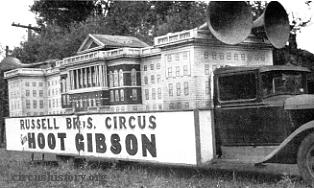 Photo: Hoot Gibson was featured in 1939. This sound truck was used in 1938 and 1939. Pfening Collection.
1938 was anticlimatic to 1937 on Russell Brothers and throughout the circus world. Webb did keep the show out all year, however, perhaps the only truck show to accomplish the feat. The equipment was the same and the performance nearly so. Hazel King had gone to Parker and Watts, Bobby Wariner to RBBB, Walter Jennier to Haag Brothers. Bertie Hodgini didn't stay with it the entire season. Joe Hodgini came on for a few early weeks, Buck Steele with liberty horses and a wild west show joined late.
The staff was mostly unchanged. New members were Jackie Wilcox, agent; King Bailey, kid show manager; Vern Crawford, concessions and Charles W. Webb (nephew) the 16 year old boss canvasman.
After opening in Rolla and going into Indiana Russell Brothers moved to Chicago and played many school-house lots, the best business done that year. The route went through western Illinois, Iowa, Nebraska, Kansas, Oklahoma, Texas, Arkansas and closed in Frederickstown, Missouri without a payday. In Enid, Oklahoma a canvas truck overturned and several employees were injured and the show was dogged with judgments for a time as a result. In Chicago, Seils-Sterling, about to close, offered Webb two elephants, free, if he'd just feed them. Webb felt he couldn't afford them, which is probably as good an indication as anything of the circus business in 1938.
For the rest, until the sale in 1943, it was not to be that the show would reach its 1937 heights. In 1939 it went out in unpainted trucks for the first time. It went east and came back through Virginia where at Mint Spring on August 6 one of the elephant trucks overturned killing Rubber, the original Russell bull. The driver, John H. Blair, was also killed and he lay in an unmarked grave until 1965 when the Staunton, Virginia CFA purchased a stone to mark him. The house at winter quarters in Rolla burned during the summer and the final day of the season in Donna, Texas the cash box was empty so the show wintered in Donna.
In 1940 the route went up into Illinois and east and wintered in Rolla for the last time. In 1941 it wintered in the Selig Zoo in Los Angeles, having gone back west to try for another success as had happened there in 1937. In later years Webb said his one big mistake had been in not going back west in 1938.
In 1942 the show opened in Pasadena and then played ten days on the Washington-Hill lot in Los Angeles. Business was excellent, the crowds big and the canvas new and Webb was apparently so satisfied with the season that he considered his goal achieved that he had begun circus life seeking. He wintered at the Selig Zoo again and prepared to go out in 1943.
In spite of the problem of locating labor the Webbs opened the 1943 season with a two day stand in San Fernando, California. The big top was blue and white and seated 4,500 people. New side show canvas and a new marquee added to the flash. The show carried eight elephants including some recently purchased from George Christy. Several new cages appeared in the menagerie, including some for mixed groups of lions and tigers. A new "horse fair" tent was used housing some 50 head of horses and ponies. An additional 40 foot middle was inserted in the menagerie tent to house the new animal displays.
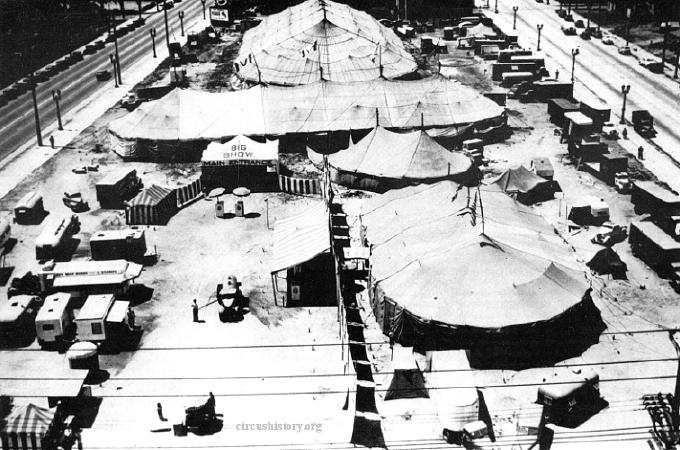
The opening of the 1943 season saw 38 show owned trucks on the lot along with trucks, trailers and cars of show personal making a total of 92 pieces of rolling stock.
Following the opening stand the show made a few stands in the greater Los Angeles area before moving to San Diego for a nine day stand, beginning on April 11. Moving north again a four day stand opened in Long Beach on April 19th. Then on April 23 the show moved on to the Washington and Hill lot in Los Angeles. Here for the first time in circus history, a circus dared to play seventeen days. The date turned out to be a triumphal and extremely remunerative effort for C. W. and Pauline Webb.
Jack Joyce was equestrian director and Norman Carroll handled the announcements. Featured in the performance were Jorgen Christiansen's Great Danes and nine Palaminos; Nellie Button and her camel "Bagdad"; Walter Jennier and "Buddy" the seal; the Dutton riding act; Miss Aerialetta (Jennier); Cheerful Gardner handling the elephants and the Flying Valentines.
Chief Sugar Brown and family headed the wild west after show. Also appearing in the concert were Rex and Mark Rossi as well as old timer Cy Compton.
A Los Angeles CFA member Dick Lewis appeared in clown alley along with 10 other clowns. Following this Lewis left the railroad business and remained with circuses.
Bill Antes arranged for good publicity when Hollywood stars Rita Hayworth, Orson Wells, Dolores Costello and Spike Jones attended the show.
General Manager Robert N. O'Hara was in charge of the show for the Webbs. During the L.A. stand there were rumors of the Cole show purchasing the Russell circus, following a number of appearances of Jake Newman on the lot.
Following the Los Angeles stand the show moved north up the coast toward the Bay area. The circus began a four day engagement in Richmond on June 5th, then made Oakland for five days. Moving to San Francisco on June 15 the show played fourteen days.
During the later part of the San Francisco date word began to leak out that the Russell show had been sold. The first name connected with the new owners was Paul Eagles. Mrs. Eagles advised the Billboard that her husband, who had been in San Francisco, would not be returning to L.A. as he was assuming the position of general manager of the Russell show.
While the show was in Stockton, the first date following the San Francisco stand, Bill Antes issued a formal news release stating that Arthur Concello had purchased the Russell Bros. Circus from Mr. & Mrs. C. W. Webb. The deal had been completed during the San Francisco stand.
Several buyers had been on the S. F. lot, looking at the truck engines and kicked the tires but no offers came until Art Concello made a bid. The story is that he walked up the short side of the lot, through the back door, out the marquee entrance and told Webb he'd take it.
Art Concello changed the title to Clyde Beatty-Russell Bros. Circus in 1944. Another article covering the 1944 season, written by Chang Reynolds will appear in Bandwagon soon.
The change to a railroad circus has been well covered by an article on the 1945 Russell Bros. Pan-Pacific Circus, written by Bill Elbirn, which appeared in the May-June 1963 issue of Bandwagon.
Mr. Webb, in his late seventies, is still alive at this writing and living in the San Fernando Valley in California. Like so many old time circus owners he is apparently no more interested in his former occupation than if he had been in real estate or wholesale groceries.
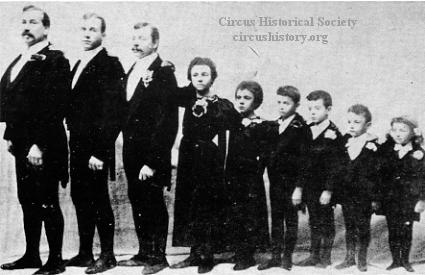 This photo of the Original Nelson Family was taken in 1892 and was used in advertising of the Ringling and Wallace shows. Left to right: Robert Nelson, Sr.; Arthur Nelson, father of Paul, Rosina, Estrella, Hilda, Oneida, Carmencita and Theol; Robert Nelson, Jr., Alice Welch, Lisa Welch, Artie, son of Robert, Jr.; Sid Buttons; Bill Welch, Adele Nelson. Author's Collection.
On January 6, 1969, a famous family of acrobats, was accorded one of circusdom's highest honors, when it was elected to the Circus Hall of Fame. A third generation member of the family, Mrs. Hilda Nelson Burkhart, was present to receive the award, presented at the opening performance of the "Red" unit of the Ringling Bros, and Barnum & Bailey Circus, in Venice, Florida.
However we must go back 120 years to begin this brief history of the Original Nelson Family, one of the foremost tumbling acts in the history of the tented world, an act which has thrilled and astounded circus goers for more than three score of years, with their seemingly impossible feats of risley tumbling.
The founder of the group, Robert Nelson, Sr. was born in London, England, in 1840. While a young boy he became an apprentice to a London cabinet maker. Becoming dissatisfied with his job and against his parents wishes he ran away and joined a circus.
A legend persists that Robert turned handsprings on the streets of London to give expression to his exultation over the defeat of Napoleon at Waterloo. An intriguing story, but not a very plausible one, since Napoleon's adventure happened nearly 30 years prior to Robert Nelson's birth.
In any case young Nelson became a part of an acrobatic act and later formed his own group of four people. He met Miss Emma Smart while with an English show and they were later married.
He called this first acrobatic act the Nelson Family, and brought the group to America in 1866. After playing a few seasons in the United States, they went to Cuba. While there one member of the troupe contracted yellow fever, and died, causing the act to break up. Two members of the group and their families went to South America where they formed a circus, while Robert started a new act with his two sons, Arthur and Robert, Jr.
Nelson booked his new act with the Dan Rice Circus in 1871, and remained with that show through the 1874 season. The following season the act was engaged for a tour of South America with the Bidwell's "Blackpool" Circus.
The Nelson Family returned to Europe at the end of 1875 and remained until 1880, when they returned to America, for a two year stay. Going back to Europe the family played theatres in France, Germany and Spain and finally contracted with the John Wilson Circus for a tour of India in 1884.
In 1885 the act had returned to London and were playing the Canterbury Music Hall, where George Primrose, the minstrel man, saw them. They returned to America to join the Thatcher, Primrose and West Minstreals, opening at the Detroit Opera House in 1885. After closing with Primrose they went to Mexico to finish the season with Orrin Bros. Circus.
During 1886 the act was with Riley and Woods Circus. Robert Nelson, Sr. purchased a half interest with Pat Riley, and they operated the show for two seasons. Like many performers Nelson fancied himself as a circus operator and planned the Nelson's Great World Combination Show. This show opened in 1887. In 1889 Robert Nelson, Sr. went to England to book acts for his show, and while there engaged four apprentices. They were Alice, Liza and Bill Welsh and Sid Buttons. These children were raised as part of the Nelson family and became part of the act.
The appendix of George Chindahl's book lists the Nelson Circus closing August 8, 1894. Mr. Chindahl shows Robert Nelson, Jr. as the owner and Robert Nelson, Sr. as equestrian director.
Following the close of the Nelson show the act joined the Ringling Bros. Circus in 1895. The act was nine in number at this time composed of Robert Nelson, Sr.; Robert Jr.; Arthur; Alice Welch; Liza Welch; Artie (son of Robert, Jr.); Sid Buttons; Bill Welch and Adel Nelson. This group is shown in a photo taken in 1892.
The 1895-96 Ringling Bros, route book lists the family doing two acts. The Nelson Sisters presented "original and graceful pedestal contortion." The Great Nelson Family are listed as "the absolute perfection of highclass acrobatics - nine in number, the sensation of Europe, and the most finished acrobatic act ever presented to an American audience." The Nelsons were again with the Ringling show in 1896. It was during this season that Arthur Nelson married Sarah Warren, who then became a member of the act.
In 1897 The Nelsons were a feature of the Great Wallace Show. A Wallace newspaper herald of that year devoted half of the back page to the $10,000 Challenge," the Nelson Family, Premier Acrobats. The herald stated, "$10,000 will be forfeited by the Great Wallace Shows if their equals can be produced in Europe or America." It refers to the 9 Nelsons, however the 1901 Wallace route book lists 11 Nelsons in the roster.
Following five seasons on the Wallace show they moved back to the Ringling show in 1902. By now there were a total of 16 in the Nelson group. The 1902 Ringling route book lists: Robert, Sr.; Arthur, Robert, Jr.; Artie; Sidney (Buttons); William; Sarah; Tiny; Rosina; Oneida; Hilda; Idelle (Adele); Delia; Emma; Eliza; and Alice. The "Nelson Sisters" did a wire act, a Miss Nelson did a bird and dog act, and the Family did their big acrobatic number. The act was with Ringling again in 1903.
The 1904 season was spent on the Walter L. Main Circus, that being the last season that the show was under the Main ownership. Parks and fairs were played in 1905 and 1906. No record has been found of the shows employing the Nelsons for the next few seasons.
In 1909 the Nelsons were with the Sells-Floto Circus, and remained there for the 1910 season.
Robert Nelson, Sr., at the age of 71, in 1911, retired from the act, to stay in Mt. Clemens, Michigan, a town he had called home since 1889. Arthur Nelson then assumed the management of the act, which now consisted of he and his wife and their children, Rosina, Estrella, Hilda, Onieda, Carmencita, Theol and Paul. Robert Nelson, Sr. owned a theater, called the Nelson Opera House. The family also owned the Arlington Hotel in Mt. Clemens.
Arthur booked his new act on the Hagenbeck Wallace show for the 1911 season and remained for the 1912 tour. In 1913 they toured with the Wirth Bros. Circus in Australia, and returned to America following the one season. Robert Jr. died while the group was in Australia.
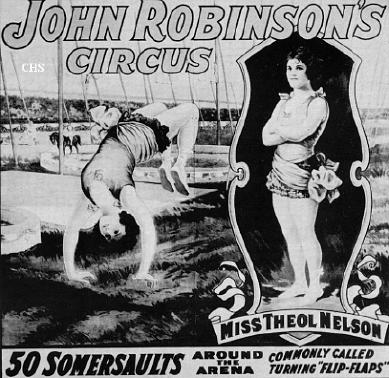
The year of 1914 found the Nelson Family with the Robinson's Famous Shows. They stayed with the Robinson show through the 1916 season, when it was known as John Robinson. The Robinson 1916 route book lists Arthur and Sarah and their seven children. The activities of the rest of the Robert Nelson, Sr. family are not known at this time, however Adele, had married Louis Reed, an elephant trainer. Reed was on the Walter L. Main show in 1904 and they no doubt met at that time. Adele was the first Nelson born in the United States, being born in Mt. Clemens, Michigan. The Reeds purchased three elephants in 1926 from Hagenbeck in Germany and presented these as Miss Adelaide Nelson and her Baby Elephants, and later as just Nelson's Elephants.
Alice Welch had left the act in 1903 and married Robert DeMont, and they worked vaudeville after leaving the Nelson group. Liza Welch also left the act in 1903, and married Arthur Berry on the Wallace show in 1904. They later had a vaudeville act called Elizabeth Nelson and the Berry Boys. She is now married to Harry (Bob) Matthews, well known for his King Tuffy Lion Act.
On Christmas night, 1916, the originator founder of this famous circus family died at his home in Mt. Clemens, Michigan. Robert Nelson, Sr. was 76 at the time of his death.
In 1917 the Nelsons were shown in the fair catalog issued by Robinson Attractions, of Chicago, Illinois, and it is assumed that Arthur and his family continued playing parks, fairs and theaters for the next few years. In 1919, 1920, 1921 and 1922 they were with the John Robinson Circus.
The opening of the Ringling Bros. & Barnum and Bailey Circus in the spring of 1923 found the Nelson Family among the performing personal. The big show felt the Nelson name was strong enough to merit five different styles of special lithographs on the Nelsons. A one sheet was used that was much like the one used by the Cole show in 1935. A vertical 1/2 sheet of the family was of a similar design. In addition a one sheet bill featured the Nelson Sisters (Oneida, Rosina and Hilda) with their wire act, and a different 16 sheet of the wire act. A 3 sheet of Theol was also used.
Arthur Nelson and his family remained on the Ringling Barnum show until 1926. The family were at home during the winters and early summers of 1927 and 1928. The large state fairs were played in the fall of 1927 and 1928. The children completed their education at this time. All of Arthur Nelsons' children were born and educated in Mt. Clemens, Michigan.
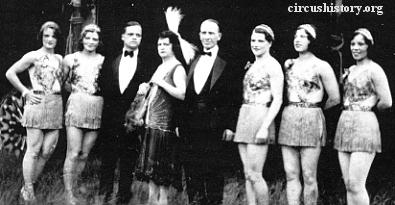 This Eddie Jackson photo shows the Nelsons on Sparks in 1930. They are left to right: Theol, Oneida, Paul, Sarah, Arthur, Estrella, Rosina and Hilda. Burt Wilson Collection.
In 1929 the Nelsons went to the Sparks Circus, where they remained until 1931. A photo by Eddie Jackson of the Nelsons taken in 1930 on Sparks shows only five girls. The missing daughter is Carmencita.
The Sells-Floto Circus featured the Nelsons in 1932.
In 1933 and 1934 Estrella Nelson presented three elephants at the Live Power Show at the Chicago World's Fair. This unit was managed for the Standard Oil Company by Zack Terrell. Paul and Carmencita also appeared with this attraction. The family act did not work together in 1933 and 1934. Oneida appeared at the Goodyear tire display at the fair.
In 1935 Zack Terrell brought the Live Power elephants and Allen King's wild animal act, when he joined with Jess Adkins to form the Cole Bros. Circus during the winter of 1934-35.
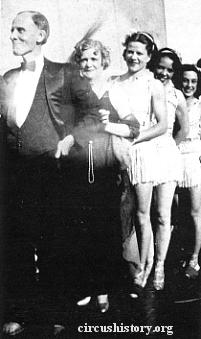 Photo: Mr. and Mrs. Arthur Nelson are shown with part of their family in the backyard of the Cole Bros. Clyde Beatty Circus in 1935. Photo by Otto Briebling from Pfening Collection.
The Nelsons were with the Cole Bros. - Clyde Beatty Circus when it opened in Chicago in the spring of 1935. The famous Nelson Family performed their world-renowned risley act for the last time on the Cole show that year. During the opening stand in Chicago Estrella Nelson and Zack Terrell were married on April 22, 1935.
Carmencita died in 1934, Oneida died in 1937. Paul Arthur Nelson remained with the Cole show until it was sold a second time at the end of the 1949 season. He was a ticket seller in 1937 and in 1938 presented a liberty horse act. From that point on Paul was identified with horses on the Cole show. In 1941 Paul built a new risley act around himself and his wife Ruth, the other four members of the act were not family. In 1942 Paul held the staff position of Director of Aerial Displays. In 1943 he was named assistant Equestrian Director, and in 1945 became the Director of Program. In 1949 he was Equestrian Director, on Cole under Jack Tavlin. During the 1940s Paul Nelson trained and presented a number of horse and pony displays and for a couple of years presented a horse riding seal.
Hilda Nelson married Noyelles Burkhart and performed for a season or two after 1935. Burkhart remained with the Cole show under Zack Terrell, becoming manager in 1944. Theol married Ray Marlowe and was on the Ringling-Barnum show for many seasons.
Paul Nelson moved to the Mills Bros. Circus in 1951 and stayed with that show for a number of years before retiring from outdoor show business.
Rosina Nelson married Dr. G. A. Brown, a Detroit dentist, who has since died, she is now living in Mt. Clemens with her mother.
Following his retirement after the 1935 season with the Cole show Arthur Nelson and his wife Sarah returned to Mt. Clemens, Michigan. Arthur Nelson remained in excellent physical condition and at age 70 could still turn a neat flip. The Nelson home was located near the center of town and from their back yard they could see the spot where the Nelson Opera House stood.
On January 1, 1941 Arthur and Sarah Nelson, were returning to Mt. Clemens from a visit with their daughter Rosina Brown in Detroit when their car was struck by another and turned over. Mrs. Nelson and Rosina were only slightly injured, but Mr. Nelson suffered a brain concussion. On January 24, 1941, he died in the Mt. Clemens Mercy Hospital, at the age of 75.
Only the third generation of the Nelson Family now remain and all are retired from the circus. They are now a part of the Circus Hall of Fame and their name and likenesses are spread over lithographs, couriers, programs and route boks spanning nearly 100 years of circus history.
This article was written with the help and inspiration of Liza (Welch) Matthews. Additional dates and information were checked with Hilda Nelson Burkhart. The original article was augmented with research material and editorial comments by Fred D. Pfening, Jr.
How Wagons Are Numbered
Can you or any reader tell me the system used by railroad shows in assigning numbers to their wagons ? One might see several wagons numbered consecutively and then find wide gaps in the following numbers. Even on the smaller shows numbers in the 80's or 90's frequently appeared on rolling stock when they actually had less than half that number of wagons on the lot. Thank you for giving this your attention. Albert Schlink, Bedford, N.H.
Unusual Circus Features
Today, I came across “Unusual Circus Features," by Ralph F. Hartman, in the November/December, 1961, Bandwagon.
Each time I re-discover this article, my imagination is spurred by the descriptions of acts such as the "record breaking speed mechanics assembling . . . the parts of a motor car," in a contest with a similar team of mechanics in another ring. Another act description which stirs my imagination is the one of the Californians troupe, which skillfully built boxes and filled them, in a demonstration of orange packing.
I do not remember seeing any photographs of these particular acts or posters depicting them. Do any Bandwagon readers recall seeing these acts and how they were received by the circus-going public? - Norman Schuller, Springfield, Ill.
Still More on Havirland
Regarding the mystery of the Havirland-Smith wagon picture. I believe this picture went to the Fryburg museum, via Mr. Gunther and was originally given to me by the late Bill Woodcock.
This was an old time carnival attraction when most shows carried a lot of privately owned wagons, including living or gypsy vans. Alert operators often hauled a walk-thru wagon down town for day time earnings and as most of the old time attractions were worth while, they could garnish additional folding money at night on the lot. This particular wagon's contents was quite similar to the one used by the Frasers, who spent their retired years in Addison, N.Y.
The wagon in the foreground is clearly a wide track or 'city' wagon such as used on rail shows. Wagon show track was narrower and were impossible to haul thsough the mud as many circuses learned to their sorrow.
To illustrate that the use of privately owned carnival wagons was very common in the old days, the Maple Shade (N.J.) wagon works built living van and ride wagons for many years, but the only order they ever received from a carnival was for a string shipped to the George L. Dobyns Shows of Dubois, Penna.
Many circuses had a downtown ticket wagon, the big Christy show, used their small old gilly ducat wagon for this purpose. - Art Doc Miller
No part of this publication may be reproduced in any form or means
Last modified February 2006.
without written permission of the author and the Circus Historical Society, Inc.