


Circus Historical Society
Bandwagon, November-December 1967
Back to Bandwagon Index
- Spec "The Glorious American Girl", with Mrs. Al G. 'Jane' Barnes leading the tournament.
- Clown Balloon number on the track
- Bert Nelson's cat act with 5 tigers and 4 lions. Mrs. Guice - Principle act - Ring 1. Harlequins - Stage. Three Nelson, Comedy acrobatics - Ring 2. Dancing Dervishes - Stage. Herbert Hobson, principle act - Ring 3
- First presentation of the famous 24 Fanchonettes in their first offering "The Precision" number.
- Cheerful Gardner with the elephants and a head carry on the track.
- Tiny Kline, iron jaw slide; Great Reynolds, head slide.
- Bessie's Collies - Ring 1. Bert Nelson's seals - Stage. Roslaies Scotties - Ring 3
- Clown walkaround
- On the track, the Rancho Cor-tez menage horses trained by Mark Smith, with Frank Miller riding Coeur d'Alene, seven gaited horse, and Padre, high school dancing horse. Woman riders were Haud Gaines, Billie Kyle, Joan Pollard, Evelyn Morse, and Ellen Mintern.
- Ring 1 - Ernie White, trapeze head balance. Stage - Violette Rooks - Head-balancing swinging trapeze. Ring 3 - Harry Rooks, trapeze head balance
- Liberty elephant on the track with man doing a dance.
- Ring 1 - Freehand Brothers. Stage- Reynolds Trio. Ring 3 - Napier Trio
- Ring 1 - Gardner with five elephants. Stage - Single elephant. Ring 3 - M. Brierly with four elephants
- Clowns with a funny ford
- Tiny Kline and Miss Reynolds on Rings; on ladders Misses Lynch, Moore, Cross, Errol, Turner, Miles, Broyle, Joachim, Cress, and Powell.
- The Fanchonettes on their rolling globes
- In the air - The Waltier troupe. Stage - Pony Drill. Ring 3 - Rancho Cortez Liberty Horses
- Clown walkaround - Shep & Dowling and hind leg dog, and clown bride
- Seven Crossonians - Acrobatics and teeterboard, with a finish trick of two and a half somersaults from board to chair.
- Ring 1 - Rooks Troupe. Stage - The Malabars. Ring 3 - Freehand Bros.
-
Walter Guise troupe - four men & one woman - Aerial Bars
- Finale - "Trouping of the Colors"
- The Guitterez Family in center ring on trampoline. Good bouncing and some laughs for the kids.
- Clowns Koko and Grace Fairburn in center ring pulling the big fish trick.
-
Ladder perch. Again in center ring, it's two of Landon's midgets
for a perch routine. Do the usual perch tricks, including the
elbow-hold spin, atop a ladder perch. Gets a good hand.
- Fred Bowery and five matched mules. Liberty act with the mules following their cues and building up to a good finale with pedestal stands and interweaving runs.
- Swinging ladder. Martha Cuitterez on the ladder with vocal accompaniment by her sister. Gloria. Miss Guitterez is graceful and the act fills in neatly. Gloria's vocals could not be evaluated because of a dead mike.
- Tiger act. Spotted in Ring 3 position is Mable Stark with seven cats. She is an able trainer and the animals are put thru a fast routine. Act leads the show in serious entertainment.
- Educated pony. Fred Bowery, trainer, in center ring has his pint-sized horse do handkerchief pickups, pedestal stands and kneels. Act is smooth and well rountined.
- Guitterez Sisters. The pair performs on tight wire over center ring. They build to a neat finish with a hoop walk in the final stages.
- Clowns. In Ring 1, they offer the aged hair-growing routine. Gets the kids tickled.
- Landon's Midgets. Two dwarfs, a midget and an adult in head balancing and tumbling. Act is fast and gets a good hand.
- Foot juggling. Gus Lind in Ring 1 with his feet tossing a barrel-sized dummy. Winds up with a bar moving in a circle with a dog on one end and a doll on the other in "airplanes." Turn gets a good hand.
- Clowns. In center ring are Grace Fair-burn and Gus Lind doing the picture-taking gag. Use a teenage girl, sitting her in the exploding chair. Audience particpation to a slight extent and getting laughs, but some ugly repercussions could come from it.
- Wire act. Johnny Guitterez in Ring 1 and Maurice Marmelejo in center ring on the slack wire. Both are good performers until they hit the imitation of the drunk with the serape. As this trick is now in its 85th year, they ought to think of something else in its place. They're capable of doing it.
- High school horses. Ed Ballard and Danny Daniels put their horses thru routines in Rings 1 and 2. Animals are well trained and groomed. The horses work with ease. Good hand.
- Elephant act. Anna Metcalfe working "Shirley Temple." Because only one is used, the routines are limited. However, pedestal stands and walkovers get a good hand.
- Clowns. Gus Lind, Koko and Grace Kairburn doing the breakaway dress trick.
- Auturo Guitterez on the bounding rope. Does swings and crotch catches. Still in his teens, performer shows promise of being a humdinger on the hemp.
- Prize Fight, Landon's midgets put a new twist on an old routine. This ace actually puts the customers in the aisle.
-
Clowns.
- Liberty act. Fred Bowery and six liberty horses and a Shetland offer a well studied routine. All except the lead horse are at liberty.
- Bill Dedrick wilh his Military ponies and monkey riders
- Jean Evans single trapeze over the ring. She was a sisler of Mrs. Clyde Beatty
- Haller Trio - Bounding trampoline
- Clowns
- Web over both rings and. stage
- Risley tumbling (stage)
- Menage horse (ring)
- Clarkonians - Water gag (stage)
- Taber's monkeys (ring)
- Clowns
- Riding act (ring) The Clarke family opened with the circus
- Teeter-board act - The De Wayne troupe
- Trapeze over both ring and stage
- Wildfire - The Famous Motion picture horse - Ring
- Clowns
- Clarkonians - Juggling, ring
- Clowns in a boxing number, ring
- Liberty Horse act
- Casting act over the stage
Bandwagon, Vol. 11, No. 6 (Nov-Dec), 1967. Note: Only some articles are included in this online edition. Illustrations are not included. The Circus Historical Society does not guarantee the accuracy of information contained in the information in these online articles. Information should always be checked with additional sources.
History And Reflections Of The
GREAT AMERICAN CIRCUS 1939
By Douglas Lyon
During the late 1920's and early 1930's a corporation called Fanchon and Marco, became greats in the theatrical field, with their touring of thirty or forty road shows throughout the United States. On the average, Fanchon and Marco would launch a new theatrical unit every week with between twenty and forty people in each of them, including a large number of show girls called the 'Fanchonettes'.
In early 1939, Fanchon and Marco were approached by Charles Nelson, an agent, with the idea of establishing a tented circus. Marco Wolf having produced many circuses, including, parts of the Al. G. Barnes show, the Worth-Hamid shows, and in it's entirety the St. Louis Police Circus and San Francisco Shrine Circus for several years; plus hundreds of other circuses; he was quite interested in a venture of this type. Nelson introduced Marco to a Ralph Clawson, who was representing the Ringling show.
Clawson explained to Marco, that he was in charge of the Ringling owned Hagenbeck and Wallace Circus, which had been quartered in Baldwin Park (at the old Barnes quarters) since their closing in 1938. Clawson was responsible for securing rentals of the show equipment and he was very anxious to lease the equipment out to movie studios, and other shows.
Marco outlined his ideas and the size of the show that he was planning, and Clawson drew up a budget, and the rental was agreed upon. It was Marco's intention to open the show on May 22 or 23 in Inglewood, California under the sponsorship of the Parent Teachers Association there.
The Marco-Hagenbeck contract covering the equipment was to be drawn up. In the meantime, Marco proceeded to line up the sponsors and various personnel.
There were many delays in getting Mr. North to sign the contract, and for a long time, Clawson couldn't be reached. But finally Clawson was found, and he reassured Marco that everything would work out fine, even though Marco had a desire to call the whole thing off at this point. The weeks that followed brought on many conversations between Marco, Clawson and North regarding the rental price. Clawson had given the okay to Marco on the equipment at $1600 per week, but North was demanding $2500, as he knew Marco had already booked several dates. The $2500 was eventually decided on. There was also a small problem as to the deposition of the railroad cars.
It was not until about a week before the show was to open that the final contract was issued by North's office.
Wayne Daillard, who had worked with Marco for years, was contracted as General Manager. Paul Eagles was hired as Business Manager, and together with Clawson, they filled out the rest of the staff.
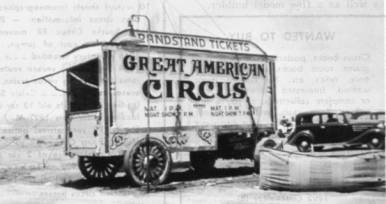 Photo: The white ticket wagon of the 1939 Great American Circus is shown on a lot. This wagon was well known as the "Blackaman" wagon on Hagenbeck-Wallace in 1938 and later as the "Leaping Tiger" wagon on Arthur Bros, in 1945. Pfening Collection.
When the go ahead was finally received, three or four commercial painting crews, attacked the equipment with spray guns. Everything was painted orange, and as soon as the paint was tacky, it was lettered with the Great American Circus title in blue and white on the orange body. The old Hagenbeck numbers were retained on all equipment. Arthur Springer was in charge of having the show painted.
The show moved out of quarters on Sunday for Inglewood, with Arthur still doing lettering. Everytime the train stopped for a moment, he would jump out, and paint a couple of more letters, and thus the Great American Circus was painted on the move.
Regarding the Great American circus title, it is interesting to note that Fanchon and Marco did not actually operate the show. Legally it was run by Ben Black, Roy Wolf, and Joe Brenn who in reality were agents and hookers. They secured the acts and booked the dates and sponsors. Marco was actually the financial backer of the show, and he supplied several of his acts for the show.
Now the physical setup of the show should come into play. The Great American Circus is commonly known as the 30 car railroad show that traveled on 15. Essentially this show was the complete Hagenbeck-Wallace Circus, without the menagerie. It had the Hagenbeck tent (which was owned by a Kansas City firm), a 160 foot round end, with three 60 foot middle pieces. It had the complete Hagenbeck cookhouse, which could feed a small army. Everything was Hagenbeck, except the menagerie, consisting of the 17 Hagenbeck Elephants and Bert Nelson's cat act (housed in long ex-Jungleland cages), which was exhibited in a small tent. A 50 foot round end with a 30 foot middle piece, as near as anyone can recall.
The full menagerie wasn't carried because of lack of train space. The train had fifteen cars; nine flat cars, two stock cars, and four sleepers. With the show employing about 400 people, this means that there were about 100 people to each sleeper. Of course, not taking into consideration the fact that one was a staff ear with staterooms, and another contained the workman's pie car, which took up about one-third of the car.
Pat Graham was in charge of the sleepers and has many funny stories to tell about these four cars, and all the problems invovled. The Franchonettes were each promised a lower single berth, they got what they were given, two to a berth, two high, with sheets utilized as berth curtains. Most of the girls being college kids, had grown accustomed to sleeping in hotel rooms, and this cattle car arrangement was a new thing for them.
One of the funniest events centering around the sleepers, happened when the train was leaving Inglewood. Everyone was finally bedded down or so Pat Graham thought, when Dusty Rhoades brought in some men. Pat wasn't too alarmed because he thought these were just extra men. He soon realized that this was the big top crew, and they were demanding berths. After some thought, Pat sent a porter through the sleepers waking up the cooks, telling them they were in town. As two cooks got up, two canvasmen were bedded down. The porter didn't mention which town, and the cooks soon found out that they hadn't left Inglewood yet, so they ended up sleeping on the flat cars the rest of the night.
The lack of train space on the flat cars, resulted in the big top poles being gillied overland by an early 1920 museum piece called a semi (from the Hagenbeck show). When it wasn't getting lost, it was breaking down. I'm sure the gilling of the Big Top poles overland, on a railroad show, must be some sort of a first in circus history.
It is very hard to relate the next five days of the show's existence, without first understanding the many handicaps they suffered.
When you realize that the whole show was framed in less than five days, you can begin to see the problems. To begin with, there was no working labor, and those that were there had no idea of what they were doing. How does one explain circus logistics to a working man, who has never seen a stake or jack before in his life, let alone when you're on the road, and moving it every night. A basic knowledge is needed here.
The staff and department heads were exceptional, excluding Daillard from the theatrical world. But, with no workers, they just couldn't function properly.
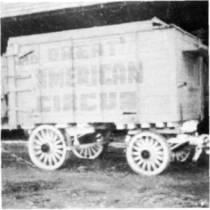 Photo: A Great American baggage wagon with title as photographed at the Goebels Farm probably in 1940. Burt Wilson Collection.
The physical equipment was in dire need of repair. It had been off the road for almost a year, and the wagons hadn't been greased since Hagenbeck days, and this caused them to constantly break down. Equipment was missing, and all the normal winterquarters work, which is usually done over a period of several months, wasn't even thought of in the few days before opening. Marco spent $3000 in the first two days the show was on the road, just buying additional equipment, and having what they possessed repaired.
The air calliope never did get fixed during the show's short life. Walter Guise refused to perform his aerial triple bar act because the rigging was unsafe.
Had the show been on 20 cars, instead of 15, this might have made a difference. But the deciding factor for it's failure was the lack of basic circus knowledge.
With these things in mind it is easier to cover the short lived Great American Circus.
The show opened in Inglewood, California on May 24th, 1939 under the auspics of the Inglewood Parent-Teachers Association, after two days of moving the show on the lot.
Because of the many problems in repairing the equipment and getting it into working order, there was no full dress rehearsal. Someone just blew a whistle and the show began. Ralph Clawson acted as Equestrian Director because he felt responsible for a large number of the show's difficulties, and he wanted the first few performances to run smoothly. One should note that at no time was Clawson on Marco's payroll.
It was here in Inglewood that a Mr. Kramer from the Actor's Guild first approached Marco in regards to unionizing the show. Marco explained some of his present problems, and he asked for Kramer to come back after their San Diego dates. Kramer knowing Marco from Vaudeville days agreed .
The matinee was fantastic, with a straw house, as was the evening show also. Tickets were sold for Adults at 55c and children at 25c, with reserve seats going for 25c. Paul Eagles once recalled that with all the discount and free tickets taken in, the show only grossed about $700 that opening day.
Music consisted of a sixteen piece band with the Hagenbeck calliope, which didn't work. Seating in the show was on chairs and plank seating, which were fourteen high.
This was no pickup show. The performance was a very strong one with Pert Nelson's lion act, Cheerful Gardner's Elephants, Walter Guise's riding act, and three numbers by the 24 Fanchonettes, one of which was a rolling globe routine.
Many historians wonder about the merit of this rolling globe routine. First of all, there were 24 rolling globes, each crated and loaded into one prop wagon. However, the stage was the main problem. This massive wooden structure, made of tung and groove and 2x4's, had to be absolutely level at every show. This would entail a group of men leveling this stage through most of the show. Obviously the Fanchonettes had never appeared on a rocky circus lot in their life.
With the opening stand in Inglewood, the show staff consisted of the following personnel: Wayne Daillard, general manager; Paul Eagles, business manager; Charles Nelson, producer; J. Ben Austin, general agent; Jack Grimes, general press representative; Ralph Clawson, representing the Ringling-Barnum interests; Ray Wolf and Charles Frank in the red wagon; H. G. Klaude, white wagon; Bert Nelson, equestrian director; Leonard Karsh, auditor and front door; Walt Matthie, front door; E. R. Robertson, auditor of the circus; William Kronkite, car manager, with 12 men and six trucks; Art Springer, announcer; George Tipton, steward; Dusty Rhoades, lot superintendent; Carl Knudsen, 24 hour man; Chester Pelky, superintendent privileges; Pop Sells, ushers; E. W. (Whitey) Versteeg, chief electrician; Harry Levy, superintendent inside tickets; George Singleton, boss can-vasman; Cheerful Gardner, elephants; Tom Fielder, lead stock; Red Forbes, chief mechanic; Charles Chic, ring stock; Max Delfon, boss property man; Whitey Beeson, trainmaster; Corney Verplough, timekeeper; George O'Brien, chief of automotive equipment and manager of privilege car; Arthur Windecker, manager side show; Charles Redrick, musical director.
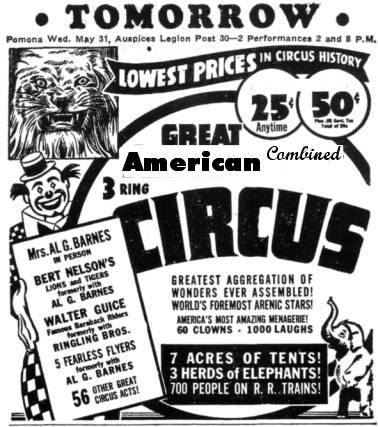
The Side Show: Managed by Arthur Windecker. Despite the rapidity with which the side show was put together, it was one that reflected great credit for Windecker. Mme. Virginia, physic analyst; Armstrong's Alabama Minstrels; Ada Mae Moore, snakes; Jose Ramirez, lightning sketch artist; R. E. Moyer, magician; Lady Sequoia, girl immune to pain; Mme. Moyer, illusion; the Airplane Girl; Prof. Strum, in charge of giant ape; A. Arturo, Mexican Punch and Judy. In the annex, Fi Fi, the sheep-headed girl; Charles Gammon, was salesman on front. On the ticket boxes were Harry Wooding, Charles Gammon, & Bert Woods. Rab Barton, ticket taker.
The Big Show Band: Charles R. Redrick, director; Cornets: Nick Schwartz, Fred Algerie, John Wildier; Clarinets: Bill Taggart, Cecil Tozier, Ed Britnitz; Trombones: Al Mitchell, William Anderson, & Charles Ransom; Baritone, Lorenzo Azcona; Basses, Jeff Davis & Warren Morne; Drums, William Farmer; Bass Drum, Miley Thomas; Organ, Doc Glenn.
On the Front Door: Leonard Karsh, Walt Matthie, Sam Metzger, Arthur Lambert, Earl Burnette, Clyde Garwood. Inside Ticket Sellers: Wayne Moore, Charles Cunningham, Bob Crawford, Al (Shadow) Rosen, and A. Reutinger. Ushers: John Edner, Johnny May, Lee Smith, P. L. Swanson, Tony Grupiano, E. Derusha, George Schutti, Andy Komar, George Rutledge, Bill Doherty, Sam Passen-heim, Don Logan, Dan Ferguson, Ernie Thill, Lewis Moran, Gordon Froeber, Ray Dunham, Ed Riffen-berg, John W. Wilson, and Bob Seaman.
Big Top Canvas: Jersey Schanck, Portland Jew, Bob Kelly, Dewey Miller and Andy Grouse. Electrical Department: Lewis Fred Foster, George Osborne, Larry Glynn, George Takaco, Bud Glider, Bob Emmons, Ed Grisham, Pat Purnell, and Joe Donner. Mechanical Department: Bill Colclaser, Wayne Stevens, G. H. Mercer, Edw. Kelly and Frank Parsons. Automotive Department: Verne Enos, Chick Hale, .Mike Porter, Ike Lewis and Pete Dattler. Pull up Team: George Hasley. Pull over Teams: Nick Stone and Pat Murnane.
Props: A. Rosenstein, Harvey Hume, Austin Jones, Harry Crouch and Mort Foley. Riggers: Joe Games, Pete Rowe, Ed Leachman, Joe Fleming, George Carpenter, Ned Myers, M. Fallwitz, Neal Howard, Rusty James, and Phil Easterly.
Elephants: William Powell, Charley Armstrong, Freddie Wells, Jack O'Brien, Ed McDonald, Ned Conrad, Fred Moore. Lead Stock: Preston Knox, W. Brown, and Rich Dike. Ring Stock: Charles Chick, superintendent; Joe Patrick, Ed Justus, Rich Bogert, and Karl Holmes. There were 30 head of ring stock, 6 baggage horses, and 12 ponies.
Candy Stands: Chester Pecky, superintendent; Jack Burslem, assistant; Homer Canton, No. 1 Stand; Harry Youden, No. 1 Hamburger; Charles Bathe, No. 2; Novelty Men: Charles Johnson, Harry Corack, and Sherman Cowen; Candy Floss: Frank Beaumond: Jimmie Thomassen, cashier stand; Sweet Men: Billie Monroe, John Kotrez; Candy Stand banners, Sparks Corack; Seat Butchers: Charley Beaver, Leo Nelson, John Katz, Joe Falke, Carlton Shorey, Oscar De Leon, Gene Streeter, Rusty Cormack, George Smith, Tom Dorsey, Bill Clevenger, Mark Douthitt, Sam Kos low, George Guffy.
Cookhouse: George Tipton, steward; Ralph Ritchey, head waiter; Homer Schafer, chef; Herbert Ericsson, Gary Renault, and James Ellsworth, cooks; Harry Vance, butcher; Charles Whipple, baker; Nels Lindquits, steamwagon cook; Leonard L. Oakley, wagonmaster; John McGinty, fireman. Short side waiters: Frank Richards, staff table; William Spaf-ford, Eddie St. John, Whitey Russell, Marino Baltzer, Elias Morach, Leo Elios, John McLeod, Mike Proveny, Henry Moogald, Ike Nomey, Fred Duncan, Elizer Dog. Long side waiters: Eluren Mills, Erroll J. Catlin, John Sholem, John Wellioms, Ernest Robert, Eugene Allen, Granville Marron, Ray Callow, Charley Chance; Jerry Spero, Jom Munday, Harry Heaton, Jackie Johnson, Mort Pollard, and Slim Greene. Watchmen: Tim Gurley and Ben Tyler. San Diego cookhouse count was 307 people.
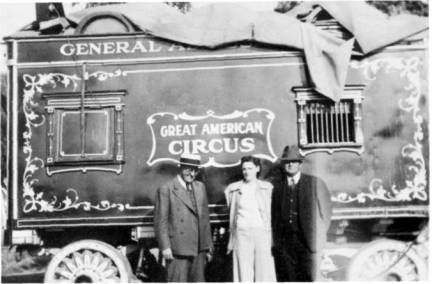 Photo: The former Sells-Floto ticket wagon was lettered for the 1939 tour of the Great American show. This photo was taken in the spring of 1940 after the show had been returned to Louis Goebels in Thousand Oaks, California. Burt Wilson Collection.
The show had a full day to move into San Diego, where it was to appear on May 26th, under the sponsorship of the American Legion. The train was spotted on Pacific Coast Highway at Broadway. Because of the limited number of baggage stock, the show was gillied by truck to the lot.
Being short handed again, Paul Eagles called on the train porters and the pie car workers to help erect the seats, as no one else was available.
Next to the big top, George Tipton's cookhouse was the largest tent on the lot. Breakfast was served all the time, with the main course being sliced eggs.
The Front Door was the first thing completely set up, and then these men who manned it, would go inside and help with the seats.
Another big mistake that Marco made, was bringing on his own theatrical ticket sellers. These men were so low on their count, that the front door was always the last thing down, because it loaded into the ticket wagon. Frequently, the ticket wagon was one of the last wagon off the lot.
The performances as it ran in San Diego is as follows:
This show ran two hours and 26 minutes, and plans were to cut it down to an hour and 45 minutes. There was no concert, but at this point, Charley Nelson was thinking about one.
Clown Alley consisted of: Arthur Borella, Curley Phillips, Carl Traynor, Art La Rue, Vic Harris, Al Napier, Cliff Downey, Dan McAvoy, Bill Cress, A. Smiletta, Jo Santez, Jeff Countier, Pedro Gomar, Celestino Torres, and Jimmie Larqueier.
The 24 Franchonettes included: Patty Kinney. Marquerite Hartwell, Millicent Fuller. Ann Haugh, Virginia Perkins. Maxine Wingo, Beatrice Sturtevant, Beverly Masterman, Ruth Barr, Jane Maxey, Dorothy Cross, Georginia Gregory, M. Saunders, Lorraine Roberts, Maline Argone, Bee Allen, Claire Wishard, Marcia Adair, Valeria Troupe, Bobbie Tomson, Peggy Robbins, Morie Carr, and Dickie Tomson.
Business in San Diego was again great.
From San Diego, the Great American Circus moved to Santa Ana, California and the sponsorship of the Elks Club. It was a long haul to Santa Ana. The show always had good rail moves, but the wagons gave them a lot of trouble.
As mentioned earlier, the wagons had been in storage for many months and they had not been greased before they left winterquarters. Consequently, while being gillied to Santa Ana, a lot of bearings on the wagons burned out.
The matinee was again very late, about 3/4 full, and by the time the evening show was to start, there was still about 30 minutes of the matinee left. The midway was very crowded, and the customers were pressing to get in to the big top. Someone came up with the bright idea of closing off the connection, and letting some of the people into the menagerie, to wait there for the show to end. It was a good idea at first, but it soon became overcrowded in the menagerie tent, and people kept pouring in. On lookers say that the tent got so full, that the crowds were actually pushing the elephants and Bert Nedson's cats cages out of the tent. The matinee crowds were released under the side-walls, and after the show had run two hours and fifteen minutes, the evening crowds were released into the big top. The menagerie looked like a deflated balloon after that.
There weren't more than fifty vacant seats that night. The show was off the lot by 4:00 AM.
The next stand was Pasadena, Californie under the sponsorship of the American Legion. The lot was located at Brookside Park.
Marco drove out to Pasadena from his Sunset Blvd. office in Hollywood, in the early afternoon. He was sure he would see the tents in the air as he approached the lot, but he didn't. He did see about 10,000 people standing around, watching the show being set up. Marco recalls that the tent was about half-way up in the air, when the falls on the second center pole broke, and down came the tent. Not having any extra rope or equipment with them, it took most of the day to locate the material to repair it. More rope broke later on in the day.
It was here in Pasadena that the famous camel incident took place. That morning, a camel had died down at the train. Now it just happened that George Tipton served steak in the cookhouse that day. This steak was quite tough, and as Walt Matthie was trying to cut into it, he just happened to comment: "Boy that camel sure was a tough stinker, wasn't he?" Beside nearly starting a riot, no one ate steak that day.
Marco admitted that he just didn't understand why the show wasn't moving along like it should. This venture was to cost him over $75,000.
During the course of the day, the trainmaster quit, and Paul Eagles promoted Pat Graham to the position. Everything was fine, the train was loaded the earliest yet, and there seemed to be a little extra space, so Pat Graham was happy. What he didn't know at that time, was that the dog wagon had been left on the lot.
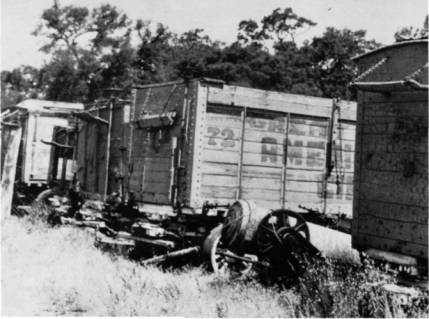 Photo: Great American Circus wagons lined up at the Goebels farm at Thousand Oaks, California, probably in 1941. Circus World Museum Collection.
It was in the next town, Pomona, where the Great American Circus ceased to exist. Earlier in Pasadena, Marco had said that if another matinee was late he would close the show, because it was unable to meet the committments to it's sponsors.
Daillard met with Marco and his lawyer Schaefer in Los Angeles to discuss the shows problems.
Kramer called on them, once again regarding the show going completely union. At this point Marco didn't want to spend any more money on it, so he wasn't receptive to Kramer's idea. Kramer then said he would give the show until after that evenings performance in Pomona to sign the Actor's Guild contract, or he 'would be doing you a favor' by forcing the show to close.
After word reached Marco that the Matinee in Pomona had been late again, he told Daillard to have Eagles deliver the train back to Baldwin Park after the evening performance. None of the show's personel knew of this decision until the next morning when they woke up in Baldwin Park.
Marco wired the sponsors in Glendale, Santa Monica, Long Beach, Bakersfield, Fresno, Sacramento, San Francisco, Oakland, and Stockton to cancel the contracts. All these contracts were signed after the Ringling contract came through, whereas the Pomona date was the last signed before the Ringling contract was executed.
At first it was hoped that the show could get reorganized and continue after about a weeks time, but this didn't materialize and everyone was paid and let go.
Many of the personel were placed by Marco with other shows and his own units, and some joined the Ringling show in the east.
It was felt that had the show lasted through the Southern California dates, it would have been a real winner. The show was just beginning to pickup the additional working men they needed, and the advance ticket sales for the future dates were great.
One law suit developed out of the show's shortlived existance, and this was Marco's suit against Ringling over the equipment and it's low standard of repair. Thus ended Fancho and Marco's venture into the circus world.
My sincere thanks go to Bill Biggerstaff, Gordon Borders, Pat Graham, Walt Matthie, and Fred Pfening for their continued help in completing this story.
A History of the Cole Bros. Circus 1935-40
by Joseph T. Bradbury
Final Supplement
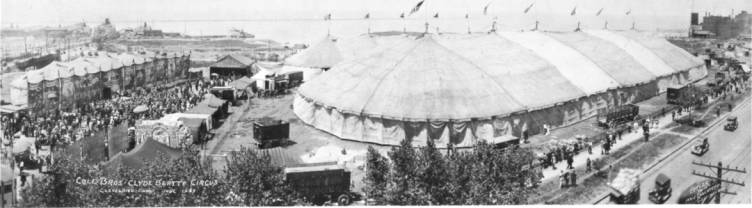
Photo: This very fine pan photo shows the Cole show on the Cleveland, Ohio lakefront lot on June 10, 1935. This picture appeared in the 1936 Cole courier, but was cut down. The No. 2 Side Show appears in the lower left hand corner. The "Petrified Man" walk through wagon is at the left end of the bannerline. The dressing top and back yard is at right. Circus Farm Collection.
Some interesting information has come from Wes Herwig which proves that Associates Investment Co. sold one of the ex Christy Bros. 12 cages to the World of Mirth Shows (Carnival) in the early Spring of 1939. This is the first evidence we have found of an actual sale of surplus circus wagons by Associates following their advertisement which appeared in a January 1939 Billboard. Herwig writes concerning the cage that went to the World of Mirth Shows as follows.
"I definitely recall that one of the 12 ft. Christy cages went to the World of Mirth Shows in 1939. When I first saw it on the Mirth train it was just as it had been on the Cole show; a wagon with predominately white background paint, gold on the corner and sunbeard carvings and some paint trim in green and red. The wagon had been painted 'Clyde Beatty's Wild Animals" on its title board, above the cage compartment, but "Clyde Beatty's" had been painted out, so it simply read "Wild Animals". The first year this cage was on the Mirth show it retained its sunburst wheels. It was used to house the lions in Earl Turtle's motor drome show. I think at one time this cage may have been numbered 23 on the Cole show but not sure of this.
"When I saw the cage the next year, 1940, it was painted all aluminum, over the carvings and everything. The sunburst wheels were gone and solid rubber tired wheels off some early type of lightweight truck had been substituted. These were not the heavy wide-track wheels off trucks as used on the baggage wagons on the Mirth show, but quite narrow. I saw the cage once again, later on, and it was fast going to pieces, losing parts of its carvings and generally taking a beating. The cage was on the Mirth show at least thru most of the 1941 season. There appears to be two possibilities as to the disposal of this cage wagon. According to one story, Frank Bergen, WOM manager, presented it to the Hickory Tree Wild Animal Farm near Boston during the latter part of the 1941 tour, and some sources state that two lions were given to the farm with it. The cage stayed there until it rotted out, so the story goes. Another version tells us that it ended up its days at the Farmers Museum at Cooperstown, N. Y. which instituted at one time, but no longer, a circus exhibit. Reportedly the museum bought it off the Mirth show while it was at Brockton, Mass, and had it trucked to Cooperstown. En route to the museum, the truck carrying it, so the story goes, was in an accident and the cage further damaged. Reportedly it was kept at the museum for a while, refitted with wooden wheels, but then the museum disposed of the circus display".
Fortunately through the help of Paul Horsman and John Cutler we located a photo of the cage wagon while it was on the World of Mirth Show in 1941, see photo No. 1.
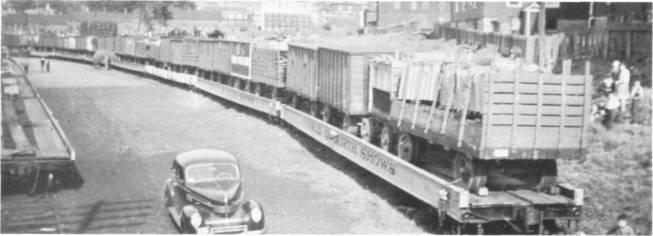
Photo No. 1: World of Mirth Shows loaded flats at Fall River, Mass., season of 1941. Second wagon forward from end of last flat is the 12 ft. cage the show purchased from surplus Cole Bros, equipment in early Spring of 1939. By now it had been equipped with hard rubber tired wheels and painted a solid aluminum color. Photo by John Cutler.
A late note from Herwig just before press time says he has heard from the assistant curator at the Cooperstown, N. Y. Museum which states that the Cole cage that was on the World of Mirth Shows never went there. This leaves Herwig to believe that the Cole cage in all probability was left at the Hickory Tree Animal Farm in Georgetown, Mass. Leaving the cage there in 1941 while the show was in the area could explain why fans who saw the show latter in the season claim the Cole cage was no longer there in 1941 although photos definitly picture the cage on the Mirth train earlier in the 1941 season.
The train light plant used by Cole Bros, in 1940 was perhaps the most unusual piece of equipment the show had during the period 1935-40. It doesn't show on the 1940 wagon list, and was I unable to spot it in the Tom Parkinson set of 1940 photos which show every loaded flat, and I had no knowledge of it's existence until Fred Pfening located the photo printed here showing it at the Nov. 2, 1940 Stand at Pampa, Texas. Just when this rather crudly built vehicle was constructed has not been determined. Possibly it was on the show at beginning of the 1940 season and loaded well up under the big top pole wagon or some similar spot on the train or perhaps it was constructed sometime during the season. Note it carries the number 1145 which was a rather common practice those days in numbering train light plants. Some train light plants were numbered 1230, 1200, or in this case 1145, evidently signifying the time of evening the plant would be in use. In 1937, Cole Bros, was using for the train light plant one of the former Christy Bros, cross cages which had been converted for that purpose.
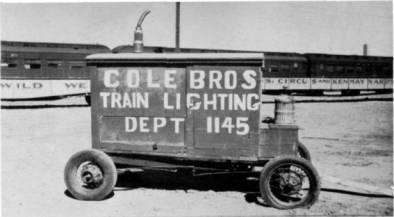 Photo: Cole Bros, train light department wagon No. 1145 at Pampa, Texas, Nov. 2, 1940. Flats and coaches are on siding in rear. Burt Wilson Photo.
Don Smith has again furnished some original correspondence given him by Jess Adkins which illustrates the dire financial condition of Adkins and Terrell in early 1938 due mainly to the heavy expenditures of launching the No. 2, Robbins Bros, show that year. The bankroll was down to about nothing when both shows took to the road in the Spring of 1938. Had the good business experienced in 1937 and expected again been present in 1938 then no doubt both shows would have been off to another great sa-son but the bum take due to the sharp business recession had a crushing effect on the shows which neither was able to overcome and hence the subsequent bankruptcy. Examples of this correspondence are printed here.
WILEY MOTORS INC.
Ford and Lincoln Peru, Indiana
March 8, 1938
Mr. Jess Adkins
Cole Bros. Circus
Rochester, Indiana
Dear Sir:
It has been called to our attention by the bank, that your February 1, and March 1, payments have not been received.
As you recall our understanding with Mr. Shirk, at the time he agreed to handle this account, that it was necessary by the rules of the bank that these payments were to be made monthly.
We thought possibly this had been an over-sight on your part.
We would appreciate your taking care of this matter at your earliest convenience.
Yours very truly,
WILEY MOTORS INC.-s-
I. E. Wiley, President
April 27, 1938
Via - Special Messenger
Mr. Earl Lindsay, Treasurer
Cole Bros. Circus
Chicago Stadium
1800 West Madison Street
Chicago, Illinois
Dear Mr. Lindsey,
Confirming conversation in your office last night with you and Mr. Terrell and Mr. George, it has been our understanding all along that during your Chicago performance you would pay us the $563.00 balance due on last year's account for printing your Programs, per statement given you last night. In fact, we were doubly assured of this when we recently agreed with Mr. Floyd King to allow him until the second week in May before requiring him to make the usual advance payment on the Robbins Bros, account for work we have contracted to do this year.
If you will talk to Mr. Adkins I am sure he will tell you that when Mr. Giere and the writer called at your office on Saturday afternoon, April 16th, to get his signature on the contract for the work we are to do for Robbins Bros., he then agreed and instructed you at that time to pay this old $563.00 account during your performance here in Chicago, and I personally do not want this small balance to in any way cause my company to doubt you people or to cause the work we have contracted to do for Robbins Bros, to be held up, and it was for that reason that I called to see you last night.
I am reporting to Mr. Cuneo today that I have your's and Mr. Terrell's word that you will take care of this small item before you leave Chicago and, as per your instructions, will either drop by to see you myself Friday afternoon or send one of our men to get your check for the $563.00 due.
Thanking you for your cooperation and wishing you all the luck in the world for the best season you have ever had, I remain, with personal regards to all of you.
Sincerely yours,
THE CUNEO PRESS, Inc.- s
Geo W. Rue, Assistant Secretary
(Copy of Telegram dated April 27, 1938)
Jess Adkins Treasurer
Indiana Circus Corp.
Rochester, Indiana
Please authorize Lindsey to pay Cuneo Press balance Five Hundred Sixty Three Dollars due on Cole Brothers last year account before leaving Chicago as agreed so this wont cause any delay producing Rob-bins Brothers job per agreement with you and King April sixteenth.
CUNEO PRESS INC. RUEDon Smith has also loaned an interesting letter from Jess Adkins to Baker-Lockwood Co. inquiring about used tents for possible use by Robbins Bros, in 1938. It may be recalled that although the show ended up getting new canvas to begin the season that a short time later the new big top was returned to Baker-Lockwood and a smaller used top was acquired from them. The letter reproduced here also gives the tent sizes for all canvas Adkins planned to have for Robbins Bros, in 1938.
(Following is exact copy of letter from Jess Adkins to Baker-Lockwood in regard to used canvas for Robbins Bros. Circus 1938. Original is in collection of Don F. Smith).
Rochester, Indiana
3 February 1938
Mr. James Morrissey
17th and Central Streets
Kansas City, Missouri
Dear Jimmie;
Your letter noted which is in regard to some used tent for the proposed number two show. We are still figuring on putting out this second show. Below find tent size required. Will you please go over your "Used Tent" stock and advise me what you have that could be used on a line-up as given.
Big Top 140 - 135 or 130 round top with three 50 ft. middles, 12 ft.
wall.
Menagerie top - 70 ft. round top with three or four 40 ft. middles, 12 ft. wall.
Side show - 55 or 60 ft. round top with three 30 ft. middles, 10 ft.
wall.
Pad Room - 40 x 160 push pole - 9 or 10 ft. wall.
Horse Tent - 37 x 105 - 7 or 8 ft. wall.
Cookhouse - 40 x 90 or a 100 ft. push pole, 7 or 8 ft. wall.
Kitchen 20, 30 or 40 - two poles, 7 or 8 ft. wall.
Other tops such as Bandman, and Wardrobe, 20 x 30.
Thanking you for reply at your early convenience.
Sincerely,
s-s
Jess Adkins
Otto Scheiman, who lives in South Bend, Ind., the home of Associates Investment Company, has come forth with some additional and most interesting information concerning a second loan from Associates to Cole Bros, which explains how the show was able to take to the road again in 1940 after the fire and expand from 20 to 25 cars. Otto writes as follows: "There was a second loan from Associates to Cole Bros, right after the February 1940 fire. When the show played South Bend that Spring I was sitting on a wagon tongue when I noticed that stenciled on the bolster of the wagon was this sign - Property of Associates Investment Co. of South Bend, Ind. On doing a little checking with Bob Orr, then president of Associates, he told me of the loan and that they sent one of their lawyers, a Mr. George O'Macht, with the show that entire season. Every day he would attach the show so no one else could. I never got to interview Mr. O'Macht before he died and Mr. Orr was killed in the Tell City, Ind. plane crash. But Orr intimated to me that they never collected the full loan and interest and that finally the loan was marked paid on the receipt of a certain amount. Mr. Orr didn't say just when this occurred (Author's note - probably in early 40's, possibly 1943 or 1944). Orr also told me that it took a special act of the Indiana State Legislature to allow Cole to move winterquarter's out of Indiana. He said they were "blackjacked" into making the second loan but he didn't go into any details on this so I'm not sure of his meaning of this. (Author's note - no doubt some of the original backers of the show whe were prominent in Indiana legal, financial, and governmental circles put pressure on Associates to grant another loan to the show.) But from his attitude in the matter I know he would not have loaned any circus a dollar as they had had their fill of circus dealings.
"Here's another interesting note. After the fire Cole moved all remaining animals to the old Peru quarters. The bulls were chained in the bull barn and the animals were caged in the permanent cages on the wall opposite them. All newly acquired animals were shipped to Peru and housed there until they went on the road in 1940."
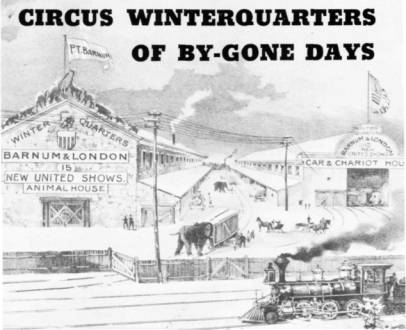
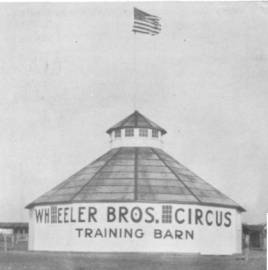
Photo left: The Barnum & London New United Shows, Bridgeport, Conn., as it appeared in a book published in 1888. Pfening Collection.
Photo right: The ring barn of the Wheeler Bros. Circus quarters in Oxford, Penna. Pfening Collection
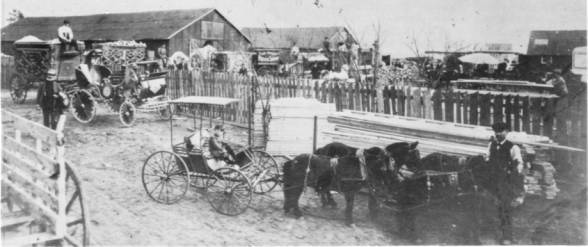
Photo: Mighty Haag Show in its winter home of Shreveport, La.
This was taken while it was a mud show. Woodcock Collection.
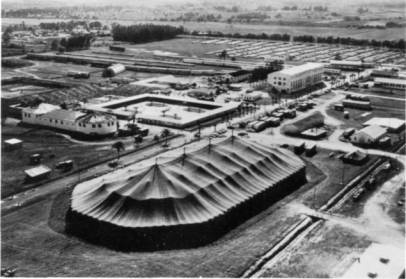
Photo: Aerial view of the Ringling Barnum quarters in Sarasota, Florida taken in 1956.
The big top was used for practice for a number of years prior to the show closing in 1956. Circus Farm Collection.
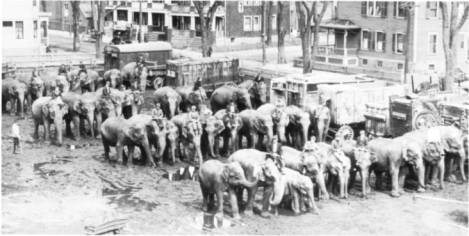
Photo: Bridgeport quarters about 1919. 35 elephants are shown. Harold Dunn Collection.
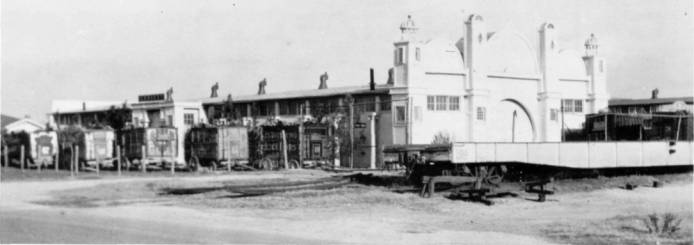
Christy Bros. Circus quarters in South Houston, Texas, around 1930. Pfening Collection.
California Circuses
by Bob Taber
Southern California land of sunshine, flowers and movie studios has never been a promising place to launch a new circus.
None ever started from a small beginning to build a reputation; then to play the same route each year or every second year.
The natives lack enthusiasm for any outfit less in size that the Ringling-Barnum, Clyde Beatty, Al G Barnes or others as they remember them of their childhood days.
Many a beginner lasted only a few days. None more than a couple of seasons.
Norris Bros, gave performances in theaters, where the actors were monkeys, dogs and ponies at the turn of the Century. This developed into the Norris & Rows circus with a home base on the Central California coast near Santa Cruz. Their fertile field was Canada.
Al G. Barnes got his grub stage on the Parker carnival with an animal show that old timers have told of grossing $1,000 a day. After 1909 thru the 30's till it was taken off the road, Canada from Coast to Coast was Barnes territory. He was a Canadian and much of that fact was used in publicity. It paid off.
This show played all spots, even cross roads, in Southern California in its early days after 1911 to give his people a long season. Thanksgiving dinner was eaten on the lot more than once.
Clyde Beatty wintered many times in the Los Angeles area. What towns missed in the Spring he played returning in the Fall.
The natives were accustomed to big things from circuses. It was difficult for a small affair to interest the circus goers.
Bert Robinson left the Cosmopolitan carnival with his lions and ponies to frame a small circus playing under an 80 foot with couple of 30's. He wintered in Orange county several years jumping out some 300 miles to a Frontier town to open.
E. K. Fernandez, the Barnum of the Pacific booked his animals for a route thru the Hawaiian Islands in 1922. This is where he made big money to enlarge Robinson Bros. Circus.
Penney Parker and wife were long the only performers with the circus. They did several acts, double trapeze, single traps, juggling and contortion. When he became too old to travel, Mr. Parker entertained around Los Angeles with his one-man show. The Los Angeles dailies gave him favorable mention at the time of his passing.
Bud Anderson brought his circus in for the winter once, but made a huried exit the following Spring.
On the death of Bert Robinson following an encounter in the Big Cage with one of his lions at an Idaho stand Tom Atkinson who was long connected with Mexican shows got hold of some equipment from the Robinson show. He long furnished trained horses, dogs and ponies for Guttierez Bros.
Harry Phillips, jeweler turned showman, used the Robinson title on a show operated with P. Perez. Some of those old Robinson Bros, programs are today collectors' items.
George Engesser, of St. Peter, Minnesota, wintered his Schell Bros, in California several times. In 1930 it moved from Hynes winter quarters to Corona to open. After one more stand it was in Arizona. The business given truck shows was no encouragement to stop long in Southern California.
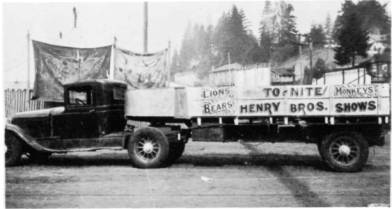 Photo: The Henry Bros. Shows toured the west coast during the mid 1930s. This photo was taken during the 1936 season. Pfening Collection.
One family show that did go out and come back was the J. E. Henry Bros, that moved from Oklahoma in the early 20's. It had been a wagon show in the mid-west, but in California it became a truck show.
The foundation for his success were the four sons Arthur, Robert, Tod, Glenn and Clifford. All were versatile performers and good musicians. Because of the musical family the show always had a good band, usually a working man could beat the drum before the side show opened. Almost every season there were baby lions on the side show. The show played the same towns so often that the natives knew the animals by name. Peanuts was a pick out burrow. On arrival, the town boys would call "where is Peanuts?"
During the years the family was growing, each boy got his pay from what he sold. One had peanuts, another birds on a stick, another pop corn or a ball game out in front.
Mother Henry's cut came from the reserves that were blue boards covered with a piece of old carpet. She took over the front door when the performance started pocketing what cash she collected from late arrivals.
She was also cook for the show folk, who ate family style. With all these duties she still had time to can fruit and berries brought in by farmers to exchange for ducats. At the end of the season the show went into winter quarters with her house-car springs bending with the weight of a winter's supply of canned goods.
The Henry show folk were well liked by the people in small towns West of the Rockies.
A daughter Bertha was not with the show when it invaded the West. She had married Al Connors and they were with Christy Bros, and others. Several of the boys have gone to the Big Lot. Tod is no longer active in the circus field. Clifford and Glen have animal acts enroute.
Henry Bros, never had an elephant in the West. Gyp, a historical bull, died from food poisoning when the outfit was in Oklahoma. Mr. Henry made a deal for a bull in California. The animal refused to enter a truck and the sale was canceled.
Thoughts of traveling with an overland show bring back memories. When just boys, Clifford and Glenn would be sent ahead of the caravan driving a pony-cage wagon containing a lion or bear. They had a rifle. Their duty was to shoot rabbits for lion feed. They seldom came in empty handed.
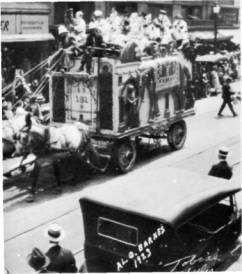 Photo: Best known of all west coast shows was the Al G. Barnes Circus. The Barnes Elephant Tab is shown parading during the 1923 season in this Toby Tyler photo. Burt Wilson Collection.
It was a tough time in the Spring of 1924 for circuses in the West. The foot and mouth disease broke out among stock in March. The Al G. Barnes circus and others couldn't move. Barnes made a record move to Illinois to open, playing the regular route backwards, making spots in the Northwest in the Fall instead of the Spring. The Henry outfit couldn't move outside Los Angeles City limits. The ban was gradually lifted. First to move from one country to another livestock had to be disinfected, people had to walk through a trough filled with sawdust and germ killer.
One incident was in late May or early June at the California border with Nevada. The show was held up at the line before traveling a few miles in Nevada before getting back into California. The inspection and fumigation was made about 5 p.m. and the necessary fee paid to Nevada. At midnite all restrictions were removed. The show folk had stopped to camp half mile from the line only.
It was an extraordinary family. They could even present a concert. In this, Mr. Henry did a little magic, Pea Nuts, the pick-out burrow did her bit and a couple of the boys did a number in black face.
The mid-40's were disastrous times in California for both old-timers and experienced people.
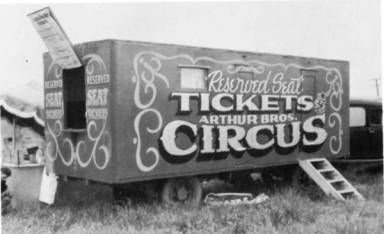 Photo: Martin Arthur purchased some equipment from Jimmie Woods as the start of the Arthur Bros. Circus in 1943. This ticket wagon was used by Woods on his Yankee Patterson and 101 Ranch shows in the middle 1940s.
After being on trucks for several years Arthur Bros, converted to rails. The '45 Coast to Coast tour was disastorous. It never went out again.
After the memorable 1946 tour of 101 Ranch Owner Jimmie Wood pondered what to do. The Yankee Patterson title had been a drawing one in '45. He decided to revive it for '47.
What equipment he could salvage from the last tour was repaired, repainted, and put in order as much as possible.
The Yankee Patterson of '47 had good people with it. Some of these had been on the 101 the year before. They were willing to try it once more.
The opening was a week-end stand at El Monte the middle of March. After a few close-in spots to L.A., the outfit headed over the Tehachapi Pass with all hoping for the best.
The program for the opening was as follows. One feature was Mabel Stark with her tigers. The show was short on paper and publicity and this act never got the advertising it deserved. She didn't remain long.
This was taken from a copy of The Billboard of April date 1947 of the '47 Yankee program:
Displays
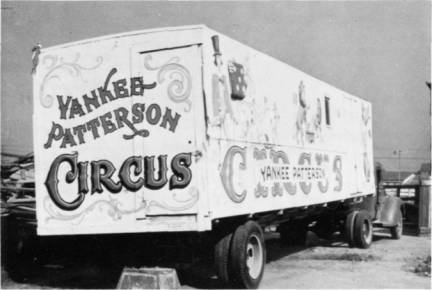 Photo: All of the Jimmie Woods shows were well flashed. This truck was on the 1947 Yankee Patterson Circus. Pfening Collection.
The Yankee Patterson hadn't been out long when illness sent the owner, big boss and life of the show to the hospital.
Ruby Wood was left in charge. The intake did not equal the outgo stopping at towns in the San Joaquin valley that had always been good for the Barnes show but not for this one in '47. Some small towns played two years previous by Yankee Patterson successfully were not large enough for this one.
Certain performers loyal to the last left their pay in the wagon hoping things would get better. Certain new acts came on with the understanding they would be paid nitely by Mrs. Wood.
The show was routed to the Redwood Highway. The plan was to work North toward Eureka, where the Barnes circus had to give four performances in one day to handle the crowds when Mr. Wood was on it.
This aggregation never reached Eureka. Things didn't improve. Mr. Wood was released from the hospital and caught up with the show at Petaluma. He called every one into the Big Top on a Saturday afternoon to announce "This is the end". It was no surprise. Some acts had already left when the ghost didn't walk. Every one went their own way.
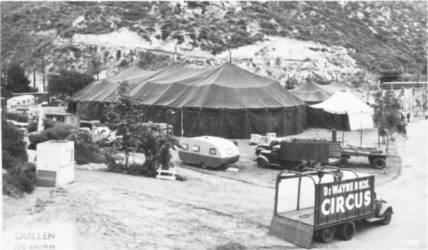 Photo: The DeWayne show's second stand was on June 2, 1947 at Laguna, California. This lot scene was taken there. Harry Quillen photo from
the Circus Farm Collection.
Photo: The DeWayne show's second stand was on June 2, 1947 at Laguna, California. This lot scene was taken there. Harry Quillen photo from
the Circus Farm Collection.
Ted De Wayne, who came from the middle west, as a youngster had practiced gymnastics in school. Later he joined an acrobatic troupe. He built a good Risley act, playing dates with the Rudy Vallee band making War Bond Drives during World War II. Later he had acts on the Clyde Realty circus and played Western Fairs.
In the Spring of 1947 he put together De Wayne Bros. Circus with new trucks, a new 80 foot round top with two 40 foot middles, a side show top filled with attractions.
He introduced several innovations. One was a shower trailer for the working men. He secured a Greyhound Pullman type bus. This was home for all the girls on the show.
Bill Petty, later long in the Red Wagon on the Beatty circus, was in the office and looked after feeding the people.
General Agent Waldo Tupper helped to organize the circus, advising and being general useful in many ways. He was in similar capacities on the Ringling-Barnum circus.
The advance and use of paper was weak. The show did not have sponsors. The public didn't realize it was in town and the attendance suffered accordingly.
Norman Anderson had the concessions. After years on his father's circus he knew that end from A to B.
George Perkins was buyer and did some clowning. He had been on Barnes. The show did not carry a big band.
The performance was given in one ring, on one slage and in the air. This set up made it really a two ring show.
The circus carried one elephant Shirley Temple. Some of the acts brought on their own animals. The program presented at Costa Mesa for the opening of De Wayne Bros, circus June 2, 1947, before a large crowd was as follows:
The De Wayne circus briefly played California working North for dates in Oregon and Washington before returning to California. It was out 100 days.
Ted De Wayne may have returned home down but not out. He is the only Southern California owner of the 40's who is still operating a tenting circus though in a different way. He has changed with the times.
Now the dates are mostly community promotions on week ends. His season is from early in January till mid-December. He makes some fair dates with Bimbo the water-skiing elephant.
The program may vary from week to week according to the sponsors desires. It usually consists of acrobats, acrialists, performing animals, lots of clowns, novelty acts. Big time numbers off the Hamid Morton and others that have appeared on the show at the Milwaukee circus parade have helped out when vacationing in California. Now that he has built up a reputation the critical California public knows what to expect.
During the tough 1947 season for some in California, Clyde Beatty in its second year on rails played 41 days in the state to good business. Cole Bros, made annual trips to the Coast in the 40's never passing up California, which always produced money in the Red Wagon. The circus patrons of California; maybe a bit particular and hard to please.
This article could not have been possible without the help of Bert Hansen of Daly City, California.
Top
French & Co. Great Southern Shows
By Art “Doc” Miller
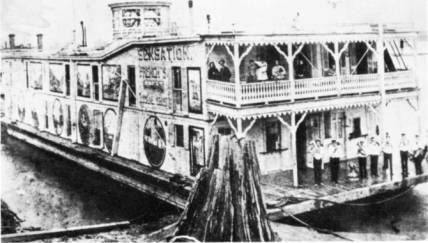 Photo: French's New Sensation showboat in 1899. French operated the showboat following his touring a circus. Woodcock Collection.
For many years I have taken notes from 'oldsters that I have trouped with, in the hopes of eventually assembling it all into book form. In all, I have over 300 typed sheets of material, and at least, have it titled; - "Rolling Sunburst Wheels". The following article is a chapter related to me and from notes passed on by both the late Sam Dock and his daughter, Claire Brison, some years ago. This is the same French that for many years was King of the River Show Boats and operated French's New Sensation. I was lucky enough to see at least the final days of the last "New Sensation" boat as it lay berthed at Mound City, Illinois were I wintered with an outfit, and saw the spring flood of '29 smash her beyond repair.
One of the late 1883 summer issues of The Clipper contained an advertisement for the French & Co.; Great Southern Shows. The notice mentioned an all winter tour in the south and wanted help in all departments. The show opened at Sabula, Iowa and many of the troupers arrived well in advance of the opening. To the natives it was quite exciting to find a large circus assembling equipment in their midst, and each day found larger numbers of folks at the blacksmith shop, the wagon works and along the levee, viewing with interest the river barge which was to transport the entire show.
French, who resembled Buffalo Bill in stature with frontier moustache and long hair, was generous to a fault and secured excellent hotel accomodations for the troupers. The hostelry owner felt the show folks were a big drawing card to his establishment and the table fairly groaned with bountiful meals.
Included in the roster were: A Mr. Monroe, part owner, Sam Dock, John Sallady, John H. Sparks, Charles Howard (equestrian director) Mr. and Mrs. Jack Shields, (mgr. of the Side Show), Willie Howard, Charles Queen, Joe Parsons, (who had just closed his mud show for the season), Joe Saunders, Wiley Ferris, St. Clair, Charles Howette, Sam Byers and Lamont, who years later operated his own mud show.
A few troupers fresh from the east, were continually bewildered by strange food, entirely different from which they were accustomed. One of the stand-bys was bread made from yellow meal. Upon John Sparks arrival, his first meal brought a look of bewilderment, but he was game and calmly speared a "chunk" of mystery.
"What it it"? asked Sam Dock. Sparks gravely replied that he didn't know, but it evidently was some kind of meat fried in sawdust. This brought gales of laughter from all the southern troupers who knew the dish as an old standby - side pork fried in yellow meal.
In those days jinx ran to real extremes. Anything yellow was definately jinx, be it overcoat, a knife handle or even a dog. Likewise the various circus expressions have long since been forgotten. The name 'jig' had not been coined. Then it was 'Moke' for any colored person. 'Jim' referred to anyone, and "Cracking Weed" meant making an opening. Thus to quiet down any pad room chatter when it was time to make an announcement, a ticket seller hurry over and yell, "Nix, Jim,! - Jack is cracking the weed on the Moke Fake". Back then the concert was always a minstrel and the idea of a wild west had not been thought of.
Candy butchers had a problem obtaining stock, so secured a good portion from local bakeries. What sold best were called "Gang Planks" and consisted of an inferior grade of ginger bread cut into sheets about six by twelve inches. As sales often dragged, butchers on occassion found themselves greatly overstocked and it was a problem to keep the stock in a saleable condition. A familiar sight to the rest of show folks were the butchers sitting in a corner, safe from prying eyes, hastily brushing the thick mold from the FRESH gingerbread.
Another old stand-by for the butchers were song books. These were about 5x7, consisted of a flashy cover with a few pages of words to popular songs, straight corn variety jokes and perhaps an advertisement for man or beast liniment. Most shows issued a Northern edition for Yankee states, and a Rebel edition complete with the "Bonnie Blue" flag for the Southern states. Since post-Civil War feelings still ran high, the booklets sold like wild fire.
Most of the troupers were seasoned river travelers, but the land lubbers had to be continually cautioned about the dangers of strong river currents. Also to avoid appearing on deck or by port holes while floating down stream through the bottom lands. These areas were still infested with renegades who had formed outlaw gangs to prey on the unwary. Ex-soldier ruffians roamed on horseback, plundering lone settlers and chance travelers. To them, passing packet boats made a convenient target on which they opened fire with muskets. Under these circumstances no one bothered to stick their head out of the window to admire passing scenery.
Several of the working men bunked in the boiler room and the 2nd week out, a steam gauge broke throwing out thick clouds of steam. Thinking the boiler was about to explode, three men jumped overboard and were never seen again, the swift current dragging them under.
At Chocktow Bend a number of troupers joined out as the John Robinson show had just closed for the season. These included Eva Ross, Madame Rheinhardt, Mike Butler and Fred McCart. Joe Parson greatly enjoyed reminiscing with the newcomers about the season they had all trouped on the M.L. Older Show. At one time that had been a large outfit but had been unfortunate in routing into Louisiania, and became quarantined during the horrible Yellow Fever epidemic and this bankrupted Older.
Just before matinee at Cairo, the performers were enjoying the usual pad room horseplay when a musket charge ripped through the side wall. Everyone ducked down between trunks, and later upon investigation, found the shooting had started between two drifters over who would 'take' a certain mark. During the exchange of shots, a drunken towner had joined in the fray and fired a round of pistol shots, one of which wounded Jack Shields. No one was seriously injured and the affair had a most amusing ending.
It so happened that one of the show's colored boys was an escaped slave, and still half expecting his owner to appear on the scene with a horsewhip. The sudden outburst of shots excited him and thinking they were directed at his hide, lit out at breakneck speed for the show's barge. Going down the gang plank he attained such a speed that, upon reaching the barge deck, he could not stop, and ran right off into the river. Fortunately the water was shallow and a mighty scared and damp colored boy was eventually hoisted back on deck.
At Arkansas City, the show set up on the river's edge and trouble with tough towners started before the wagons were spotted. The equipment was erected in spite of much trouble and heckling, but near matinee time the bolder toughs persisted in cutting holes in the ladies dressing room, and here and there slyly cutting guy ropes. French had a tough bunch of lumbermen for his crew and nothing pleased them more than a good free-for-all fight. These husky workmen casually (?) loafed around the front door at matinee time, and excess tent stakes were stacked at the marquee. The expected rush by the hoodlums was met with glee and they departed with bruised heads and a vow of revenge. During the performance "Hey Rube" echoed over the lot and everyone rushed out in time to witness a large gang speedily rushing an empty baggage wagon toward the river bank. Realizing fast work was necessary if they were to save the equipment, troupers grabbed nearby wall poles, tent stakes and similar weapons and rushed the toughs. It didn't take long to disperse the trouble makers, who retreated with bloody aching heads and a far greater respect for Hey Rube.
Near Morgan City, the packet and barge hugged the near bank too closely on a sharp riverbend and the barge struck a submerged tree trunk which ripped a large hole in the hull. Sinking rapidly it took fast action to jump the horses off and swim them ashore. A cage housing a jaguar, was tipped at a rakish angle and the poor animals could barely hold its head above water. The keeper opened its cage and the terrified animal swam to the packet and climbed on deck. There was so much excitment and confusion that no one noticed the animal which slunk into the boiler room. When the turmoil has calmed down it was noted that the bear cage wagon was missing, so French assumed it had rolled off and no doubt sunk. Mooring the packet downstream at a plantation wharf, concern was expressed over the horses which were roaming the cane brakes, an easy prey for the ruffian gangs.
Meanwhile back upstream, a cotton packet was leisurely making its way down stream, under the guidance of a pilot well fortified with corn likker. This particular stretch of river was especially dreary, foggy and dangerous, but the pilot had floated over it many a year without event. Impatient to reach Memphis with its gorgeous belles, the pilot grasped the wheel firmly and rang for more steam. Rounding the bend which had just been the center of excitement for French's show, he also, by accident, hugged the near bank. Suddenly there was an awful crashing and splintering of timber, plus a series of strange wild animal roars. The pilot now stark sober, realized he had mis-judged the boat channel and had no doubt hit an over hanging tree limb. - But why the sound of some heavy object and the strange animal growlings. Ringing the bell first for "full reverse," then "stop" and yanking the whistle cord for an ear splitting blast, the dozing deck hands sprang to life and and with torches beheld French's bear cage on the fore-deck. It became the sole object of conversation on how the cage could have been impaled by an overhead tree limb. Actually what had happened was the cage being located on the barge and which tipped skyward as the other end had sunk most rapidly. That a tree happened to be conveniently located at the exact right spot was a miracle.
Resuming its passage, the packet continued downstream and suddenly Frenchie's boat hove into view. Answering a hail, the boats were lashed together and the bear cage, sans its missing front running gear was transferred to the show's packet.
With much of the equipment lost overboard, French and Monroe decided to call it quits for the winter and wait until the cotton shipping season was over before securing another barge. Suitable quarters were found at Vicksburg, where new equipment was built and assembled. One of the workmen had the daily chore of hitching up a team for a trip to the sawmill for sawdust for bedding down the stock. French had a flair for the unusual and every few days he would announce that he would drive over for the sawdust. On such occasions, he would add a team or two, with plumes on their bridles, lash the hitch into a gallop, and ride madly through the streets shouting "Tally-ho!" The return trip left a plainly marked trail of sawdust all over the streets. After arriving back at quarters, the regular driver would harness a fresh team and make a second trip for the necessary sawdust.
Reopening, the show headed northward, playing Millikens Bend to huge crowds. Yazoo City was practically submerged and totally deserted, so the show continued on to Silver City hoping to secure food for the troupe. No sooner were the horses unloaded than the natives began to appear as if by magic. They arrived by dub-outs, rafts, skiffs and even paddled logs, An imprompto matinee was given at $1.00 admission to a capacity crowd. Hard Times Landing gave the largest attendance of the tour while St. Genevieve proved a blank due to hysteria over the James Gang who had just looted the bank and shot up the town.
Reaching St. Louis, the show closed without notice and every one was paid off short. French called a few of the troupers aside and advised them to stick around town and if in need of funds, to look him up. That winter the city was well populated with troupers, as the W. W. Cole Show was wintering there and many of the Main & Milliard folks.
The Howe Pullman shows figured it was a fine location to pick up talent, also replacement canvas etc., and promptly set up quarters.
French and Monroe, lacking funds to properly continue their own show, signed with the Howe outfit to operate the joints. They looked up most of their old employees and advised them to also join the show which would move in two baggage cars and play some western territory.
[Since photos of the French Great Southern Shows were not available a series of early concession photos were used to illustrate this article, not included in this online edition.]
The Golden Age of Chivalry Is Now in Baraboo!
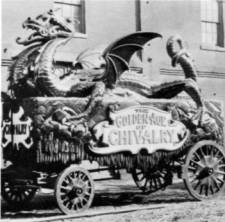
Chivalry arrived at the Circus World Museum on 24 October 1967, and the Museum's staff immediately went to work to have it restored in time for the 1968 Milwaukee parade in its original 1903 green, red, and gold glory. It is indeed fortunate that this elegant parade float has finally passed into more appreciative environment before it suffers any more from the disinterest that could be expected as long as it was no more than an oddball exhibit around an antique auto museum.
Unlike so many parade vehicles, this one no longer presents any major problems to historians. It was one of the thirteen built for Barnum & Bailey in 1903 by Sebastian. The carvings were done by, or under the supervision of, Samuel A. Robb. The above photo shows it in its original configuration. Sometimes before 1910 several vertebrae (about 15") were removed from the dragons' necks, a corresponding amount of material was taken out of the tail, and the dihedral angle between the wings was flattened to reduce its height. This may have been done so that it would no longer be necessary to take it apart to cut down on the overall height when it was loaded on the flat cars. However, the slip joints for joining the necks and the tail to the body are still with it.
The last dateable picture I have seen of it in parade was taken in Ashville, North Carolina, in 1913. The next event of importance took place on 31 December 1925, when it was included with the lot of 21 wagons sold to George Christy. It was also one of those that Christy left in Bridgeport (see my article, "The Early Ringling Railer,"Bandwagon, March-April 1967, for more particulars on this incident).
About 1933 it was acquired from the Fairfield, Connecticut, landlord where Christy was renting storage space by Whitlock, Inc., antique dealers of New Haven, who sold it soon thereafter to the Gorganigo Museum of Antique Autos in Princeton, Massachusetts. It was still in fairly good condition when I saw it there in 1947; but since then, one of the dragon heads has disappeared, the dragon's body has rotted through in spots, and all that is left of the wheels are the iron hubs and tires. According to Mr. Gene Zimmerman, its most recent owner who acquired it along with the other assets of the Gorganigo Museum in 1965 to add to his own enormous antique auto collection at his museum in Harrisburg, Pennsylvania, it was in this condition when he got it. But if past performance is any criteria, it will take more than a casual glance to differentiate between the new parts and the originals after the Museum's craftsmen have completed its restoration. - Richard E. Conover. Photo: Golden Age of Chivalry float. Photo from Princeton University Library Collection.
Question and Answer Box
Q. In the book Circus Cinders in Sawdust by Esse Forrester O'Brien is a picture entitled "John Ringling North II, and Lou Jacobs (1950). Who is this JRN II? Bob Raupfer, South Bend, Ind.
A. John Ringling North II is the son of Henry Ringling North, who is now married and has a son - John Ringling North III.
Q. Did Christy Bros, ever have pro-prams and route cards. I have never in 40 years of collecting seen one of either. Frank J. Pouska, Garfield Heights, Ohio.
A. Amazing as it may seem, the Bandwagon staff has not been able to locate either a program or route card of the Christy Bros. Circus. However, perhaps some Bandwagon reader knows of or has one.
Q. I read in the Sept. 9, 1967 Amusement Business that a Tom Champion of Terre Haute, Indiana bought a circus wagon that had been in storage in Peru, Indiana for 25 years. Has any CHS member seen the wagon and do you know anything about the wagon? Robert Russell, Stevens Point, Wise.
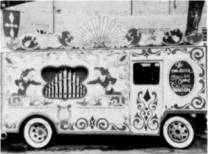 Photo: Two Jester Organ Calliope wagon.
A. Enclosed is a photo of the wagon in question, following its restoration by Tom Champion and John Starkey. Mr. Champion advises that the wagon was found on a farm south of Peru, in the woods on a farm, three years ago. A calliope has been installed inside and it is called the "Two Jester-Organ Calliope Wagon". Perhaps a reader can identify the carvings on the skyboard.
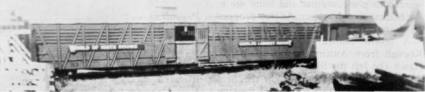
Bill Hall, Lancaster, Penna, has forwarded the above photo of a McCoy stock car on the World of Mirth carnival in 1929. Mr. Hall advises that Al Moody, W of M trainmaster, was sent to Washington by Frank Bergen in 1938 to purchase two of the stock cars for use on the carnival in 1939. In 1941 one of the cars was cut down to a flat car and the letterboards on the other car were removed and the car was painted silver. Both cars were on the carnival when it closed in 1963. The stock car went to the Circus World Museum in Baraboo, Wise, and has been used on the train to Milwaukee. The Museum also has a cut-down flat car and it probably is the other McCoy car. This flat has not been used as yet by the Museum. Photo: World of Mirth stock car.
Col. Glen J. Jarmes. the almost owner of a great deal of Robbins Bros. Circus and subject of the Cole Bros, series in the May-June Bandwagon, has given the Bandwagon this fascinating account of his dealings with the Cole Bros. Circus in 1939. Col. Jarmes writes:
“On the story in the Bandwagon of May-June, 1967. I was living in Owatonna. Minnesota, in 1939. full of vigor, vitality and vinegar and making money hand over fist in the coal business. I had an exclusive on the whole state of Minnesota, three coal mines in Indiana: and I was hankering to get back in show business after my failures of 1933-1934.
“Jesse Adkins was a very close friend of mine. I had loaned him several thousand dollars in 1938, and he paid it back - even in 1938. I was supposed to meet him in Monkato, Minn., in 1938 after they closed early. Jess wanted me to get hack in the business and buy the Rob-bins Bros, equipment. In January 1939 I went to Rochester, Indiana with my newly hired general agent, D. C. Hawn, old time Rhoda Royal man. and we picked out 13 cars of Robbins equipment, although I only wanted ten. We were to get this plus six elephants, etc. complete for $35,000. Then we went and bought all the Cole and Robbins draft horses from a farmer named Morris near Rochester for $7,000, and I gave my personal check for both.
“The understanding was that they were to hold the check for ten days until I got back to Owatonna to deposit and clear them. I had sidetrack and winter quarters all leased in Owatonna.
“Jess Murden and Zack Terrell were really put out with me because I had bought all the baggage stock they had salted away for the 1939 Cole show. The checks were sent right then, regardless of our agreement and they beat me back to Owatonna.
“Jess Adkins was fine, but Murden and Terrell were somewhat 'spunky' when the checks bounced. Terrell and Murden wanted to prosecute me and hang me to the highest tree: however, Adkins dropped all charges.
“A fellow named Garmel ‘Barnum’ Keough from Austin, Minn., and D. C. Hawn (he left me like a rat desserting a sinking ship) tried to take up the deal using my name with the Hormel Packing Company of Austin, Minnesota as a backer. They did a great job of running me through the mud, and all of this deal fell through. I never have told my side of the story, but here it is. My family, now numbering four sons and one daughter, none of whom are showmen, except maybe the youngest, Jon J.; and my ten grand children insist I do - to clear my name.
“I met Jess Adkins at Mankato, Minn., on July 29, 1939 and he forgave me and told me he sure was having trouble with his ticker and said, ‘Son, you missed the greatest opportunity of your lifetime.’ He probably was right and of course I felt bad. To me he was the greatest of them all, and a real showman of the old school and always a gentleman. He should rank at the top with James A. Bailey and the Ringlings.
“In the meantime, I and Mrs. Jarmes have worked hard, raised five children, two of which received masters' degrees and have ten grand children. So maybe it all has worked out O. K. However, I still dream and think circus twenty-four hours a day - so who knows? I sincerely hope in my small way I have been a small part of circus history.”
Copyright © 2008
Circus Historical Society, Inc.
About CHS
No part of this publication may be reproduced in any form or means
Last modified October 2008.
without written permission of the author and the Circus Historical Society, Inc.