


Circus Historical Society
Bandwagon, March - April 1967
Back to Bandwagon Index
Bandwagon, Vol. 11, No. 2 (Mar-Apr), 1967. Note: Only some articles are included in this online edition. Many illustrations are not included. The Circus Historical Society does not guarantee the accuracy of information contained in the information in these online articles. Information should always be checked with additional sources.
The patient historian sits around with his accumulation of facts, fables, conjectures, and unsolved problems and awaits the arrival of the key bit of new data which will unlock his stalled computer and cause it to spew out a few answers. Then, if his key bit has been really critical and if enough of the right facts have been in storage in his computer memory, there is a chance that a new revelation or so may be forthcoming or some perplexing problems will be resolved. Oh, if only we researchers into the ancient lore could run across new data fast enough to require the use of a modern computer!
The key that prompted this article is the picture that heads it. It came into circulation about two years ago after having been sequestered for many years in the collection of the late L. D. Melvin of St. Thomas, Ontario. When Mr. Melvin passed on, he willed his collection to his and our late friend and contemporary, Col. William Woodcock, Sr. It took longer to settle the Melvin estate than Col. Woodcock was destined to remain with us; so after the collection came into the latter's estate, this picture and many others which Melvin once had were acquired from Mrs. Woodcock by Joe Bradbury. Joe has kindly let this author tell about it.
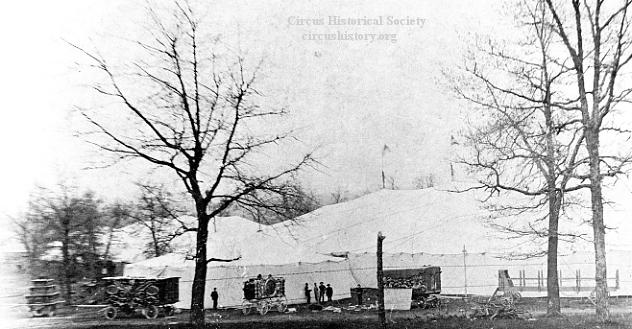
Those at all familiar with parade wagon lore will immediately recognize three wagons in this picture that were on the Ringling Brothers World's Greatest Shows for most of the 1890's and well into the first decade of this century. The immediate impulse is, therefore, to label the picture "Ringling." However, by falling back and regrouping, it will become logically obvious that it is, instead, of the Adam Forepaugh All-Feature Shows; and we will have thereby traced the origin of two more of the early Ringling railroad-show parade wagons.
In the picture from left to right (identified as we have heretofore known them), there appears: Item 1. The Forepaugh Three-Tiered Tableau, better illustrated in Photo No. 2.
Item 2. A tableau quite similar to four or five other Forepaugh tableaus, none of which have ever been so far identified with the Ringling show.
Item 3. A somewhat diminutive version of the Ringling Tableau No. 3 (Clown Bandwagon), better shown in Photo No. 8.
Item 4. Ringling Tableau No. 2, before it was modified in the late 1890's, shown before modification in Photo No. 11.
Item 5. A pole wagon, which is of no further consequence except to note in passing that even then it was the practice to carry the center poles outboard of the wagon bed on hooks.
It has been generally known for some time that the Ringlings acquired Item 1 from Forepaugh; and in my 1956 pamphlet, The Telescoping Tableaus, I identified it as the second item that was included in the purchase at the time they acquired the St. George and the Dragon Tableau (Lion and Mirror Bandwagon) in the fall of 1890. Since it is now apparent that the Ringlings acquired at least five parade wagons from Forepaugh (three of the four above, plus the Lion and Mirror Bandwagon and the parade float made from the St. George telescoping figure that was once part of the Lion and Mirror), it is no longer possible to be exactly sure which or how many of the three above came to the show in the 1890 purchase. The first, and larger, transfer of property transpired a year before.
In 1889 the Ringlings, after six years of operation as a wagon show, decided to put it on rails. A timely, for them, ad appeared in the Clipper for 2 November 1889 in which Adam Forepaugh offered some surplus show property for sale.
Otto Ringling lost no time in getting to Philadelphia to negotiate; and from the promissory notes signed at the time, we know that the deal was made on the 8th. It is interesting to note in passing that these notes were signed "Ringling Brothers., per W. H. R.," this W. H. R. being William Henry Otto Ringling, a moniker seldom associated with him. However, the handwriting on the notes checks with that of some of Otto's later letters; so there is no doubt that he was the Ringling who did the negotiating that day with Adam Forepaugh.
Besides the two promissory notes, three other documents relating to this 1889 transaction are available to me. Two of these are letters written by Adam Forepaugh, one dated 27 November and the other 16 December. The third is a Forepaugh letterhead on which Otto Ringling did some figuring - and doodling. On the face side of it, the following items are listed and were evidently under consideration:
One advance car - $1500
One 50 foot stock car - 400
One 40 foot ring stock car - 400
One 40 foot ring stock car - 350
One 40 foot elephant car - 400
Two 50 foot flat cars ($400 each) - 800
One 46 foot stock car - 350
One kangaroo - 100
One Cowalopus - 125
One camel - 400
All totaling $4,725, but evidently discounted to $4,500 for the group price.
There was some vacillation about the advance car, because the price of it was subtracted and again added; in fact, it appears that there was a complete reconsideration, because on the back side of the letterhead there is another entry (without prices) listing three stock cars, one box car, one baggage car, three loaded flats, and three empty flats. This totals eleven cars - a figure that agrees with the number that Forepaugh in his letter of 27 November to the Ringling Brothers stated were loaded and ready to leave. Except for the advance car, most or all of the above were probably included. In his 27 November letter, Forepaugh also mentioned that there were one cage and six baggage wagons on the flats and a zebra, kangaroo, and a camel in the box car with enough feed and bedding for the trip.
Before going to Philadelphia, Otto Ringling already had met with Thomas Grenier on 30 October in Chicago and purchased some property, leaving a promissory note of $1,000 for posterity to record the date but little else about the transaction. It can be assumed that some of the balance of that 1890 Ringling train of sixteen cars and, definitely, their No. 1 Bandwagon for their first year on rails came from that source. All of this was former Burr Robbins equipment which had been in the possession of Grenier since 1887 when he traded his Chicago supper club or playland known as Grenier Gardens to Robbins for his circus property. After an unsuccessful 1888 season, Grenier found out that circus ownership was not his forte and offered the property for sale the next spring.
At this point, I will revert to the logic which will establish the heading photograph as Forepaugh. As stated previously, there has been no evidence uncovered to align Item 2, or any of this series, with Ringling. However, the factor that really clinches the matter is the configuration of Item 3 at the time of the picture. Note that the body is shorter and perhaps lighter because the running gear is much lighter than that shown in Photo No. 8. Obviously, there was a complete rebuilding somewhere along the line. This would have had to have been done before 1894, because the Ringling Route Book for that year has a picture of the heavier version that matches the configuration shown in the 1900 Columbus, Ohio, photograph. Therefore, if this picture is to be Ringling in any year between 1890 and 1893, all four of these tableaus, in addition to other known items, would have to appear in the Ringling inventory. Fortunately, the Ringling route books in the 1890-93 period are more factual than fancy, and we can consult these with some confidence.
Diving into the details, we find that in 1890 there were two tableaus on the show, of which one (the Organ Tab) was a carryover from the wagon show. Listed in the 1891 Route Book were: The Neptune Tableau (possibly Item 1 above); the Organ Tableau; the Big Tableau (possibly Item 4); and the St. George Tableau, actually a float which was known to have been acquired in the November 1890 purchase along with the Lion and Mirror Bandwagon. Item 3 above could also have been there in 1891, because the list includes only parade pieces pulled with six or more horses. The route books for 1892 and 1893 list no more, or different, items which cannot be accounted for. So, in no instance, is there anything listed that would cause us to have to find room for Item 2 in any Ringling lineup before 1894; and from then on, Item 3 no longer looked like it did in the heading photo. This allows us to conclude with certainty that the photograph is not of the Ringling show.
Now that we can say that the Ringlings acquired Items 1, 3, and 4 from Forepaugh, the listings in the route books additionally tell us that not more than one of the three could have been included in the 1889 shipment, leaving the other two to be included in the 1890 purchase along with the Lion and Mirror Bandwagon and the St. George and the Dragon Float.
The rest of this article will concern the history of the three wagons which the Ringlings acquired from Forepaugh.
Item 1. The Forepaugh Three-Tiered Tableau. Both Joe Bradbury and I covered different facets of this one in the July-August and the September-October-November 1961 issue of the Bandwagon. However, enough new information has turned up since then to justify a brief rewrite. Sequentially, the following is about it:
a. This is possibly the tableau car that the Clipper for 15 March 1879 mentions as being shipped from Liverpool, England, to the Forepaugh show. At least, in its original configuration (Photo No. 2), it is one of the few of the many vehicles which have allegedly come from England that really looks like typical British construction.
b. It was sold to the Ringling show, possibly in 1889, but more probably in 1890. The Ringling 1897 route book still shows it in its three-tier configuration.
c. Before 1900, the date of Photo No. 3, the top deck was deleted.
d. Before 1903, the date of Photo No. 4, there was a rebuild which included the deletion of one of the round mirrors. This photograph is one of a set taken in 1903 by A. T. Johnson, a Baraboo photographer. In 1901, Johnson took another set of photographs which shows this tableau in the same configuration as Photo No. 3. In recent years, these two sets of pictures have come to be identified as the Trimpey negatives, after a Baraboo antique dealer who held them for many years.
e. About 1905 this tableau was transferred to the Ringling-managed Forepaugh Sells Circus. Why this was done is certainly not apparent, as that show was, seemingly, more than adequately equipped with parade wagons far bigger and fancier than this one. However, Photo No. 5 overrules any logic.
f. Shortly after the Ringlings removed Forepaugh Sells from the road in 1907, this tableau was sold to the Gollmar Brothers Circus. The Gollmars held it, without alteration, until 1916 when they sold their show to James Patterson (Photo No. 6).
g. In 1919 Patterson sold it to Al. G. Barnes, along with some other ex-Gollmar property, including Lotus, the much-publicized hippopotamus. On the Barnes show, it carried the clown band (Photo No. 7).
h. In 1925, it turned up as the candy wagon on the ten-car F. J. Taylor Circus owned by the Taylor Grain Company of Omaha, Nebraska, operating as the Consolidated Circus Company. A photograph of it on that show appears on page 9 of Bradbury's article on the Taylor circus in the May-June 1963 Bandwagon. That show lasted only until just past the middle of June. In 1927, the Consolidated Circus leased part of its property, including this tableau, to Leo E. Cook who tried to make a go, without success, of a show titled Cook & Cole. The last, datable, picture of this wagon was made in Fairmont, Minnesota, where Cook & Cole closed. There is correspondence in the collection of C.H.S. member, Howard Tibbals, that fixes it as still the property of Consolidated Circus as late as 1928.
Item 2. There are three different sources of photographs - one taken in Worcester, Massachusetts, in 1888; another taken in Bridgeport, Connecticut, in the late 1880's; and the one heading this article which discloses the existence of four, or possibly five, tableaus of this class in the Forepaugh show. The group have a commonality, in that they all had two generally oval-shaped framed mirrors on either side of the center (with different designs occupying the space between), and in that they all were provided with a small platform on the topside to which a wild animal was chained during the parade. No really good photograph of any of them has so far been found, although those available are adequate for identification and differentiation. There has been no inkling forthcoming about what may have happened to any of them after the Forepaugh show closed in 1894.
Item 3. Ringling Tableau No. 3, sometimes called the Clown Bandwagon.
a. It is now known to have originated as a smaller wagon on the Forepaugh show, and was sold to the Ringlings in either 1889 or 1890.
b. Before 1894 it was rebuilt into the configuration shown in Photo No. 8.
c. Between 1900 and 1903, it was rebuilt again into its final form as shown in Photo No. 9. It was used on Ringling Brothers World Greatest Shows continually through 1918 and went into Bridgeport with the show train at the end of the 1918 season.
d. On 31 December 1925, it was sold to George Christy along with 20 other ex-Ringling and Barnum & Bailey parade wagons. Out of this purchase, Christy selected the wagons known as Asia, America, Columbia, Palm Tree, and three of the Barnum tableau dens, vintage of the 1880's, for immediate use on his Christy Brothers Circus. He left the remainder in the Bridgeport quarters in reserve for possible future enlargement of his show. They were still there for a period of time after the Ringlings removed their property to Sarasota. Finally, when the owners of the property requested that he move them, he stored them in nearby Fairfield, Connecticut.
e. After the depression closed his show, Christy knew that he would never need the wagons that he had stored in Fairfield; and he quit paying the storage charges. The landlord disposed of two of them to museums and burned the rest for scrap iron. However, he did save quite a few of the corner statues and other carvings which have now become' collectors' items. Three of the four muses that were once on the Ringling Tableau No. 3 (Photo No. 10) are now the property of William Warren of Litchfield, Connecticut. Mr. Warren bought these from the Fairfield landlord about 1938.
Item 4. Ringling Tableau No. 2.
a. Photo No. 11, taken in Algona, Iowa, in 1894, shows that the Ringlings left it just as it was received from Forepaugh for a number of years.
b. Photo No. 12 taken in early 1900's, shows how the carvings and mirrors were rearranged sometime between 1894 and 1901. It was used on the Ringling show through 1911, when it was replaced with some newer construction that had been built for the Forepaugh Sells reissue of 1910.
c. In 1913 it was sold to J. H. Garrett who was framing his second try with the Rice Brothers title. That attempt lasted for most of the season; but for the next year and a half, the chattels were shuttled about the country while Garrett and W. E. Franklin (erstwhile general agent, partner in King & Franklin, John Robinson & Franklin Brothers, etc.), who held the mortgage, fought it out in the courts. Franklin finally won out, and in September 1915, sold all that had not been stolen off to the Wortham carnival. Of six identifiable items known to have been with that show, only two have been traced by it. It may be significant that there is a picture extant that poses J. Augustus Jones in front of this tableau.
Besides the photo and other credits already acknowledged, the author wishes to thank Chalmer Condon and C. P. (Chappie) Fox for making available the documents about the 1889 property transfers.
After a successful 1945 season with an unknown title, Yankee Patterson, Jimmie Wood put the circus paraphernalia away in the barn at Venice, Calif.
Being an ambitious manager, Mr. Wood looked around for a nationally known title.
Zack, last of the three Miller Bros, from the Cherokee strip of Oklahoma, long operators of Miller Bros. 101 Ranch Wild West Show, was then owner of a souvenir stand on the highway not far from Ponca City, Okla.
After a trip back there Mr. Wood closed a deal for use of the 101 title and Zack to appear in the performance. An accident prevented him from appearing at the opening. When he did a daughter came along to look after him as he was not a well man. She did ride in the grand entry. Zack never did participate in the arena.
Soon after Jan. 1, 1946 work got under way at Venice building not far from where the Al G. Barnes went out many times.
The Billboard, under date of Feb. 2, carried a story advising that the Jimmy Wood 101 Ranch Wild West would open about March 12, playing the Los Angeles area two weeks before heading North and East.
Some rolling stock used on the ill-fated Cronin Bros, the year previous had been purchased and was being overhauled.
Mark Smith, long on the Barnes circus, was to have his All-Girl troupe with 50 horses as headliners for the circus part of the show. Col. Zack Miller himself would appear in the wild west portion.
Smith's riding act was to feature 20 girls and 20 horses. The troupe was to furnish bare back turns as well as acts by the six girls as Roman riders.
Others already signed included the Landon Liliputians, Moe and Joe elephants previously on Arthur Bros., a troupe of well known Mexican performers.
Tony Madison, Cliff Henry were at quarters. Joe and Anna Metcalf would bring on the famous elephant, Shirley. Bob Thornton was breaking a midget mule act; Fay Avalon, who dated way back in Barnes history, would have a taxi meter mule. Maurice Marmelejo, tight wire performer, was to be featured and special paper used in advertising the act.
Also appearing in the wild west department with Col. Miller would be the Eddy troupe, Frank and Bernice Dean, Dorothy Skyeagle, Hope McClennen, Chief Sugar Brown and Indian troupe. Wildfire, the noted motion picture horse, would get special announcement.
A new wild west canopy top 148 x 228 was being built at quarters. Frank Chicarello, an experienced hand, would be utility man on the new outfit and assistant to the owner. Frank had started in the outdoor field with the original Miller Bros. 101 outfit.
The call a few weeks later was for all people engaged to report at quarters in Venice March 4; performers to Mark Smith, canvasmen to John Gutierrez; truck drivers, Bob Galbreath; side show people, William De Barrie; lithographers to Herbert Wilson; union musicians to wire Roy Cinkey, band master; all others to Jimmie Wood, 41118 Del Ray Ave., Venice, Calif.
It got away to a good start at Santa Monica March 10. The show with a new canopy, well painted trucks, made a good impression enroute and on the lot.
Bill Dedrick did an outstanding job lettering and decorating the rolling stock. An advertising deal had been made with Mobil oil and gasoline. Some trucks pictured the flying horse emblem. In the deal the oil company was to allow show posters in the windows of gas stations and distribute cut-priced tickets for the kids. It had a double page spread in the souvenir program.
Nothing in the advertising mentioned Miller Bros., only Col. Zack in person.
It was operated by the California Circus Corporation 101 Ranch Wild West and International Congress of Circus Stars; in a thrilling and glittering array of sawdust and spangles.
A flashy program was issued for the Golden Jubilee Tour with pictures of Col. Zack, 101 stars of other years, Will Rogers, Tom Mix, Buck Jones, Indian types that had been with the 101 Wild West Show.
The advance had a variety of paper. They used some stock circus lithos with some outstanding wild west posters that are today collectors' because they had advertised and picked up some rare ones.
The program was:
Concert by 101 Ranch cowboy band under direction of Le Roy Conkey.
Event No. 1 - The 101 Ranch on parade or Passing of the Old West in review.
#2 - Introduction of the world's champion cowboys, cowgirls and circus stars.
#3 - Major Bob Thornton and the 101 Ranch military ponies.
#4 - Aerial ballet by young ladies in a display of grace and beauty.
#5 - The clowns have their innings on the funny trampolin.
#6 - Pony express; showing how the mail was carried during the pioneer days in the Far West.
#7 - Landon's midgets, in a sensational perch act.
#8 - Pure bred Arabian Posing horses presented by young ladies.
#9 - Horse roping featuring horses ridden by Jack Wright, Frank Dean and Chief Sky Eagle.
#10 - The clowns are back again.
#11 - Maurice Marmalejo, king of the slack wire, center ring; Arturo Gutierrez, bounding rope, ring #1; John Gutierrez, slack wire, ring #3; Gutierrez Sisters tight wire over the hippodrome track.
#12 - Mark Smith presenting the only all-girl riding act with the Misses Tina Keehler, Skeeter Knudsen, Pat Hart, June Hannon, Betty Haller, Laura Koepp.
#13 - Western Pastimes - Fine demonstration of markmanship, rope spinning, knife throwing, push ball on horse back between two picked teams.
#14 - Landon's Lilliputains in an acrobatic novelty, the Henry duo on rolling globes, Gutierrez troupe of acrobats. #15 - 101 Ranch military mules.
#16 - More funny stuff from the clowns.
#17 - Mark Smith premiere horse trainer of America in "Ilmilad" prize winning pure bred Arabian.
#18 - Hold-up of the Ponca City Deadwood coach.
#19 - Trick and fancy riding introducing Buck Eddy, Hope McLennon, Frank Dean, Bernice Dean, Jack Wright and Dorothy Eagle.
#20 - 101 Ranch high school horses.
#21 - Elephants are smart, Shirley and her trainer prove it.
#22 - Trick roping by cowboys and cowgirls.
#23 - Toni Madison and her Wild West dogs.
#24 - Mark Smith presents America's greatest military act.
#25 - Landon's midgets in "The Prize Fight".
#26 - Shetland pony races with monkey riders; also chariot races and Roman standing races.
#27 - Attack on the emigrant train.
Finale.
The executive staff included James L. Wood, gen. mgr.; Harvey Walters, gen. agent; N. Beck, gen. press agent; Harry Melon, legal adjuster; Norman Anderson, supt. of concessions; Herbert Wilson, adv. car mgr.; James Wood, Jr., head usher; Mark Smith, arena director; Wm. Dedrick, paint supt.; Robert Thornton, equestrian director; Ova Thornton, treasurer; Wm. De Barrie, side show mgr.; John Gutierrez, canvas supt.; Le Roy Conkey, musical director; Frank Chicarello, supt. of front door; Allan Wood, announcer; Clifford Henry, supt. of lights; R. A. Simons, contracting agt.; Ovita Gutierrez, steward; Robert Galbraith, transportation supt.; Milo Hartman, mail agent.
The 101 Ranch show didn't have everything its own way. Never before or since have there been so many circuses starting out from Southern California in the Spring of one year at about the same time.
Besides the 101 there was the C. R. Montgomery Wild Animal circus out of El Monte for its second tour, the Al Dean circus headed by Forrest Freeland, the Barney O'Hearn with Rudy Jacobi manager. That was before the days of Rudy Bros. The Clyde Beatty circus was on rails for the first season. It came into the West Coast after an early opening in El Paso. The Beatty name was remembered for the Beatty-Russell following his days on the Cole Bros, as star attraction. Naturally some people wanted to wait.
The 101 Ranch played a couple of weeks in Southern California before going over the hump, as the mountain range is known.
That gave the Montgomery show a chance to get ahead and the two were never close rivals during the season. There was no billing war nor "wait" paper posted.
Getting away in the middle of the month the 101 people stole the jump in that they played the Citrus Belt, where the orange season was in high gear. It was in San Bernardino on March 24 and Riverside on the 25th.
Newspapers with the oil company tie-up gave the show good recognition. Ed Beck was ahead on publicity.
Luke Anderson, who grew up on his father's show, and his mother were both with it. Luke had the privileges. His mother had leased the elephant, Shirley, to the show. She went along not naturally for the ride, but to keep an eye on everything.
Jack Dalton, billed as "the last of the Dalton boys", famed bandits, got much publicity for the show.
Allen King, featured on Cole Bros, a few years previous with a group of performing lions and also operating King Bros., was lot superintendent.
Side show manager De Barrie from the first day demanded that the Red Wagon not be opened until he had made an opening to get a first chance at the crowd.
Joe Sullivan was banner solicitor. He traveled several days ahead soliciting ads. Bill Dedrick was back on the show to paint and hang them for display in the arena.
At Redondo the cowboys staged a shooting demonstration on the streets. Whether they were in an angry mood, liquored up or just looking for excitement the show got much publicity.
An amusement paper reported that Mark Smith knew how to handle pretty girls and spirited horses as shown by acts in the arena. It was claimed he had trained more fine girl riders than anyone in the business.
Featured was Miss Kaehler as the only woman to do a backward jump-up.
Smith came with much experience on the Barnes show and the large Kellogg Horse Ranch in California.
Bob Thornton for most of his nearly 30 years around the Barnes show, put the program together and served as equestrian director.
Though it was advertised as a show on the road 40 years the 101 title was not known on the Pacific Coast, where the show was playing. Consequently business was not what had been anticipated. This proved what the late Jake Posey told me one time. "A circus title put on the shelf 5 years is dead."
It had seldom appeared under the Miller direction in California. As a big railroad show it had been out that way in 1911, coming into California at Barstow Nov. 11, closing at Redlands on the 24th to end a season of 24 weeks playing 168 towns in 25 states, traveling 14,097 miles.
In the Spring of 1912 it opened at Santa Monica March 23 making a quick dash North.
The other trip West for Miller Bros. Wild West was in 1926. The first stop was Redding, close to the Oregon line on Sept. 25. It was in the state only 19 days with three each in San Francisco and Los Angeles.
The Jimmy Wood show suffered as one unknown. The third week for this wild west circus in '46 opened at Riverside March 25 followed by Corona, Pomona, Azusa, North Hollywood, Reseda and Burbank.
The route followed was a good one for the Al G. Barnes outfit many years. Among the spots the week of April 22-28 were Watsonville and Santa Cruz, the latter being the winter home of the old Norris & Rowe show many years.
Patrons have little protection in a wild west canopy. This show suffered from fog at San Leandro on San Francisco Bay, but did well at Salinas, an inland town, where ocean fog was not evident.
California has long barred advertising close to the highway. Arrows for direction of the show truck drivers carried the name 101 title. That cost the manager $40 at Woodland, where it played May 10.
Announcement was made from Redding on May 19 that the 101 had not been setting any records, drawing half to three quarter houses though weather was good. Marysville, May 15, had them on the ground.
The Billboard correspondent wrote that a social club under the name of Hubba-Hubba had been organized. After the first nite show of a two-day spot, Sacramento, May 11-12, a weiner roast was enjoyed in the arena. Buck Eddie's gang played their guitars and sang western songs. Bernice Dean's Ford carried a sign lettered by Bill Dedrick, "Hubba-Hubba Girls' Club, 101 Ranch Show."
Many on the outfit had colds. Ruby Wood was busy spooning out medicine. Maurice Marmelejo was teaching Ameda and Alecia Gutierrez the wire act. Jack Wright of the rodeo department was wearing gaudy ties.
The Montgomery Wild Animal circus had jumped far ahead. The first day of June 101 was in Walla Walla, Washington followed by Dayton, followed by Lewiston and Moscow in Idaho.
In Portland, Oregon, at a two-day stand, May 30-June 2, the show drew an estimated 20,000 for nine performances in two days. The seating capacity was 3,500.
Agent Walter Harvey garnered good publicity by a hook-up with the Oregon Journal. Decoration was a sellout. Salem produced two good houses. Then the outfit moved into Washington, playing Bremerton, Renton, Seattle for four days, 13-16. All records for the season broken at Bellingham.
There were spots during the season when an epidemic of polio seriously affected business. As has often been the case local officials prohibited children attending public gatherings. This had an effect on the season's gross receipts.
First week in July the Montgomery show was in Montana with dates at Fairview, Terry, Miles City, Bowman and Hettinger, followed in North Dakota too far to blame poor business on the competitor.
A July Fourth party was given on 101 at Boise, Idaho. This being a two-day stand the show people gave a special performance on the lawn of the Veterans' hospital that brought favorable press comment.
Temperature daily was between 90-102 degrees with jumps 100 miles on the average.
During the 18th week the circus-wild west combination was in Idaho, Utah and Wyoming with a two-day stand July 12-13 in Salt Lake City, followed by 12 spots in Colorado.
On July 24 it was at Canon City, where Bird Millman, long star wire performer with Ringling owned shows, is buried.
It was there the trailer of Ruby Wood caught fire. Little damage was done. Enroute on a 141 mile jump to Canon City Arthur Gutierrez driving his father's equipment, went to sleep and ran into a bridge; much damage was done. Bob Gailbraith, show mechanic, was kept busy to keep the trucks rolling. Mr. and Mrs. De Barrie picked up a new trailer going through Denver.
During the first week of August the show made stands in Kansas at Pratt, Wichita for two days; Eldorado, Fort Scott, Nevada, Pittsburgh, Carthage and Coffeeville on Aug. 11. At that point the show had covered 5366 miles, many of which were tough going. It was a long way from home with daily unexpected difficulties arising.
It had been a rough tour so far. Hope was held out that when the show got into Oklahoma territory, where the 101 title was well known, things would be better.
Operating a circus has always been a precarious deal. Peter Fink, long time steward on B. E. Wallace, Hagenbeck-Wallace and Sells Floto, retired to put his money in a California orange grove near Riverside. He told how the Wallace show one season had a long wet Spring. Business didn't change until long past mid summer. Crowds then were big. However, after a late closing, the season was a loss on the whole tour.
The management learned after reaching the hoped for promised land that the leased title was more of a liability than an asset. Several times a week while in Oklahoma the sheriff attempted to put an attachment on the show. It took some fast talking to prove the present management had not made the unpaid bills.
Pay days were irregular. Some of the help were on the point of leaving when word got around that a contract had been signed for use of the people and equipment in making a picture at a long stand in San Diego.
Uncle Leo Blondin, pioneer showman and Col. Miller arranged for an appearance of some of the performers at a lawn party during the three-day stand at Oklahoma City. Consequently there was an up-turn of business.
Accidents came fast one week. En-route from Holdenville to Okmulgee one of the show trucks killed a colored girl, injuring two other children going to school. The show driver was jailed.
Everyone had a case of bad nerves after a fatal accident at Duncan. A friend of the Sugar Brown troupe was killed on the. highway. He had joined at El Reno and was dancing with the troupe.
Early September found it in New Mexico with a slim pickings at Carlsbad on Sunday the 15th because of a National Mexican holiday celebration. Hobbs turned out to be a good day. Clovis was light and weather cold. The following week it played towns along the Mexican border of Lordsburg, Douglas, Bisbee and Nogales.
A two-day stand at Tucson Sept. 27-28 was the best in the state. A show was given at the Veterans' hospital in Tucson. Those appearing in this were Fred Bowery, roping; George and Jack Fairburn, Ko Ko; Lo Lo, clowns, Landon's midgets, Sugar Brown Indians, Toni Madison's dogs.
After a two-day stand at Yuma, Arizona, the show crossed the Colorado river to be back in good old California.
The date at San Diego, October 11 through the 20th was a disappointment. Another hospital appearance was at the Children's Hospital. Todd and Peggy Henry joined here to operate the grease joint.
A 32 1/2 week tour ended at Monrovia October 24. Jimmie Wood brought it back with help of some loyal people. They had encountered storms, dust, polio, accidents and poor business. There were three more towns not made as scheduled on the route card.
From the beginning of the 1938 circus news was bad. Cole and Robbins were no exceptions. Even before Robbins opened it was evident that Cole Bros, was not drawing like it should. A brief item in the April 30 Billboard said that Cole Bros.' Chicago business was light and that attendance for the first six days was way off reflecting general business conditions in the Windy City. The new Tim McCoy Wild West Show over in the International Amphitheater wasn't getting any business either. Business in the spring of 1938 in Chicago just wasn't to be had.
The news from Chicago was doubly distressing to Adkins and Terrell because of the additional financial obligations they had found necessary to assume in order to get both shows on the road. As was brought out later in the bankrupt proceedings the show had to borrow $25,000 from "local Rochester businessmen" in order to finance the framing of the new show and to make the necessary winter repairs and improvements on the older show. This loan was secured by giving a mortgage on the winter quarters land and buildings. It is believed that A. C. Bradley, president of the local bank in Rochester, supplied most or all of these funds. Also it became necessary through additional financing from Associates Investment Co. to give them a chattel mortgage on all equipment of both shows. The shows financial structure consisted of the original parent holding company, the Indiana Circus Corporation, and the two operating companies, Cole Bros.-Clyde Beatty Circus Inc. and Robbins Bros. Circus Inc. and all three corporations were now mortgaged to the hilt and had to either make it or break it in 1938.
Business in Chicago did not improve and after the final performance on May 1 the show moved rapidly to Rochester where all tents had been erected awaiting the opening stand under canvas on May 2. The May 14 Billboard stated that Cole's business in Chicago had been poor, terming it the worst the show has had since it was organized. The poor showing was blamed on a combination of bad business conditions and bad publicity breaks. That same issue of Billboard told of the folding of the new Tim McCoy Wild West Show in Washington, D.C., ironically at the same location the last major wild west show, Miller Bros. 101 Ranch Wild West, had gone broke in 1931. The McCoy story was simply one of "ticket wagon paralysis" and over 200 G's that had gone into framing the new show had gone down the drain in only a few weeks. At the auction of McCoy equipment a few weeks later Cole Bros, purchased the fine advance car at a bargain and had it shipped to Rochester quarters where it was parked for the rest of the season.
Billboard reporters on hand for Cole's under canvas opening in Rochester were high in praise of the show's performance and physical appearance. Special plugs were given for the new big top, a 160 ft. round with three 60's and the improved lighting. There was a new 30 ft. neon sign with 20 inch letters at the main entrance and a 15 ft. sign also with 20 inch letters for the side show. Both ticket wagons were also enclosed in new lights. During these years Cole Bros, was the leader in modern lighting and each year had seen new improvements.
After the Rochester opening Cole Bros, spent the next few weeks in its familiar territory in Indiana and Ohio. The second stand was at South Bend, then came Ft. Wayne, Muncie, Connersville, and Indianapolis for a scheduled two-day stand on Saturday and Sunday, May 7 and 8. Blue law forces intervened and forced cancellation of the Sunday stand after it had been heavily advertised and billed. Four Indiana stands followed Indianapolis and the show entered Ohio May 13 at Hamilton, then went to Cincinnati for two days, May 14 and 15.
This particular territory always had plenty of circuses in the early spring, however opposition from other shows played little or no real part in the poor showing Cole was making. Howard Y. Bary's Hagenbeck-Wallace Circus had opened in Indianapolis and the show was in opposition with Cole at several stands but generally during the 1938 season the two shows stayed out of each other's way. The early closing of Ringling-Barnum, which will be related later, eliminated opposition from the Big One. Several of the larger motorized shows such as Downie Bros, and Barnett Bros. were in Cole's territory at times but caused no trouble. The trouble throughout the season was simply bum business and at times bad weather. The combination of the two spelled trouble not only for Cole Bros, but for all shows as it will be seen.
Meanwhile Robbins Bros, had opened under canvas April 30 at Kokomo, Ind. to very disappointing business. It was cold and the crowds just didn't come. As mentioned in the previous installment the show experienced real difficulty in getting everything loaded on the wagons and on the train. At 5 a.m. the next morning the show was still on the lot and the train was hours late in moving to the next stand at Minster, Ohio. Also as previously related one cage had to be sent back to Rochester, there being room on the train for only 5 cages. Actually the show had originally planned to use a total of 7 cages. One cross cage, No. 17, was fixed up and painted with the Robbins title but never left Rochester quarters. (See photo No. 4). Of the 22 cages which Cole used in 1937 and which would have been available for use by the two shows in 1938 it was planned to use all but 3, leaving behind only the former Ringling hay eating animal den, one 12 ft. cage, and one cross cage, but as it turned out, due to extremely tight loading of the Robbins train, one cross cage scheduled for Robbins never left quarters and a 12 ft. den taken to Kokomo had to be returned due to space limitation.
In the last installment some doubt was cast as to whether or not the sea lion act was present as advertised in the Robbins performance. The absence of a sea lion cage or the act performing in the several hundred photos available of the Robbins opening in Kokomo, led us to believe perhaps the act didn't show. However, since then evidence has come forth that the sea lions were on the show a few weeks later. Why they do not appear in the Kokomo photos is not known. Perhaps they were added a few days later. Maybe the animals were transported overland by truck. Regardless of what the answer may be CHS member Wes Herwig caught the show July 21 at New Britain, Conn, and the notes he took that day state the sea lions were present. They were kept in a conventional cage that was made into a sea lion den by putting a portable tank of water on the floor. The absence of a conventional sea lion cage with drop down tank might be the reason it was not spotted in early season photos.
Wes Herwig's notes on the Robbins Bros, menagerie on July 21 are quite interesting. There were 10 elephants, 7 grown, and 3 punks. Six bulls performed, 3 in each end ring. Also present were 3 camels, 1 zebra, 1 yak, and 1 antelope (or related type of hoofed creature). There were 5 cages, two cross, and three 12 ft. dens. Cage contents were as follows: Cross cages (1) - monkeys and birds; (2) - 2 pumas, 2 leopards; 12 Foot Cages - (1) - 1 lion, 1 tiger; (2) - 4 sea lions; (3) deer.
Several Robbins Bros, trucks went overland until the show entered Canada and were dropped then because of regulations in force at the time which prohibited commercial trucks bearing a foreign license to enter the Dominion. Units that travelled overland included the frozen custard truck, petrified man exhibit, Lester Rogers peanut concessionaire truck, and Jess Adkins' private automobile.
Dick Conover has in his collection an interesting letter written by Jess Adkins to the late John P. Grace, noted circus fan and historian, which illustrates the poor financial condition Robbins Bros. was in on opening date. The show was indeed opening on the proverbial shoestring and Adkins had to borrow $750.00 from Grace evidently to meet pressing financial obligations. Conover has generously loaned us the letter which is printed herewith intact.
Bridgewater, N.S. Canada
21st June 1938
Mr. John P. Grace
Kokomo, Indiana
Dear Mr. Grace:
Have been a long time in letting you hear from me, but am at last inclosing herewith Draft #8423, The Canadian Bank of Commerce, Bridgwater, N.S. to the Canadian Bank of Commerce, New York, in sum of seven hundred fifty dollars, the amount so kindly loaned me on the ring the night we left Kokomo. Business hasn't been so hot since we came into Canada, but I believe it will be all right on the season; as crops are pretty good in the USA and looks like a good fall. Do not know just how close we will get to Indiana, but should we get close will look for you to see us. The Cole Show is not doing so hot either in Canada.
Will you please send to me By Express to Houston, ME. to reach me there by June 29th, the ring which I left with you at the time you made me this loan. Am also inclosing a twenty dollar note in addition to above draft, and certainly wish to thank you for helping me out at a time when I surely needed it. Will make this show win out before the season is over.
With all best wishes and thanking you for the above, I remain,
Sincerely yours,
- s -
Jess Adkins
Due to the lateness of the Robbins train leaving Kokomo the matinee at the second stand, a Sunday date at Minster, Ohio, didn't begin until 5 p.m. As was true at Kokomo business at Minster was not up to expectations. Several other Ohio stands followed. Marion was just fair, Wooster had a light matinee but good night crowd.
At the third stand at Lima, Ohio on May 3 the John Robinson elephants left the show and returned to their quarters at Terrace Park, Ohio. The reason given was because of the crowded conditions on the show train but in reality it was a move to cut down the show nut. The Billboard mentioned that the Robbins train was held in Marion for some time waiting arrival of an elephant from the Cole show. The delay caused a late arrival in Akron making it necessary to call off the parade after thousands had lined the streets waiting for the scheduled parade at noon. The Akron matinee was light but night crowd was pretty good.
The loss of the 3 John Robinson elephants cut the Robbins herd to 7 but the 3 were soon replaced. Several eyewitnesses say that Robbins was still carrying 10 elephants a few weeks later. In all probability the 3 replacement elephants arrived in Marion and no doubt came from excess bulls at Rochester quarters rather than from the Cole herd which was playing that day at South Bend. There is no evidence that the Cole road heard of 14 was cut.
At Akron the Billboard reported that several major adjustments were made on the Robbins show. Expenses and excess personnel were trimmed to a minimum. Opening day kinks in loading had now been eliminated and the show was moving smoothly.
In the May 14 Billboard columnist Nat Green wrote in his "Notes From The Crossroads" commenting on the folding of the Tim McCoy show and the circus situation in general summed up the Robbins show as follows:
"Robbins Bros. Circus has been framed on a sturdily business basis and has the best chance of any show to survive and even make some profit. Although it is a very pleasing show the nut has been kept down. Salaries are nominal and performers not only double, but triple, and quadruple, which is the smart thing with a show of this size. We have one girl in mind, who rides parade, appears in the spec, does a lady principal, works in the big riding act, rides menage, and works in the Wild West Concert. We're not sure but that she also does swinging ladders. A show framed so economically will get money if there's any to be had."
As this narrative continues it will be shown that one circus after another is forced to close, most of them broke with no chance of ever opening again. Before the season is over four of the six railroad shows will have closed prematurely and the list of failures among the motorized shows, large, medium, and small, is long. What was the reason? Why was it that 1938 is considered the worst circus season in history. Circus fans and historians as well as those showmen who were in the business at the time know this is true but you never hear elsewhere that 1938 was such an unusual or bad business year in general. The truth is that in 1938 there was a very sharp and severe business recession although liberal minded politicians and economists usually ignore this fact. It was a real business depression even though the Roosevelt administration never called it by that ugly word which was reserved only for Mr. Hoover and his like. Instead it was called the "recession". Liberal authors of economic history would lead one to believe that the great depression which reached the bottom in the summer of 1932 gradually eased and there was a steady upturn from then on. This is true on through the fall of 1937 but then even after years of heavy government deficit spending, pump priming, etc. in the alphabet soup days of PWA, WPA, CCC etc. a severe and sharp economic recession set in during the early months of 1938 and the nation's business economy did not recover until the heavy war time spending began in 1940.
I do not intend to get into any kind of ideological argument over this matter but am only relating a true fact which, as a circus historian, I must explain to the reader the reasons for the disastrous season of 1938. Actually it was the suddenness rather than the severity of the recession that did the damage. It came much more unexpected and business hit the skids much faster than the great depression which was more of a gradual downturn from the fall of 1929 until the bottom was reached in the summer of 1932. This time right when everything was going rosy, so it seemed, the bottom suddenly dropped out due to a number of factors. Some of these factors were labor unrest, war jitters in Europe, the new social security tax on businesses that went into effect on Jan. 1, 1938, but most of all it was caused by a false sense of economic security brought on by government pump priming rather than true business growth. Circus owners were caught completely by surprise and had not prepared themselves for it. They should have retrenched for 1938 but instead most of them had actually expanded expecting the good business of 1937 to continue indefinitely. They were in for a rude shock as the terrible tale of 1938 will relate.
At Newark, Ohio on May 9 Robbins obtained a smaller big top, a 120 ft. round with one 50 ft. and two 40 ft. middles. It was a dark and dirty and rather worn top which was in fair condition. It had a rather awkward look on the lot due to a 10 ft. strip of new white canvas added to the center middle piece to widen it to 50 ft. and this contrasted sharply with the somewhat unsightly appearance of the rest of the canvas. The new top, which had been placed into use on opening day, was shipped back to Baker-Lockwood in Kansas City in exchange for the smaller tent. This was another obvious economy move. Seating in the smaller top remained the same but the seats now spilled over into the hippodrome track. Other economy measures taken were the paring of all working departments and even the advance was cut somewhat. Adkins was quoted as saying - "this retrenchment is in keeping with present day times. The first week's grosses were far short of expectations and reflected general business conditions in the Middle West". In an attempt to bolster business the child's general admission price was cut from 50 cents to 25 cents.
Robbins found the state of Ohio full of circuses although as was the case with Cole Bros., opposition from other shows was not a major factor in the poor business received. Playing in Ohio now were Harris Bros., Barnett Bros., Downie Bros., Haag Bros., and Lewis Bros., and the Tom Mix Circus was on its way there. Harris Bros., due to a drop in anticipated business, had recently cut both the size of its big top and its program in order to lower its nut. In mid-May the only circus reporting good business was Al G. Barnes-Sells Floto on the West Coast.
"Union trouble" for circuses started early in the 1938 season. The American Federation of Actors caused a walkout during Ringling-Barnum's opening in New York City and Ralph Whitehead, executive secretary, threatened serious measures if contract difficulties were not ironed out. Sam Gumpertz, now ousted as head of Ringling-Barnum, had signed a union agreement for 1938 but the new Ringling head man, John Ringling North, was attempting to make modifications in the contract due to the current economic situation. Cole Bros, also had signed with the union. The AFA was now attempting to force Hagenbeck-Wallace into a contract and began picketing the show's grounds in Pittsburgh.
After one stand in West Virginia May 12 at Wheeling, Robbins Bros, then moved into Pennsylvania. The show's elephant car derailed and smashed into a steel bridge about 30 miles from Johnstown on May 18. No one was hurt and there was not a scratch on the bulls, however the B & O Railroad was unable to extricate the car in time for the show to get to Johnstown in time for its scheduled performances. The car was repaired and the show moved on to the next stand at Lewistown. Robbins had its first real Sunday off at Binghamton, N.Y. on May 22. The final week in May saw the show in western New York state but dipped back into Pennsylvania for a stand May 28 at Warren under auspices of the Shrine Club. Warren was home of the Warren Tank Car Co., manufacturer of circus and carnival railway equipment. The Decoration Day stand May 30 was at Niagara Falls and proved to be the banner spot so far with very good business.
Cole Bros.' business in Ohio was only fair with much rain and cool weather. A street parade was given May 19 at Canton to fulfill a promise made to city officials when granted a license. The Billboard reported that the parade was not as pretentious as the street pageant the year before but that it pleased many people. It rained heavily in the morning and the matinee had only a half house but there was near capacity at night in one of the best of the Ohio stands.
After six Ohio stands Cole entered Pennsylvania for three stands and then was at Buffalo, N.Y. on May 23. Business had not improved and now there was serious concern by the management as to the future of the show. Obviously it could not continue unless there was an upturn in business. The route through the Mid-West, which was always good circus territory in the early spring, was not producing. Later it was discovered that this particular area was the most depressed in the entire country. J. D. Newman had been routing the Cole show and Floyd King the Robbins show since beginning of the season. King had lined up a good route for Robbins through the larger and better towns of Ontario and Quebec and anticipated an upturn in business in Canada. Since it appeared that this route might be profitable and since the towns booked were on an average somewhat larger than those Robbins had been playing in the states it was decided by Adkins and Terrell to let Cole Bros, take over the scheduled Robbins route in Canada. King then re-routed the Robbins show up into the Maritime provinces and into territory that had not been played since Al G. Barnes was there in 1935.
Cole's first Canadian stand was May 24 at Hamilton, Ontario and Robbins entered the Dominion May 31 at St. Catherines, Ont. Hagenbeck-Wallace also entered Ontario and in early June there were 3 major shows in the area. The three soon separated as Robbins moved on north eastward and Hagenbeck-Wallace moved out into western Ontario. Cole's early Canadian business was only fair and the show ran into very cold weather.
In contrast to the difficulties Ringling-Barnum and Hagenbeck-Wallace were having with the union, Cole Bros, found it to be most reasonable and sympathetic to its difficulties. The June 4 Billboard announced that Cole had reached a new AFA agreement in which the wage scale for workingmen had been cut $8.00 a month from $40.00 to $32.00 and the bonus plan was out. Besides the wage reductions the workingmen's compensation system was also scrapped in favor of a new arrangement. Performers also gave concessions. Ralph Whitehead, after listening to the show's tale of woe, agreed to the new arrangement which went into effect May 23 at Buffalo. It was emphasized by both sides that the new terms were only temporary and that the union reserved the right to reestablish the old scale when it thinks business justifies.
That same issue of Billboard said that Ringling-Barnum was attempting to arbitrate differences with Whitehead but was making little progress. John Ringling North said that unless the union okays a 25% wage cut the show would have to close. North said business in 1938 had dropped as much as 80% from 1937 in some cities.
There was another major circus casualty of the season when Downie Bros., owned by the highly competent and respected Charlie Sparks, closed May 31 at Portsmouth, Va. and returned to Macon, Ga. quarters. Sparks said that business in Ohio had been very bad and although it had picked up considerably in New Jersey he still felt it best to close after giving all personnel a two weeks notice. Sparks said the show would be kept intact and would reopen later in the season if business conditions improved.
After 16 stands in Ontario Cole Bros, moved into Quebec June 13 for a two-day stand at Montreal. Seven stands were played in the province before the show returned to the states June 22 at Berlin, N.H. Very little appeared in the trade publications about Cole's Canadian tour except that business still wasn't anything to brag about.
In contrast to the scant coverage given Cole the Billboard was loaded with news of Robbins' tour of the Maritime provinces and it appeared that the smaller show with the first street parade natives in the area had seen since Sparks was there in 1928, was doing better although the Jess Adkins letter printed here would indicate otherwise. The June 18 Billboard said that Hoot Gibson, making his first personal appearance in Eastern Canada, was proving a good draw and the parade, first one in many years, was evoking great interest. The show praised the Canadian National Railroad, saying that it certainly knew how to move a circus without delay, for example the move of 180 miles from St. Johns, Que. through Montreal to Quebec City was made in 5 hours. One of the longest overnight runs was from Riviere du Loup, Que. to Campbellton, N.B., a distance of 190 miles, and the train arrived at 7:50 a.m. with two shows and the parade right on schedule.
On June 11 Robbins played Charlottetown, Prince Edward Island. It wasn't a "first" by any means as many railroad shows in the past had played on the island, but still it was a rather unusual and most interesting trip. Old timers used to say you weren't a real trouper until you had made Prince Edward Island. The June 25 Billboard told the story of the Robbins stand on the island as follows:
"Any trouper who has 'made' Prince Edward Island knows that it is a move requiring a lot of effort and preparation. Charlottetown was the only stand on the island and was on a Saturday. Friday two shows and a parade were given in Moncton, N.B. and by midnight the train was on its way. There are 35 miles on the main line to Sackville, where a branch line of 38 miles is traversed to Cape Tormentine. At Tormentine the train was split in two sections and two coaches were left on the mainland. Half of the occupants of the two coaches were up at 3 a.m. arid accompanied the first boat with the first section of the show train. This is an hour's ride over nine miles of water, the Northumberland Straits. The landing on the island is at Borden, where two engines were in readiness to take the first section to Charlottetown, arriving there at 6:30 a.m.
"The second section followed, arriving at 8:30 a.m. The parade was on its way by 11:30 and the performances right on time. The distance from Borden to the capital city is 42 miles over a twisting and in many places steeply graded roadbed. Jess Adkins and his staff were all set for the move and everything went right along as planned by the Canadian National Railroad officials. Floyd King had gone over the details with Edgar Robertson, asst. superintendent, who personally accompanied the train in a private car as far as Tormentine and there awaited its return the following morning.
"One of Robertson's assistants, Page Carlisle, went through with the circus trains to Charlottetown. On the island side Supt. E. W. McKinnon moved the trains quickly to and from Borden. P. A. McGrath, circus trainmaster, was untiring in seeing that all went along without any hitch, and neither he, nor Snooks, his assistant, barely closed their eyes for two nights.
"The run from Prince Edward Island to Sydney is a little less than 400 miles and is from one island to another. Sydney is on Cape Breton Island and requires a ferry ride for the circus train to get there. In this one trip two bodies of salt water are covered. The ferry ride into Sydney is much smaller than the nine miles from Tormentine, N.B. to Borden, P.E.I. This run was made on Sunday with a stop at Stellerton, N.S. to feed and water and with the excellent service given by the C. N. Railroad was made in record time."
Robbins then made a rather extensive tour of Nova Scotia playing 11 stands before returning to New Brunswick June 27 at St. John. There were still no railroad delays on the long moves through Nova Scotia.
Back in the States important events in the circus world were taking place that would soon affect the routing plans of both Robbins and Cole Bros. After weeks of fruitless negotiation with the union Ringling-Barnum closed for the season June 25 at Scranton, Pa. and returned to Sarasota quarters. The show had insisted there must be a 25% wage cut if it was to continue the tour. The union refused and called a strike at Scranton. After 4 more days of useless negotiations the show loaded up and returned to Sarasota. Meanwhile the AFA also began picketing the other Ringling-owned show, Al G. Barnes-Sells Floto, however at Pocatello, Idaho employees of that show agreed to take a 25% cut so the show could continue.
At Redfield, S.D. on July 11 the Barnes show was enlarged to 46 cars with equipment, menagerie features, and acts of Ringling-Barnum which arrived from Sarasota. The show was given the title of Al G. Barnes-Sells Floto Combined Circus Presenting Ringling-Barnum Stupendous New Features. The enlarged show was then scheduled to play out the projected RBBB route through the midwest and south and would winter at Sarasota.
The sudden closing of Ringling-Barnum had left vacant its annual route through New England. Since both Cole and Robbins were now entering that area after their Canadian tours the management was anxious to re-route and pick up the stands vacated by Ringling. A meeting of Adkins and Terrell and their top officials took place June 28 at Newburyport, Mass. At this meeting Floyd King was named general agent of Cole Bros, and was given the job of routing both Cole and Robbins for the remainder of the season. J. D. Newman was made railroad contractor of Cole Bros. In a recent interview Floyd King said that at this meeting he told Adkins and Terrell that he felt he could lay out a route that could save the Cole show provided they would restore the street parade on the show. King says he was given assurance that the parade would be restored but the management failed to live up to its promise. Some immediate route switching was done in New England. Robbins Bros. picked up a date Ringling-Barnum had vacated in the Portland, Maine area and Cole picked up RBBB scheduled stands at Providence, R.I.; New London, New Haven, and Hartford, all in Connecticut, Springfield, Mass, and Albany, N.Y. which in ordinary times were all extremely fine stands. Cole added to its newspaper advertisements, "Now, the Greatest Show on Earth".
A few shows in early July were saying business was a little better. The new Parker & Watts Circus, a major motorized show, said business had picked up somewhat in the Dakotas. Barnett Bros, claimed good business in the Providence, R.I. area and Tom Mix in northern New York said an upturn had been noted. However, another large motorized show, Seils - Sterling Circus, closed at Iron Mountain, Mich, on July 4 and returned to quarters where a few weeks later its equipment was sold off piecemeal.
After Cole's first stand back in the States June 22 at Berlin, N.H. the show moved into Maine for stands at Lewiston, Bangor, and Augusta. The first days in New England saw some bad weather. A strong wind and heavy hail mixed with rain ruined what promised to be a record matinee at Bangor. Night business was termed as excellent. Augusta and Lewiston had pretty good business. At Augusta Mlle. Dolores, sister of the Great Florenzo, suffered severe and painful injuries in a performance mishap. It was the second mishap for the act during the season. On opening day the Great Florenzo himself was injured when his somersaulting auto twice landed wrongside up. Doctors had forbidden him to do the stunt any more so his sister had taken over the act. While in Maine Ken Maynard left the show and returned to Hollywood. Although it was reported in the Billboard that Maynard had left only to fulfill movie commitments, actually his departure was a further move on the part of the show's management to cut down on the daily nut.
Cole's Sunday run from Augusta to Concord, N.H. was made through a blinding rain which continued off and on all through the Monday show date. Business at Concord was termed "good". The show had a late arrival the next day in Newburyport, Mass, when it was discovered the train could not negotiate a tunnel from Concord so backtracking through Boston was necessary. Gloucester, Mass, was cold but dry and overcoats were in order. Lynn, Mass, came through with one of the best days since leaving Canada with a near capacity at night. Adverse business conditions and threatening weather affected the take at Fitchburg, Mass, but a good day was in order at the Independence Day stand July 4 at New Bedford, which saw the matinee crowd sitting on the grass and there was almost a turnaway at night. Brocton with rain and poor payrolls in the town produced poor business. Plymouth was big and Fall River gave good business. At Plymouth the weather was good but a hilly lot presented some difficulties.
The several good days Cole had in New England could not compensate for the bad ones and the show left the area and entered New York at Albany on July 18.
Robbins Bros, returned to the states at Houlton, Maine June 29, played the next day at Caribou, then jumped back into Canada at Woodstock, N.B. so as to be there for Dominion Day on July 1. Then the show returned to Maine July 2 at Calais. It was cool topcoat weather during the rainy week experienced in Maine. Rain was very heavy at Calais. One pleasant side, however, was the green grassy lots the show had in Maine.
Leaving Maine Robbins went to North Conway, N.H. on July 8 and then entered Vermont the next day for 5 stands in that state before returning to New Hampshire for 3 additional dates. The show drew well in Vermont in spite of rain. There were near capacity houses at Burlington on July 13 and good business was gathered at the other stands. The train didn't arrive in St. Johnsbury until 9:30 a.m. because of delayed loading at the previous stand due to a muddy lot. It rained most of the day in Manchester, N.H. and the parade was held in a pouring rain. Rain came again at Worcester, Mass, on July 19 and because of a soft lot the parade was cancelled but matinee delayed only slightly. Six stands in Connecticut completed the Robbins tour of New England. The August 6 Billboard in commenting on the tour said Robbins had encountered an abundance of rain in New England, however no performances were lost. Beginning at Manchester, N.H. July 18 rain fell almost continuously until ending July 23 at Bridgeport, Conn. At some stands the show was actually knee deep in mud in the backyard. The old big top was getting in pretty bad shape so it was replaced by a newer and larger top at Worcester. The Billboard said the top was new and probably it was, at least photos indicate it to have been in very good shape. It was larger than the 120 ft. top and in all probability it was the same big top later used by Cole Bros, in 1939 which was a 140 ft. round with three 50's.
Meanwhile Cole Bros., after two stands in New York, entered Pennsylvania July 20 at Wilkes-Barre for four dates in the Keystone State. The show had good radio tieups at Wilkes - Barre with Harry Thomas broadcasting the unloading, setting up of show on the lot, and interviews with performers and staffers. The show claimed the good publicity resulted in good business with a three-quarter matinee and capacity at night.
Cole was now limping along, having gotten behind in salaries and other obligations. Business continued to be poor at most stands. It moved into West Virginia for stands at Charleston and Huntington and started westward through Kentucky for stands at Ashland, Lexington, Louisville, and Owensboro and August 1 was at Evansville, Ind. The next day the show was at Mattoon, Ill. and on August 3 at Bloomington, Ill. which turned out to be the final stand of the season. Actually the show was booked and billed for several more weeks with a westward route through Illinois and Iowa. The end came suddenly and without warning. Payments to Associates Investment Co. were far in arrears as well as other financial obligations. Associates was unwilling to let the show continue and felt in order to protect their investment had to foreclose on the mortgage and bring the show back to Rochester.
In order to avert possible legal action from other creditors which might tie up the show leaving it stranded enroute, the move back to Rochester was done with the greatest secrecy. Several prominent fans, such as the Parkinson brothers, Tom and Bob, were on the lot that day but no one other than a few top officials knew the show planned to close and return that night to quarters rather than proceed to the next stand at LaSalle, Ill. as expected. Contracts with the railroad were made in secret. That night the show had a routine tear down and the train was loaded and pulled out of town and when the personnel and performers woke up the next morning the show was in Rochester.
An example of the feared legal action that might leave the show stranded was mentioned in the local Bloomington papers which told of the show's closing in the edition the next day. The story said that a local constable served the show with a writ of attachment on a complaint of Richard C. Walker for $195.75 back salary. Walker had operated the frozen custard wagon. The show posted a $300.00 appearance bond and was allowed to proceed.
The August 13 Billboard told of the sudden close of Cole Bros, in the following article reprinted in its entirety.
"Biz Slump Halts Cole Tour"
''Show Goes Into Quarters After Struggling Along for 16 Weeks. Paraphernalia, equipment, animals to be kept intact - preparations for 1939 season start soon - Manager Terrell praises employees for loyalty and cooperation."
"Bloomington, Ill., Aug. 6 - After battling the business slump almost continuously for 16 weeks, Cole Bros. Circus, at the conclusion of the night performance here Wednesday, drew in its belt and called it a season. The circus trains, travelling over the Nickel Plate Railroad, departed at 1 a.m. for winter quarters at Rochester, Ind. The paraphernalia, equipment and animals will be kept intact and plans will soon go forward for the 1939 season. The hearty loyalty and cooperation given the management by the employees of the show has probably never been equaled in the annals of the white tops. Joe Weber, president of American Federation of Musicians, Leo Abernathy, president Int. Alliance of Billposters and Billers, and Ralph Whitehead, head of the American Fed. of Actors, all three organizations cooperated in every way possible to keep the show going.
"As the amusement business is a luxury at best, the recession quickly caught the Cole show, as well as other circuses early in its tentacles this season. Opening the middle of April at the Chicago Stadium, always a surefire in other seasons, business this spring shrank to less than one-half of the normal take.
"On the road the Chicago business was but a criterion. Almost in every city business with the show was off from 33 1/3 to 50 per cent. As a rule the show experienced about two satisfactory days business a week against four losing days. In the face of such obstacles the tour was continued after a consultation with the employees, who unanimously stated they were willing to string along and hope for a business pick-up.
Zack Terrell's Statement
"Never had to experience such continual bad business and weather during the 35 years I have been in the circus business", stated Zack Terrell, manager. "The only cheerful and heartening part of the season was the unselfish loyalty and help furnished by the employees to a man. When salaries fell behind there were no attachments, in fact the employees stated as if they were all partners in the amusement institution they were seeking to carry on to success.
"For weeks the show battled days of rain of torrential proportions. Yet the show moved with marvelous precision and almost invariably opened on time. Thousands of loyal circus goers greeted us daily but their attendance with other thousands absent because of non-employment was the difference between a profit and a loss.
"Not in any way do I think the permanancy of the circus is on the wane. The business grossed by two of the largest circuses on the road last season was greater than the combined gross of all the circuses 30 years ago. Good times fill the red wagons with bounteous returns but likewise hard times are keenly felt."
Robbins Bros, after leaving New England had entered New York July 27 at Poughkeepsie and then started south through New Jersey and Pennsylvania. The show was at Plainfield, N.J. the day Cole closed. Robbins' 13th week was termed a winner as the sun was now shining and there were no muddy lots but at Middletown, N.Y. it was necessary to change lots because of heavy rain the previous week. The show arrived in Middletown at 4 a.m. but in switching the train in the Erie yards there occurred two slight derailments which held up unloading until after 8 a.m. Parade was a half hour late but afternoon performance was on time.
Cole Bros, wasn't the only show that had found the going rough in August. Harris Bros, folded in early August at Hanover, Pa. due to repossession of its trucks. Newton Bros. Circus, owned and managed by William Newton, closed August 10 at Willoughby, Ohio due to poor business and bad weather. Lewis Bros, was still out but told the Billboard their business in Michigan was not good. A few bright bits of news came through the gloom. Hagenbeck-Wallace, now in Colorado, said it was now getting better business after a season filled with almost unbelievable labor, financial, and personnel turmoil. Brightest bit of news was that Downie Bros, would reopen August 15 at Columbus, Ga. with Manager Charlie Sparks asserting he felt business and agricultural conditions in the South had improved enough for the show to go back on the road.
The good weather Robbins was getting was almost too good as the show now found itself in a heat wave with the thermometer hovering around the century mark at the stands at Patterson, N.Y., Easton, Pa., Plainfield, N.J., and Allentown, Pa. No performances were lost but for humane reasons it was deemed expedient to call off the parade at Lancaster, Pa. on Aug. 5.
Leaving Pennsylvania after the York stand the next day the show then headed south rapidly for a stand at Richmond, Va. on August 8. The show now got into an area which produced some of the best business of the season. The show staged three performances both at Richmond and Norfolk in order to take care of the crowds.
At Petersburg, Va. on August 11 there was a severe electrical, wind, and rain storm. The big top was threatened as the menagerie top collapsed. Inside the big top several quarter poles swung free while personnel acted as anchors and held them down. Fortunately there were no injuries and the show left shortly after 1 a.m. for Lynchburg.
There was no parade at Lynchburg because of the steep hills which made it almost impossible to parade in the town. There had been a definite upturn in business in Virginia which led the management to believe the show might be able to recover a good bit of the early season's losses during the remaining weeks of the tour. The management also felt that if the show was enlarged and the performance strengthened the chances of recovery would be much greater.
An agreement was reached with Associates Investment Co. which permitted Robbins Bros, to be enlarged with 6 cars of Cole Bros, equipment. The cars were shipped from Rochester and joined Robbins August 15 at Bluefield, W.Va. The additional cars brought the train up to 21 cars with 1 advance and 20 back. The Billboard stated the 6 cars consisted of 2 flats, 3 stock cars, and 1 sleeper, however, observers think this is incorrect and believe it was actually 2 stocks, 2 flats, and 2 sleepers. The acute shortage of photos of the show taken after the enlargement make it impossible so far to determine what is right or wrong, however it seems logical the show would need only 2 stock cars rather than 3 and would need at least 2 sleepers to accommodate the added performers and personnel. One stock car contained baggage stock, the other had wild west horses. The Billboard stated that zebras, camels, and elephants were also added. Perhaps a few zebras and camels came on but it is doubtful any more elephants were added. Assuming the observers are correct in the type of cars added the enlarged show now consisted of 1 advance, 8 flats, 6 stocks, and 6 sleepers.
Major addition to the performance was the Clyde Beatty wild animal act. Also a few other performers joined including clown Otto Griebling. Staffers joining included Arthur Hoffman, 24 hour man, and Ora Parks, press representative.
According to the Billboard 1 cages of wild animals were added and this is correct. They included 6 of the 12 ft. or 14 ft. dens containing Clyde Beatty's performing cats and No. 20, the hippo cage. The hippo cage had the Cole title on the skyboard painted out and the word "Hippopotamus" added. Beatty, who had used 10 cages to house his animals while on Cole earlier in the season, had either reduced the number of cats in his act or crowded them into fewer cages, but he was now able to house them in only 6 cages. At least 3 baggage wagons were also loaded on the new flats with the cages. One was Cole Bros. No. 77, the steel arena wagon, which was repainted with the Robbins title and renumbered 75. Another wagon was Cole Bros. No. 73 which had carried clown props and served as Beatty's private dressing room. It was relettered with Robbins title and became No. 90. Exact identification of the third baggage wagon is unknown but it shows in photo No. 16 as it is definitely painted in the Cole rather than Robbins color scheme. Remember that Cole wagons had white wheels and gears while Robbins had red (dark) colors. Possibly there was another baggage wagon or a Mack truck as there would have been room for it.
Photos indicate on the flat cars that the Cole title had merely been painted out and they had not been relettered. A photo of one of the new sleepers taken at Chattanooga show the Cole title at top of the car to have been painted out but underneath the windows there was painted in large letters "Clyde Beatty World's Greatest Wild Animal Trainer appears in person in each and every performance".
The new cages including the hippo den were added to the parade and greatly strengthened it as they did of course the show's menagerie.
A revised program sheet was inserted in the center of the show's printed program. The addition of Clyde and Harriett Beatty's wild animal acts were a major improvement of the performance and the enlarged Robbins show was now a first class circus in every respect and fully capable of playing any size city on the proposed southern route.
Robbins reported good attendance at Gary, W.Va. and Wytheville, Va. stands played shortly after the enlargement. Floyd King routed the show into the eastern Kentucky coal fields which was territory he had played so often back in the 20's with his own railroad circuses. Robbins provided the first railroad show street parade in several places since the days of the King-owned Walter L. Main and Gentry Bros, circuses.
After a swing through the southern part of Kentucky the show dipped into Tennessee and had a really big day at Nashville on August 29 which saw a capacity house in the afternoon and a turnaway at night. The show told the Billboard that business had been most satisfactory for the past few days.
In mid and late August a few shows were finally reporting a general upturn in business. The enlarged Al G. Barnes-Sells Floto with RBBB features show said it was getting it now in North Dakota and Minnesota. Tom Mix claimed a good stand in Kansas City and both the Mighty Haag and Downie Bros, shows were singing praises of recent Georgia stands. Mighty Haag said business in the Peach State was much better than that gathered recently in the Carolinas and Charlie Sparks said the Columbus, Ga. reopening stand for his Downie show was very good.
After 6 Tennessee stands, including big city dates at Chattanooga and Knox-ville. Robbins Bros, headed eastward through the Smokies for a stand at Ashville, N.C. on Sept. 4. Two days in South Carolina followed and then it was back into the Tarheel State for a rather extended engagement of 15 stands thoroughly covering the state in anticipation of getting its share of the tobacco farmers' newly acquired greenbacks. Downie Bros, was also in the state and opposition was encountered at some stands, one of them being Ashville. Weatherwise it was varied and the show had hot days, wet days, and even felt an early cold spell.
In September the pages of the Billboard were again filled with circus disasters of this, the worst season ever. The largest motorized show on the road, Tom Mix Circus, closed Sept. 10 at Pecos, Texas, due to bad business and went into quarters at El Paso. For a few weeks there was some jazz about the show selling off its trucks as it was going on rails in 1939 but the show was sold off piecemeal and it was soon evident the show was finished. Claims of various nature appeared against the Mix show for the rest of the fall and into the winter and spring.
September also saw the finish of Hagenbeck-Wallace, one of the 3 remaining railroad shows still out, at Riverside, Calif, when heavy claims and other adversities finally killed off Howard Bary's large railer in its second season. There was some talk for a few weeks that Bary would take out a 15 car show from the wreckage but this amounted to only talk. Ringling interests took its part of the Hagenbeck-Wallace property to the Baldwin Park quarters and the creditors fought it out over the rest of it.
The Sept. 17 Billboard gave the first news in some weeks of the Cole Bros, financial troubles. It stated that 4 performers had filed a petition in federal court in South Bend on Sept. 7 claiming $7,599.00 in back wages due and asked that a receiver be appointed. The performers were identified as Irma Zavetta, Rafael and Giovanni Zoppe, and Claude Langlois. The petitioners also alleged that property of the show had been transferred to Associates Investment Co. of South Bend to defraud creditors. The article further stated that the investment company held a chattel mortgage on the Cole and Robbins show and that Cole had been able to go on the road this season only because Rochester businessmen had supplied $25,000 and took a mortgage on the winter quarters buildings. It said that Associates originally took a mortgage on both shows for $68,000 and foreclosed when the Cole show could no longer carry on. An additional item said that 70 draft horses at Cole quarters had recently been sold for benefit of Associates. (Auther's note - this evidently included all draft stock not currently on the road with Robbins.)
Following the lengthy North Carolina stand Robbins headed south with four stands in South Carolina, then played Georgia stands at Augusta, Savannah, and Waycross before entering Florida Oct. 3 at Jacksonville. The show played 10 stands in Florida and at several places was met with the first real and fierce opposition from another show of the season. Robbins and Al G. Barnes-Sells Floto fought it out for a number of the better Florida dates and engaged in a real billing war at Lakeland where Robbins accused the larger show of covering its paper. Barnes-Floto used 12 sheet "Waits" utilizing mainly Ringling stuff with "Barnes-Floto Presents" in small print. The standard Ringling lithos being used were of Gargantua, Frank Buck, and other top features. Robbins used a lot of radio time in Jacksonville, Orlando, Lakeland, and Tampa. In Orlando, Lakeland, and Tampa Robbins used 10 inch newspaper ads which read, "Don't be mislead - the Ringling circus will positively Not exhibit here this season. It closed its season in Scranton, Pa. in June and went back to winter quarters at Sarasota, But Robbins Bros. Circus will present Clyde Beatty, etc. etc." Robbins fought the larger show as best it could but veteran observers on the scene said that Barnes-Floto posted twice as much paper as Robbins.
St. Augustine on Oct. 14 was the last Florida stand and the show went back into Georgia for a stand at Valdosta the next day. A long Sunday run followed and Robbins moved to Atlanta for a two-day stand, Oct. 17-18. Again it had heavy opposition from Barnes - Floto which was booked into the city for two days, Nov. 7-8 and had posted considerable "wait" paper. Robbins also got some good daubs in Atlanta and had a wonderful banner showing on the former site of the Terminal Hotel. It was the first time Atlanta had seen two shows in one year in some time. Robbins paraded in downtown Atlanta, giving the natives their first railroad show street parade since Miller Bros. 101 Ranch Wild West had staged a march in the late 20's.
Atlanta produced the best two-day business of the season. First matinee was a full house and at night the ticket wagon closed at 7:45 with many turned away. Second matinee had a good house and it was capacity at night. The Barnes wait signs did not deter the Atlanta crowds.
After Atlanta Robbins moved northward for a stand the next day at Rome, Ga., then went over into Alabama for stands at Gadsden and Birmingham and then played the last stand of the season at Decatur, Ala. on Oct. 22. The final stand had a three quarter house in the afternoon and it was packed at night - according to the report in the Billboard.
As was true with the Cole closing earlier the end came suddenly and without warning so far as performers and all but a few top staffers were aware. The show was billed to play Columbia, Tenn. on Oct. 24 and Hopkinsville, Ky., on Oct. 25 and it had been publically announced in advance the show would close at Hopkinsvilie.
The late E. W. Adams, who was on the show in the ticket dept., once told the author that the first anyone knew that the show had closed was when they woke up the next morning and the train was in the Nashville railroad yards. It was then announced that the show had closed and according to Adams, the performers and most of the employees were let go at that time. Adams was very bitter about it and never forgave Jess Adkins for this "redlighting" of personnel as he termed it. It was evident the sudden closing after days of apparent good business was a bitter pill for the performers and workingmen.
Even though the Billboard reports of recent weeks had indicated the show had done okay of late such was not the complete story. The weather had been fine with exception of a week of rain in North Carolina and there were some good days, such as Atlanta, but the show was not able to overcome the earlier losses of the season and meet its current financial obligations.
I asked Arnold Maley about this in the interview conducted with him in preparation for this series of articles and asked him if Robbins Bros, was successful after the enlargement on August 15. He said that even though there were some good days there were still too many loosing and marginal days and the show could just not recover its earlier losses and stay solvent. About all it had been able to do was to keep going for several weeks and make a reasonably complete season's route.
The show returned to Rochester quarters, the train unloaded, and the equipment stored and awaited its fate along with the larger Cole show. Both operating corporations as well as the parent holding company were insolvent and Associated Investment Co. had foreclosed on all property of both shows held under its chattel mortgage.
An article in the Oct. 15 Billboard under the heading "Cole Registers Schedule of Debts" stated that Cole Bros, had filed consent to a judgment in bankruptcy and registered its schedule of debts with the federal court clerk in South Bend. The show declared a total in debt of $418,338 without a single asset, having transferred its property to the Associates Investment Co. to satisfy a mortgage of $40,000. The largest single item in schedule was $319,324 for unsecured claims, which was followed by $54,885 due in wages to performers and workers for the past season.
Little or no news came forth in the trade publications on the Cole and Robbins difficulties for the remainder of the year. Matters were now in the hands of the federal court and no ruling was expected until early 1939. Associates had control of the physical equipment, animals, and all properties other than the real estate and quarters buildings which was held by the bank and businessmen of Rochester. Associates made plans for disposing of some of the property at an early date. First transaction made public was in November when Clyde Beatty announced he had taken possession of his lions and tigers, having purchased them from Associates. Beatty also got three elephants, Anna May, Sidney, and Mary. It is believed Beatty got the elephants and cats partly, at least, in consideration of back salary owed to him.
The winter days of December were now on hand and the most melancholy of winters set in for many showmen. The list of those who had lost it all in 1938 was long and those that had survived were lucky and were living very frugally. Adkins and Terrell were among the many who had seen their investment and several years of hard work and careful building go down the drain in a few short months.
Circus Solly, writing in the “Under the Marquee” column in the Billboard, in noting the solemnity of the times gave this bit of inspiration, "Be Optimistic, next season will be better. They can't all be like this one. It's not in the books." Outdoor showmen everywhere hoped he was correct.
(Note. I am especially indebted to help given by Wes Herwig, Dick Conover, Al Conover, and Gordon Potter in preparation of this installment.)
Cole Bros. Official Route, Season of 1938
|
April 15-May 1 - Chicago Stadium (indoors)
May
2-Rochester, Ind. (under canvas)
June
1-Orilla, Ontario, Canada
|
June
20-Drumminsville, Quebec, Canada
July
1-Salem, Mass.
August
1-Evansville, Ind.
|
Robbins Bros. Official Route, Season of 1938
|
April
30-Kokomo, Ind. (Opening Stand) May
1 Minster, Ohio
June
1-Oshawa, Ontario, Canada
July
1-Woodstock, N.B., Canada
|
August
1-Patterson, N.J.
September
1-Knoxville, Tenn.
October
1-Waycross, Ga.
|
Adam Forepaugh Steam Calliope, Bandwagon, November-December, 1965
As seems to be the case with most articles pertaining to parade vehicles a number of new facts concerning the history of the Forepaugh calliope have been discovered after the original paper was published. Mr. Frank C. Goldquist of Savanna, Illinois, writes that he grew up in nearby Galesburg, Illinois, the home of Fred Castle. He has kindly made available to the Bandwagon some of his childhood recollections. Mr. Goldquist writes. "After the 1906 fire on the Cosmopolitan show he (Fred Castle) brought the calliope back to Galesburg for repairs. As a boy attending school in the winter of 1906-1907 I recall passing an empty factory building and watching an old German fellow making new carvings, painting, and restoring the burned calliope. Later in 1907 I remember the Cosmopolitan show was in Monmouth, Illinois, 16 miles away. During the date the restored steamer was loaded on an inter-urban flat and was brought over to Galesburg playing full blast. The electric tracks ended in front of the central fire station and next door to the newspaper office." The statement that the calliope was on the Cosmopolitan Carnival in 1907 helps clear up the confusion that surrounds the last few years of its history. It has also been determined for certain that the calliope was on the Cosmopolitan Carnival in 1905. This fact was not quite resolved at the time the article was published. Obviously the Hulburd Wild West show broke up before it could finish the 1905 tour.
Mr. Goldquist remembers seeing the Forepaugh steamer on the Cole Younger and Frank James Wild West Show in 1903. He continues, "Previously, as you noted, in 1903 Castle was with the Younger and James Wild West which opened the season in Galesburg. I hung around the lot to pick up what I could hear and see. I was right there when they were getting ready to make their first parade. Fred (Castle) always fired the boiler, but it was up to the show to provide the player. He and Frank James, or Cole Younger - I'm not sure which - were discussing the ability of the young man hired to play. James, or Younger, said. 'I told him I wanted plenty of music, but I don't think he can play.' Fred replied, 'I don't think so either.' However, as near as I can recall the music was adequate."
Recently the Bandwagon staff has acquired these two photos of Castle's calliope. The picture of the calliope in from parade is from Paul Horseman and is almost certainly taken while the machine was on the Leon W. Washburn show in the late 1890's. The other one shows the calliope on the Campbell Bros. Circus in either 1899 or 1900 and is from the P. M. McClintock collection.
Joe B. Webb Circus, Season of 1936
William H. Schreiber, a student of zoology at University of California, Davis, Calif, writes in reference to the statement on page 23 of July-August 1966 Bandwagon in the Joe B. Webb, Season of 1936 article that "Betty Webb had received a large hamadryad (what is it???) to be used for a pit attraction" as follows.
"A hamadryad is a species (papio hamadryas) of baboon, which in ancient limes was regarded as a sacred animal by the Egyptians. Although the term hamadryad can also refer to the King Cobra, in this instance I think it means a baboon as the article kept refering to an ape or baboon carried by the show as a pit attraction."
Bockus & Kilonis Circus - 1936
The following comments were sent to Bandwagon by member Leo Grouper, of Orrington, Maine.
The Bockus and Kilonis Wild Animal Circus appeared in Bangor, Maine, on short notice June 10, 1936. Newspaper ads came out about two days before the show arrived. I do not recall any paper whatsoever. I saw the matinee and business was very poor. I remember some of the acts mentioned in the Bandwagon article. I remember that Schultz's arena was set up on the back side of the tent, and the cage truck was spotted next to it. This way it was not taken down during the performance. As I remember it, it was a pretty good performance. The following Monday morning a piece appeared in the Bangor Daily News that the circus had appeared here the Wednesday before, was back at Bass Park, the lot the show had played.
According to the paper, the show had played Millinocket on Friday, June 12, and evidently the owners tried to get the show back to Manchester, New Hampshire, the winter quarters, because the paper reported that someone on the show was quoted as saying the show was scattered all the way from here to Manchester. Someone else was also quoted as saying they were stranded without food or feed for the animals, and that two trucks were about to leave and they wanted them stopped. The police chief said he had no right to, and he contacted the sheriff who said he could not do anything unless formal charges were made. It seems that most of the outfit was Schultz's.
People in the area were quite worried about the animals and called officials but the officials didn't think there was any danger and the park-keeper said they were not doing any harm just camping there. So everything quieted down on a nice warm summer night. This all happened on Saturday, June 13, and Sunday, June 14. In the Evening Commercial on Monday, June 15, a spokesman for the Shrine Committee, whom was to sponsor a circus the following week put on by Eddy Bros., said that the circus troupe was not stranded but were acts that arrived early for their circus.
Evidently the Shrine must have made some kind of a deal with Schultz. I did not go to the circus lot till the following Sunday when Eddy Bros, arrived. There was Schultz's outfit with the arena up and the lions in it sunning themselves, and dogs and ponies around and an elephant. I did not see the Shrine circus but Schultz and his troupe played it. The next Sunday, the 28th of June, I went to the lot again to see Downie Bros, arrive and I do not recall seeing any of Schultz's outfit there then.
On July 3, the local papers carried a big ad saying that Capt. Schultz's Wild Animal Show would be at Auto-Rest Park in Carmel, about 12 miles from Bangor. An article on the same page said that Schultz was framing a show for an early fall tour of the Maritime Provinces and would be at the park for the summer. It said Marion Knowlton would put her lions through their paces. Master, a dog, would hold a blazing hook while Nero, a lion, would jump through it. Lindy, an elephant, and his playmate, a dog named Buddy, pony acts, and two trained bears and Faye Murray would stage trick riding acts. I did not see the performance at Auto-Rest Park, but I saw the set-up from outside. As I recall, the tent was about the size of the cookhouse that had been on the show and could have possibly been the same.
In going through the files of the Bangor Daily News, I came across a picture of the elephant, Lindy, in a parade put on by the Republican party for their convention. Under the picture it said it was Schultz's elephant that was appearing at Auto-Rest Park at the time. This was on the 15th of July. This was the last time I heard of the Schultz group, and all I could come up with in the paper. I hope this information enlightens the readers as to what happened to the Brokus and Kellonis Wild Animal Circus in the end. That is all the information I could come up with. Maybe some of our readers can come up with something about the elephant, Lindy. I myself do not recall having heard of him before.
No part of this publication may be reproduced in any form or means
Last modified February 2006.
without written permission of the author and the Circus Historical Society, Inc.