


Circus Historical Society
Bandwagon, March - April 1966
Back to Bandwagon Index
-
Scroll down for the article you are looking for in this issue.
Bandwagon, Vol. 10, No. 2 (Mar-Apr), 1966. Note: Only some articles are included in this online edition. Many illustrations are not included. The Circus Historical Society does not guarantee the accuracy of information contained in the information in these online articles. Information should always be checked with additional sources.
The Grand Parade of 1910 and 1911, Forepaugh Sells Circus, Part One
By Fred D. Pfening, III. Bandwagon, Vol. 10, No. 2 (Mar-Apr), 1966, pp. 4-8.This article, which will appear in two parts, will cover one of the greatest, but least researched of all circus parades. Since the emphasis will be mainly on the parade, the events of the season and notes on the performance will not be covered in great depth. But some background material on the show should be given to familiarize the reader with the 1910 and 1911 Forepaugh Sells Circus.
The Ringlings brought out the Forepaugh Sells Circus in 1910 after the title and part of the equipment had been idle for the previous two years. It seems the main reason for the Ringlings putting out this third show (the other two being the Ringling Bros. Circus and the Barnum and Bailey Circus) was to give Al Ringling something to do. Evidently taking out the third show was Al's idea. The other brothers were against Al's new venture. Chappie Fox was told by Henry Moeller that Al once informed his brothers, "The hell with you, I'll take my own show out." Whether this is true or not cannot be determined, but it does tend to reflect the general attitude of the other brothers. Though the exact reason for Al's show being called Forepaugh Sells is not known, it was most likely to give opposition to the Sells Floto Circus, which had been making a big play on the Sells name during the past few seasons. Since the Ringlings owned the Sells Brothers title, they sued the Sells Floto Circus. The Ringling's main objective was to delete the Sells Bros, pictures and this was accomplished in the courts. Al must have decided on using the Forepaugh Sells title some time during the 1909 season. The proof of this is a rat sheet type herald the Ringlings issued against the Sells Floto Circus when the latter was going to appear at Suffolk, Virginia on September 21, 1909. This herald stated that the Forepaugh Sells Circus would not appear in Suffolk until 1910.
The big feature, performance wise, in 1910 was Dan Curtis and his sixty-one horse act. Other features were: the Ty-Bell sisters, the Webb seal act, the Rooney family, and the Lowande troupe. J. J. Richards directed the band. Hippodrome races were also a highlight of the 1910 show. The show had no spec as such, but had a very fancy opening with ballet girls dressed to represent the people of some of the great fallen empires of the world.
In 1911 the main feature was Mlle. Marie Petard doing "death-daring and defying deeds" in an automobile loop-the-loop act. Besides the loop-the-loop act and a fighting the flames act there was little change in personnel or performance in 1911.
The Forepaugh Sells baggage wagons were painted a yellow that is very similar to the yellow of Eastman film cartons. They were lettered green. The train was painted yellow. The Forepaugh Sells train was 47 cars in 1910 and was increased by three next season.
The reason the show was taken off the road after the 1911 tour was Al Ringling's fast failing health. It prevented his carrying the full burden of manager. The show was a big winner at the red wagon both years.
Now that the reader is somewhat familiar with the circumstances surrounding the formation of the Forepaugh Sells Circus in 1910, the history of its grand parade will be presented. As previously stated this article will appear in two parts; the first covering the tableau wagons, the bandwagons, and the allegorical pony floats; the second covering the cages and the calliope. The reason for this division is that a worthwhile paper could not be written on the cages and the calliope at this time. Just barely enough information has been catalogued for this section of the parade to have historical value. If any readers have any pictures or documents in their collection pertaining to the 1910 and 1911 Forepaugh Sells Circus or a wagon that appeared on the same, please contact the author.
The Grand Parade
The parade of the 1910 and 1911 Forepaugh Sells Circus was, without question, one of the finest ever to roll down the streets of America. In 1910 no less than twenty cages, five tableaus, two bandwagons, probably four allegorical pony floats, and a steam calliope can be substantiated. In 1911 when the size of the show was increased from 47 to 50 cars the parade had more than 32 pieces. The latter figures reference is the May 6, 1911, Billboard. As the reader will see later some of the facts this Billboard review gives may be incorrect.
The Tableaus
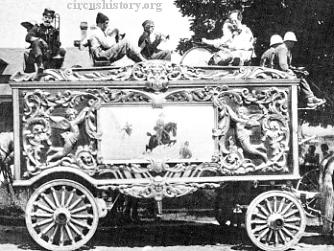 Photo No. 1 - The Angel Tableau while on the Forepaugh Sells Circus in 1911. John H. Garrett bought this wagon in February of 1913. P. M. McClintock collection.
Of the five tableau wagons used on the show in 1910 four were new and one was shipped to Baraboo from Bridgeport over the winter of 1909-1910 for use on the Forepaugh Sells Circus. The tableau that came from Bridgeport was what is now called the Sells Bros. Angel Tableau, (photo No. 1). This wagon's origin can be traced back to the Sells Bros. Circus in the 1890's. The earliest definite date on this wagon is 1894 (reference: Bandwagon, January-February, 1964). It remained on the Sells show through its final season of 1895 and then was used in the parades of the Forepaugh-Sells Circus from 1896 to 1907. While on the Forepaugh-Sells Circus the Angel Tableau was numbered 44. It was part of the group shipped to Bridgeport from Pine Bluff, Arkansas, the site of the closing stand of the 1907 Forepaugh Sells Circus. About 3/5 of the Forepaugh Sells parade equipment was shipped to Bridgeport. The rest, which included between 12 to 14 cages and two tableaus, went to Baraboo. These two tableaus were sold to the Gollmar Bros. Circus. They were the former Forepaugh Three Deck Tableau, which last appeared on the Cook and Cole Circus in 1927 and a less fancy three diamond mirror tableau that made its way to the Al G. Barnes Circus. Recent new information indicates the Angel Tableau was used on the Barnum and Bailey Circus during the 1908 and 1909 seasons. The reference for this is a note on the Moeller repair list of Forepaugh Sells equipment that lists the 1910 Forepaugh Sells Circus as having a "Barnum and Bailey Tableau." The Angel tableau is the only wagon that the Moeller records could have referenced. As previously stated it was part of the group shipped to Baraboo from Bridgeport for use on the Forepaugh Sells Circus. While on the Forepaugh Sells Circus in 1910 and 1911 the Angel Tableau was most likely numbered 2. On February 25, 1913 J. H. Garrett purchased this wagon along with Ringling cages Nos. 14 and 81, the Ringling Sea Horse Mirror Tableau (probably No. 6), a cage with an Indian Head carving on the side that was of Sells Bros, origin and the St. George and the Dragon allegorical float. After the Rice Bros. Circus folded the equipment was acquired by W. E. Franklin, of Robinson and Franklin fame, for the C. A. Wortham Carnival. All trace of the wagons Garrett purchased from the Ringlings, with the exception of the Indian Head cage, disappear after the purchase by Franklin. This Indian Head cage appeared on the 1910 and 1911 Forepaugh Sells Circus, but its history will be covered with the cages in part two.
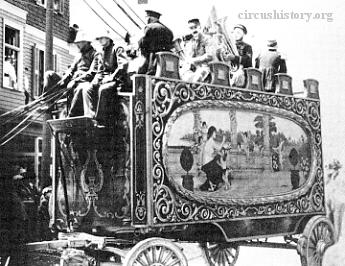 Photo No. 2 - Oval shaped Tableau No. 3 of the Forepaugh Sells Circus. This photo was taken in 1915 while the wagon was on the Ringling Bros. Circus. It was No. 6 at the time the picture was taken. Bob Good collection.
Of the four new tableaus built for the show, three were from the Moeller Wagon Works in Baraboo. It is nearly certain that the three tableaus the Moeller Company built were tableaus No. 3, No. 4 and one that doesn't seem to have had a number while on the Forepaugh Sells Circus. Tableau No. 3 (photo No. 2) shows a Roman or Greek scene somewhat similar to that which appears on cigar boxes. The only known picture of this wagon while on the Forepaugh Sells Circus was taken on the Fourth of July, 1910. In 1912 this wagon was transferred to the Ringling Bros. Circus and remained on the show until the final season of 1918. Its number was 6, while on the Ringling show. Trace of this wagon disappears after a 1918 picture. Tableau No. 4 (photo No. 3) shows pictures of the heads of Lewis and Peter Sells with Adam Forepaugh's picture in the center. This tableau was also transferred to the Ringling Bros. Circus in 1912 as tableau No. 7 and remained on the show until 1918. Over the winter of 1918-1919 this tableau was shipped from Baraboo to Bridgeport with a great deal of other parade equipment for use in the first Ringling Bros.-Barnum and Bailey parade. Sometime during the latter part of its history tableau No. 4's center mirror was removed and a painting of what appears to be the Goddess of Liberty replaced it. This wagon was probably retired to the winter quarters after the Big One stopped parading after the 1920 season.
There is no proof that definitely identifies the third tableau the Moeller's built for the Forepaugh Sells Circus. This third tableau, though, was almost undoubtedly the wagon in photo No. 4. The two clues that link it to the Forepaugh Sells Circus are its design and a 1912 Ringling Bros, parade list. The astute reader will note the very distant similarity between the band seats on top of the "Girl and Lions" tableau with the seats on the other two new tableaus. A 1912 Ringling parade list, which appeared in Chappie Fox's, A Ticket to the Circus, list the other two tableaus as "Forepaugh Tableau wagons No. 3 and No. 4." In this same list is a wagon labeled "Forepaugh Tableau Wagon" and under this is stated "Eight Ballet Girls - Fantastic costumes." To this writer that description would certainly seem to fit the "Girl and Lions." The 1912 parade list also states the wagon had a six horse hitch. A picture showing a six horse hitch on the "Girl and Lions" is in the "Heck Set" of Ringling photographs. While on the Ringling Circus the "Girl and Lions" was tableau No. 8. This "Girl and Lions" tableau remained on the Ringling Circus until 1918. In 1919 it was shipped to Bridgeport for use on the newly combined Ringling Bros.-Barnum and Bailey Circus. It last shows up in a circa 1920 winter quarters photo.
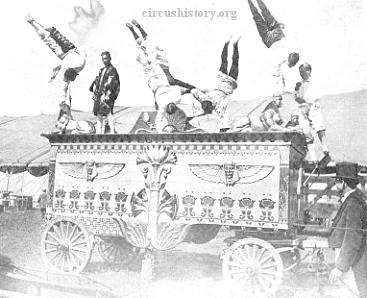 Photo No. 6 - Fine close-up view of the Egypt tableau. The Egyptian theme was also used on the Hippo Den of the 1910 and 1911 Forepaugh Sells Circus. W. H. Woodcock collection.
The fifth Forepaugh Sells tableau was the "Egypt" wagon pulled by a six and sometimes eight hitch camel team. This camel hitch idea was not new by any means. Back in the late 1860's the J. M. French Circus used 14 camels to pull a fabulous band chariot. While on the Forepaugh Sells Circus this wagon carried the number 5. No trace of the Forepaugh Sells "Egypt" tableau turns up before or after the wagon had its two year sojourn in 1910 and 1911. The wagon is very similar to an "Egypt" wagon that appeared on the Ringling Circus during this same period. The last trace of the Forepaugh Sells wagon was on a sale list issued by the Ringlings on mostly Forepaugh Sells equipment. At that time the Ringlings priced it at $550. Tableaus No. 3 and No. 4 were also for sale on this same list for the same amount. They, of course, were not sold.
It seems the famous Russia wagon, which first appeared on the Ringling show in 1903, became the sixth tableau on the show when it was increased in size in 1911. The only basis for this statement is quoted from the May 6, 1911, Billboard, "Next came three wagons followed by the tableau wagons, the first of which represents the Far North in winter. The driver has a typical Russian costume, and drives twenty Shetland ponies." Even though the part about the twenty pony hitch seems doubtful, the Russia wagon seems to be about the only wagon that would fit the Billboard description. This theory of the Russia wagon was first advanced by the late Col. W. H. Woodcock. The Billboard quote could also be a fanciful description of the Santa Claus pony float, which most likely appeared on the 1910 and 1911 Forepaugh Sells Circus. The reader will have to make his own decision on the Russia wagon. No proof that the wagon appeared on the Ringling Bros. Circus in 1911 has of yet come to light. A complete history of this wagon appeared in the December, 1961, Bandwagon.
Since the Ringling Sea Horse tableau (photo No. 11), that was purchased by J. H. Garrett in 1913, appears on the 1912 surplus sale list, which is almost entirely ex-Forepaugh Sells equipment, it can be conjectured that the Sea Horse tableau may have also been added to the Forepaugh Sells inventory in 1911. The Sea Horse is identified as tableau No. 6 on the surplus sale list. This would fit into the pattern of numbers the 1911 Forepaugh Sells Circus had. The famous Ringling Bros. Chime (bell) wagon also appears on the surplus sale and should not be ruled out, as possibly being on the Forepaugh Sells Circus though, it is more logical to assume the Ringlings wanted to sell it because it could not carry a load. During this period the Ringlings put emphasis on parade wagons that could double as a baggage wagon.
While on the subject of tableaus it would be to the benefit of those historically minded readers to clear up the confusion that exists over the connection of the Dolphin tableau and the 1910-1911 Forepaugh Sells Circus. In his book, Circus Parades, C. P. Fox noted that the Dolphin wagon that later graced the Sparks parades, was built by the Moellers for use on the 1910 Forepaugh Sells Circus. Recent correspondence between the author and Fox indicates that Fox learned of the Dolphin being on Forepaugh Sells from Henry Moeller. This was the only source on which Fox based his claim. Since at least two other cases of Henry Moeller's failing memory can be accounted for, it seems this becomes the third. No other connection between the wagon and the 1910-1911 show has been suggested elsewhere. It is the author's opinion that the Dolphin wagon was one of a large group of wagons built in 1921 by the Moellers for the Sparks Circus. There is no doubt, however, that the wagon was made by the Baraboo firm.
So ends the section on the tableaus of the 1910 and 1911 Forepaugh Sells Circus. One question that remains in the author's mind is why did the Ringlings have their cousins, the Moellers, build three new tableaus and other equipment for the Forepaugh Sells Circus when they had many fine tableaus under their control in both Baraboo and Bridgeport? This question may never be answered.
The Bandwagons
The show had two bandwagons in 1910. They were the famous Five Graces and the former Adam Forepaugh Lion Bandwagon (photos No. 7 and No. 8). The Five Graces had appeared on the Adam Forepaugh as well as the Barnum & Bailey shows. It was part of the group shipped from Bridgeport to Baraboo during the winter of 1909-1910 for use on the new show. In 1912 it was transferred to the Ringling Bros. World's Greatest Shows. The Forepaugh Lion Bandwagon had previously been in the parades of the Forepaugh, Buffalo Bill, and Barnum and Bailey shows. It was later sold to Fred Buchannon for use on his Yankee Robinson Circus in the middle 1910s. If another bandwagon was added in 1911 it is not known, but it is possible that such was the case. The only pieces of parade equipment that probably were added were the Russia wagon and the Sea Horse tableau. It seems that more equipment must have been added since three more railroad cars joined the train for the 1911 season.
The Allegorical Pony Floats
The only source indicating that pony floats were used in 1910 is the advertising issued by the show. A 1910 courier of the Forepaugh Sells Circus lists the show as having the following floats: Sinbad, Little Red Riding Hood, Blue Beard, Santa Claus, Mother Goose, Old Woman in the Shoe and Cinderella. The same drawing appears in the 1907 Forepaugh Sells courier. This shows that while the drawing carries very little authenticity, it does indicate that the show did have pony floats in 1910. The Forepaugh Sells press books of 1910 also played up the "Children's Fairyland Floats." From these sources it can safely be concluded that there were pony floats with the show the first season. These pony floats either came from Bridgeport along with the Five Graces, the Angel Tab and a few cages, or were added to the inventory when the Forepaugh Sells show played Bridgeport on July 27, 1910. In 1911 photographs (No. 9 and No. 10) the Old Woman in the Shoe and Cinderella appear. Since these two floats, as well as the Santa Claus and Mother Goose, appear on the Ringling show together starting in 1912 it can be conjectured that the Santa Claus and Mother Goose were also with the Forepaugh Sells show in 1910 and 1911.
J. H. Garrett wanted to buy the Old Woman in the Shoe as part of the equipment he purchased from the Ringlings on February 25, 1913, but the Ringlings evidently did not wish to part with this wagon. It is just as well that Garrett did not acquire the float because if he had it would almost certainly not be in existence today.
It is interesting to note that all of the Forepaugh Sells allegorical pony floats, with the lone exception of Santa Claus. have returned permanently to the winter quarters where they were stored over fifty years before. Those interested in the full history of these fascinating little vehicles should read Richard E. Conover's article on them in the July-August, 1960, Bandwagon. To summarize the pony floats it can be stated that the 1910 and 1911 Forepaugh Sells show had four pony floats, the former Barnum & Bailey Show's Mother Goose. Old Woman in the Shoe. Santa Claus. and Cinderella.
This ends the narrative of the tableaus, bandwagons and allegorical pony floats of the 1910 and 1911 Forepaugh Sells Circus. In conclusion the author would like to repeat his plea for any additional information pertaining to the cages and the calliope on the show. As of this date positive identification of the calliope has not been determined.
The author would like to thank C. P. Fox. Bill Kasiska, Edna Curtis Christiansen. Mrs. W. H. Woodcock, Joe Bradbury, and Harold Dunn for their help in the research of this article. His utmost appreciation and thanks go to Richard E. Conover for the use of information which he compiled largely from the records of Sverre O. Braathen, and for answering the endless stream of questions about the "Grand Parade of the 1910 and 1911 Forepaugh Sells Circus."
Happy Ending - British Circus 1965!
By Jack Niblett. Bandwagon, Vol. 10, No. 2 (Mar-Apr), 1966, p. 9.by Jack Niblett My article, "The British Circus Scene in 1965" which appeared in the November/December issue, outlined the position of our circuses at the beginning of the 1965 season. Now I would like to record just what happened during that momentous season.
The year opened gloomily enough. At Olympia, London, Bertram Mills ran their usual circus season, although this time the word "circus" was largely missing from the billings, and instead we were told to expect a "supershow." Thus instead of a cage act we had a pick-pocket as top of the bill, and there was (believe it or not) a "beat group" and a troupe of dancing girls set before the incredulous eyes of the circus lovers!
In February a Parliamentary Bill was proposed which would prohibit any exhibition of performing animals. The Bill was debated at length, with much heat and much bitterness in the House of Lords. Fortunately good sense prevailed and the Bill was thrown out, but naturally there was much mud-slinging and mud, unfortunately, has a habit of sticking, even to the innocent party.
The spring brought the sale of the Bertram Mills Tenting Circus, a poignant occasion indeed. Not long afterwards the Mills organization announced that the 1965-66 season at Olympia, London would be their last, and it seemed as if there would not be another Christmas circus season in London.
But with the winter of our discontent slowly disappearing, Billy Smart's Circus took to the road, opening at Birmingham in rain and snow, for a three week stand, when despite appalling weather conditions excellent business was the order of the day.
Next in size to Smart's, Sir Robert Fossett's and the Robert Bros, circuses started to roll around the Midlands. After a slowish start both shows headed north, and here as ever, the crowds began to fill the tents. Fossetts crossed the border and in Scotland did some record business. Roberts headed eastwards and southwards and found plenty of patrons to fill their benches right up to chilly end of the season back in the Midlands.
"Big" Bob Fossett, whose circus had formerly remained in a seaside resort for a whole season, also took to the road in May. "Big" Bob had a nice show, pleasantly old-fashioned in character, and in Devon and Cornwall and particularly on its homeward run along the southern counties, pulled in the crowds in goodly style. Bob has pronounced himself as being well satisfied with the results of his first tenting tour and has plans for a much bigger tent and show in 1966. There is some talk of "Lord" George Sanger being associated with this circus next year.
Our "little fellows," Joe Gandey, James Bros., and Claude Fossett all say that they had nothing to grumble at in the 1965 season. When the British circus proprietor says that, one can safely conclude that good business has been done.
Winships "Wild West" Circus had a short tenting tour, then spent most of the season as an attraction at a south coast holiday camp. I understand that this proved to be a satisfactory arrangement. I was also glad to observe that Geoffrey Winship was engaged by the Kelvin Hall (Glasgow) Circus to perform his fire-eating act at the annual Christmas circus.
Billy Mack had his usual lively and un-predictable time in Scotland and the north of England with his "Broncho Bill's Circus." His season finished a little earlier than usual, but Mack irrepressible as ever is now advertising for new acts, lion trainer, and musicians to fill out the two shows which he proposes to take out in the 1966 season.
As for our two resident circuses, the Blackpool Tower Circus and the Great Yarmouth Hippodrome Circus, they both proclaimed fantastic business for the season.
I visited most of our native circuses and spent some weeks with Joe Gandey's, Robert Bros., and Billy Smart's Circuses, so these notes are largely from my own observation. In my opinion 1965 was a testing time for British circuses, and one from which they have emerged a bit battle-worn but still full of vitality and able to face the future optimistically.
All stories should have a happy ending, and most of all this one. Bertram Mills had advertised their winter season of 1965-66 as being their very last one. This final offering at Olympia was to be a real traditional circus. Banished was the "supershow," and not a whisper of a beat group's electric guitar or the shake of a single dancing girl's leg would upset the equanimity of the classical elephants, lions, tigers, horses, sea-lions, chimps, dogs and the wonderful company of human artists. But even as we watched this glittering circus our hearts were heavy as we remembered that this was the last Bertram Mills Circus we were ever likely to see. And then, as in all English Christmas pantomimes, a good fairy appeared to dispel gloom and to make everything happy and bright once again. This particular "fairy" had no wand or wings, but instead wore the sober garb of a hotel magnate, one Maxwell Joseph, a circus-loving tycoon who bought up all the shares of the failing circus and by retaining the services of the Mills Brothers has announced that it will be possible to stage this grand circus at Olympia again next year.
Charles Bartine’s New Consolidated Shows 1868-1909
By Harry M. Simpson. Bandwagon, Vol. 10, No. 2 (Mar-Apr), 1966, pp. 10-11.
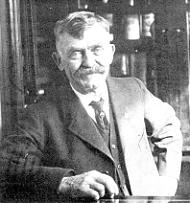 Photo: Charles Bartine is shown in a post card view that Bartine mailed to Bill Curtis, of the Sells-Floto show in 1912. William H. Woodcock collection.
No small circus carried so much "weight" as did the one-ring Charles Bartine Consolidated Shows which originated in 1868 and closed following the 1909 season.
As the late Col. William H. Woodcock once stated, "the Charles Bartine Circus was so well established through the midwest that even the great Ringling Bros. Circus refused to day and date this small, but popular, circus of 41 seasons." In an 1958 interview with Ross Bowman, of Gratis, Ohio, he mentioned that, as a boy, he would count the days until the annual arrival of the Bartine Circus. He stated that it was one ring and small, but to him ... it was the greatest.
Charles Bartine was born Charles Frederick Basore at Germantown, in Montgomery County, Ohio, on September 19, 1844. He served in the Civil War and made this village, southwest of Dayton, his home town until he moved to Connersville, Indiana in the 1890's.
It is not known when the show biz first struck this young Ohioan, but by the year 1865 he had changed his name to Charles F. Bartine and was listed in the Clipper as a member of Hooley's Minstrels where he was a blackface comedian. He spent a season with Sells Bros. Circus and for the season of 1868 he was a partner of the Dodge & Bartine Variety Show, the fore-runner of the Chas. Bartine Circus.
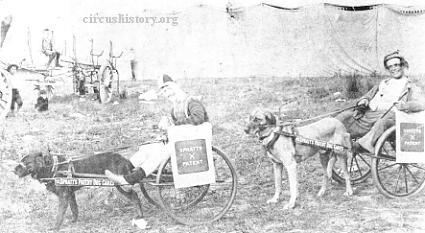 Photo: The only photo of the show available pictures two clowns with dog wagons, and a pole wagon in the background. Author's collection.
The next mention of Charles Bartine was in the May 3, 1873 Clipper as follows: Bartine & Co.'s Novelty Circus has organized as follows: Charles Bartine, manager; John Ritty, treasurer; Fred Kellogg, ticket agent; William Marshall, contracting agent; George Parker, advertising agent; Leon Whettony, ringmaster and equestrian director; Jas. Lubin, master of canvas; Dan Lockhart, master of horses. The array of talent is: the Gertrude Sisters, ceiling walkers; Mons. Duverney and Mlle. Florantaine, contortionists; Nellie Basore, Jennie DeLong, Maud Stanley, equestriennes; Chas. Bartine and Joe Moil, clowns; Luanda Bros., gymnasts; DeWitt Davidson, Geo. Hoover, John Neaven, Jake Grubb, acrobats; M. C. Miller's cornet band of ten pieces accompanies the party. William Marshall has the outside and inside candy stand privilege, and Bartine & Co. the concert privilege. The troupe consists of forty men and twenty-rive horses, and will visit the smaller cities of Ohio, Indiana and Michigan. They gave their initial performance at Dayton, Ohio on May 2, twelve miles from the Germantown winter quarters.
The list of performers varied from year to year and were listed in the Clipper and Billboard at the beginning of each season. The Bartine family, which consisted of his wife, Nellie, and his three children, dominated the list of performers. No one of great importance was ever listed on his rosters.
Equipment of the average season included an 80 foot round top with one 50 ft. middle piece; one 40 foot dressing top; 35 x 65 side show tent; large horse tent; cook and dining room tents. The show usually owned 15 wagons, three buggies and 34 horses. For several seasons they listed a band wagon. Bartine had various partners and one whom was the late Walter Webb, of Hamilton, Ohio, father of CHS and CFA member Malcolm Webb, druggist, of Camden, Ohio, who was responsible for this author searching for material on this title. Webb, who operated a livery stable in Hamilton, was a partner for the season of 1894 and 1895 and traveled with the circus as treasurer. Although only with the circus two seasons, Webb and Bartine created a friendship that lasted for years.
Among some of Walter Webb's keepsakes was a daily expense record for North Middletown, Ky. on July 30, 1894 and read as follows: Lot, $10.00; tickets, $5.00; horse feed, $4.80; flour for paste, 25c; license, $2.25; meat, $3.00; bread, $1.20; gasoline, $2.25; hotel, $6.00; hotel (agent) $2.00; horse bill (agent) $1.00; potash, l0c; total $27.85. Also listed on the expense sheet was the fact that the next stand was Mt. Sterling, Ky., distance 12 miles, good pike.
An invoice of the United States Printing Co. of Cincinnati, Ohio, for July 10, 1894, gave evidence that Bartine used plenty of good paper as the list called for 530 pictorial sheets, 3000 couriers, 6000 programs, as well as top and bottom sheets in red and blue. There was also an order for 50 streamers worded "Wait for Bartine's New Consolidated Shows." The cost of the entire order was $58.76 and the items were to be shipped to Maysville, Ky.
Bartine, like most owners, changed the title to a certain degree each season especially when he took on an "angel" and that party's name would be used for a season or part of a season. But in most part, the title "Charles Bartine's New Consolidated Shows" was used. The show did go on rails (two cars . . . one baggage and one flat) for the season of 1903 and this venture must have proven disastrous as the May 28, 1904, Clipper stated that Bartine was running a park for the 1904 season, however, he was back on the road in 1905, and closed for good at the end of the 1909 season.
Among the highlights of the history of the circus included the use of the Arnoux & Hochanson's Sun-Eclipsing Electric Light in 1880; and the use of an elephant for the season of 1890. Although frequent mention is made of owning a band chariot, an 1880 herald made special note that "No street parade was promised or made." However, he did have a street parade when one could be formed.
A well known circus agent, L. C. Gillette, was head of the advance with the circus for many seasons prior to going to the John H. Sparks and Charles Sparks Circuses.
How Charles Bartine pinched the "penny" in operating the circus is reflected in a May 23, 1909 letter to his former partner, Walter Webb, of Hamilton, in which he states in part: "Walter, you was telling me of a passenger wagon, near Hamilton, that could be bought cheap. It is where you could see and examine, and get the very lowest price? Of course it must be a good Rock Bottom Price, and if so, I would arrange to buy it." Elsewhere in the letter he states, "Do you have any chance to sell a Band Wagon? Would sell mine and put the money in a good passenger wagon or would trade for a good one, as I will not make any pretensions to parade, but will carry a cracker-jack band and put them on foot. If all show up I will certainly have a great ring show and not many people, but they all double. Dressing room salary list is but $95.00, and will run eighteen, all strong, acts."
After closing in 1909, Charles Bartine and family retired to Connersville, Indiana, his winter quarters in later years, and he operated a cigar store for several years.
In the July 17, 1920 issue of the Billboard was the following: "Charles Frederick Bartine, 75, died July 2 at Connersville, Indiana. Born in Germantown, Ohio, Sept. 19, 1844. Correct name Charles F. Basore. Civil War veteran. He and his wife running boarding house in Connersville at time of his death." Thus ended the career of a man who spent forty-one years in show business, thirty-six of which he was the owner of a circus cherished by thousands of people in small towns throughout the mid-west.
Editor's Note: I wish to acknowledge with thanks assistance received from Malcom Webb, Richard E. Conover, the late Col. Wm. H. Woodcock, and the late George Chindahl.
A History of the Cole Bros. Circus 1935-40
By Joseph T. Bradbury. Bandwagon, Vol. 10, No. 2 (Mar-Apr), 1966, pp. 12-21.Part VI - The winter of 1936-37. Building of the Great 40 Car 1937 Show.
The show had been in quarters only a short time when it suffered a major loss in the death of the huge African elephant, Jumbo II, its ace menagerie attraction, on Thanksgiving Day. Although details of his death are still somewhat sketchy it was reported in the Billboard that one of his handlers gave him a bottled soda pop which he broke and swallowed a large piece of glass before attendants could prevent him from doing so. He died a short time later. The remains were given to the Smithsonian Institute which sent a team of experts to Rochester to prepare the specimen for shipment to Washington.
The death of Jumbo II plus shipment of Boo to the San Diego Zoo reduced the bull herd total to 27. Although from time to time the Billboard reported a total of 31 elephants at Rochester this is believed to have been only press agent chatter.
According to Eddie Allen in his book, "Fun By the Ton" he had a total of 26 elephants in his 1937 Cole Bros. herd. The show began the season with 23 of the original herd of 27 currently at Rochester. Allen listed the ones carried as Babe, Louie, Carrie, Joe (the only male), Jean, Mary, Sidney, Wilmer, Little Katy, Nellie, Little Jenny, Anna May, Tessie, Tommie, Ding, Trilby, Bamma, Blanch, Little Babe, Big Jenny, Big Katy, Tony, and Juno. At Benton Harbor, Mich, on July 14, three more elephants were added. These were Judy, Little Modoc, and Empress and were all four year old punks which had just arrived in the country, having been shipped from Rangoon on April 20, 1937, only 31 days after being caught in the jungle.
Four elephants were not taken on the road in 1937. These were George, Barney (formerly Moton), Alice, and Culver, the latter having been purchased from the San Diego Zoo in the fall of 1936 as earlier mentioned. No mention is ever made any more of Alice and Culver, and it is believed these two were probably sold to some unknown buyer, possibly in the winter of 1936-37. George later is mentioned as being a member of the Cole herd and no doubt travelled with the show. He died Feb. 14, 1942 of a heart attack at the show's quarters in Louisville. Barney was with Robbins Bros, in 1938.
The new quarters buildings and improvements which were begun in the fall of 1936 were completed about January 15. There were two major projects. A huge brick structure was erected connecting the eastmost main building with the other group of buildings about 60 ft. to the west. The new structure was built flush with the others and in reality created one large building complex which housed the major portion of the quarters activities. The new building became the railroad car repair and paint shop and a sidetrack was run into it from the rear. It was large enough to accommodate three or four cars at a time. Prior to this all train work had to be done outside and these new facilities made a big improvement. The other major project was a new 300 x 60 wagon storage shed which was constructed a hundred yards north of the main group of buildings. The new shed was built by Charlie Luckey and his crew and enabled the show to give undercover shelter to most of the wagons which before had stood outside braving the elements.
A 20-ft. lean-to type shed was built adjacent to the westmost building and several other small storage sheds were constructed. Other improvements consisted of resealing the elephant barn and installation of a new heating system.
At the show's farm at Argus, Ind. two miles away where the baggage stock were kept a new 84 x 250 barn was built and the old baggage stock barn was remodeled to house camels, zebras, water buffalo, sacred cows and similar lead stock. It was announced in December that the show had purchased 25 head of baggage stock from Jack Morris of Akron, Ind. to increase the total number of stock as well as to replace some of the older horses.
Huge signs were erected on all main highways approaching Rochester calling attention that Rochester was the winter home of the Cole Bros. Circus and urging tourists to visit the show's zoo. On Sundays the quarters were open to the public and became a popular place during the winter. On one Sunday in February it was announced there had been 2,000 paid admissions to the menagerie during the day.
Adkins and Terrell were highly pleased over the success of their show during the latter portion of the 1936 season and were very optimistic that the coming 1937 season would be a good one. The nation's economy was generally good although labor unrest was brewing in some industries but all factors considered the Cole owners had every reason to believe the coming season would give good business. A decision was made to increase the show to 40 cars for the 1937 season and all efforts were turned toward making the Cole show first class in every respect.
Before the old year was out the show made two important announcements. One confirmed the earlier report that Ken Maynard, the popular Hollywood movie cowboy, would head a huge Wild West contingent and be a major feature of the 1937 show. The other announcement was a real bombshell which stated that Cole Bros, would open the new season at the Hippodrome in New York City beginning March 18, 1937 for a 25 day engagement. This meant that Ringling-Barnum would have direct opposition in the Big City and oldsters scratched their heads trying to figure when the last time something like that had happened.
Maynard went right to work on plans for the big Wild West Show and in March shipped to Rochester from his ranch in Van Nuys, Calif, a carload of bronk horses, ponies, and other wild west equipment. Maynard also sold to Barney Bros. Circus, owned by C. M. DeVere and John D. Foss, which was in quarters at Glendale, Ariz., two elephants, three lions, two tigers, one ostrich, a den of monkeys, and a Liberty act of eight horses, which were all part of the animals he had accumulated for his proposed wild west show and circus of the previous year.
The quarters shops opened in January. Fred Seymour was general superintendent over all activities; Charles Brady was boss of shops; Charlie Luckey, boss woodworker; Charlie Keys, boss blacksmith; and Ernie Sylvester, boss of paint-shop. P. A. McGrath, trainmaster, had a crew of 18 rebuilding and repainting all railway equipment.
In the early part of the winter Clyde and Harriet Beatty made a trip to Europe of several weeks and while there purchased a number of cats for his act at Stellingen, Germany. Beatty planned to have the biggest act of his career in 1937. He obtained a prize animal in a new Siberian tiger, named Romeo, which weighed over 600 Ibs. The Beattys returned to Rochester in late January and Clyde went to work at once perfecting his act in time for the winter dates.
As usual the show sent out a winter unit which made several weeks of Shrine indoor circuses including plush dates at Minneapolis and St. Paul. Three baggage cars were used to transport the unit which consisted of Beatty's cat act, two groups of elephants, seal acts, 18 menage horses, and wardrobe for the inaugural procession.
The training rings at Rochester were busy all winter. A group of new horses, all Kentucky jumpers, arrived in early January. John Smith was working the high school horses daily and Jorgen Christiansen began putting together his new 24 horse Liberty act in readiness for the opening at the New York Hippodrome.
The Cole staff remained pretty well intact during the winter, however, J. D. Newman resigned his position with the advance. Floyd King was then placed in complete charge of the advance, taking over Newman's duties as well as retaining his own. King now became general agent, railroad contractor, Sunday agent, and general press representative and was one of the most valuable and important men on the Cole team.
Adkins announced early that the usual Spring indoor date in Chicago would begin April 16 at the stadium and run for 17 days ending May 2. Thus the show scheduled major indoor engagements in both New York City and Chicago prior to the regular canvas season.
The upturn of circus business in 1936 was not overlooked by other members of the fraternity and Adkins and Terrell were not the only showmen planning for bigger things in 1937. Nearly every week the Billboard had headlines announcing plans for new shows, enlargements, or title changes or additions for the upcoming season. One aspect that was widely welcomed by circus fans was the planned reappearance of many of the popular circus titles of the past. Some of the great old names did reappear while plans for the use of others fell through before the season opened.
In early January Sam Gumpertz of Ringling-Barnum announced that the Sells-Floto title which had not been used since 1932 would be combined with that of Al G. Barnes for the 1937 season and this plan did materialize. About the same time Charles Sparks, owner of the large and successful motorized circus, Downie Bros., said that he had made a deal with Gumpertz for use of both the Sparks and John Robinson titles and that he planned to shelve the Downie title and that for the 1937 season his show would be known as Sparks and John Robinson's Combined Circus. Sparks declined to say whether or not he would convert to rails as it was generally speculated he would do. However Sparks' deal with Gumpertz fell through and the Downie Bros, motorized show went out as usual in 1937.
In February the Billboard printed the big news that Edward A. Arlington and J. Frank Hatch, both veteran showmen, had leased from Sam Gumpertz the Hagenbeck-Wallace title, menagerie, equipment for a 35 car show as well as other appurtenances, and use of the Peru quarters for a period of five years. At first it was mentioned that the Forepaugh-Sells, Sparks, and John Robinson titles were also included in the deal and the new show did include the Forepaugh-Sells title in conjunction with that of Hagenbeck-Wallace in some of its advertisements, however it was soon clarified that the Sparks and John Robinson titles were not involved.
Prospect for another new circus also seemed eminent involving Howard Y. Bary, formerly associated with Ringling-Barnum. Bary announced in early April that he had just about closed a deal with Gumpertz for use of the John Robinson and Sparks titles plus the leasing of sufficient equipment to put the new show rolling.
Arlington and Hatch did put together a very fine 35 car Hagenbeck-Wallace Circus which opened April 5 at the Chicago Coliseum for a several weeks run. In late April, Bary, who evidently had cancelled plans for his own show, purchased Hatch's interest in Hagenbeck-Wallace and in a few weeks also bought out Edward Arlington, leaving him in complete control of the show for the remainder of the 1937 season.
Needless to say the reappearance of Hagenbeck-Wallace in 1937 after a year off the road had a profound effect on Cole's planning and strategy for the new season.
The late winter and early spring of 1937 was a nightmare weatherwise and saw some of the greatest floods along the Ohio River system in history. Cincinnati as well as most communities along the Ohio were heavily hit and southern Indiana became a disaster area. In early February Adkins and Terrell responding to a call from relief officials dispatched a special train to the Jeffersonville area to aid flood sufferers. The train consisted of several sleeping cars and a few flats upon which was loaded the show's cookhouse and dining equipment and light plants. It remained in the flood area for several weeks. This humane act on the part of Cole officials was widely publicized and brought the show a wealth of good will.
It was planned to continue the use of a large and varied amount of billing in 1937 and by late February the Erie Lithographing and Printing Co. said they had completed the season's requirements for new paper and claimed the firm was furnishing 180 different styles, shapes, and combinations of four color litho bills for the show.
The increase of the show to 40 cars meant that the train would have 10 more cars than it did in 1936 and five more than it had at its 35 car peak in early 1935. Four new flat cars were purchased from the Warren Tank Car Co. and arrived in Rochester in the late spring. These were the first brand new cars ever obtained by the show. Eleven coaches were used in 1937 which were two more than had been used in the past. These additional cars are believed to have been purchased from local railroads in the area, probably the Monon or Big Four.
The 10 car increase over the 1936 train included five flats, two stocks, and three coaches. When fully assembled the 1937 train had a total of 40 cars with one in advance and 39 back. The train consisted of one advance, nine stocks, 19 flats, and 11 coaches. The train regularly moved in two sections throughout the season. The first section consisted of six stocks, 11 flats, and four coaches while the second had three stocks, eight flats, and seven coaches.
Color scheme for the rail equipment remained basically the same. The flat cars were painted aluminum with lettering and numbering in red with light green shading. They were stenciled "Cole Bros. Circus with Clyde Beatty and Ken Maynard." Stock cars were also aluminum with large red letterboards stenciled with same wording as the flats done in yellow-gold. Two large discs proclaiming the Clyde Beatty and Ken Maynard features were at both ends of the letter-board. The coaches were red and stenciled "Cole Bros. World Toured Circus" in yellow-gold.
All six of the show's Warren built flat cars were in the train and these became the six matching flats used the next year on the show's No. 2 show, Robbins Bros.
One of the best and most notable enlargements for the 1937 show was in the caged menagerie. A total of seven cages were added giving the show 22 cages and a first class menagerie in every respect. Before, the caged menagerie had consisted mainly of Beatty's lions and tigers, but now a variety of animals including leopards, bears, pumas, deer, and gnu were added. This gave additional depth and variety heretofore lacking in the Cole menagerie. Four new 12 ft. cages were built in the shops from the ground up. All were from the same pattern and looked practically alike. These were similar to the Christy 12 footers, all had a carved sunboard and on each side of the cage bars was placed a carved post like design. One of the former Christy 12 ft. cages which had not been used by Cole previously was fixed up and placed in the 1937 menagerie. It had been parked at the quarters for two years and still had its original Christy title on it and cover cage panels reading "Racing Ostrichs." If you recall Cole had obtained 10 of these Christy 12 ft. dens but prior to 1937 had used only nine. This den became the "fifth" addition to the menagerie. The former Ringling Bros, hay animal den which had come with the Christy purchase but had not been used previously by Cole was repaired and used to house a newly purchased gnu. (See photo 12, page 10, May-June 1965 Bandwagon). This cage became No. 10 and the "sixth" addition. The seventh and final cage added was one of the cross cages which had been carried in 1935 but left in quarters in 1936.
The color scheme on the cages was about the same as before with red and white base predominating and gold leaf on the carvings. Cover boards were highly decorated and were the most attractive in the history of the show. As usual the cover boards contained the name of the animals supposedly contained behind them. On the panel board of most of the cages just above the bars was printed "Clyde Beatty's Wild Animals" omitting the word "trained" on most of them. This simple omission is a key wagon historians have long used in determining the year for unidentified Cole cage photos. Some cages in 1937 had "Cole Bros. Circus" on these panel boards. Seal Den No. 20 which was white in 1936 was painted red for 1937. When all 22 cages were ready to go the menagerie lined up like this.
1. Cage No. 7-cross cage (former Christy)
2. Cage No. 8-cross cage (former Christy)
3. Cage No. 9-cross cage (former Christy)
4. Cage No. 10-former Ringling hay animal cage, containing a gnu
5. Cage No. 11-former Christy 12 ft.
6. Cage No. 12-newly built 12 ft.
7. Cage No. 13-newly built 12 ft.
8. Cage No. 14-newly built 12 ft.
9. Cage No. 15-newly built 12 ft.
10. Cage No. 16-former Christy 12 ft.
11. Cage No. 17-former Christy 12 ft.
12. Cage No. 18-former Christy 12 ft.
13. Cage No. 19-former Robbins Bros. 14 ft.
14. Cage No. 20-sea lion den (Robbins remodeled new for 1936)
15. Cage No. 21-former Christy 12 ft.
16. Cage No. 22-former Christy 12 ft.
17. Cage No. 23-former Christy 12 ft.
18. Cage No. 24-former Christy 12 ft.
19. Cage No. 25-former Christy 12 ft.
20. Cage No. 26-former Robbins Bros. 14 ft.
21. Cage No. 27-former Christy 12 ft.
22. Cage No. 28-former Robbins Bros. 18 ft. hippo den
All of the bandwagons, tableau wagons, and calliopes that were carried in 1936 were again on the show in 1937. The Lion and Mirror, Asia, America, Palm Tree, and Columbia wagons basically had the same color scheme. The same was true for No. 79 statue air calliope and No. 66 the steam calliope. The former Robbins Bros, air calliope which was carried in 1935 but not in 1936 was repaired and painted and again made the tour in 1937. It was equipped with a unafon and became No. 82. The old sunboard was replaced with one that had formerly been on Cage No. 11 (see back cover photo May-June 1965 Bandwagon). This new sunboard had carvings of birds in the center. The wagon's old outside type sunburst wheels were also replaced with the newer inside type.
The three pony floats, Cinderella, Old Woman in Shoe, and Mother Goose were again carried and were always a popular parade feature. The France Tableau was added to the show and became No. 80 being used to carry trunks and in the parade carried the No. 2 band relieving the Columbia wagon which now remained on the lot where it was used as the grandstand ticket wagon. France was used by Cole for the first time in 1937. having been in storage at Rochester since arriving with the initial Robbins Bros, equipment back in December 1934. It was a beautiful wagon, basically painted red with plenty of gold trim and with the colors of the rainbow embellishing its central carved design and paintings. In the past there has been some confusion as to when the France wagon was added in 1937. Some historians were once of the opinion that the wagon was not added until later on in the 1937 season and was not there at the beginning. Some data sheets claimed the wagon was not added until May 29 at Erie, Pa., however Gordon Potter says this report is completely in error and corrects it with this interesting observation.
"I was at Rochester, April 12th, and the France wagon was painted and drying in the sun. They loaded out for Chicago the next day as I recall and France went with the train. I talked with Fred Seymour and he said they liked the idea of having France with the show as then the Columbia wagon could remain on the lot and start selling tickets before the parade returned to the lot if need be. I knew Jimmy O'Conner of Logansport, Ind., who did the pictorial work on France and he told me how he had to cut all his paint with gasoline so it would dry faster. Some of the lesser painters put on the ground colors and he did the art work. Then they spotted the wagon right outside the paint shop door on the south side of the building in the warm sunshine to dry as they put on the final touches. I went to Chicago on April 23 and saw the show in the Stadium and France was there."
Although the winter quarters shops had put in considerable work in the building of the four new cages and doing various remodeling and repair work on the other cages and tableau wagons the main shop effort during the winter of 1936-37 was directed toward the baggage wagons. It was the poor condition of the baggage wagons that had caused so much of the show's woes during the initial season of 1935 and although they had been put in acceptable condition for 1936 they weren't really put into top notch condition until now. All were given a thorough overhaul and a large building program of new wagons took place so that by opening day every piece of rolling stock owned by the show was in nothing but the best of condition and remained that way from then on.
Gordon Potter has very kindly given the complete information on this new baggage wagon program and the list of new wagons for 1937 is as follows.
1. Stringer wagon No. 109, was built new, 28 ft. long, and was equipped with hard rubber tires. Old stringer wagon No. 107, also 28 ft. long, but still equipped with steel tired wheels, was also carried in 1937 giving the show again two stringer wagons. It may be recalled that in 1935 the show carried two stringer wagons but only used one in 1936. (See Photo No. 9)
2. Big top canvas wagon No. 94, built new from the ground up, 19 ft. long, and equipped with hard rubber tires. (See Photo No. 10)
3. Big top canvas wagon No. 95, built new from the ground up, 19 ft. long, and equipped with hard rubber tires. Potter describes the two new canvas wagons for 1937 as being very fine with exception of their "crummy" wheels. The equipping of some baggage wagons with the hard rubber tired carnival wheels the show had purchased the previous season did not set well with baggage wagon enthusiasts. The canvas wagons used in 1936 were used to carry planks in 1937.
4. Stable (or horse tops) wagon No. 40 was a fine new wagon they built that had steel sides and was equipped with steel tired wheels. It replaced the old No. 40 wagon (See photo 13, page 23, Jan.-Feb. 1966 Bandwagon) whose body was junked and lay about the Rochester quarters with other discarded wagons for several years.
5. Stake and chain wagon No. 106 was built new from the ground up. It was l6 l/2 ft. long, an excellent wagon, and was equipped with steel tired wheels. (See photo No. 7)
6. Plank wagon No. 105 was added for 1937. It was probably an old wagon which had not been previously used and was extensively rebuilt. It was equipped with steel tired wheels. Potter says he recalls how the quarters shops would take an old wagon and put in all new flooring and planking on the sides and really rebuild them very completely. He says he would guess that is what was done in case of No. 105 but is not positive. In any event it was "new" for 1937. (See photo No. 11)
7. Stake Driver No. 110 was built new but had old wheels on it. It is possible some of the mechanism came from an old stake driver but a lot of new angle iron etc. was used in it.
8. Dog Wagon No. 83 (See photo No. 6) was used for the first time in 1937 and there is quite a story to it. In 1936 Jorgen M. Christiansen played fairs with a Great Dane dog act. When he joined Cole for 1937 he brought the dog act along. He had a Dodge truck to haul the dogs, props, wardrobe etc. around to the fairs. The shops took the truck and took the body off, put new gears and steel tired wheels under it and made it into wagon No. 83. The truck chassis was left in one of the buildings at Rochester during the summer. Potter comments on the wagon by saying to "note a lot of steel ‘I’ beam pieces were used in the front gear below the 5th wheel and that doesn't look 'right' to me."
9. Light Plant wagon No. 53 was added for 1937 giving the show a total of three light department wagons. It was similar to the other two wagons, Nos. 51 and 52, and was a steel wagon which resembled a truck or trailer body and was equipped with hard rubber tires.
In addition to the above mentioned baggage wagons the show's shops also built two new chariots for 1937. They were equipped with new wheels from St. Marys. The steel tire on the left wheel was two or three times as thick as the tire on the right wheel. This was to give weight on the inside and keep them from tipping over when going around the curve at the end of the big top at a fast rate of speed.
All of the above wagons were carried by the show in 1937. Another wagon was fixed up, painted, and numbered and was all ready for the road but at the last moment did not go out but remained at Rochester. This was the old Robbins Bros, ticket wagon which had come to the show in December 1934 but had not been used. It was repaired, painted, and decorated and given the No. 81. It was intended for the wagon to carry an electric organ which would be played during come in and other times. Jess Adkins once told Potter that he had placed the order for the organ and had intended to house it in No. 81 but on opening date the organ still hadn't arrived so he just cancelled the order for it and left the wagon in quarters. This wagon does appear on some 1937 Cole wagon lists as "No. 81, P. A. System Wagon" but the fact is it never did actually leave winter quarters.
The color scheme for the baggage wagons in 1937 was red with white lettering and numbering. Wheels and gears were painted white with red and blue stripping.
It will be noted on the wagon list that the show added a fourth Mack truck for 1937. Potter says it was his understanding that the show purchased a Mack from an oil company in Indianapolis.
The train light plant on the wagon list was made from one of the original six cross cages the show used in 1935. Of this original six, three of them of course were carried in 1937 as cages, and Potter has it in his notes taken at quarters in early 1937 that Old Cross Cage No. 11 had not been fixed up to go on the road but he has nothing on the sixth cage and wonders to this day what might have happened to it.
Some explanation about the following 1937 wagon list that is printed here should be given. Some members might wonder why a 1937 wagon list that has been floating around for years was not used, especially when this particular list had the notation "Personally checked by the late Jess Adkins." That possibly might have been true but the wagon list still contained a number of errors which included the omission of some wagons known to have been carried in 1937 and the addition of some that were not. I have attempted to put together a wagon list which is as correct as I can make it. Potter has helped me with it by providing notes he made off the "official wagon list" he once saw posted in the Rochester shops. One wagon that appeared on earlier lists which I have eliminated was a "No. 33 concessions wagon." This wagon has never appeared in photos of the show and many eyewitnesses do not recall it being there. It is believed that somehow this wagon got on the list in error and that No. 65 the number of the concessions wagons actually on the show in 1937 was omitted. I have added No. 65 in the proper place as well as No. 60, a wagon carrying part of the side show, which was omitted from some lists. The various wagon lengths on this list are bound to cause some confusion, especially to model builders who are more interested naturally in the actual length of a wagon rather than the loading space the wagon took on the train. The loading space was often used even on official show wagon lists rather than actual lengths for train loading planning purposes. On the list printed here the actual wagon length is given when that fact is known, otherwise the length that appears is the one that has appeared on earlier lists and are certain in most cases to be the train loading length.
It might be also noted on the list that there are only two chariots while earlier lists show four. Potter says that the official list he saw in Rochester had only two chariots, the two newly built for 1937, and believes that only these two were carried.
A 17 ft. gilly truck on this list might be in error. Although the show did earlier have such a gilly truck it was not on the official 1937 list and does not appear in photos but there is the possibility the truck was still carried.
The No. 108 gilly wagon on the list was the small one horse wagon used to pick up stakes around the lot.
The show lined up its 1937 staff early in the spring and by opening day it was all set and was listed as follows: Jess Adkins and Zack Terrell, owners and managers; Floyd King, general agent and traffic manager; Earl Lindsey, manager; Dr. E. Partello, legal adjuster; Harry Harreld, secretary; J. L. Murden, national advertising; Fred C. Schortemeir, general attorney; Noyells Burkhart, auditor; Arnold Maley, charge of white ticket wagon; Fred Seymour, superintendent; Ora O. Parks, general press agent; Allen J. Lester, contracting press agent; Bernie Head, Raymond B. Dean, and Thomas Dawson, press representatives; William Backell, manager advertising car No. 1; Harry J. McFarlan, equestrian director; Lou Delmore, manager of side show; Vic Robbins, big show band leader with 14 piece band; P. G. Lowery, side show band leader; Eugene Weeks, manager of candy stands; Eddie Allen, superintendent of elephants; Eugene Scott, superintendent of menagerie; Al Dean, superintendent of cookhouse; Harry Brown, superintendent of baggage stock; Charles Hunter, superintendent of ring stock; P. A. McGrath. trainmaster; Louis Scott, superintendent of lights; Mrs. H. J. McFarlan, superintendent of wardrobe; Orlie Williams, superintendent of properties; Charles Young, superintendent of big top canvas; and John James, superintendent of sideshow canvas.
Cole's opening at the Hippodrome was the talk of the circus world. Details of the engagement came in the early spring and was announced the show would be framed along Continental European lines and would utilize both the stage and arena. The Hippodrome had been the scene of Billy Rose's musical production of "Jumbo," starring Jimmy Durante. which had closed a few months earlier. The seats of the Hippodrome had been decorated to resemble circus starbacks and the overall decor of the place still had a circus flavor. Cole billers scored some big hits in New York and a real banner hit was one of the largest billing stands in Manhattan circus history which covered the greater part of a side of the 15 story Hermitage Hotel building at 41st and Broadway in the heart of the Times Square district.
In order to present this unusual circus offering which is one of the most significant circus events of the 30's the full account and program review as printed in the May 25, Billboard follows:
"Cole - Beatty Circus Makes N. Y. Debut at Hippodrome. - Program patterned after European One Ringers - girl numbers intersperse regular features - Beatty cat act continues as center of interest, closing show.
"New York, March 20 - Marking the first time in nearly 30 years that a major circus other than a Ringling owned show has played a spring indoor date in Manhattan, the Cole Bros.-Clyde Beatty contingent opened its third annual tour Thursday afternoon at the historical Hippodrome. The show, in for 25 days and framed along European circus lines, got off on its initial showing with Jess Adkins supervising the entire layout and playing host to a sizable delegation of New York circus lovers. Zack Terrell, co-owner of the show, is still in winter quarters in Rochester, Ind. and is due in New York early part of next week.
"According to General Agent Floyd King and officials of the Hippodrome the advance sale, with a $2.50 top, is more than satisfactory considering the fact that the show title and location of the engagement are unfamiliar to New York circus audiences. The new visitor to New York, in town until April 11, is planning to capitalize heavily on Easter week without opposition from Ringling-Barnum. Big Show, opening April 8 at Madison Square Garden, is missing the holidays for the first time in several years.
"Under direction of Allan K. Foster, New York dance director, and Rex de Rosselli, in charge of personnel, the program has been routined along lines of the single-ring winter circuses so popular on the other side of the Atlantic. Forty elaborately costumed show girls, trained by Foster, and unusual lighting effects add a welcome dash of color, removing this layout from the usual run of circus programs. The girl numbers intersperse the regular attractions and also aid as a buildup for feature acts in other instances.
"As usual Clyde Beatty and his lions and tigers occupy the center of interest and probably for the first time in his career the young showman closes the program. Comment on this act is needless, it still rates tops in its field and bears out the fact that Messrs. Adkins and Terrell still have the biggest drawing card in the circus world. Other features of the show include Jorgen M. Christiansen's Liberty horse act, using 24 well matched equines in a routine that is nothing short of sensational; Frank Shepherd, trapeze artist who displays his usual skill in heel-and-toe catches and featuring a twisting somersault, catching by the heel; the elephant act under direction of Gene Allen, young Harold Barnes on the tight wire; humorous antics of Clowns Otto Griebling and Emmett Kelly working in the front rows of the house and the Gretona Troupe's balancing stint on the high wire.
"Thursday evening's show ran slightly under three and a half hours but with the usual trimming should be down to less than three hours in a few days. Program is paced at a fast clip by Victor Robbins' Band. H. J. McFarlan is equestrian director.
"Under direction of King, the press and billposting departments have accomplished a remarkable job of letting the city know that a new show has arrived in town. Raymond B. Dean, Ora Parks, and Allen J. Lester, press men, have landed plenty of yarns and art in the dailies with indications of increased co-operation as the date progresses, and William Backell and Clyde Williard have literally plastered the mid-town section with paper.
"The Hippodrome date is under auspices of Mrs. William Randolph Hearst's Free Milk Fund for Babies. Proceeds of the four Sundays will go to the Fund.
Detailed Review
"Display 1 - Inaugural Pageant. No special theme attaches to the parade of human and animal performers in colorful costume and gaudy livery around the circular hippodrome track. Bright spots in the cavalcade of performing talent are the svelte misses of the Allan K. Foster troupe. Because of difficulty still being experienced in cutting down show to an 11 p.m. finale several eye-filling items were omitted from the pageant of the one-ring Circus Continental.
Display 2 - Dennis Curtis Taximeter. The ring is occupied for an amusing spell by this familiar hick and mule act. Curtis is supported in addition to the anonymous mule, by two men and a woman. Plenty of laughs and loudly applauded.
Display 3 - Zoeppe Family. Here the Aurelia troupe of bareback riders double in a balancing routine on unsupported ladders. At one juncture four ladders are lined up simultaneously and the punchy windup calls for a three high stunt on a single ladder. As the Zoeppe Family does its stuff the Foster troupe provided a kaleidoscopic background with their intricate routines on a backdrop ladder arrangement of grilled squares.
Display 4 - Mlle. Cyse O'Dell. This clever aerialist gets a solo spot for her exhibition of one arm planges more than 30 ft. above the ring. At this show the tight squeeze on time forced her to omit her trap work. She did 70 planges with grace and easy endurance, drawing a loud and prolonged hand.
Display 5 -Roland Hebler Seals. Hebler paces his three fur-coated amphibians in a showmanly routine of acrobatics and balancing. The familiar windup is a musical session on horns by the star of the flappers.
Display 6 - Clown Runaround. At this interval the talented zanies of the Adkins-Terrell manage pour out over the hippodrome track with their travesties on human foibles, finally leaving the ring to one of their number who performs a rhythm tap on abbreviated skis.
Display 7 - Juanita Hobson. With the support of tastefully accoutered Foster misses and 10 equines Miss Hobson makes an imposing entrance. She remains solo for a most pleasing session of bareback riding on a white resinback. Her feature stunts are hurdles of ribbon garlands forming the ring's diameter and side-saddle hurdling of burning logs.
Display 8 - Jorgen M. Christiansen Dog Act. The famous animal trainer paces in this display five Great Danes and an unusually smart pony. The canines and the midget equine give a satisfying impersonation of a Liberty horse routine and Christiansen's showmanship is in evidence thruout.
Display 9 - Chester Barnett and Tippy. A wait is filled ingeniously by the walkaround stunt of Chester (Bobo) Barnett and his nipply little terrier. As Barnett circles the track beating a bass drum the terrier precedes him on twice around balanced with easy effort on his bind legs.
Display 10 - High-School Horses. Here Christiansen shines again as an animal master and a place in the limelight is reserved for the Foster Girls who precede the menage turn in a mass version of the minuet in appropriate Colonial wardrobe. Taking part in the skilled staging of the high school routine are six girl riders. The effect is considerably enhanced by the employment of phosphorescent costumes and horse trappings under subdued lighting. Christiansen tops off the display with solo work, assisted by two of the riding girls who also solo.
Display 11 - Gene Allen's Elephants. Here is one of the fastest paced bull turns this reviewer has caught in recent years. The attractive Miss Allen paces eight of the Cole pachyderm herd in stunts that reflect up to the minute trends in trained animal presentation. Her four grooms work with enviable skill and Miss Allen strictly on her own in the outstanding bits has the situation well in hand at all times.
Display 12 - Imperial Tatotmas. These Jap gymnasts succeed in filling every moment they are on with stunts of great appeal. There are five men and two girls and the forte lies in their Risley efforts. The incidental tumbling and contorting fits in nicely with the general theme of their work.
Display 13 - Clown Music Fest. Otto Griebling whose clever productions are in evidence thruout the evening is given an opportunity to hog the spotlight with his musical interlude. He is a laugh provoking leader and his supporting zanies are blatant tooters.
Display 14 - Harold Barnes. This tight-wire prodigy is fast growing up and improving accordingly in his work on the silver thread. At this show he scored particularly with his crotch jumps repeated in rapid succession and his back somersault feet to feet brought out one of the loudest applause demonstrations of the evening.
Display 15 - Burlesque Bull Fight. Between this display and the Barnes tightwire exhibition the Foster troupe brightened up the proceedings with a Spanish number that was well executed and colorfully dressed. The "bull fight" act calls for the services of two of the clowns and three canines rigged out as bulls. It has its funny moments but drags in spots too.
Display 16 - Picchianni Troupe. Preceding the teeterboard stunting by the renowned Picchiannis the freaks did a walkaround accompanied by detailed descriptions of the announcer. The freak parade is headed by Ajax carrying the tattooed girl in an iron-jaw contraption. Bringing up the rear are the Gibb "Siamese" twins. Without a single miss the Picchiannis went thru their familiar routine, which is highlighted by Gino's triple somersault from teeterboard to a chair.
Display 17 - Mile. Rita La Plata. This French miss works way high up on a trap, featuring a spine balance and a crooked-knee suspension without a net. The thrilling windup is a dive to a prop trap breakaway in which she clears the ring rail by inches. Swell showmanship displayed thruout both by staging and Mlle. La Plata's deportment.
Display 18 -American Indian Potpourri. This display is opened with a tableau of cowboys and girls warbling against a background of covered wagon and Western sky. The Foster Girls take part in an elaborate Indian number. As the ensemble fades out the ring is occupied by a combo of the Aurelias and Hobsons, riding families on the show. All the 10 riders wear Indian costume and work with great speed.
Display 19 - Flying Harolds. The intermission period gives the prop boys an opportunity to set up the rigging for this flying turn. In the troupe are two mixed teams with members of both sexes assigned to flying. At this show several of the somersaults were missed.
Display 20 - Beehee-Rubyatte-Ben Hamid Troupe, Originally scheduled for a spot much further down, the combined troupe of 18 tumbling Arabs fitted in cozily here. Plenty of action here. The highlights are a pyramid five high and the paried pyramids whereby two top mounters support eight men each. The Oriental motif is given strength by the appearance of the Foster girls in a dance with crotales.
Display 21 -The Torellio Dog and Pony Act. Following one of the clown walkarounds two personable misses present an offering in which canine agility and intelligence are featured. A bull terrier does lightning hurdles on a turntable; there are various other solo stunts by canines and the bulk of the time is taken up by four ponies in a Liberty routine dotted with the gamboling of dogs over and under them as they circle the ring.
Display 22 - Frank Shepherd. This outstanding trapezist is afforded an excellent setting by a contingent of Foster girls, who are grouped around the ring as he works high above. There are several breath stoppers in Shepherd's trap stunting array and the big punch is the twisting somersault winding up with a heel catch - without a net.
Display 23 - Christiansen's Liberty Act. Touted as the greatest Liberty Act in one ring in circus history this display is at least something to marvel at from many angles. Entirely alone in the perimeter made by the Cremallion stallions, Christiansen gets trigger response from the 24 animals. The windup calls for solo bits by three of the horses. The running time cut be cut here to great advantage, both to this display and to the show.
Display 24 - Griebling Comedy Act. If tieups are to be made with auto concerns Cole Bros, evidently is determined to do it right. A car of well known manufacture rolls into the ring. First emerges Griebling and there follow him from what seems to be an average size coupe 16 Foster girls and two assisting clowns. After a plug for the auto from the announcer, Griebling puts on his pleasing burlesque on snake charming.
Display 25 -The Gretonas. This thrilling high-wire act performs its familiar routine with shining new equipment and costuming. The climactic three high stunt with one of the girls perched on the shoulders of a balanced middleman held the audience entranced and bedlam broke loose when they negotiated the wire's length.
Display 26 - Clyde Beatty. Here indeed is possibly the greatest circus attraction of this era. Instead of his appeal being diluted by perennial appearances Beatty does a reverse on the proposition by showing up as a considerably punchier item than on his first appearance here with the Ringling-Barnum show several years ago. His film and radio appearances help audience appreciation and have had their effect on him, too. He has grown considerably in stature as a showman. He seems to be able to do anything with the cats except make them sing. This display could not have been anything but last because no attraction in this layout could possibly follow and expect to hold audience attention. Single drawback here is necessity of presenting act from stage, thus visual advantage of its usual center ring display.
Author's Note. I cannot overemphasize the help Gordon Potter has been in preparation of this series of articles. He has spent hours in researching his files and very carefully typing out page after page of highly important data on the Cole show. He also very kindly calls attention to unintentional errors that creep in at times. Recently he has called attention to the fact that Cages No. 19 and 26 were actually 14 ft. long (in each case) but for some reason both were put on the wagon list as 16 ft. A few other Cole Bros, wagons also had 2 ft. added to their length when put down on the wagon list while many had only 1 ft. added. This was to show the space taken up on the train and included the foot rest and any hardware that might add any to the length of the wagon. Some wagons, particularly the 12 ft. cages, had nothing added to their length when put on the wagon list. Potter also calls the reader's attention to a part on 34 of the Nov.-Dec. 1965 Bandwagon which reads "about 40 lengths of blues located at both ends of the big top." Potter says this is somewhat ambiguous and we quote his clarification as follows:
What I meant to say was that there was a total of 40 lengths of blues in the big top and of course they were located on both ends of the big top, but there was not 40 lengths at each end of the top. Actually the end where the connection to the menagerie top had about 18 lengths of blues, while the far end had about 22 lengths. This varied slightly with different shaped lots."
To be continued next issue.
Short Sketches of Former Shows, Kay Bros. Circus 1932-38
By Joseph T. Bradbury. Bandwagon, Vol. 10, No. 2 (Mar-Apr), 1966, pp. 22-23.by Joseph T. .Bradbury Kay Bros, was the name selected by William "Bill" Ketrow for his medium sized motorized circus which toured from 1932 to 1938. Ketrow had a long career in outdoor showbusiness which dated back to the turn of the century. He and his brother, Frank, operated a small, successful, motorized circus called Ketrow Bros, for the 1924 through 1930 seasons. The show did not go out in 1931 but Bill was connected with a Tom show that year and no doubt some of the equipment was used. Throughout his career Bill often switched back and forth between various branches of outdoor show business.
For the 1932 season Bill Ketrow organized another circus at his Petersburg, Va. quarters using for the first time the title of Kay Bros. Circus. It was a one ringer with a dog and pony show format which carried a single elephant. It was a family owned show with the proprietor-manager listed as William Ketrow. His wife and children and brother, Frank, were actively associated with him in the management of the show. The major portion of the equipment, no doubt, came from the 1930 Ketrow Bros. Show.
The show was gradually enlarged and by 1936 Ketrow had the largest and best show of his life. The equipment was carried on 8 large trucks, mainly semis, but the show's caravan had a total of 26 assorted vehicles and 70 people were with it. Ketrow built his own trailers in quarters and they were painted as attractively as any on the road. It was the policv of the management to continually touch up the paint during the season and each truck was washed weekly.
In 1936 the show had all new canvas. The big top, a six poler, and the four pole sideshow were beauties, the latter sporting a large seven bannerline. The 1936 tent sizes were probably the same as those later ordered for 1937 which was an 80 ft. round with two 40's and two 20's big top and a 50 ft. round with one 30 side show. The big top had comfortable seating including 700 grandstand chairs.
The show's menagerie consisted of two elephants and a couple of cages, all of which were placed in the sideshow.
The 1936 staff was mainly a family affair with William Ketrow. manager, Mrs. William Ketrow. treasurer; Bob Ketrow, asst. manager and lot supt., and Bob also was listed along with Milt Robbins as manager of the sideshow. The advance was headed by Frank Ketrow assisted by Tom Kennedy. They had a new bill truck and three billers.
Good balance and some outstanding acts marked the 1936 performance which was under the personal direction of Bill Ketrow who also served as equestrian director. The 1 hour and 28 minute performance was made up of many fine acts, some of them unusual for a show no larger than Kay Bros., and included Si and Nellie Kitchie doing perch and balancing acts; Mary Ellen Ketrow (Bill's talented daughter) with a superb wire act and she also worked the Kay Bros. Dancing Elephants; Edith Bookman, a youngster, on the Spanish web; Slim Biggerstaff and Harry Mathews. single traps; Don Carlos, unsupported ladder; Lola Morales and the Masker Trio, horizontal bars; Buck Leahey, Roman rings; Bob Matthews and his lion, King Tuffey. said to be the only wire walking lion on exhibition; William Pickard and his sea lion, Mickey; the Del Rior Trio, Carlan Troupe, and George and Edith Gregg. Buck Leahey headed up clown alley with five other joeys. There was a 30 minute after show "concert" featuring the Eddys, Australian whip crackers; the pony "Spunkey" who worked with Shirley Temple in the movie "Curley Tops"; the Don Juans, and the Kay Bros, bucking mule, "Dynamite." The performance was given in two wooden rings, an elevated stage, and a steel arena and was in reality a "four ringer." Tom Lamb headed a good seven piece band.
Mason's Monkey Circus was again a strong front end attraction with the show.
Ketrow's shows generally played on the Eastern Seaboard ranging from northern New England to southern Georgia with extensive coverage usually given to Virginia and the Middle Atlantic states.
The 1936 tour began April 15 at Portsmouth, Va. and the show followed its usual trek through Virginia, Pennsylvania, New York, and New Jersey, then worked its way south finally closing in the fall deep in Georgia before going on to quarters in Miami. The show wintered at Petersburg, Va. 1932-33 and 1935-36 and was at Miami quarters winter of 1933-34 and again 1936-37. In earlier days the old Ketrow Bros. Circus had wintered at times in Chester, Va.
Kay Bros, did not parade during the early 30's as was the custom of many motorized shows in those days. The show was fairly successful at the start and when the depression eased somewhat it made some money. The 1936 season was good for the show and Ketrow told the Billboard in late June that year that despite a wet and cold spring that so far he had not had a losing day.
During the years the show was out it played mainly in the smaller communities of from three to five thousand population and often was in county seats.
The show was on the road for the full season of 1937 and according to the Sturtevant files was out for a while in 1938 before it was converted into a dramatic tent show. The circus did not return to the road in either 1939 or 1940.
 Photo: Movie star Burt Lancaster appeared with the Jack McCarthy perch pole and three bar act on the Kay Bros. Circus, probably during the 1941 season. This photo shows Lancaster (center) and the others in the act. Pfening collection.
In 1941 Kay Bros. Circus was again on the road and played mainly in the mid-west and was around Chicago for several weeks. It was managed by Frank Ketrow and the show had a new big top, an 80 ft. round with three 30's and one elephant. Harold Barnes, wire walker, was a featured performer, and Si Kitchie was back doing his perch and head balancing act. Bob Ketrow was also a performer having joined the show after closing a tour in burlesque. The season of 1941 was the last time the Kay Bros. Circus appeared although Bill Ketrow continued in the "tent show" business until the late 40's. When I talked to him in 1950 he told me he was then retired and that the last show he had operated had been a hillbilly type tent show.
Editors Note: We are pleased with the readers' response to the initial article in this series which appeared last issue. As the title indicates, these are only intended to be "sketches," not full histories of the shows, nor complete biographies of the showmen involved. Because this minimum coverage has already been printed does not mean that we discourage further research and writing of these subjects by serious and capable historians. In fact the reverse is true. We would hope that these short sketches would only serve as preludes to greater efforts yet to come.
Copyright © 2006
Circus Historical Society, Inc.
No part of this publication may be reproduced in any form or means
Last modified February 2006.
without written permission of the author and the Circus Historical Society, Inc.