


Circus Historical Society
Bandwagon, July - August 1966
Back to Bandwagon Index
Bandwagon, Vol. 10, No. 4 (Jul-Aug), 1966. Note: Only some articles are included in this online edition. Many illustrations are not included. The Circus Historical Society does not guarantee the accuracy of information contained in the information in these online articles. Information should always be checked with additional sources.
Historically Mexican shows and performers have been closely associated with the circus history of the United States.
For over one hundred years Mexican and American amusements have intertwined. Fans catch often one or more of these shows below the border.
Several circuses play close to the U.S.-Mexican line each season. Fans knowing the dates are quick to take advantage, if possible. It is not a long trip below San Antonio, Brownsville, El Paso or San Diego.
Orrin Bros, was the big one down there in the 19th century. Geo. F. Orrin was born in England and became an acrobat with the Four Honey Bros. They appeared at Niblo's Garden in New York during 1845. The troupe had long engagements with the Mabie and Howe circuses. In 1850 they toured under canvas with Rivers, Runnels & Franklin. In the winter the act went to the West Indies, reaching Mexico in '51.
With Sig Sebastian, celebrated equestrian, Mr. Orrin formed a circus company and toured Latin America for years as Orrin's California Circus. It reached San Francisco in the Fall of 1861.
Some U.S. circuses have crossed the border. In 1906 Sells Floto played down there two weeks of December. It was in Chihuahua, December 12-13.
Norris & Rowe, the California based circus, was in Mexico the same year during December. It returned after a date at Juarez, across from El Paso, December 28.
If memory is correct the Carl Hagenbeck circus tried it in 1906, only to end in a serious railroad wreck that hastened the Hagenbeck-Wallace formation.
Mexico has not given a royal welcome to American managers in recent years. The managers there have things tied-up to keep out opposition. Ringling tried it in the 50's, Howard Suez sent his Clyde Bros, over the line in the winter of 1960-'61 to play in parks and bull rings. I saw it in Guadalaraja with a strong American cast including some Mexican acts. He never returned though he has since engaged each season outstanding Mexican acts.
In the 20's I was with a motion picture and animal show playing border towns. The first trip over all equipment was passed under bond. Business was very good. In the Mexican coinage was a 2 peso coin, twice the size of a U.S. silver dollar. I recall these were accumulated by the sack full. Word of the successful tour must have gotten around.
On the second time over, or rather attempt, the authorities wanted full duty on everything. They wanted six Mexicans for each American. The show never crossed the line.
During and after the Mexican revolution a number of Mexican circuses operated in the Southwest. These were of the family variety with most of the numbers presented by father, children and some hired acts. There has never been a child-labor law in Mexico and the children learn young. The audience, both Americans and Mexicans, attending the show would shower the youngsters with coins at the termination of their appearance. These shows played communities of all sizes ranging in size from San Francisco and Los Angeles down to the fruit camps and small mining towns. Mother watched the front door.
Because of city regulations and increased overhead this type has vanished. One of the last was El Flamante in the early 40's operated by the well known wire walker, Herbie Weber, and featuring his wife, Chata Escalante.
Among the titles well known were the Escalante Bros.. Rivas Bros., Esqueda Bros., P. Perez and Gutierrez Bros. All were very popular with the American circus fans and made their place in U.S. circus history.
The P. Perez set-up was a unique one. He had a large family with attractive daughters. They were graceful dancers and with a few hired acts gave a creditable performance.
In later years the late Harry Phillips of Los Angeles, who owned the Robinson Bros, title, teamed up with the Perez family.
There was always an American around to be fixer, interpreter, agent and sometimes presented an act.
Reubin Ray was one of these. He had some lions, ponies, etc. and talented children. Mrs. Bill Woodcock, Jr. was a Ray. Her mother came from Riverside, California, not born in the business, but all her children were.
On Gutierrez Bros., Tom Atkinson was the good man Friday. His show previous to his connection there was listed in old Billboard routes.
The Velarde family migrated to the states from Mexico. Modelo was a famous title in Mexico. Louis Velarde revived this name for a tour of California. I recall having sold him an 80 foot round top with two thirty foot middles. That was in the 30's.
Manuel Velarde, as a youngster, became famous as a tight wire walker. California lawmen were on the lookout for children under age performing. His father would not allow the boy to appear with some acts I had booked. He did go ahead and toured for many seasons, appearing with shows in the middle west.
In recent years American managers have looked to Mexico for new acts. Al G. Barnes was the first to employ them when the show changed from an all-animal performance to one with acrobats, wire walkers, etc. The Escalante Family was the first to be engaged.
Since then performers from the land of Manana have been featured on most all circuses both under canvas and the indoor type. The Ringling-Barnum show has had Mexican flying acts and single aerialists.
On the other hand, Americans have gone to Mexico for appearances that have run into long-time contracts. One of these is Joe Horwath, who worked with animals on Hagenbeck-Wallace, Dailey Bros, and others. He had a long term on Atayde Bros. This year he has been going strong in Central America with the Atayde owned cat act. Others booked for a winter tour have been the George Hanneford, Jr. riders, Celeste in her aeroplane number, the Gutis troupe, Herbert Weber and wife in their wire acts long on Beatty-Cole, the Walter Naughton bears and chimps, Rudy Bros, elephants, Therons, bicycle riders and many more including Marcia and Emanuel Zacchini Canon act.
The Big Three today in Mexico are Atayde Bros., Circo Union and Circo Bell. On all these there are some who talk English and fans will be most welcome. One does not need to talk Spanish, but it does help.
Don't expect to fly down, spend a few days or a week, contact several shows and get back in a fort night. Impossible. The Mexican managers stay in a spot so long as the money comes. The engagements may be several days to several weeks. No route cards or amusement paper containing the route ahead are available.
A few suggestions for planning a circus trip. Contact friends in the area along the border, who can tip you off when one may be playing just over the American line. Be prepared to go South in a hurry. A good time in Mexico City is the holiday season. Always there is one in Mexico City and several in the suburbs. Atayde this year opened Jan. 1 for one month in Mexico Arena. After that the show plays sometime in large cities with buildings, going under canvas in April usually at a point near Loredo.
In the buildings it is a three ring affair but under canvas is on the style of the European shows. The American acts booked extra are for the winter tour only.
Union and Bell are under canvas as one ringers always.
Contact one and usually the general locations of the others can be learned. Advertising is different. No pictorial lithos are used. Block type posters and tack cards are the main items of publicity besides newspaper ads. Pepsi Cola is a name about as prominent on all advertising and programs as that of the circus coming. They must finance the advance.
A ballyhoo truck comes in one day ahead with a crew of local boys to distribute hand bills and soon the news of a coming circus is spread. One year Atayde did, and I understand still does, carry an extra tent, poles and stakes. This arrived a day in advance at Cuervos, Baja, California. Stakes were driven, canvas spread and laced, all main poles raised the night before the show was due to open.
Two performances are given, 6 and 9 p.m. with a 2 o'clock matinee on Sundays. Prices are reasonable. I paid five pesos, 40c, at Guadalaraja in January.
The animals are in the side show.
The shows have always stressed their bands, of 8 to 12 pieces. Years ago when playing United States dates it was customary to send the band out on the street in late afternoon to announce the night's show.
The name of the show remains long after it is gone. On our last trip the name Circo Union remained on the buildings in towns months after the show had left. The words were put on with paint from Juarez to Cuernavaca.
There is no Circus Historical Society in Mexico but a record is kept of outstanding acts. Circo Bell lists in their programs acts of each year in the past.
Dr. Manuel De La Rosa of Mexico City has completed his new book giving the history of the Mexican shows and performers from the days of the Aztecs. It is ready for the printers.
He has devoted some space to Alfred and Llalo Cadona and the Cadona circus of Mexico.
Some day there will be written a book on circuses of North America. Two chapters will be needed to tell of the Mexican shows.
Fans will not find old ornate wagons or modern trucks with pictorials painted on the sides. Owners concentrate on the performance.
Each circus has its color scheme. Atayde uses orange and gray, Union red and yellow, Circo Bell red and white. Each carry the title of the show on the trucks. Because of narrow roads no large semi-trailers are used. Elephants travel one animal to an open-air truck.
American shows have sold equipment to Mexican shows. Union was using Kelley-Miller seat wagons. Miss Oklahoma and other animals from the same circus were in the side show. The Rudy elephant act was bought by them. The bulls were at one time termed The Tom Packs elephants. Two young elephants were sold by Ken Jensen to Atayde last winter.
There are a number of smaller shows playing the country. I got a tip there was a small one in a colony on the outskirts of Mexico City. On reaching the lot I found the Segera circus. General Manager Campa was on the front door. He was a member of the family that furnished the program for Ben Davenport's Campa Bros, few years back. This year several members of the same family are on the Big John Strong circus on the West Coast. On arrival in Los Mochis was just behind the Circo Mexico that had advertised 10 clowns. One time en-route between Mexicali and San Felipe a small circus was moving the 150 miles between towns. Lack of rolling stock made it necessary to double.
There is a decided difference between U.S. and Mexican circuses in programs and performance.
In the Latin-American shows everything takes place in one ring usually. This can be seen easily from any place in the tent. Never is there a rush to finish the number by cutting it short. They don't advertise three rings and have only one working and then at the far end of the tent.
Ever since Alfredo and Llalo Cadona came to be world famous aerialists, after being with their father's Mexican circus, there has been work for performers on opposite sides of the line.
The perch act of Bros. Kaylicoa from Yucatan were first on Segera, next on Atayde. Two years they were with Hamid-Morton and now are on Circo Union. The Palacios, flying acrobats, now on Herbert Castle's International, were on Ringling circus. Senor Anton in his single trap act, is but one of many Mexican acts with the Ringling-Barnum circus in recent years.
The Ward-Bell Flyers have gone below the line and into South America in past years.
The Rosell high wire act, now on Polack for the second year, come from Columbia, South America, by the way of Atayde for several seasons.
All in all it will be an interesting trip. Accommodations are good in most cities, your dollar goes a long ways, food may be a problem but you will get accustomed to it.
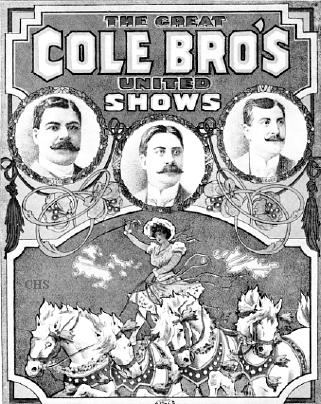 Erie Litho came into the picture with the Martin J. Downs use of the title. This 1906 courier was done for Downs that year by Erie and illustrations from this original booklet were rehashed by Erie for the next 25 years. Pfening Collection
Circuses and surprises have always gone together, and nowhere is there more of wonder, amazement and legend than in the lore of the big top.
But even the show business has nothing else to match the curse that followed the Cole name, year after year, all over the country.
For more than a generation the curse struck over and over again as long as any show clung to the Cole name. Yet cling to the name one circus after another did - and all because of Erie's glamorous posters.
To understand why one circus-owner after another braved the curse of Cole, one must understand what the magnificent paper meant to the big top, and what Erie meant to the poster business.
Although soaps, soups and cigarets have displaced the circus as the main source of poster trade for the Erie Lithographing Co., the lake city will always be known as "the Circus Poster City" to showmen.
Veteran craftsmen of the big litho house retain a fond memory of their glorious old bills which were turned out in a profusion of titles and designs to be plastered on barns, fences and "dead walls" and hung in shop windows up and down and across the continent - and in Canada and Mexico.
The Erie imprint was visible on nearly every sheet of Sparks, Sautelle, Walter L. Main, Jones Brothers, Sun Brothers, Hagenbeck-Wallace, John Robinson, Al. G. Barnes, Christy Brothers, Cole Brothers and many other fine old brand names of the tented world.
Musicals, minstrels, stock companies, fairs, movie productions, touring dramatic shows, and even baseball teams had their posters, brochures, handbills, route cards, programs, tickets and letterheads designed by Erie artists and lithographed in the plant for distribution far and wide.
But the circus bills were the thing.
"Each winter, we looked forward to the new line of posters," one old timer printer recalled. "You know, there never was a homely gal on a circus bill," he added, as his wife joined in. "Yes," she replied, "and all the men performers were regular Apollos. Funny how we settled for each other." (Both were with Erie for many years, before retiring.)
You get the impression that Erie officials viewed the decline of circus business with something of relief. It was some job to turn out a lithograph from a mere photo and a showman's description of the projected feature.
It also required the utmost skill and co-operation from the sales, art, credit, layout and press division. But the services required after the run was completed would make a gas station operator swoon.
Circus posters were printed mostly in the off months but their delivery took place during the tent season and the posters had to be on time. Usually, the general agent of the show made up a list of the bills, to be divided into each day's requirements of wall and window work. At the start of the season, the advertising car, which preceded the circus by exactly 14 days, was loaded to the roof but as the paper was posted, drop shipments were ordered thus:
"Express prepaid 6 days wall, 10 days window work to car No. 1 at Uniontown, Pa. There May 9 - Confirm."
And so on - all through the season. If a shipment went astray or was delayed, there was trouble. The dates were especially important, being pasted on the window bills each morning, by the "Main Street" lithographers, before starting on their daily routes.
In early days, a lost shipment would be traced and forwarded, but failing to catch up with the billing car it would be ordered back to Erie, to be worked into another allotment. Later, all orphan shipments were ordered back home, once they failed to make connections.
Circuses must have originated the phrase "Wire; don't write." Wires were exchanged with abandon in the pursuit of missing posters, or to increase orders when opposition fights became heated.
Back in those days of hot competition two shows would often feud, each trying to route itself into towns booked for the other, just ahead of the opposition.
In such cases, the "route list" of towns booked would be kept secret, if possible.
"Double all orders for Rider and Title bills until further notice," a show might wire. "Protect route list at all costs. Close opposition with Wallace, Iowa and Kansas."
Ordinarily, route lists were freely published in the showman's magazine, "Billboard," and "day and date" conflicts avoided if possible. But all was fair in war.
Sometimes cloudbursts, wrecks and floods could make a circus forget the axiom that "The show must go on." But never the advertising men - they had to keep on schedule, no matter what happened.
Some years ago the Walter L. Main advance car arrived at Du Bois in a cloudburst that would have drowned out any performance. Yet the billers carried on. Soaked posters and muslin banners clung to them until they looked like clowns; huge 24-sheets crumpled off brick walls as soon as posted, and every man was drenched to the skin. But all that was ever made of the occasion was the weekly report to "Billboard," that: "We decorated Du Bois, Pa. today, in brilliant water colors."
During the opposition battles of an earlier day, shows competing for the same towns relied largely on posters. This meant heavier orders to the printing houses, but only broken heads to the weary billers. Layer after layer of the opposing shows' posters would be coveted alternately by the embattled crews. It was sheer waste, but the orders were: "Don't spare the paper. Give them a licking they won't forget."
George Lux and the Lowe boys, J. R. and Maurice, were the circus specialists with the lithographing firm, and they had to be about all things to all showmen - confidante, big brother, territory scout and sometimes, even a banker. Getting orders was just a part of their job with Erie.
Many showmen went overboard in their enthusiasm for the compelling poster art and a bit of restraint in the way of credit was essential to the well being of both parties to a poster contract. Now and then a show defaulted.
A few weeks of rain, for instance, would be the difference between a winner and a defunct show. It was the sad task of Erie to close a show when all means of keeping it moving were exhausted and the poster bill was satisfied by selling the show, piece-meal, or as a going concern, to the highest bidder. Perhaps Diamond Billy, as William P. Hall, of Lancaster, Mo., was known to all showmen, would appear on the scene, bid in the trick and ship it to his celebrated circus farm, where circuses went when they died.
Pennsylvania shows were loyal to Erie for it was Erie that nursed them along in their formative days. The Sparks shows (Sparks Circus and later Downie Brothers) were owned and operated by former East Brady men for nearly half a century. The Jones boys, of Warren, Pa., bought Erie paper for such titles as Jones Brothers & Wilson, Cooper Brothers, and that most intriguing of all show titles, Prairie Lillie and Nebraska Bill's Wild West.
The Jones lads also got in on the celebrated Cole Brothers title, sharing in the curse that sent many a good showman to his grave, and many another into bankruptcy.
Not the least amazing part of the story is that the curse should have followed the Cole name at all. For W. W. Cole, the original show man to use the title, was highly successful, and retired in the '80's when his star was at its zenith.
The second Cole dynasty didn't get started until the winter of 1905-1906, when Martin Downs rolled into Erie with his Sells and Downs Circus, whose winter quarters were at Harbor Creek. Downs decided for some reason to sack the old name and try to cash in on the Cole reputation.
He hoped it would bring him luck and it did. Both kinds, but in the final outcome, bad.
For several seasons the show went forth in the spring increased in size, with splendid features, a fine parade and a top-notch free act. It was one of the best billed shows on the road, regardless of size - a fact all rivals conceded. There were special bills advertising the parade; another pictured the winter quarters with still another for the circus train.
Boom and Bust
The free act featured Mlle. D'Zizi and her bicycle loop-the-loop act - "Spanning Death's Awful Arch," as the posters had it. Now bike acts were the thing - all shows had such thrillers, but inside the big top - and they say they helped sell bicycles. Downs made a ten-strike in prestige by giving this chiller outside as a free act twice daily. "Rain or Shine." It fulfilled its mission by bringing the natives to the lot in droves.
It wasn't discovered for years that "Mlle. D'Zizi was a man, though some customers noted "her" big feet.
Franklin, Oil City, Warren and Corry fed the maws of the Cole outfit to capacity in the early spring shakedown swing through the tri-state territory. Prosperity seemed assured as the show grew into a real contender. Then adversity set in.
The show was plagued with ill luck during the season of 1909. One of the prize parade teams ran away and tore the porch off a mansion, the horses being badly injured. A performer, washing her beautiful blond hair in gasoline, was ignited by the static electricity in her locks, and died in agony.
Just before the season was to close, the Harbor Creek winter quarters burned when workmen on a roofing job let tar boil over and catch fire.
The show continued on to Corry for the winter. But it didn't leave bad luck behind.
All circus men are horse lovers, and Downs made daily tours of the stables. One winter day early in 1910 as he stood behind a temperamental Arabian, the horse lashed out with its heels, striking him in the abdomen. In a few days, he was dead.
But he had ordered and Erie Lithographing Co. had already printed a bumper supply of posters under the Cole name. After the show's property had been sold, the Erie firm offered the paper at a cut price. And with the fine engraving all ready, more could always be lithographed at a bargain rate.
Circus men, superstitious always, were now convinced that the Cole show was a Jonah - jinxed, to you - and later events bore them out. But those grand old bills at Erie kept the name alive for many years.
Were Posters a Jinx?
One showman after another decided to forego the pleasure of seeing his name and picture on the posters in order to buy that cut-rate Cole paper. And one after another died, or lived to regret it.
In long line of succession W. H. Coulter; J. Augustus Jones and his brother, Elmer of Warren, Pa.; the Kings; Jess Adkins; Zack Terrell, and the Chicago Stadium organization found the Cole title a hoodoo.
J. A. Jones was killed by a horse, much in the same manner as Downs; Mr. Coulter failed. The Kings could not lick the big depression and "walked away and left it" on the lot down in Tennessee. Mr. Adkins, one of the best liked show moguls of all time (few are popular with the show folks) and a prominent Rotarian, died of a heart attack on the show train, after fighting to keep the thing moving after fire at the Rochester, Ind., winter-quarters, did $250,000 damage.
Mr. Terrell, who took over, "got well" financially with the help of the war time boom of amusements. But his health failed and he sold out to the Chicago firm which cut the show down and eventually retired it - a losing proposition from the start. Mr. Terrell died not long afterwards, of a heart attack.
Were the posters responsible? If the tents could talk what tales they could unfold!
The show left Michigan and entered Illinois at Joliet on July 15 where it was the first major circus to play there in several years. At Elgin the next day there was a late arrival making it necessary to cancel the parade. Cole was in Rockford a month ahead of Ringling-Barnum which was scheduled for August 9. A new lot was acquired in a last minute switch from the Driving Park when show officials decided that a narrow dirt road would be perilous in case of rain. The new lot caused the parade route in Rockford to be a long one.
Iowa was entered July 19 at Davenport and the show now experienced the first real heat wave of the season. At Cedar Rapids the parade was called off because of the long distance from the lot to the business section. Waterloo on the 21st gave Cole good business despite opposition from Ringling-Barnum scheduled for August 17. This was the last opposition date with the Big One until late in the season.
The show's stand at Sioux City on July 24 was one to remember due to the blow-down caused by high winds. The Aug. 7, 1937 Billboard told the events of the day and subsequent happenings as follows:
"Cole in Blowdown. Storm Strikes at Sioux City. Property loss reported negligible - loyalty shown by all hands.
"Omaha, July 31 - The Cole Bros. Circus was in a blowdown at night at Sioux City, la. July 24. Doors opened for the night show and there was a capacity house present.
"Performance started without incident and on time and was well into the middle when things started to get a little breezy outside and a slight rain began to fall. At this instance management showed unusual judgment, warned audience in an orderly unhurried manner, making sure that everyone not connected with the show was on the outside. Packing up started. Blues on both ends had been planked down, chairs had been knocked down, and wagons started in when a twisting wind hit the canvas broadside and in less than 30 seconds the tent was in shambles. Never before in the writer's (Stanley F. Dawson) experience has he ever seen paraphernalia in such an apparently complete wreck. In less than 30 seconds after the wind had subsided (it only lasted about 45 seconds) the department heads were relaying orders to untangle the wreckage.
"Every man and woman connected with the show was back on the lot and in action in less than 30 minutes, although many of the executive staff, and performers had gone to town and to the cars. The minute the word was passed that there was difficulty, they, without being called upon, were there to do their bit. This takes in the entire personnel. There was a fine matinee attendance.
"Everything was off the lot by 1 a.m. and show made the next stand, Omaha, with sailmakers busy with palm and needle as soon as canvas was spread. The property loss was negligible but the outstanding thing was the loyalty shown by all hands. Words are inadequate to describe conditions under foot.
"There was a hot free meal and plenty of refreshments for everyone at the restaurant cars. The following day there was a beautifully worded note of appreciation and commendations from the management, thanking one and all for the loyalty shown.
"Lincoln, Neb. July 31 - Straw houses up and including here is Cole Bros, record in Nebraska. This partly recompenses the blowdown which tore the big top in Sioux City. Luckily only one person, a colored workingman, was hurt.
"Jess Adkins, manager, estimated there were more than 100 of the circus crew under the top when a heavy gust of wind capsized the tent into the reserved seats. A cloud-burst hit at the same time, which made the ripped tent and twisted rigging a mass of mud-soaked debris to handle. Circus officials said it was the fastest recovery and load-out under such conditions they ever saw.
"Circus arrived in Omaha late and had a long haul. Twenty sailmakers from Baker-Lockwood were on hand and did a fast job of patchwork, but the top did not go up in time for a matinee. Night show was a sellout. Adkins says two of the centerpieces which were badly ripped may have to be replaced, although they're now being used.
"Show got in here, Lincoln, comparatively late, which held the parade scheduled for 11 a.m. back until 12:30 p.m. but the show went on as scheduled. Strawed in the afternoon and again at night. R. B. Dean, press agent here, got twice as much publicity as any other press agent ever wrung out of the newspapers here."
The final Nebraska stand was July 27 at Falls City, one of several smaller cities on the Cole 1937 route which didn't see a big railroad show very often. After a stand at St. Joseph, Mo. the show began moving rapidly west through Kansas. At Hutchinson the lot was at the state fairgrounds and the layout was such that a wide cement walk ran the entire length of the midway from the ticket wagons to the front door. Unloading was right on the lot and Cole's management praised the outstanding cooperation of Hutchinson officials and police.
During the summer and fall of 1937 there were several serious outbreaks of livestock hoof and mouth disease in various parts of the country. These are murder to circus routing as nearly always the affected areas are put under strict quarantine. Fortunately the Cole show was not affected but an outbreak of anthrax in the Dakotas in July and August caused both Ringling - Barnum and Al G. Barnes - Sells-Floto to make route changes to avoid the area.
Following the Hutchinson stand Cole made a long 504 mile Sunday run over the Santa Fe to Denver for a two day stand, Aug. 2, 3, in the city that had launched the highly successful western tour in 1936. The show did not arrive in Denver until 1:30 a.m. Aug. 2 but unloading took place right away and by 2 a.m. the first meal was underway in the cookhouse. The trains had arrived over the Santa Fe but were switched to the Burlington which moved them alongside the circus grounds.
Denver came through again with two good days' business and after the stand the show began following essentially the same route toward the Pacific Northwest and then down the Pacific Coast to Southern California that it had in 1936. For the next few weeks the show played a great many repeat stands and although the parade did not have the newness of appeal that it had the year before it was still a great drawing card and in all places towners packed the parade route and the show gathered in a wealth of publicity. Moving through Colorado and Utah several stands played had seen the Al G. Barnes - Sells-Floto Circus earlier in the season and of course many of the Pacific Coast stands were Barnes' annuals.
At Pueblo, Colo, the show had a short haul from the runs but a long parade route. Next came a long 241 mile run (typo error in official route printed last issue) through Royal Gorge to Glenwood Springs for a night only performance. The first section arrived at 3 p.m. followed by the second at 3:30. Lot was a railroad one just across the Colorado River from the business section of town.
Although the official route lists no stand for August 7, the Billboard (also the financial data ledger) says the show played Grand Junction, Colo, where the original lot was found to be too small and had to be changed when the 24 hr. man arrived on the scene. Finding of lots of ample size to accommodate the big 40 car railer was a problem at many stands in 1937.
Another long Sunday run, this time over the Denver and Rio Grande, brought the show to Salt Lake City for a stand August 9. The show was now in its 15th week under canvas and the Billboard, in commenting on the show's tour, said that Cole had started moving westward with a vengeance, with two towns in Utah, four in Idaho, one stop in Oregon, and then into Washington. Fortunately the Union Pacific was giving top service on the long runs, getting the two sections in town even ahead of what the management had expected.
In order to get to Boise in time for two shows and a parade, an afternoon only was billed at Twin Falls, Id. on August 13. The show was now on dusty lots in which they used the sprinkling trucks profusely on the lot and at times even the performance was halted while the sprinkling trucks were brought in to wet down the track.
The Billboard also made comment that the 1937 season had been good for "blessed events" in the show's menagerie. Nellie, a big lioness, gave birth to 5 young lions in August, which was the second litter of lions born this year. A baby antelope arrived recently as did a Rhesus monkey. Two months ago a baby camel was born and nine weeks ago a Shetland pony.
Cole Bros., which prided itself as already having the most brilliantly lighted tent ever erected, went a step further in preparing for the big city and hopefully lush money stands on the Pacific Coast by installing 24 large ball globes with 1000 watt bulbs around the hippodrome track. Cole's inside and outside lighting was the talk of the circus world throughout the season.
The show entered Washington at Walla Walla, Aug. 18 and according to the Billboard did well at the nine stands in the state. At Colfax the only lot available was a ball park which was way too small, making it necessary to corral the menagerie and other tents overflowed into surrounding ground along the streets, but despite these handicaps the two shows and parade were made on time. Spokane, as was expected, gave good business. There was only a two block haul at Wenatchee but the parade was cancelled because of an adverse attitude by city officials, but the crowds still came to the two performances. At Everett there was another small lot with the show scattered over several blocks but a haul of only two blocks helped matters. The two day stand at Seattle, Aug. 21, 22, was one of the best in some time and the city turned out big for the show. The run from Seattle to Tacoma was only 40 miles so the trains arrived early using the Union Pacific grounds in the heart of the city with unloading taking place right on the lot. The Tacoma lot is notorious as a dusty and dirty one but a hard all-night rain the night before did wonders. A new wire act went into the performance at Tacoma featuring Leo, Pete, and Mike Gasca which went over greatly with the audience.
During the Washington stands Cole Bros, was faced with a situation which was later to prove fateful to circus business in 1938. A few weeks earlier The American Federation of Actors had signed a closed shop agreement with Ringling - Barnum for 1938 (included everyone, performers and workmen alike) and following their success with the Big One, Ralph Whitehead, executive secretary of AFA, began efforts to unionize the second largest and sent an organizer in an attempt to sign up Cole Bros. The initial try met with failure and Whitehead told the Billboard that his union organizer to Cole Bros, had been "roughed up" in Everett and Seattle and said he was asking all organized labor along Cole's future route to mass picket and cause trouble for the show. Such tactics did not become necessary as the show and union soon came to terms with Whitehead announcing a week later that Cole Bros, had signed a closed shop contract for 1938 with AFA, with a minimum wage of $40.00 a month plus board, transportation, and lodging. Whitehead himself signed the agreement after Guy Magely, the first organizer, had failed.
It might be pointed out that all during 1937 throughout the land there was a great deal of labor unrest and in many industries there were strikes, sit-downs, and lockouts. With a sympathetic administration in Washington, D.C. organized labor was feeling its oats again after the long depression years and the appearance of the new aggressive and often militant CIO and the jurisdictional disputes between it and the older AFL caused much of the labor trouble. Violence was not uncommon and oftentimes organizers sent into unwelcomed locales lived dangerously. Time magazine ran a classic photo showing Walter Reuther and a fellow organizer after they had been tarred and feathered on one unsuccessful organizational tour. The two unions were moving into many heretofore non-union fields and it was inevitable that their zealous organizers should find their way into the circus.
Aberdeen, Wash, on Aug. 24, according to reports, saw its first circus parade in almost a generation. Sometimes the press boys were a little over anxious in reporting the dates of the last street parades in town before Cole arrived on the scene. True, in a few locales there had not been one for many years but the old Al G. Barnes show had paraded in most of the towns - large and small - in this part of the country all through the early 20's.
Longview was the last of the Washington stands with the lot in the center of the business section and a paved sidewalk all around. The parade setting was beautiful with the march winding around a park.
Oregon came next with an opening two-day stand at Portland, scene of tremendous business in 1936. Again the town came through with good business and during the engagement Noyelles Burkhart, superintendent of front door, had an interesting experience when an elderly man with a twinkle in his eye presented for admission a hard yellow ticket of W. W. Cole's Circus dated 1878. Burkhart passed him and kept the ticket as a souvenir. Harold Barnes, featured wire walker who had been away from the show for ten weeks with a broken shoulder, returned at Portland.
There was a short run to Salem, Oregon, and unloading began at 5 a.m. and those up then noticed a little frost glistening in the bright sunlight. Weather generally had been great all through the Pacific Northwest but no one now objected to the show heading south.
Eugene, the next to last of the Oregon stands, on Aug. 29 was a matinee only date and the next day the show played Klamath Falls then made a 211 mile run to the first California stand, a night only date at Red Bluff. A couple of hundred mile plus jumps took the show rapidly down the California heartland to the big three-day stand in San Francisco.
The show continually claimed in the Billboard that it was doing well on the West Coast and at the repeat stands business had been good. This was generally true but the long rail runs were expensive and the number of one show only stands such as Eugene and Red Bluff made it rough trying to get the nut plus some for the 40 car railroad show. Floyd King was quoted in the trade publications at the time saying that business on the whole on the West Coast was about 25% better with some towns 50% better than in 1936. But despite the claims of good business still the show was not drawing on the average as it had done earlier in the season and although ominous economic winds were blowing none of the Cole management, nor those of other circuses for that matter, could correctly analyze them and confidently predicted that the good times now enjoyed by circuses would continue. Other shows continued to claim good business. Barnes-Sells-Floto said their Nebraska business was very good and Hagenbeck-Wallace strawed them in Chattanooga.
The August 27, 1937 Billboard dropped a real blockbuster of circus news by announcing that Messrs. Adkins and Terrell would expand for 1938 and have a second railroad circus on the road, however, the name of the new show would not be given until later. The Billboard commented that this was great news and it would be a wonderful thing to have another rail show and said it was a sure sign that the depression was really over.
A new lot was used in San Francisco where good business was encountered and the following two-day stand, Sept. 6, 7, at Oakland was truly great. As the 6th was Labor Day and the AFL and CIO were putting on parades that day Cole did not parade until the next day. The two performances on Labor Day saw a straw house and a turnaway.
Following Oakland was a series of one-day stands as the show moved southward through the beautiful San Joaquin Valley. Fresno had a new lot, sandy, and way out, but the six mile parade route was covered in one and a half hours. A long run over the mountains into Oxnard caused a late arrival and cancellation of the parade. There was a long parade route in Glendale with the march being out over two hours.
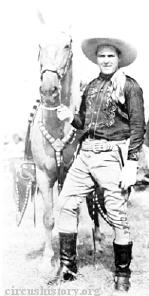 Photo: Ken Maynard shown in the backyard during the 1937 season. Don Smith Photo.
The show was now ready for the highlight stand on the West Coast, the big six-day engagement in Los Angeles, eagerly looked forward to by the entire personnel. The stand began Sunday, Sept. 19, with a straw matinee and capacity at night. The parade was given on Monday which saw a fair matinee but packed again at night. Publicity was very good in Los Angeles as newspapers gave much space and newsreel cameramen were all over the lot. Hollywood stars visited in droves during the engagement. Ken Maynard entertained many of his fellow movie stars daily and during the stand his wild west concert succeeded in holding the major part of the audiences.
The two days in Hollywood came next and then the show began one dayers again starting Sept. 27 at Santa Monica. In Pasadena the lot was opposite the Rose Bowl. Last year the parade in Pasadena was not permitted to traverse the main street but this year the city fathers permitted (for first time in memory of oldest settlers) the parade to go down the main stem in the Rose City. San Bernadino, which was passed up last year, followed Pasadena and the show gave the first parade there in 15 years.
Cole went on to the tip end of the state with a two-day engagement in San Diego, Oct. 2, 3, where it was on a beautiful lot overlooking the city. The show's Billboard correspondent said that San Diego was always a wonderful show town and this year did not disappoint. Next the show began the long runs eastward for the final weeks of the season and after a stand at El Centre left California for a 244 mile run to Phoenix.
In the Oct. 9 Billboard Jess Adkins, himself, reported on the Cole show's West Coast tour, terming it highly successful. Adkins said that business in the northern coast states was somewhat affected by strikes and difficulties between rival labor organizations, but every major city showed an increase in business over 1936. The head man said that Los Angeles business on the Hill and Washington streets lot was approximately 15% better while Hollywood showed an increase of 30% on Fairfax and Wilshire lot. Lou Delmore added his plaudits by saying sideshow business was better in the area than a year ago.
Phoenix, played by Cole on Oct. 5, was to have Al G. Barnes-Sells-Floto in on Oct. 28 for that show's closing stand of the season. At Phoenix Jimmy Reynolds, Red Ball, and Tip O'Neill left with 3 elephants to play several weeks with Frank Wirth's Winter Circus. (Note, such events as this often are not known and no doubt account for different counts of number of elephants in the herd from one stand to another.)
Tucson, played Oct. 6, was also an opposition stand with Barnes-Sells-Floto with that show billed for Oct. 27. There was a colorful affair at Tucson when Father Regis came in from the desert mission bringing 30 Yaquiri Indians with him. None of the Indians had ever seen a circus before, let alone an elephant or any other jungle animal. The show's management gave them a royal welcome.
Douglas on Oct. 7 was the last of the Arizona stands, all of which had seen pretty good business and remarkably good railroad runs on the long jumps by the Southern Pacific.
The next day the show entered Texas at El Paso, which was the final stand of the season with opposition from Barnes-Sells-Floto, that show scheduled for Oct. 25.
Rather than following the customary Texas and Pacific route across the central part of the state which was lined with a series of good sized show towns, Cole elected to go down the southernly T & N. O. route (So. Pac.) through the desolate Big Bend country for a couple of rather small matinee only stands, necessitating long railroad runs. At Marfa, with the local fair going on, the show had a packed house for the afternoon only performance. Although the town was much too small to be ordinarily visited by a 40 car railroad show, they came in from everywhere to see it. The official route book put out by the show termed Marfa as "about as wild and wooley as they come." Next came another long 197 mile run to Del Rio and another good day at the afternoon only performance. While at Del Rio many of the show's personnel went across the river for a short Mexican visit.
Next came a 169 mile run to San Antonio for two big performances and a parade. San Antonio, played on Oct. 11, had been visited by Ringling-Barnum on Oct. 2. The following day at Corpus Christi the show had two packed houses for one of the best of the Texas stands. Houston on Oct. 14 had also seen Ringling-Barnum on Oct. 4 and 5, but Cole termed Houston's business wonderful despite following so closely the Big Show. Matinee was near capacity and show strawed them at night. Known as one of the poorest show towns in the state, Galveston gave Cole Bros, good crowds on the 15th.
A historic stand came Oct. 16 at Goose Creek. Cole was the first large railroad show to play there in many years and it was the first parade in 20 years. Show played on a railroad lot with a very short haul which became muddy from a downpour coming during the matinee and night performances. Despite the bad weather business was extremely good. The official route book's comments on the Goose Creek stand, the town with the "metropolitan name" was in keeping with the good humor of the day as follows:
"They kidded Floyd King and wanted to know where he dug this one up. But at 10 p.m. the general agent had the last and best laugh. This is an oil town only a few years old with thirty thousand people within a three mile radius. In the past only two or three circuses ever made this one. Biggest event in the town's history. Everything okay."
Following Goose Creek the show entered Louisiana at Crowley on Oct. 17 for three stands and then went into Arkansas for four more.
Extremely close and formidable opposition was provided by the Tom Mix Circus at Little Rock with Mix playing Oct. 18 and Cole on the 21st. Mix was physically the largest of the motorized shows and one that could not be taken lightly. Mix arrived on Sunday in a downpour and tents had to be staked in a sea of mud and had only fair business under the circumstances. Cole had good weather and was well patronized.
Several Arkansas stands saw cold weather but it moderated at Cape Girardeau, Mo. on Oct. 25. The season was now just about over with the next to last stand coming the following day at Cairo, Ill. The final stand was at Paducah, Ky. on Wednesday, Oct. 27 bringing to a close the glorious 1937 season which will never be forgotten by those who saw the show that year. The band played "Auld Lang Syne" at the closing evening performance after which the show tore down and loaded up for the final run to Rochester quarters.
The Billboard in commenting on the final week of the season, said that the show had received good runs from the railroads and good business at the ticket wagons. It was reported that Ken Maynard had been signed again for 1938 and would present an enlarged Wild West Concert with Cole Bros. Following the close at Paducah Maynard left immediately for California to complete his picture contract for Grand National Films. Winter work for Ken called for 6 more movies, two of the total of 8 called for in his contract being completed prior to start of the 1937 season. Maynard said he was selling most of his circus property he had accumulated for his proposed wild west show in 1936 and the same issue of Billboard carried his for sale ad for stock cars and other circus equipment.
As was customary in those days many of the organized circus fans travelled, some for considerable distance, to be on the Cole lot for the final stand at Paducah. Little did they realize they were witnessing something that day never to be seen again in their lifetime, nor ever. There would be other seasons for Cole Bros, but the show would be smaller. It would parade again but the march would not be as long nor magnificent. For one shining season the show had reached to great heights and those who were privileged to have seen it have never forgotten it and to this day will still declare there has never been anything quite like it thereafter.
The season had been a good one. It had made money. Emmett Kelly drew a cartoon which was printed in Billboard showing the teardown activities after the final performance in Paducah. Watching the last loading out of the show for the season were Messrs. Adkins and Terrell who were saying, "Nice season, Jess," "Well satisfied, Zack." That about summed up the sentiments of the owners.
Considerable improvements had been made at Rochester quarters while the show had been on the road. A large frame building, which had been started earlier in the year, was now completed. Jack Bigger and a crew of 20 men had erected the three story, 150x300 ft. building which was located some distance off to the right of the main group of brick buildings on opposite side from the rail sidings. The new structure was put into use to house the electrical, tractor and truck, and seat departments on the lower floor with the wardrobe department occupying the upper floor and the sail loft above it. The new building greatly alleviated the cramped conditions existing at the quarters. Other improvements included the erection of indoor and outdoor corrals for hay eating animals.
In December the three elephants that had been with Frank Wirth's Winter Circus returned to quarters. Also in December the show took delivery on a new all steel cage equipped with pneumatic tires from the Springfield (Mo.) Wagon Co. (details in next installment). It was reported that more wagons would be constructed for Cole by the firm, however the cage was the only vehicle ever delivered. Springfield had other large orders for other shows during the winter of 1937-38 which consisted of eight wagons and cages for Hagenbeck-Wallace and a complete set of wagons for the new Tim McCoy Wild West Show being framed to tour in 1938.
All of the circuses that had hit the road in 1937 were now in the barn. Most of them reported good business, the best in years. The season had undoubtedly been the best since the beginning of the depression in 1930. Big circus news was now breaking almost weekly. Perhaps the biggest was that the Ringling family had regained control of their two shows by final payment of all notes held against them and by purchase of the 10% interest of the Allied Owners Corp. Allied's man, Sam Gumpertz, who had managed the show for several years resigned.
Rumors were still buzzing about the No. 2 show Adkins and Terrell were to put out in 1938 but no details were to come from these gentlemen until after the New Year. Not even the title was announced. One Billboard columnist told his readers that the title of the new show would be Sun Bros. Circus but he wasn't even close. After the holidays Messers. Adkins and Terrell would start to work in earnest on their plans for 1938.
(To be continued next issue.)
Supplement: Member Bob Brisendine recently received from Arnold Maley a bit of interesting correspondence between Jess Adkins and Equestrian Director H. J. McFarland concerning the performance of the Cole show during the opening Chicago engagement in 1935. Bob has generously loaned the document which is reproduced here.
Tuesday Matinee, April 23, 1935
Mr. McFarland:
Your performance this afternoon ran as follows:
1. Spec, 12 minutes
2. Comedy acrobats, 2 min.
3. Ring curb dogs, 4 min.
4. Allen King Animals, 11 min.
5. Jockey riding act, 4 min.
6. Ladders and aerial, 6 min.
7. Clyde Beatty animals, 14 min.
8. Two seals acts, 6 min.
10. Cyce O'Dell, 6 min.
11. Riding acts, 7 min.
12. Wild West, 7 min.
13. Elephants, 8 min.
14. Skating girls, 6 min.
15. Clown band, 3 min.
16. Wire acts, 5 min.
17. Clown cannon, 3 min.
18. Liberty horses, 8 min.
19. Florescue Teeth act, 2 min.
20. Acrobatic, 9 min.
21. Menage act, 8 min.
22. Crazy number, 2 min.
23. Flying acts, 8 min.
25. Jumps & races, 9 min.
26. Races, 2 min.
27. Florescue High perch, 6 min.
2 hours and 40 minutes (Note: no No. 24 act was listed.)
Suggest following changes:
Speed up people in spec to 11 minutes
Seal acts cut 1 minute
Cyce O'Dell cut 2 minutes
Wild West cut 1 minute
Skating girls cut 1 minute
Liberty horses cut 1 minute
Acrobatic act cut 2 minutes
Flying acts cut 1 minute
Jumps and races cut 1 minute
Florescue perch cut 1 minute
With above changes the program will be brought down to a little under two hours and thirty minutes, which is necessary in the Coliseum.
Have clown cannon act come closer to center of arena, especially putting small cannon on middle ring curb, instead of on the end.
Change music on flying acts. "Flying trapeze" overdone.
Jess Adkins
Special Author's note: It is my plan to fully cover all phases of the Adkins and Terrell No. 2 show, Robbins Bros., which, was on the road in 1938 as well as Cole Bros. We have plenty of Robbins Bros, photographs available for illustration for the early part of the season but are in great need for photographs taken in the late summer and fall after Cole Bros, had closed and sent six cars of equipment to supplement Robbins Bros. Anyone who has photos of Robbins Bros, after this enlargement took place and would be willing to loan them for illustration of the article is invited to contact me about what you have.
[Repeat of 1937 route with additional information on receipts, weather, etc. is not included in this online edition.]
After covering predominantly eastern circuses so far in this series, by way of contrast we now move to a prairie or "high grass" show by relating an account of the Joe B. Webb Circus of 1936.
The selection of the Joe B. Webb Circus is significant in two respects. First, it is a typical example of the many small and medium motorized circuses which have traversed the American prairie country since the coming of good roads and trucks in the late 1920's and early 30's. These shows actually covered a good bit of territory, far more than did their wagon show predecessors. They generally roamed from Texas to the Dakotas, rarely going east of the Mississippi, but sometimes moving westward into the Colorado Rockies or through Wyoming or Montana toward the Pacific Northwest. At other times these shows would take a southwesterly swing into New Mexico and Arizona but generally they would remain in the great American plains where although distances between stands usually were much greater than those of similar shows in the East the roads were straighter and the grades easier.
The Webb Circus is also typical of the considerable number of one season circuses that took to the road in the mid 30's. As the great depression eased in 1933 a number of showmen each year would try their luck with a motorized show. Many of these showmen had been forced off the road during the depression but now they were coming back for another try at it. Typical were Howard King and Harold Christy (brother of G. W.), both of whom framed and took out a motorized show. Unfortunately many of these new motorized circuses lasted only a single season, or part of a season, as was the case of both King and Christy. The Joe B. Webb Circus was out only one year, the 1936 season. Several other new shows taking to the road for the first time in 1936 had the same record with each show having its own particular cause for its short life.
Joe B. Webb had been in circus business for about 25 years when he decided to frame his own circus to tour for the 1936 season. Webb had done a variety of jobs around a circus, mainly those of an executive type and also he was an accomplished Wild West Show performer who could ride, do trick roping etc., a talent he put to use in the concert of his own show. In 1935 Joe Webb had spent part of the season on the front door of C. W. Webb's Russell Bros. Circus, a pretty good sized motorized show, and rest of the time as legal adjuster for Bud Anderson's Seal Bros. Circus, also a fair sized mudder which had a good menagerie and presented a daily street parade.
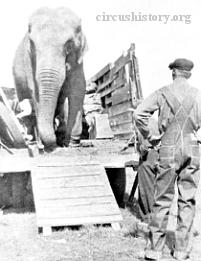 Photo No. 7 - Mr. Fleming, Sr. watches Big Vera getting ready to descend the loading ramp of the elephant semi as his son, Joe, records the scene on film for posterity. Photo by Joe Fleming.
The Jan. 18, 1936 Billboard broke the story of Webb's plans by announcing that he had made a deal with Tol Teeter for the Orange Bros. Circus equipment which consisted of 10 trucks and all canvas which included a 70 with three 30's big top, a 50 with two 30's menagerie-sideshow top, a 20 x 30 cookhouse and other smaller tents. Also in the deal was a large elephant, "Vera," horses, ponies, and a few wild animals.
Tol Teeter, from whom the equipment was obtained, had been in show business for a number of years having operated circuses as well as other types of amusements. He operated Tol Bros. Circus in 1934 and owned the equipment of Orange Bros. Circus which was on the road in 1935. In earlier years he had operated a small wagon show called Lucky Tull's Show and Joe Fleming, who has furnished so much of the information used here, recalls that this little mudder played his home town of Trenton, Neb. about 1917.
Webb established winter quarters in Dallas, Texas and went immediately to framing his new show. He selected his own name as title for the show and it was officially called the Joe B. Webb Circus Menagerie and Wild West, somewhat of a contrast to the dozens of "brothers" outfits in those days.
The former Orange Bros, motorized equipment was reworked, the motors overhauled, and the trucks painted and relettered with the Webb title. Color scheme used was bright red with lettering in silver and gold leaf. The fleet consisted of both semis and straight bed trucks.
Webb added a factory built especially constructed trailer which was used as the office and ticket wagon as well as living quarters for the office force and in Billboard accounts the show claimed it had added a new calliope truck.
Webb announced that the show would move on 10 trucks and he planned to carry 16 head of ring stock, 2 elephants, a camel, and have 6 cages in the menagerie including "King Kong," a giant ape. Webb's plans did materialize to some extent, however, only one elephant, "Big Vera," was ever acquired and when Joe Fleming visited the show at McCook, Neb. on May 6 there was no camel and no caged animals with the exception of a large ape or baboon of some description in the sideshow, which was probably the "King Kong" described above.
The initial staff of the show on opening day included, Joe B. Webb, owner and manager; Mrs. Margaret Espy, treasurer; Bert Carroll, lot superintendent; Fred Crandall, equestrian director; Pete. Kramer, sideshow manager; Jack Turner, general agent; and L. B. Saunders, brigade agent. The advance department used one auto and two billing trucks.
A special line of bill paper was acquired and the show advertised fairly heavy throughout the tour.
Webb used the services of Circus Magazine which provided him with a neat, slick magazine which listed the performance in detail and gave other interesting facts about the show. For the purpose of this article the accounts of the performance given by the Billboard and eyewitnesses will be used rather than a reproduction of this official printed program.
In early March the show was all assembled and ready to go on a route laid out through the territory Webb knew best and that generally traversed while he was with Russell Bros, and Seal Bros, the year before. The Billboard, in summarizing the final few weeks of activity in quarters, stated that Fred Crandall had produced the opening spectacle, "Valencia," which would feature Aline Patten as prima donna. Four trucks had gone from quarters to Oklahoma City to bring back seats, tents, and other equipment, also that Walter Jennier was at quarters breaking 2 sea lions.
Webb opened the 1936 season on March 17 at Mineral Wells, Texas and had rough weather for the initial stand.
The March 28, 1936 Billboard reported the opening as follows:
"Webb Opens in Storm at Mineral Wells, Texas - The Joe B. Webb Circus opened here Tuesday, March 17. Matinee was witnessed by a small attendance but night show was presented to a capacity house.
"The show opened in a typical West Texas windstorm. Before the day was over the cookhouse tent was badly damaged by wind; also the menagerie top. Manager Webb immediately sent to Dallas for a new tent for the cookhouse and supplies to repair the menagerie tent but all was in order before showtime in the next town, Ranger.
"Fred Crandall, equestrian director, did well in arranging the performance. The program consists of pony drill, single traps, riding dogs, globe and barrel, ladders, dog act, aerial endurance, wire acts, contortions, foot juggling, web, perch, high school horses, rings, mule act, iron jaw, riding school, clown antics, and the feature act, Walter Jennier's seal, Buddy.
"Performers are James Hamiter, the Wallingfords, Aerial Kesters, Orton Troupe, Slats Beeson, Charles Dryden, Joe Goodwin, the Misses Goodwin and Woodcock, Betty Webb, Ethel Jennier, Tom Thornton, and his clowns and Betsy Ross, Hollywood Stars and Wild West in concert."
As can be seen by the above account of the opening performance it was a strong one for a 10 truck show, however some retrenching was done before early May, a major loss being Walter Jennier and his seal "Buddy," a feature act of any size show.
Of special interest to circus historians is the fact that the late W. H. "Bill" Woodcock and his wife, Babe, were on the Webb show that season. Bill worked the elephant in performance and did a number of other jobs on the show. Mrs. Woodcock appeared in the performance with other members of her family, the Ortons.
Other Texas stands following Ranger were Albany on March 19, Colorado on the 20th, and Lamesa, 21st. After a swing through the West Texas panhandle the show was scheduled to go into New Mexico for a number of stands although the Grace files which are far from complete on the Webb route do not give the names of any. By mid April the show was up into Kansas with stands at Coffeyville, 10th, Independence, 11th, and Columbus, 12th. Later it was at Sterling, 21, Stafford, 22, Kinsley, 23, and Jetmore, 24.
Very little appeared in the trade publications after the opening date on how the new show was faring but the May 9 Billboard reported some personnel changes had been made, one being that Ralph Noble had taken over management of the sideshow being assisted by Bill Woodcock, who makes second openings. They both also make banner and concert announcements and sell reserve seat and concert tickets. On a small show such as this everyone doubled and tripled.
Following the Kansas stands the show went northward into Nebraska for several weeks.
The May 23 Billboard came up with a more detailed account of the show and gave the circus world some knowledge of how the season was treating the Webb show. The Billboard report read as follows:
"Bridgeport, Neb., May 8 - Business with the Joe B. Webb Circus has been very good through Western Kansas and Nebraska. Schools are being dismissed nearly every afternoon and matinees have been packed. The concert is holding a large percentage of the crowds. Program consists of singing, dancing, comedy and Wild West numbers. Ralph Noble, who has added some new acts, is doing well with the Side Show.
"Roy and Dorothy Hilbert recently joined and are working in big show. Hillbert is training Mr. and Mrs. Webb's six English collies, which are 8 months old. Some trailers and cages are being built for the show.
"The program, with Fred Crandell as equestrian director and presented in three rings, follows in order:
The Program
"Spec, 'Valencia,' Spanish tango, Betty Webb. Pony drills, Miss Woodcock, Jimmy Hamiter. Roman rings, Betty Webb and Gene Rogers. Kester Duo, the Hillberts. Clowns. Riding dogs and monkeys in all rings. Clown baseball number. Rolling globe, Tetu Moromoto; barrel kicking, Charles Dryden. Swinging ladders, Grace Orton, Betty Webb, featuring Janey Taylor with swivel, center ring. Clowns. Dogs, presented by Jimmy Hamiter. Clown band. Orton wire performers. Comedy juggling, Charles Dryden; contortion, Betty Webb. Single traps, Janey Taylor, Tetu Moromoto, finishing with muscle grind; Dorothy Hillbert. Elephant, Bill Woodcock presenting "Big Vera." Clowns. Menage and high school horses, Buck Brenner, Babe Woodcock, Jimmy Hamiter. Introduction of Col. Joe B. Webb and his Wild West concert. Slack wire, Gene Rogers, Web, Hazel Kester, Janey Taylor. Perch, Orton Duo. Balancing trapeze, Norman Kester. Clowns. Iron-jaw, Hazel Kester, Tetu Moromoto, Janey Taylor. Clown walk-around. Riding school.
"Show is moving on 12 trucks and trailers and a score of private cars. Has a chair grandstand. Big top is an 80 with three 30's; sideshow menagerie a 60 with three 20's and a nine double deck banner-line. (Note: tent sizes are slightly larger than those reported earlier at time of sale of equipment to Webb. There was no change of tents made, and above size is believed to be in error, perhaps typographical. Eyewitnesses think the big top was a 70 ft. round rather than 80 and photos indicate same.) Show is not only putting out plenty of billing matter, but also going strong on newspaper publicity and radio announcements. George Felix is publicity director.
The Staff
"Joe B. Webb is owner-manager; Betty Webb, secretary; Mrs. Ivan Epsy, treasurer; Joe Cole, auditor and superintendent front door; Jack Turner, assistant manager; Cash Wiltsie, legal adjuster; "Slats" Beeson, inside tickets; Charles Martin, on tax box; Willard Isely, band director; Martin Smith, boss canvasman; George W. Henderson, steward; William Durant, contracting agent; William Jackson, advertising brigade; Louis Ingleheim, lithos; Edward Hays and Joe McCoshla, billposters.
''Side Show is managed by Ralph Noble."
Four stands before the above Bridgeport, Neb. account CHS Member Joe Fleming caught and photographed the show on May 4 at McCook, Neb. Fleming is a real circus historian who can and has furnished the author with numerous notes on circuses he has visited going back as far as Gollmar Bros, in 1922. Bandwagon readers are well aware of his past contributions. Joe is a farmer who lives in Trenton, Neb. and a few weeks ago, despite this being his busy season, very kindly burned the midnight oil one evening to put down on paper for me his recollections of this little known show he visited thirty years ago. Joe also furnished the photos which are printed here. Cooperation such as he always gives should not go unnoticed by the membership.
Fleming is an authority on circus horses, both baggage and ring, and in giving his account of the Webb show it was natural that he give the full and complete picture on the stock carried by the show. He remembered the show as follows:
"It was a small show, on about 10 trucks, but I enjoyed it very much and truthfully would like to see a present day show as good as it was. All of the show's stock are shown in these photographs, which includes the 3 spotted horses, the two groups of ponies and the mule, which is shown tied with the ponies alongside the horse truck. There was also a donkey tied to the bull truck but was not used in the performance. The group of ponies tied to the bull truck were all sorrel and white spotted two year old stallions but worked nice in the drill. The 3 spotted geldings comprised the entire horse herd for the show but they were beautiful animals, one bay and white, the other two black and white spotted, fat, gentle, and well broken. Only one horse was used in the horse catching act in the Wild West concert. In the performance a single horse was used for menage, and another did what could be called a one-horse liberty act or perhaps a menage act with the person working it on the ground instead of riding the animal. One of the spotted horses was used as the rosinback and kids from the audience came down to be buckled onto the mechanic for a ride in the riding school act.
"One semi and one straight bed truck shown in the photos, hauled all of the stock. The elephant, 'Vera,' rode the semi with one group of ponies, the horses and other stock in the straight bed. You may notice in the photo that the elephant truck is patched up. Well, one fine morning they upset the rig in Kansas and literally pulverized it but the bull, ponies, and men riding in it were uninjured although a couple of men were thrown over a barb wire fence.
"There was an 8 piece band but the day before I saw the show the leader had blown the show taking all of the music, hence in McCook the band played without a leader and music, but as far as I could tell they couldn't have done better with both the leader and the music. The band played 'Valencia' for the opening spec of the same name.
"In the performance I recall Tex and Grace Orion's wire act, several good aerial numbers, dog act, and the elephant act. Joe Webb did some fancy work with a rope in the Wild West aftershow.
"There was no separate menagerie tent, no camel nor other lead stock and I don't remember any cages at all with exception there was some sort of large ape or 'lion slaying baboon' as a sideshow attraction. Frankly, all I remember about the side-show was a magician and Tex and Alice Orton's knife throwing act.
"Our good friend, the late Bill Woodcock, was on the show and I remember him being connected with the sideshow as well as handling the elephant. He told me that Tol Teeter owned a lot of the equipment and that Jimmy Hamiter owned some of the horses and ponies on the show.
"Old Vera, the elephant, was a very gentle and very large animal. At one time she was a Ringling elephant and was sold to the Overton Park Zoo in Memphis, Tenn. William P. Hall bought her in 1926 and when the Robbins Bros. Circus passed through Lancaster, Mo. en-route to Kirksville they picked her up along with some other animals and added them to the menagerie. On the Robbins show Vera was featured as "Big Bingo," the largest brute alive. She stood on a small platform which not only served as a picket pin but also caused her to look even larger than she was. Well, later Vera went back to Lancaster with the rest of the Robbins show when it called it quits in 1931 and in 1934 Tol Teeter bought her for his show. Teeter later sold her to Jimmy Hamiter about 1938 and when Jimmy went into the army during World War II he sold her to the Arthur Bros. Circus where she died in 1945."
The next couple weeks were spent in Nebraska, an example of the stands being played were those during week of May 13-18 which saw the show at Hyannis, Hemingford, Chadron, Rushville, Gordon, and Valentine. Evidently business was now fairly good as Webb told the Billboard that he had experienced big business and strawed them at Atkinson, Neb. on May 20. There was good business at Butte, Neb. despite a heavy wind and rain storm.
Other developments reported by Webb were that Bob Stevens was now in charge of candy stands, Tex Orton had an impalement act in the sideshow and Betty Webb had received a large hamadryad (what is it??) to be used for a pit attraction.
The last few days in May found the show in South Dakota and Rapid City, played May 28, was termed banner day of the season so far with two straw houses.
The June 20 Billboard said that a hyena escaped from a trailer cage when it crashed into a bridge eight miles west of Spearfish, S.D. (If this report was true it would indicate the show had actually added some caged animals as planned and reported earlier.)
Early June saw the show in Montana and from the 3 through 7 it was at Baker, Wiebaux, Circle, Jordan, and Winnett. The show moved completely across the state and went into Idaho and stands in that state from June 18-27 were at Salmon, Challis, Hailing, Shoshone, Jerome, Bule, Rupert, American Falls, Shelly, Rexburg. On July 1 it was back in Montana at Ennis and moved then eastward through the state to North Dakota, then southward, where it played Timber Lake, S.D. July 8 and Pierre on July 9.
The rest of July found the show returning to Nebraska with stands from July 14-18 at Niobraia, Creighton, Randolph, Columbus, and Fullerton. On July 23 it played the old Campbell Bros, quarters town of Fairbury. A good sized stand for the show was Lincoln on July 31.
August began with the show entering Kansas at Ellsworth on the 1st followed by stands at Wilson, Russell, and Hayes.
Little or nothing now appeared in the Billboard about the show and the Grace route lists only the stand at Augusta, Kan. on August 13 until the final stand of the season at Steele, Mo. on Sept. 8 from which the show went into quarters at St. Louis.
It is probable that the terrific heat wave and drought in Kansas and Nebraska in July and August finished off the show. Even the large railroader, Cole Bros., took a beating at the box office through Kansas at this same time and only the sensational two-day stand at Denver enabled that show to play out the rest of its planned 1936 route.
Joe Fleming opines concerning the Webb closing as follows:
"Why they closed I don't know but I do know that money was scarce in these parts and 1936 was one of the worst years I ever saw here for drought and no crops."
The Joe B. Webb show had folded for good and was unable to try it again in 1937. Webb himself returned to Seal Bros, in 1937 where he was again legal adjuster. Jimmy Hamiter left with his horses and ponies and it is evident Tol Teeter retained the trucks and most of the physical equipment. In 1938 Teeter again had Orange Bros. Circus on the road.
I am especially indebted to the help rendered in preparation of this article by Joe Fleming as numerated before and also to Dick Conover who very kindly sent me information on the route from the Grace files, which he owns, and also to Rick Pfening for researching the Billboard files.
No part of this publication may be reproduced in any form or means
Last modified February 2006.
without written permission of the author and the Circus Historical Society, Inc.