


Circus Historical Society
Bandwagon, January - February 1966
Back to Bandwagon Index
-
Scroll down for the article you are looking for in this issue.
Bandwagon, Vol. 10, No. 1 (Jan-Feb), 1966. Note: Only some articles are included in this online edition. Many illustrations are not included. The Circus Historical Society does not guarantee the accuracy of information contained in the information in these online articles. Information should always be checked with additional sources.
Circus Hall of Fame Elects Three Performing 'Greats'
Bandwagon, Vol. 10, No. 1 (Jan-Feb), 1966, p. 3.
Three American circus greats whose daredevil feats once thrilled millions throughout the country were named to the Circus Hall of Fame at Sarasota, on January 15. Joining the select group of circus stars permanently enshrined at the Hall of Fame were Con Colleano, the first person to successfully execute and regularly perform the difficult forward somersault on the tight wire; Orrin B. Davenport, an outstanding bareback rider, who later became a show producer and helped pioneer the American indoor circus; and Charles Siegrist, one of the most versatile performers of all time.
Colleano, the only living member of the newly-elected trio, personally accepted his Hall of Fame award from awards committee members Herman Linden, Earl Allen and Fred D. Pfening, Jr. in the center ring of the Ringling Bros. and Barnum & Bailey Circus. After receiving his award, Colleano, now retired and living in Miami, blew the ringmaster's whistle to officially start the 1966 performance of "The Greatest Show on Earth" at nearby Venice, Florida.
Davenport was born in Chicago in 1885 and began his circus career five years later with a riding act on the MacDonald Wagon Show. Often called "America's best equestrian acrobat," Davenport later produced his own Orrin Davenport Indoor Circus, which became an annual staging in such major cities as Cleveland and Rochester. He died in 1961.
Siegrist was not only a "jack of all trades" in the circus world, but also the master of many. Born in Oregon in 1880, he was adopted while a small child by Charles Lee, who featured him as the "boy wonder bareback rider."
He soon established himself as a superb equestrian, a juggler, a death-defying aerialist, an acrobat, a leaper of renown, a clown, and as one of the finest trick tumblers in the circus world. He died at the age of 72 in 1953.
Carl Hagenbeck-Wallace Circus 1923,
Chang Reynolds. Bandwagon, Vol. 10, No. 1 (Jan-Feb), 1966, pp. 4-10.
A brief review of the 1923 circus season would indicate a repetition of the tenting history of the previous year. The same strong opposition between circuses, very few innovations in performance or equipment, and a vigorous, strong, healthy effort to rid both circuses and carnivals of their undesirable aspects, all marked the season of 1923.
The American Circus Corporation, headed by Jerry Mugivan. Bert Bowers, and Ed Bullard, was extremely busy developing and renovating the Peru, Indiana, winter quarters where the Sells-Floto and the John Robinson Circuses were housed. The Gollmar Circus was in quarters in Montgomery, Alabama, and the Hagenbeck-Wallace Circus was housed at West Baden, Indiana. The personnel of this last circus had completed a most successful winter season on January 20. Billed as the Hagenbeck-Wallace Winter Circus it had played dates in Chicago, Milwaukee, Cleveland, and Rochester.
Since the Hagenbeck-Wallace Circus did not make its first stand of the season until April 28 a great deal of activity had already taken place by the time it ventured on the road. In early April, Ohio became the location of a billing war between the advance crews of several circuses. Industry was in full swing in this region and there was no danger of a strike interrupting the circus activity. The Walter L. Main Circus, which had opened in Charlottesville, Va. on April 7, was the first circus into the state of Ohio. However, the advance crews of the John Robinson Circus, the Al G. Barnes Circus, and the Ringling-Barnum Circus were in that state early in April to plaster every available site with "coming soon" paper. Thus, a repeat of the scramble for dates of the year before was in evidence very early in the season.
The Hagenbeck-Wallace Circus opened the season at Eclipse Park, Seventh and Kentucky Streets, in Louisville, Kentucky on Saturday, April 28. On this date the Al G. Barnes Circus was in Newport, Kentucky and the Rubin & Cherry shows were scheduled to open in Eclipse Park on Monday, April 30. The train on which the Hagenbeck-Wallace Circus moved to Louisville was the same as was used the year before — 7 stock cars, 14 flats, and 8 sleepers. With the advance car, which at this time was in Virginia picking up those dates lost during the railroad problems of August, 1922, the train comprised a total of 30 cars. In general, the wagons were the same as those used the year before with a couple of additions and a new loading order. The same seven tableaus were used with the steam and the air calliope for parade purposes. These tableaus were Nos. 14, 20, 21, 22, 25, 26, and 27. The seven seat wagons continued with the show but had one change in numbering. No. 45 was dropped and No. 51 replaced it. Apparently the buggy used in 1922 was not carried in 1923, but the two tractors and one truck continued in service. A wagon numbered 99 appears on the train loading order in 1923 which was researched by Havirland. This was used for dogs. Wagon No. 23, which carried harness trappings in 1922, is listed as a snake den in 1923. Although no flat numbers are presented in the Havirland material, the loading order will be presented here since there are some differences between 1922 and 1923, Length of wagon is furnished in parenthesis. The description and contents are according to the Havirland report. Further detail, if desired, is presented in the 1922 list.
First flat car: No. 34 Cook House (13 ft.); No. 33 steam wagon (14 ft. 9 in.); No. 36 stake driver (14 ft.): No. 40 sprinkler (12 ft.); No. 32 cook house (16 ft. 7 in.).
Second Flat Car: No. 37 Stable Wagon (16 ft. 9 in.); No. 39 Menagerie spool (26 ft.); No. 21 Menagerie tableau (13 ft.); No. 41 Ticket wagon (12 ft.)
Third Flat Car: No. 20 Tableau (17 ft.); No. 38 Side Show (20 ft.); No. 35 Sprinkler (12 ft.); No. 26 Tableau (19 ft.)
Fourth Flat Car: No. 53 Big top spool (26 ft. 6 in.); No. 23 Snake den (14 ft. 6 in.); No. 54 Big top spool (26 ft. 6 in.)
Fifth Flat Car: No. 42 Property (20 ft. 10 in.); No. 25 Tableau (19 ft.); No. 45 Seat wagon (30 ft.)
Sixth Flat Car: No. 43 Property (14 ft. 6 in.); tractor (15 ft. 9 in.); tractor (15 ft. 9 in.); No. 27 Tableau (19 ft.)
Seventh Flat Car: No. 56 Pole Wagon (40 ft.); Auto Truck (15 ft.); No. 52 Property (14 ft. 6 in.)
Eighth Flat Car: No. 9 Hippo den (18 ft. 6 in.); No. 6 Cage (15 ft. 6 in.); No. 2 Cage (17 ft.); No. 10 Steam Calliope (20 ft.)
Ninth Flat: No. 18 Cage (14 ft. 6 in.); No. 5 Cage (15 ft.); No. 11 Cage (13 ft.); No. 17 Cage (15 ft.); No. 12 Cage (13 ft.)
Tenth Flat: No. 8 Cage (16 ft. 6 in.); No. 1 Cage (16 ft. 6 in.); No. 19 Cage (16 ft. 6 in.); No. 7 Cage (9 ft.); No. 99 Dog wagon (12 ft. 6 in.)
Eleventh Flat: No. 14 Tableau (13 ft. 6 in.); No. 31 Air Calliope (10 ft.); No. 16 Cage (16 ft. 6 in.); No. 49 Seat Wagon (30 ft.)
Twelfth Flat: No. 51 Seat Wagon (30 ft.): No. 48 Seat Wagon (20 ft.); No. 50 Seat Wagon (20 ft.)
Thirteenth Flat Car: No. 47 Seat Wagon (30 ft.); No. 46 Seat Wagon (20 ft.); No. 44 Seat Wagon (20 ft.)
Fourteenth Flat Car: No. 103 Light Plant (17 ft.); No. 104 Light Plant (17 ft.); No. 55 Stake and Chain (12 ft. 6 in.); No. 22 Tableau (17 ft.)
The Queen's Den (Cage No. 18, 3 lions) followed the hunters. Mille De Arcey was the Queen with T. Montgomery, J. Dugger and B. Gray as guards. Behind the den came Cage No. 1 (4 zebras) and behind it was wagon No. 31, the screaming air calliope. Babe Delmore was aboard Cage No. 17 (3 lions) which followed the calliope and a painted tableau (No. 25) with the members of the Japanese troupe came next. Following this, in order, were Cage No. 12 (seals); Cage No. 23 (snake den); and tableau No. 26 with seven clowns. Sylvia Andrews rode the snake den and Billy Hart, Jimmy Thomas, A. Flemm, Kid Kennard, Danny Ryan, Louis Plamondon, and B. Harddig were the clowns on No. 26.
The next entry was composed of eight ladies in red and white costumes (V. Arcaris, M. Solt, R. Irwin, Grace Ringlin, R. Delevan, O. Powell, J. Goodenough, and H. Yoshida) with tableau No. 21 behind them. After this tableau came Cage No. 7 (monkeys); Tableau No. 22 [sic] (The Carl Hagenbeck Lion Tableau); Cage No. 11 (3 tigers); Tableau No. 22 (band): and fourteen mounted men. This group was composed of the Two Eugene Troupe, Smillitta Bros., H. Powell, J. Harddig, A. Harddig. C. Solt, W. Powell, and R. Mays.
After these riders came Cage No. 8 (bears); Cage No. 19 (llamas); Tableau No. 27 (side show band); and Cage No. 16 (1 lion, 2 tigers). These four units were followed by the Wild West group of John and Ethel McCracken. Mary Sutton, Al and Lena Faulk, Bill Davis, Charles Flemm, and L. Schimerhorn.
No. 9 hippopotamus den was the next entry followed by the camels and elephants. The steam calliope was the next to the last unit with the final group composed of four Marshalls (George Conners, Ernest LeDoux, Fred Crandall, and Cecil Lowande). A total of 14 cages and dens, seven tableaus and bandwagons, two calliopes, 54 horses and two mules made up the parade. As indicated earlier this parade list was dated April 10 and there could have been some changes between the time the plans were made and the actual execution on April 28.
The tournament plan (dated April 6 in the Havirland material), which led off the program, placed heavy emphasis on an Arabian theme. This Arabian reflection was used for several years by this circus during the 1920s.
George Enos, Kid Kennard, Chester Barnett and Walter Goodenough, in Oriental Robes, led off with a flourish of trumpets. The big show band, also in Oriental robes, followed. Orrin Davenport and Cecil Lowande bore the two American flags which followed the band. After the flag bearers came members of the Two Eugene Troupe and R. Mays dressed as Arabs and bearing flags of that nation. Mary Enos, Rose Ryan, Irma Conner, Louise Le Doux, Lula Davenport and Bessie Costello, dressed in Arabian garments and gayly ringing bells, rode next. Four men from the Eugene and Smilletto Troupes and W. E. Gray and C. W. Stokes walked behind the ladies. They beat tom-toms and were also dressed as Arabs. Then came Shorty Flemm and Dick Pinkney with two zebras. Six mounted men followed the zebras. They were dressed as Arabs and bore spears. Fred Crandall, Ernest LeDoux, Ray McDonald, two of the Powell Troupe, and V. Sheppard made up this half-dozen. The ten Japanese bearing flags of their nation were the ninth group. A ladies group, dressed in Arabian costumes and ringing bells, rode ahead of five men who walked and beat tom-toms. The ladies were Victoria Davenport, Louise Grieble, Mrs. Ryan, Jessie Goodenough, Hazel Sharp, and Margaret Crandall. The men, dressed as Arabs also, were Mr. Jackson. B. Lawler, A. Powell, Joe Coyle, and Louie Plomondon.
After the tom-tom beaters were six mounted men, dressed as Arabs with spears. These were Mr. Trueblood, C. Solt, Vance Gill, Mr. Earl, A. Flemm, and one of the Powells. The next seven ladies walked and beat drums as well as they were able in their flowing Oriental garments. Lottie Shaw, two of the Powell Troupe, H. Yoshida, E. Enos, M. Solt, and Miss Earl comprised the group.
Another group of six men, also in Arab costumes and carrying spears, rode behind the ladies. Three Harddig Bros., Jimmy Thomas, and E. Raymond were the announced members of this section. A variation from the Arabian theme, the Wild West section, was the fifteenth entry. These nine riders were John and Ethel McCracken, Earl and Mary Sutton, Al and Lena Faulk, Bill and J. Davis, and L. Schimerhorn. Still avoiding the Arabian theme, the next entry represented eight members of the Zulu tribe of South Africa. Danny Ryan and Billy Hart followed the South Africans with a pig tandem, and the Arabian motif was resumed by the last groups which were the camels and elephants whose handlers were dressed as Arabs. Forty-four horses and 24 ladies and 58 men were entered in the tournament. The spectacle may seem quite repititious but is probably no more so than hundreds of others put on by circuses in recent years. (It is this author's conviction that the personality of the people in the tournament sets the stage rather than the method in which they are garbed).
After the tournament had passed in review the acts were presented in the following order:
1. While the hippopotamus ambled around the track, Ruth Irwin presented the pumas in the arena and Capt. Sharp and Mr. L. Conner worked bears riding horses in the rings.
2. Mrs. Montgomery and Alma DePuy presented ten elephants, five in each ring.
3. John Helliott and Ruth Irwin presented a tiger riding an elephant in the arena and bears were wrestled by their trainers in the rings.
4. Cecil Lowande and Orrin Davenport presented the gentlemen's principal riding act.
5. Robert McPherson worked five tigers in the arena and Charles (Shorty) Flemm and Billy Hart presented boxing kangaroos in the rings.
6. John Helliott had three lions riding a horse, in succession, in the arena while zebras, worked by Capt. Sharp and E. A. Trueblood were in the rings.
7. Aerial acts: Aerial Colts, Two Enos and Two Earls, double trapeze: W. Powell, L. Grieble, and J. Duggar, single trapeze; R. Ryan, H. Sharp, Alma De Puy, J. Goodenough, H. Yoshida, and Miss Powell on ladders.
8. John Helliott presented seven lions in the arena.
9. Irma Conner, contortion: Two Earls, ring act; Powell Troupe, comedy acrobats; Three Harddig Bros., with boomerang hats; and several Japanese groups doing double-barrel kicking.
10. Ladies principal riding act with Margaret Crandall, Victoria and Lula Davenport.
11. Four seals worked by Capt. Solomon with a pig act presented by Danny Ryan in one ring and a bear act handled by John Helliott in the other ring.
12. Rapid sawing and chopping of timber by Jackson and Lawler, The Australian Woodchoppers. was the feature of this display. Also Mary Enos did a rolling globe act and the Japanese Troupes worked a single tub, a risley act, and ladder balancing.
13. The Powell Troupe, Houma, and Irma Conner were featured on the wire. The Powell Troupe was composed of three men and two women who used two tight wires and Walter Powell was the star performer.
14. Aerial bar acts presented by the Eugene Troupe and the Stokes Troupe and Echo Yoshida in a trapeze head-balancing act.
15. Mrs. McCracken, Mrs. Al Faulk, Louise Le Doux, L. Conner, Ernest Le Doux, H. Sharp, Capt. Sharp, Jessie Goodenough, Ruth Irwin, Alma DePuy, R. Ryan, Lottie Shaw, John McCracken, Fred Crandall, E. A. Trueblood, Louise Grieble, Mary Sutton, and T. Montgomery were featured menage riders.
16. The exciting hunting scene was presented by Earl and Ethel Sutton, Mr. and Mrs. John McCracken, Ruth Irwin, Bill Davis, E. Trueblood, and Charles Flemm. The outstanding events in this act were Ethel Sutton on "Porter," the high-jumper, and the broad jump with John McCracken, the rider. Shorty Flemm furnished the comedy aspects of this display.
17. Cecil Lowande and Le Doux and the Riding Crandalls furnished jockey acts in the end rings. Featured in the center was the comedy riding of the Davenports, with Orrin Davenport as the star.
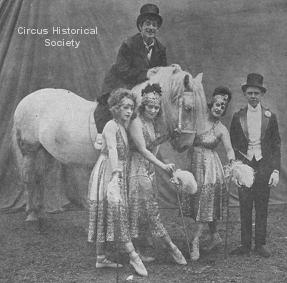
The Riding Davenport Troupe was a feature of the Hagenbeck-Wallace show in 1923. Shown here are Orrin on the horse in clown makeup, and left to right, Bess Costello, Lou Davenport, Victoria Davenport and Orrin, Jr. Burt Wilson Collection.
18. Five perch acts made up this display. Performers were the Two Solts, Gene and Mary Enos, and three Japanese couples.
19. The last feature was the racing event in which there were: the three-horse tandem; a ladies flat race (Mary Sutton, Lena Faulk, Ethel McCracken, and Lottie Shaw); a boy's flat race; a liberty race; and a three-horse Roman standing race by Ernest LeDoux, Vance Gill, and Walter Goodenough.
A Wild West Troupe of ten members presented the concert. They were: Johnny
and Ethel McCracken, Bill Davis, Al and Lena Faulk, Earl and Mary Sutton, Augie Mongez (probably Augie Gomez), Lottie Shaw, and Charles (Shorty) Flemm. Acts were trick riding, bronc riding, roping, pony express, and clowning.
Both of the side shows on this circus were under the management of Arthur Hoffman. The T. E. White Minstrel Show and its band furnished the music with the displays. Presented were: The Waldoras, fancy bag punchers; J. G. Tarver, the Texas Giant; Davis Duo, impalement act; Silvia Andrews, snakes; M'lle. DeArce, sword walking; Babette, novelty; Little Alright, Japanese Wonder Worker; Prince Laurie, sword swallower; Cleve Gill, cowgirl giantess; The Great Kelkman, fire eater; Tom Pace, skeleton; the Musical Seminoles; Viola, the California Fat Girl.
James McSorley directed the No. 2 side show which was entitled, "Chimpanzee Land." It featured two of these apes.
Clowns on the big show were the Three Harddig Bros., Kid Kennard, Billy Hart, Joe Coyle, Louie Plamondon, Dick Pinkney, Mickey McDonald, Chester Barnett, Walter Goodenough, Vance Gill, H. Smiletta, Shorty Flemm, Jimmy Dugger, Jimmy Thomas, Dan Ryan, Bartlett, Eugene, and Shepard.
The Executive Staff included Bert Bowers, General Manager; Louis Chase, Assistant Manager; Harry E. Sarig, Treasurer; Ralph Woodward, Auditor; Ed C. Knupp, General Agent; Al Hoffman. 24-hr, man; Ed Dellavin, front door; Spike Goodell, 24-hr, man; Bert Cole, announcer; Don Montgomery, Musical Director; George Conners, Equestrian Director; Charlie Brady, Properties; George Stump, Baggage Stock; Chas. Davis, Refreshment Stands; J. C. Donahue, Mgr. Advance Car No. 1; Jack Warren, General Press Agent; Wm. Kellogg, Legal adjuster; Wm. Curtis, Construction Superintendent; Ed Dowling, Inside Tickets; Bert Noyes, Superintendent of Animals; James M. Farris, Ass't. Ticket Superintendent; Spot Conners, Superintendent Ring Stock; Bill O'Day, Side Show Canvas; Wm. Baney, Dining Car.
The Hagenbeck-Wallace Circus began its first full week of the season with two stands in Cincinnati on April 30 (Cumminsville lot) and May 1 (Norwood lot). The rest of the week was spent in Ohio with stands at Dayton, Chillicothe, Portsmouth, and Ironton. The Al G. Barnes Circus, which was making a bold tour of the east this season, was spending the first of two weeks in Ohio during this same week. The John Robinson Circus also spent four days of this first week in May in Ohio. The routes of these three circuses are curiously intermeshed during the early weeks of the season. The importance of industry to the well-being of the circus is pointed out by the fact that in addition to the outfits mentioned, Sells-Floto spent all spring and most of the summer in the northeastern states, and Ringling-Barnum did not leave that area until the end of the first week of July. Competition was rough!
The Hagenbeck-Wallace Circus began its second week in Bluefield, West Virginia on May 7. Pulaski, Roanoke, Lynchburg, and Danville (all Virginia) followed with the Saturday date at Henderson, North Carolina. Snow flurries marked the day at Roanoke on the 9th, and those persons brave enough to go to the show grounds, dressed for it. Difficulties of another sort were encountered at Danville, where the owner of an amusement park who had an antagonism toward circuses, forced the management of the show to virtually build a new street to the circus lot. The irate owner, who was feuding with the Mayor, tried to prevent the circus from holding the parade also. He did not succeed but an elephant that became unhappy at the Lynchburg stand did. The bull held up the show for three hours and the parade at Danville was omitted because of the late arrival and the road building problem.
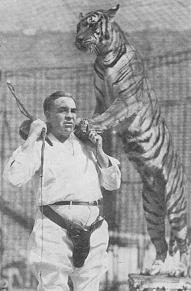
Robert B. McPherson presented one of the big wild animal acts with the Hagenbeck show in 1923. He is shown here in a photo taken in the middle 1920s. MacPherson died at the age of 66 in June 1946. Burt Wilson Collection,
The third week of the season included dates at Norfolk, Newport News, Richmond, Charloltesville. Staunton. and Covington. All week was spent in Virginia. Late arrivals caused postponement of the parades scheduled for Richmond, Newport News and Charlottesville. At Newport News, Robert McPherson was injured by a tiger at the afternoon show. He finished the act, was treated, and did not miss a performance.
The fourth week opened on May 21 and the Hagenbeck-Wallace Circus was set for a series of four West Virginia dates at Charleston, Huntington, Parkersburg, and Fairmont. The Walter L. Main Circus, the Sparks Circus, and the John Robinson Circus had already played Charleston before Hagenbeck-Wallace reached there on the 21st. The same three circuses had played Huntington before the Hagenbeck-Wallace date on Tuesday and Walter L. Main and Sparks had played Fairmont. The last two stands of this fourth week were made at Uniontown, Pa., and Cumberland, Md. Meanwhile, the Hagenbeck-Wallace, Al G. Barnes, and Ringling-Barnum advance crews were heavily billing the larger centers in the state of Michigan during this week. The Barnes show had opened its tour of Michigan on May 14 and was to be followed within a short time by the other two circuses.
During the fifth week Hagenbeck-Wallace moved into McKeesport, Pa.; Warren, Ashtabula, and Lorain, Ohio; and Monroe and Ann Arbor, Michigan.
The Hagenbeck-Wallace Circus opened Sunday in Hamtramck, Michigan, for a four-day stand in the Detroit area. The dates were Hamtramck, June 3, and Detroit on June 4, 5, 6. The Barnes show had made a two-day stand in Detroit on May 14-15, moving in from Toledo, Ohio, a Saturday date. The Ringling-Barnum Circus played Toledo on Saturday, May 31, and played Detroit on June 1 and 2, immediately before the Corporation show. The Hagenbeck-Wallace Circus moved on to Pontiac, Port Huron, and Flint (all Michigan) to conclude the week. Al G. Barnes played Pontiac and Port Huron on May 16 and 17 and Flint on the 21st. Both Pontiac and Flint were to be played by Ringling-Barnum early in July. The Hagenbeck-Wallace parade went out daily during these days and a great amount of advertising paper was displayed with the result that the attendance was exceptional according to a report in Billboard.
While Ringling-Barnum returned east to engage in competition with Sells-Floto. the Hagenbeck-Wallace Circus continued to follow the general route of the Barnes show. The seventh week took the Bowers managed outfit into Bay City, Owasso, Ionia, Grand Rapids, and Benton Harbor, Michigan, and Michigan City, Indiana. Of these stands. Bay City and Grand Rapids had already been played by Barnes less than a month earlier.
The week of June opened in South Bend. Indiana, with Fort Wayne and Huntington in the same state the Tuesday and Wednesday dates. Danville, Decatur, and Springfield, Illinois, were played the last half of the week. Residents of South Bend had been staring at Ringling-Barnum "WAIT" paper since May 20 but both the Barnes and Hagenbeck-Wallace outfits had come and gone before the Big One arrived on July 13. Original plans had called for the Hagenbeck-Wallace Circus to play Taylorville, Illinois, on June 22 but the date was changed to Decatur. The fact that Cheney lot in Taylorville was to be occupied by the Nat Reiss Shows on the same date, with only a barbed wire fence between it and the circus, may have caused the latter to change its location. This circus was the last outdoor attraction that had exhibited in this town and that event had occurred in 1921. In Decatur, after a late arrival, the temperature rose to nearly 100 degrees but the citizens turned out to visit the show. The local "experts" maintained that this was the first circus parade that had been on time for many a year, and complained that this was the first circus that they had ever seen without a pony. However, they seemed satisfied with the program that was presented. George Trueblood was badly injured while riding in the hunting scene during the performance at Springfield. During this act, a hurdle was knocked over and "Shorty" Whitcomb, an usher, attempted to replace it. He and Trueblood's horse reached the hurdle at the same time. The horse went down and the rider was thrown under the hoofs of the horses which were approaching. Trueblood suffered a broken wrist and a crushed foot and Whitcomb received a broken kneecap and several severe bruises.
The ninth week opened with the last Illinois stand at Peoria, June 25. The long jump to Davenport, Iowa for the Tuesday date resulted in a change to more favorable weather (the Illinois stands were hot) and another missed parade because of the late arrival. Iowa City, Cedar Rapids, Waterloo and Marshalltown (all Iowa) concluded the week. With this move to the west the Hagenbeck-Wallace Circus removed itself from the competition in which it had been heavily engaged since the season opened.
On the firsi of July the Ringling-Barnum Circus was in Connecticut and the Al G. Barnes Circus was in Pennsylvania. The Walter L. Main Circus had moved to Wisconsin and the Sparks show was in Maine. The other two circuses of the American Circus Corporation were also in the east. Sells-Floto remained in Massachusetts where it had been opposing Ringling-Barnum and the John Robinson Circus was in New York State. A great contest between these two and the Barnes show was brewing.
The tenth week began at Des Moines, Iowa, with Boone, Sac City, and Sioux City comprising the stands through Thursday. The Friday date was Sioux Falls, South Dakota, and on Saturday the show returned to Iowa to play Cherokee. With the advent of the western tour, news from this circus was scantily reported. It was pursuing its solitary route through the west with no opposition. The Ringling-Barnum tour later in the season would duplicate part of the Hagenbeck-Wallace route but the Big One didn't leave Minnesota on its western route through Canada until August 3. The Al G. Barnes Circus left Kansas on its way to California by way of the southwest at the end of August. Thus, for nearly two months, the Hagenbeck-Wallace Circus had this territory to itself.
On July 9, Hagenbeck-Wallace opened in Omaha, Nebraska, to big business. Thousands lined the streets to watch the parade, and this first circus of the season pulled large crowds to both performances. Shenandoah, Nebraska, was the Tuesday date, and then the show moved back to Iowa to play Creston, Ottumwa, and Centerville. Trenton, Missouri, was the Saturday stand.
The following Monday (July 16), this circus began a series of Kansas and Oklahoma dates. Topeka, Lawrence, and Iola were the first three towns played in week number twelve, with Bartlesville, Tulsa, and Pawhuska in Oklahoma concluding the six days. Over Sunday the show moved to Wichita, Kansas. Great Bend and Dodge City followed on Tuesday and Wednesday. Thursday was an afternoon performance only at Garden City and the show concluded its dates in Kansas for the month of August. It would return later in the season. Pueblo and Colorado Springs, Colorado, finished the week. The omission of the night performance at Garden City, Kansas, was only a prelude to several matinee only stands made necessary by the long hauls involved in western travel.
The fourteenth week commenced with a two-day stand at Denver, Colorado. Boulder and Greeley were the Wednesday and Thursday dates and then the Hagenbeck-Wallace Circus moved to Laramie, Wyoming, for an afternoon performance. Rock Springs was given two shows on Saturday since the rural folk could make it into town and Evanston, Wyoming, was another matinee only stand on Sunday.
The next week opened with stands in Salt Lake City, Ogden, and Logan, Utah. Then the show moved into Idaho for three dates at Pocatello, Twin Falls, and Idaho Falls. Hagenbeck-Wallace went to Dillon, Montana, for another single Sunday performance on August 12. This date was followed by a full week tour of Montana. The stands were Anaconda, Helena, Bozeman, Livingston, Red Lodge and Billings. According to one of the rare reports in Billboard, this circus played to 11,716 paid admissions for the two performances in Anaconda. On the 15th of August, when the Hagenbeck-Wallace Circus was in Bozeman, the Ringling Bros, and Barnum & Bailey Circus moved out of Canada into Great Falls, Montana. It played Butte and Missoula before continuing its tour to the west coast. After its San Bernadino, California, stand on September 18 it returned to Utah and played Salt Lake City and Ogden, two dates which Hagenbeck-Wallace had played on August 6 and 7.
A study of the routes would indicate that this Corporation show was sent west, not to challenge to Ringling-Barnum organization in an all-out fight as Sells-Floto had done in 1922, but to pick up the money in the Rocky Mountain States before the Ringling show could arrive in that region. In fact, the Hagenbeck-Wallace circus had played six of the nine cities visited by the Ringling circus after it left San Bernadino. The route also indicates that the Hagenbeck-Wallace show hastened into position to block the Barnes circus after the Big One had continued on to the Pacific slope from Montana. As Al G. and Tusko and company left Missouri at Butler on September 22, the Hagenbeck-Wallace outfit had swung a half-circle across the Great Plains States and was in Texas. Thus it was astride the route of the Barnes show as it returned to quarters in California. It also was on the Ringling route as that circus returned to the east. The tactics used by Mugivan, Bowers, and Ballard during these years are worth noting. They could afford a slugging match as Sells-Floto had done a year earlier, or they could use a more refined tactical maneuver as the one illustrated by the movement of Hagenbeck-Wallace in the late summer of 1923. It would be most interesting to know what prompted the choice of tactics in either of these situations, or in many others.
After the Billings stand the Hagenbeck-Wallace Circus carried its tour into the seventeenth week with a Monday date at Sheridan, Wyoming. There were no parades or performances on Tuesday as the show jumped to Scott's Bluff, Nebraska, for another single performance. On the 23rd the show was in Casper, Wyoming, and on Friday, it moved to Cheyenne, Wyoming for another single performance, this time at night. Fort Collins, Colorado, was the Saturday date and Sunday at Sterling in the same state was another matinee.
A week of Nebraska dates followed the rather hectic seventeenth week. North Platte, Kearney, Hastings, Grand Island, Columbus, and Norfolk made up the route for the six days. Norfolk was played on September 1 and at this time Ringling was in San Francisco and Al G. Barnes was entertaining the people of Ashland, Ohio. In consequence, the Hagenbeck-Wallace show had plenty of time to pick up all the larger towns in the region before moving into Texas.
During the week beginning September 3, the circus was in Council Bluffs, Iowa; Hiawatha, Kansas; St. Joseph, Missouri; Atchinson, Kansas; Olathe, Kansas; and Springfield, Missouri. All dates were played in the order listed and Olathe was another matinee only stand. The other five towns had two performances.
The move south began on Monday of the twentieth week at Fort Smith, Arkansas, McAlester, Durand, and Ardmore, Oklahoma, followed with Gainesville and Wichita Falls (both Texas) bringing the show into perfect position. Barnes arrived in Wichita Falls for its first Texas stand since spring on October 13. Hagenbeck-Wallace made that town on September 15.
The next week, September 17-22, this Corporation circus played Fort Worth, Dallas, Waco, Temple, Austin, and San Antonio. Although Barnes had made all but Temple in April, it avoided all of these towns in the fall. Ringling-Barnum, a much bigger outfit, had to make the largest cities so it was in Fort Worth, Dallas, Waco, Austin, and San Antonio during the second week in October.
On September 24, the Corporation outfit opened in Galveston, Texas. The rest of the week was occupied by playing dates in Houston, Beaumont, Port Arthur, and Orange, Texas. The Saturday stand was in Lake Charles, Louisiana. The Ringling show duplicated two of these dates (Houston and Beaumont) on October 15 and 16 and then moved on to Louisiana.
Franklin, Louisiana, was the Sunday date and October 1 (Monday) brought the Hagenbeck-Wallace show to Thebodeaux in the same state. During the next six days it played entirely in Louisiana. The cities were New Iberia, Crowley, Opelousas, Baton Rouge, and two days at New Orleans. Opelousas was a matinee only. The two-day stand in New Orleans (a Saturday and Sunday) was made in cold weather and business was only fair.
On Monday, October 8. this circus was in Gulfport, Mississippi. Mobile, Alabama, was the Tuesday stand. On Wednesday it played Pensacola, Florida, and Brewton, Alabama, was a matinee only date on Thursday. Friday's town was Selma, Alabama, where the City Council permitted the circus to oppose the Dallas County Fair which was underway during the week. The Saturday stand at Demopolis, Alabama, concluded the week.
The show opened week number twenty-five at Laurel, Mississippi. When it pulled into Hattiesburg the next day the show people learned that it had been raining all night. It was drizzling during the unloading and half the gear was on the lot when a severe wind storm, accompanied by more heavy rain, arrived and the decision was made to cancel the town. The local newspaper editor was irate the next day but many of the townsfolk understood the situation and were not overly critical. Brookhaven, Natchez, Vicksburg, and Greenville, Mississippi, concluded the week.
The twenty-sixth week began at Clarkesdale, Miss., and the rest of the
week was spent in that state with Greenwood, Yazoo City, Winona, Canton, and McComb making up the other five stands.
Four more dates in Mississippi — Jackson, Koscuisko, West Point, and Corinth — began the next week. A pouring rain began at noon in Koscuisko but the crowds turned out in spite of the downpour. The show made Jackson, Tennessee on Friday and was scheduled for Dyersburg, Tenn., on Saturday. This November 3 in Dyersburg, however, was not fit weather for any circus so this one didn't bother to unload. It headed for West Baden, Indiana, instead.
The 1923 edition of the Hagenbeck-Wallace Circus was on tour for twenty-seven weeks and one day. It had 169 actual show days, of which six were Sunday stands. It visited twenty-eight states and covered 13,994 miles. The 1923 tour was four days shorter than that of the 1922 season but one more show date was played. Approximately 700 more miles were covered in 1923 and several more states were included.
The personnel and trained animals of this circus were in quarters for only a matter of days before they left to open the winter season. The Hagenbeck-Wallace Indoor Circus, featuring almost the same line-up of acts as that of the tenting season, began the tour at the Coliseum in St. Louis, on November 12. Arthur Hoffman was assistant to Bert Bowers in this production with Frank Braden in charge of publicity and C. W. Finney handling promotion. Featured were the wild animal acts, trained by John Helliott, Bob McPherson, and Ola Darragh; the riding acts of the Davenport, Lowande, and Crandall Troupes; the Powell Troupe, wire-walkers; the Australian Woodchoppers; the Wild West group; the hunting scene; and clowns. A special feature was the display of the pigmy hippopotamus, "Jimmy."
The indoor version of the Hagenbeck-Wallace Circus was reportedly to play Milwaukee, Cleveland, Toronto, and other cities after the St. Louis stand. However, it played ten days in Cleveland and then moved to Toronto, Canada where the tour ended. It did not end soon enough for John Helliott who was attacked by a lion at the Tuesday afternoon performance on December 11. Helliott was engaged in fighting off one lion when another alighted on his back. After treatment, Helliott continued working the act for the rest of the Toronto stand.
Appreciation is given to Jim McRoberts for supplying the Havirland material which is invaluable for the details necessary to tell this story. Also, many thanks are extended to Fred Pfening and Joe Bradbury for illustrations. Gordon Borders, my great resource at Ihis corner of the country, was again very helpful with advice and loan of materials. The Billboard files were also searched for information.
Great Wallace Running Lion and Rhino Tableaus,
Richard E. Conover. Bandwagon, Vol. 10, No. 1 (Jan-Feb), 1966, pp. 12-14. Note: not all photographs accompanying this article are included.
During the last half of the 1890 decade, the Great Wallace Show obviously underwent a big expansion. This expansion also contributed to the hometown economy because Sullivan & Eagle, a firm in the Wallace winter quarters city of Peru, Ind., supplied at least 13 new parade wagons in this buildup. For the most part, these wagons were works of major proportions, distinctive for their line carvings in heavy relief, with four of the cages, in particular, having exceptionally massive corner posts. Besides these four, there were four other fine cages, including a hippopotamus den, a very fancy ticket wagon with clown-head carvings on its corners, a small parade chariot with carved eagles forward, and the two tableaus which are our subject.
It is convenient and proper to consider these two lableaus together, because certain common characteristics in the artistry of their carvings almost assure that the same woodcarver did both of them, and because, for a span of years, they had a parallel history. From a camera angle, the origin of the Rhino Tableau was almost left out of the picture; the only one so far discovered of it while it was actually with Great Wallace reveals just one end of it in the fringes of a faraway lot scene and, as such, it is good for documentary purposes only. On the other hand, we have three good pictures of the Running Lioness Tableau on Great Wallace, the earliest taken in Neenah, Wisc., when the show played there on May 31, 1898. This Neenah picture (Photo No. 1) is an important contribution to this note, because it is the only one that shows the rear end. Likewise, and for the same purpose, Photo No. 2 has been chosen because it best shows the front end.
Shortly after the Great Wallace and the Carl Hagenbeck Greater Shows were combined into Hagenbeck-Wallace in 1907, these two tableaus were sold to the Sells Floto Circus. We have good photographs (Nos. 3 and 4) of each of them with the Floto show, the one of the Rhino being, incidentally, the earliest satisfactory one of it.
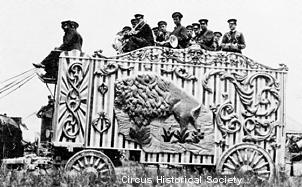
Photo No. 6 - The Sells Floto Buffalo Tableau. Author's Collection.
In 1915 the Running Lioness Tableau was rebuilt and part of its carvings transferred to the rebuilt version which was as shown in Photo No. 5. This same year, a Buffalo Tableau appeared on Sells Floto (Photo No. 6). The year for both these actions can be exactly determined because, on the one hand, the Buffalo Tableau was photographed in the wreck of the Floto show at Holden, Kan. on Sept. 14, 1915 while, on the other hand, these same buffalo carvings were being used to obscure an insignificant vehicle (Photo No. 7) in 1914. Even without knowing the latter, it took only a glance at any of the surviving photographs of it to convince even the least artistic of us that the Buffalo Tableau was a hybrid. This yarn began to unravel with the acquisition of the Neenah photograph a few years ago which revealed that the carvings in its vertical front panels were off either side of the rear doors of the Lioness Tableau, and the principal scrolls at the top rear, above the buffalo, came from the front end of the Lioness, while other portions off the rear doors are scattered around elsewhere. The very recent acquisition of the Terre Haute picture has prompted the completion of this note which should erase one more of those fictional scribblings that somehow get entered on the back of pictures. This one had the Buffalo Tableau built for Buffalo Bill Wild West in the 1890's, sojourned with Barnum & Bailey in 1908-09 which was followed by a period with the Two Bills Show before it landed on Sells Floto in 1914.
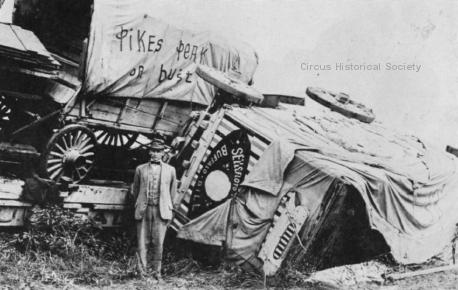
Photo No. 10 - Buffalo Tableau in Sells Floto wreck of September 14, 1915. Author's Collection.
While it is certain that both the Running Lioness and the Buffalo Tableaus stayed with Sells Floto until they were junked, the whereabouts of the Rhino Tableau from the time that it disappeared from Sells Floto until it reappeared on the Al G. Barnes Circus in the 1920's, is filled with conjecture. Joe Bradbury, in his article on the "Al G. Barnes Circus. Season of 1924" (White Tops, Nov.-Dec. 1963), has this to say on page 5, column 3: "By some unknown route, it got to Tom Wiederman, who used it on his Barton & Bailey Circus out of the Hall Farm in 1915. In 1916 and 1917 the wagon was on the Coop & Lent Railroad Circus, which was purchased by the Horne Zoological Garden Co. after that show went broke in mid-season 1917. Barnes added the Rhino wagon from Horne while his show was playing Kansas City in 1920." In some recent correspondence with Bradbury it turns out that he and the late Bill Woodcock agreed that the Rhino Tableau was on Barton & Bailey in 1915 and based their conclusion solely on a photograph, which could have been taken anywhere and anytime, on which someone had written "Barton & Bailey." Since there is no way of correlating this picture with any others that are presently available, it is best not to accept this lone picture as conclusive evidence.
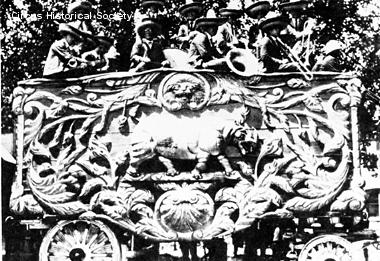
Photo No. 8 - The Rhino Tableau on Al. G. Barnes in the 1920s. From the Walker Morris Collection.
If it was on Barton & Bailey, it is probable that it was already at the Hall Farm before that short-lived show was framed there in 1915; and, whether the foregoing is true or not, it is quite reasonable for it to have been on the Coop & Lent Railroad Circus of 1916-17, because some of the equipment from that one which was not put on truck chassis for the 1918 motorized edition of Coop & Lent ended up in the possession of Horne. It is generally agreed that Barnes acquired the Rhino Tableau from Horne; in fact, one of the better pictures (Photo No. 8) that we have of it was made while it was with Barnes. The final accounting for its missing years should, however, be withheld pending the finding of more Barton & Bailey, Coop & Lent, or other photographs.
The Rhino was the last to be junked of the group that Sullivan & Eagle built for Great Wallace. This occurred in 1952 after it had sat around for over 20 years on a lot in Los Angeles that specialized in renting circus props to movie studios. If this one was ever used for that purpose, it evidently ended up on the cutting room floor.
Besides the photo credits given under the pictures, both Ricky Pfening and Joe Bradbury contributed to this article. Researcher note: it is not true that "it evidently ended up on the cutting room floor." See "O'Shaughnessy's Boy," 1935 film starring Wallace Berry and Jackie Cooper.
History of the Cole Bros., Part V, The 1936 Season
Joseph T. Bradbury. Bandwagon, Vol. 10, No. 1 (Jan-Feb), 1966, pp. 15-25. Note: not all photographs accompanying this article are included.
The show began the 1936 season with a 23 day engagement at the Chicago Stadium giving two performances daily from April 11 through May 3 inclusively. As mentioned in the previous installment the show did not parade in Chicago and did not carry the sideshow nor the full menagerie to the Windy City. Only the working animals made the trip. Another strong program was featured to inaugurate the circus' second season and the April 18, 1936 Billboard carried the full review as follows:
"IMPROVED SHOW REVEALED AT COLE-BEATTY'S OPENING." Chicago Stadium engagement starts light, believed due to holiday, although pickup is noted at night — Clyde Beatty's animal act is again the big feature.
"CHICAGO. April 11. — Jess Adkins and Zack Terrell promised that the show which the Cole Bros.-Clyde Beatty Circus had assembled for the opening of the season at the Chicago Stadium would be a real one, and they kept their promise. The show opened this afternoon favored by grand spring weather. The performance was smooth and fast moving thruout and there was an imposing array of meritorious attractions. Afternoon house was light, due undoubtedly to the fact that it was the day before Easter. A light rain started to fall late in the afternoon but there was a very fair evening house.
"This year's pageant, 'The Serenade of Spain,' is a colorful extravaganza of music and dance, beautifully costumed and pleasingly presented. Alice Sohn and Julia Rogers are the prima donnas whose excellent voices came over the public address system clearly. The pageant was staged by Rex de Rosselli. Music was arranged by Victor Robbins whose band furnishes excellent music for the show, and Betty Jones directs the dancers. Wardrobe was designed by Mrs. H. J. McFarlan, and electrical effects are by Louis Scott.
"H. J. McFarlan, equestrian director, handled the job well. Ray Dean, young announcer, has an excellent voice and splendid delivery.
"William Soaper Sneed, well-known Circus Fan and friend of Jess Adkins and Zack Terrell, had the honor of blowing the whistle for the start of the engagement and he made an imposing figure as he stood on the track and gave the signal for the grand entry. Victor Robbins' Band headed the pageant, and there followed the usual kaleidoscopic array of picturesquely costumed men and women and gayly caparisoned animals.
"Clyde Beatty's group of lions and tigers is the outstanding attraction of the show. There is no spectacular riding act, but it is expected a feature act will arrive before the close of the engagement here. Show as a whole is considerably better than last year's.
THE PROGRAM
"Inaugural pageant, 'The Serenade of Spain.'
No. 2 — Comedy acrobatic acts; Ring 1, the Otto Trio; Ring 2, Harddig Troupe; Ring 3, Le Forneau Company; Stage 1, Adolphus Trio; Stage 2, Three Comiqumicos. Clowns on tracks.
No. 3 — In center ring Harriet Beatty's animal act, a lion and tiger riding an elephant. This is a new feature and was well handled. In Rings 1 and 3, performing ponies, worked by John Smith and John Joyce. On Stages 1 and 2, trained dogs, worked by Veg Powers and Mae Curtis.
No. 4 — Lady principal act. Ring 1, Ernestine Clark; Ring 3, Elizabeth Hanneford in graceful equestrian feats.
No. 5 — Cliff Thompson, giant, and Jumbo the Second, African elephant in track walkaround.
No. 6 — Four troupes of seals, worked by Jack Joyce, Albert Mann, A. Fleet and Walter Raddle.
No. 7 — Aerial tournament. Ira and J. Millette, balancing feats on trapeze; Mlle. Esma Wilson, graceful muscle grind; Albert Powell, contortionistic equilibrist; Gene Evans, aerial novelty; iron-jaw numbers that included the Edwards Sisters and Misses Denham, Lucky, Eliott, Barnett, Barnett, O'Dell, Sullivan, Cooke, Cutshall, Lindsay, Daisy, Goodenough and Sharon; ladder gymnastics by a score of graceful girls.
No. 8 — Clyde Beatty's group of lions and tigers. A thrilling exhibition handled with consummate skill and showmanship by Beatty. Featured the rollover tiger and the rearing lion, first to be seen with any circus and a distinct novelty.
No. 9 — Wild West exhibition by a troup that included Jimmy Foster, Edward Hornett, Earl Doering, Mabel Hornett, Albert Jones, Estelle Jones, Mary Doering, Cristine Elder, Louise Mann, Cecil Tatum, Frank Gilbraith, Al Stevens, Estelle Tatum, Sultan Shakmanoff, Prince Orskioffski, Ralph Clark and Alice Foster. Climaxed by Ted Elder jumping two horses over a flaming automobile.
No. 10 — Center ring. Prof. Dennie Curtis and his taximeter mule, an act that is always surefire for laughs. Ring 1, Wells Brothers, horizontal bars; Ring 3, Le Roy Brothers, horizontal bars; Stages 1 and 2, Smiley Daly and Raymond and Marcus, comedy equilibrists on the swaying tables.
No. 11 — Mlle. Cyse O'Dell, petite aerial gymnast, in graceful one-arm planges.
No. 12 — Performing elephants. Four in Ring 1. worked by Wanda Wentz; eight in center ring worked by Jean Fisher; five in Ring 3, worked by Betty Stevens. Finishing with long mount on the track.
No. 13 — Bareback riding. In center ring the Lulu Davenport troupe; Ring 1, the Clarks; Ring 3, Elizabeth Hanneford.
No. 14 — High pole act. Florescue, climaxing with head stand on the swaying pole.
No. 15 — The Eugene troupes of aerial bar acts, the old aerial comedy standbys.
No. 16 — Clown number. Clown band led by Otto Griebling.
No. 17 — Wire act. Harold Barnes, the young man who made his debut in fast company on the Cole show last season. A graceful and clever performer whose act is a real feature. He has improved in many ways since last year and is destined to become a real star of the silver thread.
No. 18 — Liberty act. Three groups of eight horses each put through their paces by Trainers John Smith, Jack Joyce and James Foster. A pleasing equine display.
No. 19 — Walkaround by Chester Barnett and his dog Trixie, who walked
around the entire arena on his hind legs.
No. 20 — The Great Gretonas. Without a doubt one of the greatest highwire acts in existence. Their exploits high above the heads of the audience gave them some thrilling moments during their performance. The head stands on the wire, the bicycle work and other tricks were all marvelously done, but the last stunt was a supreme feat of balancing that brought cheers.
No. 21 — A combination of athletic and gymnastic exhibitions. In center ring, the Six Belfords with a swell Risley offering featuring the kicking of three men off to a somersault. Ring 1 had the Dobs Comrades in teeterboard and other equilibristic feats; Stage No. 1 held the Reynolds troupe of seven girls in fast and skillful roller-skate work; Stage 2 had Nellie Donavon's troupe of roller-skating girls, and Ring 3 the Nine Desert Arabs did the usual line of Arabian acrobatics and formations.
No. 22 — Menage. On the hippodrome track and in the three rings an array of well-trained high-school horses did a variety of interesting things that showed evidence of patient and careful training.
No. 23 — Clown walkaround with many new, grotesque and clever getups.
No. 24 — Aerialists. Over Ring 1, the Imperial Illingtons, three people, and over Ring 3, the Flying Harolds, also three people, both groups displaying daring accomplishments on the flying trapeze. Over center ring the Peerless Potters with some great tricks, turns and somersaults on the aerial bars.
No. 25 — Series of novelty races including a jockey race, Shetland ponies and monkey riders, riderless horse against a jockey and Roman standing races."
The April 25, 1936 Billboard carried a story with further comments on the Cole program and stand in Chicago and also listed the full 1936 staff as follows:
"COLE ATTENDANCE BUILDING STEADILY." Chicago, April 18 — Attendance at the Cole Bros.-Clyde Beatty Circus is steadily building and indications are that the second week will be a big one. The show, which ran extremely
long at the start, has been cut to a little under two hours and a half and is due for further trimming. Some further changes in the general routine also have helped to improve the show, which is running in splendid form.
"A clown stunt that has been added since the opening and is getting a tremendous reception is Otto Griebling's auto number. Otto speeds around the hippodrome track in a big new auto, stops opposite the center stage and steps from the car. Looks around in apparent bewilderment, then opens the car door, and from what appeared to be the empty car there emerge 15 clowns in quick succession, Emmett Kelly, in tramp attire, being the last out. Cleverly built up and gets a tremendous hand.
"Another extremely clever stunt that goes over as big as anything else in the show is Chester Barnett's dog walk-around. As Barnett marches around the track beating a drum a little terrier walks on his hind legs alongside of Barnett, completely circling the track without once stopping. It's a stunt that must be seen to be appreciated.
"Outstanding aerial act is the Flying Potters, trained by the veteran Harry Potter.
"The Great Gretonas, high-wire act, present a performance that is replete with thrills and gets a great hand. Earl Reynolds' two roller-skating acts also come in for plenty of applause. They are fast and spectacular. Jack Joyce is to be highly complimented on his magnificent Liberty horse act. Eddie Allen has done a thorough job of training the various elephant groups. The group of eight in the center ring, worked by Eddie and his wife, is outstanding.
"Several of the acts working in the stadium will not go on tour with the show. Among those in only for the building are the Earl Reynolds skaters, the Eugene troupes, Florescue and the Peerless Potters.
THE STAFF
"A few additions are yet to be made to the show's staff, but as it stands now the management gives out the following list:
"Jess Adkins and Zack Terrell, owners and managers; Jake Newman, general agent; William J. Lester, contracting agent; Fred C. Kilgore. contracting agent; William Backell, manager Car No. 1; Clyde Willard, manager Car No. 2; Mike Lyons, manager brigade: Don Hanna, checker-up; Floyd King, general press representative; Robert E. Hickey and Ora Parks, story men; Rex de Rosselli, radio; Earl Sisson, contracting press; J. L. Murden, national advertising; Jack Mills, banners back with the show; Earl Lindsay, treasurer; Harry Harreld, secretary; Al Hoffman and John Corey, 24 hour men; Noyells Burkhart, supt. front door; George Cutshall, supt. inside tickets; Arnold Maley, white wagon; Harold Smith, downtown tickets; Robert
Courtney, Sidney Ayles, E. W. Adams, Mike Mahoney, Charles Vale, inside tickets; Nick Carter, head porter; Charles Young, boss canvasman; Henry Brown, boss hostler; Al Dean, steward; John James Washburn, side-show canvas; M. F. Campbell, boss ring stock; Fred C. Seymore, lot supt.; E. F. Partello, legal adjuster; Fritzie Partello, physician; Mrs. H. J. McFarlan, wardrobe; H. J. McFarlan, equestrian director; Ray Dean, announcer big show.
"Side show: Lou C. Delmore, manager; Jack Ryan, announcer; Jack Fraser, Arthur Dupius and Frank Loving, tickets; Judge A. B. Palmer, front door.
"Ted Elder is a sensation with his stunt of jumping two horses over a burning auto.
"A party of some 60 Kiwanians from Rochester, Ind. visited the show in a body Thursday afternoon and were royally entertained by Messrs. Adkins and Terrell."
Throughout the Chicago engagement each issue of the Billboard kept the circus world informed on how the Cole show was faring. The May 2 issue stated that business which no doubt started very slow was continuing to build each week and that of late there had been light matinees but fair night houses. Also mentioned for the first time was that the show was using a spectacular burst of fireworks for the spec finale indicating that a lot of production went into The Serenade of Spain which Rex de Rosselli had directed. Unfortunately Clyde Beatty had lost a tiger to pneumonia and also a menage horse and a seal had died during the Chicago stand.
Before the show left Chicago it was announced that night houses had recently been very good and that the show would leave the Windy City with some money. No figures were given on how the 1936 engagement compared with that of the previous year but it is believed both years produced about the same amount of business.
As the Chicago stand came to a close it was announced that Floyd King, the general press representative, had been appointed general agent, the job he had held the previous year, and that the present general agent, J. D. Newman, would become traffic manager handling the routing and railroad contracts.
The first canvas stand was at the quarters town of Rochester, Ind. on May 4 and the tents were up and all was in readiness when the train came in from Chicago. The first parade of the season was given and an estimated crowd of 7,000 watched the colorful downtown march. Both performances at Rochester drew capacity houses. The performance was cut somewhat for the canvas tour but at Rochester it still ran 2 hours and 45 minutes which was far too long and it would continue to be trimmed somewhat. The opening spec, Serenade of Spain, was eliminated in favor of a simplified opening walkaround. It was announced by the show that a few of the Chicago acts that would not make the canvas tour had been signed for the performance to be given at Indianapolis. The concert now featured the No. 5 unit of Major Bowes' amatures, which was a great radio favorite in those days. This rather novel concert attraction didn't work out and was shortly eliminated in favor of the traditional wild west after-show and a wrestling match.
The show had gotten off to a wonderful start for the canvas tour which was in marked contrast to the nightmare opening day the year before. The second stand, South Bend, also came through with excellent business.
Gordon Potter was on hand at South Bend and made notes of the complete parade lineup as given that day. His notes are printed here intact just as he made them at South Bend, Ind. May 5, 1936.
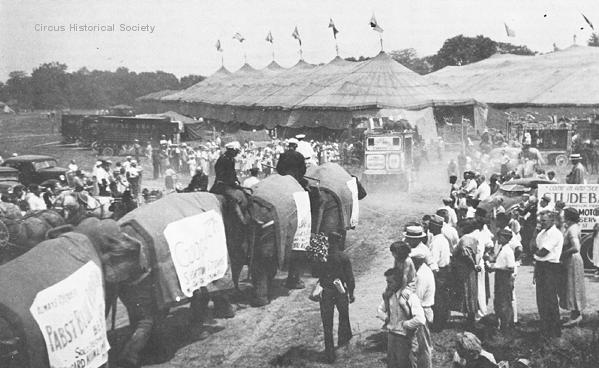
Photo No. 10 - Cole Bros. Parade returning to the back lot.
1936 Cole Bros. Circus Parade lineup.
6 Riders (on horses)
8 Horses pulling the Lion and Mirror Bandwagon
4 Horses pulling No. 19 Cage, 4 lions
4 Horses pulling No. 26 Cage, 3 lions
4 Horses pulling No. 22 Cage, 3 lions
6 Ponies pulling Cinderella float
4 Horses pulling No. 27 Cage, 3 lions
4 Riders (on horses)
4 Horses pulling No. 23 Cage, 3 lions
2 Riders (on horses)
4 Horses pulling No. 21 Cage, 4 lions
6 Horses pulling No. 25 Cage, 2 lions
5 Riders (on horses)
4 Horses pulling No. 24 Cage, 3 tigers
4 Horses pulling No. 17 Cage, 3 tigers, 1 lion
4 Horses pulling No. 16 Cage, 3 tigers
6 Horses pulling No. 70, Palm Tree Tableau (clown band)
8 Horses pulling No. 62, Columbia Tableau (No. 2 band)
6 Ponies pulling Old Woman in Shoe float
5 Riders (on horses)
6 Horses pulling No. 71, Asia Tableau (sideshow band)
6 Riders (on horses)
4 Horses pulling No. 18 Cage, 2 tigers
2 Horses pulling Buggy
6 Horses pulling No. 72, America Tableau
4 Ponies pulling No. 14 Cage, monkeys
12 Riders Wild West (on horses)
6 Ponies pulling Mother Goose float
6 Donkeys pulling No. 12 Cage, monkeys
1 Donkey pulling Buggy
2 Zebras
4 Camels
18 Elephants
6 Horses pulling No. 66, Steam Calliope (End of parade)
1936 Parade Totals
9 Tableau Wagons
13 Cage Wagons
2 Buggies
40 Riding horses
86 Baggage horses (two 8's; five 6's; ten 4's)
22 Ponies (three 6's; one 4)
6 Donkeys (pulling cage)
1 Donkey on light piece
2 Horses on light piece.
Potter also made note that two elephants didn't make parade. These were Safari (Jumbo II) the African and one working bull, probably Bama. Also not in the parade lineup was the new seal den, No. 20 and Cage No. 28, the former seal den but which was now made ready to receive the hippopotamus due to arrive later in the day from Chicago. In subsequent parades the hippo den was almost always present either being pulled by a six-horse hitch or a Mack truck. The seal den, No. 20, although oftentimes remained on the lot, did make some parades as photos will indicate. The air calliope, No. 79, did not parade that day but usually did.
The new hippo arrived on the South Bend lot around noon by truck from the Brookfield Zoo in Chicago. She had been purchased by the show during the Chicago engagement but since the cage had not been carried to Chicago the delivery of the animal was delayed until the show was at South Bend which was somewhat closer than Rochester. There is some confusion as to source and name of the hippo. Member Richard J. Reynolds III, noted hippo and rhino historian and authority on circus menagerie animals in general has done considerable research on this matter. He is convinced that the hippo was Pinkey, an 8 year old animal, who had been born of Alice, sired by the huge male, Victor, on the Hagenbeck-Wallace Circus in 1928. This information comes directly from the Washington, D.C. Zoo's records and it will be learned later that this hippo was traded to the Washington Zoo by Cole Bros. in early 1939 for a pygmy hippo so the Zoo does have accurate and official records on this animal. The confusion comes from a story in the May 9, 1936 Billboard which stated that Cole Bros. had purchased "Chunky," an 8 year old hippopotamus from the Brookfield Zoo. Chunky was definitely the name of a hippo at Brook-field at one time. Unfortunately the present day Brookfield records cannot clarify the apparent error of the Billboard story in the name of the hippo going to Cole, nor can the detailed time and route of the hippo, Pinkey, from the Ringling owned Peru quarters to Brookfield be determined. What we can be reasonably sure of is that the hippo which arrived on the Cole show in South Bend was Pinkey, formerly on the Hagenbeck-Wallace Circus. She was a big one by time Cole got her and greatly added to the depth and variety of the menagerie and parade.
Gordon Potter has recently sent added information which gives a very clear picture of the canvas layout of the show in 1936. He writes that the big top was a full 160 ft. round top with three 60 ft. middle pieces. Each round end had 27 side pole spaces (3 sections with 9 pole spaces in each). The menagerie tent was an 80 ft. round top with one row of quarter poles and had five 40 ft. middles. The Marquee was about 30 ft. x 30 ft. The sideshow was a 60 ft. round top with three 30 ft. middles, one row of quarter poles, bale ring type. It had a standard banner line with 17 poles. The pad room was about a 55 ft. round top, bale ring type, one row of quarter poles. It had four 28 ft. middles with 4 pole spaces in each. (Special Note — They look like 40 ft. middles but for horse tops they use 3 strips of canvas between side poles (on the middle piece but not on the round ends) instead of 4 strips of canvas between side poles as they do on all the other tops. Then the quarter poles are 14 ft. apart and one canvas trough 14 ft. long to go between two quarter poles accommodates 4 horses on each side of it.) The Dining tent was about a 60 ft. by 180 ft. hip roof, 5 push poles, with four 30 ft. middle pieces. The show had two baggage stock tents: 34 ft. by 84 ft. gable end tops, with 7 push poles. Each tent would accommodate 48 head of stock. (Special note — these tops also had 3 strips of canvas between side poles, making them 7 ft. apart. So there were six 14 ft. troughs down the center with 8 horses to each trough, or 48 head total for the top. They could accommodate 96 head in the two tops, or just 3 cars of stock.
As was the custom in describing the day by day events, business done at various stands, weather conditions etc. of the 1935 season the same will be done in this narrative of the 1936 season. It must be pointed out that the Billboard reports of the show's business done at various stands were sometimes accurate while at other times not too accurate. Most of the time these reports came from the show itself. These reports are printed to give additional interest to this article and to let the reader see the news of the show's activities and business that were appearing in the trade publications at that time.
The 1936 season was highly successful for the show. It started off rather slow at the Chicago stand but gradually increased at the end of the stand. Early canvas business was good but later dropped off and for a few weeks in mid summer it was very weak. The tide turned at Denver August 3-4 and from then on business was wonderful and the show for the first time began making some real money. The details of this upsurge will be dealt with later.
The third stand at Kokomo saw a large crowd on hand for the parade and the matinee produced a packed house with capacity at night. Cole played entirely in the State of Indiana during the first week which came to an end with a two day stand at Indianapolis on Saturday and Sunday. The show began a policy of playing Sunday stands and this was generally the rule most of the season. A glance at the season's route sheet shows that there were only 11 off Sundays during the entire season.
Sideshow business started off fine, much better than in 1935. Features of the sideshow included Cliff Thompson, giant; Major Mite, midget; Jolly Mazie, fat girl; Anderson Sisters, spotted girls; Forest Layman, armless wonder; Gertrude Redden, impalement; Anna Loving, snakes; Esther Fraser, mystery illusion; Al Linton, sword swallower; Lemore, man with iron tongue; Madame Allicia, mentalist; Duke Kamukua and company, Hawaiians; Bill Hines and company, Scotch bagpipers, and P. G. Lowery and his Georgia Minstrels and Band. The Broadway Vanities was a special feature of the sideshow and this musical review was headed hy Reinee Ramcy. Leona Theodora, Jean Harrow, and Irene Spencer with music furnished by Bobby Gregory and his Radio Syncopators.
The second week under canvas found the show playing more Indiana and a few Kentucky stands. The week closed with the show at Covington, Ky, which produced a half house in the afternoon and near capacity at night on Friday and then it moved across the river to Cincinnati for a two day stand on Saturday and Sunday. Both Sunday performances in Cincy, the first Sunday date for a show there in many years, had almost capacity and the concert crowd for the matinee was the biggest so far for the season. Prof. Agnew, who again had his Petrified Man Exhibit on the midway, did big business.
Cole's early season business under canvas was strong and was on a par with the good take of the year before. Other shows were also claiming good business during the early weeks. Al G. Barnes on the West Coast boasted of good attendance and Barnett Bros., a motorized show owned by Ray W. Rogers said 1936 business was up 20 to 25 percent over the preceding year.
The June 6 Billboard commented on the Cole season which, including the Chicago indoor stand, was now in its seventh week. It said the show was doing good business and that the weather for the canvas tour had been very good with only three rainy days so far. It was also evident that the little bugs that had caused so many late arrivals, parades, and performances a year ago had been eliminated and the show was now moving smoothly and with clock like precision. So far not an advertised parade had been missed and no parade had been over an hour late. The train, moving in one section on most runs, was moving on time and the show was experiencing no delays in the morning unloading, haul, and set up. Middletown, Ohio had a night straw house while Richmond, Ind. had the honor of producing the largest reserved seat sale for two performances in the history of the show. Dayton, Ohio business was termed by the show as magnificent and Zanesville, Ohio, despite poor local conditions, was a bang up day.
Cole Bros. was the first railroad show to go into the flood area in West Virginia and Wheeling came through with a big afternoon house and almost capacity at night.
Although it does not appear on the official route sheet the Billboard reported that the show did play Youngstown, Ohio on Sunday, May 24. There was a lot of agitation in the city pro and con for the circus appearing on a Sunday but the show did play the city as felt it would be a good date with the steel mills running at a good capacity and the show reported later that business done on the Sunday date was 33 percent better than a year ago. However, much trouble came by way of the elements and no doubt the natives opposed to the Sunday showing claimed Divine Providence was taking a hand. The show ran into a heavy rain and electrical storm which broke shortly after the matinee house was in. Rain blew into one side of the big top forcing patrons to move from the top rows. Rain falling on the hot light bulbs broke many of them and water poured in where the center poles pierce the top. The center ring was partly filled with water and a stream crossed the runway. Scores of autos were mired in the mud. The show which had played a lot outside of the city limits had difficulty in getting off after the night show although the rain held off in the evening.
Youngstown was followed by a two day stand in Pittsburgh. Butler and McKeesport, which were high spots in 1935 for Cole, again retained their standing while New Castle was way over the gross for 1935. The parade was cancelled in McKeesport which, along with Cincinnati, were the only week-day stands where the show had not paraded.
May 30, Decoration Day, found the show at Akron. Ernest Tucker, superintendent of concessions, reported a new high at this stand for a single day. The show had the best afternoon house so far in the season and night business was practically capacity. The next day, a Sunday stand, saw the show at Canton, Ohio and more good business. Canton city officials had cooperated with the show executives and aided in getting a new lot right at the edge of the city with good parking facilities. The next day at Sharon, Pa. Cole followed two carnivals in playing the town but that fact seemed to have had no effect on business done.
The June 13 Billboard reported that the after show concert was now clicking with Jimmy Foster's Wild West and Tiger Tigerson's wrestling match. The show's softball league was now in full swing with games nearly every afternoon between shows.
After a month into the canvas tour it was apparent that 1936 was proving to be different from the previous season in several respects. First, there was a definite lack of the fierce opposition from other shows encountered in 1935. This of course was due mainly to Hagenbeck-Wallace being off the road. With the large number of motorized shows on the road in 1936 naturally there was some competion with them. Barnett Bros. played Pennsylvania quite extensively and had been ahead of Cole in some stands. Rice Bros., owned by Ray Marsh Bryden, was in Indiana and Walter L. Main, another truck show, gave some opposition in Ohio but these smaller circuses really offered no real competition as had Hagenbeck-Wallace in 1935. Ringling-Barnum followed Cole about a month in a few stands such as Pittsburgh and Erie, Pa. but the time lag was usually sufficient to do little damage.
Another factor of the 1936 early season route was that Cole was playing a great number of repeat stands, many more than they would have ordinarily. This again was a result of Hagenbeck-Wallace not being on the road. Many of these towns were good railroad show stands and had been often visited by Hagenbeck-Wallace in recent years and now with Cole the only railer in sight, it was natural that the show would go in again in 1936 regardless of whether it was a repeat date. Cole had a top notch performance with big name performers and a great drawing power in its street parade and there was no instance on record where the 1936 take was slack at a stand purely because it was a repeat date.
The show played Pennsylvania stands at Sharon and Erie the first two days in June and then entered New York on June 3 at Niagara Falls for seven stands in the Empire State. The parade at Niagara Falls was called off due to rain and an eight mile parade route.
The Billboard reported that Binghamton, Elmira, Niagara Falls, Ithaca, and Williamsport, Pa. were all played in 1935 but this year these stands produced bigger attendance and a greater reserve seat sale. Show officials attributed the good take to the substantial reputation left by the show last season.
All of the personnel enjoyed the first Sunday off in some time at Binghamton. Much painting of props and equipment was done during the day. At Elmira three young lion cubs, which had been born earlier in the season, were placed on exhibition for the first time. A Shetland pony was born at Corning.
On June 11 the show headed back into Pennsylvania for nine stands before returning to Ohio. Although the management still claimed business was great in the East the Billboard reported that Cole had decided to eliminate some eastern cities due to unsettled business conditions and to turn around and head back into Ohio and Indiana. Despite the rather slow economic situation the show termed Altoona, Pa. as one of the biggest days of the season and said the show got splendid business at Harrisburg, Johnstown, Greenburg, and Uniontown. Two more lion cubs were born at Harrisburg.
At Altoona, Archie Majors, a negro drummer with the show, had both legs broken when he leaped from the top of a wagon during the parade. Near panic broke loose along the route when a cage wagon carrying three lions got out of control descending a hill. During the excitement Majors, riding the wagon in front of the cage, leaped from the top to the pavement and received his injuries. The lion cage was brought to a stop without further mishap.
The show had scheduled a Sunday stand June 21 at Alliance, Ohio but later cancelled it due to a controversy over the lot. Big business at Steubenville the next day was a result of the city having its first circus parade in years. Cole was the first rail show at Wooster, Ohio in almost ten years, the last railer being Sells-Floto. This stand was billed for 30 miles in the country. Although Cole was not having tough opposition from other circuses so far in 1936 a great amount of billing was still being put up and the boys were getting good daubs on the country routes as well as in the cities.
After four Ohio stands the show entered Indiana for four more and then headed west through Illinois. The July 11 Billboard stated that Cole had a good take in the Hoosier state. Cole was the first big railroad show to play Crawfordsville in six years and despite a day and date with the Happy Days Shows (carnival) the show had capacity business. At Hammond, another of the many repeat dates, many executives and performers from the Tom Mix Circus visited the show, driving over from nearby Chicago where Mix was playing. Cole claimed Marion and Ft. Wayne were good stands with the revenue at the latter city double that of 1935.
Dubuque, Iowa on July 6 was the first of five stands in the Hawkeye state. Hot weather had now hit and the continued heat wave would have a telling effect on business for the rest of the month.
Despite a scorching 107 degrees in mid afternoon the show had a big day in Des Moines on July 10. The local papers gave wonderful publicity, especially to the big parade feature that day. The show was on the fairgrounds lot and through an arrangement with the local Circus Fans of America Association Tent, the famous old Barnum and Bailey Two Hemispheres Bandwagon, which was owned by the local fans and kept at the fairgrounds, was used as the lead bandwagon in the parade being pulled by Cole's finest eight horse hitch. It was the first time this famous old bandwagon had been seen in a circus parade since 1930 when it was on Fred Buchanan's Robbins Bros. show. The parade route went through the heart of Des Moines and measured more than eight miles in length, the longest so far of the season.
After Des Moines the show played a stand at Trenton, Mo. and then went to Kansas City for what was hoped would be a great two day stand, July 13-14. Unfortunately the stand which officials had hoped would produce the largest two-day gross so far in the season was killed off by the terrific hot spell. It was two of the hottest days in history of the local weather bureau. The heat made it necessary to cancel the street parade. The first afternoon attendance was off but the night crowd was okay. The next day was only fair. The show's employees enjoyed the off day on Sunday and crowded the local hotels in an effort to escape the heat. Employees of the Baker-Lockwood Co.. numbering 275, attended the Tuesday night show in a body, and Messrs. Adkins and Terrell and company officials confered on details for the big top to be ordered for 1937.
Other shows were also complaining about the heat wave. Ringling-Barnum in Ohio was fussing at the hot weather but said that 1936 business was still running 11 percent ahead of last year. Walter L. Main, Seils-Sterling, and Downie Bros. reported good business and E. H. Jones' two car show, Cooper Bros., way up in the wilds of Western Canada, was having very good business or so they told the Billboard.
Cole Bros, had now begun to get a taste of some bitter opposition from other shows. The Cole and Ringling-Barnum advance crews clashed in Dubuque and Des Moines, which resulted in quite a bit of covering of each other's paper. Other opposition from Ringling-Barnum came later at Springfield, Mo., Oklahoma City, and Tulsa.
The show was at Oklahoma City for two days on July 19-20, the first day being on a Sunday. Cole was the first show ever to play the Oklahoma capital on a Sunday but no word was raised against it. It was played under auspices of Post 35 of the American Legion. After four days in Oklahoma the show went into Kansas for 10 stands. The hot weather continued and with it business took a dip. Because of the extreme heat it was necessary to eliminate parades at Ft. Scott, Joplin, Tulsa, Oklahoma City, and Enid. Henry Brown lost several baggage horses due to the excessive heat but was able to purchase some new stock as replacements.
At Topeka when the Notification Parade was held for Gov. Alf Landon, the Republican presidential candidate, the show loaned the elephant "Bama" to the Chamber of Commerce for the parade. An elaborate program to honor Gov. Landon, U. S. Senator Arthur Capper and other notables at the Monday night performance in Topeka was hastily cancelled when a violent electrical and wind storm with heavy rain hit the fairgrounds just as doors were to open at 7 p.m. The storm was the worst encountered by the show all season. All workmen, as well as performers and executives, rushed into action and prevented any damage to the show or equipment. The menagerie tent was lowered without a rip in the canvas but there were several tears of six or seven feet in the big top. The big top withstood the storm in wonderful fashion and most of the credit was due Charles Young, boss canvasman, and his assistants for battling the elements. No patrons were allowed in the menagerie or big top during the storm, however many sought refuge under buildings on the fairgrounds. After the storm passed the night show was given to a half house.
The generally slow business encountered by the show in recent weeks on its trip westward had a sobering effect on the management which had looked forward to a great season in 1936. The show was moving well with few if any problems, the only real problem being that of late the show was not drawing like it should. Of course the heat had a great deal to do with it but since the show was now entering a phase of the route where it was absolutely necessary that it draw well because it was planned to send the show up into new territory through the wide open spaces and mountains to the Pacific Northwest and then down the Pacific Coast to Southern California. These plans were to put the show into the old territory Zack Terrell knew so well during his long association with Sells-Foto, he of course going back to the days prior to 1923 when it still wintered in Denver and was generally regarded as a western show. Terrell desired to send the show into this territory fully believing it would draw well but also fully realizing that if it didn't the heavy nut caused by the long rail hauls necessary to get it there could be a killing blow to the new show.
Perhaps the most decisive stand ever played by the Cole show was the two days in Denver, August 3-4. which was marked as the beginning of the western tour. Arnold Maley, in the interview with him last year conducted by Bob Brisendine and the author, mentioned that Terrell had said that if the show didn't draw at Denver the show would close there for the season and return to quarters.
What happened at Denver, a milestone for the new show, made circus history. The August 15 Billboard stated that one of the biggest crowds in circus annals watched the street parade Monday morning. The crowd estimated at 100,000 turned out to see the first street parade in Denver since 1924. Business the first day was termed wonderful. The matinee produced a capacity crowd and the night house was literally a sellout. Tuesday was the banner day for total attendance so far in the season. The demand for reserve tickets had been so great that the advance sale opened downtown on Saturday before the show arrived on Sunday from La Junta. Throughout the stand Zack Terrell renewed old friendships he had made when he was manager of the old Sells-Floto Circus when it wintered in Denver.
The show then began its trip through Colorado, Utah, Montana, Idaho, Washington and hence to the Pacific. The long trek included two afternoon only stands at Salida, Colo, and Helper, Utah, made necessary by the extremely long runs. The show started making real money at Denver and continued to do so for the rest of the 1936 season. Grand Junction, Colo. gave capacity at both performances, and Salt Lake City saw two big houses, the night crowd being on the straw despite a bad rain and wind storm about 5:30 p.m.
What was it that caused this sudden upsurge in business for the show? The August 22 Billboard correctly attributed it to the street parade, commenting that circus enthusiasts in the area had not witnessed a circus parade in 10 or 12 years and as a result Cole was now establishing new records in the way of parade crowds. These crowds didn't then go back home but later paid their money at the wagon to witness the performance. Local newspaper critics in Pueblo, Grand Junction, Colorado Springs, Salt Lake City, Denver, and Ogden stated that more people came out daily to see the Cole parade than for any event in years. Police at Ogden said as many people turned out for the Cole parade as during the Pioneer Celebration two weeks ago. Ogden gave the show a big matinee and near capacity at night. It must be remembered that even though the street parade was also extremely popular in the midwestern and eastern cities Cole had played, still those towns were not as parade starved as were these western towns because Hagenbeck-Wallace had given a full season of parades in the area in 1934 and a few at selected stands in both 1933 and 1935 and likewise the last of the parading railroad circuses such as Sparks, Robbins Bros., and the King brothers railroad shows had mainly bypassed these western communities. But here in these western towns Cole was now playing most of the natives saw their last street parades prior to mid-season 1924 when Al G. Barnes quit parading or the following year which saw the last parades of the American Circus Corporation units. True, Christy Bros, played some stands in this area in the late twenties and Floyd King's Cole Bros. Circus in 1930 passed through, both shows giving parades, but for most communities the circus fans were parade starved and truly ate up the Cole parade.
Most of the runs now were long and hard but fortunately the show had been getting good service from the railroads and Cole officials highly praised the Union Pacific for such a fast run made to Pocatello, Idaho where the unloading took place adjacent to the lot.
Montana stands proved good. Butte saw its first parade in 12 years and Cole drew the largest crowds at the performance of any show there since 1929 according to the Billboard. Idaho Falls was originally scheduled for August 13 but the stand was cancelled later due to the American Legion convention and rodeo. Dillon, Mont. was substituted on short notice and came up with a fine matinee and good night house. The show continued to praise the Union Pacific for excellent runs and the Milwaukee Road moved the show 237 miles from Missoula, Mont. to Spokane in extra good time. It picked up the train late on Saturday night and had it in Spokane by 11 a.m. on Sunday.
The show was eight days in the State of Washington and Spokane started it off right with a big matinee and a tremendous straw house in the evening. Some new spec costumes were received at Spokane for use to freshen up the performance for the remainder of the season. Wenatchee and Everett came through with good days and Seattle produced four big houses despite a newspaper strike which affected publicity there. The parade left the Seattle lot right on time for an eight and one-half mile march. The show continued to get great publicity in the local press at most stands, most of it geared to the parade. Local papers estimated 75,000 witnessed the march at Tacoma which police say was the largest parade crowd there in history. Aberdeen played on Sunday, Aug. 23, gave excellent business on a small lot that made it necessary to leave out one center pole in the menagerie tent. It rained in Aberdeen on circus day for the first time in 40 days.
Near the end of August the Billboard commented on the season's circus business in general. Most shows were doing okay. Bud Hawkins Circus closed early in August but most of the others were making a full season. Tom Mix Circus had made a transcontinental tour from California to the Atlantic claiming good business on the way. Ringling-Barnum continued to say that 1936 was being kind to the show. But it was Cole Bros. which was doing the outstanding business at the present time and the Billboard was telling the circus world about it.
After Washington the show moved down through Oregon and into California where it would remain a little more than a month. Portland came through with the largest total two day gross so far despite an unpleasant shakedown on the part of the city officials. The September 12 Billboard reported that the Portland city fathers had turned and twisted in their attitude toward a parade and at first they refused a license until the press forced the issue. Then the city council called a meeting for Tuesday morning and while the parade was passing through the streets passed an ordnance calling for a $250.00 fee. The local press gave the city dads a real sacking for this.
The railroads which had been praised of late for their good service on the nightly runs came in for a panning on the run from Eugene to Klamath Falls. The train departed Eugene at 11:57 p.m. but didn't arrive until 10 a.m. at Klamath Falls. After an hour delay in switching it was 11:45 before a wagon reached the lot. This delay made it necessary to cancel the parade as the lot was beyond the city limits and the haul had been almost two miles.
The first stands in California saw hot days and cool nights as the show worked its way down the Coast. The first date at Weed proved to be a very fine Sunday stand with an afternoon only performance. The train was loaded and departed shortly after 7 p.m. for the next stand but due to heavy traffic on the Southern Pacific did not arrive until 8 a.m. the next morning.
A four day stand was played in San Francisco, Sept. 4-7. The parade in Frisco was 12 miles long. It left the lot at 8:30 a.m. and returned at noon. For a Labor Day parade the show loaned Vic Robbins and his band and two elephants. In San Franciso John Smith and Gladys Wykoff were injured when Miss Wykoff's horse failed to clear two horses over which she jumps. Miss Wykoff wasn't hurt badly but Smith had to go to the hospital for a possible broken jaw. The show had been remarkably free from accidents to performers all season long.
The show went on down through territory long claimed by Al G. Barnes and played each spring by that show. This past Spring saw the Barnes show and the Tom Mix Circus fighting it out for patronage up the California coast but the fact that many areas had two circuses in the Spring had no adverse effect on the business done by Cole.
Cole played a big five day stand at Los Angeles September 20-24 and was in the immediate area for several more days. The September 19 Billboard said the show's personnel were eagerly looking forward to the Los Angeles stand because after the long jumps through the Midwest to the Coast they would welcome the number of very short hauls to towns in the area. A great time was had during the stand in Los Angeles. Many visited the Warner Bros. movie studio and Hollywood stars made numerous visits to the show lot. S. L. Cronin, manager of the Al G. Barnes Circus, also visited while Cole was in Southern California. His show had closed its season September 28 at Phoenix and returned to winter quarters at Baldwin Park near L. A.
A rumor appeared in the October 17 Billboard that Ken Maynard, famous cowboy movie star who had been in conference with Adkins and Terrell when the show was in Los Angeles, indicating that Maynard would be with Cole Bros. in 1937. A week later the Billboard confirmed that Ken Maynard would definitely be with Cole Bros. in 1937. Maynard kept insisting all spring and early summer that his new wild west show and circus on rails would appear on the road later in 1936 but when it became obvious such would not occur he then said it would be out in 1937 for sure. Things however had not worked out right for Maynard and although he had accumulated a great deal of equipment and animals, his show never got on the road. A few weekend performances at his ranch in Van Nuys were given but that was it. The report that he was going with Cole in 1937 proved to be correct as we shall later see.
While in the Los Angeles area the show picked up a large number of solid
rubber tired carnival type wagon wheels. No one seemed to know just how many there were but various Cole people said they were loaded on the train in every available place. Some were in the stock cars, some on the flats, while others were loaded in wagons or anyplace where they could be put to transport them back with the train to Rochester. There must have been around a hundred of these wheels. It was these wheels which would later be put to use rolling the Cole wagons and by 1942 every wagon on the show would be using them. Gordon Potter well remembers these wheels stashed away all over the train when it came back to Rochester quarters at the conclusion of the 1936 season.
Also while in Southern California the show purchased an elephant, about 20 years old named Culver, from the San Diego Zoo. According to the Zoo's records they sold the elephant to the show on October 3, 1936 but she wasn't picked up no doubt until the show played San Diego on October 6. Chang Reynolds, noted circus and elephant historian, furnished the above information and also mentions that the Cole elephant, Boo. was at the San Diego Zoo in the Spring of 1937 and he speculates the show could have left Boo at the zoo while playing San Diego in 1936 or could have shipped her later after the season was over. Gordon Potter believes Boo did not go to San Diego until the completion of the 1936 season because while he was at Rochester quarters in November 1936 after the show had returned to the road he definitely counted a total of 29 elephants and noted at the time that the show must have picked up an additional elephant on the road. This total of 29 would include the 20 carried on the road in 1936 plus the eight that did not go out and plus one additional elephant added during the season. It may be recalled that the total number of the herd of 29 had been reduced to 28 following the execution of Major back in February. Potter is of the opinion Culver was purchased to replace Major to bring the herd back up to 29 and he feels sure Boo must not have gone to San Diego until after the close of the 1936 season. No information listing by name the 20 elephants carried in 1936 has turned up. Although the show, while in California, was advertising 30 elephants in the parade notes made by the late Isaac Marcks during the Oakland stand, September 12-13, 1936 put the number of elephants at 20.
Gordon Potter is of the opinion that at least a number of the eight elephants left in Rochester were rented out to other shows during the season. In all probability a few were again rented to Ray Marsh Bryden's Rice Bros. Circus which name was changed to Dan Rice Circus later in the season.
The last California stand was a matinee only at El Centro on October 7 followed by a 244 mile haul to Phoenix. After additional Arizona stands at Tucson and Douglas the show jumped across New Mexico and into Texas at El Paso, October 12. Cole was now headed home and began the last month of the 1936 season. Going east Cole had only two opposition dates with the Al G. Barnes Circus, which came westward over the same territory about two weeks earlier. Barnes was in Phoenix September 28 followed by Cole on October 8 and in El Paso September 21 with Cole in on October 12. These two stands were actually the only real opposition dates with Barnes for the entire season although, as pointed out earlier, Cole had made many cities in the Rockies, Pacific Northwest, and California which had been played by Barnes early in the season.
Cole played a total of 18 stands in Texas from the western tip of the state at El Paso to the southeastern tip at McAllen. Ringling-Barnum had been in Texas a couple weeks earlier but played only two opposition stands with Cole. Ringling had been in San Antonio October 2 with Cole coming in October 19 and at Corpus Christi October 3 with Cole following on October 21. This was the first encounter with the Big One since both shows battled for a number of towns in Oklahoma, Kansas, and Colorado back in late July and early August.
The show entered Arkansas October 31 at Hope and after stands at Little Rock and El Dorado played a single stand in Louisiana at Monroe, then entered Mississippi on November 5 at Vicksburg to pick up the last of the cotton crop money in the Delta region. Five additional Mississippi stands followed with the closing stand of the 1936 season coming November 11 at Clarksdale. Although very little news of the show's progress was found in the Billboard during the final few weeks, business was known to still be holding up well. Jess Adkins publicly said in the Billboard that the show's western tour had been highly profitable.
The October 21 Billboard stated that Adkins had already returned to Rochester a few weeks ahead of the show to supervise the start of a large program of construction and improvements at the quarters. He also stated that he had purchased a home in Rochester from Mrs. H. C. Shafer. The house had 11 rooms and the Adkins family moved in shortly.
Thus the show's second season had come to an end. The route had taken the show 15,225 miles with much of it being in new territory for Cole Bros. The route set a pattern which would be followed often during the coming years.
After only two seasons it was evident that Adkins and Terrell's show could not be classed as any kind of a regional show. It had established itself from coast to coast and had already made a goodly number of these United States. The show had been framed to be a money getter and it was the management's policy to put the show where the money was. Floyd King, the general agent, had earned a reputation as a routing genius, a reputation he still holds to this day, 30 years later. Adkins and Terrell's management skill and King's routing ability had made the show at last a big money winner.
For information furnished the author for this particular installment I would especially like to thank Chang Reynolds, Richard Reynolds, and Gordon Potter and my utmost appreciation goes to Rick Pfening who so kindly did much of the research in the 1936 Billboard files for me.
(The events of the winter of 1936-37. the great improvements made to the Rochester quarters, and substantial enlargement of the show for the 1937 season will be covered in the next installment.)
Route
|
April 11 - May 3 Stadium, Chicago, Ill.
May 4 - Rochester, Ind. May 5 - South Bend, Ind. May 6 - Kokomo, Ind. May 7 - Muncie, Ind. May 8 - Anderson, Ind. May 9, 10 - Indianapolis, Ind. May 11 - Terre Haute, Ind. May 12 - Evansville, Ind. May 13 - Owensboro, Ky. May 14 - Louisville, Ky. May 15 - Lexington, Ky. May 16 - Covington, Ky. May 17 May 18 - Cincinnati, Ohio May 19 - Middletown, Ohio May 20 - Richmond, Ind. May 21 - Dayton, Ohio May 22 - Zanesville, Ohio May 23 - Wheeling, W. Va. SUNDAY May 25 - Pittsburgh, Pennsylvania May 26 - Pittsburgh (East Liberty, 5th & Penn Sts.) May 27 - Butler, Pa. May 28 - McKeesprot, Pa. May 29 - New Castle, Pa. May 30 - Akron, Ohio May 31 - Canton, Ohio June 1 - Sharon, Pa. June 2 - Erie, Pa. June 3 - Niagara Falls, New York June 4 - Jamestown, New York June 5 - Hornell, New York June 6 - Corning, New York SUNDAY June 8 - Binghamton, New York June 9 - Ithaca, New York June 10 - Elmira, New York June 11 - Williamsport, Pa. June 12 - York, Pa. June 13 - Lancaster, Pa. SUNDAY June 15 - Harrisburg, Pa. June 16 - Altoona, Pa. June 17 - Johnstown, Pa. June 18 - Uniontown, Pa. June 19 - Greensburg, Pa. June 20 - New Brighton, Pa. SUNDAY June 22 - Steubenville, Ohio June 23 - Wooster, Ohio June 24 - Lima, Ohio June 25 - Hamilton, Ohio June 26 - Marion, Ind. June 27 - Ft. Wayne, Ind. June 28 - Hammond, Ind. June 29 - LaFayette, Ind. June 30 - Crawfordsville, Ind. July 1 - Danville, Ill. July 2 - Springfield, Ill. July 3 - Champaign, Ill. July 4 - Bloomington, Ill. July 5 - Freeport, Ill. July 6 - Dubuque, Iowa July 7 - Oelwein, Iowa July 8 - Marshalltown, Iowa July 9 - Boone, Iowa July 10 - Des Moines, Iowa July 11 - Trenton, Missouri SUNDAY July 13 - Kansas City, Missouri July 14 - Kansas City, Missouri July 15 - Fort Scott, Kansas July 16 - Springfield, Missouri July 17 - Joplin, Missouri July 18 - Tulsa, Oklahoma July 19 - Oklahoma City, Oklahoma July 20 - Oklahoma City, Oklahoma July 21 - Enid, Oklahoma July 22 - Wichita, Kansas July 23 - Hutchison, Kansas July 24 - Salina, Kansas July 25 - Manhattan, Kansas July 26 - Atchison, Kansas July 27 - Topeka, Kansas July 28 - Eldorado, Kansas July 29 - Great Bend, Kansas July 30 - Dodge City, Kansas July 31 - Garden City, Kansas August 1 - La Junta, Colorado SUNDAY August 3 - Denver, Colorado August 4 - Denver, Colorado August 5 - Colorado Springs, Colorado August 6 - Pueblo, Colorado |
August 7 - Salida, Colorado (Matinee Only)
August 8 - Grand Junction,Colorado August 9 - Helper, Utah (Matinee Only) August 10 - Salt Lake City, Utah August 11 - Ogden, Utah August 12 - Pocatello, Idaho August 13 - Dillon, Montana August 14 - Butte, Montana August 15 - Missoula, Montana SUNDAY August 17 - Spokane, Wash. August 18 - Wenatchee, Wash. August 19 - Everett, Wash. August 20 - Seattle Wash. August 21 - Seattle, Wash. August 22 - Tacoma, Wash. August 23 - Aberdeen, Wash. August 24 - Longview, Wash. August 25 - Portland, Oregon August 26 - Portland, Oregon August 27 - Salem, Oregon August 28 - Eugene, Oregon August 29 - Klamath Falls, Oregon August 30 - Weed, California (Aft. Noon Only) August 31 - Chico, California Sept. 1 - Sacramento, California Sept. 2 - Stockton, California Sept. 3 - San Jose, California Sept. 4-7 - San Francisco, California Sept. 8 - San Mateo, California Sept. 9 - Palo Alto, California Sept. 10 - Vallejo, California Sept. 11 - Santa Rosa, California Sept. 12 - Oakland, California Sept. 13 - Oakland, California Sept. 14 - Fruitvale, California Sept. 15 - Modesto, California Sept. 16 - Merced, California Sept. 17 - Fresno, California Sept. 18 - Bakersfield, California Sept. 19 - Glendale, California Sept. 20 - Los Angeles, California Sept. 21 - Los Angeles, California Sept. 22 - Los Angeles, California Sept. 23 - Los Angeles, California Sept. 24 - Los Angeles, California Sept. 25 - Hollywood, California Sept. 26 - Hollywood, California Sept. 27 - Hollywood, California Sept. 28 - Santa Monica, California Sept. 29 - Riverside, California Sept. 30 - Pasadena, California Oct. 1 - Oxnard, California Oct. 2 - Santa Barbara, California Oct. 3 - Long Beach, California Oct. 4 - Long Beach, California Oct. 5 - Santa Ana, California Oct. 6 - San Diego, California Oct. 7 - El Centro, California (Afternoon Only) Oct. 8 - Phoenix, Arizona Oct. 9 - Tucson, Arizona Oct. 10 - Douglas, Arizona SUNDAY Oct. 12 - El Paso, Texas Oct. 13 - Midland, Texas (Ngt. Show Only) Oct. 14 - Big Spring, Texas Oct. 15 - Abilene, Texas Oct. 16 - Brownwood, Texas Oct. 17 - Temple, Texas Oct. 18 - New Braunfels, Texas Oct. 19 - San Antonio, Texas Oct. 20 - Laredo, Texas Oct. 21 - Corpus Christi, Texas Oct. 22 - McAllen, Texas Oct. 23 - Harlingen, Texas Oct. 24 - Victoria, Texas SUNDAY Oct. 26 - Bryan, Texas Oct. 27 - Palestine, Texas Oct. 28 - Henderson, Texas Oct. 29 - Longview, Texas Oct. 30 - Texarkana, Texas Oct. 31 - Hope, Arkansas SUNDAY Nov. 2 - Little Rock, Arkansas Nov. 3 - El Dorado, Arkanaas Nov. 4 - Monroe, Louisiana Nov. 5 - Vicksburg, Mississippi Nov. 6 - Jackson, Mississippi Nov. 7 - Brookhaven, Mississippi SUNDAY Nov. 9 - Greenwood, Mississippi Nov. 10 - Greenville, Mississippi Nov. 11 - Clarksdale, Mississippi End of Season |
Lewis Bros. Circus 1931-45, Short Sketches of Former Shows
Joseph T. Bradbury, Bandwagon, Vol. 10, No. 1 (Jan-Feb), 1966, pp. 28-29. Note: not all photographs accompanying this article are included.
This new Bandwagon feature which will appear regularly was suggested by several but was inspired mainly by Director Paul Horsman who pointed out the dire need for a series of short articles to preserve in print the history of the scores of smaller circuses that once populated the American scene. Horsmon rightly asserted that although the lengthy and detailed histories of various shows which Bandwagon was running were most necessary some additional effort on a smaller scale should be made to supplement our historical project with less detailed accounts in order to more rapidly cover a wider range of shows if we were to make any real progress in our goal of recording the history of the American circus.
Acting on these suggested guidelines it is our plan to cover one or more circus in each issue. These articles will consist of a brief history of the show, listing the owners, years of operation, size, mode of operation and transportation, plus a general description of the physical layout and the performance presented. A selection of historical photos and other illustrations of a particular year or years the show was on the road will be used to give added interest.
This initial sketch is on the Lewis Bros. Circus, a medium sized motorized show of the 30's and early 40's. The show was owned and operated by Paul M. Lewis and maintained quarters in Jackson, Mich. It was on the road from the 1931 through 1943 seasons continuously. It did not go out in 1944 but made a short final appearance in the summer of 1945.
Paul M. Lewis had previously been associated with Ray Zimmerman in operating the motorized Lewis & Zimmerman Circus from 1928 through 1930. Lewis launched his own show bearing the title of Lewis Bros. in 1931. A few weeks were played indoors before the opening canvas stand at Connersville, Indiana in May. The first season saw the show on 18 trucks and for a while at least a railroad baggage car was used to transport the stock and other properties. The big top was a 90 ft. round with two 40's, and with the later addition of a third middle this was generally the size of the big top throughout the life of the show. Most of the equipment used to launch the 1931 show came from the former Lewis & Zimmerman circus.
Lewis was a pioneer in playing dates under auspices with a number of these coming the initial season. Lewis also followed the custom of many shows of that day by annually sending out a winter unit which played various indoor engagements.
The show always carried a goodly number of horses and ponies but was somewhat light on menagerie animals which were housed in the sideshow. One or two cages plus a single elephant usually was it. Some years the show featured a caged wild animal act but regular circus type acts predominated in the performance.
A typical Lewis Bros, season was 1938 which is illustrated in photos here. Lewis was one of the few shows able to make it okay through this worst of all circus seasons and made little retrenchment during the year. In 1938 the big top was a 90 ft. round with three 40's and had a stripped sidewall. The side show-menagerie top was a 60 with two 20's. The show claimed a total of 60 vehicles which of course included trucks, semis, house trailers, and passenger cars. Lewis had begun early using trucks with semi trailers for the heavier loads. Motorized equipment was nearly always painted a light color and in 1938 a somewhat unusual color
of light gray was used.
The 31 display performance in 1938 lasted one and a half hours and began with the Spec, "Hawaiian Serenade." John F. Dusch was bandleader. Feature acts included Capt. Jerome Smith's 4 trained lions in the steel arena, the Hassen Ben Abadiziz Troupe of acrobats, and Blinkey Hoffman's Funny Ford act in the socko finale. Rest of the program consisted of trained dogs, ponies, goats and sheep, high school horses, and various aerial numbers.
Lewis Bros. played mainly through the Mid-Western states of Illinois, Indiana, and Ohio and of course extensively in its home state of Michigan. The show often went east as far as Pennsylvania and New York state but usually confined its annual tour to the area just described. The canvas season lasted from mid-May until late September most years.
The show became a relatively strong member of the rather small group of motorized shows on the road in the immediate pre-war and early years of World War II.
Copyright © 2008
Circus Historical Society, Inc.
No part of this publication may be reproduced in any form or means
Last modified October 2008.
without written permission of the author and the Circus Historical Society, Inc.