


Circus Historical Society
Bandwagon, July - August 1965
Back to Bandwagon Index
Bandwagon, Vol. 9, No. 4 (Jul-Aug), 1965. Note: Only some articles are included in this online edition. Many illustrations are not included. The Circus Historical Society does not guarantee the accuracy of information contained in the information in these online articles. Information should always be checked with additional sources.
It was early spring in a small southern Ohio community when the circus bill-poster rolled into town. Onto the side of a barn went a colorful lithograph announcing the arrival of Sun Brothers' World's Progressive Shows in nearby Chillicothe on May 15, 1912.
A skinny nine year old boy stood awe-struck at the picture of jungle killers that would perform at the big show. That boy was Clyde Raymond Beatty, pronounced Bay-tee, and the town was Bainbridge. From that day on this boy dreamed of the day he would be the greatest wild animal trainer in the world.
As he grew older he saw circuses but resisted leaving home until he was eighteen. He could wait no longer after hearing that the Howes Great London and Van Amburg Trained Wild Animal shows were coming to Chillicothe. On show day he rode a mule from his home to the show grounds in the nearby city and joined out as a cage boy in the menagerie. The year was 1921 and it was the start of a long employment with the circus company that became the American Circus Corp.
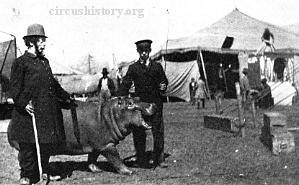 Photo: Clyde Beatty, age 19, shown with clown Abe Goldstien, on the Gollmar Bros. Circus in 1922.
He finished the season on the Howes show, and there was no question in the young man's mind that he had found his job for life. The following year the Howe equipment was out as the Gollmar Bros. Circus. Beatty continued working for Joe Metcalf on the Gollmar show. A polar bear act was worked by Dorothy Asal, and he saw this as his chance to get into the steel arena. He worked the act some during the 1922 season.
The following year Gollmar Bros. became John Robinson and to enlarge the show an act comprised of 14 polar bears was moved over from the Hagenback show and Beatty was in charge of them. It was on the Robinson show that Clyde came under the guidance of a great cat trainer of that time - Peter Taylor. Beatty studied Taylor's every movement day after day during the season. He later gave credit to Taylor for the showmanly tactics that became his trademark. At age 20 Beatty became a performer and was listed as such in the 1923 John Robinson route book.
In 1924 he again worked the polar bear act. There were five other arena acts on the Robinson show that season. John "Chubby" Guilfoyle worked a mixed group of leopards, pumas, lions, hyenas and a black panther. Hattie Guilfoyle presented a group of leopards. A lioness riding a horse was handled by Margaret Thompson. The tiger riding an elephant number was presented by Dolly Castle. The big mixed act of 16 lions and tigers was handled by the featured trainer Pete Taylor. Clyde's polar bear act opened the show and his "balloon bear" act was the last number. He also worked a riding bear act in an end ring in the middle of the show, but this did not require the steel arena.
In 1925 Clyde Beatty moved to the Hagenbeck-Wallace Circus to begin ten straight years of being featured in the center ring. He worked the polar bears and also took over the mixed act that Guilfoyle had worked on Robinson in 1924.
For the 1926 tour the polar bears were given to W. K. Bernard and Beatty continued with the mixed act and took over the big lion and tiger act formerly worked by Pete Taylor. There were 19 in the big act. During the winter of 1926-1927 Clyde polished up the act. Other wild animal trainers around Peru during the middle 1920's were John Helliott, Robert McPherson, Robert Schroeder, Jules Jacot, Aaga Christensen, Mable Stark and a couple of other young fellows - Allen King and Terrell Jacobs. All of these were on the various Corporation shows.
In 1927 Clyde Beatty had completed his rapid rise to featured status in the circus world. Recognition came in many ways - one of which was publicity including two photos in the program and an introduction as "America's youngest and most fearless wild animal trainer." The program coverage was the same in 1928 when he set a record for mixed cat act - 28 lions and tigers. In 1929 he was billed as Captain Clyde Beatty, presenting the world's greatest collection of African and Nubian lions and Royal Bengal and Siberian tigers. Two more animals added making total of 30 in arena at once.
It appeared that Beatty might at last be featured in Madison Square Garden in 1930, when the Corporation signed to bring the combined Sells-Floto and Hagenbeck-Wallace shows to New York City for the big spring date. However "Mr. John" Ringling would not allow this and although Beatty did not open in New York he did find himself working for the Ringling circus. On the Hagenbeck show in 1930 he handled his greatest act, a group of 40 jungle bred lions and tigers.
But in 1931 John Ringling did call for Clyde Beatty and the big one presented a cat act for the first time since Mable Stark was on the show in 1924. The Ringling Barnum show billed Beatty as the "sensation of the century, greatest and most daring wild animal act ever presented." A full page photo of Beatty appeared in the Garden edition of the Ringling program that year. The trainer's name appeared in lights on marquee of Madison Square Garden. Following the New York and Boston Ringling dates Beatty returned to the Hagenbeck show.
During the 1931 season Clyde met a ballet girl on the Hagenbeck show. As the season passed he and Harriett Evans became seriously interested in each other.
One cold January Saturday in 1932, Clyde was rushing through the act in a winter quarters animal barn. He wanted to finish and get on his way to Chicago and a date with Harriett. Not more than eight or ten people were in the building during this private training session. All but three of the cats had left the cage when Nero caught Clyde off guard and knocked him to the ground. The big cat then sunk his teeth into the trainer's thigh. This action was strange because a year before Nero had saved his master's life. At that time the lion had battled a tiger that had taken a pass at Beatty.
Six hours after the trainer had been bitten, he developed a temperature of 104 degrees. Finally the doctors determined that he was infected by the pasteurella germ, a very rare microbe. At the time there was not a serum for this infection. While Beatty's life was held by a thin string the Peru doctors conferred with specialists all across the country. Finally Dr. Stephen D. Malouf after using a serum for treating usual cases of blood-poisoning to no avail, decided to operate and perhaps locate a seat of the infection deep in the leg. After going clear to the bone he was successful in locating the pocket that held the infection. Relieved of this poison Beatty was able to make his system immune to its dangers and throw off the rest of the infectious material.
After six weeks he felt about ready to leave his wheel chair and re-enter the big cage. He was concerned because he was scheduled to return to the Ringling show for the 1932 Garden date. The New York date was delayed and he recovered and did appear in New York in 1932 as well as 1933 and 1934. Each of these years he returned to the Hagenbeck show for the road season. In 1934 he was featured on the cover of the Hagenbeck-Wallace program.
During the years from 1929 to 1934 Jess Adkins was Beatty's boss on the Hagenbeck show. As manager of the Hagenbeck-Wallace Circus Adkins was very aware of the drawing power of the Beatty name. Adkins resigned following the end of the 1934 season.
In the fall of 1934 Jess Adkins joined with another former Corporation executive, Zack Terrell, to form a partnership that would bring the first new big circus to America in many years. These two men selected Cole Bros. World Toured Shows as the title and chose Clyde Beatty as the feature attraction.
Beatty had a serious decision to make - should he leave the Ringling interests, that owned the H-W show. He had been using the show owned cats for his movie work in Hollywood. The H-W animals appeared prominently in "The Big Cage." He had taken 43 of the Ringling owned cats to California and had paid a handsome rental. He also used the cats later while making "The Lost Jungle" a serial for Republic Pictures. Republic also paid the Ringling management for the use of the Peru animal barns where some scenes were taken. However after this film the Ringling management decided that Beatty was being "exposed" too greatly in movies and that it was affecting his drawing power in the circus. Since the Ringling circus was not actually being operated by the Ringling family, but by a group acting for the mortgage holder, they were interested only in hard business facts and not circus tradition. Pressure had been building up during the 1934 season between Beatty and the management of the Ringling interests.
He accepted the offer made by Adkins and Terrell and allowed his name to be used in the title for advertising purposes. But this created many problems - the greatest of which was the fact that the Ringlings owned the act Beatty had been working. Building a completely new act after locating all new cats was a monumental task. And it had to be done not by spring but by the first of the year when a group of winter dates began.
Beatty found many animals in the Los Angeles Zoo. He shipped these and others to the new winter quarters in Rochester, Indiana, a small town just north of Peru. He was successful in breaking the act and he made the winter dates. On April 20, 1935 the regular season opened at the Coliseum in Chicago.
In 1934 Zack Terrell had operated the Live Power Show at the Chicago World's Fair and featured Allan King and a mixed wild animal act. Terrell brought King with him to the Cole show. However using two large cat acts was unsatisfactory and King left in the middle of the 1935 season.
The 1935 tour of the Cole show was successful and Beatty was happy with his new affiliation. Following their marriage a few years earlier Harriet had become very interested in the cats and had expressed interest in working them. During the winter of 1935 and 1936 Clyde and elephant boss Eddie Allen broke a Siamese elephant to carry a lion and a tiger together on its back. When the 1936 season opened this act was presented by Harriet Beatty. Clyde also added cats to his act that year.
In January and February 1936 he made another movie, "Darkest Africa."
After two very successful seasons Adkins and Terrell in 1937 opened the season on 40 cars. The route took the show from coast to coast and border to border. The season opened at the Hippodrome and New York City again saw Clyde Beatty. For the first time in many years two major circuses were in Manhattan at the same time. The Ringling spring strong hold was challenged. It then moved to Chicago and again found opposition, this time from the Hagenbeck-Wallace show. But business was good at the two indoor stands as well as throughout the road tour. In fact Adkins and Terrell were so encouraged they planned a second circus in 1938, Robbins Brothers.
During the winter and spring of 1938 some of the Cole equipment was assigned to the Robbins show along with some new rail cars. The Rochester quarters hummed with activity. The Robbins show featured cowboy Hoot Gibson and Clyde Beatty continued with Cole.
However, the summer of 1938 did not treat circuses very well. The new Tim McCoy Wild West closed after four weeks, the Ringling Barnum show closed and returned to Sarasota in mid season. The Tom Mix and Downie shows closed early. And the Cole show had its problems early in the season. The owners felt that business would improve but the show closed in Bloomington, Illinois, on August 3rd. Some of the acts, including Clyde Beatty, moved over to the Robbins show. Using the "Famous Robbins" title through the south this show finished the season. The Cole show opened in 1939 again but Clyde Beatty was not with it.
In 1939 Beatty took his act to Atlantic City and was featured at Hamid's Steel Pier. Another film "Perils Of The Jungle" starring Beatty was made this year. The Atlantic City booking lead to an association with George Hamid and Bob Morton. For the first time the Hamid-Morton indoor circus toured under canvas in 1940 and featured Clyde Beatty. This was Beatty's first experience on a truck show.
In 1941 he framed his own circus using a 110 foot round top and two 50 foot middles with one ring and the arena.
The Clyde Beatty Wild Animal Circus was featured with the Johnnie J. Jones railroad carnival that season. Also in the performance were Jean Evans, Kinko the clown and Albert Fleet with Beatty chimps. Duke Drukenbrod handled the front.
While with the Jones carnival Beatty tried his hand at another type of thrill job. Lucky Teter, father of auto thrill shows, was playing the North Carolina State Fair with the Jones carnival. A publicity man dreamed up the big idea of Lucky going in the big cage with Clyde. Then Clyde would later ride with Teter in an auto high jump. Neither liked the idea, but went ahead and the stunts pulled great reams of publicity.
The Beatty show was back on the Jones carnival again in 1942. Clyde also operated a Jungle Zoo at Summitt Beach in Akron, Ohio part of the summer.
During his many years on the road Beatty had thought about a permanent home in the south where he could develop a zoo of his own and present a program of circus acts. Late in 1939 in Fort Lauderdale, Florida he found just the place. This was developed into a fine animal farm and a large amount of money was spent making natural cages for the animals. The Clyde Beatty Jungle Zoo was a leading attraction in South Florida during the early 1940's.
In 1943 Clyde joined Ray Rogers' Wallace Bros. show which toured as Clyde Beatty and Wallace Bros. Circus Combined. In 1944 he moved to the west coast to be a part of Clyde Beatty and Russell Bros. Circus.
During these two years Beatty studied the operation and overall management closely. In the winter of 1945 he purchased the Wallace Bros. show and opened in April of 1945 as the Clyde Beatty Circus. Ralph Clawson was the manager that first season. This was the beginning of a now famous title that has been used for 20 consecutive years.
With the country hungry for good clean entertainment the show prospered during the war year of 1945. In fact Beatty did so well he decided to move onto rails. After closing the 1945 season on October 25th in Dublin, Georgia, the truck show was sold to Floyd King.
Beatty then went to the west coast and purchased controlling interest in the Russell Bros. Pan Pacific Circus that Art Concello had framed the year before using mostly equipment from the Beckman Gerety railroad carnival.
Most of the staff came from the Russell Pan Pacific show and had been with Beatty on the Beatty Russell show in 1944. The show wintered and opened in El Paso, Texas on March 22. The 21-week season closed on October 16 in Brunswick, Georgia and moved to winter quarters in Nacogdoches, Texas.
In 1947 Beatty became sole owner and the show remained on 15 cars. The show was dogged by weather that year. On July 8th a derailment of the train tossed eight cars off the track.
Fine route books were published recording both the 1946 and 1947 seasons.
The show wintered in Shreveport, Louisiana in 1947-48. Some Ringling-Barnum coaches were added at this time replacing the carnival sleepers.
During the winter of 1948-49 Beatty purchased most of the steel wagons that had been built new for the 1947 Sparks show. Four big cages were also added for the cat act.
Harriet Beatty had not been feeling well during much of the 1950 season and passed away on October 25th in Kosciusko, Mississippi. Shaken by the loss of his wife he left the show and Joe Arcaris worked the big cage act the remaining ten days of the 1950 season.
During the 1950s the show remained on 15 cars and wintered in El Monte, California and Demming, New Mexico. During the 1952 season Beatty again went to Hollywood to make a motion picture and TV film. During his absence Joe Walch worked the act.
In 1954 the color film "Ring of Fear" was filmed on the show featuring Beatty and many performers. A Martin & Lewis movie was also filmed using the Beatty equipment about this time.
The 1956 season was rough from the start and even with the Cisco Kid as an added attraction the crowds stayed away. The show played its usual California spring route opening in March. In Burbank on May 9th the show closed and returned to quarters in Demming.
The present owners, Frank McClosky and Walter Kernan, purchased the show and reopened it in New Mexico on August 29 and finished the season. The new owners brought the show to Deland, Florida for the winter and promptly converted it to a truck show for the 1957 season.
During the 1950s Clyde Beatty was featured at many of the outstanding winter Shrine circuses. He was for over 30 consecutive years the star attraction at the Detroit Shrine date and frequently went to Honolulu for E. K. Fernandez. In the early 50s he remarried and he and his wife, Jane, have a son, Clyde Beatty, Jr.
The Kernan-McClosky-Beatty combination was a winner from the start. In 1959 the Cole Bros. title was added and thus the cycle has been completed from Cole Bros.-Clyde Beatty to Clyde Beatty-Cole Bros.
Early in 1960 he again opened a jungle zoo in South Florida. Clyde Beatty’s Jungleland was located on U.S. Route 1, seven miles north of Miami. He spent some time there between winter dates. The tourist attraction was operated for only one season.
In mid-season of 1964 Beatty became ill and left the show to go to Chicago for an operation. The act, less the tigers, was worked for the remainder of the season by his assistant, "Red" Hartman.
When the 1965 season opened in Commack, New York, Beatty was on hand and worked the act during the engagement and for a few stands on the road, but the strain was too much and he returned to the Chicago hospital for a checkup. He was advised that his condition was not good and that he should return to his home in Ventura, California.
After fighting for his life in the steel arena against wild animals for 43 years, he was now fighting the killer cancer, to whom he was no match. He lost the battle.
Clyde Beatty, often called the king of wild animal trainers, was a featured performer in the center ring of the big top for 40 years, probably longer than any individual in circus history. During his last years, even though over 60 years of age, he looked like the youthful fireball that battled a mixed group of 40 lions and tigers in the mid-1930s. There will probably never again be the thrill that came when the big show announcer said, "Presenting the greatest wild animal trainer of all time - Cly-de Baay-tee," and with the spine tingling music from the band a wavy black haired man in gleaming white pants and shirt with black boots entered the big cage. Showmanship to perfection, that was the king.
Clyde Raymond Beatty, born June 10, 1903, died July 19, 1965.
Part II, The 1935 Season
The new Cole show had assembled an outstanding performance to be presented during its first season. The April 27, 1935, Billboard told the story of the initial stand of the show in Chicago in a front page article under headlines, "New Cole Show Has Good Start," "Adkins and Terrell do a splendid job - thousands see torchlight parade."
"Chicago, April 20 - With one of the finest and most complete equipments with which any circus ever started, the Cole Bros. and Clyde Beatty Circus launched its first season today at the Coliseum to a good-sized audience and with a performance that for a premiere worked with astonishing smoothness. Weather conditions were ideal and a torchlight parade on Friday night, which was seen by tens of thousands, had whetted the public's appetite for the show. Advance ticket sales for next week indicate a healthy interest in the circus and Managers Jess Adkins and Zack Terrell express confidence that the show will do excellent business here during its 16-day stay.
"The matinee performance was run off without a hitch. Dress rehearsal on Thursday night was, as to be expected, rough, but in the interim numerous changes were made and acts which slowed up the action were cut out, with the result that today's performance present a glittering array. Menagerie and side show are in one section in the building. Lou Delmore has an excellent lineup of attractions.
"Managers Adkins and Terrell have done a great job in assembling and whipping into shape in so short a time a show of such magnitude as this. Their staff throughout is composed of seasoned and competent men and they have created an organization that is destined to make circus history - in fact, it is already making it. There are a lot of things that should be said about it that cannot be included in this story because time is too short.
"H. J. McFarlan, equestrian director, handled the show very well, keeping everything moving at a fast pace.
"Thomas Hagis, announcer, did an excellent job, his voice coming over the loud-speaker system distinctly.
Review
"Display 1 - Inaugural pageant. To a fanfare of trumpets The Serenade of Spain ushered in the premiere performance of the Cole Bros. and Clyde Beatty Circus promptly at 2:15. Redolent of the land of romance, the cavalcade of several hundred men and women, horses, elephants and camels in glittering and vari-colored costumes and accouterments presented a gorgeous sight as it circled the track, and the spectacle of music, song, and dance presented in the three rings to the accompaniment of the lively melodies of Vic Robbins' band and climaxed with a sizzling rhumba dance and a burst of fireworks was spectacular and entertaining. Rex de Rosselli staged the spec and deserves credit for his work. The dancers were directed by Betty Jones; music was arranged by Vic Robbins, and the beautiful wardrobe was designed by Josephine McFarlan.
"Display 2 - Comedy acrobats. In Ring 1 the LaBelle Trio and in Ring 3 four of the clowns working in place of the Montone Trio, who are to join later. Entertaining tumbling, gymnastics, and clowning.
"Display 3 - Pony drill. John Smith in Ring 1 and Albert Hodgini, substituting for Merritt Bellew in Ring 3, put the pony troupes through a series of intricate drills.
"Display 4 -Allen King, animal trainer, who was a sensation at A Century of Progress last summer, presented his mixed group of lions, tigers, and leopards, putting them through a routine of thrilling and breath-taking stunts that kept the audience gasping. Entirely devoid of fear, King handled the cats magnificently, especially considering that many of the animals are new ones and this was a first performance. King is putting plenty of showmanship into his performance and without question is going to have one of the finest acts of its kind before the season is far advanced.
"Display 5 - Jockey act. Joe Hodgini in Ring 1 and Bertio Hodgini in Ring 3. Joe Hodgini is one of the best of the older generation of riders, while Bertio ranks among the top-notchers of the younger generation, and both gave splendid performances.
"Display 6 - Iron-jaw numbers with the Edwards Sisters and Cyse O'Dell over one ring and Viola Barnett, Hallie McCabe and Bertha Benham over the other. Ladders with Misses Griebling, Manning, Kinko, Wolfe, Cooke, Forrest, Goodenough, Carter and Tatum. Muscle grind by Esma Wilson over Ring 1, and Agnes Doss over Ring 3, two performers who are the acme of grace. Climaxing the display, Frank Shepherd on the trapeze did a sensational twisting somersault heel-catch that is a real feature.
"Display 7 - The Man Without Nerve. Pulled to the top of the auditorium, Florescu did a giant teeth swing, followed by a toe-swing while being again pulled aloft, giving the audience a breath-taking thrill.
"Display 8 - Ring curb dogs and comedy mules, worked in Ring 1 by Roy Lewellyn and in Ring 3 by Merritt Bellew. These acts will be highly entertaining when they have had a little more training.
"DISPLAY 9 - Clyde Beatty. Introduced as the world's greatest animal trainer presented his "Cage of Fury," a seething, snarling group of jungle beasts which he put through their paces at a furious pace and with consummate showmanship. From start to finish the act is replete with thrills, and its feature the roll-over tiger, wins tremendous applause. Beatty has a knack of dramatizing his work in a way that sells it 100 per cent.
"Display 10 - Jimmy Foster and his cowboys and cowgirls put on a rip-roaring exhibition of trick and fancy riding, roping and whip cracking. An excellent bunch of riders. Ted Elder is with them and will put on his sensational jumping horse when the show is down to its regular routine.
"Display 11 - Performing seals. Worked in Ring 1 by A. Fleet, Ring 2 by Harry Frith, and Ring 3 by Grover McCabe. These seals are new but are rapidly being whipped into form and in another couple of weeks will be doing excellent work.
"Display 12 - Big clown number with all of the joeys participating in comedy antics.
"Display 13 - Cyse O'Dell, single arm plange. Miss O'Dell is a graceful performer and her feat of strength and endurance won deserved recognition from the audience.
"Display 14 - Clown runaround, the joeys doing a variety of amusing stunts on the track.
"Display 15 - Equestrianism. In the center ring Harrietta (Hariett Hodgini) in a riding act of superb artistry. Miss Hodgini has beauty of face and form and as a rider she probably is unsurpassed. Graceful in the extreme, she makes a beautiful picture and her work throughout is superb. In Ring 1 the Davenports, two graceful equestriennes, offered a pleasing routine while Joe Hodgini and his wife did the same in Ring 3. Both of these acts are splendid examples of pleasing equestrianism.
"Display 16 - Clown number. This show has some of the best clowns in the business. Among the outstanding joeys whose pantomimic work deserves particular mention are Otto Griebling, Bumpsey Anthony, and Emmett Kelly.
"Display 17 - Pacyderms. Five ponderous bulls in each ring. All excellently trained and went through the usual routines without a hitch and at a fast pace. Worked by Jean Fisher, High-Pockets, and Estrella Nelson.
"Display 18 - Clown band, led by Otto Griebling, in some excellent comedy that got them a lot of laughs.
"Display 19 - Wire acts. The Cole Bros.-Clyde Beatty Circus has in Harold Barnes a youngster whose age is given as 16, but who looks a couple of years younger, a lad who bids fair to become a sensation on the wire. He works with consummate ease and has a marvelous sense of balance. Without doubt the best in his line for so young a performer and destined to go places. He works in the center ring. In Ring 1 Rosina Nelson does a fast and graceful routine on the wire, and in Ring 3 an unbilled girl gives a pleasing and excellent performance.
"Display 20 - Liberty horses. For many years Jorgen M. Christiansen has had some of the finest horses to be found under canvas, and in these Liberty acts are assembled as fine a group of equines as can be found anywhere. They work simultaneously in the three rings. Christiansen handling the center ring, Joe Hodgini Ring 1 and John Smith Ring 3. The horses go through many difficult maneuvers, and the act is climaxed by the animals in all three rings rearing at one time. A beautiful sight.
"Display 21 - High Pole Act. Florescu, seen at A Century of Progress last summer, is doing what is one of the highest and most sensational high pole acts extant. Top of the pole is almost up to the roof girders. Florescu climaxes his act with a head-stand that brings gasps of astonishment from the audience.
"Display 22 - Statues. Graceful posing all three rings, representing Spring, The Early American, and other subjects.
"Display 23 - Clown Bride. The old reliable laugh-getter cleverly presented by the joeys.
"Display 24 - Athletes and Gymnasts. As fine an array of acts of this sort as can be found anywhere. In center ring the Nelson Family, for many years one of the outstanding acrobatic acts in the country and still holding that distinction. In Ring I the Liazeeds, a leading Arab troupe, forming pyramids and doing all sorts of difficult ground acrobatics with astonishing ease. In Ring 3 the Ben Bey Arabs, also topnotchers in the acrobatic field, agile and accomplished. The Nelsons climax their act with Estrella Nelson doing flip-flaps on a platform with amazing agility. The Liazeeds and Ben Bey Troupe finish with fast tumbling on the track.
"Display 25 - The Seven Wonder Girls, sensational roller-skating act, put together by that daddy of skating instructors, Earle Reynolds. A fast and amazing exhibition of stunts on the little wheels, done with a speed and skill that amazes. This act is featured in the center ring, nothing else working while it is on. Deserves the highest praise.
"Display 26 - High School Horses. An array of beautiful horses is presented in the usual stunts and makes a beautiful appearance. An innovation has been introduced, all of the riders riding side-saddle, something that has not been seen for years. While a few of the horses are a bit "green" most of them go through the routines very well and all in all give a splendid exhibition.
"Display 27 - Clown walkaround.
"Display 28 - Flying Acts. In this department the Cole Bros.-Clyde Beatty has two of the finest flying acts seen under canvas. The Flying Thrillers, with Bert Doss, Mitzi and Eldred Sleeter, and the Harolds, with Harold Voise, Eileen Larey and W. Reiner, present as fine an exhibition of flying as has ever been seen under the white tops, their difficult stunts abounding in thrills. A third troupe, the Esquedas, will join the circus in a couple of days.
"At the opening performance the usual races were omitted. Performance ran too long but is gradually cut and in a few days will be down to standard running time."
No mention was made of an after show but during the canvas tour Jimmy Foster headed up the after show billed as "The Colossal Frontier Day Exhibition, 30 Minutes in the Golden West" and had on hand a goodly number of cowboys and cowgirls.
At Chicago in heavy opposition playing at the Stadium was the Ringling owned Hagenbeck-Wallace 4-Paw Sells Bros. Combined Circus. The show was under the management of Frank Cook who was soon replaced by Ralph Clawson. Although the giant 50 car show of 1934, which Jess Adkins had managed, was now cut down to 35 cars and the daily street parade dispensed with although a few parades were given during the season it was still a formidable opponent. Bert Nelson was brought on to work the former Clyde Beatty wild animal act and a strong and well balanced program was presented. This show was to be a thorn in the side of the new Cole show for much of the 1935 season. Tradition has rightly held that the Ringling interests, headed by General Manager S. W. Gumpertz, "resented" very strongly Adkins leaving the fold and going into competition with the organization which had been relatively free of any real opposition since John Ringling purchased the American Circus Corporation in September, 1929.
The 1935 Cole roster of executives and department heads was filled with experienced and capable circus people, as follows: Jess Adkins and Zack Terrell, owners and managers; Floyd King, general agent; Earl Lindsey, treasurer; Harry Harrold, secretary; E. F. Partello, adjuster; Jess Murden, special representative; H. J. McFarlan, equestrian director; Fred Seymore, general supt.; Vic Robbins, big show band leader; William Backell, mgr. Car No. 1; Frank Mahery, mgr. Car No. 2; Clyde Willard, opposition brigade; Fred C. Kilgore and Karl Knudson, local contractors; Si Semon, special agent; Robert E. Hickey, general press representative; Rex de Rosselli, press; Earl DeGlopper, contracting press; Klara Knecht, radio; Al Hoffman and Clarence Adolph, 24 hour agents; Noyes Burkhardt, supt. front door and auditor; George S. Cutshall, supt. tickets; E. H. Tucker, supt. concessions; Fritzie Partello, doctor; John Eberle, supt. canvas; Lou C. Delmore, manager sideshow; John James Washburn, supt. sideshow canvas; Nick Carter, supt. dining cars; P. A. McGrath, trainmaster; Al Dean, supt. cookhouse; Blackie Diller, boss baggage stock; M. F. Campbell, boss ring stock; Eddie Allen, boss elephants; Theo Premont, chief electrician; P. G. Lowery, sideshow band; Mrs. Harry McFarlan, supt. wardrobe.
Lou Delmore had the following attractions in the main sideshow: Charles Demont, inside lecturer and Punch and Judy; Jack Fraser and wife, ticket seller and sword box girl; Betty Green, Koo Koo, the Bird Girl; Robert Gregory, piano-accordian player; Ward Hallings, tattooed man; Ada Mae Moore, snake act; Jean McLean and Company, Scotch piper and drummer; Frances O'Connor, armless girl; Renee Ramey, dancing girl; Laonia Theodora, dancing girl; Cliff Thompson, giant; Genie Weeks, half -girl.
Arnold Maley, who furnished so much of the information used in these articles, was time keeper and ran the No. 2 wagon.
The Billboard reported that the combined Hagenbeck-Wallace and Cole gate the first week in Chicago was several times that of the 1934 take of H-W indicating that circus fever had hit the natives of the Windy City and they were putting in an appearance through the doors of the Coliseum and Stadium. Upon completion of the Chicago stand of both shows which was identical in the dates the Billboard stated that both shows were well pleased with business generated but that Hagenbeck-Wallace had better total attendance. The final stand in Chicago was May 5 and the show loaded and departed for the opening canvas date in the winter quarters town of Rochester, Ind., on Monday, May 6.
A lot some distance from the quarters was used and all tents were erected prior to arrival of the train early in the morning of May 6 from Chicago. Fate intervened however to spoil the opening day as heavy rains flooded the lot and the movement of the menagerie and other props from the train that morning necessitated hours and was only accomplished after much hardship and suffering to men and animals. Many wagons mired up to their beds. While unloading the baggage stock that morning it was discovered that a prized 8 up of matched grays had fallen in the car with one dead and six seriously wounded which had to be left at quarters. Topaz, one of Jorgen Christiansen's prize liberty horses was badly injured when it fell from the unloading chute.
Member Sverre Braathen was on hand for the opening in Rochester and tells of the day as follows:
"I drove over on Sunday with an attorney friend of mine and his wife. It had snowed the night before and the ground and roads were white with snow. The Cole show came into Rochester early Monday from Chicago. I sat in the hotel lobby looking out the window at the rain coming down as did many other people from the show. I stood with Jess Adkins under a canopy at the hotel and watched the street parade. Before it began I said to Jess, "Are you going to parade in all this rain?" He replied that they would do so and with all their good wardrobe because the people in Rochester had been so good to the show. It was a cold rainy day and the lot was a mud hole. I didn't take any photos and it would have been hard to take any with the rain coming down on a dark and dismal day.”
The Billboard later reported that much of the parade props and wardrobe were ruined beyond use until it could be overhauled.
Member Gordon Potter was also there in Rochester and fortunately he made notes on this historic occasion and his parade lineup and other notes of interest which form such a vital part of this account of the opening canvas stand of the new Cole show are printed intact and without edit just as he made them that day. His parade lineup and notes are as follows:
"Complete parade line-up of the Cole Bros. World Toured Circus and Clyde Beatty's Gigantic Trained Wild Animal Exhibition with Allen King as it returned to the show lot in Rochester, Indiana, Monday, May 6, 1935, the first stand made under canvas by this show.
2 Riders (on horses).
4 horses pulling Tally-Ho.
8 horses pulling Lion Bandwagon with No. 1 big top band.
1 Rider (on horse).
2 horses pulling Cage with leopards.
2 horses pulling Cage with lions.
6 horses pulling No. 72, American Tableau wagon.
6 Riders (on horses).
4 horses pulling Cage with lions.
4 horses pulling Cage with lions.
2 horses pulling Cage with tigers.
6 horses pulling No. 62 Columbia Bandwagon with No. 2 big top band.
8 Riders (on horses).
Clown on pony.
6 horses pulling No. 79 White and Gold statue corner tableau (air calliope with sides closed).
Emmett Kelly on bicycle.
4 horses pulling Cage with lion.
2 donkeys with buggy.
6 horses pulling No. 70 Palm Tree Tableau wagon with clown band.
4 horses pulling Cage with lions.
4 horses pulling Cage with lions.
2 horses with chariot.
2 horses with chariot.
6 horses pulling No. 71, Asia Tableau Wagon with side show band.
5 Riders (on horses).
2 horses pulling Cage with tigers.
4 ponies pulling Cross Cage with lions.
6 Riders (on horses).
4 ponies pulling Cross Cage with tiger.
4 ponies pulling Cross Cage No. 11, closed, no animals in it.
20 Wild West Riders (on horses).
4 ponies pulling No. 78 Small Unafon wagon.
6 ponies pulling Cross Cage with monkeys.
6 ponies pulling Cross Cage with hyena.
4 ponies pulling Cross Cage with birds.
4 camels.
2 zebras.
2 sacred cows.
1 buffalo.
15 Indian elephants.
2 horses pulling Cage with tigers.
4 horses pulling Cage with tigers.
4 horses pulling No. 116, steam calliope.
Parade Itemized
76 head of baggage stock.
32 head of ponies.
47 riders (on horses)
8 tableaux and calliope wagons.
11 large cages (nine 12 ft. and two 14 ft. cages).
6 cross cages.
15 elephants.
9 head of menagerie lead stock.
8 buggies and chariots with 10 horses and donkeys.
(Special Note: 2 elephants, Bamma, and the African, Jumbo II, remained on the lot and did not make parade. The Sea Lion Cage No. 15 did not parade and customarily was left in the menagerie top.) Potter concludes his observation of the opening day parade, "It was a wonderful and impressive street parade with some of the finest tableaux wagons ever seen by me. It poured all day long and was cold and the weather was the worst ever experienced by me while attending a circus."
The show entered the season's tour very short on baggage stock. Every available animal was put into use to make the opening parade at Rochester full length, however many hitches were short of the desired number. On May 4 Jack Morris, circus horse buyer, was given orders to purchase 6 and 8 up matched baggage stock as they could be found and to deliver them to the show enroute. During the early weeks before the shortage of stock eased oftentimes some cages were left in the menagerie top at parade time. As indicated in the Rochester parade list the show used ponies extensively for the lighter vehicles. A four hitch of donkeys (mules) soon began hauling the unafon wagon in parade.
The show's bandwagons, tableaux, and calliopes looked great in the parade. The lead bandwagon, painted white with gold leaf carvings, was the famous old Forepaugh "St. George and the Dragon" originally built as a telescoping tableau with a huge St. George carving as the central figure. The wagon first appeared on the Adam Forepaugh show about 1881 and some historians believe it was imported from England. Dick Conover gives excellent treatment to the early history of this famous wagon in his publication, "The Telescoping Tableaus." The wagon was sold to Ringling Bros. in late 1890 and appeared on that show in 1891 and continued through the final season of 1918. Before it was put into use by Ringling the telescoping mechanism and the St. George carving was removed and the wagon remodeled into its present form. It was later stored at Bridgeport and was sold to G. W. Christy who used it on his Christy Bros. Circus, 1926-30.
The No. 2 bandwagon, also painted white with gold leaf carvings, was commonly called Columbia and was built by Bode for Forepaugh-Sells in 1903. In 1908 it went to Barnum & Bailey where it remained through the final season of 1918 and also served in the final parades of the combined show in 1919 and 1920. After it was stored at Bridgeport for a few years. G. W. Christy purchased it for use on his show from 1926-30.
The America and Asia tableau wagons had a common history. Both were originally telescoping wagons with large central figures and were built by Sebastian for Barnum & Bailey for the 1903 season, In about 1912 they were remodeled and built into box type wagons. After the final B & B season of 1918 they were stored at Bridgeport until Christy got them in 1926. Both vehicles in 1935 were beautifully painted using some white plus all of the colors of the rainbow appearing on the carvings sprinkled with some gold leaf.
A wagon that originated as a cage-tableau on Sells Bros. in the 80's and commonly called the Palm Tree Tableau was used for the clown bandwagon. In 1896 the wagon appeared on the combined Forepaugh-Sells show and was used on into the early 1900's. When retired it was stored at a barn near the old Baraboo quarters until it was sold to Christy in 1927. Cole had it painted red with gold leaf carvings in 1935.
The unafon wagon originated as an air calliope wagon on Yankee Robinson Shows about 1915 and served on the show through its final season of 1920. Fred Buchanan retained possession of it and later used it on his 1923 World Bros. Circus and 1924-31 Robbins Bros. Circus.
The history of the air and steam calliopes was covered in the previous installment. The air calliope was painted basically white with multi colored carvings and the steamer was red with carvings in gold leaf.
A season which saw opposition frequently and often furious greeted the new Cole show. All three of the other railroad circuses on the road in 1935 were Ringling owned. These were Ringling-Barnum, Hagenbeck-Wallace Forepaugh Sells, and Al G. Barnes. Major motorized shows on the road in 1935 included Downie Bros., Tom Mix, Barnett Bros., Russell Bros., and Seils-Sterling and almost two dozen smaller mudders also were out. Cole was the only rail show presenting a daily parade but as mentioned earlier Hagenbeck-Wallace did stage several during the season. However the street parade was still not too much of a rarity as several of the larger motorized shows, including both Downie and Mix, presented daily parades. Actually the street parade was the rule rather than the exception with the larger truck shows even as late as the 1935 season, a fact often overlooked by some circus historians.
From the beginning General Agent Floyd King had to do some fast route maneuvering to avoid too close competition. Originally Cole was scheduled to be in Cincinnati May 9-10 but after Hagenbeck-Wallace booked the city for May 7-8 Cole changed its stand for the 9th to Louisville, the 10th for Lexington, Ky., and scheduled the 11th for Covington, Ky., across the river from Cincy. Those stands completed the first week under canvas.
Needless to say loading of the show that night after the opening at Rochester was a nightmare. The train was scheduled to leave for Indianapolis, the second stand, at 1 A.M. but due to the battle with mud and elements was still in town at 6 A.M. The matinee and parade of the first day of the two-day stand (May 7-8) at Indianapolis was missed. The parade was presented the next day and it required three performances that day to handle the crowds.
The Billboard reported the under canvas performance was essentially the same as that presented at Chicago with exception of Rosie Wallett and Lulu Davenport, equestriennes, the Seven Wonder Girls skating act, Esma Wilson trapeze and muscle grinds, the Liazeeds and Ben Bey Troupe of tumblers. The Esqueda troupe of 6 people presenting bar and comedy acrobatic numbers joined the show for the canvas season.
The Circus Fans Association held its annual convention in Cincinnati and visited the new Cole show at Covington. Unfortunately a late arrival forced cancellation of the parade in Covington as it also had done in Lexington but literally thousands waited and watched the arrival of the train and set up of the show as photos here attest.
Sverre Braathen followed the new show down from Rochester and was a visitor again at Covington. He recalls that the show encountered numerous delays due to breakdowns in the baggage wagons right from the start caused by dry rot and lack of sufficient time at quarters to have them fully repaired before opening date. Tom Scaperlanda was also a visitor at Covington and we are indebted to him as well as Braathen for furnishing us photos taken that day which show the equipment while it was still fresh and bright in its new coat of paint.
The second week saw the show in West Virginia and the third week it had one more stand in that state, two in Pennsylvania, and three in Ohio. Rain and long hauls made it difficult for the show to open on time at some stands, however, at Clarksburg, Fairmont, Morganton, and New Castle doors opened promptly. Due to a late arrival in McKeesport the parade had to be cancelled and the matinee was late. Late arrival had been caused by a four mile haul over a narrow road the night before from the Morgantown lot to the runs. A slight derailment of an elephant car shortly after the show left Morgantown and delays in the Pittsburgh yard further added to the lateness in arrival. McKeesport gave good business despite Downie Bros. being in a week earlier and strawing them at both performances. The matinee started a few minutes before 6 in the afternoon followed almost immediately by the evening performance. Crowds jammed the runways in the evening to such extent that some acts had to be curtailed. Standees were everywhere.
Twelve additional head of baggage stock were received in Morgantown after being trucked from Rochester. Blackie Diller informed the Billboard that he now had 110 head of baggage stock. The show said because of the 12 new horses they would add three more cages to the parade indicating it had not been up to full strength lately. The ponies were helping their own cause and the fourth pony birth of the season also occurred at Morgantown.
The Billboard reviewing the early weeks of the Cole season stated that 11 of the first 17 outdoor stands had turned patrons away. It was evident to the management that the big top was too small and a rush order was put in for two additional 40 ft. middle pieces in order to enlarge the big top and seating to accommodate the crowds. U. S. Tent worked overtime on the order and the enlarged tent was erected for the first time at Williamsport, Pa., on May 27, where the show had two banner houses. The big top was now a 6 pole 145 ft. round with three 50 ft. and two 40 ft. middle pieces. Interior was arranged for the performance to be presented in three rings and two stages. It was a major job to convert from the 4 pole to the 6 pole top over the weekend at Williamsport. New quarter poles had to be installed, new stringers built for the seats, and two stages 30x30 constructed. The show gained four sections of reserved seats and nine additional lengths of general admission blues. It was claimed in the Billboard that the enlarged top could now accommodate 7500 people. After the enlargement of the big top the show began billing itself as the "2nd Largest." No additional wagons or cars had to be added as the loads were shifted around and the new equipment loaded on the existing vehicles. Since the start of the season the train had moved regularly in two sections.
During the early weeks the sideshow and candy stands also reported good business as did Prof. Agnew's "Petrified Man," operated as a pit show in a wagon on the midway.
The June 8 Billboard reported that recent additions to the performance included Jorgen Christiansen's Great Dane dogs, two more pony drills, another sea lion act, a Japanese troupe, the Radke Sisters, acrobats, Agnes Doss in her aerial gymnast offering, Kinko and his contortion number. Otto Griebling in a juggling act, and the Esquedes in their flying act using five people. The program now ended with Ted Elder's Roman Standing Jump over a Ford automobile. Running time of performance was two hours and twelve minutes. The same Billboard said the show had added another Mack truck which now gave them a total motive power of 3 Macks and one Fordson tractor. The baggage horses had all recovered from their recent colds and the show and parade were now moving on time.
The show's fourth and fifth week was spent in Pennsylvania and New York. Business continued to be good in a season which so far according to the Billboard had been phenomenal for the new show. The management reported that New Castle, Akron, Youngstown, Steubenville, Williamsport, Wilkes-Barre, Scranton, and Binghamton all turned in excellent grosses despite heavy opposition billing. Cole was posting approximately 10,000 sheets of paper daily especially in opposition towns.
A delayed Billboard dispatch reported that the show didn't arrive in Akron until noon but the matinee started shortly after 3 to a three-quarters house. Night show was straw. The sleepers were parked alongside the Akron lot and there was a three-quarter mile haul from the runs.
The show presented two young hyenas and a four year old Barbary lioness to the local zoo in Binghamton and the town responded with a matinee straw house. Ray Choisser, the steam calliope player, in addition to playing in the parade was now giving evening concerts on the lot at 6 P.M.
Ithaca and Utica proved pleasant surprises for the show. Cole was now getting much favorable publicity as being the only railroad circus giving a street parade and the press boys were playing it up big. It was claimed in the Billboard that another stock car was added at Rochester, N.Y., and that the show was now traveling on 36 cars, however, observers have pointed out that they doubt such addition was made. Even though conceivably another stock was added to transport the elephant additions soon to arrive it has been pointed out that the show had ample stock cars to fully accommodate all stock plus the new bulls and there was no reason for another car to have been added. No doubt the new show's press was feeling its oats due to the exceptionally good business it was receiving in the early weeks and was telling the story to the world.
It should be pointed out here that no day by day figures of the show's gross are available and reports of business done at various stands come primarily from reports printed in the Billboard. Often these reports were accurate, sometimes not too accurate. But in order that no one gets confused into believing that the show due to such glowing reports surely should have made a fortune during its first season the following testimony from Arnold Maley is given. Maley says the show did come home with a slight profit in 1935, something around twenty thousand, but no larger. After a careful review of the first season it would seem that early season business on thru early July was very strong, then it took a dip which made it necessary to reorganize late in that month, with the remainder of the season being spotty. However for the benefit of those readers who might be interested, the account of business done at various stands as reported in the Billboard will be given.
On June 10 the show began a two day stand at Cleveland, then went to Toledo, then into Michigan, where it remained through the 23rd. More big days were claimed at Toledo, Grand Rapids, and Jackson. Blackie Diller resigned as boss hostler because of illness and was replaced by Joseph Wallace.
From June 16 thru 19 the show played four days in Detroit using three different locations. It returned for one more day in Detroit on the 23rd using still another lot location. Cole and Ringling-Barnum engaged in a heavy direct competitive billing war for Detroit patronage.
On June 23 in Detroit the show added nine elephants which now gave the herd a total of 26 which included 25 Indians and one African. Eight of the new bulls were females while "Little George" was a five year old male. Eddie Allen began using 24 elephants in the parade each day leaving only Jumbo II in the menagerie and Bamma to work on the lot. The long bull line in the parade was an impressive sight and made a field day for banner salesmen L. D. Hall and Jimmy Lieberman and Apr. 20 each parade saw plenty of evidence of their work.
All of the nine additional elephants are believed to have come from the Hall Farm. The late Col. W. H. Woodcock, noted circus and elephant historian, listed 15 elephants coming to Cole either before or during the 1935 season. Three more which came late in the 1935 season and were sent directly to Rochester quarters will be mentioned later. Names of the 15 were given as Anna May, Little Babe, Boo, Blanche, Ding Dong, Big Jennie, Little Jennie, Little Katie, Mary, Nellie, Sidney, Tessie, Tommie, Wilma, and George. Actually the Colonel had Empress on this list but it was evident he had inadvertently erred as he also listed Empress as the name of an elephant coming to Cole in 1937 from another source, which was true. Since George did definitely come to Cole in 1935 and the Colonel insisted a total of 15 did come from Hall I feel sure that George should have been on the list of Hall elephants but was only left off by mistake. Names of the other 11 elephants making up the full herd of 26 were Big Babe, Carrie, Louie, Joe, Jean, Tony, Big Katie, Juno, Barney, Bamma, and Jumbo II.
On June 24 Cole entered Ontario for a stand at Windsor to be followed by two full weeks in the Dominion. The new show was welcomed in Canada with capacity business at Windsor, London, Brantford, Guelph, and Hamilton. The parade was the first seen in Canada in many years and as a result traffic was so heavy at most places special constables were needed to aid the situation. At many stands the show was the first major circus in seven years so the Billboard reported. The size of the show surprised many and at one Canadian stand 24 hour man, John Corey, found it necessary to cut three acres of wheat to make room for the big top and menagerie on the lot. The show advised the Billboard that it was now moving with clock-like precision, the earlier kinks having been ironed out. The two trains are now loaded around midnight and 1 a.m. respectively. Joe Wallace, the new boss hostler, has the hauls made quickly and the parade starts for downtown at 11 a.m. daily. Harvey Beach has been named boss canvasman.
Cole had two big days in Montreal, the last Canadian stand, July 8-9 despite a constant downpour Monday night and threatening weather on Tuesday. At 8 p.m. Monday it was necessary to close both the white and red ticket wagons and hundreds were placed on the straw for the performance. The sideshow had its largest day's gross of the season to date. At Montreal the show had a ten mile parade route. It left at 9 a.m. and returned shortly before noon. Harry McFarlan, equestrian director, was now leading the parade with his buggy and trotter, "Hamister Todd."
Back in the states July 10 at Plattsburg, N.Y. the show continued to periodically report good business, however, there was a definite slow down of the glowing reports that had filled the Billboard in recent weeks indicating that the heavy take of the early season had now definitely slackened. Good business was reported in New York state despite following many truck circuses. The show did not arrive in Glen Falls until 1 p.m. as lot at Plattsburg the night before was not cleared until 4 a.m. and as a result did not parade in the town. The matinee, which began at 5 p.m., was light but night house was packed. The show was now being routed into smaller towns, many of which had not seen a railroad circus since the depression began. Many smaller towns of about 10,000 population were now coming back on a railroad show's route. An example of these towns being played by Cole were Plattsburg, Odgensburg, Saranac Lake, Little Falls, Gloversville, Oneida, and Geneva, not one over 25,000 but according to the Billboard reports all gave good business. Floyd King was succeeding in his aim in bringing back the railroad show to long neglected communities and this fact aided no end in the immediate favorable response of the public to the new Cole circus. The show had been blessed with good weather for some weeks but a storm hit during the evening performance at Oneida, N.Y., where 4,000 were in attendance but fortunately no one was injured.
An infantile paralysis scare, which was murder to circus routing in those days, reared its ugly head in the Richmond, Va. area, causing Cole and other shows to cancel contracted stands and re-route. Cole was scheduled for Richmond on August 1 and Hagenbeck-Wallace for August 12. It was necessary for Cole to cancel Richmond and other Virginia dates at Harrisonburg, Staunton, Charlottesville, Newport News, Portsmouth, Norfolk, Petersburg, Lynchburg, and Roanoke, all scheduled for August appearances, however several of the stands were rescheduled and played later in the fall. The show altered its route on rather short notice to go back into Ohio after a week in Pennsylvania which followed the New York state tour. During the week in Pennsylvania the show had two good houses at Butler which was also to have in Hagenbeck-Wallace shortly. Altoona and Johnstown were the only cities where heavy competition was not encountered in the area. An example of the close opposition Cole was mixed up in occurred on July 1 when fans reported that the advance cars of both Cole and Ringling-Barnum were tacked on to the same New York Central train passing through Ft. Plain, N.Y.
Cole's business was now definitely off its earlier pace. Some adjustment had to be made if the show was to continue to tour profitably. The nut was large and business off. Something had to be done. It was done immediately following the July 27 stand at Cumberland, Md. as the show prepared to go into Ohio over the weekend for a stand at Marietta on the 29th on the newly revised route.
(To be continued. Next installment to cover the conclusion of the 1935 season.) (Note: Several corrections must be made in the initial installment. The sea lion den No. 15 was listed as 15 ft. long. It should have been listed as 18 ft. in length. Also it was Mr. Norris who was head of the Associates Investors Corp., not Morris as printed.)
Official Route Cole Bros., Circus Season 1935
|
May 5 Chicago, Ill.
May 6 Rochester, Ind May 7 Indianapolis, Ind May 8 Indianapolis, Ind May 9 Louisville, Ky. May 10 Lexington, Ky. May 11 Covington, Ky. May 13 Charleston, W. Va. May 14 Logan, W. Va. May 15 Huntington, W. Va. May 16 Parkersburg, W. Va. May 17 Clarksburg, W. Va. May 18 Fairmont, W. Va. May 20 Morgantown, W. Va. May 21 McKeesport, Pa. May 22 New Castle, Pa. May 23 Akron, Ohio May 24 Youngstown, Ohio May 25 Steubenville, Ohio May 27 Williamsport, Pa. May 28 Wilkes-Barre, Pa. May 29 Scranton, Pa. May 30 Binghamton, New York May 31 Ithaca, New York June 1 Elmira, New York June 3 Utica, New York June 4 Syracuse, New York June 5 Rochester, New York June 6 Buffalo, New York June 7 Buffalo, New York June 8 Niagara Falls, New York June 10 Cleveland, Ohio June 11 Cleveland, Ohio June 12 Toledo, Ohio June 13 Jackson, Mich. June 14 Grand Rapids, Mich. June 15 Lansing, Mich. June 16 Detroit, Mich. June 17 Detroit, Mich. June 18 Detroit, Mich. June 19 Detroit, Mich. June 20 Flint, Mich. June 21 Saginaw, Mich. June 22 Port Huron, Mich. June 23 Detroit, Mich. June 24 Windsor, Ontario June 25 London, Ontario June 26 Brantford, Ontario June 27 Guelph, Ontario June 28 Hamilton, Ontario June 29 St. Catherines, Ontario July 1 Peterboro, Ontario July 2 Bellville, Ontario July 3 Kingston, Ontario July 4 Brockville, Ontario July 5 Ottowa, Ontario July 6 Cornwall, Ontario July 8 Montreal, Quebec July 9 Montreal, Quebec July 10 Plattsburg, New York July 11 Glen Falls, New York July 12 Rutland, Vermont July 13 Burlington, Vermont July 15 Ogdensburg, New York July 16 Saranac Lake, New York July 17 Little Falls, New York July 18 Gloversville, New York July 19 Oneida, New York July 20 Geneva, New York July 22 Lock Haven, Penna. July 23 Clearfield, Penna. July 24 Butler, Penna. July 25 Johnstown, Penna. July 26 Altoona, Penna. July 27 Cumberland, Maryland July 29 Marietta, Ohio July 30 Athens, Ohio July 31 Chillicothe, Ohio |
Aug. 1 Portsmouth, Ohio
Aug. 2 Springfield, Ohio Aug. 3 Newark, Ohio Aug. 5, Mansfield, Ohio Aug. 6 Sandusky, Ohio Aug. 7 Lima, Ohio Aug. 8 Ft. Wayne, Indiana Aug 9 Kalamazoo, Michigan Aug. 10 Muskegon, Michigan Aug. 12 Benton Harbor, Michigan Aug. 13 Hammond, Indiana Aug. 14 Lafayette, Indiana Aug. 15 Bloomington, Illinois Aug. 16 Peoria, Illinois Aug. 17 Macomb, Illinois Aug. 18 Quincy, Illinois Aug. 19 Burlington, Iowa Aug. 20 Davenport, Iowa Aug. 21 Cedar Rapids, Iowa Aug. 22 Waterloo, Iowa Aug. 23 Fort Dodge, Iowa Aug. 24 Council Bluffs, Iowa Aug. 25 Omaha, Nebraska Aug. 26 Falls City, Nebraska Aug. 27 St. Joseph, Missouri Aug. 28 Topeka, Kansas Aug. 29 Emporia, Kansas Aug. 30 Wichita, Kansas Aug. 31 Ponca City, Oklahoma Sept. 2 Ardmore, Oklahoma Sept. 3 Ada, Oklahoma Sept. 4 McAlester, Oklahoma Sept. 5 Muskogee, Oklahoma Sept. 6 Fort Smith, Arkansas Sept. 7 Russellville, Arkansas Sept. 9 Little Rock, Arkansas Sept. 10 Pine Bluff, Arkansas Sept. 11 Stuttgart, Arkansas Sept. 12 Jonesboro, Arkansas Sept. 13 Blytheville, Arkansas Sept. 14 Sikeston, Missouri Sept. 16 Memphis, Tennessee Sept. 17 Greenwood, Mississippi Sept. 18 Greenville, Mississippi Sept. 19 Vicksburg, Mississippi Sept. 20 Jackson, Mississippi Sept. 21 Meridian, Mississippi Sept. 23 Selma, Alabama Sept. 24 Montgomery, Alabama Sept. 25 Columbus, Georgia Sept. 26 Albany, Georgia Sept. 27 Thomasville, Georgia Sept. 28 Valdosta, Georgia Sept. 30 Waycross, Georgia Oct. 1 Savannah, Georgia Oct. 2 Charleston, S. Carolina Oct. 3 Columbia, S. Carolina Oct. 4 Augusta, Georgia Oct. 5 Greenwood, S. Carolina Oct. 7 Charlotte, N. Carolina Oct. 8 Salisbury, N. Carolina Oct. 9 Greensboro, N. Carolina Oct. 10 Raleigh, N. Carolina Oct. 11 Goldsboro, N. Carolina Oct. 12 Rocky Mount, N. Carolina Oct. 14 Norfolk, Virginia Oct. 15 Newport News, Virginia Oct. 16 Richmond, Virginia Oct. 17 Charlottesville, Virginia Oct. 18 Lynchburg, Virginia Oct. 19 Roanoke, Virginia Oct. 21 Winston-Salem, N. Carolina Oct. 22 Hickory, N. Carolina Oct. 23 Asheville, N. Carolina Oct. 24 Spartanburg, N. Carolina Oct. 25 Gastonia, N. Carolina Oct. 26 Burlington, N. Carolina Oct. 28 Kinston, N. Carolina Oct. 29 Washington, N. Carolina Oct. 30 New Bern, N. Carolina Oct. 31 Wilmington, N. Carolina Nov. 1 Fayetteville, N. Carolina Nov. 2 Florence, S. Carolina Nov. 4 Greenville, S. Carolina Nov. 5 Athens, Georgia Nov. 6 Macon, Georgia End of season |
Installment No. 9 Important Trivia
"To make no mistake is not in the power of man." - Plutarch
The above quote may have been written almost 2000 years ago, but still holds true today - and forever. Because he is "human," no one man can possibly know all that's to be known - even about one single subject. If he did, he'd be God! And if the expert scholars who write an encyclopedia can make mistakes, it only goes to prove that Alexander Pope was correct when he wrote: "To err is human; to forgive is divine."
So we'll have to concede that we're only "human" - and pray that our readers can be "divine" and forgive us for the errors we made during the writing of the previous installments of this series. But then, inasmuch as no past or present historian or chronicler has ever written anything about the circus without a certain amount of inaccuracies, we certainly wouldn't have wanted to be the first one to set such a precedent and cause embarrassment to all of our predecessors!
God forbid that anyone should have the audacity to write anything about circus history that would be 100% correct! That'd spoil all the fun for everybody! Why, this would leave the reader without anything to beef about! - and deprive the editor and writer of all those interesting gripes coming through the mail, which never fail to remind each one what an idiot he is! That last is always good for the soul, because it keeps reminding him that there are times when "you can please some of the people some of the time - and other times when you can't please anybody at all!"
Nevertheless, in this installment, we are going to correct not only some of the "errors of omission" which didn't appear in print, but also those inadvertent "errors of commission" which did. By "inadvertent," we don't want to imply that all of the "errors of commission" in previous installments should be charged to the linotypist and/or the proof-reader. Not by a long shot! We made our share of these, too!
Thus, and without further ado, we shall now proceed in our attempt toward that goal named "accurate reporting" - and with the full knowledge that, no matter how hard we try, the following installment will still contain its usual quota of errors of omission and commission. Alas, it will always be so! - because writers and editors and proof-readers and linotype-setters are "human," too!
In reviewing the material presented thus far, it does occur to us that some circophile is bound to wonder: "How come there's not a single mention pertaining to the bare back riders, wire performers, or other specialists? Surely, there must be some of these who accomplished the triple!"
Without fear of contradiction, the answer is a big, unqualified no on all counts. This will seem strange to the average circus buff. After watching numerous performers executing triples and even quadruples from the teeterboard; triples from the trampoline and some tumblers turning doubles right from the ground, it does seem incredible that, from the countless number of extraordinary rosinback riders such as the Yieldings, Clarkes, Clarkonians, Hannefords, Carolys and so many more too numerous to mention, not one of them was ever capable of executing a triple from a horse to the ground!
To the uninitiated circus buff, it would seem that, between the height of the horse and the spring imparted from its croup as it trots, it should be as simple to turn a triple from that height as it was for Charlie Seigrist to turn a double on the ground.
Most people would faultily reason that if George E. Holland could turn a series of 53 consecutive back somersaults on his horse; and if May Wirth could execute a forward with a half twist on a horse; and if Lucio Cristiani could turn a full twister to another horse - such virtuosos should have been capable of executing a triple from the horse to the ground!
Alas, it just ain't so, friends! As a matter of fact, from the long list of the many sensational rosinback riders that graced our circus rings during the past century, only two ever succeeded in turning a double!
Back in the first decade of the 1900's, the famous John Frederic Clarke managed to execute some doubles, though rarely publicly. Even so, those doubles have to be qualified. In the first place, these were executed from the "pad" rather than directly from the horse's croup. Moreover, quite often his landing was accomplished in a crouch - and sometimes practically to the knees. Some 50 years later, the Russian riders, Alexander Serges, while performing at the Moscow Circus in 1956, were able (with the "mechanic") to execute a double from a two-high to another horse trailing behind. But, except for the two named above, no other rosinback rider has ever done the double - let alone execute a triple!
Jumping to erroneous conclusions, it would seem that either one of the above mentioned should have been able to turn a triple to the ground. But any professional will quickly enumerate why the triple from a horse is a physical impossibility.
In the first place, the "propulsion" imparted by the gait of the horse is more visual than real. Compared to that of an understander "pitching" a top-mounter, it could be considered almost worthless. Even the momentum a ground tumbler gathers from a round-off and flip-flap before going into a ground-double is far greater than the "spring" given by a rosinback's croup.
Secondly, that rhythmic motion of the horse's croup is actually more detrimental than helpful to the performer, inasmuch as, having to keep a precarious balance, while simultaneously keeping in rhythm with the gait of the horse, it precludes a complete and firm "set" of the feet necessary for a solid "take off."
From this it follows that somebody will ask: "If John F. Clarke could turn a double on the 'pad,' why wouldn't he have been able to turn a triple to the ground?"
The answer to that would be: Not utterly impossible - but most improbable.
The execution of a triple requires either:
(a) Sufficient "propulsion," which will give the performer sufficient time and distance during which to turn three revolutions. Lacking this, the only compensating factor is:
(b) Increased speed of the "spinning" factor, which makes it possible to turn the three revolutions within a shorter distance and time.
In case (a), the performer is imparted sufficient "propulsion" by such devices as the big springboard, the teeterboard, or the trampoline. The flying trapeze also falls into this category, for the long swing of the fly-bar gives the flyer a momentum which, coupled with the proper "whip" of the legs, gives him both, sufficient distance and spin.
In case (b), the increase of the "spinning" speed will vary, depending on the specialty. In the horizontal bars, this is imparted by the momentum gathered from a giant swing, plus the back "whip" of the body as the hands leave the bar. In a casting number, it's an additional "whip" from the wrists of the catcher (the better term would be "thrower"), timed precisely and simultaneously with the leaper's "whip" of the legs - just a fraction of a second before the parting of their hands.
In risley and "ground-and-shoulders" acrobatics, the matter becomes much more difficult - which accounts for the rarity of the triple having been executed in either one of those two fields. In risley, it becomes a combination of perfect timing between the "kicker's" push of the feet and the top-mounter's "throw" of the shoulders as the latter leaves the kicker's feet.
In "ground-and-shoulders" acrobatics, it is the "push" of the understander - either from a "pitch," a "basket-hold," or the shoulders - coupled with the top-mounter's "throw" of the shoulders. In this field the difficulty is so great that, to our knowledge, The Millettes are the only one to have ever done a triple, with Al Millette "pitching" Ernest. But the brutal jars of the landings were so dangerous and damaging, that the Millettes wisely discontinued the feat.
There is another exception, in which Harry Scranton, a top-mounter for the Lamont Troupe (earliest American teeterboard act) used to turn a triple from a 3-high column. However, this was the "mechanic" - and into a sawdust pile, in Saginaw, Michigan. Factually, the feat was never accomplished either without the "mechanic" or without the sawdust pile - or publicly in front of an audience. Of a consequence, it just can't be counted.
No doubt someone will pose the question: "If the Alexander Serges' topman - with the "push" from his understander - could turn a double from one horse to another, would not the additional height of the horse have given him sufficient time and space to turn a triple to the ground?"
Again the answer to that would be: Not utterly impossible, but highly improbable. As in the case of Al and Ernie Millette, the execution might be possible - but the landing on terra-firma much too dangerous. Even more dangerous from a horse than from an understander's "pitch" - for the performer could land partly on the ring-fence.
You can be sure of one thing: If the triple from horseback was not a physical impossibility, such extraordinary artists as John Clarke, Lucio Cristiani, Alexander Serge and quite a number of others would have attempted it - if only as a matter of professional pride! Perhaps some day there will appear on the circus horizon one super-rosinback-rider who will accomplish this impossible feat - but don't hold your breath until you see the day!
Having disposed of all the pros and cons regarding the triple on horseback, let us now proceed with correcting some of the "errors of omission" which didn't appear in previous installments - and those of commission, which shouldn't have.
Keeping in the chronological order of the various installments as they appeared in print, we shall start with:
The Big Springboard
Anybody who ever had to put an edition "to bed" will be aware of the pressures of "deadlines" - not only on the writer, but the linotype-setter, the proof-reader, the editor, and the printer. Under such pressures, it's quite often that slight errors will wind up in the final print with either disastrous or ridiculous results.
Such was the ease with a paragraph regarding Billy Dutton's execution of the triple in 1860 at Elkhorn, Illinois. That's what it did read! And was our face red when our good friend, Gordon Yalon, reminded us that the State of Illinois has no town named Elkhorn! He was so right! It should have read: Elkhorn, Wisconsin!
In that same installment, a reference to Gus Werner killing himself while attempting the triple was left without details of the time, place and circumstance - due to the fact that documentation wasn't available by the time the installment was going to print. Since then, our good friend, Ernie Millette, came up with the details, which we are happy to present herewith. According to a New York Herald dated April 16, 1897, here is the terse report of the Gus Werner tragedy:
"August Werner was doing a double somersault over the elephants in Madison Square Gardens on the Barnum & Bailey Circus. He missed his calculations and landed on the back of his neck. Later he confessed to the surgeon, 'I tried to do the triple but lost control.' "
Except for the aboves, plus the customary "typos" which resulted in some few inconsequential mix-ups of various dates, we think that this installment can now stand up under the scrutiny of the most finicky of the "nit-pickers!" - that is, until somebody points out something else. Now we can go forward to:
The Flying Trapezes
Here we come to something which is really going to make our circus historians and professionals blink their eyes and cause a lift of the eyebrows!
For a long, long time most circophiles - and even some of our historians - had been holding to the erroneous notion that the Great Alfredo Codona was the first one to execute the triple from the fly-bar - until it was divulged that Ernie Clarke had done the feat at least 9 years before Codona and that Ernie Lane had also turned the triple at least 2 years before "the King."
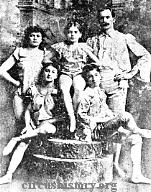 Photo: The Flying Jordans in 1897. Left to right, standing: Mamie Jordan; seated; Lena Jordan; center, Nellie Jordan; seated, Steve Ouff and standing, right, Lew Jordan.
But hold on to your hats! Now comes evidence that long before Ernie Clarke ever turned his first triple, a 16 year old Russian girl named Lena Jordan was turning triples as far back as 1897 and 1898! And just as astounding is the revelation that the same Lena also executed a "casting" triple between two catchers - not to and from the conventional "cradles," but with Mrs. Jordan, hanging down from a swinging catch-trap, "casting" the girl-leaper into a triple to a catch in the hands of Lew Jordan, also hanging down from another swinging catch-trap!
Over the years we had often heard about the legend of The Flying Jordans. Every now and then, when some "old-timer" happened to be reminiscing over sundry events of the distant past, they would extoll the feats of The Jordans. But somehow, the various tales always varied from each other, either pertaining to dates, names or places.
Thus, though we were familiar with the legend for a long time, we decided to exclude it from our installments because we had never come across any data or documentation that substantiated the legend - which was always considered more fiction than fact.
But lo, and behold! - the installment had no sooner come off the press when our good friends, Ray and Buster Melzora, unearthed some evidence which turned the legend into a fact!
Cluttering a corner of the Melzora attic in Saginaw was an old travelling trunk, left there years ago by Nellie Jordan - a daughter of Mrs. Lewis Jordan. In that old trunk were miscellaneous ancient mementos and documents of the past glory of The Flying Jordans. Among these was the usual collection of old lithos, photos, programs and scrap books which performers collect during their years of travelling over the world. And in that old battered trunk was evidence indicating that the rambling reminiscings of some of those "oldtimers" contained more truth than fiction - that the legend of The Flying Jordans was a fact! Piecing this welter of faded old data was a rather tedious job - from which emerged these salient facts:
Obviously, The Flying Jordans were a renowned American flying act, which also appeared in Europe, Australia and South Africa during the 1890's. Its personnel consisted of Lew Jordan, his wife, Mamie, and three children. One of two girls was their own daughter, Nellie; the other girl and the boy were apprentices, picked up by the Jordans while in Russia.
The girl's name was Lena, brought out of her native country when only in her early teens. According to Lew Jordan's own account of the girl's acquisition, which appeared in The Johannesburg Times and dated March 16, 1898, we read:
"Miss Lena is an adopted daughter of the Jordans. She was born in the city of Riga, on the Baltic, in Russia. She sprung from a humble Russian family and was christened Lena. When 14 years old, she was what is commonly termed "a weak, puny child." A troupe of celebrated American aerial performers happened to appear about this time at Riga, who, desiring to add to the variety of their gymnastic act, advertised for a child, a girl, to be apprenticed to them for a term of years to learn the profession of aerial gymnastics. Amongst the numerous applicants was our little Russian maiden, who, being selected from all the other applicants as being most suitable, was then and there apprenticed and left her parents to travel with her new employers to America."
In a similar account, presenting an interview with Lew Jordan in the Sydney Truth, dated May 23, 1897, we read:
"Mr. Jordan told this reporter how he had come to train Lena to the act. His wife and he had, when travelling in Europe, selected Lena out of about a thousand little girls, brought by their parents in answer to an advertisement for adoption in the troupe. 'She was then,' said Mr. Jordan, ‘about as weakly and reedy (?) a child as it would be possible to see, and I chose her for the very reason of her lightness, as I had in view a 'catching act' from my wife to myself, and I wanted a girl we could play catchers with good and easy. She is a Russian by birth.'"
If Lena was the "puny weakling" described by Lew Jordan at the time he picked her up in Russia, then the Jordans had certainly remedied that physical deficiency by 1897, for this same reporter wrote:
"From an anatomical standpoint, the physical development of Miss Jordan is truly remarkable. She displays a symmetrical development of the muscles from head to foot, the muscular system bearing every indication of careful, systematic and thorough general training."
In another interview printed in The Truth, of Sydney, Australia, and dated May 23, 1897, one reporter expounded:
"Miss Lena Jordan, the 18 year old member of the Jordan family, possesses a muscular development simply amazing. . . ." Further: ". . . Lena is still a very attractive atom of femininity. She scales 94 1/2 lbs. . . . and stands about 4 ft. 10 in. high . . . extraordinary biceps ... forearms as hard as that of a cast-iron god . . . and when she threw back her shoulders, a regular ravine was created between the rolls of muscles on each side of her spine."
No doubt this muscular development of Lena must have become the cause of some skepticism as to whether this person was really of the feminine gender or a small male performing in the guise of a girl. Perhaps in anticipation of such speculation, Lew Jordan evidently had Lena submit to some anatomic examination by some New York medics in 1896, for we read:
“. . . at a recent exhibition before the medical faculty in New York, the leading surgeons of Gotham gave it as their firm opinion that little Lena Jordan is the most absolutely physically perfect and healthy female that ever came under their notice."
Having disposed of Lena's origin and physical attributes, now we can analyze her ability as a performer. There can be no question that The Flying Jordans were considered an outstanding flying act, for the following excerpts from posters, handbills, programs and reviews indicate that they were.
From the Daily Telegraph, Sydney, Australia, April 24, 1897: "The Five Flying Jordans, the absolute monarchs of the air, in the most thrilling trapeze performance ever witnessed, presenting for the first time in Australia, their famous triple somersault and catch. These are the only artists in the universe who have ever accomplished this breath-suspending act."
The Sun, Sydney, Australia, April 9, 1897: "First and foremost are the Five Flying Jordans, a most interesting family, who perform an astonishing aerial trapeze act, in which one member, a girl of 15 years, accomplishes a triple somersault and catch, a feat hitherto considered by gymnasts as impossible."
The Sydney Mail, May 22, 1897: "20 years ago, a single somersault from a trapeze was regarded as a feat. Walter Silbon, who was in these colonies, created a sensation by demonstrating the possibility of a double somersault, and it was generally felt that anything further would be physically impossible. Yet, this little girl (Lena Jordan) actually performs the previously unheard of feat of turning three somersaults in midair while diving from a high trapeze to Mr. Jordan on a lower one."
The Melbourne Punch, July 30, 1897: "The Jordans are decidedly excellent in their line, and their feats as trapezists and gymnasts generally surpass those of any combination hitherto witnessed in Melbourne, The Silbons not excepted,"
The Australian Star, April 27, 1897: "The principal in the act is a pretty, petite brunette girl, about 15 years old. She is held by the hands of Mrs. Jordan, who is suspended by her feet from the trapeze at one end of the auditorium. They swing to and fro in the air a number of times, gradually increasing the force of their momentum. When the proper point is reached, the little girl is flung out into space, spins around like a ball, making three distinct somersaults, and, as she comes down the last time, she darts out her stretched arms, and her hands are grasped by Mr. Jordan, who is hanging by his feet from the trapeze suspended just above the stage. It is a hair-raising performance, the like of which has never been seen in this country!"
The aboves are but a small portion of similar items found by Ray and Buster Melzora in that old battered trunk. But they suffice to ascertain the fact that The Flying Jordans, with Lena as their "top" leaper, were executing the triple as far back as 1897. Just how long before that date had they done so, is a moot question.
A question which also comes to mind is: Was this really a true "flying-return" number? - or should it be considered as belonging in the casting act" category?
If we are to accept one of the reported descriptions of the performance, then it would not be a true "flying-return" act - but more of a "flying-casting" number. However, if we are to appraise another description written in "The Truth," dated April 11, 1897, we read:
"This act is accomplished by the 15-year-old girl, Rosa (?), who leaves the central trapeze, swinging into space; then, releasing herself from the bar, she turns three complete somersaults - that is, she makes three complete revolutions - before alighting in her father's arms."
The above would indicate a typical "flying-return" act rather than a "flying-casting" - for the reviewer specifically reports: "releasing herself from the bar."
It is doubtful that the "Rosa" mentioned would be the other girl in the act - for the writer does specify: "the 15-year-old-girl," which was Lena's age and (judging from the photos of that day) at least approximately 5 to 6 years older than the other girl. Obviously, the insert of "Rosa" instead of "Lena" must be a typographical error.
After considerable study and appraisal of the many reviews from Australia and South Africa, Buster Melzora has come to the conclusion that the Jordan's number was actually a true "flying-return" act, but including one routine which should be considered "flying-casting."
According to the data, Buster is of the opinion that Lena executed a triple to Lew Jordan in the customary fashion from a fly-bar - except that, instead of taking off from the usual pedestal, she launched herself into her swing by hanging from her knees from a trapeze bar suspended high over the pedestal board.
After appraising the data, it becomes evident that it must have been Lena who also executed the "casting" triple between Mamie Jordan's and Lew Jordan's hands - unless the boy in the troupe might occasionally have performed in the guise of a girl under the name of Rosa.
But, if so, the pseudonym Rosa would have been mentioned more often by the reviewers. And if he was the one who executed this routine in question regularly, then they also would have mentioned his name, Steve Ouff, another youngster which the Jordans had also picked up in Russia.
The photos of the act during that period include Nellie Jordan, oldest blood-daughter of the Jordans. However, she couldn't possibly have been the one to execute such a difficult routine, for no one of that age would be capable of turning a triple.
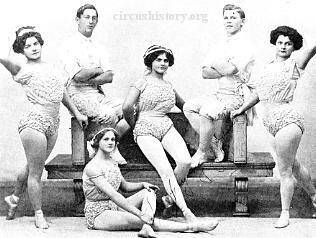 Photo: The Flying Jordans in 1910. Left to right, Nellie Jordan, unknown catcher, Josephine Jordan, George Novikoff, Mamie Jordan and the lady seated on floor is unidentified. George Novikoff Collection.
In the search for additional confirmation of the Jordans' feats, we contacted the oldest of the "old-timers" available today. Among these were Polly Loretta (of the Loretta Twins, famous barrists of the 1910 period) who had known the Jordans intimately; also some friends and relatives of Oscar "Linskoffi" Jordan, adopted by the Jordans; and George Novikoff, still another Russian boy picked up in Vladivostock - and who later remained as the top-leaper after Lew Jordan turned the act over to his wife and two daughters, Nellie and Josie.
Obviously, the Jordans had a strong propensity for picking up Russian youngsters and molding them into great trapezists - for not only Lena, but George and Oscar became great performers on the fly-bar!
From the discovery of the Melzora brothers has emerged sufficient evidence to ascertain that the legend of The Flying Jordans was indeed a fact. Lena Jordan was executing the triple from a fly-bar - at least in Australia and South Africa - quite a long time before any other leaper ever staked a claim as being the "first" one to accomplish this feat!
For this enlightenment, we must proffer our thanks to Ray and Buster Melzora. Simultaneously, we must also offer our apologies to Buster for an "error of omission" in Installment No. 3, Part II, of the Flying Trapeze topic.
At the time, we had written a rather detailed account of a feat of The Flying Melzoras, which has been considered even greater than the execution of the triple. Somehow or other (probably due to the pressure of meeting the deadline), the pages on which this was written were lost in the shuffle and never reached the editor. Since we are making corrections for past errors, we will belatedly include it in this installment now.
What is this feat which can be considered greater than the triple from the fly-bar? It's called "The Majestic Leap" - and was created by Buster.
Who says it is "greater?" One irrefutable fact: Over the years, more than 20 leapers have succeeded in executing the triple from the fly-bar. But not a single one has yet succeeded in duplicating Buster Melzora's Majestic Leap! Many did try but failed. Matter of fact, many, upon seeing Buster execute it, have blinked and said: "Impossible! It can't be done!"
Exactly what is this "Majestic Leap?" Well, it consists of a back somersault "double pass," during which the No. 1 leaper is returning from the catcher's hands to the flybar, while, simultaneously, the leaper No. 2 is leaving the fly-bar to execute a back somersault over the returning leaper No. 1 before grasping the hands of the catcher.
Now the average circus buff could not be expected to recognize that such a seemingly simple "double pass" offers more difficulty of execution than a triple somersault - which incidentally, Buster was also doing daily regardless of the fact that he was 6 foot 1 inch tall and weighing 178 pounds. Considering the fact that most flyers are seldom more than 5 foot 5 and weighing hardly more than 145 pounds, Buster was considered a freak! Anyone who's ever swung from a fly-bar will tell you that - technically speaking - doing a back somersault from the fly-bar over another returning leaper from the catcher to the fly-bar is absolutely an "impossible" trick!
Usually, the "double-pass" is executed with the second leaper "vaulting" from the fly-bar over the returning first leaper - either with a simple "vault-over" or a "forward" somersault. But in the "back somersault double-pass there are four dangerous moves involved. 1. Timing: If late, the going leaper No. 2 will kick the returning leaper No. 1 in the face. 2. Height: In turning the back somersault over the returning No. 1 leaper, the No. 2 leaper must gain sufficient height to clear him. 3. Control: If the No. 2 leaper turns over too fast and/or too early, the No. 1 returning leaper will ram into No. 2's stomach. 4. Blindness: Once the No. 2 leaper has lifted into his back somersault, he is unable to see the No. 1 leaper underneath. Put them all together - and the answer is: "Impossible!"
Nevertheless, Buster Melzora, with Paul Garee on the catch-trap and Anne Melzora (Buster's sister-in-law) as the No. 1 leaper, executed this seemingly "impossible" feat daily for a 5 year period! Buster, who also executed the triple during that same period, considers that "double-pass" even more difficult than the triple.
And any leaper who ever swung from a fly-bar will agree to that!
Having disposed of those two main errors of omission," in the next installment, we will try to correct the "errors of commission" - begging the reader their forgiveness of our mistakes.
(To be continued. In the final installment, more about the Flying Trapeze, The 3 Bars, Risley and the Teeterboard).
Each season there are seen numerous new titles on the road, and some of the old ones don't come back. For everyone that closes there is a new show to take its place and such is the case of the Turner Bros. Dog and Pony Circus.
The show was owned by Percy Turner and Al Smith, with Percy and Joy Turner managing the show. Percy being new to the circus media, built a strong little show regardless of his inexperience. The show was framed by Percy and Joy Thomas, with the help of their three sons, Percy, Jr., Bob, and Vincent.
Jimmie Wood provided most of their rolling stock. Percy, having spent much of his previous life in the sign painting business, took a brush to the equipment can came up with some of the most beautifully painted equipment on the road in 1958 and 1959. The trucks were red, white and blue. Red bottom, white in the middle, and a blue top. Lettering was on the white, done in red and yellow, and there was some yellow scrolling on some of the equipment.
Rolling equipment was assembled from Jimmie Woods as follows:
(1) Semi - Canvas and pole wagon - 33'.
(2) Semi - Ticket wagon - 281.
(3) Big Top Sleeper.
(4) Seat wagon - Flat bed - (also carried cages).
(5) Band Trailer - 14, - (also hauled calliope).
(6) Bus - Band Sleeper (used for wardrobe).
The show also carried three parade and menagerie cages, which were painted red with yellow lettering on them. Also three llamas and a goat.
The big show canvas was a 70 foot round with two 30 foot middle pieces, one ring and one stage.
The General Agent for the show was Lee Smith, and Gerrimaine Stanfield in the office, and announcing the show in real circus style.
The show opened its 1958 season in the late fall at Clairmont Shopping Center in San Diego for four days: October 9, 10, 11 and 12.
The program ran just over one hour with a spec given in the old-time circus tradition, while the five piece uniform band opened it, marching down the hippodrome track playing "On the Square" March.
Dale Petross lead off the spec mounted on a horse carrying the American flag, followed by Mrs. Joy Turner in costume, then two mounted riders, six ponies, the rest of circus performers and then Gene Holters two elephants, Rocky and Big Babe.
The program was presented as follows:
1. Elephant - Rocky - Ray Chandler.
2. German Police Dogs. Pony Act.
3. Clown Walkaround.
4. Trampoline - Larry Shaul & Co.
5. Acrobatics - DeLyons Troupe.
6. Clowns.
7. Uno - balancing, concluding with a one-finger stand - DeLyons Troupe.
8. Liberty Horses - Dale Petross.
9. Elephant - Big Babe - Ray and Thelma Chandler announced by Gene Holter.
Gene Holter provided the German Police Dogs and the two elephants, Rocky and Big Babe. Clowns on the show were Abe Goldstein, Al Hubbard, and Jim Spice.
As previously mentioned the show opened at Clairemont's South Quad Shopping Center, where the show did good business despite Ringling's advance ticket sale for their appearance at nearby Westgate Park.
The band was headed up by Billy Carmen, with four other members of the local musicians union. They had a very good sound, although they played mostly dance music instead of circus music. The show also had a calliope, which was played by Lou Johnson on occasion, but Lou became too ill to continue on.
After Clairemont, the show laid off for three days, and then showed at Old Town on October 16. The reason for the layoff is attributed to several things.
When the show arrived on the lot from the previous stand, the fire department wouldn't let them set up before the lot had been completely bulldozed. Also it seems, that the sponsor forgot to get the license to play Old Town, so the show had to acquire this, thus causing the show's trucks to be parked on the street for two days. The rest of the show's equipment was brought over on the 16, and despite all their previous troubles, they had two three-quarter houses. Also here, Ted DeWayne and his troupe joined on for about four days.
The third stand was at Linda Vista on October 17, 18, and 19. This was a nice short move, but the animals and cages were left at the Old Town lot. Here again the sponsor neglected to get the lot license, causing a late evening show the first day. It was a very good stand even though Ringling was in Westgate Park now about a mile away. Matinees on both Saturday and Sunday pulled three-quarter houses.
October 20 was spent at Allied Gardens. Here again the animal cages were late arriving on the lot, also the ticket wagon. The light plant wasn't working because one of the working men had switched junction boxes from 110 to 220, blowing everything out. (This was the second time this happened, first at Old Town). Yet the show had near capacity crowds.
Lakeside was on the 21, 22, and 23 of October. The show was supposed to play Santee, but because of a mixup, played Lakeside. The bus and three cages (which contained a lion, leopard, and ocelot) were left on this lot for three weeks.
Alpine was the October 24 date, but the show didn't play because of the poor turnout.
The show had to move to Calexico because of some trouble with their license plates. They showed here for two days, October 28-29, then closed.
Most of the equipment went to the Fairgrounds at El Centro (Imperial, Calif.) and part was returned to Thousand Oaks.
A quick revamp of the dates during their 1958 season is shown below:
Oct. 9-12 - Clairemont, California
16 - Old Town, California
17-19 - Linda Vista, California
20 - Allied Gardens, California
21-23 - Lakeside, California
24 - Alpine, California
28-29 - Calexico, California
Winterquarters: Fairgrounds, El Centro, California.
Percy Turner decided to give it another try so he started framing the show again for an opening in early June of 1959. This time with Ret. Lt. Comm. Alan Smith of La Jolla. The show incorporated for $20,000.00.
There was no equipment changes, so these won't be re-listed. Boss Canvasman was Raymond Maxwell, and Bob Paradise was the show's General Agent.
The nucleus of the show was built around Roy Bible and his wife, Dolores Wicks Bible, and their acts. They had a four pony drill, dog act, Dressage Horse, Swinging Ladder, Spanish Web, Wild Animal act, consisting of two lions in a steel arena, and an elephant named Baby Boo, which was on the mean side. Also two clowns and Al Hubbard.
The show opened on June 28 for a two-day stand at National City to rather poor business. This was followed by Hemet, California for July 2. Then Perris, California, for the 3 and 4. It was originally planned for a one-day stand, but the show stayed over an additional day. The show then halted for re-organization on a ranch north of Perris for a week. After discovering their next dates were in mountainous territory for jumps over 125 miles each, they decided to call it quits then. This was the last appearance of the Turner Brothers Dog and Pony Show.
Percy Turner, owner, very open mindedly attributes the show's troubles to three things. (1) Lack of circus experience. (2) No dates, which goes back to the first. (3) Wasn't planned. The first season opened late in the fall when all the other shows were closing, although this was good for picking up acts. Also they had too little money to put a show of this size on the road.
Yet people learn by their failures, and sometime in the not too distant future, we will again see Turner Bros. Dog and Pony Show on the road.
My thanks go to Percy Turner for his help with this story. Also James M. Parker for the loan of his photo collection, and added comments.
No part of this publication may be reproduced in any form or means
Last modified February 2006.
without written permission of the author and the Circus Historical Society, Inc.