


Circus Historical Society
Bandwagon, March - April 1964
Back to Bandwagon Index
Bandwagon, Vol. 8, No. 2 (Mar-Apr), 1964. Note: Only some articles are included in this online edition. Not all illustrations are included. The Circus Historical Society does not guarantee the accuracy of information contained in the information in these online articles. Information should always be checked with additional sources.
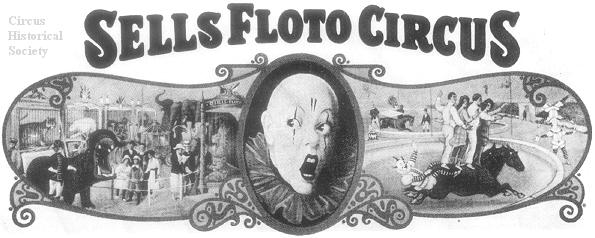
Reports from Peru, Indiana, in the early spring of 1924 indicated that the Sells Floto management would substitute performing animals for most of its standard circus acts during the coming season. The four ring barns and three arena buildings were a hive of activity as the trainers of the Sells Floto and John Robinson Circuses worked-up the acts that were to be featured in this second election year since the war. At West Baden, the Hagenbeck-Wallace trainers were also busily at work. Although this third member of the American Circus Corporation planned less extensive wild animal features, it promised to present a pleasing variety of acts for the season. Enough animal acts were in training at Peru to keep the ring-barns and arenas occupied for twenty-four hours a day. Two, twelve hour shifts were used with the Sells Floto trainers scheduled for the day shift one week and the Robinson trainers on duty at night. The schedule was reversed each week. The Robinson animal men included Ernest Schuman, Peter Taylor, Charles Guilfoyle, Clyde Beatty, Robert Thornton, W. W. Weaver, Cheerful Gardner, Bernie Griggs and Fred Nelson.
Sells Floto trainers that spring were Aage Christensen, Jules Jacot, Allen King, Joe Miller, Fred Collier, John Smith, R. M. LeDantes, Grover McCabe, Frank R. Kelso, George Allen and Louis Reed.
At West Baden, John Helliott, Bert Noyes and Robert McPherson carried the load with the comparatively few wild animal numbers to be displayed by the Hagenbeck-Wallace Circus.
This promised to be a far cry from the first years of the 'Twenties. In 1921 the management stated that "the performance presented by Sells Floto was strictly a circus performance with no tiresome wild animal acts on its program." This evaluation in the Pasadena Star News of October 18, 1921, continued with, "Probably one of the most outstanding features of the Sells Floto program is the total absence of 'carnival wild animal acts.' No mangy lions, whose claws are about to drop out or tigers which have to be fed with 'wet foods' because their teeth dropped out through age, or starved elephants which have to be propped up, were presented. Nothing but the highest class circus acts and features worth looking at were on display and the big audience thoroughly enjoyed itself."
This was a direct slap at the Al G. Barnes Circus in whose territory the Sells Floto Circus was playing, and which would be in the Crown City on November 12 with its quantity of featured animal acts. The "Circus Beautiful" continued to feature the traditional circus offerings until the 1924 season.
A great deal of construction had been completed at the Peru quarters during the winter season of 1923-24. Some buildings were finished, roads built, and high-pressure water mains installed. The fire-fighting equipment included two large electrically driven centrifugal pumps, which were capable of delivering water through the fifty fire hydrants at a pressure of two hundred pounds. When reports of the fire at the Ringling-Barnum quarters at Bridgeport in February reached Peru, this precaution against fire damage was especially emphasized.
Additional signs of modernization at the American Circus Corporation quarters were the installation of electrically driven sewing machines, electrically operated cutting and embroidery machines, steam and gas operated kitchens for the show's cookhouse, power harness stitching equipment, and new electric plants to augment the overhauled light plants. A new generator was also installed on the train to provide light and power to the fans and cooking ranges in the dining car.
By early March, personnel of both shows began arriving at Peru in preparation for rehearsals. The advent of spring allowed some of the trainers to work in the open and four rings, two arenas, and a high jump hurdle were moved outside. George Myers, creator of the grand entry and spec, was an early arrival. Kathryn Thompson, Ruth Irwin, Madge Fuller and Irene Ledgett were at work, and the painters were finishing the pure-white and red-orange trim for the Sells Floto show and the yellow with maroon trim of the Robinson circus.
Manager Zack Terrell and Assistant Manager Charles Bouleware made a hurried trip to Chicago to conclude plans for the opening in the Coliseum. The switch to the wild animal emphasis with the added arena and chutes for the cats made necessary a change of layout for the usual opening date. Plans were made for the 30-car show to leave Peru at midnight on March 31 and arrive in Chicago early in the morning of April 1. Rehearsals were scheduled to begin immediately. Publicity for the opening stand again emphasized the wild animal and horse act features of the performance. Promised by Frank Braden, general press representative, were a fox chase in Grant Park and an English tallyho, a master of hounds, people riding to the hounds, and hounds (packs of them), touring Michigan Boulevard each day. Very British, this opening. Posing and live statuary acts were eliminated for the season, according to reports from the show, but the number of horses was increased. Scheduled were forty-eight liberty horses and thirty high-school horses.
In addition to the number of horses involved in the performance, plans called for the big act of eleven tigers imported from Denmark. These animals were presented by Col. Aage Christensen, who accompanied them on the ocean voyage in February. Jules Jacot, principal trainer of the Sells Floto Circus, broke a large mixed group of pumas, lions and leopards and an act of fifteen female lions. Allen King's contributions to the performance were a male lion group, ten in number, and the bear act. The latter was made up of ten polar bears and one black bear. The elephant herd of fourteen was trained by Louis Reed and worked in three rings by Kathryn Thompson, Irene Ledgett, and Madge Fuller. One tiger was trained by Jacot to ride an elephant and was used in a steel arena feature early in the program.
While Sells Floto was moving into Chicago, the John Robinson and Hagenbeck-Wallace Circuses were making the last minute preparations for their season's tour. Word from West Baden was that Sells Floto and Hagenbeck-Wallace were to be routed into eastern territory. This would leave the west for the John Robinson Circus which had been in the east in 1923.
The Chicago stand of the Sells Floto organization was immensely successful and was the most profitable of the show's engagements in the city up to that date. The opening performance, a matinee on April 5, gave the fans of the city a surprise in that it was a very different performance from that of 1923 in the same location. The previous year had brought a complete circus performance with only one animal feature - the horses. The observers felt that the change in the performance, in which only the feature aerial, riding and acrobatic acts were retained, with the addition of trained wild animals, showed a real grasp of the changing trends of the circus world. Another intelligent move by Jerry Mugivan and his associates was the scheduling of a special train, three coaches and two sleepers, which left Peru at midnight on April 5 with executives of the John Robinson Circus and newsmen and fans of northern Indiana for an excursion to the Chicago performance of the Sells Floto show. The group arrived in time for breakfast at the cookhouse in the Coliseum before visiting the show, seeing the performance and returning to Peru in the evening. Frank Braden master-minded and hosted this venture and it was extremely successful, as well as an unusual, event. Business in Chicago continued to be very satisfactory throughout the stand. There were four turnaways during the first week.
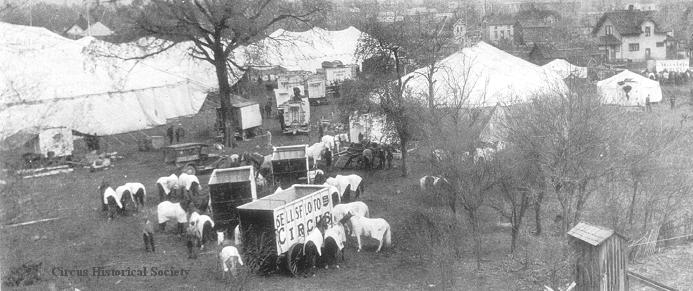
On the 28th of April, in the early morning hours, the Sells Floto train left Chicago for the run to the opening stand under canvas in Peru. New canvas, freshly painted wagons and equipment awaited the personnel on the lot in the winter quarters city. Capacity business greeted both performances; that in the afternoon being encouraged by the closing of the business establishments between the hours of two and four p.m.
Meanwhile the Hagenbeck-Wallace organization left West Baden on April 22 for its opening date in Louisville, Kentucky, on April 26. The John Robinson Circus had opened in the auditorium at Cleveland, Ohio, on April 16 for a week's engagement; left that city at the conclusion of the performance on the 22nd; and gave its first show of the season under canvas at Marion, Indiana, on April 25.
With the advent of the tenting season an exciting and somewhat confusing tour was in prospect. Excitement, and no little heartbreak, was brought to the situation by weather conditions. Confusion, especially to the advertising crews, descended as a result of many circuses trying to play the same territory at the same time. The greatest conflict of interest occurred because of the routes of the Sparks, the Ringling-Barnum, the Sells Floto and the Hagenbeck-Wallace circuses in the spring months. John Robinson and Al G. Barnes had some troubles in the west during the summer; and in the fall Sells Floto, Sparks and the Christy Show ran into each other in the south. In fact, the touring season started with the Christy and the Golden Bros. Circus running close together in April in - of all places - Texas, where there should have been plenty of room.
Some additional samples of the fight for territory indicate the strength that was necessary in the composition of the advance crews. Akron, Ohio, with its busy rubber industries, was scheduled by the Sparks Circus for May 5; Hagenbeck-Wallace on May 8, and Ringling-Barnum on June 25. Opposition brigades from all three of these shows were scrambling for space in Ohio early in May.
Sells Floto planned to play Newark, New Jersey, on May 9-10 while Ringling-Barnum was due to show there on May 26-27. Plainfield, N.J., was visited by the Sparks show on May 16 with Hagenbeck-Wallace in on May 27.
Buffalo, N.Y., was also a billing war with Ringling-Barnum booked for June 20 and John Robinson there for two days, May 29-30. However, after this skirmish the Robinson show turned west to Michigan where the Al G. Barnes Circus was playing. Early in the month of May the Robinson advance men were squabbling with the Sparks advance in Ohio.
The Christy Bros. Circus was in the vicinity of Pittsburgh late in May and Ringling-Barnum also played a stand in that city on May 30. Hagenbeck-Wallace had made a two-day stand there on May 12-13. Christy was on the lot at Elyria, Ohio, after a late arrival when the Al G. Barnes Circus passed through town headed for an even later arrival at Barberton where it lost its stand due to the lateness of the hour.
John Robinson played various locations in Detroit, Michigan, for a week at the beginning of June with Ringling-Barnum due in on July 14-15, and Al G. Barnes there for a week at the end of May.
New England became a part of the battle with Ringling-Barnum, Sells Floto and Sparks providing the fireworks. Sells Floto reached Connecticut by the middle of May with the Sparks forces into that state at the end of May and Ringling arriving on June 2.
Andrew Downie's Walter L. Main Circus reported, that of the twenty-six cities billed in Pennsylvania in May, eleven were opposition stands, and his show wasn't playing the large towns. Hagenbeck-Wallace, in its move from Ohio through Pennsylvania to New Jersey, probably supplied some of Downie's concern, while the early advent of the Christy Show in the Keystone state added to the frustration of Downie's billposters.
These samples of the advance brigades scrambling for space, and the circuses playing towns within a few days of each other or within a few miles of each other indicate the healthy business conditions of the country following World War I and the lustiness of the circus business itself. Reports indicated that industries were booming and that agricultural crops were in fine shape in the east and south. Many observers were critical of the situation and stated that this type of opposition booking did nothing to improve show business. Rather, it proved to be a costly investment in advertising and labor. Regardless of opinion, it was a tactic used at the time that has become a part of historical lore.
Sells Floto found April 29 at Richmond, Indiana, a fine day for weather and business, but the next day at Dayton, Ohio, brought the show onto a lot which was a sea of mud and water. The parade was cancelled and business was light. At Chillicothe on May 1 and Parkersburg, W. Va., the next day, the weather was pleasant again and business was better. The first week of the season concluded at Wheeling, W. Va., in another day of bad weather. The parade was omitted, the lot had mud ankle-deep and business was light. The mud-covered equipment was loaded that night for the 346-mile run on the Pennsylvania Railroad for the Monday stand, May 5, at Lancaster, Pa.
The second week of the tour brought good weather and good crowds at Lancaster, Pa.; New Brunswick, and Paterson, New Jersey. This last city was a two-day stand on the Clifton Race Track lot between Paterson and Passaic. The parade went out on a tour of Paterson on May 7 and then into Passaic on May 8. At Newark, May 9, the first wagon on the lot sank into the mud over the axles. This was Dayton and Wheeling combined. It took two hours to excavate the wagon, and meanwhile, Manager Terrell was searching for another lot. The old Federal League baseball park in Harrison was located, and a Harrison license was procured. The change in location was broadcast over the Newark radio station on Friday evening, and two performances were given on Saturday.
While the staff of this organization was not replete with outstanding names, they were very competent men, experienced circus professionals. With the outstanding leadership of Zack Terrell, they demonstrated many times throughout the season that they could handle this show in a business-like manner. Competition, extremely bad weather and sudden difficulties did not defeat them, or even slow them down for long. As mentioned, Charles Bouleware was assistant manager, and Frank Baden held the post of advance press agent. Other members were F. A. McLain, treasurer and auditor; Robert C. DeLochte, secretary; R. M. Harvey, general agent and railroad contractor; L. B. Greenhaw, local contractor; Elmer Lingo, special agent; Allen Lester, contracting press agent; Gerald Fitzgerald, press agent back; Joe Wallace, general superintendent; Frank Gavin, supt. of privileges; Ed Bowman, front door man; Harrison Riley, supt. of reserved seat tickets. George D. Steele was the legal advisor.
Fred Ledgett, was equestrian director of the fast-moving program and Victor Robbins led the fine musical organization of twenty-five members. The animal departments were supervised by Bill Laren, supt. of ring stock; Louis Reed, supt. of elephants and Emery Stiles, supt. of animals. Henry Brown was boss hostler. Jack Bigger held the trainmaster position; John O'Connell was supt. of canvas; Irving D. Newman, supervised the commissary dept. and Tom Myers was in charge of the lighting crew. G. H. (Blackie) Williamson was supt. of properties and W. M. Fullhouse had charge of the working crew. Charles Walbock was the blacksmith.
Ahead of the show were the 24-hour agents, Harry Busenbark and Curly Stewart. Paul W. Harrell was manager of advance car No. 1; William E. Polkingborn had advance car No. 2, and Arthur Diggs was in charge of the No. 3 car.
The veteran William H. McFarland was side show manager and outside lecturer. The inside lecturer was Jack Tyrone. Al Isenberg, Jack Elkins and George Stranzs took the tickets and Capt. Jacobs and George Bailey were on the doors. The attractions were presented under a top that consisted of a seventy with two forties. Displayed on platforms covered with rugs and drapes were Mlle. Cleo, snakes; George Nelson, tattooed man; Cuban Mack, sword swallower and fire eater; Swatchiki, sword walker; Capt. Kearn's Kilties (5 people); Paul Herold, giant; Dykman, fire-eater; Tormalita, long-haired lady; Tiny Mite, midget horse; Princess Elizabeth, albino lady; Jack Tyrone, magic and Punch and Judy; Carlos Gonzalez, impalement act; Kalakeon's Troupe of six, Hawaiians; the Five Stranzs Sisters called the Colonial Belles (added later in the season), and Professor Proctor's Band and Minstrels.
The third week of the season opened at Reading, Pa., on May 12. Sparks Circus had been scheduled here early in the season but had apparently dropped the date, and the Ringling Bros. and Barnum & Bailey Circus was to arrive on Thursday of the same week. The parade got off the lot in bright sunshine but returned in a heavy rain that continued into the afternoon. There was only fair business for the afternoon performance but the weather cleared by night and attendance improved. At Pottsville the next day the weather was clear and business was again big. But on the 14th, at Lebanon, it rained from mid-day on. Phoenixville and Norristown in Pennsylvania and Burlington, New Jersey, concluded the week with weather improving and business good. The parade was cancelled at Phoenixville because of difficulties getting on and off of the muddy lot.
Stamford, Connecticut, opened the fourth week with a wonderful stand. New Britain and Willimantic in Connecticut and Worcester, Springfield and Framingham in Massachusetts were the concluding stands of the week before the Boston engagement. At the last stand the show paraded despite strong winds and rain.
The Sells Floto Circus went into Boston the week of May 26-31 and used a new lot located at Andrews Square, South Boston. Techniques for encouraging attendance were good, since all records for the circus were broken. C. W. Finney, assistant to R. M. Harvey, got out a one-sheet and herald that graphically displayed the subway connections to Andrews Square from all locations in and about the city. Terrell's method of organizing the arrival of the huge crowds on the lot, so that speedy entry to the big top seats was attained, was outstanding. The opening night performance was broadcast over WNAC, and this, added to the lavish billing and newspaper coverage, further encouraged attendance. Three performances were given on Memorial Day to accommodate the crowds. The last wagon cleared the lot before midnight on May 31, and the show was loaded for the run to Utica, New York. Apparently, the show was enlarged for the Boston stand since notes by Mr. Marcks report that two Sells Floto trains passed through Pittsfield, Mass., on June 1. The first section of 29 cars went through town at 8:30 a.m. and the second section of ten cars, used for the Boston date only, cleared town at 10:30 a.m.
Opposition was still a factor in the tour for the Sparks show had entered New England from Long Island while Sells Floto was spending the week in Boston. Ringling-Barnum was returning to the east from a brief tour of Pennsylvania and New Jersey. On June 2, the week opening Sells Floto's fifth under canvas, Ringling was in Waterbury, Conn., Sparks in Woonsocket, R.I., and Sells Floto in Utica, N.Y. In fact, the Ringling-Barnum show was to be in Utica just two weeks later. This Sells Floto stand was followed by Seneca Falls, N.Y., on June 3 and Canandaigua, N.Y., on the 4th. This date again brought rain, mud and discomfort. Fulton, Rome and Gloversville, all New York State, concluded the week.
The opening stand of the sixth week brought "The Circus Beautiful" into Pittsfield, Mass., at 11:30 a.m., on Sunday, June 8, according to Mr. Marcks. His notes indicate that the train of 29 cars included six horse cars, fourteen flats, eight sleepers and one stock car. He recorded the names of the eight coaches which reflect the early history of the Sells Floto Circus in that, for the most part, they were names of Colorado landmarks and were related to the Tammen and Bonfils shows. Five were named as follows: Pueblo, Colorado, Denver, Pike's Peak and Royal Gorge. A sixth was called Cody, after the frontiersman who reluctantly terminated his days with the Denver based outfit. Tambon was the seventh, and referred to the second baby elephant born to Princess Alice and Snyder of the earlier show. The eighth coach was named Mississinewa, after a small river near Peru. Mr. Marcks reported that the cars were painted white with red ends and that the coaches were white with red ends and tops.
Sunday at Pittsfield brought the ever-present rain in the afternoon during which the show unloaded and set up its tents. Baggage stock used in this operation included four, eight-horse teams; eight, six-horse teams; five, four-horse teams, and four, two-horse teams. Two elephants were used to pull wagons around the lot. Another animal active on the lot that Sunday afternoon was the hippo, which was out of its cage for exercise. The observer's account of the horses on the show lists 120 baggage horses and seventy-two ring horses. There were three tents for the baggage stock. Additional animals noted at the time were fourteen elephants, four camels, two baby camels, one llama, six ponies, three donkeys, and fifteen cages which contained exhibition stock and performing cats and bears.
The composition of the herd of fourteen elephants is only complicated by one factor and that is the lack of positive identification of the young elephants delivered to the show from Hagenbeck, Germany, in 1922. Frieda and Trilby had been Sells Floto property for about twenty years at this time and were an important part of the show's operation. Young Snyder, a good-looking young male, had been on the show for about five years and Mary, a young female, was in her seventh season with Sells Floto. She was to meet her death four years later after a long run in blistering heat from Spokane to Lewiston, Idaho. Kas and Mo, the famous "twins" of 1911, were still in the elephant herd with Mo living until the Coliseum date four years later and Kas going to Al G. Barnes and then the Ringling-Barnum circus before her death in the menagerie fire at Cleveland, Ohio, in 1942. Big Tillie and Virginia were delivered to the Sells Floto quarters in Denver, Colorado, in early February, 1922. They were described as “mother and baby" arriving from Calcutta, India. Bill Woodcock has reported that Virginia was purchased by Win. P. Hall from Rube in 1921 and was sold to the John Robinson circus that year. Big Tillie, over thirty years old at that time, may have come from the same circus, but I have been unable to clear her previous biography with any certainty. It is safe to say that neither animal arrived directly from India. However, both she and Virginia became a part of our circus history with Tillie joining the Ringling-Barnum herd after the close of the Sells Floto Circus. Virginia, of course, had a checkered career after she left the Corporation show in 1928 and did not become a noted member of pachyderm society until she came on the Mills Bros. Circus in 1942. Her name was changed to Burma in 1935.
These eight bulls were certainly on the herd for the 1924 season and the remaining six must have been some of the members of the group delivered in New England during the 1922 season. Of these, Myrtle, Charley-Ed and Tommy were likely candidates for membership in the 1924 herd. Myrtle died of exposure during the stampede at Cranbrook, B.C., in 1926. Charley-Ed trouped with the Sells Floto forces through 1932; spent a couple of seasons on Hagenbeck-Wallace, and then joined Tommy, Prince and Joe on a trip to the west coast to make the film, "Clive of India." These four males, two of them (Charley-Ed and Tommy) sporting a single tusk, had a wonderful time in the warm breezes and sunshine at Baldwin Park that winter. William "Red" Powell once told me that this winter of 1934-35 was a picnic for these bulls, but one long headache for the handlers. All the men working the elephants at Baldwin Park were glad when the film was finished and three of the bulls departed. Charley-Ed went to the zoo in San Francisco and his name was changed to Wally. On June 18, 1936, he killed Ed Brown and was executed. Prince killed Joe Reed at Baldwin Park and was sold to the San Diego Zoo, where he died within a few months. The heavily-chained Tommy went back to Peru in June of 1935 and Joe remained at Baldwin Park, chained in one corner of the bull shed. He was executed in 1939 before Cheerful Gardner took the herd to Thousand Oaks. Joe was a very tall, slender male with no tusks and had been Ringling-Barnum property since he arrived at Bridgeport in November, 1922.
If Myrtle, Charley-Ed and Tommy were on the show in 1924, as I assume, three bulls remain unaccounted for in the herd. One of these could have been Tony. She was probably with the herd before 1926 when she definitely was a part of it. There are several possibilities for the thirteenth and fourteenth elephants but the reader should not be exposed to studied guesses. Rather, it is to be hoped that some historian or former circus employee would share his information on this subject so that the exact composition of the herd can be determined.
Regarding the beautiful white wagons so often covered with mud during the 1924 season, Joe Bradbury writes, "By a careful perusal of the Condon set of 1924 Sells Floto photos it seems the show carried at least 7 band and tableau wagons, a steam calliope, and an air calliope. This number and type should be about correct as detailed parade and loading lists for Hagenbeck-Wallace at the time indicate that the show was carrying 7 tabs, a steamer, and air calliope. However, it is possible Sells Floto did have additional parade wagons not listed here."
Author's note: Mr. Marcks noted twenty-four wagons in the parade at Pittsfield. This could mean that the fifteen cages plus the nine listed by Bradbury comprised the parade vehicles.
Joe Bradbury's research continues. "The Elephant Bandwagon (see photo No. 6) had been used as the No. 1 bandwagon in parade for several years and probably was used to lead the march in 1924. This vehicle had been built at the Denver quarters about 1905 for the Great Sells Floto Shows and had been on Sells Floto continuously from 1906. (See Circus Wagon History File, November, 1957, Bandwagon).
"New to the show in 1924 was the Gladiator and Lion Bandwagon (see photo No. 2) which had been on the John Robinson Circus through the 1922 season. There is a possibility the wagon was on Sells Floto a year earlier in 1923 but all evidence seems to have it stored at Peru quarters that year. (See Circus Wagon History File, Sept.-Oct., 1963, Bandwagon). it was used as the No. 2 bandwagon in parade.
"A huge wagon, commonly called the Buffalo Tableau (see photo No. 4), was also used to carry a portion of the big top band in parade. Photos indicate that evidently the band was split into three sections for parade purposes. This wagon, according to tradition, originated on the Buffalo Bill Wild West Show in the 90's and carried by the show through the 1908 season and then was on the Buffalo Bill-Pawnee Bill show from 1909 thru 1913. However, I have never seen a photo of the wagon on either the Buffalo Bill or Two Bill's shows. The wagon first appeared on Sells Floto for the 1914 season. Title for the show for both 1914 and 1915 was Sells Floto-Buffalo Bill. In that period the wagon had extensive carvings on the side in addition to the large center buffalo, or more proper, bison, carving. By 1924 all of the carvings, with the exception of the central figure, were gone, however elaborate art work was done on both sides, front and rear of the wagon. On the front, under the footboard, is pictured what appears to be Buffalo Bill himself or a fellow frontiersman. Bill died in January, 1917, but Mugivan and Bowers acquired full rights to use the Buffalo Bill title when they purchased the Sells Floto show following the 1920 season.
"The sideshow band rode the Running Lioness Tableau in parade. This carving of the lioness originally appeared on a highly carved tableau wagon which was built in the 90's for the Great Wallace Shows. It went to Sells Floto about 1906. In the period 1906-24 the carvings on the wagon gradually disappeared until finally only the central carving of the lioness, itself, was left. The 1924 wagon is most surely either a new wagon with the carving tacked on the side or conceivably a very extensive rebuild of the original. There is no doubt the lioness carving, itself, is the same that appeared on the Great Wallace wagon 25 years earlier. (See photo No. 11).
"The clown band probably used the India or Jardiner tableau wagon in parade. (See photo No. 4). No 1924 photos show the clown band on the wagon but from process of elimination it seems likely this was the one. John Robinson used it for their clown band in 1921-22. The wagon was built in the early 1900's for Pawnee Bill Wild West and it was on that show through the 1907 season. From 1909-14 it was on the Mighty Haag Railway Show and in 1915 was on the Wortham & Allen Carnival.. In 1916 it was on Wheeler Bros., the large rail show put out by Al F. Wheeler and Van Leer Black that claimed 30 cars and lasted a single season. By some unknown route it got to Mugivan and Bowers and was on John Robinson Circus for sure in 1921 and 1922 with a possibility it was there earlier. It probably was on Sells Floto in 1923.
"The show also carried a tableau wagon which historians call the Dancing Girls wagon for identification purposes. It featured a painting in the center of the wagon with two carved statues of 'dancing girls,' one on either side. The late Bill Woodcock once said he believed the wagon to have been built in 1923 at Peru quarters for Sells Floto, probably by Bill Curtis, with the two statues possibly coming from an old Great Wallace Tableau wagon. I have never seen the statues on any other wagon prior to this one. Costumed performers no doubt rode the wagon in parade. (See photo No. 7).
"The seventh and final tableau wagon appears faintly in the background of photo No. 3. On the original photo it shows plainly enough to identify it as a drop frame type wagon with the sides painted with various comic type characters. Photos show this wagon on John Robinson in the period 1919-20 and an undated photo, probably 1923 or 1924, show it with the Sells Floto title printed on the sunboard. Costumed performers appear to be on the wagon. It would be assumed the wagon had been built for Mugivan and Bowers in the late teens probably by the show's own forces.
"The air calliope (see photo No. 3), was a rather short, box type, wagon typical of most of the air calliopes carried by circuses in those days. The origin of the wagon is somewhat obscure however many historians speculate that the 1924 wagon was a rebuild of an open type air calliope Sells Floto had in the period 1917-20. Similarity of profile, structure, corner and panel posts, etc., lead them to believe the open sides of the 1920 vehicles were merely closed it to give it the 1924 appearance.
"The familiar Two Jesters steam calliope brought up the rear of the 1924 parade. (See Circus Wagon History File, Nov.-Dec., 1958, Bandwagon). This wagon had been built by Leonard Ainsworth and Charlie Luckie at Denver quarters about 1920 and had been on the show since that time.
"Presently both the Elephant Bandwagon and the Two Jesters steamer are preserved at the Ringling Circus Museum in Sarasota and the center panel carvings off one side of the India or Jardiner wagon are displayed by the Miami County Historical Society in Peru."
As mentioned earlier, Sunday brought rain to Pittsfield, but on Monday, the show date, the weather was ideal. North Adams and Holyoke also provided good weather and good attendance. The Sparks show played the latter town the Wednesday previous to the Sells Floto date. Thursday and Friday were devoted to stands in Brattleboro and Bellows Falls, Vermont, with Saturday's date in Claremont, New Hampshire. It was a week of good business, good weather and no haul longer than sixty miles. Frank Braden's radio publicity from Boston had provided keen anticipation for "The Circus Beautiful" throughout New England and each day brought comments from the patrons that they had listened to the broadcast from Boston.
The seventh week opened at Keene, N.H., and then the show moved back to Massachusetts for stands at Creenfield, Fitchburg, Lynn and Gloucester, and then back to New Hampshire for the Saturday date at Nashua. Manchester and Concord, N.H., opened the eighth week and on Wednesday the show returned to Massachusetts again to play Lawrence, Salem and Haverhill with a return to Rochester, N.H., on Saturday.
These moves in New England were undoubtedly designed to embarrass the Ringling-Barnum and Sparks Circuses, and the schedule succeeded in doing just that. The Ringling forces had cancelled their Boston stand and juggled dates in New York State in order to avoid the Corporation show. The Big One made some complaint from Salem, Mass., on June 10 about Sells Floto paper and advertising; cancelled Hornell, N.Y., and got into Ohio with a sigh of relief at the respite from opposition within the borders of the Buckeye state.
Meanwhile, the Sparks Circus had been in Massachusetts during the week that Sells Floto moved into New York State; then had entered Maine and gone into Canada. Sells Floto followed Sparks into Maine with a date on June 30 at Augusta. Bangor, Waterville, Lewiston and Portland concluded the stands in this state and for the fourth successive week the Sells Floto show went back into New Hampshire for a Saturday stand. This time the date was July 5 at Portsmouth.
The tenth week opened with stands at Lowell, Brockton and Taunton, Mass., and concluded with dates at Woonsocket, R.I., Fall River, Mass., and Newport, R.I. The eleventh week opened at Providence, R.I., with the balance spent in Connecticut at Putnam, New Haven, Waterbury, Meridan and Hartford.
Monday's stand on June 21 at Albany, N.Y., opened a nine-day tour, of the Empire State. Ringling-Barnum had preceded Sells Floto into Albany on June 14. The Mugivan and Bowers show was the first to parade in Albany out of the new circus lot at Hoffman Park. The lot was first used in 1923 by the Al G. Barnes Circus which had been unable to parade. The Sells Floto Circus unloaded in the downtown railroad yards, hauled several miles to the lot, and then sent the parade out on time. Kingston, Walton, Norwich, Binghamton and Oswego concluded the week.
Olean, Hornell and Elmira finished the tour of New York State on Wednesday of the thirteenth week. The remaining days of this week included Scranton, Wilkes Barre and Allentown, Pa.
Week number fourteen opened at Asbury Park, N.J., on August 4 with the eyes of the agents of the opposition circuses upon the next move. The Sells Floto show had made some long jumps during the first part of the season but, except for parades lost because of the weather, the distances had not affected the schedule. The next stand for the circus was Wilmington, Delaware - 153 miles, three junction points, two terminals, and a change of railroad crews away. This long run was to be accomplished between two week-day stands. The train was loaded in the usual time after the night performance at Asbury Park and left that city about one half hour before midnight. It arrived in Wilmington about six o'clock on August 5. In spite of a rather long haul to the lot the parade went out on time. The humidity and heat were most oppressive at this stand, but the attendance was capacity at both houses. The show moved to York, Pa., for the Wednesday date and then to Frederick, Hagerstown and Cumberland in Maryland to conclude the week.
The first week in Virginia opened on August 11 and included stands at Winchester, Harrisonberg, Staunton, Charlottsville, Richmond and Newport News. Sells Floto was the first big show to play Richmond in 1924. The train was several hours late getting from the previous stand due to difficulty in negotiating a narrow tunnel at Crozet, Va. The second week in the state (August 18-23) began at Norfolk despite earlier difficulties in billing the town. While the show was in Asbury Park, Paul Harrell and his crew, began to bill Norfolk, despite an impending fair date. In 1916, the Virginia legislature had passed laws which prohibited circuses from posting bills or publishing newspaper advertisements within thirty days of the date of a fair. However, circuses were allowed to show the week prior to the fair, during a fair, or a week after the fair, but were discouraged from doing so by an excessive license fee.
Paul Harrell's crew was billing two weeks ahead of the circus date, and twenty-days ahead of the fair so arrests were made at once. R. M. Harvey, general agent for Sells Floto, had anticipated the difficulty and was in Norfolk in case of trouble. He retained a local legal firm which convinced the county attorney that the law applied to only those circuses which planned to show a week ahead, a week after, or during a fair. Since Sells Floto's date was nearly a month ahead, the prosecutor ordered the incarcerated advertising crews released and notified the police that no more arrests were to be made. The circus played Norfolk without trouble on the 18th and concluded the week at Petersburg, Farmville, Lynchburg, Roanoke and Pulaski.
The seventeenth week began at Bluefield, West Virginia, with Williamson, W. Va., as the Tuesday date. The next four stands were in Ironton, Portsmouth, Circleville and Xenia, Ohio.
The Sells Floto Circus returned to Cincinnati on September 1 and 2 for the first time since June 8, 1916. It played a lot in Cumminsville on Labor Day and moved to Norwood the following day. The lot in Norwood was small and the menagerie was side-walled. The weather was overcast and it had rained at the previous night's performance. However, in spite of the contrary weather, plans to broadcast from the circus lot were carried out by Radio Station WLW. A review of the program was published in the September 13 issue of Billboard.
The spectacle, "The Bride and the Beasts," was lavishly costumed and composed of a chorus, ballet girls, horses, elephants and camels. Principals were Matelene Schlessinger, Thelma Alton, Pearl Stewart, Frances Kayrle and Oscar Delle. Following this imposing presentation the circus performance got underway with pony drills by Rose Collier and Helen Young; bucking mule acts worked by Jim Williams and Fred Collier, and leopards and pumas presented in the steel arena by Jules Jacot.
Display No. 3 featured the hippopotamus walking the track while carrying a baboon on his back. Ponies, again presented by Rose Collier and Helen Young, were in the rings.
Display No. 4 featured a tiger riding an elephant (Jules Jacot) and elephants and ponies presented by Mildred Aylesworth and Stella Rowland. Meanwhile, a gaily decorated cart with horses, girls and dogs paraded the hippodrome track.
Display No. 5 was the first number which reflected the Sells Floto performances of the past. It was an elaborate aerial presentation and brought a welcome response from the audience. Lillian Ward, Irene Ledgett, Cecilia Fortuna, Helen Tybell, Little-Bit Leonhart, Bee Ward, Miss Caress, Rita Tybell and Polly Bennett were on the swinging ladders. Mayme and Nellie Ward were featured in cloud swings, and Erma Ward, the star of the Sells Floto 1924 tour, closed the aerial display with one-arm phlanges. She accomplished 208 turns on the night of September 2.
Display No. 6 brought back the wild animals, which consisted of a male lion act (six, cats) presented by Allen King. In the rings were collie dogs and ponies, worked by Rose Collier and Mildred Aylesworth.
Dogs dominated Display No. 7 with Jim Williams and John Smith handling the high-diving dogs and monkey act, and Joe Miller presenting the leaping hounds.
Display No. 8 brought the Riding Hobsons and the Albert Hodgini Troupe in two fast-moving, colorful, comedy riding acts.
The big tiger act (eleven) from Denmark, presented by Aage Christensen, was featured in Display No. 9. This group was well received at all stands during the season. In contrast to this powerful feature in the steel arena, trained geese, presented by Sophia Egener and Robert Hamm, were offered in the rings.
In Display No. 10, the patrons were given a chance to laugh as Art Adair's clown band strutted forth. Adair was producing clown, with the Koplin Trio, Toby Tyler, Phil King, Phil Keeler, LeRoy Thompson, Kinko, Jack Klipple, Bobby Hamm, Bill Caress, Jack Albion, Mal Bates, George White, Bob Emerson, Louis Shaw, Billy Ashton, Freddie Briggs and J. Welsh as assistants.
Spitz dogs, exhibited by Rose Collier and Betty Miller, flanked the bear act which was worked by Allen King. The group was composed of ten polar bears and one black bruin. Posing horses completed Display No. 11. They were handled by Mary Kinkio, Betty Miller, Pearl Stewart, Miss Gossans, Miss Keeler, Helen Young, Rose Collier, Alma Owens, Miss Johnson, Miss Caress, Mildred Aylesworth, Miss Nemo, Anita LaMarr and Miss McLeod.
An iron-jaw display, in which the LeRoy Sisters, Madge Fuller, Stella Rowland and the Tybell Sisters participated, comprised Display No. 12.
The female lion act, presented by Jules Jacot, was the feature of Display No. 13, with trained goats, by William Caress and Sophia Egener, accompanying acts.
Display No. 14 brought out clowns Phil King and Toby Tyler on stilts as well as the rest of the clowns.
The riding of the Hobsons and Hodginis followed the clowns for Display No. 15 and then Kathryn Thompson, Irene Ledgett and Madge Fuller brought out the elephants for Display No. 16.
Liberty horses, featuring twelve blacks in Ring One; twelve grays in Ring Two, and twelve bays in Ring Three made up Display No. 17. They were presented by Joe Miller, Fred Collier and John Smith. A clown walkaround followed the liberty horses for No. 18.
Display No. 19 brought on one of the best flying acts in the circus world. These were the two Flying Ward Troupes, eight people in each. Headliner was Mayme Ward, who highlighted the display when she accomplished a double somersault to Eddie Ward's outstretched hands while blindfolded and bound in a sack. This display attracted a great deal of attention during the week of the Boston stand and at all other locations. There were seven men and nine women in the act. The clowns appeared again following the flyers for Display No. 20.
The menage riders were in the spotlights for Display 21. Polly Bennett, Mildred Aylesworth, Hallie McCabe, Marv Kinko, Cecilia Fortuna, Betty Miller, Helen Young, Stella Rowland, Madge Fuller, Alma Owens, Kathryn Thompson, Irene Ledgett, Rose Collier, Ruth Jacob and the Misses Gossans, Nemon, MeLeod, Caress, Johnson, Hodgini, Hossford, and Bailey were the twenty-two menage riders.
The fox hunt, concluding with low-hurdle jumps, comprised Display No. 22, after which the high-jumping horses were the attraction for No. 23. The performance was concluded with the gentlemen's flat race, pony race with monkey riders, liberty races, tandem races and the Roman standing race.
The Wild West Concert featured the usual riding and roping put on by Fred Collier, chief cowboy, and Lloyd Schermerhorn, James McLoud, Clarence Kieffer, Dave and Rose Nimmo, Mr. and Mrs. Al McLeod, Margie Nelson, Anita LaMont, Kathryn Thompson, Anita Hossford, Golden Caress and Mr. and Mrs. Cuban Mack.
After completing the two-day stand in Cincinnati, the circus moved to Kentucky to finish the week. Lexington, Richmond, Lebanon and Louisville were the dates for September 3-6.
Owensboro and Hopkinsville in the same state opened the 19th week with Wednesday and Thursday stands in Nashville and Tullahoma, Tennessee. A two-day stand in Georgia at Atlanta completed the week. On Thursday, September 11, the newspaper in Statesville, North Carolina, carried a story about the arrest of Leo Smith and Edward Richards, billposters of the Sells Floto Circus. They were charged with covering posters of the Sparks Circus which showed Statesville on Sept. 12, the day Sells Floto opened in Atlanta.
The arrests indicated that the bitter fight between the Corporation show and the Sparks Circus, which had started in the spring, had flared up again. Evidence indicated that agents and billposters of both circuses were under orders to cover or tear down the paper of the other show. The battle was waging with particular heat in both North and South Carolina and Florida. Legal adjusters and general agents were on the spot and routes were changed to put one show in a town ahead of the other. "Wait" advertisements used by the Sells Floto Circus informed the public that this was the Sells Three-Ring Circus combined with the Floto Trained Wild Animal Show. It was reported that the 1924 publicity men believed that "the original Sells Bros. Circus was well-known and quite popular in this territory in the past." An interesting sample of the advertising distributed by Sells Floto during the fall is reproduced in the March-April, 1960, issue of Bandwagon. This paper ridicules the attempts of "A Certain Small Circus" to win patronage by insinuating that the Sells Circus is from another section of the country. It mentions the owners of the Sells Circus as Mr. Zack Terrell of Owensboro, Kentucky, and Mr. Ed Ballard of Miami, Florida, and urges the people to "Wait for the Big Circus."
However, competition for business in the south was not limited to Sells Floto and Sparks. The Christy Show had run into the Corporation advance at Bristol, Tenn., on August 11, and competed with Sparks billcrews in Alabama in September. The same occurred in Georgia, where the general agents of the Sparks Circus were at the Christy stands on more than one occasion making arrangements for their tour a month later. In fact, the Christy ownership reported that their tour of Alabama and Georgia brought the most "strenuous" opposition of the year, which probably was also the understatement of the year. Chief opposition seems to have come from the Sparks show which was fighting valiantly to hold what it considered its own territory. However, in an interesting move, the John Robinson Circus came into Alabama and Mississippi for October and November dates which put the Mugivan and Bowers squeeze from that direction. This flanking maneuver was similar to the role played by the Hagenbeck-Wallace Circus in the spring when it worked in conjunction with the main drive by Sells Floto.
The Ringling-Barnum circus, after running into a hoof and mouth disease quarantine in Texas which caused a change of routes, moved into Alabama late in October for three stands. This show added Atlanta, Georgia, and Greensboro, N.C., on November 1 and 2 and then made the run for home.
The Sparks Circus hastened into North Carolina early in September and set the pattern for a series of competitive stands reminiscent of the spring opposition activities. It played Asheville, N.C., on Sept. 10 with Sells Floto in that town on the 22nd of the month. Winston-Salem, High Point, Burlington, Durham, Raleigh, and other cities were witnessing two circuses within two or three weeks of each other. Sparks moved from North Carolina on October 1 to Georgia and Alabama while the Sells Floto Circus continued its tour of North and South Carolina. Both were within two weeks of each other at Jacksonville, Florida, where Sparks played October 13. Sells Floto had a two-day stand there on October 27-28. The brigades of both shows were in Florida early in October plastering everything in sight with paper.
The arrests of the Sells Floto men in Statesville, N.C., were engineered by the Sparks management according to the American Circus Corporation. In Salisbury, N.C., Sparks obtained an injunction which restrained the Sells Floto Circus from covering its paper and R. M. Harvey obtained a similar statement. As a result both circuses were "restrained and enjoined from mutilating, destroying, covering over, tearing down or otherwise damaging or interfering with the advertising matter, signs, posters and banners" of each other in that state. It is of peculiar interest that each circus paid one-half the court costs. Probably as much heat and vocabulary could be vented on a discussion of this fall opposition as was dispensed at the time. This summary may give some hint as to the emotions that were generated in the fall of 1924.
Sells Floto opened the 20th week of the tour on Monday, September 15, at Chattanooga, Tenn. Knoxville followed with Middlesboro, Kentucky, the Wednesday stand. It returned to Morristown, Johnson City and Bristol in Tennessee to complete the week.
The tour of North Carolina began at Asheville on September 22. A jump to Spartansburg, South Carolina, was made on Tuesday, and a return to North Carolina finished out the week - Statesville, Winston-Salem, Greensboro and High Point.
The twenty-second week was scheduled to open at Danville, Virginia, but heavy rain provided a swamp instead of a circus lot and both performances were lost. Since the cancellation occurred about an hour before the matinee doors were to open, an exhausting afternoon's work was undertaken to get the wagons off the lot and loaded in order to move to Burlington, N.C., for the Tuesday date. Durham, Raleigh, Fayetteville in North Carolina, and Florence, South Carolina, concluded the week of Sept. 29-Oct. 4.
The first five days of the next week brought the Sells Floto Circus to Charleston, Sumter, Columbia, Bennettsville and Darlington in South Carolina. Wilmington, N.C., was the Saturday stand and the show continued its tour in that state during the week of Oct. 13-18. Dates were played at Wilson, Rocky Mount, Goldsboro, Kinston, New Bern and Washington.
The twenty-fifth week completed the North Carolina tour on Monday and Tuesday when Salisbury and Charlotte were the stands. The last four stands in South Carolina were played during the rest of the week at Greenville, Anderson, Greenwood, and Newberry.
The two-day stand at Jacksonville, Florida, which opened the twenty-sixth week, brought outstanding business. On October 27 two performances were given at night in addition to the afternoon show. On the next day the house was "strawed" for both performances. Palatka, Gainesville, Lake City and Ocala concluded the week.
Monday, November 3, opened the week with another three-performance stand at St. Petersburg, Florida. Weather conditions had improved and business was good at these Florida towns. Tampa was a two-day stand and Lakeland, Orlando and Sanford followed.
Sells Floto moved out of Florida and into Georgia for the week of November 10-15. Waycross, Valdosta, Albany, Macon, Columbus and Griffin made up the week's schedule. An interesting sidelight of circus activity took place between shows at Macon, when a display of needlework was presented by the members of the ladies' dressing room. Judges, selected from the residents of the city, awarded the prizes to Rita Tybell, Mayme Ward, Kathryn Thompson, Harriet Hodgini and Mrs. Ray Bailey, all of which indicates that the ladies with the show had skills in addition to those displayed before the public at performance time.
The next to the last week of the season took the circus to Montgomery and Evergreen, Alabama; Pensacola, Florida; Mobile, Alabama, and Gulfport, Miss., from Monday through Friday, Nov. 17-21. New Orleans, La., was played to four capacity houses on Nov. 22 and 23, with Baton Rouge and Hammond concluding the tour in Louisiana. Four stands in Mississippi at Jackson, Hattiesburg, Laurel and Meridan concluded the 1924 tour of the Sells Floto Circus.
The John Robinson Circus had toured through this territory about a month before and had given performances in some of the towns played by Sells Floto in late November. In fact, Meridan was played by John Robinson on Oct. 29, a month before Sells Floto's closing stand in that town. The Robinson circus closed at Dyersburg, Miss., on November 13 and went into quarters at West Baden, Indiana. Sells Floto, of course, returned to Peru and Hagenbeck-Wallace closed at Little Rock, Arkansas, on Nov. 19 after a most interesting season's tour and moved into Peru to share quarters with Sells Floto. Thus the John Robinson and Hagenbeck-Wallace circuses exchanged quarters and plans were made by the American Circus Corporation to change the program of the latter circus to bring it into line with the wild animal features of Robinson and Sells Floto. This was to be accomplished by the use of a number of animals purchased from Ringling-Barnum in the fall of the year. The elephant herds of the John Robinson and Hagenbeck-Wallace circuses were even switched intact in order to strengthen the latter show.
This review would not have been possible without the cooperation of several CHS members. It is a demonstration of what can be done when various researchers willingly pool their efforts to supply information and is the sort of joint effort encouraged in these pages so often by our President, Joe Bradbury. Of course, the author is responsible for assembling the materials and any interpretations or deductions drawn from the resources provided.
Gordon Borders was the first to encourage the author to write of this season's activities of the Sells Floto Circus. He drew a great deal of information from his files which made the task easier. Joe Bradbury has furnished the illustrations, descriptions and history of the tableaus and calliopes without which this review would have been barren. Don Marcks, Bob Bernard and the late Col. William Woodcock also furnished details. Issues of the Billboard for the year 1924 have been consulted. In conclusion, I would like to thank Gordon Borders again for his encouragement and persistence in urging me to develop this article.
"The work of a circus performer holds its own significance; it is an artistic achievement which develops like a symphony, and it contains the composition of a painting and the rhythm of a poem." - Gustave Frejaville
The Flying Trapeze (Les Volants)
Ever since a Frenchman named Jules Leotard created "Les Trapezes Volants," the flying trapeze has always remained the favorite attraction that delights all circus fans. It is now more than a century since Leotard startled Paris when, on November 12, 1859, he presented his innovation at the Circus Napoleon, to the astonishment of both, the spectators and the professionals who, for the first time, were witnessing a man flying (at least momentarily) through the air from one trapeze to another somewhat like a bird leaping from one tree branch to another!
To be sure, Leotard's initial display of artistry on the flying trapeze was a far cry from what is now considered the accepted "standard." Today almost any high school gymnast would excel Leotard. His primitive rigging was also a far cry from what subsequently evolved from it. It consisted of 3 rather short trapezes aligned in a row over a 5 foot wide runway, the length of which was heavily mattressed. At one end of said runway was an elevated platform about 10 feet high. From this elevation, Leotard would launch himself into a swing from the first trapeze, to catch a second one which had been swung into motion by his father from the runway. The latter would then set a third trapeze into motion in the same manner-allowing his son to fly (?) from the second to the third, after which Leotard would climb the pedestal again and perform his next routine.
As can be readily deduced by the description of this crude rigging, Leotard's performance, when judged in the light of modern standards, couldn't possibly have been too spectacular. At the apex of his swings, his "passes" from one trap to the next could never have been more than 15 feet above the mattressed runway, while at the nadir of its arc, his feet barely cleared the runway.
If one is about to make comparisons between Leotard's achievement and that of the modern trapeze artist who actually flies more than 40 feet high to execute a triple, then Leotard's performance pales into significance. But the fact remains that Leotard was the creator of the flying trapeze and, as such, deserves to be honored for the innovation which has become a traditional "must" on every circus program.
The fact also remains that immediately after he presented this novelty at the London Alhambra, imitators began to appear in England, France and Germany, Subsequently, a host of newly formed teams and troupes of aerialists were presenting flying trapeze acts all over the world! Within a decade those inventive imitators were doing tricks that Leotard had never dreamed possible! By then the crude rigging had gone through many transformations and improvements, the major ones being: the advent of the all-important net, the "return-platform," and longer lengths of trapezes.
With these gradual improvements naturally came higher, lengthier and more complicated flights from one trap to another. This was followed by the introduction of the "catcher" hanging from another trapeze - and by 1900 no self-respecting circus would have considered presenting a program without a flying trapeze act.
By 1905, in Europe, were already such famous flyers as Edmund Rainat, Jules Alex and Raoul Monbar, who executed the double from bar-to-bar - with Alex also doing a "lay-out" back somersault with Only One Hand! In the States, there were the Seigrist-Silbon Troupe, with Walter Silbon turning a double and a half to a catcher; the Flying Wards, doing likewise, and Ernest Clarke, of the Clarkonians, turning a double with a full pirouette - which is not only different but much more difficult than the "twister."
For a long time most of the ringmasters, with their usual propensity to exaggerate, would loudly announce: "And now, ladies and gentlemen, introducing The King of the Flying Trapeze! - presenting his spectacular, sensational and sublime Triple Somersault!" And for a long time the average spectator, seldom sufficiently versed in the art of acrobatics to distinguish between fact and fiction, gaped with admiration and awe at the performer who never executed the triple - but only a double and a half, which at least a dozen other "kings of the flying trapeze" performed daily over a dozen other circus rings.
However, it was inevitable that, sooner or later, one performer would actually execute the triple. Inasmuch as circus performers are always striving to excel in their art, it is axiomatic that, in due time, one with sufficient patience and endurance, courage and determination, would master the order and rhythm - and succeed in turning the triple, One did. Others followed.
Somehow or other, whenever circophiles get to discuss the triple on the flying trapeze, the first name that comes to mind is always: Alfredo Codona, regarded by one and all as "The King" - and, in most instances, credited for being the first artist to perform the triple!
No one will contest that the great Alfredo's supreme artistry deserves a special place of honor in the Circus Hall of Fame. The ease, the rhythm, elegance and assurance with which he executed all of his "passes" were indeed unsurpassed! Truly an aesthetic achievement to behold! However due credit for the first execution of the triple belongs to Ernest Clarke who, with his brother, Charles, as catcher, was the first artist to succeed in performing the difficult feat! - almost 10 years prior to Codona's mastery of the triple turn.
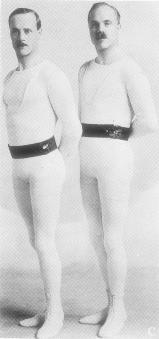 Photo: Ernest Clarke (left) shown here with his brother, Charles, in a 1919 photo. They were on the newly combined Ringling Barnum show that season. Burt Wilson Collection.
With the Clarkonians, it was younger brother, Charles, who first suggested it to Ernie - and who kept urging that they try it. Just as it had been before when attempting the double with the full pirouette, it was again Charlie who kept prodding his older brother not to give up, ribbing him sarcastically whenever (which was often) Ernie was ready to give up.
The double with the full pirouette had taken the brothers almost a year of assiduous and arduous practice - and more than 600 drops into the net before they'd managed their first catch; then 3 1/2 more years and approximately 2,000 more trips to the net before mastering that complicated "pass."
Digressing from the triple for a moment, perhaps the difference between the Clarkonians' double with a pirouette and other flyers' doubles with twisters should be explained. To the uninitiated, the Clarkonians' pass may not have seemed any different than that of Art Concello, who turned a back somersault with a half-twist, followed by a forward with another half-twist; or that of Ed Rainat, who turned his first back with a full twister, followed by a straight back before catching the bar of the return trap. It goes without saying that the latter, if executed with a catcher, would have been much easier to accomplish. Bar-to-bar, it was quite a feat! - for the unassisted catch of the bar not only required split-second timing, but also involved a shock of great magnitude which made it difficult for the performer to "hang-on" after the catch.
With Ernest Clarke, he first turned a complete double, then, unbelievable as it seems, managed to turn a full pirouette before the catch to his brother's hands. To this day, many professionals will tell you: "It can't be done - because the rapid momentum from a double on the vertical axis will prevent you from twisting the body on its own horizontal axis for the pirouette." Theoretically, this is true. The fact remains that Ernie Clarke proved the contrary! Therefore, is it any wonder that he was the first artist to execute the triple on the flying trapeze!
For Ernie and Charlie Clarke the triple actually did not involve as many hours or as many trips to the net as that double with the pirouette. Within two years they had mastered the triple sufficiently to present it in public - and by 1910 they were the first to accomplish the feat at every performance!
Perhaps it should also be mentioned that the Clarkonians, then performing as only a "two-men-team," had no one on the return platform to control the timing of the "fly-bar" for Ernie's return from the triple! That the Clarkonians were able to execute the triple with such precision timing as to make it possible for Ernest to catch the free-swinging "fly-bar" for his return is a finesse which no other flyer has yet duplicated!
Up to the time of his death in 1941, Ernie Clarke was always the first to concede that Alfredo Codona's triple was a more aesthetic achievement than his own. The fact remains that without the Clarkonians pioneering the triple back in 1910, there is no assurance that Codona would ever have been stimulated into duplicating the feat. It is also a matter of fact that it is the great Alfredo himself who publicly corrected the erroneous impression that he was the first to execute the triple.
In 1937, when the Clarkonians were appearing at an indoor circus at the Long Beach Auditorium in California, still presenting both of their acts (flying trapeze with Ernie's daughter, Ernestine, and rosinback voltige with the younger brother, Percy) it was the great Alfredo who blew his ring-master's whistle to call the audience's attention to something he wanted to announce.
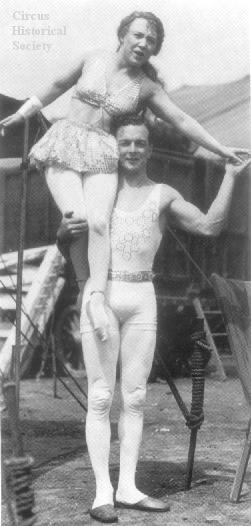
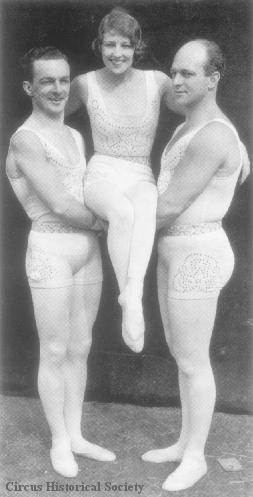
Photo left: Codona, the king and his queen, Lillian Leitzel. Pfening Collection.
Photo right: The Codona flying act as they appeared with the Ringling Barnum show in 1933. Alfredo, left, Vera Bruce and Lalo Codona. Burt Wilson Collection.
At the time, Alfredo's brilliant career had already come to an abrupt end as the result of an accident suffered in 1933. Public adulation had made him "The King" - and a King he proved to be when he addressed the audience that night. Those who were present on that occasion may have forgotten his exact words, but the substance of them will not be forgotten. It wasn't a lengthy or flowery oratory. Rather a brief, simple statement of facts which, paraphrasing it, ran something like this: "Since 1919, when I began turning the triple, I've been given the credit for creating it. But here before you tonight is the greatest flying trapeze artist of all times - Ernie Clarke! This is the man who first did the triple! - when I wasn't even dreaming of it. He is the one who inspired me. And as far as I'm concerned, Ernie Clarke is still the greatest!"
Coming from the lips of the fabulous Alfredo Codona (who wasn't exactly considered a "shrinking violet") this was indeed a heart-warming tribute! - which triggered a spontaneous ovation for Ernie Clarke.
Perhaps it may be considered slightly ironical that Clarke should have had to wait 27 long years before publicly receiving the credit due him. Perhaps it is also slightly regrettable that, in the midst of the tumultuous excitement of the moment, neither Alfredo nor Ernest had the presence of mind to express a few words of appreciation for their respective brothers, Lalo and Charles - without whom neither could ever have executed that seemingly impossible triple!
Also rather puzzling is the fact that no one present at the time ever mentioned the name of another great flying trapeze artist, who also had executed the triple in public at least one and a half years earlier than Codona.
From the days of Leotard's innovation to the present day, circus historians and chroniclers have written reams about the many artists performing on the flying traps. Yet, for some unaccountable reason, it is rarely that one can find the name of Ernest Lane mentioned.
Nevertheless, it is an established fact that Ernie Lane, then with "The Flying Wards," was catching triples publicly in the spring of 1918 at almost every performance. There is some evidence that Lane was turning the triple as far back as 1917, though complete documentation of this is not available. Also puzzling is the fact that, while the annals are replete with the feats of such famous artists as the Rainats, Alexes, Clarkonians, Seigrist-Silbons, Codonas, Concellos and others, it is not too often that one comes across many mentions of "The Flying Wards" - whose accomplishments were equal to the best!
Ed Ward, Sr. and his wife, Mayme, were not only splendid artists on the flying traps, but also the foremost teachers of the art, and out of their "Flying School" in Bloomington, Illinois, emerged the greatest number of outstanding catchers and flyers that ever performed over a net! - including Arthur and Antoinette Concello!
It was under Ed Ward, Sr.'s tutelage and with Ed Ward as catcher that Ernie Lane became the second artist to publicly execute the triple in the wake of the Clarkonians. But Lane's fame was short-lived. On the 8th of April, 1921, when The Flying Wards were presenting the act on the Sells-Floto Circus at the Chicago Coliseum, Ernie Lane, then only 22 years of age, missed his catch and plunged to the net - to his death.
To this day no one has ever been able to account for the cause of Ernie Lane's "strange" death. "Strange" because he had landed properly on his back in the net and the medical examination by the hospital doctors failed to reveal either a broken neck, any broken bones, or even torn ligaments or muscles. The medics at the time could only assume that Ernie Lane, either in straining for the catch or twisting for a proper landing in the net, must have ruptured a large artery.
He was pronounced dead the following day - and thus another remarkable artist was added to the Circus Martyrelogy!
In the meanwhile The Cordonas' artistry had loomed to such a stage of perfection that, during the early 1920's, circophiles throughout the world were already acclaiming Alfredo "The King!" He reigned as such for almost a decade. But then in April of 1933, the great Alfredo's brilliant career was brought to an abrupt end when he tore the muscles of both arms and shoulders while turning the triple. That accident spelled "finis" for "The" supreme artist of the flying trapeze!
But another great flying act had been ascending over the circus horizon - and destined to fill the void left by Alfredo's retirement. "The Flying Concellos," graduates from The Ward's "Flying School," had joined the Ringling Show in 1930, where they performed over one of the end-rings, while The Codonas rightfully occupied the center ring. At the time of Alfredo Codona's unfortunate accident in 1933, and before another flyer named Clayton Behee could be mustered into the Codona act to replace Alfredo, The Flying Concellos were moved over to the feature spot over the center ring.
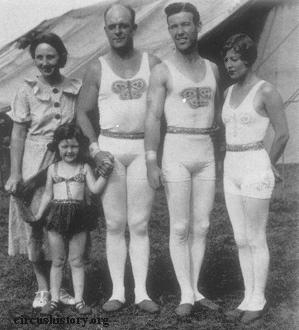
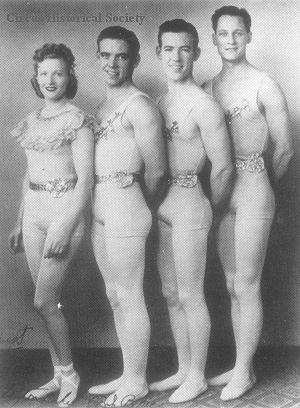
Photo left: Clayton Beehee filled Alfredo's place when the act was on Hagenbeck-Wallace in 1934. Mrs. Codona, Lalo, Beehee and Vera Bruce are shown in this photo. Burt Wilson photo.
Photo right: The Flying Beehees, as they appeared on Cole Bros. in 1938. Rose, Bob, Clayton and Ralph Swisher. Burt Wilson Collection.
To be sure, neither Art Concello or Clayton Behee have ever been considered the equals of the great Alfredo. And even though either of them could duplicate Codona's various "passes," neither of them ever possessed the assurance, precision and elegance which had stamped Alfredo as "The King." Be that as it may, Arthur Concello, a little athlete of not more than 5 foot 2 inches, then weighing not more than 150 pounds, was an indefatigable and determined man who had dedicated himself to reach the heights of his chosen profession!
Whatever may be said regarding Concello's lack of aesthetic form or grace of performance, he possessed one asset which established the act in a class by itself. The distinction was his wife, Antoinette! A mere 5 foot 1 inch and weighing only 112 pounds, Antoinette was not only one of the most attractive brunettes to grace a circus ring, but one of the very few women who could also execute all of the "Passes" and routines usually reserved for men only. Under the tutelage of her husband, the svelte and comely Antoinette could turn a double and a half to the catcher - and even a double with a full twister! Her form, elegance and grace of performance were indeed poetry in motion! Either before or since, there never has been a female performer on the fly-bar who could be considered her equal!
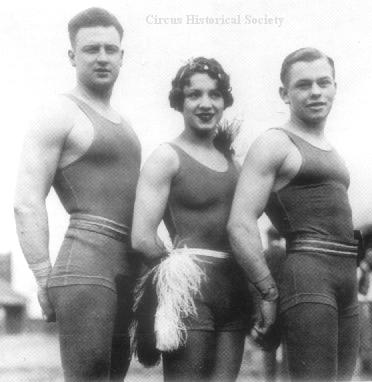
Photo left: The Flying Concellos as they looked in the early 1930s when they appeared in an end ring while Codona was in the center. The catcher on the left is unknown, Tony center and Arthur on right. Pfening Collection.
Photo right: Antoinette Concello, the "Queen of the Flying Trapeze," in a 1941 photo while at her peak. Burt Wilson Collection.
But to the ambitious and dedicated Arthur Concello, occupancy of the center ring was not yet to be considered the pinnacle of his career. In the meanwhile he, too, had been practicing the triple - not only for himself, but also for Antoinette. Eventually came the crowning glory for his perseverance when, at the season's opening of the Ringling Show in 1937 at the New York Madison Square Garden, The Flying Concellos with Ed Ward, Jr. (son of their teacher) catching, were able to thrill the packed auditorium as both Arthur and Antoinette turned and caught the triple during the same performance!
For any woman to execute the triple is indeed a terrific accomplishment! However, perhaps it should be mentioned that Antoinette never did turn the triple with the same degree of regularity as her husband or other predecessors such as Clarke, Lane or Codona. Moreover, it must also be said that, in order for her to execute the catch, her catcher's trap was usually lengthened two feet. Nevertheless, to this day, no other female performer has ever duplicated her feat! Therefore, and regardless of the above commentary, Antoinette Concello must be listed in the circus annals as "The Queen" - flyer "emeritus!"
In the meanwhile, under the guidance and prodding of the great Alfredo Codona, Clayton Behee was also turning the triple from the fly-bar to the capable hands of Lalo Codona. For a period of a few years these two presented it with regularity at every performance with a fair average of catches. But then, for one reason or other, that average began to dwindle down to less than 30%; occasionally it even sank to less than 20%!
Among the experts there are some who claim that Clayton had lost his timing; that he was late on his "takeoff," therefore "breaking out" of the triple when Lalo was already swinging back instead of coming up to meet the catch at the dead-point of the swing - thereby making it almost impossible to hold on to the catch. That well may be. There are others who are inclined to think that Clayton may have been bitten by that old bug which has afflicted many flyers - and can almost paralyze the mind and heart.
Among the flying trap fraternity there is an old but axiomatic expression often heard. "He should become great - if his shoulders hold out," is expressed whenever the potentials of a young leaper's future are being discussed. How true! Whether consciously or subconsciously, no flyer can ever completely ignore the haunting prospect that a set of torn shoulder-muscles can spell the difference between a long career and the abrupt ending of a promising one - such as happened to Codona.
With Clayton Behee, it is quite possible that a subconscious desire to spare those all-important shoulders might have been the cause for the ever-decreasing number of successful catches. For Lalo Codona, who for a decade and a half had successfully caught his brother's triples with nary a miss - and who was then trying to keep the famous Codona name in orbit across the circus firmament it must have been a terribly frustrating experience!
Nevertheless, Lalo and Clayton doggedly continued to try for the triple at every performance - with more misses than catches. Then when in November of 1936 Lalo suffered a crippling injury in France, falling to the net after catching a double and a half, the illustrious name of "The Codonas" experienced another setback. Subsequently, after Lalo's recuperation, the latter and Clayton resumed presenting the triple - but with no improvement in the average of catches. Thus the name of "The Codonas," which had so brilliantly illuminated so many circus programs, was doomed to sink into permanent eclipse.
Legend has it that, during the period between 1915 and 1935, Charles Seigrist had also turned the triple from the fly-bar. But that is strictly fiction and not fact. Which makes it the strangest oddity of the circus world! - for Charlie Seigrist was about one of the greatest artists that ever graced the circus ring. If not the greatest, at least the most versatile of all!
An accomplished performer on the flying traps, rosinback, wire, tumbling and all sundry phases of acrobatics, Charlie Seigrist was also possessed with an indomitable spirit - it was really an obsession - to be at least as good as the best in any and all fields. Inasmuch as, in his prime of life, he was as good on the fly-bar as any of his contemporaries, it was taken for granted that when Ernie Clarke started presenting the triple in public during 1910, Charlie Seigrist would have been goaded into duplicating the feat - especially after Ernie Lane and Alfredo Codona had succeeded in doing so. It becomes a strange oddity that Seigrist - only 28 years of age in 1919 - never made an attempt to equal them - if only to prove that he was every whit as good as they were!
Charlie went on to the "great beyond" in 1953 - and the question remains: How come he never did the triple? If the "little dynamo" went to the same Walhalla as the Clarkonians, Codonas, Ed Ward and Lane, it is a certainty that each and every one must have queried: "How come, Charlie?" And if there is anyone here who knows the answer, we, too, would like to know.
(To be continued in the next issue: Part II, The Flying Trapeze).
The excellent article by Mr. Homer C. Walton in the Nov.-Dec., 1963, issue of the "Bandwagon" about the circus career of Allen King, reminded me of the early days of Cole Bros. Circus. I was fortunate in being able to get down to the winterquarters at Rochester, Indiana, about a half dozen times each year the show was there from 1935 on, besides catching the show at various stands. In this way I became fairly well acquainted with various members of the staff, such as Jess Adkins, Zack Terrell, Fred Seymour, P. A. McGrath, Arnold Maley, Joe Kuta and others.
In the late 1930's on the lot one day I ran into Jess Adkins when he didn't have much to do and was in a talkative mood so I took the opportunity to ask him about the beginning of Cole Bros. Circus.
Mr. Adkins told me that the plans worked out in late 1934 while he was manager of Hagenbeck-Wallace Circus and Zack Terrell was manager of the Standard Oil Live Power Show at the Chicago Century of Progress, were for them to have two railroad circuses on the road in 1935 with both of the shows presenting a street parade. He was to manage the larger show which would be on 20 cars and use the parade wagons obtained from Christy Bros., while Zack Terrell would manage a 15-car show using the parade wagons obtained from the Hall Farm that had been on Fred Buchanan's Robbins Bros. Circus.
The 15-car show was to have a sponsor, just as Mr. Terrell's show had at the Chicago Fair. But I don't know if it was to be Standard Oil again or not. However this sponsor deal fell through sometime during the winter of 1934-35 so it was decided to put out only one show, but make it a large one using 35 cars. The show had a large herd of elephants as it was planned to have a good size herd of bulls on both the 15 and 20-car shows and now all these were available to the 35-car unit.
The show didn't use the Robbins Bros. parade wagons, with exception of the unifon wagon, but used those obtained from Christy Bros. The canvas had not as yet been ordered for the 15-car show but the canvas was on order for the 20-car show and work had commenced on the big top and the manufacturer would not allow a change in the order. So it was necessary for the 35-car Cole Bros. Circus to begin the 1935 season with a 145-foot round top with 3 - 50-foot middles. The seats were not built until after it was known that only one large show would go out from Rochester in 1935. So they cut down on the width of the hippodrome track a bit and the top end of the stringers were poking the sidewall out in order to get in a few more tiers of seats and increase the seating capacity for the 35-car show which was saddled with a big top that was too small for it.
Within a short time 2 40-foot middles were added to the big top and the program was rearranged to make use of the two stages on either side of the center ring. This increased the seating capacity and made the big top a bit more satisfactory. But for the 1936 season a 160 foot round top was ordered from another manufacturer, with 3 60-foot middles. Then in 1937 when the show was on 40 cars a 170 foot top with 3 60-foot middles was used.
At the end of July in 1935 the train was cut to 30 cars and 5 cars were sent back to Rochester, 2 flat cars, 2 stock cars and 1 coach. I believe it was at this time that Allen King left the show although it may have been earlier. Clyde Beatty was to have presented the cat act on the 20-car show and Allen King would have done the same on the 15-car show. There was not much need of having both of them on one show.
Although Ray Marsh Brydon was called the owner of the Rice Bros. Circus, the Cole Bros. organization put up at least a part of the money to take out the show in 1935. They also furnished some animals and equipment and Allen King had his cat act on Rice Bros. after he left Cole Bros. Circus.
Of course Adkins & Terrell did put out two railroad shows from Rochester in 1938 (Cole Bros. on 30 cars and Robbins Bros. on 15) but I was interested to learn that this had been their original plan for 1935.
I was talking with Zack Terrell in the morning on the lot at South Bend, Indiana, which was the second stand under canvas for Cole Bros. in 1938, when a telegram was brought to him. He told me it was from Jess Adkins asking him to phone him at a number in the town where Robbins Bros. was playing that day. So Mr. Terrell headed for a gas station across from the lot to make the call. After Mr. Terrell came back to the lot I asked him how Mr. Adkins was getting along with Robbins Bros. He replied, "Something is wrong, they are not getting the business they should," expressed with surprise, or astonishment. No doubt they didn't realize that the dark pall of the Roosevelt Recession had already settled over the land. Of course no one realized at such an early date that 1938 would see the closing of so many circuses, but it turned out to be one of the most disastrous circus seasons of all time. The 40-car Cole Bros. edition of 1937 was such a marvelous show and enjoyed such wonderful business during the season that it gave them confidence to branch out and put two shows on the road for 1938.
I might mention that the Associates Investment Co. of So. Bend, who put up a big share of the operating capital for Adkins & Terrell in 1935, '36, '37 and '38, has grown and prospered and has expanded their holdings and operations tremendously in more recent years. Their loan was secured by a mortgage on the equipment and they ordered the abrupt closing of Cole Bros. in mid-season in 1938. They also ordered the sale of some of the animals and equipment. For example they sold the three small elephants as they figured (and rightly so) that they would bring more than the older bulls. Jess Adkins wanted to keep the small bulls but was overruled. He was especially interested in them as they were "pets" of his and he had ordered them the previous season. The show had planned on picking them up when the indoor unit played New York City in the spring of 1937 in opposition to the Big Show, but they didn't reach this country in time. They arrived at Benton Harbor, Michigan, from New York when the show played there August 14th and the express charges came to over $1,800.00. Associates later gave permission for Adkins & Terrell to take out a smaller show in 1939.
One of the real big thrills in my life was to come on Cole Bros. lot at Rochester on May 6, 1935, and see the entire spread of new, pure white canvas in the air. It was a beautiful sight and one I had not experienced before. A number of times after that I caught shows with new canvas at their first or second stand, but they didn't quite equal Cole Bros. of 1935 for sheer beauty.
Of course the Ringling-Barnum show during the 1920's and up to 1938 was a wonderful organization, but two of the finest shows ever to take the road were Hagenbeck-Wallace in 1934 and Cole Bros. in 1937. Jess Adkins was responsible for both of them, so the circus fans owe him an everlasting debt. He was a man who truly loved the circus: and the street parade.
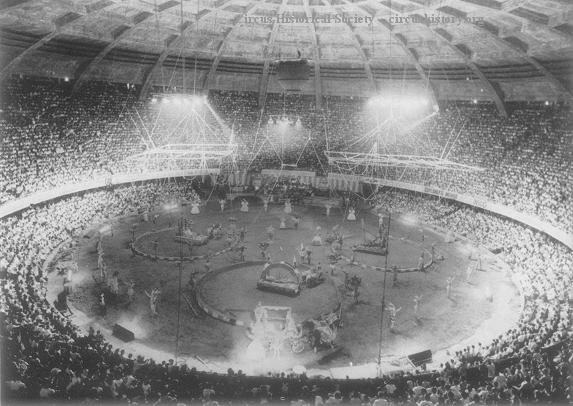
Photo: Inside the arena at Rio de Janeiro, Brazil, showing ring layout and great crowd. Photo from Paul Eagles.
On the Friday before Christmas, 1960, Paul Eagles received word that he was needed immediately at the Ringling quarters in Venice, Florida.
Paul arrived in Venice on the 27th and with Pat Valdo, began framing a second unit under the Ringling title which would tour South America. The plans called for the South American unit to be entirely separate from the regular Ringling show in the United States.
The show was built around the 1960 Ringling show, with all the ''spec'' floats and costumes coming from it. A set of indoor rigging, like that of the parent show was constructed for the South American unit.
Meanwhile, Art Concello confirmed plans for the South American unit and stated that the promotion would be handled by Carlos Vasquez, who, in 1960, had had a unit of the Russian Moscow State Circus in South America.
It was soon disclosed that the title for the unit would probably be the Ringling Circus International, but the one actually used was the Ringling Bros. Barnum and Bailey Circus International, Ltd.
The South American unit's key personnel were: Paul Eagles, agent and general manager; Lloyd Morgan, superintendent; Raymond Escorsia, bandmaster; Justino Loyal, who was the Equestrian Director and Audrey Smith, aerial display.
Most of the acts (about 120 people) were hired in the United States. However, an additional hundred, including spec girls and the workmen, were hired in South America to fill out the personnel roster. These additional people were hired, independently, in each city for that date. Of these about fifteen stayed for the whole season.
A freighter left Jacksonville, Florida, on January 30 for the thirteen day trip to Rio de Janeiro, bringing the show to Rio on February 12 for its opening on the 15. This freighter carried all of the animals and equipment, and some sixteen men, included in the show, except for some monkeys which were flown in.
A bus took most of the people to Tampa on February 11, where they boarded a chartered Constellation for Rio. On the morning of the 12th, fourteen more left from New York City via jet, bringing additional acts and personnel to South America.
The two planes and the freighter all arrived in Rio on the 12th of February. Upon arrival, the show was immediately hung, for its opening on the 15th. The expenses incurred in transportation, amounted to the sizable sum of $192,000, which was the total cost of the round trip.
Merle Evans, Bob Dover, Richard Barstow and Audrey Smith, also went to Rio for a few days to launch the new unit.
The Rio de Janeiro date was from February 15th through the 12th of March. The show was exhibited in a large circular building, with an extremely high dome ceiling, seating a capacity crowd of 18,500. The Arena was staffed with a full complement of hospital personnel, which, fortunately, weren't often called upon to administer their aid.
The show exhibited on the dirt floor of the arena, which was covered over with green shavings for the purpose of holding the flying dust to a minimum. The performances while in Brazil were given at 2:30 and 9:00 P.M. on weekdays, and at 10:00 A.M., 2:30 and 9:00 P.M. on Saturdays and Sundays.
In its entirety the show used fourteen elephants, plus an additional elephant which Eloise Berchtold obtained from the Paul Kelley Farm.
The show was exceptionally well received in Rio and consequently it had a very successful run until that unfortunate last day when nature intervened.
The last night, all three performances were over sold, resulting in over capacity crowds for the show. During the interval between the second and third shows, it began to rain.
Normally this wouldn't have hurt the show at all, but in this case it did. The arena had been built without a drainage system and in addition was located on the bank of a river.
The crowds were then reluctant to leave because of the rain, those on the outside wanting to get out of the downpour, the ceiling of the arena leaking like a waterfall, and water coming in from underneath the floor, because of the nearby river. As a result the arena floor was a sea of mud and broken glass.
Within a matter of fifteen or twenty minutes, the show was completely rained out of the arena.
The show equipment and props were fished out, and fortunately no one was cut from the glass, which was strewn on the floor.
These prevailing conditions doomed a German Ice Show which was to open in the same arena the following day.
The show then moved by trucks, a train and a plane four hundred miles to the show's next date of twenty-seven days at Sao Paulo, Brazil.
Here the show was scheduled to open on March 15, but was mis-billed, and the show exhibited from March 14 through the 8 of April.
The elephant acts were the most popular in Sao Paulo. It seems that the people of Sao Paulo had never seen a show of this size in South America before, and it was more than well received.
Upon closing on the 8 of April, the show moved to Buenos Aires for its closing date in South America.
From Sao Paulo, the show was transported to Santos, Brazil, by a cog railway, then proceeded from Santos to Buenos Aires by boat. They arrived at 6:30 on April 13. They were then hung that same evening, and consequently opened on the next day, April 14, for their seven week run which ended on May 28.
Here the show played in a rectangular building, which seated 12,820 people. The shows were given during the week at 2:00 and 10:00 P.M. and on weekends at 10:00 in the morning, 2:00 and 10:00 P.M.
The performance at Buenos Aires is listed below and was similar to this throughout the earlier part of the season.
Act 1 - Eloise Berchtold working the Paul Kelly lions
Act 2 - Clowns
Act 3 - Manuel Baragon, Cloud Swing
Act 4 - Belmontes on the trampoline
Act 5 - Ibarra Brothers on the aerial bars
Act 6 - Clowns
Act 7 - Principle riding acts - Antoinette, Corky and Gilda Cristiani
Act 8 - Elephant Acts - Frank Regan, Oscar Cristiani, Al Kyle
Act 10 - Aerial Ballet - Deliah Cristiani and Lianne Stanek, with 20 other girls up
Act 11 - Clowns
Act 12 - The Rudas - Australian Acrobatic Troupe
Act 13 - Clowns
Act 14 - Ruby Haag's Dogs and Ponies, Konyot's Chimpanzees, Zoppe's Riding Dogs
Act 15 - Leigh, Aerial Loop
Act 16 - Unus
Act 17 - Spec - "Fairyland Fantasy" - The 1960 Ringling spec
Intermission
Act 18 - Ibarra Flying Act
Act 19 - Clowns - Kinko and his miniature automobile, Draguett and his magic hat
Act 20 - Masters of the tight wire - Remo Loyal, Antoinette Cristiani and Lolita Perez
Act 21 - Clowns
Act 22 - Ferry Forst, illusionist
Act 23 - Dieter Tasso, slack wire
Act 24 - Cristiani Family - nine person riding act
Act 25 - Freddia and Ortans, rola rola; Lentini (Canistrelli) Sisters, ladders; Manuel Baragon, tables
Act 26 - Bill Burschbom's Nine Liberty Horses
Act 27 - Clowns
Act 28 - Cristiani's teeterboard, Stanek's teeterboard
Act 29 - Daviso, high school horse
Act 30 - Finale - "Americana - a salute to the 49th and 50th States, Hugh Zacchini's Missile cannon.
Clowns on the show included Kinko, Jackie LeClaire, producing clown, Billy McCabe, Kenneth Dobb and Lou Mirando, plus an array of clowns that were hired in each of the three cities played.
Below is a complete listing of all the performers with the South American unit:
Manuel Barragan, Fatima Bent, Eloise Berchtold, Leo Shannon, William Buschbom, Fred Canestrelli, Tosca Canestrelli, Corcaite Cristiana, Delia Cristiani, Joaquin Cruz, Lou Dateo, Wanda Deisler, Dianos Elephants, Roger Defoce, Kenneth Dodd, Marco Droguett, Paul Eagles, Roman Escorcia, Ferry Forst, Delores Garcia, Ruby Haag, Barbara Hamilton, Leigh Heisinger, Hancy Heisinger, Selma Higgins, Susann Higgins, William Higgins, Ibarra Bros., Judy Jacobs, John LeClereo, Paul Kelley Lions, Konyot Chimps, Giustino Loyal, Remo Loyal, William McCabe, Arnold Maley, Alex Mentler, Phil Miranda, Lloyd Morgan, Marilyn Norton, Genica Regan, Sarah Reynolds, Manuel Roman, Rudas, Audrey Smith, Staneks, Glen Sunbury, Dieter Tasso, Ursula Tausendfreund, Frans Unus, Lucinda Wheeler, Norma Wright, Catarina Zacchini, Hugo Zacchini, Napoleon Zamperla, Alberto Zoppe.
Besides the above performers, the following workmen were associated with this unit:
George Adams, Murray Churney, Monty Conklin, Royal Deisler, Wallace Diehl, K. C. Glover, J. A. Hayes, Alfred Kyle, Henry McGrothers, Frank Perez, James Porter, Louis Regan, Elmer Santana, Lawrence Taylor, Frank Wallace, Emanuel Zacchini, Victor Zacchini.
It is interesting to note that the Hugh Zacchini Missile Cannon was not fired in Buenos Aires because there wasn't enough space to safely use it.
The show closed on the 28th of May and on the 31st, the performers boarded a chartered Boeing 707 for Tampa, Florida.
Paul Eagles stayed over for a few more days to help several of the South American performers gain entry into the United States.
All of the personnel on the show were paid in American currency, thus receiving more money on the current monetary exchange basis.
The currency in the South American cities fluctuated to the extent that no set price for admission was charged. But the contract did call for the minimum ticket to sell for $1.00 and highest to go for $6.00 (in American money).
This South American unit was Ringling's first such venture in a number of years. It eventually gave birth to the European show in 1963.
My sincere thanks go to Paul Eagles and Norman Carroll, without who's help this story would not have been possible. I also wish to thank Mrs. Ashley Simms, Corky Cristiani and Arnold Maley for their continued help.
Rare Zebra on 1928 Sparks Show
Member Richard J. Reynolds III, expert extraordinary on circus and zoological animals and author of numerous articles appearing in international zoological publications, writes as follows: "The 1928 Sparks show exhibited a very rare mountain zebra. A good photo of this animal appears in Chang Reynolds' fine article on circus menageries. This is the zebra in full view at the left of the photo on page 6 of the 1963 Nov.-Dec. Bandwagon.
"There are two varieties of mountain zebra, the nearly extinct Cape mountain zebra and the more common, but still rare, Hartmann's mountain zebra. Both are very similar in appearance, but Hartmann's has broader white stripes giving the appearance of a much whiter animal. I am convinced the Sparks' zebra was of the Hartmann variety.
"Both mountain zebras are easily distinguished from other forms by the presence of transverse 'gridiron' stripes extending over the haunches right at the base of the tail. Also, the mountain zebras have very thick and widely separated stripes on the thigh below the 'gridiron' pattern. These features can be clearly seen in the photo by comparing them with the stripes on the legs and haunches of the other zebra in the photo, which is one of the common forms of Burchell's zebra.
"Today, mountain zebras are rarely shown in captivity. In the U.S.A. Hartmann's variety can only be seen in the zoos of Philadelphia, San Diego and the Catskill Game Farm. Although the Cape variety was exhibited with some regularity many years ago (Adam Forepaugh had one for sure in 1893), it is not presently shown in captivity anywhere in the world."
Hagenbeck-Wallace 1933, (Nov.-Dec., 1963, Bandwagon)
Gordon Potter calls attention to an error, readily admitted by the author, in which it was stated that Hagenbeck-Wallace was increased from 30 cars to 35 cars for the 1931 season. Such was not the case. The increase to 35 cars did not come until the 1932 season. Potter says his count for 1931 gave the show 8 stock cars, 14 flats, 7 coaches, and 1 advance, for a total of 30. Show had 20 elephants and 16 cages that year. For 1932 Potter says he counted 9 stock cars, 17 flats, 8 coaches, and 1 advance, for a total of 35, and that year the show carried 20 elephants and 20 cages.
Potter also made the following interesting observation: "The article about menageries by Chang Reynolds in the Nov.-Dec., 1963, Bandwagon was very good. The use of the 50 elephant picture taken on RBBB in 1933 by the late Harry Atwell made me think of something. I was never able to figure out how they got that picture as there were never that many bulls with the show in those days. I knew Harry Atwell real well and used to go up to his studio on Randolph Street every time I got to Chicago. So I asked him about the picture but he couldn't shed any light on it as he just thought there were 50 elephants with the show that season and that all of them came out of the menagerie top.
"I asked Atwell if either the Hagenbeck-Wallace or Al G. Barnes show was playing nearby and if they sent a car of bulls over for the picture, possibly on a Sunday, but he didn't know anything about that. I looked up the routes the other day and the Barnes show was mostly in Missouri during the time RBBB was in Chicago in 1933 and Hagenbeck-Wallace was mostly in Virginia but did get to Pittsburgh the last day RBBB was in Chicago. But that was too far away for both shows. I doubt if there were 10 bulls at Peru that could have been sent up to Chicago for the photo, but maybe there were. Is it possible that a car of 10 were sent to the show in Chicago in 1933 from Peru and finished the season on RBBB? I rather doubt this, but just can't figure out how they got the picture.
"Here is my own elephant count for Ringling-Barnum for a few years: 1925 - 34 elephants; 1926 - 35 elephants; 1927 - 37 elephants including Pawah and his companion; 1928 - 34 elephants (was sick and didn't see the show in 1929 and 1930); 1931 - 34 elephants; 1932 - 41 elephants; 1933 - 40 elephants; 1934 - 35 elephants; 1935 - 34 elephants, and 1936 - 35 elephants. I don't seem to have the count for 1937."
Sells Bros. and Forepaugh Sells (Jan.-Feb., 1964)
Our past treasurer, Richard E. Conover, wrote the Editor concerning the Sells article as follows: "Your comprehensive article on Sells Brothers - Forepaugh- Sells was excellent both for those who previously knew but little about this show as well as for us who needed only a document such as the equipment inventory to expand on and rationalize certain hazy areas of our knowledge.
"Very shortly after it appeared I had three inquiries asking if I went along with the identification of the former Montgomery Queen Tableau. Since I furnished this bit I had to admit that I did. I went on to elaborate that I had arrived at that conclusion from a pictorial drawing in an 1876 Queen courier with collaboration from a newspaper write up that I had run across of the Queen parade that mentioned "an elegant wagon with a big eagle on its side."
Another interesting revelation is the appearance of the tableau with the three round mirrors in the lot scene on page 12. This is the same vehicle discussed by Bradbury in the September-October-November, 1961, issue in which he traced it from the British Sanger Circus to the Cook & Cole of 1927. At the same time this article was being prepared I had some correspondence with the late Col. Woodcock, who furnished most of Bradbury's material, in which I was not ready to concede that the four mirrored version that traveled from Sanger to Forepaugh and later to Ringlings was the same basic vehicle as the one with three mirrors identified sequentially with Gollmar, Patterson, Barnes and Cook & Cole. It now develops that if this lot scene is actually 1904, as stated, the four and the three mirrored versions are definitely different wagons because so much money for new equipment was being invested in Forepaugh-Sells at that time to preclude any reason for rebuilding second hand wagons. If, perchance, the picture should be dated after the Ringlings bought into it in 1905, there is still little likelihood that a transfer and rebuild would have been needed to dress up the Forepaugh-Sells parade.
I would also modify one of your late paragraphs so as not to imply that equipment was pulled off Forepaugh-Sells as early as 1906-07 to build up the Ringling Show. Actually, it was after the show closed in 1907 that most of the train was sent to Bridgeport to build up the Barnum & Bailey property. The rest, principally loaded stock cars, was sent to Baraboo. According to the published route books the title was also mailed to Baraboo."
Another reader advises that the Sells show acquired some equipment from the Cooper & Jackson show in 1884. Great Western Printing Co. and Strobridge Lithograph Co. placed attachments on the Cooper and Jackson show and forced the sale of the show at auction on December 1, 1884. Lew Sells attended the sale and the Clipper reported that he purchased five of the cages. The Cooper & Jackson show had an elephant named “Add" after Ad Sells, but it was sold to another buyer.
Ed Lester, of Oklahoma City, questioned how a 52 foot long stringer wagon could be loaded on a 50 foot flat car. The editor did some double checking after hearing from Ed and found that the fully detailed list from which the wagon and train measurements came actually lists three 60 foot flats and one 48 footer. These all moved in the third section. All other flats in the Sells train were 50 feet in length. A further careful check of the Sells article (after publication) shows that by a typographical error the contents of some of the baggage wagons were shifted. Actually the No. 16 wagon with the 52 foot length was the big top pole wagon and not a plank wagon. The list through wagon No. 20 is correct, however, from wagon 21 through the next 11 wagons the contents were incorrect. The proper contents are as follows: No. 21 big top canvas, No. 18 chandelier, No. 6 big top quarter poles, No. 16 big top poles, No. 8 seat planks, No. 28 trunks, No. 10 seat planks, No. 1 props, No. 3 reserve seat chairs, No. 4 reserve seat chairs, No. 12 reserve seat chairs. The listing from No. 26 containing wardrobe on through to the end is again correct.
No part of this publication may be reproduced in any form or means
Last modified February 2006.
without written permission of the author and the Circus Historical Society, Inc.