


Circus Historical Society
Bandwagon, March - April 1962
Back to Bandwagon Index
Bandwagon, Vol. 6, No. 2 (Mar-Apr), 1962. Note: Only some articles are included in this online edition. Many illustrations are not included. The Circus Historical Society does not guarantee the accuracy of information contained in the information in these online articles. Information should always be checked with additional sources.
This is not the story of a man, but of his name and the show that bore that name. The John Robinson Circus was built and successfully sustained by a succession of proprietors, three of whom had the same name. Each made his contribution, and took his cut, but in the end the show itself proved more durable than any of these men - even its legendary founder, Old John Robinson.
Describing Old John Robinson as legendary involves careful selection of the word. By the dictionary a legend is "a story coming down from the past which many people have believed." Until quite recently, the oft-repeated stories of the founding and early days of the Robinson show have been accepted as fact. Only thru the recent advent of the circus historian have some of these pat stories begun to come under some suspicion. This stems from the realization that most of these stories originated and were handed down by the show itself - and historic integrity was hardly the motivating force behind the claims of the Robinson circus, nor of any other circus, for that matter.
Dick Conover's Bandwagon article (June 1953) was, to my knowledge, the first published inquiry into the reliability of the Robinson legend. At that time, Conover invited others to expand on the subject. As we piece together the Robinson story here, we hope to do just that. Like Conover, we do not profess to have all the answers, and hope others will continue the process of refinement. As for the beginning of the John Robinson Circus, one version (6) alleges that, in 1824 at the age of 22, John Robinson was offered and received an interest in a circus in return for using his physical prowess to reassert the authority of the rightful owners over a band of rebellious employees. I will not directly deny that story; however, the manner in which Gil Robinson treats this incident in his book, throws some shadow of doubt over it.
Preceding this tale, the book carefully chronicles Old John's earliest experiences as an employee of other shows. Specific shows are spelled out such as Blanchard's Circus, Page & McCracken, Turner's, Rockwell's, The Zoological Institute, and others. Names are named and places identified such as New Bedford and Boston. Suddenly, on mentioning the above story the location is given as "a town in eastern Tennessee;" the show identified as "a circus;" and the owners as "they." Where earlier events are so precisely spelled out, it seems unlikely that an event as important as John's first circus would be veiled in such generalities - unless that is, the specifics were non-existent. Gil Robinson, in his book, does not resume specific details until mention is made of his father's partnership with G. N. Eldred. This brings us to the second version of the show's founding.
This second version (1) states that (again in 1824), John began his career as a circus owner by entering directly into partnership with G. N. Eldred to form the Robinson and Eldred Great Southern Circus. It is evident that existence of a Robinson owned circus before the Robinson and Eldred partnership is vague and cloaked in generalities. While admitting the evidence is inconclusive, such evidence as exists tends to substantiate the second version at the expense of the first. Further observations in Dick Conover's report (7) strengthens this view.
As for the 1824 founding date, this can be discarded once and for all. In his 1953 report, (7) Dick Conover advances substantial evidence to discredit that date. I propose to submit here additional new evidence to the same end. Dick and I arrive at different founding dates. This is not to imply disagreement; but, rather, as Conover states in his lead sentence (7) "The exact date of the founding of the John Robinson Circus is obscure." While the exact date is subject to alternate but equally convincing theories, there is unanimity on the fact that 1824 is not that date.
It is true that both sources for the origin of the show recite that date. It is also true that the Robinson show steadfastly claimed that 1824 founding date. I suggest that these observations, far from confirming the date, are, in fact, the cause of the confusion.
The 1824 date being itself manufactured, it became necessary to manufacture stories of the show for the years it was not actually a reality. The fact is, evidence that originated with the show itself, can be cited to discredit that 1824 date claimed by the show.
First, is the fairly established fact that the Robinson and Eldred combination was terminated in 1856 (1 & 3). Second, is Gil Robinson's statement (6) that these two were partners for "over 20 years." This would place the beginning of Robinson and Eldred as 1836 or shortly before. Third, is the '99 route book's flat statement that John Robinson's first experience as an owner was in the Robinson and Eldred partnership, which would place the founding date as the same 1836 or shortly before. Researcher note: it is not correct that the beginning of Robinson and Eldred as 1836 or shortly before or the founding date stated.
I do not say that these facts are themselves wholly reliable. I do not state that 1836 is the actual founding date. I do say that this set of observations reveals that those who claimed the 1824 date did, in the same breath, recite details that undid themselves.
I can now add another item of evidence in the form of the 1871 newspaper ad reproduced here. Reference is made to "John Robinson of Cincinnati, Ohio, 65 Years of Age with 40 Years' Experience as Owner of a Menagerie." Forty years from 1871 would have been 1831, not 1824. I propose to show that the 1824 date originated in 1898, and 1899, 75 years from the event, and in the absence of the founder. I put more faith in the 1871 advertisement, as the founder was still alive and the event only 40 years past. Perhaps, some exaggeration existed even in this 1871 ad; however, if so, the element of exaggeration would have been to stretch the tenure of Old John to 40 years. If his proprietorship had actually exceeded 40 years, they surely would have claimed it.
On this evidence, we can throw out the 1824 date once and for all. The points made here, suggest the actual founding date was 1831 or shortly after, or 1836 or shortly before, which is saying very close to the same thing. Conover's evidence (7) arrives at 1840. Researcher note: the dates cited in this paragraph are not correct.
I suggest that a survey of old newspapers in the South and New England, where newspapers date back that far, may give us further evidence to better pinpoint the date.
It appears that this legendary 1824 founding date was fabricated in 1898 and 1899 as an outgrowth of the change in management which took place then. True, it was implied in some 1884 advertising (7) but it did not take root and was dropped. For all practical purposes the date was re-created anew for the 1899 season, and as will be shown, this time it did take root and became the basis for a half century of misinformation.
Altho the Ringling Brothers operated John Robinson Circus in 1898, John G. Robinson (Old John's grandson), was with it. He was the sole representative of the Robinson family on the show, and no doubt played his roll in anxious anticipation of his assumption of full command in 1899. That 1898 advertising thus conveniently heralded the "74th year of uninterrupted success" (see ad) suggests careful planning on John G's part to coincide his first year of management, with a glorious 75th diamond anniversary tour. Such a spectacular beginning for new management is typical of its desire to prove itself. The happy coincidence of the 75th anniversary coming in 1899 with a new proprietor suggests its motivating factor was convenience of the day, not historical fact. Also, being now three generations removed from the origin, who was present to question it, or who really knew or cared?
Having publicised 1899 as the 75th tour, it was inevitable that the resume of Robinson history published in the '99 route book had to justify the claim by proclaiming 1824 as the first year. That '99 book did just that, and thus the 1824 date was published as history. That article on Robinson history was written by John Lowlow, a clown who (6) joined the Robinson Circus in 1855. Being a senior member of the show's staff lent authenticity to his story but he still was not senior enough to have known the show's origin first hand.
That this Lowlow story in the '99 route book was the origin of the 1824 date is largely substantiated by the fact that the story was reprinted verbatim in the 1916 route book. It was then published without identifying the author, as a blunt statement of fact. The show was then Corporation property, and their widespread publicity of their 1824 origin throughout the 1920's was apparently based upon that 1899 report. Altho Gil's book was often cited as establishing that date, it was published in 1925 and was in fact simply parroting a fact which common usage had already proven convenient.
Resuming the story, we find that the Robinson and Eldred partnership was terminated in 1856 (1 & 3) due to a disagreement between partners (6). Old John then intended to permanently retire from show business (1). As has been the fate of a multitude of troupers, however, the balmy spring air of 1857 shattered his good intentions. Learning that the defunct Flagg & Aymar Circus was for sale at Buffalo, N.Y. (1), he bought same. He resumed the road with his own show under the title of The Robinson Show (1). He reportedly toured the same show in 1858.
In 1861 and 1862 the show is known to have used the title Robinson and Lake Circus. The clown William Lake was John's partner. Some sources claim this partnership began as early as 1859, which could be correct but I have no confirming evidence. Bill Lake did shake loose to operate his own show in 1863 under the title Lake & Co.'s Great Western Circus. An ad for this show is in the newspaper for Muscatine, Iowa, June 20, 1863. Lake's Circus allegedly operated until 1869 (6) when he was shot, and a few years thereafter by Mrs. Agnes Lake. This appears to be the case, except some question arises as to whether Lake and Robinson were again associated in 1864, as we will cover shortly.
The 1899 route book states that the Robinson show used the title Robinson Brothers in 1863 and 1864. Old John's brother Alexander was supposed to have been his partner. I question this. Advertisements of 1864 made no mention of Alexander and used the title Robinson Great Circus & Menagerie. Gil Robinson, in his book, never refers to Alexander as a partner in John's show. He does mention that Alexander operated his own circus off and on from 1864 through 1877. It appears likely the two men were interested in each other's shows, but that they operated as separate units.
The advertisements used by the Robinson show in 1864 raise the question of whether the Lake family was again associated with that show. It is quite evident that the cuts used that year were Robinson & Lake cuts with the word Lake cut out in every place where it had appeared relative to title or Bill himself. Bill Lake's name was actually shown as manager in an ad in Monmouth, Illinois, but this was probably an oversight. It is rather evident that Lake was not identified in a managerial capacity; however, the ads heavily featured Agnes and Alice Lake. Perhaps Old John was simply practicing economy by using old cuts without regard to whether the Lakes were actually with it. Until positive evidence of the presence of Lake's own show in 1864 is advanced, the possibility of the Lake family being with Robinson that year should not be totally ignored.
Bill Lake's Hippolympiad was definitely on tour in 1865, and in that year the name Robinson totally disappeared from the title of Old John's circus. As evidenced by the connecting ads from Jerseyville, Illinois shown here, the two shows were in opposition in that town. Robinson's show used the title Great Union Combination.
That same title (Great Union Circus) was used by another show consisting of George W. DeHaven, Dan Castello and Miles Orton, in 1862 according to an ad of that year in Muscatine, Iowa. How that same title came into use by the Robinson clan by 1865 is unknown; however, this obviously was the case. The Great Union, in 1865, listed W. H. Hough as business manager, a known Robinson associate (6) and John Robinson Jr. as equestrian Director. This confirms the report that John F. Robinson, Old John's son assumed a responsible roll that year (1). The ads also feature one M. J. Robinson in words normally reserved for the riding act of Old John himself. Gil Robinson never mentions any M. J. Robinson in his book.
Why was the Robinson name eliminated from the title in 1865? Why was the name of Old John, the proprietor eliminated from advertising? Perhaps they were having trouble living down their famous slogan of a few years before, "Southern men, Southern women, Southern horses and Southern enterprise against the World." Such a reputation might have given some embarrassing moments in 1865, thus the obvious title Great Union Combination. Why the title was not used until the last year of the Civil War is unknown. Perhaps the combination with Lake had been sufficient to disassociate the name Robinson with the old Robinson and Eldred Great Southern Circus. Perhaps, also, this explains why they continued to use doctored Robinson and Lake cuts thru '64 even if Lake was no longer with it.
As for 1866, the 1899 route book states that the Robinson show moved by steamboat that year. Another report (3) states that the show resumed its domination of Southern territory immediately after the Civil War. These reports mesh on the grounds that inland travel and prosperity were upset due to war damage. River towns had ready-made communications lines, and were first to re-establish commercial ties necessary to the flow of money.
We also observe that the title used that year was The Great Combination Circus, according to ads in Monmouth and Jerseyville, Illinois. Now, the Civil War was over, and a show that intended to return to the Southland would best not incorporate the word "Union" in its title - yet, for the time spent in the north, neither was the southern - associated Robinson name sufficiently healed for use. The painfully neutral title Great Combination Circus is the obvious result.
Did the show travel by steamboat in '66? Towns where they were known to appear include Monmouth and Jerseyville, Illinois and Crittenden, Ky. These are all within easy horse range of Mississippi and Ohio River docks. Available evidence does not discredit the steamboat story, and neither does it prove it.
Altho Gil Robinson's book gives the title of the show as John Robinson's Great Combination for the years 1866 thru 1870, newspaper advertising did not use the prefix John Robinson, at least not in '66. Probably, Gil was merely assuming what everyone knew, that it was the Robinson show, while ignoring that at the time, the JR was played down. His reference to the Great Combination suffix does suggest that that title stuck thru 1870. I, however, have no direct evidence on the show for the years 1867 thru 1870.
It should be clarified at this time that up to now the name John Robinson Circus, by which we know the show, had not been used. It had been Robinson & Eldred, Robinson, Robinson & Lake, Great Union, Great Combination and possibly Robinson and Gardner.
If newspaper data at my command is indicative, 1871 was probably the first year that the actual name of John Robinson Circus was put to use. It was also the year that John F. Robinson assumed full control of the show from his father (1). That the prefix "John" was apparently not utilized until the second generation of management is worthy of mention.
We reproduce here a beautiful ad for the show for the Kewanee, Ill. date of July 11, 1871. At last, the title John Robinson Circus is in full bloom. At first glance, the considerable mention in this ad of "Old John Robinson The Boss" might imply that John F. had not assumed control. The opposite, however, is probably true. Such play upon Old John had never been done before. Apparently the new management was going to considerable lengths to properly identify itself with the old. This probably partially explains why the full name John Robinson came into use at this particular time.
Another interesting observation is made from this advertisement. Considerable advertising space was devoted to clarify which Robinson show was coming. This was the old John Robinson Show, as against Yankee Robinson, James Robinson and "John W. ('Galesburg, Illinois') Robinson" shows which were also on the road. Another reason, probably, why the prefix John was added about 1871. Thus was finally born the title by which the show has since been known, and apparently not until Old John himself was out of the picture as owner.
This brings to issue a subject which any student of the Robinson show must keep straight. You must first remember the difference between the many different Robinson shows. There was Old John Robinson, Yankee Robinson, James Robinson, Alexander Robinson, and John W. Robinson all of whom had shows in their own right. There was also a show in 1870 called C. T. Ame's & Robinson's Excelsior Circus, which may have been one of the above, or yet another inroad on the Robinson name.
In the operation of these shows were the above persons, plus John A. Robinson, Alexander's son who was shot and killed in 1866. There were Old John's sons Gil, Charles and John F. Robinson plus John F's son John G. Robinson. The name Boyd Robinson is frequently mentioned in connection with the show. I do not know his relationship, but he probably was a relative because Old John's mother's maiden name was Boyd. We haven't mentioned a multitude of other Robinsons who apparently were no relation, but employed on the show.
It is little wonder the name Robinson became well entrenched in the circus industry. Keeping the various Robinsons separated and in their proper place was an ordeal at the time, to say nothing of now.
The John Robinson Circus used system flats for railroad transport at an early date. An 1874 ad for Dixon, Illinois claims the use of "Special trains of cars for transportation." 1881 is purported to be the first season they used their own show-owned railroad cars. This is somewhat confirmed by a Jerseyville advertisement of that year claiming the show to be "Thoroughly re-organized, vastly enlarged, re-equipped and outfitted," etc.
1893 and 1894 were financially difficult seasons for Robinson as it was for all other shows. The 1890's were largely consumed trying to recover. At least one outside angel put money in the show, resulting, I understand, in use of the Robinson & Franklin title in 1896 and 1897. The effort finally culminated in 1898 when the family leased the title and considerable equipment to the Ringling Bros. The deal with the Ringlings was probably mutually agreeable. The Robinson family needed funds to put the show on its feet, and the Ringlings needed another show to hold the Midwest territory while they invaded the East after Barnum took leave to Europe.
The 1900 Ringling 20 year route book gives interesting details of the Robinson show in '98. There were 24 cars, 22 behind and 2 ahead. There were 6 elephants, 1 hippo, 14 cages, a calliope; big top was a 150 with 3 50's and menagerie an 80 with 2 30's. The show was framed at Baraboo. The equipment was about half Robinson and half Ringling. Henry Ringling managed the show and John G. Robinson was along on a salary basis. This show remained in the Midwest playing extended tours in Iowa, Wisconsin and Nebraska, and lesser sessions in Illinois, Kansas, Minnesota, the Dakotas, etc. The show closed in Rogers, Ark., Nov. 7th at which point the equipment was divided and returned to the proper quarters either Cincinnati or Baraboo.
1899 saw the John Robinson Circus under the control of John C. Robinson, Old John's grandson. He operated the show until the end of the 1911 season. At that point, the show was retired from the road. It was never to troupe again under the banner of the Robinson family.
The Famous Robinson Circus of this period was a different show from the John Robinson Circus. It was first operated by one Dan Robinson, and later by Mugivan & Bowers. It lasted 1910 thru 1915.
By 1916 Mugivan and Bowers tired of operating under the pirated Robinson name (Famous Robinson) and purchased the John Robinson title. In that year, 1916, the John Robinson Circus resumed the road as a Corporation show. The equipment used was actually that which had comprised Famous Robinson in 1915, consisting of a 30 car show (5).
In 1917 the equipment of the Corporation owned Howe's Great London Circus was merged with the 1916 Robinson show and John Robinson toured as a respectable 45 car circus (5). From 1918 thru its last season of 1930, the Robinson show was generally operative on 25 or 30 cars. Probably more than anyone else, the American Circus Corporation was successful at operating shows others had founded. But for that happy development, it is likely that precious few of today's circus fans would have known the John Robinson Circus first hand.
In the now famous 1929 transaction between John Ringling and the Corporation, the John Robinson Circus became Ringling property. The combination of the Great Depression plus the desire to reduce the field against the Ringling Circus put an end to the John Robinson Circus at the close of the 1930 season.
The John Robinson name, however, was not done yet. It was dusted off again in 1932 in a last ditch effort to save the Sells Floto show. Attesting to the value of the Robinson name in the south, advertising of the Sells Floto show in the South, used the combined John Robinson-Sells Floto title. Robinson clearly took the lead over the Floto name in that area. The Robinson title was also used on a few lithographs with the Barnes-Floto show of 1938, comprising one of the most powerful name-combines ever used - Al G. Barnes Sells Floto John Robinson Combined Circus. When date tags later added "Ringling Bros. Barnum & Bailey Features," the result was the all-time champion title.
Thus ended a remarkable circus career that no one else could hope to match. Here was a circus which penetrated to the present generation, after having fought the Flatfoots at its origin. It came closer than any other show to spanning all the years of the American circus. For this reason, it offers an alluring challenge to the circus historian. I do hope others will pursue the Robinson story further to refine and perfect what is reported here.
Bibliography
(1) John Robinson Circus Route Book 1899.
(2) John Robinson Circus Route Book 1916.
(3) Article by C. G. Sturtevant, White Tops, April 1928.
(4) Ringling Bros. 20 Year Route Book 1900.
(5) "The American Circus Corp." Bandwagon March-April 1961.
(6) "Old Wagon Show Days" Gil Robinson, Brockwell Co. 1925.
(7) "Origin of John Robinson Circus by Richard E. Conover, Bandwagon, June 1953.
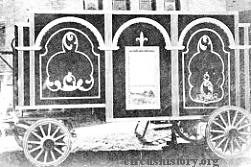 Photo No. 1 - Newly built Bandwagon for the Dode Fisk Shows standing in front of Moeller Brothers Shop, Baraboo, Wisconsin, Winter of 1909-10. Photo courtesy of Circus World Museum.
The first of the two wagons covered in this article is the one commonly called by historians for identification purposes the Dode Fisk Bandwagon. It was built by Moeller Brothers of Baraboo for the Dode Fisk Circus in the winter of 1908-09. Originally the wagon had a huge mirror on each side as shown in Photo No. 1. This was evidently the No. 1 bandwagon on the Dode Fisk Show and served on that 10 car circus for the 1909 and 1910 seasons.
Photo No. 1 - Newly built Bandwagon for the Dode Fisk Shows standing in front of Moeller Brothers Shop, Baraboo, Wisconsin, Winter of 1909-10. Photo courtesy of Circus World Museum.
The first of the two wagons covered in this article is the one commonly called by historians for identification purposes the Dode Fisk Bandwagon. It was built by Moeller Brothers of Baraboo for the Dode Fisk Circus in the winter of 1908-09. Originally the wagon had a huge mirror on each side as shown in Photo No. 1. This was evidently the No. 1 bandwagon on the Dode Fisk Show and served on that 10 car circus for the 1909 and 1910 seasons.
Following the 1910 season the show was sold to Jerry Mugivan and Bert Bowers who used the property to put out a circus in 1911 under the title of Sanger's Combined Shows. In the period 1911-13 the show used a variety of Sanger names including Great Sanger Shows, and Sanger's Greater European Shows. Sometime in mid-season 1913 the show became known as Robinson's Famous Shows. In 1914 and 1915 the show also used that name and in 1916 went out under title of John Robinson Circus. During the period 1911 thru 1916 Mugivan and Bowers also had on the road another circus titled Howes Great London Show. We know the Fisk bandwagon was owned by Mugivan and Bowers and assume it was kept on the Sanger and later the Robinson show, however, it is possible it could have been shifted over to the other circus. Photographic proof pro or con seems to be lacking. For 1917 both shows were combined into a great 45 car show bearing the John Robinson title. This was the largest circus ever operated by this famous duo. Due to World War I problems the show was cut to 30 cars for the 1918 and 1919 seasons, and the surplus equipment was stored at Peru. In the 1918-19 period the show advertised for sale in the Billboard numerous cages, bandwagons, calliopes, tableau wagons, baggage wagons, and other circus property for some time. It is believed that the Dode Fisk wagon was stored at Peru with this property. Bill Woodcock says he doesn't recall seeing it on the Robinson show in 1918 and the many photos available of the show in 1919 fail to picture this wagon. For sure, a lot of property was surplus after the cut of 15 cars for the 1918 season and it is logical the wagon was part of that stored in Peru.
With the post war boom in full force in 1920 Mugivan and Bowers put out a 15 car circus called Howes Great London Show to give them a third show on the road for the 1920 season. Following the 1918 season they had purchased the Hagenbeck-Wallace Circus and had taken Edward Ballard into the partnership and operated the show in 1919 and the following years. Of course the John Robinson show was operated continuously. In 1920 the Dode Fisk wagon went out on the Howe show as the No. 1 Bandwagon as shown in the second photo. Sometime during the period after it was built and this 1920 photo the mirror was removed and a series of three panels of paintings installed. Also traditional inside type sunburst wheels replaced the earlier ones. It is assumed these changes took place after Mugivan and Bowers got the wagon.
In 1921 Howes Great London Show and Van Amburgh's Trained Wild Animals went out on 25 cars, the additional property coming from the Yankee Robinson Show which had been purchased from Fred Buchanan in the winter of 1920-21, and the Fisk wagon remained on the show. However, the big ex Norris and Rowe - 101 Ranch - Yankee Robinson bandwagon became the No. 1 bandwagon in 1921 and the Fisk wagon used for the No. 2 band.
In 1922 the Howe show was titled Gollmar Bros. Circus and that title was painted on the skyboard of the Fisk wagon as per Photo No. 3. No property change took place for 1922, just a switch in titles as Mugivan and Bowers had secured a five year lease on the Gollmar title. For 1923 the best equipment of the 1922 Gollmar show and the 1922 John Robinson show went into a single show that went out under the John Robinson title. The Gollmar equipment predominated with some of the 1922 Robinson equipment going into the 1923 Sells-Floto Circus, which was also owned by Mugivan, Bowers, and Ballard, which had now formed the American Circus Corporation.
The Fisk wagon remained on the John Robinson Circus for the 1923 and 1924 seasons and it can be assumed it was there in 1925. All three of the American Circus Corp, units, Sell-Floto, Hagenbeck-Wallace, and John Robinson went out in 1925 intending not to parade, however, they were equipped to parade, and after about a month the parade was restored for the remainder of the 1925 season. For 1926 the parades were cancelled and the parade wagons were stored in Peru.
Following the 1925 season the Fisk wagon joins the highly carved Norris and Rowe-101 Ranch-Yankee Robinson wagon (see Circus Wagon History File, June, 1957 issue), and the Yankee Robinson steam calliope which served as the lead bandwagon and steam calliope respectively on John Robinson in 1923-24-25 in becoming "lost." It is strange none of these three ever appear in the many photos taken at the Peru quarters in the late 20's and early 30's. Most historians speculate that a fire which destroyed one of the John Robinson barns at Peru in the period 1926-29 may have consumed the three wagons. At any rate they vanish after the 1925 season.
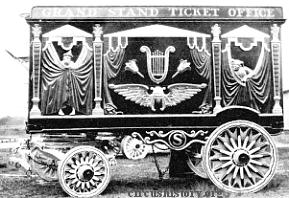 Photo No. 7 - Sparks Circus Grandstand Ticket Office Wagon, newly painted, shown at Sarasota Quarters just prior to opening of 1931 season. W. H. Woodcock Collection.
The other wagon covered this time is one that served on about as many different shows as any we have thus far recorded. The design which consists of three panels of carvings is quite unique. The end panels seem to represent a stage curtain with clowns peering over it. Originally the center design had a large carving of a backward riding clown on a jackass or some such varmint, see Photo No. 5. He is riding as was the custom of so many of the laugh getters in the past. The early history of this wagon is quite obscure and I'm sure many will wonder why I should pick out one like this to attempt to give its history, since there are so many missing facts about it. Well, for one thing perhaps someone will come up with some of these missing facts, and another reason is this wagon travelled many a parade mile on the old Sparks Circus, one of the historian's favorite shows of all times, and a wagon well remembered by those who can recall the Sparks parades of the 20's.
The earliest show we can trace this wagon to is the Col. Cummins Wild West Show of 1906. That is it was based on a full page ad of that show in the Billboard which the late George Chindahl, well known circus historian, copied some years ago. In a very small and poor photo reproduction is what appears to be this wagon. Prior to that discovery most of us were of opinion that it originated on the Martin Downs Cole Bros. Circus sometime in the period of 1907-09. Bill Woodcock says that assuming that the wagon was on the Col. Cummins Wild West Show that he doubts if it was built new for that show and could have possibly come by way of the 1905 Sig Sautelle-Welsh Bros. Circus. Actually we just don't know for sure who built the wagon or for what show it was built, or when it was built, but believe it was sometime in this period. Woodcock further opines that in 1907 the wagon possibly could have been on the Fashion Plate Shows, a circus Walter L. Main was interested in. Main, of course, was also principal owner of the Col. Cummins show. We know that positively the wagon was on Down's Cole Bros. Circus and some years ago Dick Conover, noted circus historian and CHS director, came across a series of post cards advertising a group of wagons for sale by Cole Bros, in the winter of 1909-10. The 1909 season was the last for Cole Bros, and the equipment was sold off shortly after Martin Downs death. The wagon was purchased by J. Augustus Jones and was placed on his Buffalo Ranch Wild West Show for the 1910 season.
Jones sold the show after only one season with the bulk of the equipment going to Thomas Wiedeman for his new show which went out in 1911 under title of Kit Carson Buffalo Ranch Wild West Show. It is believed Wiedeman got this wagon and used it for the 1911 thru 1914 seasons. This assumption is based on fact that Wiedeman did have for sure another wagon that was on Cole Bros, and also appeared in the post card advertisements mentioned. This wagon was a heavily built bandwagon with a central carving of a man faced lion and was covered in the Circus Wagon History File Sept.-Oct., 1957, issue. After the Kit Carson show went broke in 1914 the equipment was sold at auction March 20, 1915, at Cincinnati. The Billboard stated that buyers of the equipment included the Dodson Carnival, Harry Rice, Rice & Dore, and J. A. Jones. Evidently Jones purchased the wagon for the second time at that sale because the wagon definitely appears again on a Jones owned show in 1916. Although Jones operated 2 car shows in the period 1911-13 after selling his flat car show Buffalo Ranch Wild West after 1910 season he did not return to flat car operation until he put out the Jones Bros, and Wilson Circus in 1914. In 1915 he operated Jones Bros. Circus and in all probability this wagon was there. In 1916 the title was changed to Cole Bros, and for sure the wagon was there as per photo No. 6. The Cole title was continued for 1917 and following the 1917 season the show's property was sold off in early 1918. This wagon was then purchased by Charles Sparks who also bought elephants and other circus property at the sale. The wagon should have been on the Sparks Circus in 1918 although the first photo I have ever seen of the wagon on the Sparks show is from the W. H. B. Jones set taken of Sparks in 1919.
Sometime between 1916 and 1919 the center carving of the clown and donkey were removed and was replaced by a lyre and a winged head. The wagon kept this general appearance from then on, although from time to time it was painted in different color schemes.
The wagon served out its days on the Sparks Circus. It was used in the great parades of the late 20's as the sideshow bandwagon. After Sparks sold the show to the American Circus Corporation following the 1928 season the wagon was still used in the parade of 1929, the one year the show was operated by the Corporation. After John Ringling purchased the show in 1929 the street parade was discontinued for the 1930 and 1931 seasons, however the wagon was carried both those years being used as the Grandstand Ticket Wagon. Following the close of the 1931 season the wagon and the rest of the Sparks property was stored at the Ringling-Barnum quarters in Sarasota where it gradually rotted away until it was burned about 1938. Researcher note: captions for photos No. 2 and 4 (not online) are switched.
George Werner is back with the Beatty-Cole show after a busy winter in which he first went to Hollywood to put up last year's Beatty top as a two-pole spread for MGM's use in making "Jumbo." Then he toured Mexico and Central America for three weeks and stopped over in Hot Springs en route to his Illinois home . . . Frank Whitbeck writes that "Jumbo" is one of MGM's biggest shows ever, using hundreds of actors and performers. Three bulls fill the title role in the film. They are Sidney, Hattie and Anna May. Slivers Madison is working them . . . Corky Cristiani trained some rosin backs for Doris Day to ride.
But one item on "Jumbo" says the movie lot has "a side show" complete with Merry-Go-Round.
Mae Lyons, Ringling's general publicity director, has signed Charles Schuler. He has been with Beatty-Cole in recent seasons . . . Howard Suesz stopped over in Chicago on his way to Toronto for a committee meeting . . . Bill and Jackie Wilcox now are reported headed for the Famous Cole Circus. Earlier, Jackie was reported set with Sells & Gray . . . John Tavlin, brother of Abe (Jack) Tavlin and himself a former Cole Bros. Circus staffer, was fatally shot by a robber in his New York liquor store . . . Atlanta radio station WQXI announcer, Bob Brisendine, CHS, conducted a panel show with guests that included Arnold and Esma Maley, Milton (Doc) Bartok, David Bartok, Fred Bailey Thompson, and Richard Reynolds III. Brisendine visited Sam Warren in Macon.
Bob Couls has a new letterhead for his Famous Cole show . . . Sells Bros. Circus scored big business in its first two weeks. The show was in Texas, stays there through March at least . . . Paul Pugh's Wenatchee (Wash.) Youth Circus was written up in the Saturday Evening Post. It will be at the Seattle Fair August 19-26. The show has new red and gold plastic canvas, more rigging, new rolling stock and new stunts that include a passing leap in a flying act.
Beers-Barnes publicity for 1961 included Joe Bradbury's review from The Bandwagon. Gene Christian will be back as agent of Beers-Barnes this season after a year of routing Famous Cole and keeping in close touch with Beers-Barnes, too ... With the Polack Bros, show are Henry Kyes, Prince El Kigordo (until Pat Anthony joins), Peggy and Mac McDonald, Torelli Sisters, Riding Zavattas, Flying Zacchinis, Aero-Stylites, the Kimres, the Staneks, Fredonias, Zoppes, Jungowes perch and ladder troupe, and a new set of clowns headed by Jerry Bangs.
Orrin Davenport was at Grand Rapids, Mich., and remained in a hospital there while his show went on to Rochester and Cleveland . . . Harry Bert is taking it easy in Chicago . . . Babe Boudinet is with the Knickerbocker Hotel, Chicago . . . Louis Berger, carnival agent, has been quite ill ... George Flint, last man to use the Walter L. Main title, has recovered from a recent illness in Chicago . . . Harry Anderson, Enquirer Printing Co., was in Florida to set details of the paper plans of Beatty, Hoxie, Sells & Gray, King and Cristiani-Wallace . . . Recent news reports say Mario Wallenda has been told he won't be able to walk again.
Marion Lewis spotted an article in the March issue of Boys' Life about circus billing. It mentions Clyde Carleton, Steve Kuzmicz, George Moxley, Paul Grossinger and John Brassil as well as a number of shows.
Col. Tim McCoy reportedly will be with the Hoxie-Bardex show, and some trucks have been painted with his name . . . Pete Cristiani has one elephant; another one died recently . . . Ringling elephants, Sabo and Minijak, have been sold to Hoxie-Bardex. That show also bought six small cages from King Bros. . . . Hunt Bros, sold a set of jacks, stringers and planks to Cristiani . . . William O. Tarkington, long-ago circus agent, died at Kokomo, Indiana, recently . . . Big John Strong Circus bought a new elephant.
Kelly-Miller opens April 14 or 15; Carson & Barnes April 16; and Famous Cole April 9 ... Pete Cristiani bought a Vernon Pratt Liberty act in Hugo. Hoxie-Bardex bought a Liberty act from Carson & Barnes . . . The Dan Carson show had a clem among the relatives on opening day and split up. The Rossis took out on their own, with Ben Thomas as agent. The Cristianis were beating the bushes for an agent and planned to travel.
The Four Kovacs have returned to England after playing the U.S. and Australia . . . Nino Rubio, recently with Ringling, is working in Rome . . . King Everest, a sensational style high diving act, is coming from Europe to join Ringling . . . Bartschelly will have an act with Ringling and a duplicate in England . . . The Mistin Juniors have been playing Copenhagen . . . Rudy Horn, formerly with Ringling, recently played a Glasgow circus date.
Obert Miller's new show hasn't revealed its title. But the show is to have five trucks, two elephants, new calliope wagon for a pony hitch . . . Kelly-Miller's new route book was prepared by Agent Joe McMahon. The show will have new newspaper art this year. Rolling stock is being painted by Henry Thompson and onlookers are raving . . . Capt. Fred Logan will work lions for Kelly-Miller. Betty Spence will handle the Cuneo animals there. Eddy Kuhn has joined Hamid-Morton with his wild animal act.
Among the Clyde Bros, acts are Esquede Troupe, the Ivanovs, and Rex and Gina Williams with the Clyde Bros, double-deck elephants . . . Hamid-Morton Circus has Charles Basile's band, the Conley Family, Bettina high act, Bobo Barnett, Reynosa Trio, Wimpey, Jack Joyce's new Liberty horse act, Frank Cain, Charley Cheer, Geoff and June Dewsbury, Frank Cook on the high wire, Rosaire and Tony, Vidbel's (H-M) Elephants, the Bertinis, Flying Leotaris and Suicide Stanley in his loop-the-loop auto.
King and Sells & Gray play Palisades Park April 20-29 . . . John Frazier will contract the Famous Cole route . . . Helen and Buster Hayes are operating Bailey Bros, for Big Bob Stevens again this year. He has lost the sight of one eye . . . Ted LaVelda and Ed Riley caught Atayde Bros, in Mexico and Sells Bros, in Texas . . . Buckles Woodcock had the Woodcock Elephants at the Detroit Shrine date, hopped to Texas for Sells Bros., and will stay there until time for the Palisades, N.J., date . . . Syd Stevenson will be with Obert Miller.
Harold Voise reports his Harold Bros. Circus played Lansing, Mich., with El Ki Gordo, Rudy Dockey, Gracien, the Haslevs, Sikorskys, Jan Risko and Nina, Watkins Chimps, Malikova, Bobby Nelson's Pigs, Jenniers Seals, the Freddies, Kelly's Elephants and the newly returned Flying Palacios.
Late Bulletions - Clyde Beatty & Cole Bros. Circus is acting like it might want to play the Chicago lake-front . . . J. C. Rosenheim has been in town . . . Kelly-Miller has converted last year's arena wagon into a band chariot to head a parade this season . . . Al Dobritch will stage a big circus in the Los Angeles Sports Arena. Emmett Kelly will be there after playing Honolulu for E. K. Fernandez.
During the matinee performance of the Thomas Hargreaves Circus in White Plains, N.Y., on April 29, 1907, the reserved seat sections collapsed and injured a number of people. As a result the circus packed up and moved out as quickly as possible. Thus it was that the circus train of 6 flats, 3 stock cars and 5 sleepers arrived in Pittsfield, Mass., two days ahead of their advertised dates.
The show leisurely put up their bigtop, menagerie, side show, freak top, cookhouse, dining and dressing tents. Then since all was in readiness, it was decided that the show would open the night before the advertised opening, thus allowing for three performances in this city. Each of the shows was well attended and received. Unusual animals in the show's program included a large elephant, a musk ox, mule and a camel.
Twenty-seven wagons were required to carry the show and these were all well painted and lettered. - From Don Marck's Note Book
Away from the busy show world there lives today in retirement in Hollywood, California, a man who played an important part in the rapid expansion of the Al G. Barnes 4 ring wild animal circus.
Murray Pennock held important positions on the staff during the sensational growth between 1911 and 1922. Seven of these years he was the general agent. He had the uncanny ability to put the circus in the right spot at the right time. The Barnes show earned more profit during his time than it ever did before or after.
It was over a rough road that Murray, as he is still known to his friends, made it to the top. He was born in Perry, New York State, in 1887. As a youngster he went to Canada with his parents. He attended school there. Because neither the birth of his father or his had been recorded in New York State it was necessary later to become a citizen of the United States by naturalization.
He was just the right age for a husky youngster to get a job with a circus when Norris & Rowe played through Canada in 1908. It had opened at Santa Cruz, California, March 18.
When he approached Walter Shannon for work he was made a candy butcher. That was the first step on his climb up the ladder to prominence in the circus world.
Among his daily duties was that of helping to set up and tear down the refreshment stands.
Soon his know-how came to the front and was recognized. A big heavy concession wagon had been built in quarters. There was in this a place for everything, but everything had to be put in its place.
The head man, who knew every inch of space counted, didn't show up for work one night. His chief assistant couldn't master the puzzle. Manager Rowe arrived about that time. He wasn't of much help as he didn't know the loading order. Murray, then a young man of 20, stepped forward, offered a few suggestions. Under his direction all was soon put away.
That brought recognition by Mr. Rowe, who hadn't known he was on the show.
Advancement was fast for the young man who knew the right people on the show. He was transferred to the side show, sold tickets and helped put it up and take it down.
In the fall the show crossed into Old Mexico on the last of several trips south of the border.
The head ticket seller became sick at Guaymas on October 19. Mr. Rowe moved the young Canadian from the side show ticket box to the Red Wagon to sell big show tickets.
He recalls that crowds were terrific. He tells how the natives stormed the window to spend their money. There was such a surging, pushing crowd that when the sale stopped the wagon was two blocks from the lot. Unintentionally the eager ticket buyers had pushed it that far as they surged to get to the ticket window.
The show closed the season at Salinas, California, November 7. He put in his first winter in San Francisco.
When the show made its first stand March 12, 1909, he was with it and for it. He started the season on tickets.
Any who have been around a circus know that the unexpected can happen and always does. In this case one day the 24 hour man was unable to take care of the next town. It was a place in Western Canada.
Mr. Rowe turned to Mr. Pennock, known as "Hey You," gave him a few explicit directions and sent him ahead.
On arrival at the next town it wasone of those tough situations where the contracted lot is too small and none 100% perfect was available.
He sized up the situation. He had some temporary approaches built. Then he went a few blocks away to choose a spot for the cookhouse and dressing tent, leaving the menagerie to be sidewalled. On retiring at the hotel he left an early call so he could get a few hours sleep.
Next morning he was called and told the train was just coming in.
He met the train that was then traveling on 20 cars using a 120 foot round top with three 40's. When the bosses were shown the situation all said "it cannot be done." We can't put it in this town on those lots." He stood his ground. The show put up playing to big business. Again he won a spot with the management.
The remainder of his apprentice days with Norris & Rowe he did much 24 hour work.
One thing he learned during his early days of responsibility was that one on the advance must do his own thinking, making his own decisions and take the consequences.
During his first season Ed Warner, one of the most successful agents of his day, was general agent. He met Mr. Warner whenever he was back on the show. In conversation with him he learned the best positions on a circus were on the advance.
Some of the advice given him stood good in the second and other seasons. Mr. Pennock set his eye on the top. It was a long climb but he made it.
It was an early morning in 1909 when he was thrown on his own. He had a tough situation. He was undecided what to do. He went to the train, knocking at the door of the coach in which Manager H. S. Rowe and his wife lived. He wanted advice. He didn't get it. All he got was orders to handle the situation as he thought best or start walking down the track. Murray Pennock didn't walk down the track.
Of Mr. Rowe he speaks well. He is described as being hard working and very ambitious, perhaps too ambitious for always the good of the show.
That was the last full season of the Norris & Rowe outfit. In mid-season the future didn't look good. He left to finish the summer at the Seattle Exposition.
In 1910 he opened with Sells Floto at Albuquerque, New Mexico, April17-19. He wasn't there long. Due to a misunderstanding with the manager he suddenly departed, going to the Al G Barnes show at Wenatchee, Wash., in late April or early May. The show hadn't been out long from Spokane. On that show he worked as contracting agent under Wm. Peck.
He got in on the ground floor of the Barnes show. It was then developing from a carnival type animal show playing week stands to a one day stand circus. It closed the season, going into quarters at South San Francisco.
Bud Atkinson, an American cowboy, had played an engagement in Australia. The bucking horses had gone over so big that he returned to the States to frame a wild west and circus to play that continent.
When selecting paper from the Danaldson Lithographing Company he was put in touch with H. S. Rowe, who was suggested as a capable agent.
In October, 1911, he was again connected with Mr. Rowe. This time on the Atkinson show in Australia working the advance as a contracting agent.
The going was rough. Railroads on some jumps were of different gauges. This meant transferring the show to other cars in the middle of a long jump. The public was not taking too eagerly to the American type of show. The Wirth show they knew and preferred.
Conditions were getting rougher and rougher behind. He didn't know that up on the advance telegrams didn't reach him. They were often mailed. One morning in picking up a newspaper he read of the closing of the Atkinson show with all people stranded.
When he attempted to get back to the stranded circus he ran into difficulties. On presenting his transportation credentials he was informed these had been cancelled. A trainman, who had worked in the United States, extended his papers for six months enabling him to get back to Melbourne. A benefit performance was given by the show folk in Sidney. From this $1800 was raised for transportation home.
The Spring of 1912 found him back on the Pacific Coast. Both he and Mr. Rowe went to the Irwin Bros. Wild West show out of Cheyenne, Wyoming. This didn't last long. He was contracting there.
According to an old newspaper advertisement I have from the Barnes collection it advertised two big bands; Gladys Irwin, finest horse-woman; "Cheyenne," only Texas Long Horn; Montana Jack, fancy roping; Frank C. Miller, champion rifle and pistol shot; Floyd Irwin, trick riding; Mrs. W. H. Irwin, twice champion lady rider; Scotty and Pete, only trained buffalo; "Montana Jack" Ray, sensational trick rider; monstrous street parade.
After that show folded Mr. Pennock went back to the Barnes show. There he was assigned as 24 hour man.
During his connection with the wild animal show of the West it was a fast growing, money-making organization. One season it went into quarters with a net profit of $250,000 for the year. He saw it evolve from a carnival show to a real honest to goodness wild animal circus playing large and small towns. Things happened fast during those days.
One winter he was left in charge of quarters at Barnes City, California. Mr. Al G. went East to secure some serviceable wagons from the Robinson, Gollmar and other shows. One of these was of the cottage type cage wagons used by John Robinson circus. This is shown in some of the Barnes parade pictures.
When the owner returned he was amazed at what had happened to the rolling stock. The ancient wooden cars of carnival days had been replaced with eight new 72 flats, 5 modern stock and one elephant car, and vestibule coaches also added. Mr. Al G. was disturbed at first. He realized that Murray Pennock had done right as times were changing. In the end he appreciated it.
The former general agent today recalls memorable events of his pleasant years connected with the four ring wild animal circus. After working under Wm. Peck for several years he became general agent.
In 1915 it was necessary to give four performances at Eureka, California, Sept. 13. Many natives came out of the hills who had never seen an elephant. The railroad had just been completed.
During the eleven years Murray was around Al G. had confidence in him. The routing was exclusively in his hands. The owner had no idea what towns were ahead often until the new route cards were out. Care was used in selecting towns. Murray recalls more than once back-tracking as much as 500 miles to take a second look at some spot set. He would size up a town by taking a walk through the business section. If the streets were full of shoppers, a large stock of merchandise on the shelves, he was not afraid of the town. More than once it didn't look good the second time and was cancelled.
He did not necessarily follow the pattern of other agents. They would route into industrial towns in the Spring. Often they were rained out. He would play the same spot later in the season doing well.
Some times he was curious as to the reception the show would get in a town. To get the facts straight he would return and be on the lot all day. One of these occasions was Eureka, California, in 1919. He returned to the Coast from Chicago and saw receipts from three performances total $12,700.
The Master Showman, Al G. Barnes, was a genius at building a program strong on animals. This pleased the public. One advertising slogan was "The Show Different"; another "Every actor an animal; every act an animal-act."
It was an inexpensive show to operate. Salaries of the animal actors consisted of good food and a warm dry place to sleep. Of course there were a few wild animal subjugators who became famous as Louis Roth, Mabel Stark, Martha Florine.
More money was spent on the advance than in salaries behind, he recalls. He laid out an advertising campaign with appeal. Animals predominated in this from one to 24 sheet size lithos. There were between 16 and 20 sheet displays with three high paper in sizes of 9, 12, 15, 18 sheets. Those were the days when merchants welcomed the lithographer and half sheets were unknown. He had innumerable streamers of 5, 6, 12 sheet size enabling the advance to plaster a high board fence circling an entire block.
In one city 5,000 sheets of paper were posted. There was not a duplicate litho in town.
How the circus collector of today would like to get hold of some of those ancient lithos of animals. Barnes paper is almost non-existent. Collectors today must be content to get from dealers some photos of the ancient lithos.
One season the advance car carried 16 styles of 24 sheets; 10 each of 16 and 20 sheet size.
Billposting plants were not everywhere when he started on the advance. He tells how much more than once he had to hire carpenters to erect boards on which to post paper. The show left these standing. When they returned another year these had been taken over by an operator. The show had to pay for the use of boards they had bought and paid for once.
Newspaper ads, today collectors' items, were most attractive around the early '20's. One of these carried a picture of Lotus, 5 ton performing hippo; the only Okapi in captivity, the only educated zebras, the aviating lion, Sampson; 30 lions in one group; 20 performing Bengal tigers. Those were the days of the parade at 10:30 with open dens of animals. This was told of.
One day Mr. Barnes was being joked about the strange animal resulting through the cross-breeding of a Shetland pony and a zebra. The result was what he called on Okapi. He remarked in answer "Well there is one isn't there? "It was featured a number of years.
Years later the Ringling show imported one but was never allowed to exhibit it.
It was the big advertising that brought the crowds. The biggest business the Barnes show ever did, Mr. Pennock remembers, was Vancouver, B.C., June 2, 1919, when it required four performances to satisfy the circus-hungry.
He recalls being in spots where the novelty of the Barnes show was such that customers from the first show would be let out the back door. They would go to the front, purchase a ticket and go in for the following performance.
Another big memorable season was 1921. At San Francisco three shows were given on each of two consecutive days; four at one day in Oakland; three shows at Winnipeg, Canada; both days at Cincinnati and one day at Louisville, Ky.
A day not to be forgotten was the day the big elephant, Ned, was bought from the M. L. Clark & Sons wagon show. Al G. paid $5,000 for what was to become Tusko as famous as Jumbo. Murray thinks Tusko was more famous. Then he tells just how the door in the first express car was not large enough; a second car had to be ordered so the huge beast could get inside. What the bill for express from Joplin, Mo., to Minneapolis, Minnesota, he doesn't remember but it was perhaps more than the animal cost.
An employee, who works with the boss as close as the general agent did, gets to know the owner pretty well. He tells how Al G. was a hard worker during the expansion days; temperate in all things; seldom taking anything stronger than a glass of light wine late at night. His family life was not happy. The wife did not cooperate 100%; otherwise things might have been different.
Floyd King got one of his first circus jobs when he came to the Barnes circus to work on publicity.
The season of 1923 was a bad one. The show had closed in the Fall of 1922 to winter at Dallas. It was not brought to California because Mrs. Barnes had started court proceedings against her husband. It was feared she might tie up the show should it come into the state.
Anyway the Spring was rough with lots of wind, rain, muddy lots. To make things worse some of the trusted executives back on the show were trying to get control. Matinees were missed regularly through their tactics.
I had been told before meeting Mr. Pennock that these same individuals would not come to the aid of Mr. Barnes with money they stole from him when he needed help later.
When the general agent returned to the show from time to time during the season he saw the hand writing on the wall of the Red Wagon. As is the case so often others can see the case more clearly than the affected party. Mr. Barnes thought those close to him on the show were working for him. Instead they were working against him.
Mr. Pennock had a couple of encounters with the corporation shows. The Barnes show had a reputation and it was a hard one to buck.
One of these was at Oshkosh. The two Barnes and Sells Floto played day and date, one of those occasions that creates interest in the public. The patrons decide which show they will attend.
That day both paraded. The Barnes show got the business. The other got the experience. They never tried it again.
In the Spring of 1921, the Howes Great London planned to play the Pacific Coast. Bert Rutherford was agent. Murray heard of it and got the drop on the opposition lining up all the towns and railroad contracts he wanted. That show made a quick trip thru, over and around Barnes' territory to get into the northwest.
I recall how when the J. Augustus Jones Cole Bros, wintered in 1916-1917 in Riverside on the fair grounds, where I was secretary. Mabel Stark and Louie Roth came from the Barnes show to train some animals. Murray went out ahead of Barnes. When it came time to open both Mabel and Mr. Roth were back on their accustomed places with Barnes.
When the Cole show opened the animals broke by the Barnes employees were worked by Mr. Gay, who later operated Gay's Lion Farm at ElMonte, California. Both he and the farm became quite famous. The site is now occupied by homes.
It was with a sad step that Murray Pennock walked off the lot at winter-quarters at the end of the 1923 season leaving the services of a man who had given him opportunities even to the buying of an interest in a Nevada silver mine in which Mr. Barnes at one time had holdings.
His hunch was right. The sale brought Al G. from the American Circus corporation only a part of the real worth of the property and title.
He still remembers how seated with Al G. and a few others in the cookhouse on the lot in Indianapolis, just a few years previous to his leaving, a certified check for $600,000 from the American Circus corporation for the show was rejected.
(Ed. note: Barnes sold the show to the American Circus Corp., Jan. 5, 1929, for $150,000.)
After that Mr. Pennock was completely out of the circus field. He had been offered an attractive executive job by John Ringling. He turned down a chance to go with the American Circus Corporation also.
For the better part of 20 years he managed motion picture theaters in New York, Minneapolis and Los Angeles.
About 1942 he became connected with the well known costume house, Jacks of Hollywood. After the death of his wife a few months ago he disposed of his interests in that. He has one son in the navy.
The present day circus set up in buildings does not appeal to him. He seldom goes near the location.
Mr. Pennock has written a manuscript concerning the activities of old timers, gone but not forgotten. If ever published it should make interesting circus historical reading.
Here is a man who will go down in circus history as a successful executive.
On Saturday, June 3, 1961, my father and I journeyed about fifty miles from our home to the beautiful little town of Nashua, Iowa, to fulfill a desire of a number of years by catching the Famous Cole Circus. We left Albert Lea, Minn., about 10:00 A.M. on a beautiful day for a circus and arrived in Nashua about 12:30 P.M. Nashua has a population of 1609 and is about the average size town played by Famous Cole.
Downtown enroute to the lot we saw quite a variety of circus paper up, with plenty of lithos and cards plastered all over vacant buildings, telephone poles, and in windows. A real splash of paper up was on an old metal sided building about 80 ft. long. Both sides of the building were covered with some of the biggest and sharpest lithos I have seen. Also enroute to the fairgrounds lot I saw one of the most unusual billing stands I have ever encountered. Near the shore of a lake was a large boat house and above the front door was a large Famous Cole litho which could have only been put up by someone in a boat or crawling out on the roof.
When we reached the lot we met the three elephants all decked out in their spec blankets, the Chevrolet advertising trucks and the new little air calliope trailer coming back from downtown bally.
The Famous Cole Circus makes a beautiful sight on the lot. Beautiful rolling stock, midway, and tents made a spectacular sight.
The 1961 Famous Cole show is owned by H. W. Walters and Robert Couls. The staff includes Ross McKay, concession manager; Ted LaVelda, sideshow manager; Eugene Christian, general agent; George Carter, boss of properties; Albert Franklin, supt. of elephants; Raymond Duke, special agent; Jack Gagne, bill car manager; Donald McCracken, billposter; M. McKay, pit show manager; Edward Hines, 24 hour man; Edward Tandy, concession boss; John Collins, electrician; William Simpson, menagerie supt.; and Robert Green, equestrian director.
The rolling stock is second to none in general appearance and paint job. The trucks are painted white and lettered and decorated in red and blue. The following is the general truck list:
No., Show, No., Type, Contents, Color, Make
1, No., 5, Trailer, Cookhouse, White, -
2, No., 7, Trailer, Sleeper, White, -
3, No., 9, Semi, Poles, White, Chev.
4, No., 10, Wagon, 3 den cage, White, -
5, No., 11, Semi, Pit show, White, Chev.
6, No., 12, Semi, Main office and tickets, White, Chev.
7, No., 15, Semi, 5 den cage, White, Chev.
8, No., 20, Trailer, Air callliope, White, -
9, No., 21, S. B., Water and seats, White, Chev.
10, No., 23, S. B., Canvas spool, White, Chev.
11, No., 25, S. B., Power plant and sideshow, White, Chev.
12, No., 26, Wagon, Bear cage, White, -
13, No., 32, Semi, Elephants (3), White, Chev.
14, No., 36, S. B., Stake driver, White, Chev.
15, - , S. B., Electric organ, White, Chev.
The show also has another truck in advance.
New equipment for the 1961 season includes the No. 9 semi, No. 10, 3 den cage wagon, No. 20 air calliope trailer, and No. 25, power plant and sideshow truck.
The combination menagerie-sideshow was housed in a 4 pole push pole top, about a 50 with three 20's, made of white canvas. Each center pole was topped with a colorful flag. Eight double banners are used and are very colorful with pictures of the animals and attractions inside. When Ted LaVelda made the opening the people really lined up for tickets. The sideshow-menagerie is a fine one for a show of this size. Animals displayed in the menagerie included No. 15 semi with 5 dens housing a leopard, 2 lions, 1 panther, 2 white deer of India, and 2 bears. Wagon No. 26 carried 5 dens of different species of bears. Wagon No. 10, newly constructed, had 3 dens, two of small monkeys, the other containing a seal. In addition to the caged animals there were three elephant and two camels. Regular sideshow type attractions included TedLaVelda and his sketch pad and a puppet show.
On the midway was a pony ride and a new "World's Largest Regal Python" walkthrough snake show mounted in a new semi. The snake show was flashed up with green and red flags and colorful foldout type banners. Also on the midway was the air calliope trailer, 3 grease joint and concession stands, and the office and ticket semi. The latter was new in 1960 but to the observer it looked like it was still brand new.
The original big top used in 1961 had been earlier damaged in a windstorm and an ex Kelly-Miller menagerie tent had been pressed into service by Famous Cole to use until it could be replaced by another and larger big top. Space was quite crowded. Top was about a 70 with 3 30's push pole type made of white canvas. Big top was supported by 4 center poles painted blue, 12 red quarter poles and about 30 side poles. Colorful flags also flew from top of the center poles. Performance was given in three rings, with ring curbs made of wood. Seating was about 6 high throughout the tent. Bandstand was located on the organ truck and band consisted of Floyd Bradbury on the organ, Charlie Jacobs on drums, and George Bell on trumpet. What this outfit lacked in number they made up for in volume.
Performers on the 1961 roster included Mike, Rita, and Elba Ferreira, Charlie and Shirley Rex, Sonny and Dot Burdett, Patti Couls Rucker, Ray Adkinson, Ted, Carrie and Danny LaVelda, Dick and Mavis Johnson, Hines Rucker, and Marlene Bradbury. The Ferreiras did perch and other acts, Patti Couls Rucker, talented daughter of owner Bob Couls and her husband, Hines Rucker, did roly boly, regular and foot juggling, and other acts. Most of the performers did several turns.
The performance presented at Nashua was as follows:
1. Spec, walkaround.
2. Juggling.
3. Pony drill.
4. Clowns.
5. Swinging ladders.
6. Slack wire act.
7. Trained dogs.
8. Cloud swing.
9. Clowns.
10. Perch act.
11. Rolling globes act.
12. Foot juggling.
13. Clowns.
14. Trained chimps.
15. Swinging perch act.
16. Clown giraffe gag.
17. Web number.
18. Acrobats, knockabout routine.
19. Trained elephants.
Costumes and lighting were excellent and the entire show was thoroughly enjoyed by the audience.
The after show, which was attended by about 30 people, consisted of magic tricks, a trained donkey, and escape artist routines. Tickets sold for 25c.
While visiting on the lot I met Ted LaVelda and his wife, Bob Couls and many others of this very friendly show. Also on the lot was CHS member John Holley of Shell Rock, Iowa.
Evening was fast approaching as we left the big top following the after-show concert and we then had to leave this very fine little circus to return home.
(Editor's Note: Douglas Lyon has written a very complete account of the Eastern and Western units of King Bros. Circus during the 1956 season. This very fine article will appear in the May-June issue of BANDWAGON. Associate Editor Joe Bradbury has written an introduction covering Floyd King's shows up to 1955. Be on the lookout for Doug's article.)
The author, who has most competently covered the final season of the King Bros. Circus while it was under the ownership and management of Floyd King, has asked me to briefly outline the circus career of this famous showman. This is a big order to try and condense in a few words, his almost 60 years in show business. No one still active in circus business can equal the long and colorful career of Floyd King, who during the years has reached the pinnacle of success on some occasions and hit the bottom of despair on others. Today he is generally recognized as the top general agent in the business and is actively engaged in routing the Clyde Beatty-Cole Bros. Circus, the nation's largest under canvas circus, and its affiliated shows. During King's lifetime he has held top notch positions on the other fellow's show, but twice during the many years he has put in outdoor show business he has sat in the chair as owner and manager of his own circus. At one time he and his brother, Howard, owned both a 15 car and a 10 car railroad circus, both shows fully paid for. Just a year before the ill-fated 1956 season King owned the largest motorized circus that ever toured the country.
Floyd King, after serving some years on a number of circuses in various capacities, entered the ownership field when he put a 2 car gilly type railroad circus called the Great Sanger Shows on the road for the 1919 season. He remained a gilly show owner using a variety of titles through the 1924 season. In 1925 he came out with a new flat car type circus called the Walter L. Main Circus. For the 1926 thru 1929 seasons he and his brother had two circuses on the road, one on 15 cars, the other on ten. Titles of Walter L. Main, Gentry Bros, and Cole Bros. were used. In 1930 he fielded a single 10 car circus called Cole Bros., and after that show went broke in mid-season he again found himself working as an employee. For the year 1935 through 1937 he was general agent for the fine Adkins and Terrell owned Cole Bros. Circus, and in 1938 he routed the duo's two circuses, Cole Bros., and Robbins Bros. Later he operated a wild life show.
In 1946 he returned as a circus owner and he and his partner, Harold Rumbaugh, put out a new motorized show called King Bros. Circus. Although that title had been used by others in the past it was the first time that Floyd King had used his own name on a circus he owned. The King Bros. Circus was framed at Hartford, Kentucky, using mainly equipment obtained from the 1945 Clyde Beatty Circus and the Bud Anderson Show.
Following the 1947 season the show went into quarters at Central City Park in Macon, Ga., the old home of the Sun Bros., Sparks, and Downie Bros. Circuses. King was always of the old school that realized the value of such things as adequate menageries in a separate tent, street parades, steam calliope concerts and the like. During the 20's his shows always paraded after most other show's parades had been eliminated. In 1946 he acquired an old steam calliope and had the late Deacon Albright play it for downtown noontime concerts and evening lot concerts until it was finally wrecked in 1948. Rumbaugh and King parted company in 1948 and King went it alone, and after a rocky season in which he almost went under several times took the show into Rosenberg, Texas, quarters. During the winter of 1948-49 King formed a partnership with Lucio Cristiani. With the famous Cristiani family supplying most of the performance and with King's genius on the advance the show was taken up into many years fresh territory in Western Canada where it reaped a small fortune. Although the physical equipment was beat to a fraz when it came back to Central City Park quarters late in the 1949 season the show's bank account was bulging. Vast improvements were made for 1950 and succeeding years. Both the 1950 and 1951 seasons were good.
Beginning in 1951 King started sending several units downtown each day to make a small street parade. Usually the air calliope and the elephants were sent and sometimes other units would join them and at times it did resemble a parade. The fine reception these downtown bally units received from the townspeople and the press convinced King that perhaps now was the time to give them a regular old time street parade.
In 1952 big things happened. The title was changed now to King Bros, and Cristiani Circus, and the street parade was revived in all its glory. A steam calliope was acquired as well as a bandwagon, pony drawn cages, and other parade equipment. For a short time when the bandwagon and cages were still equipped with sunburst wheels it was a great nostalgic sight but the inevitable occurred and they were soon all rolling on pneumatic tires, but still it was a great parade and the King show became a top favorite of the fans and townspeople alike. The parade drew heavily everywhere as it was the first real circus parade put out on a daily basis since 1939. The show continued to parade until finally discontinued a few days after the start of the 1956 season.
After the highly successful 1953 season King and Cristiani dissolved the partnership, divided the property, and went their separate ways. King kept his equipment in Macon and formed a partnership with Arnold Maley and in 1954 put out another fine motorized show using the King Bros, title once more.
For the 1955 season the two partners framed the largest motorized circus it has ever been this reporter's pleasure to see. It took 70 trucks to move it. A large new bandwagon was built in quarters and new equipment was added almost weekly during the preceding winter. Unfortunately the giant show did not remain so very long. It was just too big to move and retrenchment soon set in. Many of the trucks, although very beautifully painted and decorated, were old and just couldn't get it over the road, and many incompetent drivers didn't help matters. To sustain the huge $5,800 daily nut it was necessary to make long jumps into large population centers. Soon the show was limping along with tractors having to double back on loads. Late and missed matinees, cancelled parades, etc., encouraged generally poor business. The show fell behind on payments on the new equipment and creditors started hounding the show. Heavy losses during the season just about finished off the show. Many observers think the show should never have attempted to go out in 1956 while so heavily in debt, and that bankruptcy with later reorganization and equipment lease from the creditors similar to that accomplished by Adkins and Terrell following the disastrous 1938 season should have been the steps taken. However, Floyd King, who has a reputation of being able to keep a show going longer on less money than anyone in the business, wanted to try and operate in 1956.
It was my experience to have visited both the Eastern and Western units on opening day 1956 and to observe many of the antics of the Eastern unit on its swing northward through Georgia. As a postnote to Doug's extra fine article on the 1956 season, I would like to report that the elephant and some of the animals left on the lot at Winder are still at the Grant Park Zoo here in Atlanta. The sideshow fighting lion has long since gone to his reward and his old cage and the stock truck have now vanished from the Humane Society's grounds.
For hours we had stood huddled in the doorway of the freight shed waiting for the arrival of the big Buffalo Bill's West Show, which would be coming in from Albany, N.Y., to play a one day stand here in Pittsfield, Mass., on this 15th day of June, 1907. Slowly the sky grew lighter as day dawned and soon we could hear a train whistle and we knew this was the moment that we had been waiting for.
It was 6:30 A.M. and the first section of the show train pulled in and was then switched over to the unloading spurs. We counted 21 flats; 16 stock cars and 10 sleepers plus 32 wagons on this first section. Men scrambled from everywhere and went quickly to work unloading the train. Within a half hour the second section of the show train came into the yards and this was quickly moved alongside the first section and was hastily made ready for the task of unloading the 25 wagons on the shows' 10 flats. Eight horse cars and five sleepers were included in this section. We watched the complete unloading operations and then walked down to the lot at Tillotson's. Here we found the show setting up under great difficulty for the soft ground mired wagons down to their hubs and often as many as 14 horses were required to free the wagon and move it across the lot to its correct place. Even so the arena top, side show, blacksmith, Col. Cody's top, wigwams and other tents were put into the air to present a thrilling sight of white canvas and colorful flags.
No parade was given but this didn't seem to hurt attendance as crowds jammed their way into the arena until some had to be turned away.
During the afternoon show one of the cowboys was injured. His horse caught a foot in the soft earth, tripped throwing the rider and then the horse rolled over him, breaking several ribs. The night show was jammed to overflowing and the huge crowd stayed on the lot to watch the tear-down operations. We hurried to the runs shortly after the show, to check the railroad cars and to be first in line to watch the show loading up for its run to Boston.
In checking the car numbers we found that the flat cars were numbered 116 to 136; stock cars were 100 to 107 and 109 to 116; sleepers had numbers 50 to 58 and the wagons were number 1 to 50 with two wagons having no numbers on them.
It was a long slow process of loading the train that night, from what we could gather by overhearing the grumbling men, the show was having troubles getting the heavy wagons off the lot and so it was well after 2 A.M. before the last wagon even came down to the train. Certainly that night the men got very little rest, for it would only be a few hours and they'd be up and unloading the train again.
Circuses on Tour - Season 1918
Listed according to railroad equipment, also owner’s name.
Railroad equipment: advance, stock, flats, passenger, total
Ringling Bros. "World's Greatest Shows." Ringling Bros. 3, 24, 40, 19, 86
Barnum & Bailey "Greatest Show on Earth." Ringling Bros. 3, 24, 41, 18, 86
Hagenbeck-Wallace Circus. Ed. Ballard. 2, 15, 27, 13, 57
Al G. Barnes Circus. Al G. Barnes. 2, 6, 14, 8, 30
John Robinson's Circus. Mugivan & Bowers. 2, 7, 14, 7, 30
Sells-Floto Circus. Tammen & Bonfils. 2, 7, 14, 7, 30
Yankee Robinson Circus. Fred Buchanan. 1, 5, 9, 5, 20
Sparks Circus. Charles Sparks. 1, 4, 6, 4, 15
Walter L. Main "Fashion Plate Shows." Andrew Downie. 1, 3, 6, 5, 13
Gentry Bros. Famous Shows. Austin & Newman. 1, 3, 7, 3, 14
Cole Bros. "World-Toured Shows." J. Augusta Jones, Howard Damon. 2 Car show until Aug. 31st, then enlarged to 1, 2, 5, 3, 11
Coop & Lent's Motorized Circus, (American Circus Corporation). E. P. Home, I. S. Home. (R. M. Harvey.) First big motorized circus - unsuccessful
Sun Bros. “World’s Progressive Shows.” Geo. and Pete Sun. , 1, 2, 4, 2, 9
13 Circuses on tour in 1918
Circuses on Tour - Season 1919
Listed according to railroad equipment, also owner’s name.
Railroad equipment: advance, stock, flats, passenger, total
Ringling Bros. & Barnum & Bailey Combined Shows. Ringling Bros.
Carl Hagenbeck & Great Wallace Shows. Mugivan & Bowers. 2, 7, 14, 7, 30
Sells-Floto Circus. Tammen & Bonfils.
Al G. Barnes Circus. Al G. Barnes. 2, 6, 14, 8, 30
John Robinson's Circus. Mugivan & Bowers. 2, 7, 14, 7, 30
Yankee Robinson Circus. Fred Buchanan.
Sparks Circus. Charles Sparks.
Walter L. Main Circus. Andrew Downie 1, 3, 6, 5, 15
Gentry Bros. Famous Shows. Austin & Newman. 1, 3, 7, 3, 14
Cole Bros. "World-Toured Shows. Elmer H. Jones. - , - , - , 2, 2
Col. Geo. W. Hall's Railroad Circus. William Campbell. - , - , - , 2, 2
Great Sanger Circus. Floyd & Howard King. - , - , - , 2, 2
12 Circuses on tour in 1919.
No part of this publication may be reproduced in any form or means
Last modified February 2006.
without written permission of the author and the Circus Historical Society, Inc.