


Circus Historical Society
Bandwagon, November - December 1960
Back to Bandwagon Index
Bandwagon, Vol. 4, No. 2 (Mar-Apr), 1960. Note: Only some articles are included in this online edition. Not all illustrations are included. Scroll down for the article you are looking for in this issue. The Circus Historical Society does not guarantee the accuracy of information contained in the information in these online articles. Information should always be checked with additional sources.
A dozen years ago when interest in wagon history was rather high it was most confusing to say the least in trying to solve the riddle of the steam calliope wagons built in the early 1900's by the well known firm of Sullivan and Eagle circus wagon builders of Peru, Indiana. Of the known six calliopes they built all are quite similar. All follow the some general pattern. Some are completely identical, others identical save for a carving or two. It was a perplexing but fascinating task attempting to check out the history of each one of these wagons. Although the complete history from date of construction to date of final disposition for each wagon is not known and may never be known, most of the more difficult problems have been solved and a fairly accurate and logical report can now be given on these calliopes. The novice as he gazes on the following illustrations of four of these calliopes may think his eyes are deceiving him and that he is seeing things, but we trust this article covering these wagons that Sullivan & Eagle built can clear up the puddle for him a little.
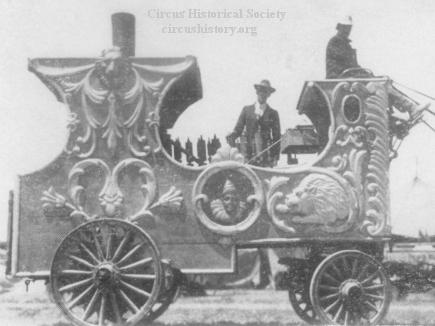 Photo No. 1. Steam calliope, Gentry Bros. Famous Shows, season 1922. E. Deacon Albright, player, standing in wagon. Note rebuild of wagon drop frame. Photo by Walker Morris.
Photo No. 1 shows one of the Gentry “twin" calliopes which is perhaps the best known of the bunch. Sullivan & Eagle actually built two identical calliope wagons as well as bandwagons and ticket wagons for the Gentry Bros. Famous Shows, which operated from one to four units annually in the very early 1900's. Some speculate there was a third set of identical wagons but no proof has come forth that such was the case. The calliope pictured was built in 1902 for Gentry Bros. and was on that show's units from 1902 through the 1922 season. The Gentry units finally narrowed down to one and that show was last operated by the Gentry brothers in 1916 and following the season was sold to Newman and Austin who continued operating the show from 1917 through the 1922 seasons.
In the winter of 1922-23 the calliope along with the other equipment was sold to James Patterson of Paola, Kansas. In 1923 the calliope was placed on Patterson's circus called Gentry Bros. and James Patterson Combined Circus, a fine, clean, little 15 car show that was on the road through the 1925 season. In the winter of 1925-26 Patterson sold the show to Floyd and Howard King.
For the 1926 and 1927 seasons the Kings placed the calliope on their 10 car circus titled Gentry Bros. In 1928 the show was called Walter L. Main, and in 1929 and 1930 was Cole Bros.
Cole Bros. went broke Aug. 30, 1930 at Scottsville, Ky., and shortly thereafter the calliope with the other property was sold to H. C. Ingraham and Bert Rutherford who shipped it to Peoria, Ill., for their proposed circus. Their show never got started and the wagon was later taken over by the Venice Transportation Co. which held a mortgage on the Cole property.
In 1938 G. W. Christy purchased the Cole property and had it shipped to his place in South Houston, Texas. It was rumored that Christy was returning to the road with a railroad circus, however that did not take place. Christy advertised the show for sale as a unit but finding no buyers he finally sold most of it off piecemeal commencing about 1945. The calliope was sold to Dr. C. S. Karland Frischkorn of Norfolk, Va. who was a circus fan and also operated magic shows. He renovated the wagon and replaced the sunburst wheels with pneumatic tires.
In the early Spring of 1952 this writer was visiting the King Bros. Cristiani Combined Circus winterquarters in Central City Park, Macon, Ga., looking over equipment being assembled for the street parade which the show was reviving for that season. Floyd King told me he had just gotten an oldtime steam calliope and was very proud of that fact. When he showed me a photo of it, I recognized it instantly, and Floyd remarked that he had owned it years ago. And true it was indeed, the steam calliope he had owned 22 years ago had come back to him again. It was delivered a week or so before opening date. It was fitted up for the road with a tractor attached to pull it over the road and it brought up the rear of the King-Cristiani street parades of 1952 and 1953, and the King Bros. parades of 1954 and 1955. After financial disaster struck the huge 1955 King show the equipment was split into two smaller units for 1956, both titled King Bros., but one known as the Eastern Unit, managed by Floyd King, the other known as the Western Unit and managed by Arnold Maley. The steam calliope went with the Eastern Unit. I heard it play in the abbreviated 1956 parade of the Eastern Unit on opening day in Macon in 1956. A few days later much of the parade equipment was attached, abandoned and the parade was finished. The show limped along for several months before closing. The show's receiver sold the steam calliope in the fall of 1956 to the Blue Grass Shows, a carnival, which had intended to use it for lot ballyhoo. Difficulties in getting parts and repairs made that scheme impossible, but finally an old retired employee of a steam calliope manufacturer got it in working shape. About 1958 it was sold to a drive-in theater in Nebraska. Here the trail is lost to this reporter. If anyone can furnish the name and address of the present owner to me please do so. This calliope should be restored to it's former appearance and placed safely in one of the circus museums for posterity.
The other so called Gentry twin calliope was covered in this column in the Jan.-Feb. 1959 issue of Bandwagon, see photo No. 5.
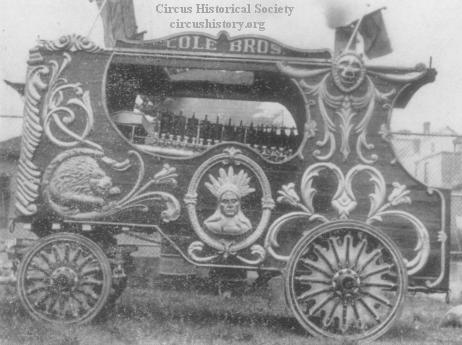 Photo No. 2. Steam calliope, Cole Bros.-Clyde Beatty Circus, 1935. Photo by Robert D. Good.
Photo No. 2 shows another steam calliope which is almost identical to the Gentry wagons. The only difference is that the central carving is an Indian head instead of a clown's head. This particular wagon was built by Sullivan & Eagle for the Louella Forepaugh Fish Wild West Show which went out in 1903. It is assumed the Indian head carving was carrying out the wild west theme. This show lasted only a very short period and the calliope was purchased by Gollmar Bros. Greatest of American Shows which was just getting changed over from a mud show to a railroad circus. The wagon was on the Gollmar show from about 1904 through the 1916 season.
During the winter of 1916-17 the Gollmar show was sold to James Patterson, a carnival operator of Paola, Kan. A one year's lease of the title was also in the deal.
In 1917 Patterson used the calliope with the rest of the Gollmar equipment on a railroad circus titled James Patterson Gollmar Bros. Combined Circus. The show was on the road for only one season. From 1918 through 1921 Patterson used the steam calliope for bally purposes on one of his carnivals. In 1919 it was on the Patterson & Kline Shows. In 1922 Patterson returned to the circus field and put out the James Patterson Big 4 Ring Wild Animal Circus and used the steam calliope on that show.
As indicated earlier, during the winter of 1922-23 Patterson purchased the Gentry Bros. Famous Shows, getting one of the Gentry twin steamers in the deal. As he now had two steam calliopes he sold the Gollmar steamer to G. W. Christy who was beginning to go places in the circus field.
From 1923 through 1930 the calliope was on Christy Bros. Circus. That show folded in mid-season 1930 and the property was sent back to South Houston quarters where it remained until sold in the fall of 1934 to Jess Adkins and Zack Terrell, who were planning big things with a new railroad circus to open the following year and to be called Cole Bros.-Clyde Beatty Circus.
From 1935 through 1937 seasons the calliope was on Cole Bros. In 1938 it was placed on Adkins & Terrell's No. 2 circus, a fine 15 car railroad show titled Robbins Bros. As the venerable old calliope had trouped almost 40 years it was decided to retire her during the winter of 1938-39. A new wagon was built to house the instrument. Some of the carvings were placed on the new wagon, the rest left on the old wagon body. The old wagon was parked on the quarters lot at Rochester, Ind. and survived the fire which destroyed the Cole quarters and much of the equipment in February 1940. It remained in the boneyard with other old Cole and Robbins wagons left at a nearby farm when the Cole show left to take up new quarters in Louisville, Ky.
About 1946 Alex Clarke of Princeton University got the remainder of the old calliope wagon. He wrote me that only about a fifth of the wagon remained, some wheels, gears, and partial sides, with little or no carvings.
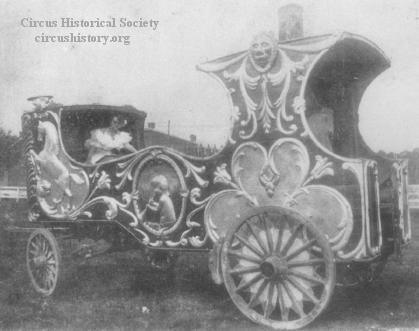 Photo No. 3. Steam calliope, Mighty Haag Railroad Shows, season 1909, Nellie King Oram, player.
Photo No. 3 shows another steam calliope wagon built by Sullivan & Eagle about 1900 for the Pawnee Bill Wild West Show. Note it's similarity to the others, with the principal difference being the huge carved horse, presumably carrying out the wild west theme again. It was on the Pawnee Bill show from about 1900 through the 1907 season. Pawnee Bill did not go out in 1908 and sold off it's equipment, the most of it going to Ernest Haag and Campbell Bros.
Ernest Haag who had operated a wagon circus for some years got the steam calliope along with other railroad show equipment from Pawnee Bill. In 1909 Haag put out a railroad show titled the Mighty Haag Show. It was a medium sized show and lasted for six seasons 1909-14. Following the 1914 season Haag decided to dispose of his railroad show and to return to the mud show field, which he did the next year. Haag sold the railroad show wagons and equipment, all except the huge heavily carved Columbus-John Smith Bandwagon which he kept until 1925, to the Worthem & Allen Carnival firm. This firm operated several carnivals, the Great Worthem Shows, Worthem & Allen, Tom Allen Shows etc. and used parade equipment quite extensively as did many carnivals of that period. In 1915 the steam calliope was on the Tom Allen Shows. Here the trail of the steamer becomes lost. The only assumption we can then make is that it served out it's days doing bally work for the Worthem & Allen carnivals. This carnival outfit finally became the Beckman & Gerety Shows which lasted into the 1940's. The final disposition of the calliope is clouded in obscurity.
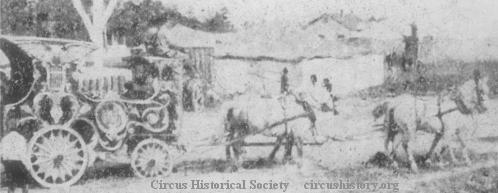 Photo No. 4. Steam calliope, John H. Sparks Shows, season 1911.
Photo No. 4 shows still another steam calliope built by Sullivan & Eagle. This one which features a spread eagle carving and lyre but differing only slightly in appearance from the others is the least known of the bunch. The illustration, a poor one, but the only one in existence to my knowledge is a reproduction of a photo appearing in the Dec. 16, 1911 Billboard under caption, "John F. Sparks Shows." Actually that caption just about tells the story of what we know of it. It was built for the John F. Sparks Shows evidently about 1910 when the Sparks show was built into a regular flat or type show. For a few years before that Sparks had been a combination of flat car and gilly show, using a flat, tunnel car, coach etc. For sure the calliope was on the show in 1911 as per date of the Billboard. What happened to this wagon is not known, whether it was destroyed by a wreck, sold to another show or what. It was replaced on the Sparks Circus by the larger and more familiar steam calliope which remained on the show until it stopped parading following the 1929 season. I have never been able to determine the exact year the newer calliope came on the show, but I have always assumed it to be about 1916, a year that Sparks did considerable enlarging, receiving new parade equipment etc. If any reader has a better photo of this particular calliope we would appreciate loan of some so that it can be printed in a future issue of Bandwagon. It would create quite a bit of interest for sure.
A sixth steam calliope known to have been built by Sullivan & Eagle on the some design as the others, although quite devoid of carvings, was constructed in the winter of 1903-04 and delivered to the Great Floto Shows. This wagon was covered in this column in the Nov.Dec. 1958 issue of Bandwagon.
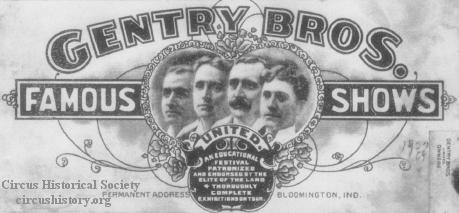
Few circus titles have graced the American scene over an extensive number of years. Forepaugh, Barnum & Bailey, Ringling Bros., John Robinson were among those known to the circus public for a great number of seasons.
Gentry Bros. Dog & Pony Show (and Circus) also appears in circus history over a period of 43 years. Henry B. Gentry lead brothers J. W., Frank and W. W. into show business around 1883. H. B. presented "Prof. Gentry's Dogs and Ponies" as a theater act until 1891, when he framed a two car show that operated as a circus.
In 1895 a second unit, also on two cars, was added. In 1899 the Gentrys purchased two of their competitors and doubled the number of cars on each unit. In the spring of 1899 Gentry Bros. Dog & Pony Units 1, 2, 3 and 4 opened - each on four cars. Each of the Gentry brothers managed one of the units during that season. In 1902 they moved into the full fledged circus class when flats, stocks and sleepers were used in place of baggage and coach cars. The Sullivan & Eagle calliopes were added in 1902. The twin chariot bandwagons and twin ticket wagons were added around 1902 also.
For the first time a route book was published following the 1902 season. It listed a total of 72 railroad cars, 22 elephants, 12 camels, 12 sacred cattle and 50 horses. This probably exaggerates, as it is generally believed that each of the four units used around 5 cars. The four units were operated through the 1904 season. Following that year the Gentrys cut back until only two units toured in 1906 and both were sold at the end of the season to M. W. Savage, who operated one unit in 1907. The Savage unit used 15 cars. Then W. W. Gentry opened a two car show using the title that sme year. A third Gentry show also operated in 1907 and was owned by a third group.
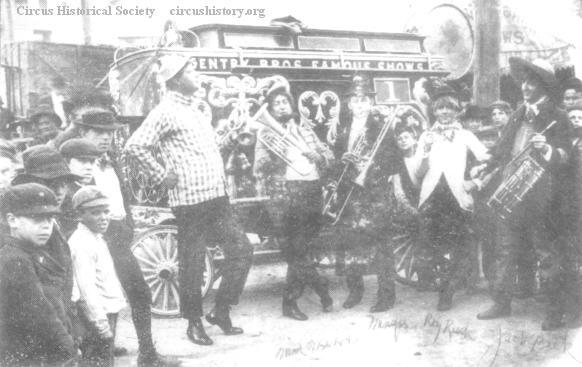 Photo: This cabinet photo shows the Rube Band on the Gentry show in 1905. The twin ticket wagon in background was used as a bandwagon for the parades. The bass drum is shown on the top rear of the wagon. Eddie Jackson was a press agent on the show that year. Whenever he was back on the show, for week long stands, Eddie played the bass drum in this band. Pfening Collection.
In 1908 the brothers returned to the circus field in force. For the 1910 season they framed their largest show to date using between 12 and 14 cars. The family continued through 1916 operating sometimes one and sometimes two units. In December of 1916, they lost control of the show and it was sold to Ben Austin and J. D. Newman, former employees of the show.
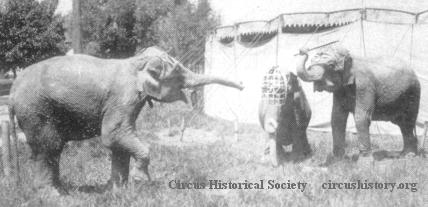 Photo: Three famous Gentry elephants - Bable, Queen and Pinto. This publicity shot of their baseball act was taken in Cleveland, Ohio in 1917. Pfening Collection.
Newman and Austin toured the show until the end of the 1922 season when it was purchased by James Patterson. He in turn operated the Gentry Bros. James Patterson Circus on 15 cars from 1923 to 1925.
At the end of that season it was sold to Floyd and Howard King. The Kings used the title on each of their 10 and 15 car shows at different times until 1929 when they lost the show.
In 1930 the title was first used on a truck show, operated by Sam B. Dill. In 1931 Henry B. Gentry and Frank Gentry again tried to regain the show's old position in the circus world. They toured Gentry Bros. Famous Shows and the Original Gentry Bros. Circus through 1934 when they could no longer survive the depression.
In the late 1940's Jimmie Woods used the title for a short period on the west coast, Gentry Bros, is a fine old name in the circus world that survived from 1891 until 1934.
This short sketch of the Gentry title was taken from a complete history of the show written by Tom Parkinson that appeared in the November-December 1959 White Tops.
Bill Griffith's show was caught at some Illinois stands in the throes of virtual winter weather, the temperature dipping to a wet 38 degrees during the afternoon at locations like Rock Island and Kewanee, Illinois. Business, the not outstanding under normal conditions, was quite amazing considering the miserable elements.
Griffith's show appears to have settled pretty well on the Adams-Sells Circus title, having progressed in earlier seasons thru such deviations as Adams Bros., Adams Bros. & Seils Bros.; and Adams-Seils. The final change, affecting spelling of Seils to Sells, results in a smooth-sounding title with a circus ring, which fans and historians should take a liking to.
Adams and Sells do a creditable billing job ahead. I do not knew just how many sheets they post in each town; however, in a town of 16,000 like Kewanee, Illinois it appears very strong indeed. In a city of 50,000 like Rock Island, it is somewhat thinner, but nonetheless adequate and only the blind would not see it.
Newspaper advertising is strong by all standards.
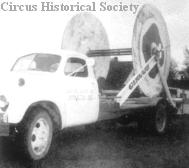
The show moves on 10 trucks including 6 straight beds, a bus, and 3 semis. Big top is a colorful 80 with 3 40's, with 3 fresh white rings, 26 lengths of blues and 10 lengths of reserved planks, (at Rock Island.) Animals include one very well trained elephant, a lion and a bear plus several small domestic wild creatures. Rolling stock is not as colorfully painted as in previous seasons. Big top canvas is carried on a spool truck, as they are on most current motorized circuses; however, its design does not conform to the usual spool mechanism.
The Performance, cued by a genuine air calliope, moves well, and pleases. Featuring "Lady Birtha,'' elephant worked well by Jenda Smaha, it is filled out commendably by The Burdettes, Santiagos, Floyds, Dick Johnson, and Tony Smaha. Billy Sheets directs and Cecil Eddington, Tommy Whiteside and Jimmy O'Donnel do the clowning. On numerous occasions, the show proves its claim to be a bonafide three ring circus, with all three rings going simultaneously.
It is perhaps inevitable that remarks will be heard to the effect that Adams-Sells is playing cities out of its league, such as Rock Island and Peoria. If one insists on reserving such cities for the likes of Ringling, Cole and Hagenbeck, the observation may be well-taken, however, these larger cities have never been off-limits for enterprising small circuses. The barrier is not in the minds of the big-city circus goer - the public often has displayed its pleasure with the small family type circus. The barrier is in the ability of the smaller show to cope with the pressures, prices, politics, and pay-offs of the city. Adams-Sells' continued policy of operating in larger cities evidences the management's success at meeting these problems. It is hardly the place of the outsider to criticize success, so perhaps we should wish this organization God-speed in its big city courage.
Editor's Note: As noted Bob Parkinson's review was written very early in the season. As the season rolled on the show began encountering troubles. Most of the season was played in the Chicago area. Hard luck struck a number of times. After moving out of the Chicago area on July 12, the show went north to Wisconsin and played eight stands in Michigan. Returning to Wisconsin on August 6th, creditors began turning the heat on and brought the season to a close on August 12th, in Stevens Point, Wisconsin. The small elephant was sold to the Circus World Museum in Baraboo.
A season route folder, with program and staff was published by Jay Beardsley of Madison, Wisconsin.
No part of this publication may be reproduced in any form or means
Last modified January 2006.
without written permission of the author and the Circus Historical Society, Inc.