


Circus Historical Society
Bandwagon, July - August 1959
Back to Bandwagon Index
Bandwagon, Vol. 3, No. 4 (Jul-Aug), 1959. Note: Only some articles are included in this online edition. Not all illustrations are included. The Circus Historical Society does not guarantee the accuracy of information contained in the information in these online articles. Information should always be checked with additional sources.
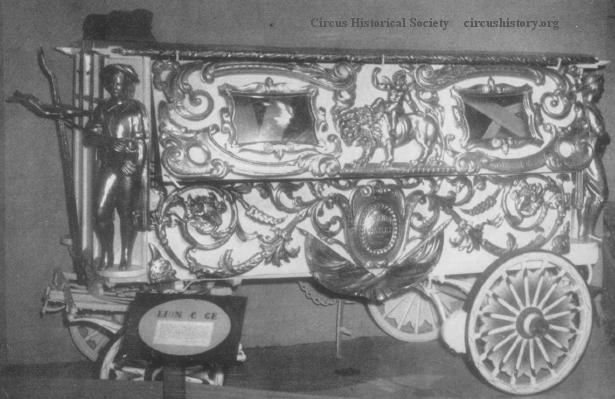
New information concerning the history of a few of the Al G. Barnes Circus tableau wagons has recently turned up, thanks to CHS member Bob Bernard of Bellflower, Calif. Bob is the type that is not content to sit down and merely read circus history but gets out and does something about collecting it. He has been interviewing some of the old Barnes men living in the Los Angeles area and as a result has come up with some very interesting facts concerning many of the old Barnes tableau wagons. Since this information is new to even the most serious wagon historians it is being printed at this time despite the fact that the photos used in illustration are not the best in the world but are adequate and the only ones available to use at this time.
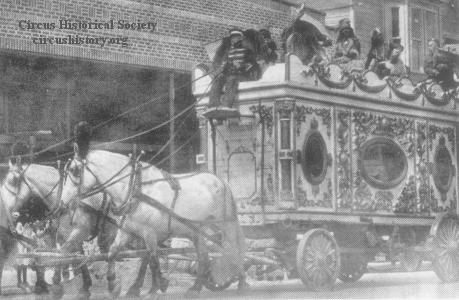 Photo No. 1 - "Mirror Tableau" in parade, Al G. Barnes Circus, Olympia, Wash. about 1921. P. M. McClintock Collection.
Photo No. 1 shows the Al G. Barnes Circus Mirror Tableau wagon in parade in Olympia, Washington. The date of the photo would be either 1921 or 1923 as Barnes routes show Olympia was played those years and from the history of some of the wagons appearing in this parade set we know the correct date would have to be sometime from seasons 1921 thru 1924. This wagon was built in the old Barnes quarters on Van Ness Avenue in San Francisco in the winter of 1910-11 and was no doubt among the first bandwagons to be used by the show. It may be recalled that the Barnes show went out on rails as a regular circus playing daily stands in 1911 after being an exhibition "fair type" sort of show for several years. This mirror tableau wagon headed the Barnes parades for many years. It is assumed that it remained on the show through 1924, the final year regular parades were given. Observe the photo appearing in Charlie Puck's Oldtime Snapshot feature and you can see this wagon at the old Barnes quarters in Culver City, Calif.
What finally happened to this wagon is not definitely known but it is believed that it followed the route of most of the other old Barnes bandwagons, tableaux, and calliopes. After the 1924 season it was stored in winter quarters for several years. In the fall of 1928 Charles Cook, manager of the Al G. Barnes Circus sold these wagons to a Mr. Thoms who operated a studio rental business on Santa Monica Blvd. in Los Angeles. This outfit rented various props, wagons, vehicles etc. to the movie studios and these wagons were used in many movies with a circus theme. (Note to wagon lovers, don't miss the old TV movies with a circus background as you nearly always will see some of the old tableaux and baggage wagons. Just recently I spotted several of them in one of the Three Stooges comedies.) Several years later the owner of the studio rental business died and his brother, Archie Thoms, sold the old Barnes wagons to Jimmie Woods of Venice, Calif. Some of the wagons Woods dismantled, others he rebuilt for movie use. About 1953 a few of the wagons were destroyed, but some still remain to this day in Disneyland and in a park in Venice.
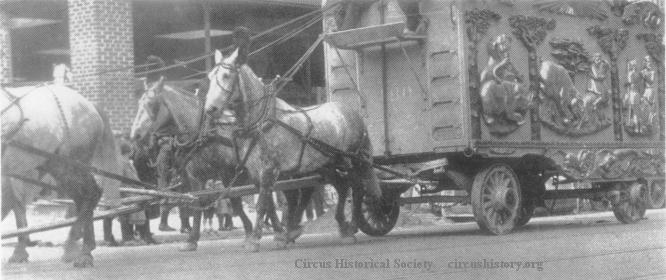
Photo No. 2 pictures the Al G. Barnes Tableau No. 180, which features carvings of animals, trees, and natives in a jungle motif. The photo was taken in Olympia at the same time as the first one. This wagon was used as the elephant trappings wagon and in parade was used as a bandwagon or tableau, but in this particular shot the photographer seems to have cut off the top portion of the wagon so we don't know whether a band or just costumed performers are riding it. This wagon was one of three that was built during the winter of 1920-21 at the Barnes quarters by Louis Berg. The other two were the Cornelia Tableau, photo No. 3, and the Barnes Elephant Tableau (see this column Dec. 1957 issue). Louis Berg and his brother formerly operated the Berg Bros. Tent & Awning Co. in Spokane, Wash. and Berg, being a tent maker, made many of the Barnes tents in a barn loft at the show's quarters in Culver City, California.
A car load of carvings was received from the Bode Wagon Works of Cincinnati, and these carvings were used to decorate the wagons Berg built in quarters. It is said that these carvings were excess that Bode had originally made to be used on the set of U. S. Motorized tableaux. The last circus wagons Bode built were for Frank Spellman's, U. S. Motorized Circus which went on the road for a few days in 1919, and they were cleaning out the remaining carvings etc. left over from this large order of very beautiful tableau bodies which were mounted on motor truck chassis.
It is assumed this No. 180 tableau was used on the Barnes show from the 1921 season on through 1924, and then no doubt it was later dismantled. No trace of the wagon or carvings has ever come to light, but the carvings of the other two wagons in this set of three did. Those of the Cornelia wagon as listed below turned up, and the big bull carving off the side of the Elephant Tableau is now used on the main entrance to Jungleland in Thousand Oaks, Calif.
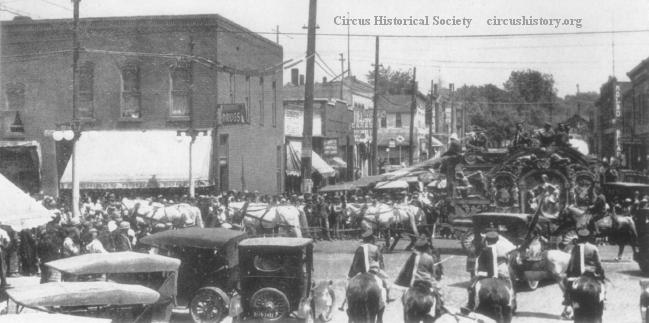
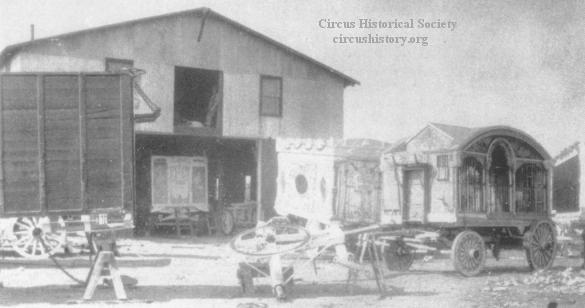
Photo No. 3 shows the Barnes tableau commonly called by wagon fans, "Cornelia and Her Jewels," this term being tacked on about 1946 more or less for identification purposes. Just who first used that name isn't exactly known. Perhaps the central carved figure is Cornelia. Anyway, that's as good a name for identification as any. This wagon was also built by Louis Berg in winter of 1920-21 at the Culver City quarters using Bode carvings and is perhaps the most attractive tableau wagon ever to appear on the Barnes show. It shows the professional touch of a master wagon builder and looks like one of the fine ones turned out by Bode, Moeller, and others in years gone by. It was used on the Barnes show from the 1921 through the 1924 season as the sideshow bandwagon. The final regular parade was given by the Al G. Barnes Circus July 14, 1924 of Denver, Colorado. After the 1924 season it is assumed this wagon was stored at winter quarters and then as previously mentioned went to the studio rental service and hence to Jimmy Woods. In 1946 Frank Meyers of Peoria, Ill. got the carvings that had come off the long before dismantled wagon and were now strewn about the Woods lot in Venice and took them to Peoria to put on a wonderfully built little air calliope wagon he had constructed. For years the origin of the carvings Meyers had picked up in Venice remained a mystery to wagon historians, We knew they must have come from an old Barnes wagon because they had come from the Woods lot which at that time stored the remaining parade wagons of the show, but no one seemed to be able to recall such a wagon bearing the Cornelia carvings, nor could anyone find a photo of such a wagon. In 1955 Walker Morris, an old Barnes musician, who had been on the show in 1924 came up with a couple of photos of the original wagon and hence the mystery was solved. So far as it is known the little air calliope that Meyers built is still in Peoria.
|
June 25 - Milford, Pa.
June 26 - Pine Bush, N. Y. June 27 - New Paltz, N. Y. June 28 - Amenia, N. Y. June 29 - Copake, N. Y. July 1 - New Lebanon, N. Y. July 2 - Berlin, N. Y. July 3 - Hoosick Falls, N. Y. July 4 - Greenwich, N. Y. July 5 - Ballston Spa, N. Y. July 6 - Luzerne, N. Y. July 8 - Warrensburg, N. Y. July 9 - Chestertown, N. Y. July 11 - Pottersville, N. Y. July 12 - North Creek, N. Y. July 13 - Long Lake, N. Y. July 14-15 - Inlet, N. Y. July 16 - Blue Mt. Lake, N. Y. July 17 - Indian Lake, N. Y. July 18 - Speculator, N. Y. July 19 - Piseco, N. Y. July 20 - Remsen, N. Y. July 23 - Waterville, N. Y. July 24 - Cazenovia, N. Y. July 25 - DeRugter, N. Y. July 26 - Maine, N. Y. July 27 - Owego, N. Y. July 29 - Towanda, Pa. |
Aug. 6 - DeWart, Pa.
Aug. 7 - Loganton, Pa. Aug. 8 - Rebersburg, Pa. Aug. 9 - Lamar, Pa. Aug. 10 - Pleasant Gap, Pa. Aug. 13 - Austin, Pa. Aug. 14 - Emporium, Pa. Aug. 15 - Penfield, Pa. Aug. 16 - Brockport, Pa. Aug. 20 - Kersey, Pa. Aug. 21 - Cherry Tree, Pa. Aug. 22 - Carrolltown, Pa. Aug. 23 - Dysart, Pa. Aug. 24 - Blandburg, Pa. Aug. 27 - Pinegrove Mills, Pa. Aug. 28 - McClure, Pa. Aug. 29 - Beavertown, Pa. Aug. 30 - Hendron, Pa. Aug. 31 - Barrysburg, Pa. Sept. 1-2 - Treaverton, Pa. Sept. 3 - Gowan City, Pa. Sept. 4 - Lavelle, Pa. Sept. 5 - Valley View, Pa. Sept. 6 - Helper, Pa. Sept. 7 - Loyaltown, Pa. Sept. 8-9 - Millerburg, Pa. Sept. 10 - Halifax, Pa. Sept. 17 - Boyce, Va. Sept. 19 - Strasburg, Va. Sept. 20 - Edinburg, Va. Sept. 21 - Mt. Jackson, Va. |
Barnett Bros. played a 40 week season opening in South Carolina, April 11, 1933, closing in January 1934.
In the Spring of 1934, Art Windecker opened as side show manager on the Al G. Barnes circus. I worked my Monkey circus for him when he had the side show at the Pollock date for the Shrine in San Francisco in 1937. Later he was in the side show department of the Ringling show.
The Barnes show that season made a transcontinental tour, traveling 20,082 miles; exhibiting in 19 states and 8 provinces. Was out 30 weeks.
Bandwagon, Vol. 3, No. 4 (Jul-Aug), 1959, p. 10.
Two dramatic tent showmen had a fling at the circus business. In August 1935, Harley Sadler bought the Bailey Bros. equipment. He announced that he would operate a three ring circus with himself as sole owner and manager. Tol Teeters had a 3 ringer, called Orange Bros. Neither lasted long.
No part of this publication may be reproduced in any form or means
Last modified January 2006.
without written permission of the author and the Circus Historical Society, Inc.